“It is love that believes the resurrection.”
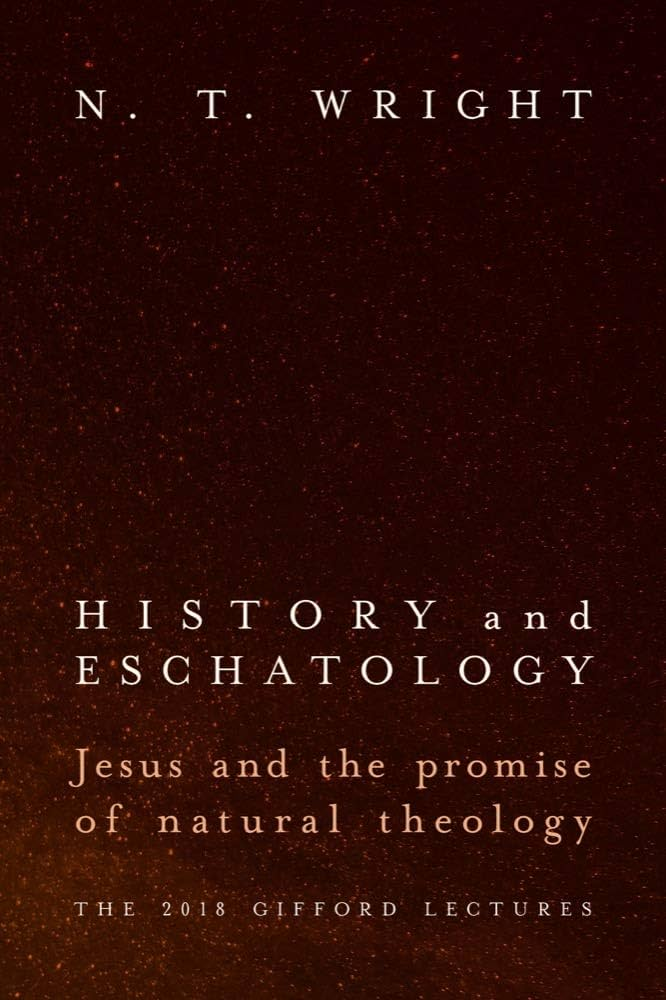
I finally finished Wright’s History and Eschatology, based on his 2018 Gifford Lecture. Wright takes us on a jaunt through 18th-century optimism about nature and divinity—a time when thinkers like Joseph Butler thought the natural world sang of a benevolent, orderly God. But then comes the Lisbon earthquake of 1755, a disaster that tore through Portugal and the hearts of Europe’s philosophers. Suddenly, the beautiful tune of nature clashed with a bitter dissonance, raising the uncomfortable question: If God created this world, is He good, or even paying attention?
Wright is keen to show how this cataclysm shifted the philosophical tide toward skepticism and its sidekick, Epicureanism—a worldview that relegates gods to the sidelines of a universe that basically runs itself. Here begins the “secularization” of the Western mind, with the rise of Deism as a halfway house. Deism, which pictures a God who creates the world and then checks out, gave philosophers the excuse they needed to slip further away from traditional theism.
The Philosophical Context of Skepticism
With an eye on the fallout, Wright critiques this secular shift, warning of a culture stranded between a deity who’s an absentee landlord and a universe that appears utterly indifferent. This first chapter is as much an invitation as a warning to modern readers: Don’t let natural theology be sanitized of God’s vitality, or we may wind up with a narrative where humanity bears the burden of purpose alone.
Wright then switches gears and begins to examine the academic habit of doubting the Gospels. This Epicurean worldview is connected to the so-called quest of the historical Jesus. Thanks to figures like Reimarus, Schweitzer, and Hume, modern thinkers are convinced that Jesus the miracle-worker needs a serious fact-check. Wright presents these critics as the 18th and 19th-century celebrity skeptics who basically throw Jesus under the (historical) bus. Their approach? Take the Gospels at arm’s length, treat their miracles as myth, and leave Jesus looking like a nice, possibly disillusioned prophet who wanted the world to end—probably.
But Wright is having none of this. He labels their approach as “Docetic”—an early Christian heresy that downplays Jesus’ humanity—suggesting that some of these scholars, in their desire to strip out the miracles, actually stripped out Jesus’ historical impact as well. This has left us with a strange cultural dichotomy, Wright argues: the secular view of Jesus as a failed prophet and the religious view as a miracle-worker suspended over history, disconnected from the grit of everyday life.
Through it all, Wright’s critique sharpens on the Enlightenment’s legacy of turning the Gospels into suspect documents—neither entirely trustworthy nor easily dismissed. He warns that modern Christian theology cannot afford to ignore Jesus’ historical context if it wants to present a coherent view of God’s interaction with the world.
The Theological Necessity of History
In chapter 3, Wright tackles what he calls “the shifting sand” of history itself. What do we mean when we say “history”? For Wright, it’s a question that’s seen many a career fall into the quicksand of assumptions. History can mean (a) events that happened, (b) the stories we tell about those events, (c) the work historians do to piece it all together, or (d) the big, often philosophical meanings we attach to these events. And, he notes, confusion arises when we start switching these meanings willy-nilly.
Wright argues that history must be more than abstract ideas and must be anchored in tangible events. He contrasts “Docetic” approaches (which abstract Jesus as a symbolic or divine figure without historical grounding) with the historical engagement required for a meaningful understanding of Christian claims about God. For Wright, history is indispensable to Christian thought and practice; it provides the grounding for doctrines like the Incarnation and salvation.
Wright argues that Enlightenment rationalism and Epicureanism separated God from human history, leading to a fragmented worldview. This shift, Wright notes, led to a cultural tendency to view history as an ongoing, inevitable progress toward secular “liberty” rather than a divinely orchestrated narrative. As history was secularized, it began to favor narratives that depicted human autonomy over divine agency. He links this separation to figures like Hume and Gibbon, who promoted historical narratives that advanced secular ideals and criticized religious influences. Wright warns that this approach often lacks balance, dismissing theological insights in favor of an Enlightenment-driven view of history as a march toward secular progress. For Wright, this Enlightenment project has left us in a conundrum where history is often expected to “prove” its own secularity—a self-fulfilling prophecy that has shaped modern historical methods.
In the end, Wright doesn’t just want history to be a subject; he wants it to be a dialogue. He champions a “critical realism” approach, an empathy-driven method that tries to understand historical figures on their own terms, without the smug superiority of hindsight. This approach, he argues, requires humility, love, and (unsurprisingly) a generous dose of patience.
In summary, Wright challenges both secular and theological communities to consider history as an arena of divine-human interaction. He argues that the secularization of history in Enlightenment thought has limited modern understanding and insists that true theology must engage deeply with history to avoid reducing Jesus and his impact to mere symbols devoid of historical substance.
Untangling Eschatology
In chapter 4 Wright focuses on how Jesus and his followers interpreted eschatology and the concept of an impending “end.” Wright tackles the common assumption that early Christians expected an imminent apocalyptic end to the world. He proposes that while Jesus spoke of the “kingdom of God” arriving in power, he wasn’t predicting the literal end of the physical universe but rather a profound transformation in human history through God’s intervention.
He points out that “apocalyptic” language, particularly within Jewish literature, served as metaphorical and symbolic expressions of political and social upheaval rather than predicting literal, cosmic destruction. Wright argues that early Christians believed in a radical, this-worldly renewal led by God’s intervention rather than a cataclysmic end. Drawing from the Jewish two-age view (the present age and the age to come), Wright explains that Jesus and his followers saw themselves as living at a crucial juncture between these two ages. This transition period, he says, did not imply the end of the physical world but rather a transformation toward divine justice and peace, echoing themes of exile and return central to Jewish hope.
Wright criticizes modern theologians who interpret “apocalyptic” as solely a worldview focused on divine “breakthroughs” from beyond time and space. Instead, he suggests understanding it as a genre where symbolic imagery speaks to contemporary events. For example, references to stars falling from the sky or earthquakes are metaphors for political shifts and upheavals, not literal predictions of the end. Particularly important for Wright is the writings of Paul. He notes how Paul anticipated a transformative future but never implied that this would involve the literal destruction of the cosmos. Paul’s vision, according to Wright, is one of cosmic renewal rather than annihilation. In Wright’s view, Jesus spoke of the “kingdom of God” arriving within his followers’ lifetimes. This “kingdom” involved God’s rule manifesting in the present world, reshaping it rather than obliterating it. Wright proposes that this interpretation allows us to read Jesus’ sayings as forward-looking without assuming an end-of-the-world prophecy.
Epicureanism’s Intellectual Grip
The next chapter serves as a critical juncture in his overall argument. Here, he asserts that Western thought, shackled by centuries of quasi-Epicureanism, has skewed our understanding of both “natural theology” and the historical Jesus. His task now? To reset the stage by recovering a robust Second Temple Jewish worldview—a worldview Jesus and his early followers inhabited and that, according to Wright, provides the essential lens through which to understand Jesus’ claims about the Kingdom of God.
On his understanding, the Temple was seen as the microcosmos, a place where God’s presence bridged the divine and earthly realms. Sabbath, likewise, was the weekly “in-breaking” of God’s eschatological promises, a foretaste of the renewed creation. For Jews of the Second Temple period, both were profound symbols of God’s commitment to dwell with His people, a message carried forward and radically reinterpreted by Jesus and early Christians.
Wright refutes the notion that Jesus preached about a literal “end of the world.” Instead, he presents Jesus as embodying a radical eschatology—a vision not of the world’s destruction but of its renewal. When Jesus proclaimed the arrival of God’s Kingdom, he was talking about a transformative new age, a re-creation of the world in which God’s justice and mercy would become tangible. The “stone rejected by the builders,” as Wright interprets it, symbolizes Jesus’ countercultural message that challenged the political and religious expectations of his day.
Wright highlights how Jesus embodies the ultimate vision of humanity as God’s image, standing at the intersection of heaven and earth. He argues that Jesus’ life, death, and resurrection were the “Temple-event” par excellence—a final, transformative meeting place of divine and human. For Wright, the implications are massive: Jesus redefines what it means to be human by drawing people into this new creation, where they, too, reflect God’s image within a redeemed cosmos.
Wright concludes by asserting that any future discourse on “natural theology” must start with this re-grounded worldview. For him, studying God’s presence in creation isn’t about proving abstract truths; it’s about understanding how Jesus, the “cornerstone,” has redefined the world as a place where heaven and earth can meet through him.
Epistemology of Love
In chapter 6, Wright shifts the focus to a radically transformative concept: that the resurrection of Jesus isn’t merely an astonishing event but the launchpad for a “new creation.” Here, Wright argues that this new reality requires a fresh approach to knowing—what he terms an “epistemology of love,” through which resurrection redefines both the physical and spiritual cosmos.
Wright borrows Ludwig Wittgenstein’s cryptic phrase, “It is love that believes the resurrection,” using it as a springboard to argue that love, far from being sentimental, represents a comprehensive mode of knowledge. This epistemology goes beyond mere intellectual assent and reaches into an embodied, historical knowledge that captures the resurrection’s transformative essence. Love, in this framework, isn’t just an emotion; it’s a way of knowing that respects the distinctness of reality without forcing it into preconceived molds.
Wright critiques Western culture’s “split-world” approach, rooted in Epicureanism and modern rationalism, which dismisses “love” as a subjective, irrational perspective unsuitable for serious epistemology. He argues that modernity’s obsession with “knowing as control”—the need to categorize, explain, and dominate—has marginalized an authentic engagement with the divine and the mysterious, effectively sidelining any notion of resurrection as either impossible or irrelevant.
The resurrection, Wright contends, isn’t just a miraculous oddity but inaugurates a new reality where heaven and earth intersect in a unique way. Jesus’s resurrection, therefore, creates its own epistemic framework, which brings a new lens for understanding history, nature, and even knowledge itself. This “new world” of the resurrection, according to Wright, requires a knowledge that combines historical rigor with an openness to transcendence.
Wright sees historical research as critical in “defeating the defeaters,” dismantling alternative explanations like cognitive dissonance or metaphorical resurrection. He argues that a bodily resurrection was the foundation for early Christian belief, even as it defied both Jewish and Greco-Roman expectations. The persistence of the belief in a physical resurrection amid such skepticism suggests that the disciples truly believed they had encountered a risen Jesus, a conviction so strong that it reoriented their worldview.
For Wright, the resurrection is God’s resounding affirmation of the physical universe, which modern secularism often ignores. By rising bodily, Jesus underscores that creation is good, redeemable, and integral to God’s ultimate plan. This “new creation” doesn’t negate the old but transforms it, offering an ultimate “Yes” to the value of material existence and human embodiment within it.
In this chapter, Wright presents a sophisticated, almost poetic, reimagining of knowledge that challenges the sterile categories often forced upon theological concepts in a post-Enlightenment world. His “epistemology of love” is both provocative and refreshing, asking readers to reconsider not only the resurrection but the very way they perceive reality.
Revisiting Natural Theology
Wright then pivots toward redefining natural theology by focusing on human experiences that hint at transcendence, even though they often fail to deliver on their promise. Wright refers to these experiences as “broken signposts”—aspects of human life that seem to point toward deeper truths but fall short due to the fractured nature of human experience.
Wright critiques traditional natural theology approaches for attempting to prove God’s existence through reason alone, arguing instead for a “retrospective reading” of creation that considers how human longings reveal something about divine reality. He proposes that natural theology should reflect the “Emmaus Road” moment from Luke 24, where Jesus reframes the disciples’ understanding of the Old Testament in light of his resurrection, showing how past narratives pointed towards something greater.
Wright identifies seven fundamental areas of human life as “broken signposts”—Justice, Beauty, Freedom, Truth, Power, Spirituality, and Relationships. Each one resonates with something crucial but remains incomplete, like a melody that never quite resolves. According to Wright, these signposts are not simply empty aspirations; they contain fragments of divine reality, revealing humanity’s deep-rooted yearning for fulfillment.
The quest for justice, for instance, represents a universal but often elusive desire. We all recognize its importance, yet it remains perpetually out of reach, as human societies are riddled with inequities and systemic failings. Beauty, too, is universally cherished, whether in nature, art, or daily life. However, beauty’s fleeting nature creates a sense of longing rather than fulfillment, pointing beyond itself to an enduring beauty found in God.
Freedom is a fundamental aspiration yet is often constrained by societal structures or personal limitations, hinting at an ultimate freedom only achievable in relationship with God. Truth, though sought after, is often distorted by lies, leaving humanity in a maze of subjectivity. Power, while necessary for human governance, is frequently corrupted, underscoring humanity’s inability to wield authority without divine guidance.
Wright sees spirituality as a universal human impulse, a reach toward transcendence that modern secularism struggles to explain. Similarly, relationships reflect humanity’s need for connection and love but are often marred by selfishness, betrayal, or misunderstanding. These broken signposts of spirituality and relationships reveal our need for a deeper fulfillment, achievable only through union with God.
For Wright, these signposts are only fully understood in light of Jesus’ resurrection, which reinterprets and fulfills human longings. He suggests that by understanding these areas through the lens of Christ’s life, death, and resurrection, natural theology moves beyond abstract reasoning to a concrete, lived reality that resonates with human experience. Jesus, then, becomes the ultimate “broken signpost,” whose life and death appear as defeat but point to the profound truth of God’s redemptive plan.
Natural Theology and the Missio Dei
In his conclusion, Wright brings together the themes explored throughout the book, setting forth a vision of “natural theology” as both profound and profoundly practical. Using Gerard Manley Hopkins’s poetry as a thematic anchor, he reflects on how the world’s beauty and brokenness reveal the grandeur of God, even as they point to a deeper reality yet to be fully realized. He frames his argument around a central image—the chalice, which though empty, symbolizes potential meaning and fulfillment.
Wright argues that conventional natural theology has been stunted by the modern secular divide that separates the sacred from the secular, heaven from earth. Instead, he proposes a “new” natural theology that starts from the premise of resurrection and eschatology, embracing the idea of “new creation.” This perspective doesn’t seek to prove God in the abstract but to reveal divine presence through an understanding of history and vocation grounded in Jesus’s resurrection and mission.
Expanding on his metaphor of “broken signposts,” Wright reflects on how the beauty and pain in the world act as a paradoxical call toward God. The “empty chalice” symbolizes creation’s longing to be filled with divine presence. He argues that Hopkins’s famous line, “The world is charged with the grandeur of God,” captures the reality of a world that hints at God’s grandeur yet remains marred by suffering.
Wright envisions the church’s mission not as an isolated, otherworldly endeavor but as a continuation of God’s work in the world, especially through justice, beauty, and love. The resurrection calls Christians to be active in creation, embracing their role as “image-bearers” who stand at the intersection of heaven and earth, embodying God’s presence through action.
Love remains central in Wright’s vision of knowledge; he emphasizes that understanding God and creation requires a knowledge rooted in relational, empathetic engagement rather than detached rationality. This “epistemology of love” embraces both the reality of suffering and the hope of redemption, aligning with a theology that looks beyond natural evidence alone to a relationship with God through Christ.
Wright’s History and Eschatology is both poetic and challenging. He urges readers to approach natural theology with humility and commitment to the “missio Dei”—God’s mission in the world. This is a natural theology of action, informed by love, justice, and an eschatological hope grounded in resurrection. This is a compelling vision for a new natural theology.
 James C. Ungureanu