Lessons from King Thamus
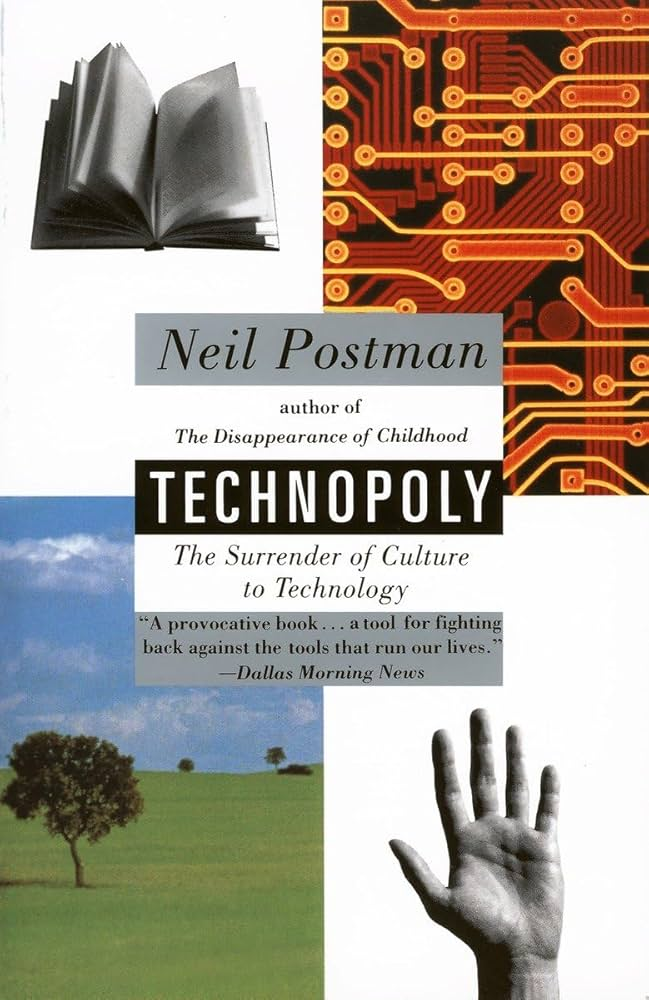
Neil Postman (1931–2003) was a media theorist, cultural critic, and educator who spent his career interrogating the societal impacts of communication technologies. Best known for works like Amusing Ourselves to Death (1985), Postman argued that media forms fundamentally shape cultural values, behaviors, and institutions. Technopoly: The Surrender of Culture to Technology (1992) extends this critique, presenting a compelling case against uncritical technological adoption. In an age where algorithms shape political discourse, artificial intelligence mediates creativity, and smartphones govern attention, Technopoly feels more prophetic than historical.
By examining how technologies alter not only what we do but who we are, Postman offers a lens to understand today’s tech-saturated world. Chapter 1, “The Judgment of Thamus,” serves as the book’s cornerstone, anchoring its arguments in a timeless parable that underscores the transformative power of tools.
Postman opens with Plato’s dialogue between King Thamus and the god Theuth, found in the Phaedrus. Theuth presents “writing” as a gift that will enhance memory and wisdom, but Thamus rebukes this claim, asserting that writing will weaken memory by externalizing it, fostering the illusion of wisdom rather than its reality. Postman uses this tale to introduce his central thesis: technologies are never neutral. They shape not only actions but also values, perceptions, and social structures.
He critiques what he calls the “one-eyed prophets” of technological optimism—those who see only benefits while ignoring consequences. Technologies, Postman argues, do not operate in isolation; they create “ecological change.” Like the introduction of a new species into an ecosystem, a single technological innovation can reconfigure entire cultural and institutional landscapes.
Postman also explores the concept of “knowledge monopolies.” He contends that those who control new technologies amass power, often at the expense of others. Television, for example, privileged its producers and broadcasters while sidelining print-based educators, transforming the way knowledge was valued and disseminated. Similarly, the computer revolution empowered institutions but often left individuals feeling alienated and surveilled.
The Dual-Edged Sword of Technology
Postman’s framing of technology as inherently ideological is one of the chapter’s strongest insights. Technologies, he argues, do not merely provide new tools but redefine the contexts in which those tools operate. Writing, for instance, redefined memory as externalized recollection rather than internal retention. Likewise, the mechanical clock—originally designed to structure monastic devotion—became the foundation for capitalist productivity, imposing rigid schedules on human activity.
One of Postman’s most poignant observations is that technologies alter the meanings of fundamental concepts:
“Technology imperiously commandeers our most important terminology. It redefines ‘freedom,’ ‘truth,’ ‘intelligence,’ ‘fact,’ ‘wisdom,’ ‘memory,’ ‘history’—all the words we live by. And it does not pause to tell us. And we do not pause to ask.”
Postman’s critique of “Technophiles” resonates deeply in an era dominated by tech evangelism. His ecological metaphor—likening technological change to environmental transformation—reinforces the systemic nature of these shifts. Technologies, he asserts, do not simply add or subtract; they transform. The printing press, for example, did not create “old Europe plus books”; it created an entirely new Europe, with altered religious, political, and social landscapes.
Postman’s discussion of “knowledge monopolies” also proves strikingly relevant. Those who master new technologies—whether television executives or data scientists—inevitably gain disproportionate power, leaving others marginalized. The losers, ironically, often cheer the winners, succumbing to the illusion of progress.
As a historian of science and religion, one might draw intriguing parallels between Postman’s critique and broader discussions about the interplay of faith, knowledge, and technology. The printing press, for example, democratized access to sacred texts but also fragmented religious authority, mirroring the challenges of integrating innovation into established belief systems. Similarly, contemporary technologies challenge foundational epistemologies, reshaping how individuals understand the divine, the natural world, and their place within it.
Postman’s reflections also invite deeper theological considerations. If technologies redefine the meaning of wisdom, memory, and truth, how might this affect religious practice and interpretation? These questions feel particularly urgent in a digital age that often conflates information with understanding.
The Rise of Technocracy
In the second chapter of Technopoly, Neil Postman expands his critique of technology by charting its historical evolution from tool-using cultures to technocracies. Drawing on historical examples and philosophical insights, Postman introduces a taxonomy that captures the shifting relationship between technology and culture. This chapter examines how tools, once subordinate to the values and beliefs of a society, increasingly began to dictate and redefine those very structures. For historians of science and religion, this analysis offers fertile ground for reflecting on how technological innovation has reshaped humanity’s understanding of authority, meaning, and the divine.
Postman begins by referencing Karl Marx’s observation that technological advancements shape societal structures, such as the steam engine’s role in the rise of industrial capitalism. He adopts this insight to propose a taxonomy of cultures based on their relationship with tools: tool-using cultures, technocracies, and technopolies.
In tool-using societies, technology serves two main purposes: solving practical problems and supporting cultural values, such as religion and art. Tools are integrated into the existing worldview without challenging its core principles. For instance, the medieval mechanical clock was initially a religious instrument for regulating monastic prayer, illustrating the subordination of technology to theological imperatives.
In a technocracy, tools begin to take a central role in defining cultural norms. Postman identifies the printing press, mechanical clock, and telescope as pivotal inventions that disrupted traditional ways of knowing. The telescope, for example, shattered Aristotelian cosmology, which had long been integrated into the Judeo-Christian worldview through medieval theology. This worldview, rooted in Greek natural philosophy, emphasized an Earth-centered universe. The discoveries of Copernicus, Kepler, and Galileo overturned this framework, displacing Earth from its central position in the cosmos and destabilizing the theological narrative of humanity’s unique place in creation.
Postman briefly hints at technopoly—a stage where technology overtakes culture entirely—but reserves detailed discussion for later chapters. He notes that while technocracies still wrestle with the tension between tradition and innovation, technopolies fully embrace technology as the defining force of society.
Postman’s taxonomy is both insightful and provocative. The distinction between tool-using cultures and technocracies sheds light on the interplay between technology and belief systems. In tool-using cultures, technologies are governed by religious or metaphysical frameworks, as seen in the medieval Church’s oversight of inventions. However, the rise of the telescope exemplifies how certain tools can challenge these frameworks. Postman poignantly illustrates this with Galileo’s discoveries, which destabilized the theological worldview by proving that Earth was not the universe’s center—a revelation that Milton later encapsulated in Paradise Lost:
“Before [his] eyes in sudden view appear / The secrets of the hoary Deep—a dark / Illimitable ocean, without bound, / Without dimension…”
This shift, Postman argues, marked a turning point where technology began to reshape human self-perception.
The chapter’s ecological metaphor further strengthens its argument. Technologies do not simply extend human capabilities; they transform how people live, think, and interact. However, Postman’s reliance on historical anecdotes occasionally risks oversimplification. For instance, while he attributes the decline of medieval theology to technological advancements, he underestimates the role of broader intellectual, political, and economic shifts.
Nevertheless, for scholars of science and religion Postman’s taxonomy offers profound insights into how technological innovation has historically intersected with theological frameworks. The shift from tool-using cultures to technocracies mirrors the secularization thesis, where technological and scientific advancements progressively displace religious authority. Yet Postman’s narrative also challenges simplistic readings of secularization. Innovations like the printing press did not merely undermine religious structures; they also facilitated the dissemination of religious texts, sparking movements like the Reformation.
Postman’s reflections invite deeper theological questions: How can religious traditions adapt to technological disruptions without losing their essence? Can tools like AI or genetic engineering be reconciled with theological principles, or do they inevitably challenge the metaphysical underpinnings of faith?
When Progress Becomes the Gospel
Postman’s third chapter charts the cultural transformation from technocracy—where technology coexists uneasily with traditional values—to technopoly, a state in which technology becomes the organizing principle of society, marginalizing alternative worldviews. By grounding his analysis in historical developments such as the Industrial Revolution, the rise of capitalism, and the emergence of scientific management, Postman offers a compelling critique of how technology’s promise of progress became a self-justifying ideology. For scholars of science and religion, this chapter illuminates the tension between technological determinism and the human longing for meaning, autonomy, and purpose.
Postman traces the rise of technocracy to late 18th-century England, with the invention of the steam engine and Adam Smith’s Wealth of Nations (1776). The steam engine revolutionized manufacturing, ushering in mechanized production, while Smith’s economic theories justified large-scale, impersonal systems of labor and capital. Together, these developments laid the groundwork for a culture increasingly organized around technological progress.
Technocracy, Postman explains, prioritized efficiency, standardization, and objectivity, often subordinating human values to technical imperatives. This shift is epitomized by Frederick W. Taylor’s Principles of Scientific Management (1911), which sought to replace human judgment with technical precision and to structure labor around measurable outputs. Taylor’s philosophy, according to Postman, marked a turning point: in technocracies, humans adapted to machines rather than vice versa.
Postman contrasts technocracy with technopoly, a more extreme cultural condition. Technopoly eliminates competing value systems, redefining concepts like truth, religion, and privacy to align with technological imperatives. In technopolies, technology is not merely a tool or cultural force—it becomes the culture itself. Postman singles out 20th-century America as the first technopoly, where technology redefined humanity as consumers and progress as the unassailable ideal.
Postman’s exploration of technocracy and technopoly is rich with historical insight. His portrayal of technocracy highlights how technological advances are rarely neutral; they reshape societal values and human relationships. For example, Taylor’s scientific management, while ostensibly aimed at industrial efficiency, introduced a dehumanizing philosophy that reduced workers to cogs in a machine:
“Taylor’s system relieved workers of any responsibility to think. The system would do their thinking for them.”
This observation resonates in contemporary debates about artificial intelligence and automation, where algorithms increasingly dictate human decision-making. Postman’s analysis suggests that such trends are not new but are extensions of a technocratic mindset that privileges efficiency over human dignity.
The transition to technopoly, as Postman describes it, is marked by the erosion of alternative worldviews. His critique of the 20th century’s “technological theology” is particularly compelling. He observes that Americans, disillusioned with traditional belief systems, found solace in technology’s tangible successes:
“Airplanes do fly, antibiotics do cure, radios do speak… and computers never make mistakes—only faulty humans do.”
Postman’s historical framing is particularly effective when he links technopoly’s rise to cultural conditions unique to America: the frontier ethos, the entrepreneurial spirit of figures like Henry Ford and Andrew Carnegie, and the triumph of convenience and consumption. Postman’s argument is provocative and prescient. His critique of technocracy as a precursor to technopoly sheds light on the ideological underpinnings of technological progress.
Information Glut
In Chapter 4 of Technopoly, Postman examines the consequences of information overload, a phenomenon that emerged alongside the rise of modern technological systems. He contends that the sheer volume and speed of information in a technological society have severed the connection between knowledge and purpose, creating what he dubs “The Improbable World.” Postman argues that while earlier societies grounded their understanding in cohesive narratives and worldviews, modern culture has become increasingly fragmented, inundated with context-free data. For historians of science and religion, this chapter offers profound insights into the disconnection between technological advancement and human meaning.
Postman opens with an experiment to demonstrate contemporary credulity, where absurd claims—so long as they are framed with an air of authority—are often met with belief rather than skepticism. This highlights a cultural shift: where once people believed in the authority of religion, they now unquestioningly trust the authority of science and technology. Postman argues that this is symptomatic of a deeper problem: a lack of coherent worldviews in an age dominated by technological and informational flux.
“Technopoly deprives us of the social, political, historical, metaphysical, logical, or spiritual bases for knowing what is beyond belief.”
He contrasts the medieval world, where events were understood within a theological framework, with the modern era, where information proliferates without discernible patterns or purposes. The advent of the printing press, which democratized knowledge, is both praised and critiqued as the beginning of this shift. Innovations like pagination and the modern school system initially sought to organize information, but as technological advancements accelerated, the volume of data began to overwhelm society’s ability to contextualize and prioritize it.
Postman introduces the concept of “information glut,” noting that the modern world suffers not from a lack of information but from an excess of it—much of it irrelevant, contradictory, or disconnected from meaningful frameworks. He critiques the modern celebration of information technology, arguing that its emphasis on speed and quantity often comes at the expense of wisdom and coherence.
Postman’s critique of information overload is as relevant today as it was when the book was published. His metaphor of a shuffled deck of cards, where information appears randomly and without order, aptly captures the disorientation of modern culture. This imagery contrasts starkly with the structured worldview of premodern societies, where religious and metaphysical systems provided coherence.
This loss of coherence is directly connected to the rise of “technopoly,” a cultural condition where information is elevated to a metaphysical status. In technopoly, information is both the means and the end, a pursuit for its own sake. Postman’s observation that information has become “a form of garbage” highlights its paradoxical role: while it inundates us, it often fails to address fundamental human concerns such as suffering, morality, or meaning.
The decline of theological frameworks and the rise of technological determinism challenge traditional narratives about progress and human purpose. Postman’s observation that information without context is dangerous echoes theological concerns about the loss of metaphysical grounding. If, as he argues, modern culture lacks a “transcendent sense of purpose,” then the challenge for religious traditions is to provide frameworks that can integrate technological advancements without succumbing to technopoly’s dehumanizing tendencies.
When Gatekeepers Fall
According to Postman, the rise of technopoly coincided with the collapse of the mechanisms that societies traditionally used to control the flow of information and maintain cultural coherence. In a technopoly, these mechanisms brake down under the weight of information glut, leaving institutions like religion, law, and education unable to filter, prioritize, or contextualize knowledge effectively. Postman uses this chapter to argue that as traditional defenses falter, societies increasingly rely on technical solutions—bureaucracies, experts, and standardized tests—that exacerbate rather than resolve the problem. The chapter offers a sobering reflection on how the erosion of shared narratives impacts humanity’s moral and intellectual foundations.
He identifies the collapse of a number of traditional “defenses.” Religious systems like Christianity provide comprehensive worldviews, helping individuals filter information and assign it moral significance. However, the advent of science and technology weakened these narratives, reducing their authority. Courts also had control of information by enforcing rules on admissibility and relevance, excluding extraneous details to maintain due process. Postman argues that the erosion of these principles mirrors the broader breakdown of institutional defenses. Schools and families also once functioned as gatekeepers of cultural values and norms. Curricula excluded irrelevant or controversial topics, while families shielded children from inappropriate knowledge. Both institutions now struggle to manage the flood of unregulated information.
As traditional defenses collapse, societies increasingly turn to technical solutions like bureaucracies, experts, and standardized tests. While these mechanisms aim to impose order on chaos, Postman contends that they often oversimplify complex realities, further alienating individuals from meaningful engagement with knowledge.
Postman’s use of the immune system metaphor is particularly effective in illustrating how societies manage the tension between tradition and innovation. He argues that institutions like religion and law act as cultural “immune systems,” maintaining a balance between novelty and coherence. When these systems fail, information proliferates unchecked, leading to what Postman describes as a “general breakdown in psychic tranquility and social purpose.”
Postman’s critique of technical solutions is incisive. Bureaucracies, he argues, prioritize efficiency over humanity, reducing individuals to data points. Experts, meanwhile, often wield disproportionate authority while lacking the holistic perspective needed to address moral or existential questions. Postman captures the theological dilemma poignantly:
“Sin and evil disappear because they cannot be measured and objectified, and therefore cannot be dealt with by experts.”
This observation resonates with contemporary debates about the limitations of technocratic governance, where moral and philosophical considerations are sidelined in favor of data-driven decision-making. However, the tools designed to impose order on chaos often amplify it, as Hartmut Rosa observed more recently in his The Uncontrollability of the World (2018). The “expert” is the new priest, but not a very good one.
Machines of Meaning
In chapters 6 and 7 of Technopoly, Postman explores how medical and computer technologies exemplify the ideological power of machines in a technopoly. While no doubt dated, both chapters nevertheless serve as case studies illustrating how technological systems redefine cultural values, reshape human agency, and create unintended dependencies. While medical technology prioritizes technical intervention over holistic care, computer technology extends its influence to nearly every facet of human life, promoting metaphors that equate humans with machines.
Postman critiques the American healthcare system as a paradigm of technological excess. He argues that medical technologies, while lifesaving, foster dependency and alienation. Instruments like the stethoscope and CAT scans shift the focus from the patient’s subjective experience to objective data, reducing the doctor-patient relationship to a technical interaction. Postman highlights the systemic factors driving this trend: (1) cultural predispositions toward conquest and technical mastery; (2) the economic and legal structures that incentivize technological interventions; and (3), the displacement of traditional medical skills by machine-dependent diagnostics. In short, medical technology has redefined health care, making it less about patient well-being and more about technological mastery.
Postman extends his critique to computer technology, describing it as the quintessential machine of technopoly. Computers, he argues, promote metaphors that redefine humans as “information processors” and nature as data to be manipulated. Unlike medical tools, which operate within specific domains, computers integrate into every aspect of life, from education to bureaucracy.
Postman’s critique in these chapters illuminates the pervasive ideological power of machines. His examination of medical technology highlights how tools, once subordinate to human needs, increasingly dictate the terms of human interaction. The stethoscope, for instance, not only extended the doctor’s diagnostic capabilities but also diminished the value of the patient’s narrative. As Postman observes:
“Medicine is about disease, not the patient. And what the patient knows is untrustworthy; what the machine knows is reliable.”
Similarly, his analysis of computer technology exposes its role as a cultural metaphor. By equating human thought with computation, Postman argues, computers devalue the emotional, moral, and spiritual dimensions of human life. He critiques the hubris of artificial intelligence advocates who claim machines can replicate or surpass human intelligence. In a particularly biting remark, he writes:
“The computer, in its capacity to smooth over unsatisfactory institutions and ideas, is the talcum powder of the mind.”
Postman’s critique of computers extends to their role in reinforcing bureaucratic structures. The “agentic shift” he describes—where decisions are attributed to machines rather than humans—parallels broader cultural trends of deferring responsibility. This dynamic erodes accountability, as illustrated by his observation that bureaucrats armed with computers claim authority while disclaiming responsibility.
These chapters raise profound questions about the metaphysical assumptions embedded in technological systems. Medical and computer technologies challenge traditional notions of human agency, morality, and spirituality. Postman’s critique also resonates with theological concerns about the limits of human mastery. The metaphor of humans as machines echoes the caution from a host of religious writers, from Augustine to Ratzinger, against hubris and the loss of spiritual grounding.
Unseen Engines
In Chapter 8, Postman shifts focus from tangible machines to subtler cultural mechanisms that function as technologies without being recognized as such. He identifies systems like language, statistics, and management as “invisible technologies” that shape thought, behavior, and institutions as powerfully as physical machines. Postman’s argument underscores how these tools, concealed in their ubiquity, reinforce the dominance of technopoly by subtly dictating the terms of human engagement with the world. For scholars of science and religion, Postman’s insights highlight the ideological undercurrents of ostensibly neutral tools and their influence on the metaphysical fabric of society.
Postman begins by examining language, which he describes as the most pervasive ideological technology. Language structures thought, divides the world into categories, and dictates what can be named and understood. Using examples like the aggressive subject-verb-object structure of English, Postman argues that language biases perception in ways that remain largely unconscious.
Postman’s discussion of language as an ideological technology is both insightful and provocative. His claim that language shapes perception aligns with linguistic relativity theories, such as those proposed by Edward Sapir and his student Benjamin Lee Whorf. For example, Postman references how the Japanese language differs ideologically from English, influencing scientific reasoning and clarity. This connection underscores the cultural specificity of tools often assumed to be universal.
He then explores the ideological power of mathematical symbols, particularly the concept of zero and its role in enabling advanced calculations and statistics. Statistics, Postman contends, functions as a tool for creating “new perceptions and realities” but also as a mechanism for reifying abstract concepts like intelligence or beauty into quantifiable entities. He critiques the misuse of statistics in areas such as eugenics, intelligence testing, and polling, arguing that it often masks subjective biases under the guise of scientific objectivity.
The critique of statistics is equally compelling. Postman’s examples, from Francis Galton’s eugenics experiments to modern intelligence tests, reveal how quantification can distort complex realities. His use of Stephen Jay Gould’s critique of reification is particularly effective in illustrating how abstract ideas are transformed into “things” that can be measured and ranked, often to the detriment of human understanding.
Management is another invisible technology Postman critiques, tracing its origins to educational and military systems in the 19th century. He argues that the hierarchical and calculative structures of modern management, while effective, promote dehumanization and the illusion that organizations cannot function without such systems. By tracing its roots to military and educational reforms, he highlights how management systems, designed for efficiency, often become ends in themselves. Postman’s analysis resonates with critiques from figures like Max Weber, who warned against the “iron cage” of bureaucratic rationality.
Postman concludes by emphasizing the autonomy of these technologies in a technopoly, where their origins and purposes are obscured, leading to uncritical acceptance and dependence. This analysis has significant implications for understanding the ideological power of science and its tools. The reification of abstract concepts, such as intelligence or morality, through statistics parallels broader concerns about the scientization of ethics and spirituality.
The Myth of Certainty
This leads Postman, in the following chapter, to his critique of “scientism,” which he defines as the elevation of scientific methods and metaphors to the status of a comprehensive belief system. He exposes how scientism appropriates the prestige and authority of natural science to assert unwarranted moral and philosophical claims, reducing human complexity to quantifiable data and procedural absolutes. Postman situates scientism within the broader cultural framework of technopoly, revealing its role as both an intellectual refuge and a source of societal distortion. This chapter therefore offers critical insights into the cultural consequences of scientism, particularly its implications for moral authority and the human search for meaning.
Postman begins with a satirical reflection on the “discoveries” of social science, such as the fear of death or the correlation between family stability and academic success. He uses these examples to highlight the trivialities often presented as profound findings under the banner of science.
This sets the stage for his broader critique of scientism as a cultural phenomenon. Postman attributes the origins of scientism to figures like Auguste Comte and institutions like the École Polytechnique, which championed the application of scientific methods to human behavior. He outlines three core tenets of scientism:
- Application of Natural Science to Human Behavior: The belief that scientific methods can uncover universal truths about human life.
- Social Engineering: The idea that society can be rationally organized through principles derived from social science.
- Science as a Comprehensive Belief System: The view that science can provide ultimate answers to moral, existential, and philosophical questions.
Postman accuses scientism of conflating natural processes with human practices, ignoring the subjective and moral dimensions of human experience. He contrasts the empirical rigor of natural sciences with the storytelling nature of social sciences, arguing that the latter is closer to imaginative literature than to science.
According to Postman, scientism undermines moral authority by displacing traditional sources of meaning, such as religion, with procedural and technical solutions. Postman calls this the “illusion of scientism,” a misguided hope that science can fulfill humanity’s deepest moral and existential needs.
Postman’s critique of scientism is both incisive and culturally resonant. His discussion of the trivial findings of social science highlights the overreach of scientific language into domains better served by philosophy, literature, and theology. He writes:
“In Technopoly, precise knowledge is preferred to truthful knowledge, and science is used to solve the dilemma of subjectivity.”
This observation underscores the reductionism inherent in scientism, where complex human realities are flattened into data points and procedural outcomes. Postman’s example of Freud’s exchange with Einstein—where Freud insists his work is science—illustrates the allure of scientific authority, even for disciplines that lack empirical rigor.
Postman’s exploration of the moral implications of scientism is particularly compelling. He critiques the displacement of moral reasoning by scientific procedures, arguing that science, while powerful in explaining natural phenomena, is ill-equipped to address questions of meaning, purpose, and value. His critique aligns with broader philosophical concerns about the limits of scientific naturalism, particularly its inability to provide a foundation for ethics.
The Price of “Progress”
Postman goes on to examine how technopoly trivializes and drains cultural symbols of their meaning and power. He argues that sacred and serious symbols, which once grounded societal narratives, are now exploited for commercial and trivial purposes, leaving cultures impoverished and adrift. This phenomenon, he argues, is not blasphemy but trivialization—a more insidious assault on the potency of symbols. Postman identifies advertising, mass media, and technological progress as the primary forces driving this symbolic depletion, and he explores how this process undermines education, religion, and civic identity. This erosion, he contends, disrupts humanity’s capacity to construct cohesive worldviews and sustain moral frameworks.
Postman traces this symbolic erosion to the “graphics revolution” of the 19th century, which democratized access to images through prints, photographs, and later, movies and television. While these technologies expanded the reach of symbols, they also diluted their potency by turning them into commonplaces.
He also highlights how schools increasingly prioritize technical skills over moral and intellectual development. Postman critiques the technocratic focus on efficiency and economic utility, which he contrasts with the rich narratives of thinkers like Jefferson, Dewey, and Locke, who saw education as a means of cultivating civic responsibility, ethical reasoning, and intellectual freedom.
What are the broader consequences of the symbolic drain? Without meaningful symbols, Postman argues, societies lose their narratives—the stories that give coherence to culture, provide moral direction, and inspire collective purpose. In their place, Technopoly offers the narrative of progress, with technology itself as the central symbol.
The Guardians of Meaning
In the final chapter of Technopoly, Postman addresses the perennial question faced by cultural critics: “What is the solution?” His response avoids prescriptive formulas, instead advocating for individuals to become “loving resistance fighters”—those who resist the dominance of technopoly while affirming the values and symbols that make life meaningful. Postman argues that such resistance requires intellectual courage, moral clarity, and a commitment to nurturing cultural narratives that transcend the technological mindset.
These “resistance fighters” must maintain a critical distance from technology, viewing it as an artifact of cultural and political contexts rather than as a natural or inevitable force. This involves skepticism toward efficiency, progress, and data-driven solutions that disregard human judgment and morality. They must also view the task of education as character development, cultivating in students a sense of coherence, purpose, and intellectual depth, counteracting the fragmented and superficial nature of technopoly on education. Postman critiques well the technocratic bias in modern curricula, which prioritize marketable skills over intellectual and moral development. Instead, Postman advocates for a curriculum centered on the “ascent of humanity,” integrating history, philosophy, science, and the arts. The “loving resistance fighter,” in short, is someone who cherishes cultural traditions and narratives while resisting the dehumanizing effects of technological domination.
By framing resistance as a moral and intellectual stance rather than a reactionary rejection of technology, he offers a path forward that balances critique with affirmation. His emphasis on love as a guiding principle—love for humanity, for tradition, for the transcendent—grounds his critique in a vision of hope and renewal.
Technopoly and the Future of Human Meaning
Postman’s work reminds us that resistance to Technopoly begins with awareness. Recognizing the biases and assumptions embedded in technological systems is the first step toward reclaiming agency. His call for “loving resistance fighters” is not a rejection of technology but a call to ensure that it serves human values rather than undermining them.
The task ahead is to balance the undeniable benefits of technological innovation with a commitment to preserving the cultural, moral, and spiritual dimensions of human life. This requires fostering education that reconnects students with history, philosophy, and the arts, institutions that uphold ethical accountability, and communities that prioritize human relationships over mechanized interactions.
As Postman warned, technology must never become the end in itself. Instead, it should remain a tool in the service of human flourishing. In an age dominated by artificial intelligence, data-driven governance, and algorithmic culture, Postman’s insights remain as urgent as ever, challenging us to think critically, act morally, and resist complacency. His vision of “loving resistance fighters” is a clarion call for our time—a reminder that humanity’s future depends not on technological advancement but on the preservation of its soul.
 James C. Ungureanu