Idols of the Mind
In an age where faith in traditional religious systems often yields to secular frameworks, the concept of idolatry—once confined to ancient graven images or overtly pagan practices—has taken on a renewed and insidious relevance. Modernity, with its promises of progress, autonomy, and self-realization, has, in many ways, restructured its idols, elevating ideologies, institutions, and material desires to places of ultimate significance. There have been a number of recent (and not so recent) works that explore the nature and impact of these modern idols, who, though writing in different contexts, share a profound concern with the spiritual and cultural maladies wrought by misplaced worship.

At the heart of this discussion lies Herbert Schlossberg’s Idols for Destruction (1990), a penetrating critique of Western society’s turn away from God and toward the worship of creation. Schlossberg’s insights provide a foundation for understanding idolatry not merely as a theological error but as a central cause of societal decay. Complementing Schlossberg’s work are William Cavanaugh’s more recent The Uses of Idolatry (2024), which examines the interplay between idolatry and power, and Daniel Mahoney’s The Idol of Our Age, a politically charged exploration of secular humanism’s moral failings. These contemporary reflections resonate deeply with yet another earlier critique by Henri de Lubac in The Drama of Atheist Humanism (1944 [French]; 1949 [English). Both de Lubac and Mahoney point to the rise of Auguste Comte’s positivism as the source of modern-day idolatry. It should also be noted, for those of us interested in the history of science, that the founder of our discipline, the Belgian-American George Sarton (1884-1956), was deeply inspired by Comte, which led him to argue that the discipline of the history of science should be considered the “New Humanism.”
Together, these works expose how the modern world, in rejecting divine transcendence, has succumbed to the worship of its own creations, whether in the form of human reason, the state, or material wealth. In this post, I want to begin with Schlossberg’s foundational analysis of idolatry, outlining his argument that contemporary crises—whether cultural, economic, or political—stem from humanity’s perennial tendency to replace the Creator with created things.
Idolatry as the Root of Modern Discontent

Herbert Schlossberg’s Idols for Destruction offers a sweeping critique of modern Western society by identifying idolatry as its fundamental spiritual disease. For Schlossberg, idolatry is not limited to the explicit worship of false gods; rather, it is the substitution of anything created for the Creator. Whatever occupies the apex of one’s “pyramid of values,” he argues, becomes an idol, and the consequences of such substitutions are invariably destructive.
“Western society, in turning away from Christian faith, has turned to other things. This process is commonly called secularization, but that conveys only its negative aspect. The word connotes the turning away from the worship of God while ignoring the fact that something is being turned to in its place […] All such principles that substitute for God exemplify the biblical concept of idol.”
Schlossberg’s analysis revolves around six primary categories of modern idolatry: history, humanity, mammon, nature, power, and religion. Each of these, he contends, represents a specific form of misplaced worship that distorts human life and society. For instance, the idolatry of history manifests in the deification of progress or historical inevitability, as seen in Marxist and historicist ideologies. By contrast, the idolatry of humanity elevates human autonomy and reason to divine status, rejecting any authority beyond the self. This human-centered worship, Schlossberg argues, leads not to liberation but to moral relativism, societal fragmentation, and ultimately, tyranny.
“This application of historicism, like all of them, deifies time, making it an idol. Time will unfold all things, it says, in a way that is inevitably right no matter what happens […] Trying to “turn back the clock” becomes more serious than impropriety or stupidity; it is an act of impiety. Historicism is a dogma […] This is a church with many branches, all of whose members are on the move. Anyone convinced that X is the wave of the future is tempted mightily to enter the struggle on the victory side. Certain that he is on the team that the future will vindicate, the historicist fights with abandon; tepidity is only for people with doubts.”
Schlossberg is particularly incisive in his critique of materialism, which he identifies as the idolatry of mammon. In a society preoccupied with wealth and consumption, material goods become ends in themselves rather than means to greater purposes. This relentless pursuit of material satisfaction, however, leads to insatiable desires and social pathologies, echoing the biblical warning that “a man’s life does not consist in the abundance of his possessions” (Luke 12:15).
Another powerful strand in Schlossberg’s argument is his critique of the modern state, which he views as an idol of power. The state, particularly in its bureaucratic and paternalistic forms, assumes a godlike role, promising salvation through technocratic planning and centralized control. Yet this messianic vision of the state, Schlossberg warns, leads not to justice or prosperity but to dehumanization and oppression. “When loyalty to God disappears,” he writes, “there is no longer a barrier to the omnicompetent state.”
Underlying all these forms of idolatry is a rejection of divine transcendence. Modernity’s idols, Schlossberg argues, are inherently immanent; they derive their significance and authority from within the created order.
“The idea of humanity as a deity is seldom avowed openly but rather is expressed by ascribing to man attributes of God: sovereignty (or autonomy), complete rationality, and moral perfection.”
This immanence stands in stark contrast to the biblical worldview, which locates ultimate meaning and authority in a sovereign God who transcends creation. By sacralizing the temporal and the finite, modernity loses sight of the eternal and the infinite, resulting in what Schlossberg describes as cultural and spiritual despair.
A Political Polemic and the Legacy of Comte
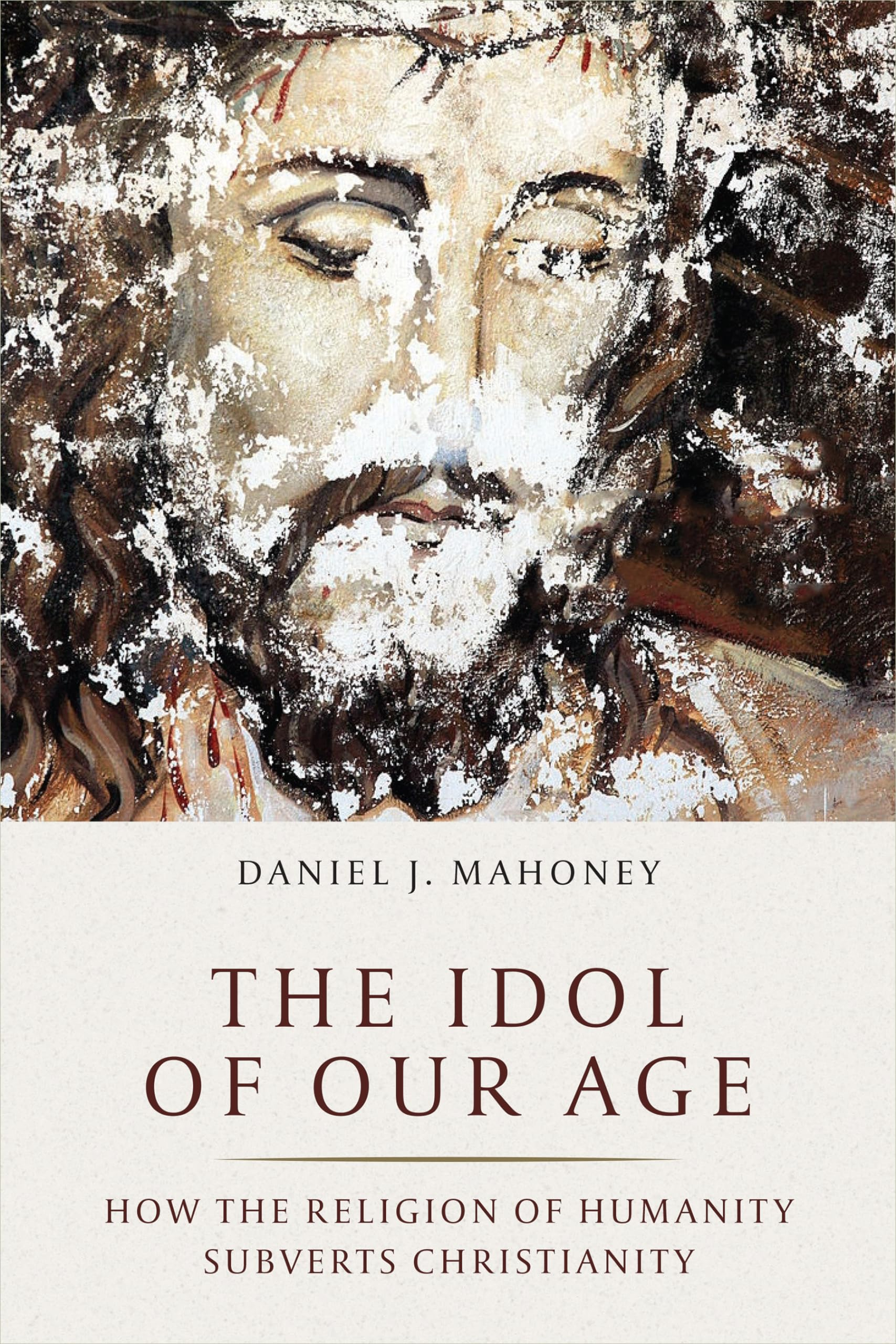
Like Schlossberg, Mahoney’s The Idol of Our Age offers a penetrating critique of contemporary society’s elevation of humanitarianism to a quasi-religious status, supplanting traditional Christian values. Mahoney argues that this “religion of humanity,” a term he borrows from Comte, reduces Christianity to a mere vehicle for social justice and radical egalitarianism, stripping it of its transcendental essence.
Mahoney traces the origins of this secular faith to thinkers like Comte, who envisioned a society where human reason and altruism replace divine authority. This shift leads to a moral framework grounded solely in human sentiment, devoid of any higher spiritual reference. Indeed, as Schlossberg also observed, humanism can be called “King Sentiment.” As he writes:
“Humanism thrives on sentimentality because few religions are more dishonest in their doctrinal expressions. Unable to withstand dispassionate analysis, which would reveal its lack of foundation, it stresses feeling over thought. That is what makes its sentimentality so vicious. People can get good feelings from almost anything; ‘sadism’ refers to a philosophy that elevates feeling into a moral principle.”
Mahoney likewise contends that such a foundation is inherently unstable, as it lacks the moral absolutes provided by traditional Christianity.
A significant portion of Mahoney’s polemic is directed at the contemporary Church, particularly under the leadership of Pope Francis. He asserts that the Pope’s emphasis on social issues and egalitarianism reflects an alignment with humanitarian ideals, potentially diluting the core spiritual message of Christianity. Mahoney warns that this conflation can lead to a form of “unthinking sentimentality,” where the pursuit of social justice overshadows the need for spiritual repentance and moral rigor.
To bolster his argument, Mahoney draws on the works of thinkers like Orestes Brownson, Vladimir Soloviev, Aurel Kolnai, and Aleksandr Solzhenitsyn. These figures, he suggests, offer valuable insights into resisting the encroachment of secular humanitarianism and reaffirming the transcendent dimensions of Christian faith.
In essence, Mahoney’s work calls readers to resist the subtle ways in which the “religion of humanity” seeks to redefine moral and spiritual values. By exposing the limitations and dangers of this secular creed, he advocates for a return to a more authentic and transcendent understanding of Christianity, one that acknowledges human dignity without succumbing to the relativism and sentimentality of contemporary humanitarianism.
This critique aligns with Herbert Schlossberg’s analysis in Idols for Destruction, where the elevation of human constructs—be it the state, material wealth, or human reason—to ultimate concern leads to societal decay (unfortunately, Mahoney does not cite Schlossberg). Both authors caution against the perils of substituting divine authority with human-centered ideologies, emphasizing the need to re-anchor society’s moral compass in transcendent truths.
The Universal Reach of Idolatry
Cavanaugh’s The Uses of Idolatry builds upon the premise that idolatry is a universal human phenomenon, emphasizing that everyone worships something. Drawing inspiration from the late David Foster Wallace’s claim that all humans are worshipers by nature, Cavanaugh argues that modernity has not diminished worship but redirected it toward human creations like wealth, power, and nationalism. Such migrations of devotion, he contends, are not signs of progress but evidence of humanity’s enduring spiritual misorientation.
Cavanaugh critiques the common narrative that the modern West is a “disenchanted” secular world. He suggests that this binary between secular and religious obscures the pervasive presence of worship in contemporary life. For example, rituals such as Black Friday shopping or the near-sacred faith in the “invisible hand” of the market reveal a deeply entrenched pattern of worship that defies the supposed rationalism of modernity. By unmasking these secular rituals as forms of idolatry, Cavanaugh challenges the self-congratulatory narratives of a scientifically enlightened West.
“The so-called disenchantment of the world” [he observes], “is itself a myth; modernity has not abandoned worship, but rather reallocated it.”
Idolatry, as Cavanaugh explores it, is not simply a theological error but a sociocultural phenomenon rooted in humanity’s longing for transcendence. He frames this critique within an interdisciplinary approach, drawing insights from figures like Max Weber, Karl Marx, and Charles Taylor. This allows him to analyze modern idolatries such as consumerism and nationalism as “godlike systems” that structure social life while enslaving their adherents. These systems operate beyond individual choice, embedding idolatry into the very fabric of public and private existence.
Despite his critique, Cavanaugh recognizes that idolatry reflects humanity’s innate yearning for meaning. He proposes sacramentality as a remedy, advocating for practices that reorient worship toward God without denying the significance of the material world. Such sacramental worship acknowledges creation’s beauty while avoiding its elevation to ultimate status. For Cavanaugh, this is not merely about rejecting false worship but cultivating a form of devotion that aligns human life with divine purpose. As he writes:
“The cure for idolatry is not an abandonment of the material world, but a reorientation of our desires so that the material points us toward the divine.”
Cavanaugh’s sophisticated analysis provides a vital framework for understanding idolatry in its modern manifestations. By dismantling the binaries of secular and religious, immanent and transcendent, he calls readers to reconsider the true objects of their devotion and the societal structures that sustain them.
The Drama of Atheist Humanism

Henri de Lubac’s The Drama of Atheist Humanism builds upon the critiques of Schlossberg and Cavanaugh by examining the philosophical underpinnings of a world that has sought to construct humanism apart from God. Focusing on figures like Ludwig Feuerbach, Friedrich Nietzsche, and especially Auguste Comte, de Lubac explores how the rejection of divine transcendence has led to the elevation of human constructs such as reason, the state, or material progress to ultimate status. This parallels the modern idolatries outlined by Schlossberg and Cavanaugh, as it replaces the Creator with creations, leading to a spiritual impoverishment of humanity.
De Lubac’s analysis highlights the existential and societal consequences of this shift. By excluding God, atheist humanism inadvertently diminishes human dignity, creating a vacuum that paves the way for totalitarian regimes and moral relativism. As de Lubac observes,
“No true humanism exists apart from the Gospel of Jesus Christ, which has to be rediscovered and relived age after age.”
His work thus serves as both a critique of secular humanism and a call to re-anchor human dignity in its divine foundation.
What distinguishes de Lubac’s approach is his emphasis on the tension between the longing for transcendence and the inability of human-centered ideologies to fulfill that desire. Echoing the insights of Fyodor Dostoevsky, de Lubac warns that a society without God risks descending into existential despair and moral disintegration. This resonates deeply with Cavanaugh’s more recent exploration of how modern society sustains idolatrous structures that enslave rather than liberate.
De Lubac’s prophetic vision enriches the broader exploration of idolatry, offering a powerful reminder that any attempt to construct humanism apart from God risks undermining the very humanity it seeks to elevate.
Visions of the “New Humanism”

The themes of modern idolatry find further resonance in the work of George Sarton, often regarded as the “father of the history of science.” In his writings, particularly The History of Science and the New Humanism (1931), Sarton proposed a vision of progress grounded in the cumulative achievements of scientific inquiry. Sarton’s “New Humanism” drew heavily on the positivist philosophy of Comte, celebrating science as the ultimate means of understanding and improving human civilization. However, this perspective also reveals the potential for a new form of idolatry, where science and human reason are elevated to the status of ultimate arbiters of truth.
Sarton’s commitment to Comtean positivism led him to view history as a narrative of the progressive triumph of reason over superstition. He famously described the history of science as
“the story of an endless struggle against superstition and error,”
positioning scientific inquiry as the hero in humanity’s march toward enlightenment. This narrative, while celebrating the achievements of science, often dismissed religion and metaphysics as relics of a less enlightened age. Sarton’s call for a “New Humanism” was not merely a celebration of science but a manifesto for its centrality in shaping human values and aspirations. He argued that
“scientific activity is the only one which is obviously and undoubtedly cumulative and progressive,”
underscoring his belief in the primacy of science over other forms of knowledge.
While Sarton’s vision of a “New Humanism” aligns with the broader secular humanist project, it also exemplifies the dangers of conflating progress with the idolatry of human reason. By situating science as the ultimate source of meaning and value, Sarton’s philosophy echoes the critiques of Schlossberg, Cavanaugh, and de Lubac, who warn against replacing divine transcendence with immanent constructs. Just as Schlossberg critiques the idolatry of power and Cavanaugh examines the rituals of consumerism, Sarton’s “New Humanism” can be seen as a form of intellectual idolatry that elevates human achievement to the status of ultimate concern.
Moreover, Sarton’s reliance on Comte’s positivist framework highlights the limitations of a worldview that excludes transcendence. While Sarton acknowledged the cultural significance of religion, his writings often reduced it to a pre-scientific stage in humanity’s development. This reductionist approach risks ignoring the profound ways in which religious traditions have shaped human history and values. In this sense, Sarton’s “New Humanism” reflects the broader tensions inherent in modernity’s attempts to construct meaning apart from religious foundations. Sarton’s legacy, while foundational to the history of science, also serves as a cautionary tale about the perils of uncritical devotion to progress. In the end, his “New Humanism” underscores the enduring challenge of balancing human achievement with the need for a deeper, more transcendent sense of meaning.
A Persistent Temptation
The examination of modern idolatry in the works of Schlossberg, Cavanaugh, de Lubac, and its connection to thinkers like Sarton and Comte, reveals a sobering continuity in humanity’s struggles across time. While the forms of idolatry may have evolved—from ancient golden calves to the worship of nation-states, consumerism, and scientific progress—the underlying temptation remains strikingly consistent. Like the story of the Garden of Eden, modernity reflects humanity’s enduring desire to “be like God,” claiming autonomy and control over creation while dismissing the necessity of transcendence.
This desire, though seductive, carries profound dangers. In elevating finite constructs to infinite significance, societies risk losing sight of the broader frameworks of meaning that ground human dignity and purpose. The consequences of such misplaced worship are evident in the fragmentation, moral ambiguity, and existential discontent that characterize much of contemporary life. Whether in the pursuit of unchecked material wealth, the deification of human reason, or the technocratic promise of salvation through the state, idolatry consistently undermines the very aspirations it seeks to fulfill.
The way forward lies not in abandoning human achievement but in critically examining the ends to which it is directed. Recognizing the limits of immanent frameworks and embracing a more balanced perspective—one that integrates the material with the transcendent—offers a path, I think, toward a richer and more sustainable vision of human flourishing. The insights of the thinkers examined here challenge us to confront the idols of our age with clarity and courage, urging us to ask: What ultimately deserves our devotion? By reflecting on these questions, we may find a way to transcend the limitations of modern idolatry and rediscover a deeper sense of meaning in our shared human journey.
 James C. Ungureanu