Why the Future of Science-Faith Dialogue Needs the Theologians, Not Just the Physicists
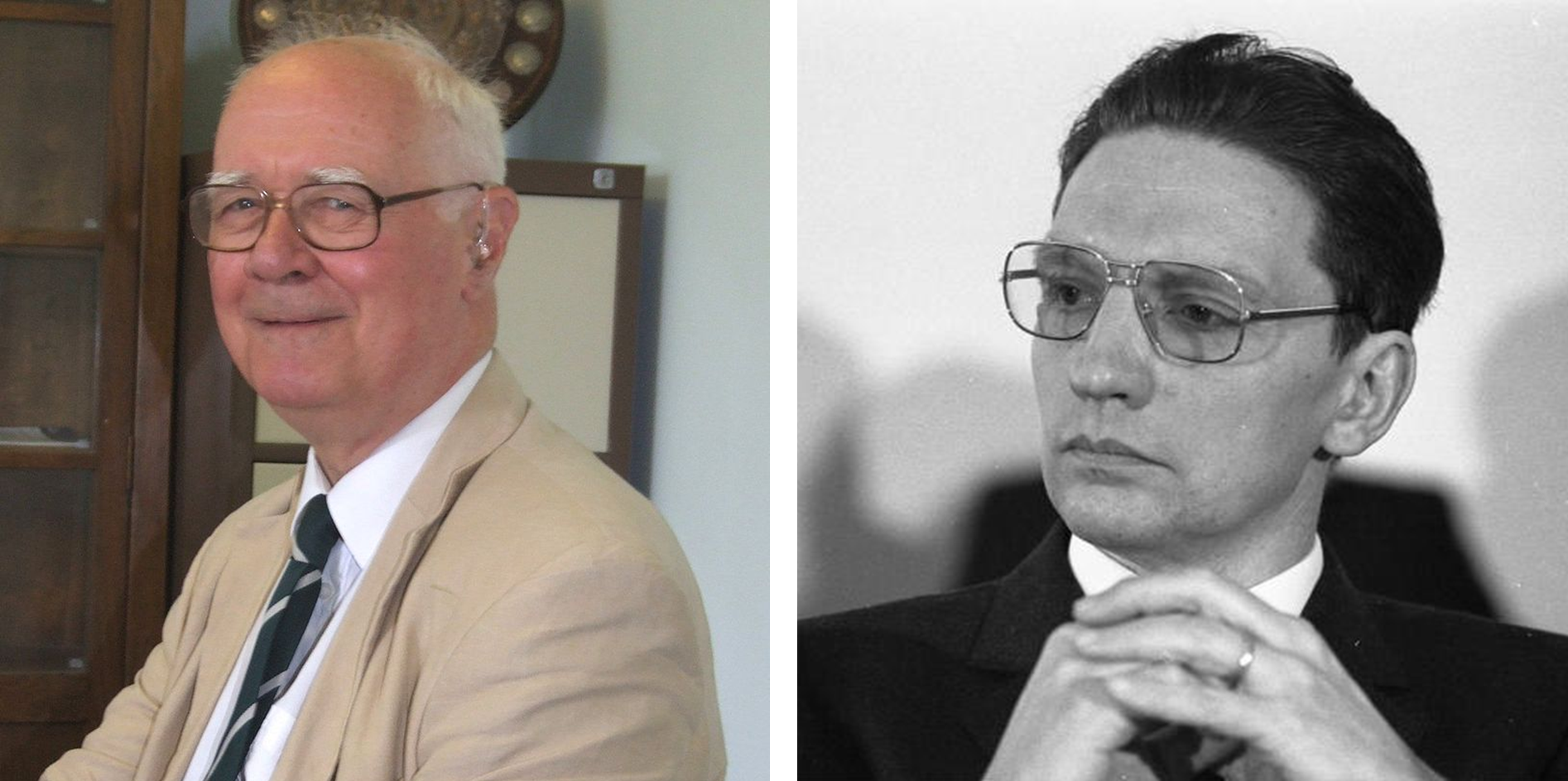
In the modern dialogue between science and Christian theology, two names loom large: John Polkinghorne and Wolfhart Pannenberg. Both sought to reconcile faith with the empirical rigor of the natural sciences, yet their approaches diverge in ways that reveal a deeper, often unspoken tension in the conversation. Polkinghorne, the physicist-turned-theologian, is frequently cited as a model of interdisciplinary harmony, his work praised for its accessibility and congeniality toward scientific consensus. Pannenberg, the systematic theologian, is far less referenced in these discussions—and this, I contend, is a grave mistake. For while Polkinghorne’s contributions are valuable, they suffer from an uncritical deference to scientific authority, a superficial grasp of history, and a theological method that too often accommodates rather than challenges. Pannenberg, by contrast, offers the more robust, philosophically coherent, and theologically profound path forward—one that refuses to let science set the terms of the debate.
A Well-Meaning but Flawed Approach
Polkinghorne’s work is characterized by a deep respect for science—unsurprising, given his background as a quantum physicist. His writings often emphasize consonance, seeking to show that Christian belief and scientific discovery are not at odds. Yet herein lies the problem: his method frequently assumes that science, as practiced in secular institutions, is the neutral arbiter of truth, with theology left to fill in the metaphysical gaps. His concept of “critical realism” borrows from both scientific and theological discourse, but in practice, it often grants science an epistemological privilege that theology must then accommodate.
This is most evident in his treatment of divine action. Polkinghorne, influenced by chaos theory and quantum indeterminacy, posits a God who acts within the “gaps” of natural indeterminacy—a kind of divine causality operating in the interstices of physical law. While creative, this approach risks reducing God’s agency to the leftover contingencies science has not yet explained. It is, in essence, a retreat from classical theism’s robust doctrine of providence, wherein God sustains and governs all creation immediately, not merely through the cracks of quantum uncertainty.
Moreover, Polkinghorne’s historical and philosophical engagement is surprisingly thin. He often speaks of the “Galilean settlement” as if the warfare model of science and religion were an established historical fact, ignoring the nuanced scholarship of writers who have dismantled such simplistic narratives. His philosophy of science, while sophisticated in its own right, rarely questions the metaphysical assumptions underpinning scientific materialism—assumptions that Pannenberg, by contrast, confronts head-on.
Polkinghorne’s optimism about scientific objectivity falters under scrutiny. His critical realism assumes science delivers a “stable foundation” for theology, neglecting insights from post-Kuhnian philosophy of science. Thomas Kuhn’s paradigm shifts, Paul Feyerabend’s epistemological anarchism, and Bruno Latour’s actor-network theory all expose science as a socially embedded practice, where “facts” are shaped by institutional priorities, funding biases, and cultural narratives. The anthropic principle, for instance, is not a neutral observation but a metaphysical interpretation of data—one that materialists dismiss as coincidence. Polkinghorne’s bottom-up method, while admirably interdisciplinary, risks reducing theology to a reactive discipline, forever adjusting its claims to fit scientific consensus.
Theology as the Framework for Science
Pannenberg, unlike Polkinghorne, refuses to let science dictate the terms of engagement. For him, theology is not a supplement to scientific knowledge but its proper horizon—the ultimate context in which all truth, including empirical truth, finds its meaning. His method is unapologetically Christocentric: because Christ is the Logos through whom all things were made, all knowledge, including scientific knowledge, must be understood in light of Him.
This is no mere assertion of theological privilege but a rigorous philosophical claim. Pannenberg argues that science itself depends on metaphysical presuppositions—uniformity in nature, the intelligibility of the cosmos—that cannot be justified within a purely materialist framework. Only a theology of creation, grounded in the God who guarantees the coherence of the world, can provide the necessary foundation for scientific rationality.
Pannenberg’s doctrine of divine action is also far more robust. Rather than locating God’s activity in quantum gaps, he insists that God acts through natural processes, not in competition with them. Creation is ex nihilo, sustained at every moment by God’s will, and thus all events—whether the orbit of planets or the choices of free agents—are directly upheld by divine providence. This is classical theism at its finest, refusing to concede any sphere of reality to autonomous naturalism.
For Pannenberg, science’s metaphysical assumptions (e.g., nature’s uniformity, causality) are borrowed capital from the Christian worldview. The very possibility of scientific rationality presupposes a universe contingent on a rational Creator. His eschatological ontology—the belief that the future (God’s kingdom) determines the present—subverts the materialist dogma that only past causes explain reality. Unlike Polkinghorne, Pannenberg does not seek “integration” but subordination: science, like all human knowledge, finds its truth only when judged by Christ, the alpha and omega.
The Only Way Forward
Pannenberg’s theological project did not end with his death in 2014. A cadre of scholars, inspired by his unyielding commitment to theology as the scientia ultima, have taken up his mantle, deepening and expanding his insights in ways that address the pressing scientific and philosophical challenges of the 21st century. While figures like Philip Clayton and Ted Peters have indeed advanced Pannenberg’s project in creative ways, their theological commitments sometimes diverge from classical Christian orthodoxy (e.g., Clayton’s panentheism or Peters’ openness to process thought). This tension underscores the need to distinguish between Pannenberg’s own orthodox framework and later interpretations that stretch its boundaries. Fortunately, there are scholars who maintain fidelity to Nicene Christianity while expanding Pannenberg’s vision in dialogue with science. Their work demonstrates that a robust, orthodox theology of nature is not only possible but necessary.
Though not a direct disciple, the Scottish theologian Thomas F. Torrance (1913–2007) shared Pannenberg’s conviction that theology must engage science without surrendering its dogmatic core. Torrance, a key figure in the 20th-century revival of patristic theology, argued that both theology and science pursue “realist” knowledge of their objects (God and nature, respectively). His work on space-time relativity and the incarnation, such as in Space, Time and Incarnation (1969), insists that Christ’s bodily resurrection validates the ontological unity of creation—a theme central to Pannenberg.
Torrance’s dialogue with Einsteinian physics exemplifies orthodox engagement: he rejected both dualism and materialism, arguing that the universe’s contingent order reflects the Logos who became flesh. His emphasis on theosis (deification) as the telos of creation aligns with Pannenberg’s eschatological ontology but roots it firmly in the Cappadocian tradition.
Another close follower is Alister McGrath, molecular biophysicist-turned-theologian, who bridges Pannenberg’s ontological rigor with C.S. Lewis’s imaginative apologetics. Though occasionally grouped with Polkinghorne, McGrath’s work—such as A Scientific Theology (2001–2003)—is deeply Pannenbergian in its insistence that Christian doctrine provides the “ultimate explanatory framework” for science.
These thinkers demonstrate that Pannenberg’s project can flourish within orthodox boundaries. Unlike revisionists who dilute doctrine to appease scientific materialism, they follow Pannenberg in challenging science’s metaphysical overreach while affirming God’s transcendental freedom, the historicity of the Resurrection, and the Logos as rational ground. Even critics of Pannenberg’s methodology, such as theologian John Milbank, concede that his insistence on theology’s “comprehensive truth claim” is a bulwark against secularizing trends in science.
The science-faith dialogue stands at a crossroads. Polkinghorne’s critical realism, though well-intentioned, risks captivity to what Charles Taylor calls “the immanent frame”—the secular mindset that reduces reality to the empirically verifiable. Pannenberg’s eschatological ontology, by contrast, shatters this frame, proclaiming that all knowledge—scientific, historical, philosophical—finds its coherence in the risen Christ.
To accept Polkinghorne’s bottom-up approach is to concede theology’s explanatory sovereignty. To embrace Pannenberg’s top-down vision is to reclaim it. The choice is not between science and faith but between two worlds: one where God dwells in the gaps of quantum uncertainty, and one where He reigns as the Logos who lights every lab, every equation, every star. The future belongs to those who dare to choose the latter.
 James C. Ungureanu