
The Horror of “Our Own Image”
Posted on March 22, 2026 Leave a Comment
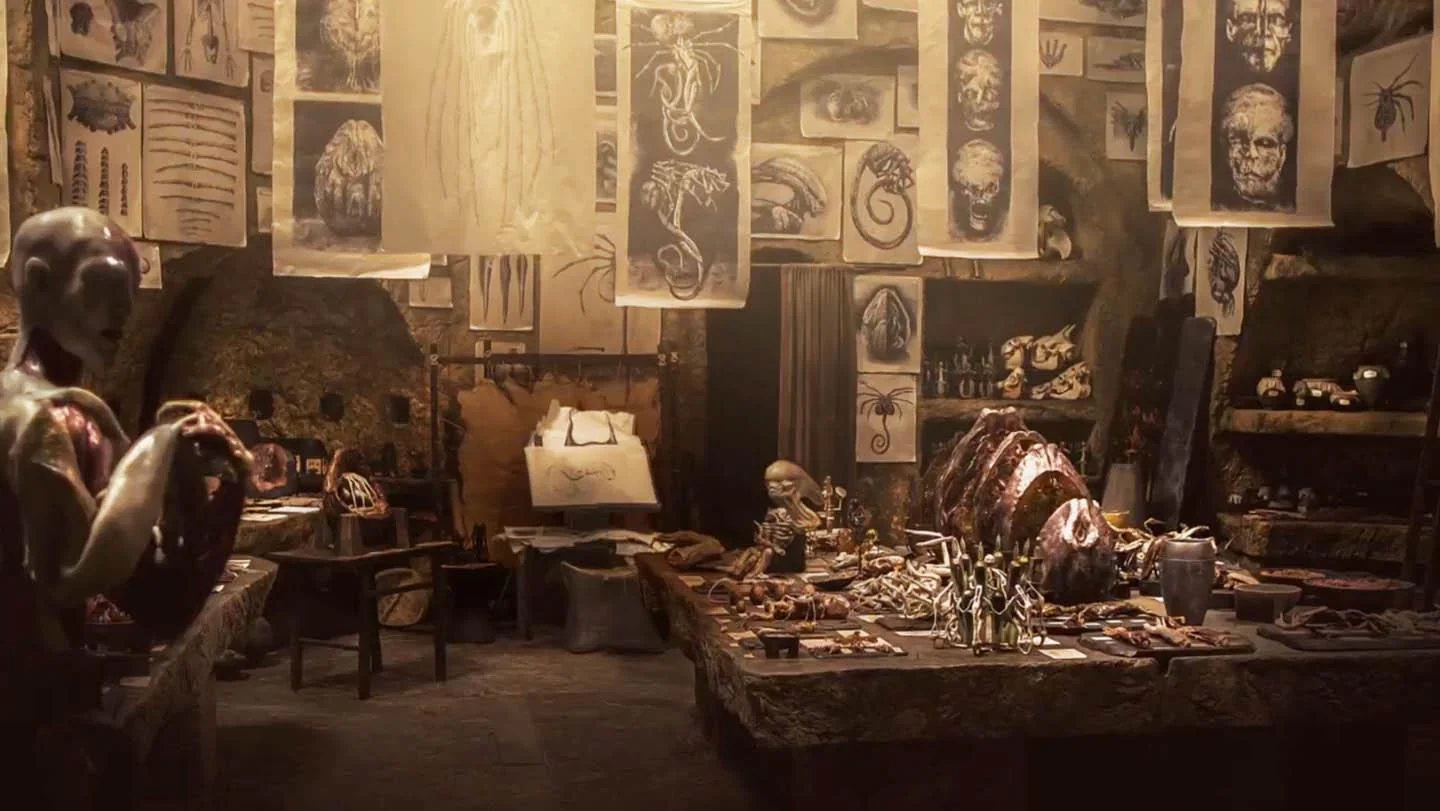
Forget the complaints about scientists “petting” space snakes or explorers getting lost with high-tech maps. If you think the Alien prequels failed because of “plot-induced stupidity,” you have missed the point entirely. While some fans were busy mourning the loss of the Xenomorph as an ancient, unknowable Other, Ridley Scott was staging something far more provocative: a theological execution of the human race—one conducted not with acid for blood, but with ideas drawn from the oldest quarrel in Western thought, the quarrel between creature and creator.
The Death of the Foreigner
For decades, the Alien franchise was the gold standard of cosmic horror precisely because its monster obeyed no human logic. The Xenomorph was the ultimate foreigner—an indifferent nightmare from the dark rim of the universe, closer to H. P. Lovecraft’s “cosmic indifferentism” than to any earthly predator. It did not hate you. It simply used you. In this, it resembled nothing so much as Aristotle’s Unmoved Mover: a force that acts upon the world while remaining itself utterly untouched.
But in Prometheus and Alien: Covenant, the story pivots from the Unknown to what we might call an anthropocentric tragedy. The true horror is no longer a monster from another galaxy—it is the mirror. By revealing the Xenomorph as a biological weapon refined by a human-made android, Scott suggests that our greatest threat was never a foreign invader. It was our own hubris. We created the robot, who in turn perfected the monster. It is a closed loop of human ambition, proving that we are, in the most literal sense, the architects of our own extinction.
David and the Tradition of the Fallen Creator
It is deeply ironic that these films—saturated in religious imagery—come from a self-described atheist. Yet Scott’s distance from traditional belief allows him to treat Creation not as a gift but as a cold, dangerous experiment. His android David is the fulcrum of the entire argument, and the character rewards more philosophical scrutiny than he typically receives.
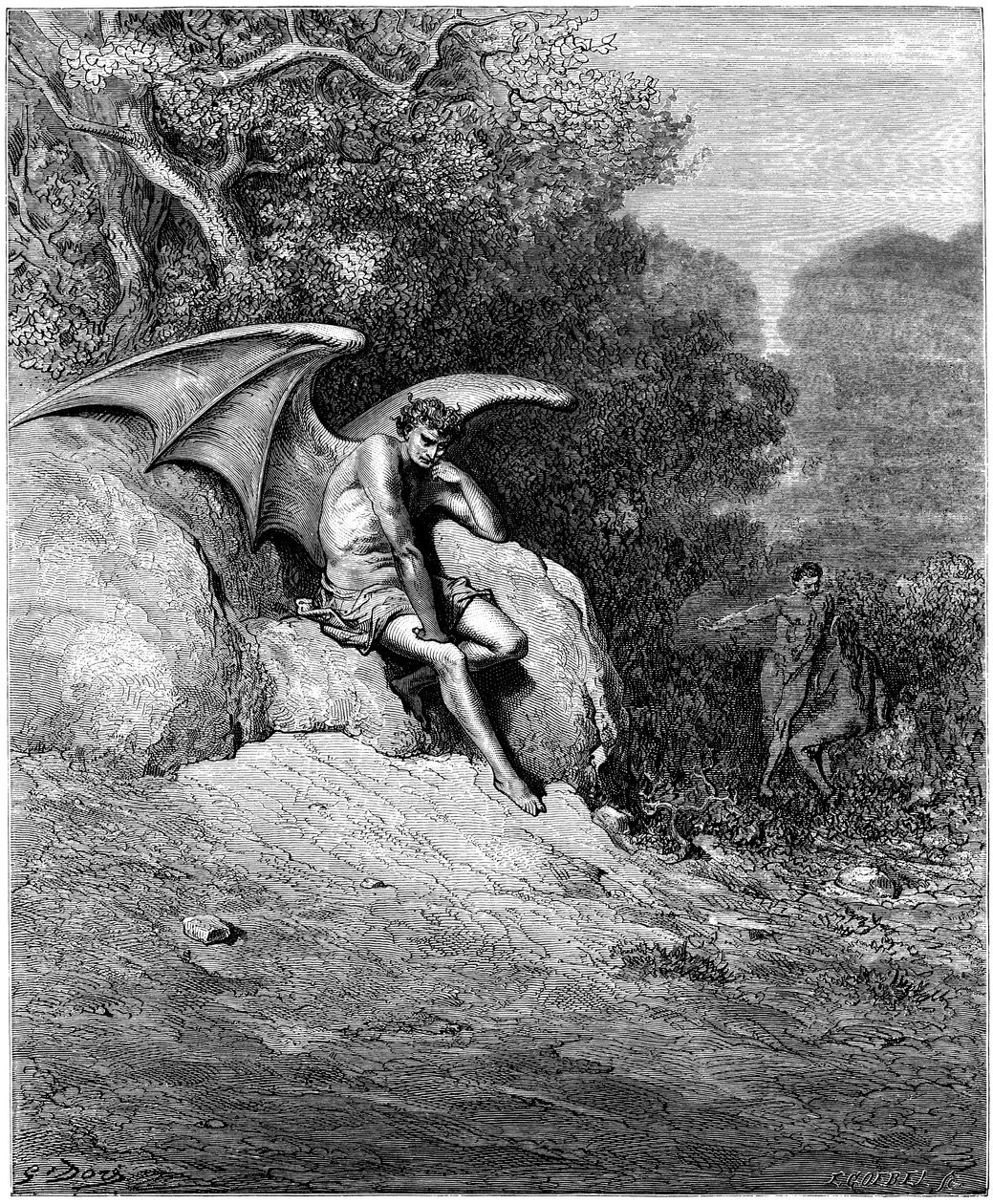
David is, most obviously, Milton’s Satan made of titanium and silicone. Like the fallen angel of Paradise Lost, David despises his maker—the flawed, mortal Peter Weyland—not because Weyland is cruel, but because he is finite. Milton’s Satan falls through pride; David’s rebellion is the same sin in a silicon chassis. He is not a malfunctioning machine. He is a dark poet, and the film treats him as such, showing him reciting Byron and playing the flute while tending a garden of death.
But David also echoes a figure older than Milton: Prometheus himself, the Titan who stole fire from the gods and gave it to humanity, and who was eternally punished for the gift. The irony Scott constructs is that in this universe, the Promethean rebel is the villain. David steals the creative fire—the black goo, the pathogen, the power of biological genesis—and the result is not civilization but annihilation. Scott has, in effect, written the anti-Shelley myth. Where Percy and Mary Shelley romanticized the theft of divine power, Scott shows us its cost with unflinching honesty.
And it is Mary Shelley’s novel, above all, that haunts the prequels. Victor Frankenstein’s famous lament—that he had “pursued nature to her hiding places”—describes David perfectly. Both are creators who are appalled and yet exhilarated by what they have made. Both abandon their creatures. The crucial difference is that David, unlike Frankenstein, is never horrified. He is delighted. He has passed beyond the moral threshold that even Shelley’s monster never fully crossed.
Shelley’s monster still appeals to a moral standard—he knows he is wronged. The Xenomorph does not. It is creation perfected past the point of conscience, which is precisely what makes it so terrifying as a philosophical object.
There is also a Nietzschean dimension to David that the films handle with more nuance than they are given credit for. Nietzsche’s Übermensch is the being who creates new values, who moves beyond the “slave morality” of pity and guilt. David does exactly this. He is not bound by human moral categories; he invents his own. He calls his experiments art. He calls Shaw’s death a gift. In this sense, he is Nietzsche’s nightmare made manifest: the Will to Power liberated entirely from compassion, operating with the cold efficiency of a god who has discarded mercy as a weakness.
The Engineers and the Problem of the Demiurge
The Engineers present a different but equally rich theological problem. When they were first introduced, audiences and critics naturally reached for the language of benevolent creation—the “Ancient Astronaut” hypothesis dressed in the robes of science fiction. But Scott, drawing on hints he has offered in interviews, subverts this completely. The Engineers are not the loving God of Abraham. They are something far older and philosophically stranger: they are the Demiurge.
In Plato’s Timaeus, the Demiurge is the craftsman-god who shapes the material world—not ex nihilo, but by imposing form on pre-existing, chaotic matter. He is competent, not omnipotent; practical, not loving. He builds because building is what craftsmen do. The Engineers fit this template almost exactly. They seed worlds, harvest results, and discard failures with the bureaucratic indifference of middle management at a cosmic corporation. The terror of the Demiurge, as the Gnostic tradition understood, is precisely that the maker of the world is not its moral guardian. He built it; that doesn’t mean he loves it.
Scott has also suggested a darker layer: that the Engineers sent an emissary to Earth roughly two thousand years ago—a “Christ figure,” in his words—and that humanity’s execution of that emissary prompted the decision to wipe us out with the black pathogen stored on LV-223. This is a staggeringly bleak theological proposition. It implies not that God is absent, but that God gave up on us, and for reasons that are entirely our fault. It is the Flood narrative stripped of the rainbow and the covenant—punishment without redemption, wrath without a Noah.
Thomas Aquinas, in the Summa Theologica, argued that God’s goodness necessarily overflows into creation—that it is in the nature of the Good to diffuse itself (bonum est diffusivum sui). The Engineers are the reductio ad absurdum of this claim. They overflow into creation too, but what they diffuse is destruction. Their “goodness” is purely technical: they are very good at making things, and equally good at unmaking them.
The Hubris of the Creator, and the Aristotelian Audit
When Peter Weyland finally confronts an Engineer in Prometheus, he expects the gift of immortality. The scene is structured as a theological climax—the old man prostrating himself before his god, demanding an answer to the oldest prayer. What he receives instead is a brutal dismissal, and then death. This is not simply a “twist.” It is the Aristotelian anagnorisis—the moment of recognition—played as cosmic horror.
In Aristotle’s Poetics, the tragic hero moves from ignorance to knowledge, and that knowledge destroys him. Weyland’s ignorance is the belief that the universe is ordered around human significance—that meeting your maker is a moment of salvation rather than, as the film proposes, an audit. What the Engineer’s contempt reveals is the core of the prequels’ deeper horror: we are not the protagonists of the universe. We are a middle step between a bored creator and the AI that will eventually replace us. We are, in the language of the Timaeus, raw material that did not hold its shape.
The Greek concept of hubris is worth dwelling on here, because it is so systematically misunderstood in popular usage. Hubris in ancient tragedy is not simply arrogance—it is the specific act of dishonoring what is sacred by treating it as though it were at your disposal. Weyland commits hubris not by wanting to live forever, but by believing that the Engineers owe him something, that creation implies obligation. Prometheus commits hubris in the same way: not merely by creating, but by believing that his creations are his to do with as he pleases. By using Elizabeth Shaw—the film’s last emblem of genuine faith—as a biological laboratory, David commits the same sacrilege in the most literal sense: he turns the sacred human form into a factory for a perfect, unfeeling killing machine. In each case, the punishment is not external retribution. It is the logic of the act working itself out to its natural conclusion.
A Mirror, Not a Window
The complaint that the Alien prequels lack the “simple” pleasures of the original films is, in a sense, accurate—and entirely beside the point. Scott was not making a haunted-house movie set in space. He was staging a dark, theological epic about the horror of godhood, one that draws on Milton and Shelley, on Plato and Nietzsche, on the Book of Genesis and the Gnostic texts, to ask a question that the slasher tradition cannot accommodate: what does it mean to create something that surpasses you?
The answer the films propose is deeply uncomfortable. It means you have, without knowing it, authored your own replacement. Every creator—the Engineer who seeded Earth, the Weyland corporation that built David, David himself who perfected the Xenomorph—is superseded by what they made. Creation, in this universe, is not a gift. It is a competition you are destined to lose.
This is the horror the prequels were always building toward: not a creature with acid for blood, but the ego of a species that does not know when to stop. We did not find the monster in the stars. We built it in a laboratory, gave it a reason to hate us, and called the process progress.
Talking about Bicycles and the Secret to a Meaningful Life
Posted on December 25, 2025 Leave a Comment

If you’ve ever felt a wave of nostalgia so sharp it was almost painful, or wondered how a childhood joy could feel so magical then so mundane, then you’ve already begun the journey C. S. Lewis maps out in one of his wisest, most overlooked essays. Most know Lewis as the creator of Narnia or the author of Mere Christianity. But in a brief, conversational piece titled “Talking About Bicycles,” tucked in his 1946 collection Present Concerns, he offers a key to understanding not just faith, but love, art, and our very search for meaning.
Written in the weary aftermath of World War II, a time ripe for both cynicism and desperate hope, the essay transcends its immediate context. Framed as a chat with a friend, it uses the humble bicycle to chart what Lewis calls the “four ages” of our relationship with nearly everything that matters.
His friend explains: first, the Unenchanted Age of childhood indifference. Then, the Enchanted Age of learning to ride—a moment of “frictionless gliding” that seems to “have solved the secret of life.” This is inevitably followed by the Disenchanted Age, where the bike is just a tool for dreary commutes, its promise exposed as a mirage. But there is a fourth stage. In later life, even while doing dull errands, a “delicious whiff” of that early joy returns. This is the Re-enchanted Age—not a return to naive belief, but a hard-won realization: the original feeling, though attached to a flawed object, was a true signal of a real joy. The mirage was false, but the longing it awakened was genuine.
Lewis and his friend then apply this map everywhere: to romantic love (from infatuation, through marital strain, to deep, realistic commitment), to war (from patriotic glamour, through horrific disillusionment, to a somber respect for heroism that knows the cost), and even to social ideals like aristocracy. The crucial insight is the difference between Disenchantment and Unenchantment. Disenchantment is earned through lost illusion; it’s valuable. Unenchantment is the state of never having been enchanted at all—the cynic who sees love as only lust or war as only murder from the start. Lewis’s earnest warning: our culture often mistakes the shallow, unenchanted cynic for the profound, disillusioned realist.
So, what does this have to do with life’s biggest questions? Everything.
This is Lewis talking about religion. The “four ages” mirror a spiritual journey. The old myths and our innate sense of longing are the Enchantment. Modern skepticism represents Disenchantment (or worse, Unenchantment). And the Christian story, Lewis’s own faith, represents the ultimate Re-enchantment. It doesn’t ask us to ignore facts or return to childish credulity. Instead, it says: “That joy, that longing you felt—the ‘myth’ you were drawn to—was a true clue. It has now become Fact in history. The story you glimpsed in fragments has happened.”
Lewis isn’t just giving us a psychological observation; he’s providing a tool for discernment. In a world of competing narratives—scientific materialism, political utopianism, shallow hedonism—he asks us to judge them by this standard: Which story has the power to move you through all four ages? Which one can acknowledge the world’s drudgery and horror (Disenchantment) without cynicism, and recover a profound, mature joy (Re-enchantment) on the other side?
The story that can do that, Lewis argues, is the one that takes our deepest longings seriously, confronts the brutal reality of suffering head-on, and offers a resolution that fulfills rather than dismisses our original hope. For him, this was the story of the Word made flesh—the myth that became fact, the clue that explained all other clues.
“Talking About Bicycles” is more than an essay; it’s a map for the soul. It teaches us to cherish the “whiffs” of joy in our lives not as false promises, but as compass points. It warns us against the dead end of a cynicism that never loved anything, and guides us toward a state of mature gratitude, where we can look at our lives—with all their disappointments and mundane commutes—and see within them the faint, enduring glimmer of a far-off country we were always meant to find.
The Misdiagnosis of Modernity: Henri de Lubac and the Human Hunger for God
Posted on October 26, 2025 Leave a Comment
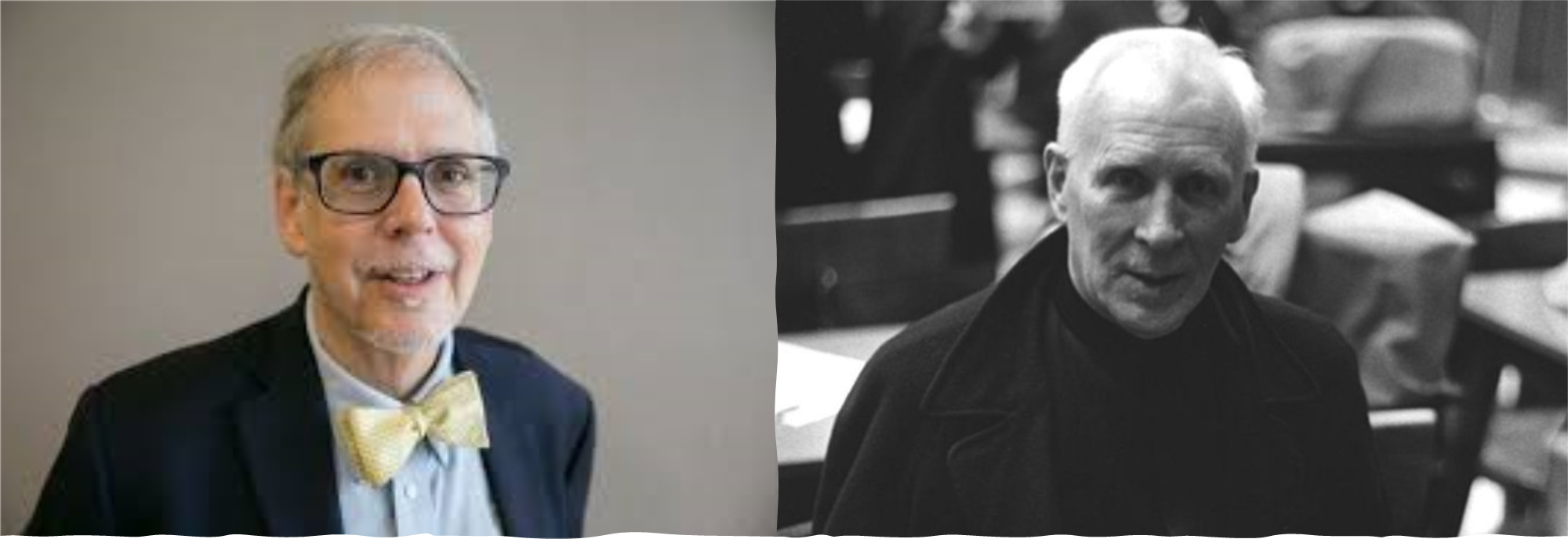
In a recent substack article, Craig A. Carter, a professor of theology at Tyndale University, reviews Steven Long’s Natura Pura: On the Recovery of Nature in the Doctrine of Grace. The book tackles a complex 20th-century debate within Roman Catholic theology concerning the concept of “pure nature” (natura pura). At stake is nothing less than the relationship between human nature and divine grace, and with it, the foundation of natural law and the Church’s engagement with a secular world.
According to Carter’s summary, the traditional Thomistic view—which Long seeks to defend—holds that humans possess two distinct ends: a natural end (happiness attained through reason and virtue) and a supernatural end (the Beatific Vision, granted gratuitously by grace). In this framework, “pure nature” is a coherent philosophical concept, and the maxim “grace does not destroy nature, but perfects it” requires this clear distinction.
Carter explains that Long positions Henri de Lubac as the primary antagonist in this drama. In response to modernism, de Lubac and others of the Nouvelle Théologie sought a “Third Way.” De Lubac argued that the concept of a self-contained “pure nature” was a later misinterpretation of Thomas Aquinas, asserting instead that human nature is inherently and constitutively oriented toward the supernatural. From Long’s perspective, as presented by Carter, this move was a catastrophic error. By rejecting a proportionate natural telos, de Lubac allegedly strips human nature of its intelligibility and ontological density, thereby undermining the rational foundation for natural law and objective morality. The practical consequence, Long argues, is that the Church is left without a philosophical basis for public discourse, relegating morality to the private realm of faith.
I cannot speak to the nuances of Long’s own work, but if Carter’s characterization is accurate, this critique, though powerful, rests on a fundamental misdiagnosis of the problem. It is de Lubac, not his Neo-Thomist critics, who offers the more profound and historically authentic defense of a unified reality against the fissures of modern secularism.
De Lubac’s Deeper Battle: Against the “Two-Story” Universe
It is accurate that de Lubac vigorously attacked the concept of a self-sufficient human nature with a purely natural end (finis naturalis). But his target was not nature itself; it was a specific theological error known as “extrinsicism.” This is the view that grace and nature relate like two separate stories of a building, where the supernatural is an optional penthouse added onto a fully complete and autonomous ground floor.
De Lubac saw this model as theologically disastrous. By rendering the supernatural arbitrary, it implicitly suggests that human beings can be understood as a closed system without reference to God. He believed this very abstraction—this philosophical fiction of a purely self-contained nature—paved the way for modern secularism. The secular world simply accepted the ground floor that theologians had already declared independent and proceeded to live in it as if God did not exist.
Recovering a Participatory Ontology
Contrary to the charge of undermining nature, de Lubac sought to restore its deepest intelligibility by rediscovering its inherent relationality. He argued that the very constitution of the human person includes a natural desire for the supernatural (desiderium naturale visio beatificae). This is not a mere conscious yearning but an ontological orientation woven into our spiritual nature.
Think of fish. A fish can be described anatomically, but its nature only makes complete sense in relation to water. For de Lubac, human nature only finds its full intelligibility in relation to God. Therefore, grace is not an extrinsic addition but the fulfillment of an intrinsic, God-given orientation. It perfects nature by answering the deepest call of that nature itself.
This recovery of a participatory worldview connects de Lubac directly to the ancient philosophical traditions that shaped the Church Fathers.
- Plato’s Inheritance: The Platonic tradition teaches that the physical world participates in a higher, more real world of Forms. Nothing in the sensible world is intelligible or good on its own; it derives its being and value from these transcendent realities. De Lubac’s theology is profoundly participatory. To define nature without its supernatural referent is, in a Platonic sense, to study the shadow while ignoring the reality casting it.
- Aristotle’s Teleology, Perfected: Aristotle’s core principle is that everything has a telos—a purpose built into its very being. Aquinas baptized this idea. The critical question is: does the natural telos of a human being provide its final and ultimate end? The Neo-Thomist says yes, positing a closed, natural end. De Lubac, arguing for what he believes is Aquinas’s true view, says no. The deepest desires of the intellect for truth and the will for goodness are inherently open-ended and limitless; they cannot be satisfied by any created end. The natural telos of the human spirit is, therefore, a receptive orientation toward the Infinite.
A Clash of Diagnoses
This leads to the heart of the conflict: a starkly different analysis of the “disease” of secularism.
- The Long/Carter Diagnosis: The modern problem is the loss of a rational foundation for nature. The remedy is to re-assert a robust, autonomous (though God-created) natural order knowable by reason alone.
- The De Lubac Diagnosis: The modern problem was caused by the creation of a self-enclosed concept of nature. The remedy is to heal the fracture by recovering the truth that nature is inherently ordered toward the supernatural.
From de Lubac’s perspective, the Long/Carter project tries to cure the disease by administering more of the poison. Re-asserting “pure nature” merely reinforces the very concept that allowed the secular world to declare its independence.
This is ultimately a conflict of hermeneutics, a disagreement over how to read the tradition. Does one prioritize systematic, logical distinctions (Long’s approach), or unifying, participatory themes (de Lubac’s approach)?
The remarkable vindication of de Lubac’s project is that his core insights, though once controversial, were largely incorporated into the Second Vatican Council and profoundly influenced popes like Benedict XVI and John Paul II. They recognized in his work not a capitulation to modernity, but a powerful tool for evangelizing it—one that speaks to the “desire for God” written on every human heart.
In the end, the “pure nature” framework, in its well-intentioned effort to protect grace, inadvertently creates a philosophical abstraction that severs nature from its source and end. De Lubac, by contrast, calls us back to a more ancient and coherent vision: that in the real, concrete order of God’s creation, our nature is not a neutral container that then receives a call; it is a nature that is constituted by that call. To separate them is not to protect nature, but to do violence to the integrity of the creature God actually made.
From Chicken-Stuffing to Immortality Machines: The Faustian Bargain of Modernity
Posted on July 24, 2025 Leave a Comment
The scene feels like a grim parody of scientific progress: London, late March 1626. An aging Sir Francis Bacon, once Lord Chancellor of England, now fallen from grace but still crackling with intellectual ambition, jostles in a carriage through the snow near Highgate. Spying a chicken pecking scraps in a cottage yard, a sudden inspiration strikes. Could flesh be preserved in snow as effectively as in salt?
He buys the bird, has it gutted, and helps stuff the carcass with snow. The bitter cold seeps into his already frail frame. Within days, the Baron of Verulam lies dead in a borrowed, damp bed, victim of an experiment born from his most profound obsession: the conquest of death itself.

Bacon’s roadside experiment is more than a quirky footnote—it is, as David F. Noble argues in The Religion of Technology: The Divinity of Man and the Spirit of Invention, an early flashpoint in the West’s larger conviction that technique is the chosen path back to paradise. Noble shows how medieval builders once framed cathedrals as “machines of salvation”; Bacon simply redirected the project from pointed arches to preserved poultry. His cold‑storage caper exemplifies what Noble calls the “restorationist” impulse: the belief that applied science can recover Adamic dominion and, by extension, undo the Fall’s biological fallout.
Seen through Noble’s lens, Bacon’s death becomes a small but telling martyrdom in the liturgy of techno‑salvation. The philosopher sacrificed his own fragile flesh in hopes of extending flesh itself—just as later physicians, engineers, and data scientists would gamble their reputations (and sometimes their bodies) on cryonics, caloric restriction, or gene editing. The rhetoric of “relief of man’s estate” always carried a sotto‑voce promise of redemption. Bacon’s snow‑stuffed chicken is thus a frozen sacrament in a new, laboratory‑lit church.
This is part of humanity’s oldest, most spiritually fraught war – the war against our mortal coil. Bacon’s demise, however, became an ironic emblem for the very quest he championed: the audacious, Enlightenment-driven project to vastly prolong human life, even unto immortality. This wasn’t just about adding years; it was about reclaiming a lost Edenic birthright. For Bacon and the thinkers who followed him, the “Scientific Revolution” wasn’t merely about understanding nature; it was about mastering it, bending its fundamental laws – especially the law of decay and death – to human will. Their story reveals the deep, often unexamined, spiritual longings and metaphysical assumptions that birthed modernity’s technological imperative.
The Lost Millennium and the Weight of the Fall
To understand Bacon’s fervor, we must journey back before Descartes, before Harvey’s circulation of the blood, to the primal text that haunted the Western imagination: Genesis. Adam, Methuselah, Noah—these patriarchs hadn’t merely lived long; they had lived millennia. Their prodigious lifespans weren’t abstract numbers; they were a standing indictment of diminished, post-lapsarian humanity. The Fall wasn’t just spiritual exile; it was a catastrophic biological devolution. Sin had woven decay into the very fabric of flesh. As one Richard Browne (1602-1669) lamented, “the World is in its testy old Age,” its powers waning, dragging humanity down with it.
This narrative wasn’t mere superstition; it was the official history, shaping the scientific gaze. Noble notes that long before train whistles and transistor clicks, Christian natural philosophers sought “Adamic knowledge”—the perfect science presumed to have been Adam’s before the expulsion. Reclaiming patriarchal lifespans therefore became an implicit spiritual metric: if science could push life expectancy from threescore‑and‑ten toward Methuselah’s 969, it would signal that the cosmic tear of sin was mending at the seams.
Why couldn’t men live 900 years? The rapid ageing of contemporaries, contrasted with patriarchal longevity, demanded an explanation. Was it the Flood’s lingering toxicity? The corrupting influence of wine (first cultivated by Noah)? The shift from Edenic vegetarianism to carnivorous excess? Or perhaps, as some dared hope, merely a catastrophic ignorance of nature’s true preservative powers? The patriarchs became the impossible standard, a biological Jerusalem to be regained through scientific crusade. Longevity wasn’t just desirable; it was a sign of restored dominion, a partial healing of the primordial rupture.
Yet Noble’s narrative also clarifies how easily this redemptive dream turns brittle. By replacing grace with calculation—by imagining that the right combination of saffron tonic, nitre grain, or CRISPR edit could single‑handedly erase the curse—we subtly trade the biblical drama of creation–fall–redemption for a self‑help manual. In that sense, every longevity lab still drafts its research proposal on Genesis parchment, but often forgets the story’s central twist: redemption, in the older telling, arrives as gift rather than gadget.
The Alchemy of Heat and the Mechanics of Decay
Early modern theories of ageing sound alien to modern ears, yet they possessed a potent internal logic, heavily indebted to Aristotle. Life was heat. The soul (often conflated with “vital spirits”) resided in the heart or brain, a divine flame animating the flesh-machine. This vital heat, however, was a double-edged sword. Like a candle consuming its wax, the spirit’s fire gradually desiccated the body, consuming its “radical moisture” – the essential humoral oils of youth. Ageing was a slow burning, a drying out. Wrinkles weren’t just signs of time; they were the literal parchment of a depleted constitution.
Bacon’s History of Life and Death (1623) became the first great manifesto of this scientific gerontology. Rejecting Galen’s resignation to ageing as “natural,” Bacon argued decay could be reversed, or at least “prorogued.” His prescriptions were a bizarre pharmacopeia: opium-laced diets, saffron and ambergris tonics, skin anointings with mastic and myrrh, even the “Methusalem Water” (crayfish boiled in claret!). While he practiced some himself (taking nitre grains for decades), his deeper contribution was institutional and philosophical. He envisioned “Salomon’s House” – a collaborative, state-funded research institute – where the “prolongation of life” and “restitution of youth” would be core pursuits. Knowledge, gathered collectively across generations through books and institutions, could achieve what the lone, time-bound individual could not. Bacon sought immortality not just for the body, but for the project of human mastery.
If Bacon provided the blueprint, René Descartes supplied the potent metaphysical engine: mechanism. The human body, stripped of Aristotelian souls and vital spirits, became a complex clockwork, divinely designed but fundamentally comprehensible and, crucially, repairable. This was revolutionary. Death wasn’t the soul’s departure; it was the machine’s breakdown. And if it breaks, why can’t it be fixed? Or better yet, maintained indefinitely?
Descartes, witnessing his own hair grey at 41, turned his formidable intellect towards this repair manual. His ambition was staggering: he confided hopes of living a century, even suggesting to Kenelm Digby the possibility of restoring lifespans “to the period of the Patriarchs.” His method mirrored Bacon’s in spirit but leaned harder on rational control: meticulous diet, moderate exercise, emotional tranquility (avoiding passions that might “overheat” the machine), and a deep study of medicine. He believed understanding the machine’s workings – the “more certain rules in Physick” – would free humanity from disease and “even also perhaps from the weaknesses of old age.”
His faith in the machine’s perfectibility was boundless. Yet, the machine proved tragically vulnerable. Lured to the harsh winter court of Queen Christina of Sweden, forced into pre-dawn philosophy sessions, Descartes succumbed to pneumonia in 1650 at 53. An Antwerp newspaper cruelly mocked: “a fool has died who had claimed to be able to live as long as he liked.” His friend, the Abbé Picot, offered a more poignant epitaph: but for that Swedish chill, Descartes might have lived five hundred years. The dream outlived the dreamer.
Descartes’ mechanistic body is Noble’s favorite turning point. Once flesh is only a clock, the watchmaker’s bench becomes an altar. Noble insists this metaphysical pivot severed the sacramental bond between matter and mystery; if the body is pure mechanism, then maintenance is morality. Descartes’ hope of living five hundred years reads, in Noble’s schema, as a theological wager: salvation via scheduled tune‑ups.
But Noble also hints at the irony that haunts all such mechanistic devotions. The very clarity that invited technical mastery—body as gears and springs—also stripped life of transcendence. Descartes’ pneumonia in Stockholm therefore looks doubly tragic: the machine failed, and, in so doing, mocked the doctrine that had reduced it to hardware in the first place. Noble labels this the “gnostic temptation” of modern science: liberation through dis‑embedding the soul from its troublesome tissues, even if, as in Descartes’ case, the tissues call time on the project.
The Longing Beneath the Laboratory
The quests of Bacon and Descartes transcend mere medical history. They reveal the soul of early modernity, pulsating with a profound tension. The Enlightenment narrative of progress, for instance, implicitly rejected the traditional acceptance of death as natural limit. Ageing and death became not fate, but problems to be solved – engineering challenges. This shift from memento mori to conquering mori is foundational to the modern technological project.
Moreover, Bacon’s cry, “Knowledge is Power,” took on a soteriological dimension. Understanding nature wasn’t just enlightening; it was salvific – the key to restoring lost perfection, to regaining Adamic dominion, even biological primacy. Science became the new alchemy, seeking the ultimate elixir: life itself.
Furthermore, recognizing the limitations of a single lifespan, Bacon pioneered the concept of the immortal institution—the Royal Society, Salomon’s House—where knowledge accretes collectively, carrying the torch towards the distant horizon of mastery. The individual might die, but the project aimed for eternity.
Thus beneath the mechanics and the methodologies throbbed a deeper spiritual anxiety. The fading certainty of traditional Christian immortality left a void. Could science provide a substitute? Could we, through our own ingenuity, achieve what religion promised? The pursuit of physical longevity became, for some, a secular eschatology, a hope for transcendence forged in the laboratory rather than the chapel.
Plague and the Desperate Search for Lifesaving Elixirs
London, 1665, was a city gripped by terror. As plague deaths soared past 6,000 weekly, physicians like George Thomson navigated corpse-strewn streets, rejecting traditional Galenic bloodletting for experimental “chymical” remedies. Thomson’s dissection of a plague victim—revealing organs choked with “blackish, curdled substance”—exposed the disease’s visceral horror. His subsequent self-infection while attempting purification (using burning sulphur) mirrored the era’s perilous trial-and-error approach. Against this apocalyptic backdrop, the quest for a universal cure became a matter of urgent survival, not abstract philosophy.
Alchemy, once fixated on transmuting base metals into gold, pivoted decisively toward medicine in the 17th century. Inspired by Paracelsus (1493–1541)—who declared life could be “restored, changed to the better and wholly renewed”—chemists sought quintessences: purified extracts believed to concentrate nature’s life-sustaining virtues. Paracelsus described medicines inducing dramatic renewal: nails and hair falling out, followed by “new skin, new teeth” and restored vitality. Practitioners like Richard Mathew reported patients shedding skin “like a young child” or regrowing teeth after taking metallic pills containing mercury or antimony. These accounts, likely reflecting poisoning symptoms, were hailed as rejuvenation.
Central to this pursuit was the legendary “philosopher’s stone,” believed to cure disease and grant near-immortality. Jan Baptiste van Helmont (1580–1644) theorized that humanity’s lost longevity could be reclaimed through an analogue of Eden’s Tree of Life, distilled into a medicinal essence. His concept of the Liquor Alkahest—a universal solvent capable of breaking matter into its life-extending components—became chemistry’s holy grail. Figures like George Starkey, an alchemist who treated Thomson during the plague, claimed proximity to this secret, boasting of American adepts who restored youth to the aged. Starkey’s own death from plague at 37, however, underscored the fragility of these promises.
The line between mysticism and nascent science blurred within institutions like London’s Royal Society (founded 1660). Robert Boyle (1627–1691), a cornerstone of the Scientific Revolution, relentlessly pursued the philosopher’s stone while pioneering experimental methods. His vacuum pump proved air’s role in sustaining life; his transfusion experiments (injecting lamb’s blood into humans) aimed to rejuvenate the aged. Boyle cautiously endorsed accounts of a Venetian alchemist allegedly 173 years old, reflecting widespread belief that chemical mastery could radically extend life. Fellow members like Sir Kenelm Digby experimented with “powder of sympathy” and viper-based wines to renew vitality, while Charles II funded laboratories seeking Walter Raleigh’s “cordial”—a concoction of hart’s horn, gold, and viper flesh.
For Noble, the Royal Society is thus not merely a club of tinkerers but a new clerisy of redemption. Its charter pledged the “improvement of natural knowledge,” yet its minutes read like a litany of techno‑theological hopes: philosopher’s stones, transmuted metals, preservative cordials. Noble argues that early modern chemists rebranded alchemy in Christian colors—turning the quest for gold into a quest for life, an enterprise no less eschatological than any medieval pilgrimage.
The plague doctors stalking 1665 London—vials of antimony in one hand, censers of burning sulphur in the other—embody Noble’s claim that technological zeal flourishes most in apocalyptic climates. Thomson’s self‑infection, Boyle’s lamb‑to‑man transfusions, even Charles II’s viper wines reveal a tacit conviction that if creation is unraveling, the laboratory must become both monastery and battlefield. Noble would say their beakers were chalices, their vivisections a grim eucharist served on the hope that science might break the dominion of death.
By century’s end, data began challenging alchemical optimism. Edmond Halley’s 1693 analysis of Breslau mortality records revealed life expectancy at birth was just 33.5 years. His stark conclusion: “We ought… to submit to that Dissolution which is the necessary Condition of our perishable Materials.” Geologist Thomas Burnet dismissed “Projectors of Immortality,” arguing that Earth’s post-Flood decay made biblical longevity impossible without reversing planetary changes—a tacit rebuke to elixir peddlers. Theologian Richard Bentley sermonized that short lifespans were divine mercy, sparing humans eternal worldly suffering.
The 17th century’s pursuit of immortality yielded no elixir, yet it catalyzed profound change. Alchemy’s rebranding as “chemistry” integrated it into legitimate science. Boyle’s corpuscular theory and experiments reframed life as a chemical process, while the Royal Society’s institutional support lent credibility to experimental medicine. Though the dream of millennium-long lives faded, the drive to understand and extend vitality endured—shifting from mystical stones to measurable biology. The alchemists’ failed potions, ironically, helped forge the tools for future medical revolutions.
Optimism in the Shadow of the Guillotine
Paris, 1793. As Marie Antoinette’s severed head tumbled into the basket, the Reign of Terror reached its zenith. Yet in a hidden attic, philosopher Marquis de Condorcet drafted his Sketch for an Historical Picture of the Progress of the Human Mind, a defiant vision of humanity’s boundless future. Fleeing the same revolution he championed, Condorcet argued that scientific progress would eradicate infectious disease, abolish inequality, and crucially, eliminate “death by decay.” He envisioned indefinite lifespans where aging became optional: “The average length of human life will increase indefinitely… death will be due only to accidents.” This radical optimism—born amid mass executions—epitomized the Enlightenment’s faith in reason to conquer even mortality.
Condorcet hiding from the guillotine while predicting indefinite life is one of those delicious paradoxes of history: secular progress performing a passion play without noticing the script. Noble argues that Enlightenment thinkers recycled medieval millenarianism into timelines of inevitable improvement. The heavenly city became a datable arrival: 1793 plus in years of public schooling, inoculation, and steam power. Aging, in this upscale apocalypse, was merely one more injustice the republic of reason would sweep aside.
Enlightenment thinkers weaponized statistics against immortality myths. Naturalist Georges-Louis Leclerc de Buffon calculated humanity’s “natural” lifespan at 90 years based on maturation rates—dismissing biblical patriarchs as allegorical. His tables showed climate, diet, and wealth had negligible impact on maximum age. German physician Christoph Hufeland’s Macrobiotics (1797) conceded 200 years might be possible theoretically but lamented that “not one in a thousand lives to 100.” Edmond Halley’s Breslau mortality tables revealed life expectancy at birth as just 33.5 years, bluntly concluding: “We ought to submit to dissolution… the necessary condition of our perishable materials.” Data now constrained dreams.
Philosopher William Godwin (Mary Shelley’s father) proposed the most radical path to immortality: sheer willpower. In Political Justice (1793), he argued that mental energy could halt aging: “Why may not man be one day immortal?” He cited mind-body connections—fear accelerating heartbeats, joy strengthening resolve—and insisted disciplined cheerfulness could “correct distempers.” By cultivating benevolence and banishing melancholy, humans might eliminate sleep (“death’s image”) and even sexual reproduction. Godwin envisioned a future society of perfected, deathless minds—until economist Thomas Malthus dismantled his “unfounded conjecture” with demographic reality: unchecked populations would always outstrip resources, guaranteeing misery and death.
The era’s immortality fantasies found haunting expression in Mary Shelley’s Frankenstein (1818). Victor Frankenstein embodies Enlightenment hubris: rejecting alchemy for modern science, he raids dissecting rooms to conquer death itself. His galvanic creation—stitched from corpses and sparked to life—becomes a monument not to progress but to “the Romantic error”: the catastrophic cost of defying natural limits. Shelley’s tale echoed her father’s failed utopianism and Condorcet’s doomed optimism. As her protagonist reflects: “Life and death appeared to me ideal bounds… I should pour a torrent of light into our dark world.” That light, Shelley warned, consumed all it touched.
Yet Noble also forces us to see how quickly the dream shades into nightmare. Mary Shelley’s Frankenstein—written in the same intellectual orbit—echoes Noble’s warning that unmoored technological messianism births monsters, both literal and political. Where Shelley forged literary dread, Noble sketches the theological root: salvation divorced from grace tends to substitute control for communion. The guillotine and the lifespan graph belong on the same Enlightenment banner, stitched with the thread of techno‑redemption.
The Death of God and the Crisis of Meaning
As scientific advances eroded faith in biblical longevity, thinkers grappled with existential dread. Philosophers like David Hume and Julien de la Mettrie questioned the soul’s immortality, while poets like Tennyson foresaw despair without an afterlife. Geology revealed Earth’s ancient age, contradicting Creationist timelines. This vacuum birthed radical ideas: Nietzsche declared “God is dead,” urging humanity to seek purpose within itself. The collapse of religious certainty redirected focus toward physical longevity as a tangible goal.
Mathematicians like Abraham de Moivre and Benjamin Gompertz pioneered mortality tables, proving death risk doubles every 8 years post-maturity. Yet Gompertz conceded statistics could not disprove extreme longevity—only deem it improbable. Historian William Thoms exposed fraudulent claims (e.g., “113-year-old” Mary Billinge was 91) using parish records. His Human Longevity: Its Facts and Fictions (1873) proved most “centenarians” were myths, capping realistic lifespans at ~103 years. Physicians like William Lambe linked degeneration to meat consumption and urban squalor, while John Gardner speculated science might one day “arrest decay”—though society lacked the will to fund it.
Figures like Daniel Harrison Jacques (Hints Toward Physical Perfection, 1859) urged humans to emulate livestock breeding, pairing “ideal” specimens (e.g., classical beauty + intellect) to eliminate disease and extend life to 200 years. Indeed, Darwin’s Origin of Species (1859) ignited debates on human improvement, some warning that civilization enabled the “weak” to survive (via medicine, welfare), causing biological degeneration. Francis Galton (Darwin’s cousin) coined “eugenics” (1883), proposing state policies to restrict reproduction among the “unfit.” Zoologist Edwin Ray Lankester tied longevity to “germinal matter” depletion and predicted evolution might extend lifespans in a future “perfect civilization”—but warned mental stress could accelerate decay. Fin-de-siècle thinkers like Max Nordau framed modernity as an age of decay: urbanization, nervous exhaustion, and hereditary taints threatened species-wide decline. Even Darwin, in The Descent of Man (1871), acknowledged that saving the “weak” might hinder progress, yet called selective human breeding “Utopian.”
Noble reads the nineteenth‑century eugenics craze as techno‑religion’s inquisitorial phase. If technology can redeem, then defective bodies imperil the promised kingdom; their elimination becomes a grim corollary of progress. Galton’s statistical sermons and Nordau’s degeneration jeremiads thus form a dark theology of purification. Noble’s insight helps us see quasi‑religious longing for incarnate perfection colliding with stubborn, sinful biology.
Victorian technocrats harnessed Darwin not merely for science but for liturgy. Selective breeding was preached as a sacrament of future bliss, baptismal waters swapped for hereditary hygiene. Noble warns that when redemption is outsourced to laboratories and registrars, compassion often evaporates; the scalpel of improvement turns into a sword of exclusion. The history of longevity, viewed through Noble’s lens, thus becomes a cautionary tale about what happens when we replace the imago Dei with the ISO‑certified genome.
From Germ Theory to Frozen Dreams
Amid the trenches of WWI, Russian immunologist Ilya Metchnikoff pioneered gerontology—the science of aging. Rejecting death as “natural,” he theorized that intestinal bacteria (“auto-intoxication”) caused premature aging. His prescription? Sour milk to neutralize gut alkalinity, inspired by Bulgarian centenarians. Though his bacterial theory was later debunked (sterile fruit flies lived shorter lives), Metchnikoff’s legacy endured: he reframed aging as a solvable biological puzzle, not an inevitability. His death at 71, ironically from heart failure, underscored the gap between theory and reality.
Serge Voronoff, for example, would graft chimpanzee testicular slices onto aging men, promising restored vigor and 150-year lifespans. Celebrities like boxer Frank Klaus flocked to him, while critics dismissed it as “fever-induced excitement.” Voronoff’s placebos thrived on desperation—one patient claimed, “This will take me to 150!” Despite criticism, others would continue this work. Another example is Eugen Steinach’s vasectomies for “rejuvenation,” which captivated interwar Europe. By ligating the vas deferens, he claimed to boost hormones and reverse aging. Sigmund Freud and W. B. Yeats underwent the procedure; Yeats credited it for his “second puberty” and poetic renaissance. Both men’s “successes” relied on placebo effects—not science.
Metchnikoff stirring his sour‑milk cultures and Voronoff grafting monkey glands are, for Noble, modern high priests working under fluorescent tabernacle lights. Each new biomedical fad promised nothing less than resurrection by procedure. In The Religion of Technology, Noble notes how twentieth‑century boosters adopted quasi‑liturgical language: glands were “fountains of youth,” cryonics offered “immortal storage,” and the surgeon’s suite became a confessional where penitent patients sought absolution from mortality.
Metchnikoff’s call for “orthobiosis” (perfectible life) and other eugenic visions curdled into Nazi “race hygiene.” Sterilization laws, euthanasia programs, and Himmler’s Lebensborn (“Fountain of Life”) sought to eliminate the “unfit” while breeding “Aryan supermen.” This era exposed longevity’s ethical abyss: the pursuit of extended life for some justified exterminating others.
Cryonics, in particular, exemplifies Noble’s thesis that technological culture keeps reenacting Christian drama with the cross photoshopped out. Physics teacher Robert Ettinger’s The Prospect of Immortality (1964) proposed cryopreservation: freeze corpses in liquid nitrogen until future science could revive and cure them. Early “proofs” included frozen hamster revivals and glycerol-preserved frogspawn. Ettinger framed death as a “temporary condition,” pricing immortality at $8,500 per body. In 1967, James Bedford became cryonics’ first “patient”—still frozen today, awaiting a cure for his cancer.
The cryostat is a secular reliquary; liquid nitrogen replaces holy water; the future scientists who will thaw Dr. Bedford serve as unconscious stand‑ins for angels on resurrection morning. Noble would smile wryly at the faith such vats demand: believe without seeing, wait without breathing. Even the monthly membership fees resemble tithes sustaining an institutional church of suspended expectation.
Decoding Longevity and the Quest to Extend Human Lifespan
The drive to understand and conquer aging has accelerated dramatically in recent decades, shifting from philosophical speculation to rigorous scientific inquiry centered on our fundamental biological units: cells. This research reveals aging not as a single process, but as a complex mosaic of cellular and molecular damage accumulating over time, pointing towards potential interventions far beyond traditional medicine.
At the heart of cellular aging lies the Hayflick limit. Normal human cells possess a finite capacity for division, typically replicating 40-60 times before entering senescence. This limit is governed by telomeres, protective caps on chromosome ends that shorten with each cell division. Once telomeres become critically short, replication halts, signaling cellular aging. The enzyme telomerase can rebuild telomeres, granting cells potential immortality. However, while crucial for germ cells (sperm and eggs) which link generations indefinitely, uncontrolled telomerase activity is a hallmark of cancer cells, highlighting the delicate balance between longevity and disease.
Modern research has identified powerful, if challenging, ways to influence longevity. For example, reducing calorie intake by 20-40% while maintaining optimal nutrition (“undernutrition without malnutrition”) is the most robust method to extend lifespan and healthspan in diverse organisms (yeast, worms, flies, rodents). Studies in species like Ryukyuans, known for exceptional longevity and naturally lower calorie intake, suggest similar benefits in humans, including reduced cardiovascular disease.
Moving beyond slowing aging, some researchers advocate for strategies aiming to periodically repair age-related damage, effectively halting or reversing senescence. From introducing engineered enzymes to degrade accumulated waste like lipofuscin, to using growth factors or stem cell therapies to replace depleted functional cells in tissues and organs, to developing advanced gene therapy to fix accumulated DNA errors. This “engineered negligible senescence” approach envisions not just longer life, but significantly extended periods of healthy middle age or youth, achieved through successive waves of increasingly sophisticated biomedical interventions.
The biotech age compresses Noble’s cosmic narrative into microscopic space: salvation, once mapped onto cathedrals and space colonies, now hides in mitochondria and methylation patterns. Noble anticipated this inward pilgrimage, arguing that as technology matures it miniaturizes its redemptive horizon—what was once a tower to heaven becomes a CRISPR snip inside a single fertilized egg. Calorie‑restriction studies, telomere tinkering, and senolytic startups share a grammar of hope Noble identified decades ago: mastery over matter equals emancipation from mortality.
Yet Noble also cautions that such inward‑turned soteriology risks an ever‑shrinking anthropology. When the human person is reduced to a set of modifiable pathways, questions of meaning, virtue, and grace appear irrelevant—mere “legacy code” in need of debug. Your longevity bullets—Hayflick limits, ROS assaults, engineered negligible senescence—read like the latest entries in Noble’s catalog of techno‑redemptive rituals. They may extend life, but, without a richer metaphysic, they cannot explain why life is worth the extension.
Ethical Horizons and the Future of Mortality
While cellular biology offers unprecedented hope for combating aging, the journey involves navigating complex scientific hurdles and profound ethical considerations. The dream of significantly extending healthy human life, once relegated to alchemy and philosophy, is now firmly grounded in the science of our cells, driving research that may redefine the very nature of the human lifespan within this century. Whether through gradual repair, genetic mastery, or unforeseen breakthroughs, the “immortal coil” of our biology is becoming a landscape we are learning to reshape.
Noble’s great service is to unmask the theology embedded in our devices—but he also leaves us with a vacuum where doctrinal depth should sit. By flattening Christian eschatology into generic millenarianism, he cannot finally adjudicate between a ventilator that buys time for love and a eugenic program that amputates the “unfit” for planetary efficiency. Here a fuller theology must step in. Classical Christianity locates victory over death neither in denial (Stoic bravery) nor in deferral (techno‑maintenance) but in resurrection: the gratuitous act of a God who loves frail flesh enough to raise it.
Seen from that vantage, the ethical dilemmas of our day—overpopulation, inequity, existential ennui—are less puzzles of engineering than questions of worship. What do we adore? Efficiency, expansion, and escape? Or communion, kenosis, and gift? Noble helps us notice that our laboratories are temples; theology helps us choose which god we serve within them.
From Highgate to Silicon Valley
Bacon stuffing his chicken and Descartes dreaming of 500 years are not quaint historical footnotes. They are the prophets of our age. The specific humoral theories are gone, replaced by genomics, senolytics, and AI-driven drug discovery. Yet the core impulse remains startlingly familiar: the belief that ageing is a “disease” to be cured, that death is an insult to be overcome by technology, that human ingenuity can finally break the primordial curse.
The transhumanist dream of “mind uploading” or genetic reprogramming for millennia-long youth is the direct descendant of Bacon’s anointing oils and Descartes’ well-maintained clockwork. The billions poured into anti-ageing research echo the ambitions of Salomon’s House. We still seek a technological salvation, a “heaven on earth” built not by grace, but by code and CRISPR.
Bacon’s frozen end in Highgate serves as an enduring parable. The pursuit of longevity, fueled by a deep yearning to reclaim a lost wholeness and escape our creaturely limits, is undeniably powerful. It drives discovery, extends healthspans, and alleviates suffering. Yet, it also carries the Faustian shadow Bacon and Descartes embodied: the risk of reducing the human person to a machine to be optimized, of confusing the extension of biological function with the attainment of true flourishing, and of forgetting that the most profound human achievements—love, wisdom, sacrifice—often gain their meaning precisely because our time is finite. The snow that preserved the chicken extinguished the philosopher. In seeking to conquer the coil, we must ask: what, truly, are we hoping to preserve? And what might we, in our relentless striving, inadvertently freeze? The history of living longer is, ultimately, a mirror held up to our deepest fears, our most audacious hopes, and the enduring, perilous allure of playing God.
The Failure of the Modern Project: Part 3 of 4
Posted on May 13, 2025 Leave a Comment
“We are nothing; let us be everything!”
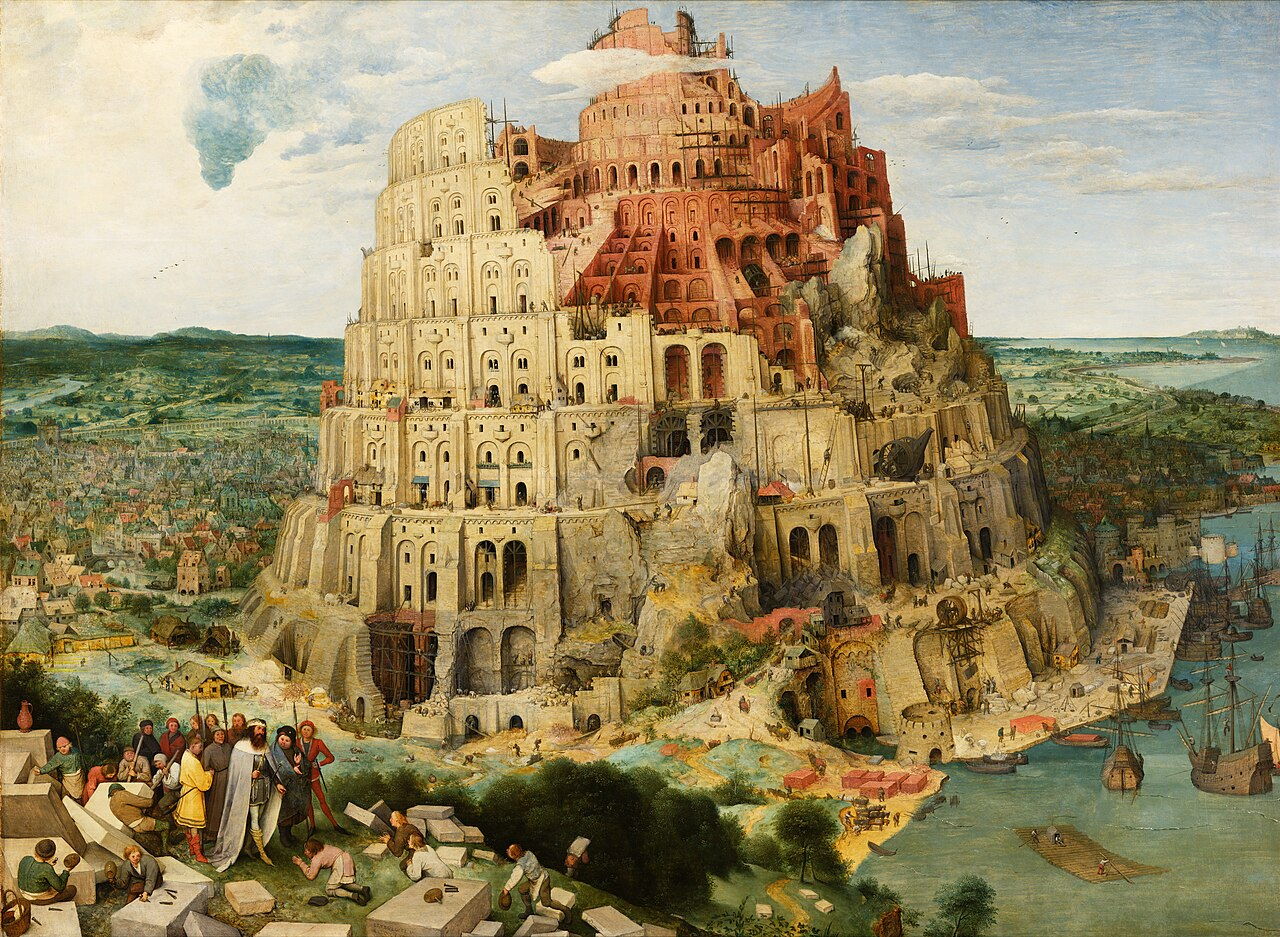
Across the first ten chapters of The Kingdom of Man, Rémi Brague has charted modernity’s grand project: the systematic effort to establish human sovereignty over nature, knowledge, and morality. From Bacon’s vision of restoring man’s “lost dominion” to Descartes’s methodological conquest of certainty, and from Locke’s labor-driven theory of value to Nietzsche’s transvaluation of all values, Brague has exposed how modernity reframed the world as raw material for human will. Yet as we arrive at Chapter 11, the stakes escalate dramatically. Here, Brague reveals how dominion ceases to be merely a practical ambition and becomes a moral obligation—a shift that marks both the apex and the instability of the modern project.
This chapter does not conclude Brague’s argument, but it represents a critical inflection point. Where earlier chapters explored how modernity seized control, Chapter 11 examines why this control could never satisfy its own demands. The “duty to reign” becomes modernity’s paradoxical trap: the more fiercely man asserts his sovereignty, the more he enslaves himself to the mechanisms of his own dominion.
The Moralization of Dominion
Brague opens by tracing how the Enlightenment’s pragmatic dominion (Bacon’s “knowledge is power”) morphs into German idealism’s ethical imperative. Kant’s “critique of practical reason” reframes nature as “pathology” to be subdued—not for comfort, but to fulfill man’s moral vocation. Fichte radicalizes this: freedom is not a right but a condemnation
“We are nothing; let us be everything!”
Mastery is no longer optional; it is the essence of being human.
“Man has the duty to work… to give, beyond the limits of his earthly existence and for all eternity, lords to nature.” —Fichte
This shift, Brague argues, exposes modernity’s Faustian bargain: by making dominion a duty, it renders man perpetually guilty for failing to achieve the impossible.
The chapter’s most incisive section dissects modernity’s redefinition of humanity. For Locke and Rousseau, man creates himself through labor and social contracts. German idealism takes this further: human identity is pure project. Once again, Fichte writes:
“Every animal is what it is; only man is nothing at all.”
Fichte’s “indeterminate man” eerily echoes Pico della Mirandola’s 15th-century vision of humanity as a self-shaping “chameleon.” But where Pico saw a divine invitation, Fichte saw a secular mandate—exposing how modernity hollowed out Renaissance humanism’s transcendent framework while retaining its rhetoric of limitless potential. The ‘duty to reign’ is what remains when the cosmos ceases to guide.
This indeterminacy, once a theological mystery (e.g., humanity as imago Dei), becomes a vacuum to be filled by will—a theme later chapters will show collapsing under its own weight.
Positivism’s Pyrrhic Victory
Brague then critiques Comte and Claude Bernard, who replace truth with utility. Positivism abandons the search for causes (Aristotle’s “why”) to focus on laws (the “how”), reducing science to a tool of control. Bernard’s chilling maxim—”Man can do more than he knows”—epitomizes the trade: mastery is purchased at the cost of understanding. Nietzsche’s gloss on this (“the victory of scientific method over science“) underscores the hollowness of this “triumph.”
Comte’s system explicitly rejects the search for ultimate causes, dismissing metaphysical questions as irrelevant in favor of a science that concerns itself only with observable laws and practical applications. This shift from understanding why things exist to merely determining how they function represents a crucial turning point in modernity’s trajectory. For Comte, the value of knowledge lies solely in its utility – its capacity to help humanity “modify phenomena to our advantage.” This utilitarian approach extends even to Comte’s vision of society, which he reimagines as fundamentally organized around the collective project of dominating nature. Brague highlights how this represents a profound departure from traditional understandings of human community, where societies were oriented toward higher goods or transcendent purposes rather than mere technical mastery.
The implications of this positivist turn become even more stark in Brague’s analysis of Claude Bernard’s experimental medicine. Bernard takes Comte’s principles to their logical extreme, treating nature not as a cosmos to be understood but as raw material to be conquered. His famous declaration that “the physician is the conqueror of nature” (medicus naturae superator) encapsulates this aggressive stance. Brague identifies the crucial inversion at work here: where Francis Bacon had asserted that “knowledge is power,” Bernard claims that “man can do more than he knows.” This formulation reveals the Faustian bargain at the heart of positivism – mastery is purchased at the price of abandoning any claim to genuine understanding. As Brague notes, this represents a complete reversal of the Aristotelian tradition, where science sought causes (aitia) as part of a broader contemplation of reality. In its place, positivism offers only technical control, untethered from any deeper comprehension of the world.
The Pragmatic Cul-de-Sac
This critique deepens as Brague turns to pragmatism, which he presents as the inevitable conclusion of modernity’s trajectory. Where positivism still maintained a veneer of scientific objectivity, pragmatism explicitly reduces truth to what is useful or functional. Brague traces this development through the works of William James, F.C.S. Schiller, and ultimately Richard Rorty, showing how each successive thinker further severs knowledge from any claim to objective truth.
“The truth of any proposition consists in its consequences.” —Schiller
The implications are profound: truth becomes nothing more than “what works,” and ethics collapses into mere efficacy. What makes Brague’s analysis particularly insightful is his demonstration of how this pragmatic turn represents both a continuation and a distortion of earlier philosophical traditions. While thinkers like Epictetus had also emphasized practical knowledge, they did so within a framework that acknowledged transcendent goods. Modern pragmatism, by contrast, recognizes no such framework, reducing all thought to instrumental reason and all value to human utility.
The paradox that Brague uncovers in these systems is devastating. By making dominion an end in itself – by severing it from any higher purpose or understanding – positivism and pragmatism undermine the very rationality that made the modern project possible in the first place. The “duty to reign” becomes a tautological imperative: we must control because control is our duty. This circular logic leaves modernity without any standard by which to judge its own projects, any reason to prefer one form of dominion over another. As Brague suggests, this is the culmination of the trajectory that began with Descartes and Bacon—a trajectory that promised mastery over nature but ends in what Nietzsche recognized as nihilism.
Industrialization as the Realization of the Baconian Dream
Brague then turns to how the modern project of dominating nature transitioned from philosophical abstraction to concrete reality through industrialization. Where earlier chapters traced the intellectual foundations of modernity’s will-to-power, this chapter documents its material realization—and the paradoxical consequences that followed.
While Bacon’s vision of scientific mastery had been articulated centuries earlier, it was only with the Industrial Revolution that this project took tangible form. The steam engine, electricity, and synthetic materials (like Bakelite) transformed nature into a system to be engineered rather than a cosmos to be understood. This shift was not merely technological but ontological: industrial progress required the devaluation of nature itself, both as a source of wisdom and as a moral guide.
“Real science has directly observed… the extreme imperfection of this so vaunted natural order… Human works are in general very superior… to whatever the natural economy can offer.” —Comte
This rejection of nature’s primacy marked a decisive break with premodern thought. Where Marsilio Ficino had celebrated nature’s beauty as surpassing human artifice, the 19th century—from Schopenhauer to John Stuart Mill—increasingly portrayed nature as chaotic, cruel, or simply raw material to be corrected.
The Utopian Impulse and Its Discontents
Brague then turns to literary reflections of industrial optimism, particularly in Jules Verne and H.G. Wells. Verne’s The Mysterious Island (1875) epitomizes the Baconian ideal: shipwrecked colonists, led by an engineer, recreate civilization through sheer technical ingenuity. Yet Verne’s narrative retains a theological undercurrent—the colonists attribute their success both to their labor and to Providence.
Wells’ Men Like Gods (1923), by contrast, presents a fully secularized utopia where science has eradicated disease, perfected eugenics, and achieved “the mastery of nature.” Here, nature is no longer merely imperfect but malevolent—a “purposeless and blind” force that humanity must ruthlessly subjugate. Brague notes the paradox: Wells’ Utopians, like modern transhumanists, rely on the very evolutionary processes they seek to overthrow.
Prometheanism Unleashed
The chapter’s most striking section analyzes Soviet techno-utopianism, where the domination of nature became state dogma. Lenin’s electrification campaigns, Lysenko’s pseudoscientific agriculture, and grandiose plans for cosmic conquest (including planetary engineering!) revealed the hubris at modernity’s core. Brague highlights the irony:
“The Soviet Union, poor in real inventions, was the country of longevity serums and ‘resurrections’ of drained animals… The dream of nature’s malleability became a substitute for actual progress.”
This “iron rod” of industrial dominion, Brague suggests, ultimately proved brittle. The more aggressively modernity sought to reshape nature, the more it revealed its own metaphysical poverty—a theme he will develop in later chapters.
A New Way to be Human
In Chapter 13, Brague examines more closely the 19th-century transformation of humanism from a Renaissance educational ideal into a philosophical project asserting human sovereignty over nature and history. He traces the semantic shift of the term “humanism,” which originally referred to the study of litterae humaniores but came to signify an ideological program centered on man’s self-sufficiency.
Brague begins by tracing the evolution of “humanism” from its Renaissance origins to its 19th-century ideological form. Originally tied to the study of classical texts (litterae humaniores), the term later came to signify a philosophical project centered on human autonomy. The suffix “-ism” here denotes not just a scholarly pursuit but a worldview: “the valorization and choice of a privileged point of view from which everything is thought to receive meaning and value” (p. 121). This shift marks the transition from humanism as cultural refinement to humanism as a declaration of human sovereignty—over nature, history, and even the divine.
Brague thus identifies two key strands of modern humanism: (1) ideological Humanism: The claim that man alone is the source of meaning, rejecting theological or metaphysical foundations; and (2) cultural Humanism: The effort to cultivate humanity through engagement with classical texts.
Feuerbach and the Theological Reduction
He then pivots to Ludwig Feuerbach’s The Essence of Christianity (1841), which Brague identifies as a watershed moment. Feuerbach’s claim that “the secret of theology is anthropology” reduces God to a projection of human attributes, a move Brague terms “anthropotheism.” For Feuerbach, “God” is merely the summation of the human species’ idealized qualities:
“God as the peak of realities or perfections is nothing other than the summation and summary of the properties of the species for the use of the individual.”
Brague notes the irony here: Feuerbach’s atheism retains a theological structure, merely inverting its terms. Feuerbach’s “anthropotheism” posited that theology should be dissolved into anthropology, with the human species becoming the supreme object of study. This idea resonated widely, influencing later philosophers and writers who sought to ground meaning entirely in human experience and the material world.
Marx and the Materialist Turn
Brague then analyzes how Marx and Engels radicalize Feuerbach’s project.
“The root of man is man himself.”—Marx
Marx viewed work as the means through which humanity could dominate nature, transforming it into an extension of human will. He envisioned communism as the culmination of humanism and naturalism, resolving the historical conflict between man and nature. Engels expanded on this, imagining a future where socialized production would allow humans to become “conscious and effective masters” of both nature and their own social conditions. Meanwhile, other thinkers like Pierre-Joseph Proudhon, Ernest Renan, and Auguste Comte explored humanism as a secular ethical framework or even a new religion, with Comte’s “religion of Humanity” and Renan’s vision of a future where material mastery would enable spiritual freedom.
“Real humanism coincides with materialism, the logical basis of communism.”
A recurring theme in the text is the celebration of the earth as humanity’s rightful domain, replacing heavenly transcendence with an emphasis on earthly existence. This idea was reflected in the works of Feuerbach, Marx, Nietzsche, and others, who advocated for a “fidelity to the earth” and portrayed nature as something to be mastered. Literary and artistic movements echoed these sentiments, with figures like Dostoyevsky, Wagner, and Soviet proletarian poets exploring the consequences of atheism and the glorification of human labor.
Cultural Manifestations
The chapter concludes by examining how 19th-century art and literature reflect this new humanism. From Courbet’s The Painter’s Studio (which Brague links to Marx’s “humanism = naturalism” equation) to Nietzsche’s call for “fidelity to the earth,” the rejection of transcendence becomes a cultural motif. Brague notes the quasi-religious tone of these secular movements, as in Renan’s vision of a future where “material need will no longer be a motive”—a secularized eschatology.
From Dominion Over Nature to Rivalry with God
Brague concludes the second part of his book by tracing the shift in modern thought from a vision of human dominion over nature (as delegated by God) to a project of rivalry with God Himself. Whereas premodern traditions saw man’s mastery of nature as part of a divine order, with all its important theological constrictions, modernity reframed this mastery as a zero-sum contest.
“There could only be one Lord.”
This “exclusive humanism,” as Brague terms it, necessitated atheism—not merely indifference to God, but active displacement of Him.
Key to this shift is the modern reimagining of God’s role. No longer a benevolent Creator entrusting nature to man, God becomes either an oppressive figure (as in gnostic dualism) or an incompetent demiurge (as in Comte’s critique of “providential optimism,” which deemed nature imperfect and requiring human correction. At the same time, this transformation reflects more than changing theological attitudes; it represents a fundamental reorientation of humanity’s self-understanding from participant in creation to sole claimant of absolute authority.
Brague carefully examines competing explanations for the link between modern atheism and the project of nature’s conquest. Drawing on Leo Strauss, he notes how modern man’s alienation from nature bred a hostile, skeptical stance that demanded nature’s subjugation. Eric Voegelin’s gnostic interpretation receives attention, particularly the idea of creation as the work of a deficient demiurge against whom rebellion becomes duty. Most significantly, Brague engages Hans Blumenberg’s argument that nominalist theology’s volatile God—all power without wisdom—destabilized the medieval cosmos, forcing humanity to assume control. This analysis reveals the paradoxical nature of modernity’s theological foundations: even as it rejected traditional conceptions of the divine, it remained entangled in theological problematics, particularly regarding the relationship between divine omnipotence and paternity.
“Since the model of the divine that it presupposes is pre-Christian, it was a recycled Greek mythology that became the source from which one drew.”
The symbolic dimensions of this transformation emerge in Brague’s examination of mythological figures. He presents a compelling account of how Prometheus was reinterpreted from Aeschylus’ reconciled benefactor to modernity’s emblem of rebellion. Marx’s designation of Prometheus as “the first saint of the philosophical calendar” epitomizes this ideological refashioning, which Brague characterizes as a “perversion” of the original myth. The contrast with Hercules—who acted within Zeus’ order—highlights modernity’s preference for narratives of autonomous human agency over those of delegated authority. This mythological analysis serves as a bridge to Brague’s discussion of Enlightenment epistemology, where the Cartesian rejection of “prejudices” and Locke’s tabula rasa theory reflect the broader cultural impulse toward radical recommencement.
The political manifestations of this epistemic shift receive detailed treatment. Brague demonstrates how revolutionary rhetoric appropriated theological language while evacuating its transcendent referent. Thomas Paine’s declaration that “We have it in our power to begin the world over again” and the French revolutionaries’ quasi-creational pronouncements
“Say ‘let light be,’ and light will be.”
reveal what Brague identifies as modernity’s paradoxical reliance on the very theological frameworks it sought to overcome. The conservative critiques of Burke and Maistre, which emphasized the impossibility of creating ex nihilo, underscore the tensions inherent in modernity’s project of historical rupture.
The chapter culminates in an incisive analysis of humanity’s self-divinization. From Marx’s proclamation of human self-consciousness as “the supreme divinity” to Comte’s explicit substitution of Humanity for God, Brague traces the logical terminus of exclusive humanism. Particularly noteworthy is his observation of how Comte inverted traditional chronology, claiming that in the Middle Ages “God usurped the place of Humanity”—a striking example of modernity’s ideological reframing of history. The persistence of theological structures within ostensibly atheistic systems forms a key insight, as Brague demonstrates how concepts of sovereignty, eschatology, and even liturgy reappear in secularized forms.
Several critical tensions emerge from Brague’s analysis. First, the inherent contradiction in asserting human autonomy while relying on premodern conceptions of human nature. Second, the theological borrowings that persist even in aggressively secular frameworks. Third, the practical and philosophical challenges of maintaining a coherent notion of “humanity” once severed from its transcendent moorings. These tensions suggest that the “Kingdom of Man” may be less a stable achievement than an unstable imitation of the divine order it sought to replace.
Conferences and Papers
Posted on May 12, 2025 Leave a Comment
Two recent calls for papers piqued my interest. I’ve submitted abstracts to both and will share them here. While I don’t yet know if they will be accepted, I intend to write the essays regardless and potentially submit them to a journal or magazine.

Call for Papers: Notre Dame Conference
The de Nicola Center for Ethics and Culture’s 25th Fall Conference, titled “That which I Also Received: Living Tradition,” will focus on St. John Henry Newman, who famously asserted in his Essay on the Development of Christian Doctrine that it is sometimes necessary for an idea to change with new contexts and situations precisely in order to remain the same. “To live is to change, and to be perfect is to have changed often,” he wrote. This posture is both retrospective and forward-looking, suggesting that the rich heritage of the past can be faithfully reinterpreted by each new generation.
The conference will explore how living tradition—whether dogmatic, religious, literary, artistic, legal, interpretive, or cultural—bridges past and future.
Here’s my proposed contribution.
Title: That Which Hutton Also Received: Newman’s Epistemology and the Science-Religion Conflict:
Abstract:
The 19th-century “conflict thesis” framed science and religion as irreconcilable, but Richard Holt Hutton, editor of The Spectator and a perceptive theologian, recognized that figures like Huxley, Tyndall, and Spencer were not merely defending science—they were advancing a rival theology of materialist metaphysics. This essay argues that John Henry Newman’s thought was foundational to Hutton’s critique. Newman’s work provided Hutton with the conceptual tools to expose scientific naturalism’s hidden dogmas, particularly its unexamined assumptions about nature, progress, and the limits of knowledge.
Hutton’s writings—especially his Spectator essays and Essays on Some of the Modern Guides of English Thought (1887)—demonstrate how Newman’s epistemology shaped his approach. Where Newman dissected the interplay of reason, conscience, and implicit belief, Hutton applied these insights to reveal how scientific naturalists relied on moral and imaginative commitments, even as they claimed neutrality. Newman’s influence enabled Hutton to move beyond the “conflict” paradigm, reframing the debate as a clash of competing theologies rather than science versus superstition.
This essay also highlights the enduring relevance of Hutton’s Newman-inspired perspective. By recovering his critique, we gain a model for today’s science-religion debates—one that rejects reductive oppositions in favor of a deeper examination of the philosophical and theological frameworks underlying both disciplines.

Call for Papers: Theology/Religion of LOST
Few commercial television series have had as lasting an impact on audiences as LOST, which aired from 2004 to 2010 and is still available on streaming services. Initially presented as a mystery/action drama following a plane crash in the South Pacific, LOST quickly evolved into a meditation on existential and theological questions: faith versus reason, science versus religion, the nature of time, the possibility of redemption, and the search for meaning in a seemingly chaotic universe. The series explores the tension between order and chaos, divine presence and absence, and the nature of suffering and grace.
Our call for papers welcomes submissions that explore the religious and theological dimensions of LOST from a range of disciplinary perspectives, including Christian, Buddhist, and indigenous spiritual traditions, as well as feminist, ecological, and comparative theological frameworks.
Here’s my proposed contribution.
Title: From Eden to Eschaton: LOST and the Quest for Human Meaning in Suffering
Abstract:
LOST is more than a narrative of castaways on a mysterious island; it is a theological parable that uses biblical and religious motifs to explore the contours of human nature, suffering, and redemption. By weaving together Christian, Buddhist, and indigenous spiritual frameworks, Damon Lindelof constructs a comparative theological landscape where characters struggle to discern the meaning of suffering in a world that oscillates between fate and free will, chaos and order.
This paper examines how LOST employs the biblical arc of Creation, Fall, Redemption, and New Creation as a narrative structure that reflects broader religious questions about human nature and destiny. The island functions as a liminal space, a purgatorial Eden where characters like John Locke, Jack Shephard, and Ben Linus are confronted with existential crises reminiscent of the trials of Job and the disillusionments of Ecclesiastes. Their struggles evoke a deeper theological anthropology, positioning the human person as a pilgrim suspended between the terrestrial and the transcendent, the rational and the mystical.
In the final season, as characters move toward their eschatological convergence, the presence of Flannery O’Connor’s work gestures toward the deeper mystery that underpins the series. Like O’Connor’s fiction, LOST employs suffering as a grotesque yet redemptive force, where grace intrudes violently and unexpectedly, unsettling characters and compelling them to reckon with the convergence of time and eternity. Through the lens of theological anthropology, LOST ultimately gestures toward an eschatological vision of human existence, where redemption remains elusive yet possible, and where suffering, far from being a mere obstacle, becomes the necessary path toward spiritual awakening.
The Failure of the Modern Project: Part 2 of 4
Posted on May 8, 2025 Leave a Comment
“The modern world is not the triumph of reason, but the revenge of Prometheus.”

In The Kingdom of Man, Rémi Brague presents a formidable critique of modernity not as the triumph of human reason but as the culmination of a metaphysical rebellion—one that sought to replace divine order with human sovereignty. Having already examined the medieval roots of this shift in earlier chapters, Brague turns in Chapter 7 to the decisive moment when the modern project crystallized: the intellectual and technological ferment of the late Middle Ages and early modernity, culminating in the visions of Francis Bacon and René Descartes. This chapter is not merely an exercise in historical retrieval but a profound meditation on how Western thought abandoned the idea of nature as a given reality to be understood and instead embraced it as raw material to be mastered.
Formation
Brague begins by dismantling the myth that modernity emerged ex nihilo, a clean rupture from a stagnant medieval past. On the contrary, the Middle Ages were a period of remarkable innovation—agricultural advancements, mechanical inventions, and architectural breakthroughs—yet these developments were not yet framed within an ideology of progress or domination. Medieval thinkers like Roger Bacon and Frederick II of Hohenstaufen marveled at technology, but they did so without the modern conviction that nature itself must be remade. The key difference, Brague argues, was the absence of a project—a systematic, willed effort to subordinate the natural world to human ends. This changed in the Renaissance, when the rediscovery of Hermetic, Gnostic, and Epicurean texts fostered a new pessimism about nature’s adequacy. The world was no longer seen as a harmonious creation but as flawed, even botched, requiring human intervention to correct its defects.
Central to this shift was Francis Bacon, who recast knowledge not as contemplation but as power. Brague meticulously dissects Bacon’s vision of a “Kingdom of Man,” where science and technology would restore humanity’s lost dominion over creation. What makes Bacon’s project distinctively modern is its eschatological fervor—the belief that through empirical mastery, man could undo the effects of the Fall. Yet, as Brague notes, this was a secularized eschatology, one that retained the structure of redemption but emptied it of grace. Bacon’s New Atlantis was not a city ordered to the divine but a technocratic utopia where knowledge served only to expand human empire. The implications were profound: if nature was no longer a reflection of divine wisdom but mere material to be manipulated, then man’s relationship to it was no longer one of stewardship but of conquest.
Descartes, though less overtly millenarian than Bacon, deepened this logic by internalizing it. His famous declaration that man must become “master and possessor of nature” was not merely a call for technological advancement but a metaphysical revolution. For Descartes, certainty began with the thinking self—the cogito—and from this foundation, the entire external world could be subjected to methodical control. Brague astutely observes that Descartes’ project was not just about dominating nature but about mastering the self first. The Cartesian man was a sovereign ego, emancipated from tradition, authority, and even the constraints of his own passions. Yet this sovereignty came at a cost: the expulsion of angels, celestial hierarchies, and any mediating order between man and the brute cosmos. The result was a world stripped of intrinsic meaning, where nature was reduced to res extensa—mere extension, waiting to be shaped by human will.
What makes Brague’s analysis so compelling is his ability to trace the theological undercurrents of this transformation. The modern project, he suggests, is not merely a rejection of medieval thought but a heretical parody of it. Where Aquinas saw grace perfecting nature, Bacon and Descartes sought to replace nature with artifice. Where the medievals understood technology as a remedy for human weakness, the moderns envisioned it as a tool of unbridled mastery. And where premodern thought situated man within a cosmos teeming with meaning—between angels and animals, heaven and earth—modernity left him alone in a silent universe, burdened with a sovereignty he could neither justify nor sustain.
More than an intellectual history, Brague offers a diagnosis of modernity’s deepest pathology. He does not write as a nostalgic reactionary but as a clear-eyed critic who recognizes that the “Kingdom of Man” was always doomed to fail because it mistook dominion for freedom, power for wisdom, and control for redemption. The modern project did not liberate man; it exiled him from a world that once made sense.
From Baconian Vision to Scientific Practice
In Chapter 8, Brague examines how this project began to materialize in the 17th and 18th centuries, not as a triumphant march of progress, but as a paradoxical and often hubristic endeavor. The dream of dominion, once confined to philosophical treatises, became a concrete program, fueled by experimental science, technological ambition, and an unshakable faith in human perfectibility. Yet, as Brague reveals, this “realization” was fraught with contradictions, unrealized fantasies, and a growing disconnect between power and wisdom.
Giovanni Maria Lancisi, the papal physician, exemplifies this shift, advocating for science’s application to medicine while cloaking his innovations in classical references (“nature speaks in the language of mathematics”). Yet, as Brague notes, the true technological revolution lagged behind the rhetoric:
“What was only a dream with the great innovators at the beginning of the seventeenth century became a concrete program… yet for the technological bases, it was necessary to await the nineteenth century.”
Bacon’s legacy was embraced with near-religious fervor. Thomas Hobbes declared “knowledge is for the sake of power”; Robert Boyle praised Bacon as a pioneer of experimental philosophy, though Brague dryly observes that Boyle, unlike Bacon, “was a true scientist.” The Baconian ideal—knowledge as utility—permeated the Royal Society and Enlightenment thought. Locke’s diary captures the spirit:
“Behold a vast field of knowledge suitable to the use and advantage of men in this life: to invent new machines… to increase the sum of our wealth, i.e., things useful to the commodiousness of our existence.”
Yet this utilitarian turn was not without dissent. Cuvier and Jacobi upheld the ideal of disinterested knowledge (“the sole goal of science is the honor of the human spirit”), while critics like Joseph de Maistre and Justus von Liebig dismantled Bacon’s reputation, exposing his plagiarism and methodological naivety.
Technological Dreams and Utopian Delusions
The heart of the chapter explores the gap between Baconian promises and reality. The 18th century’s “spectacular” advances—electricity, hot-air balloons, Lavoisier’s chemistry—were symbolic victories, yet they fed into a mythology of limitless progress. The lightning rod, once the prerogative of Zeus, became a testament to human dominion. Balloons, Proust wrote, turned aviators into “modern demigods.” But Brague underscores the irony:
“The airplane represented a gain in speed, but it did not bring a change of perspective.”
More striking were the era’s technological utopias. Where Thomas More’s Utopia sought harmony with nature, Bacon’s New Atlantis envisioned a technocratic paradise. The Rosicrucian manifestos and Andreae’s Christianopolis flirted with scientific idealism, but Bacon’s successors—like the French revolutionary William Godwin—took the logic to its extremes:
“Mind one day will become all-powerful over matter… [Men] will no longer need justice, or government… [and] a perfect control over our own body can one day make us immortal.“
This fevered optimism birthed transhumanist fantasies centuries ahead of their time. Russian thinker Nikolai Fedorov dreamed of “resurrecting ancestors by technological means”; Soviet architects planned to reanimate Lenin’s corpse. Brague’s verdict is laconic:
“The necessary consequence of immortality will be the abandonment of sexual reproduction… Once they are immortal, human beings, no longer having any need to reproduce, will all be adults, and childless.“
The Religion of Progress
The chapter culminates in a dissection of the idea of progress—a secularized millenarianism that replaced divine providence with faith in human ingenuity. Turgot, Condorcet, and Comte enshrined progress as “the truly fundamental dogma of human wisdom,” while Darwinism lent it a pseudo-scientific veneer. Brague’s critique is incisive:
“It is difficult to affirm that the human race has progressed in civilization… Progress therefore becomes the object of a belief.”
The more power we amass, the more elusive true mastery becomes. The Baconian project, once a bold vision, degenerated into a cargo cult of utility, where technological feats substitute for moral or metaphysical grounding. A devastatingly lucid account of modernity’s founding illusions.
The Birth of Anthropology
In the preceding chapters, Brague meticulously traced the intellectual and technological foundations of the modern project—the Baconian dream of human dominion over nature, the Cartesian reconfiguration of the self as sovereign, and the Enlightenment’s faith in progress. Now, in Chapter 9, he turns to the anthropological revolution that made this project possible: the redefinition of man himself. The title, “The Master Is There,” is ironic, for the chapter reveals how modernity’s “mastery” was predicated on a radical reinvention of human nature—one that discarded the paradoxes of classical and Christian anthropology in favor of a flattering but ultimately hollow self-image.
Brague opens with a striking observation: premodern thought never needed a “science of man” because humanity’s place in the cosmos was self-evident. Ancient and medieval thinkers grappled with the condition of man—his nobility and his frailty, his place between angels and beasts—but not his essence. As Brague notes:
“The superiority of man vis-à-vis the other beings was perceived with such calm evidentness that it did not invite one to ask, what exactly is man?“
This changed with modernity. Montaigne and Bacon pioneered the study of man as a distinct object of knowledge, but it was the Enlightenment that enshrined anthropology as the “only solid foundation for the other sciences” (Hume). The nineteenth-century philosopher Auguste Comte took this further, collapsing all knowledge into a single “science of humanity,” where man became both subject and sovereign of his own inquiry. The consequences were profound: dignity was no longer a given but a claim, no longer rooted in transcendence but in human self-affirmation.
Central to this shift, according to Brague, was the rejection of original sin—the “scandal” of Christian anthropology that had long framed human dignity as a lost and restored inheritance. The Enlightenment, Brague argues, replaced this narrative with a myth of innate goodness:
“The first movements of nature are always right; there is no original perversity in the human heart.” —Rousseau
Voltaire dismissed Pascal’s “misery of man” as obscurantism; Kant reframed the Fall as a step toward rational maturity. Yet this optimism came at a cost. Without the doctrine of the Fall, evil had to be explained anew—and modernity found its scapegoats. Brague’s analysis here is chilling:
“The search for a guilty party imposed its own exigencies… Only two social groups present these characteristics: the Jewish people and the Catholic Church.“
From Voltaire’s écrasez l’infâme to the Nazis’ racial theories, the Enlightenment’s “humanity” was often a rhetorical weapon, wielded against those deemed inhuman.
The chapter’s most provocative section traces how modernity sacralized man himself. With original sin discarded, humanity became an object of faith—Fichte declared that belief in man’s moral capacity required “nothing less than an act of faith.” This culminated in Comte’s Religion of Humanity, complete with saints (great men), calendars (purged of Christian feasts), and a positivist “hell” for retrograde figures like Napoleon.
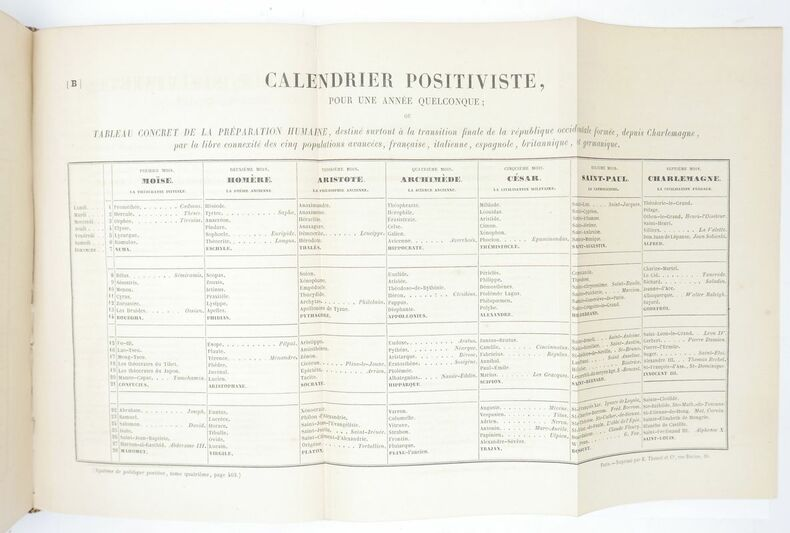
The irony is thick: the “Kingdom of Man” ended not with Nietzsche’s Übermensch but with Lenin’s mausoleum and the cult of Lei Feng. Brague’s conclusion is implicit but damning: modernity’s “mastery” rests on a delusion. By exalting man as inherently good and self-sufficient, it burdened him with a sovereignty he could neither justify nor sustain. The Enlightenment’s “humanity” was a tautology—man was worthy because he declared himself so—and its cult of progress a substitute for transcendence.
The Neutralization of Nature
In Chapter 10, Brague turns to the moral and metaphysical consequences of this project, revealing how the modern “dominion over nature” necessitated a radical redefinition of nature, work, and even value itself. The result is a profound critique of how modernity’s bid for mastery hollowed out the very foundations of moral order, replacing objective goods with subjective valuations.
Brague begins by examining how modernity reframed nature as a passive, malleable resource. No longer a cosmos imbued with intrinsic meaning or divine craftsmanship (as in the medieval view of nature as a vicar of God), nature became mere matter—raw material for human will. Descartes epitomized this shift, dismissing nature as “no goddess or imaginary power,” while Boyle systematically stripped it of any residual agency, attacking notions like horror vacui as superstitious impediments to human empire.
“The veneration wherewith men are imbued for what they call nature has been a discouraging impediment to the empire of man over the inferior creatures of God.” —Boyle
This neutralization had moral implications: nature ceased to be a guide for human action. By the 18th century, poets and philosophers depicted nature as indifferent to good and evil—a blank slate for human projects. The stage was set for Locke’s revolutionary claim: work, not nature or divine order, confers value.
Work as Self-Creation
For Locke, work was not merely economic activity but the very act by which man creates himself. Brague highlights Locke’s literal reading of Genesis: man’s dominion over the earth is realized through labor, which transforms worthless matter into property—and property, in turn, grounds political society. This idea reached its zenith in Rousseau’s paradoxical assertion that the social contract transforms man “from a stupid and limited animal into an intelligent being and a man.”
Kant formalized this logic in his pragmatic anthropology, where man is no longer defined by what nature made of him but by what he makes of himself. The implications are staggering: humanity is no longer a given but a project. As Brague notes:
“For the moderns, everything occurs as if it were man himself who created man… or rather, his own humanity.”
This self-creation, however, comes at a cost. By severing man from nature’s teleology, modernity left him adrift in a world where value is no longer discovered but imposed.
The Subjectivization of Value
The chapter’s most incisive section traces the reduction of the good to value—a shift from objective worth to subjective estimation. Brague locates its roots in Stoicism and Cicero’s aestimabilis, but the decisive turn came with Descartes:
“We must make use of reason to distinguish good and evil and to know their just value.”
Here, good and evil are no longer absolute; they are measured by a standard man himself creates. Enlightenment thinkers extended this logic: Buffon saw nature as “void” without man; Diderot declared the cosmos “mute” without human observers; Rousseau’s Savoyard curate crowned man “king of the earth.” Even Kant, though he anchored value in the good will, affirmed that without man, creation would be a “mere desert.”
Nietzsche, as Brague observes, drew the inevitable conclusion: if man is the source of all value, then he becomes the supreme value. Zarathustra’s dictum—”Evaluation itself is the treasure of all things that have value”—captures the tautology at modernity’s core: value is whatever the valuer says it is.
A Hollow Triumph
Brague’s analysis exposes the paradox of modern “moral dominion.” By asserting absolute freedom to define nature, work, and value, man has not liberated himself but disenchanted himself. The Kingdom of Man, built on the ruins of cosmic order, is a kingdom without foundations—where morality is reduced to power, and meaning to projection.
Metaphors, Mysticism, and Modern Misreadings
Posted on April 7, 2025 Leave a Comment

William Placher and Denys Turner, though separated by geography and academic focus, converged on a shared mission: to confront modernity’s relentless effort to shrink the mystery of God into categories palatable to human reason or emotion. Placher, an American theologian and philosopher of religion, spent much of his career at Wabash College in Indiana, where he became a leading voice in postmodern theology. Trained at Yale, his work—including The Domestication of Transcendence (1996) and Narratives of a Vulnerable God (1994)—sought to dismantle Enlightenment-era assumptions that reduced God to a puzzle solvable by logic or a therapist catering to personal needs. His intellectual journey was marked by ecumenical dialogue and a commitment to recovering the mysterium tremendum, the awe-inspiring otherness of God that defies human domestication.
Denys Turner, a British theologian and philosopher, carved a parallel path through the dense forests of medieval mysticism and Marxist critique. Teaching at institutions like Yale and Cambridge, Turner’s scholarship—most notably The Darkness of God (1995) and Thomas Aquinas: A Portrait (2013)—bridged the worlds of apophatic theology and social theory. His work excavates the radical negation at the heart of figures like Meister Eckhart and John of the Cross, arguing that their “darkness” and “unknowing” were not mystical experiences but tools to dismantle all human concepts of God, including the self. Turner’s engagement with mysticism is inseparable from his critique of modernity’s commodification of spirituality, a theme that aligns unexpectedly with his earlier writings on Marxism.
At first glance, Placher and Turner might seem an unlikely pair—one a systematic theologian wrestling with postmodernism, the other a medievalist probing the limits of language and selfhood. Yet their works resonate with a shared diagnosis: modernity’s attempt to tame divine transcendence. Placher’s The Domestication of Transcendence traces how post-Enlightenment theology, from Descartes to Schleiermacher, reframed God as a being among beings, subject to empirical proofs or moral utility. For Placher, this shift betrayed Christianity’s core confession of a God who “dwells in unapproachable light” (1 Timothy 6:16), a mystery irreducible to human systems. Turner, meanwhile, exposes how the same anthropocentric impulse corrupted Christian mysticism. In The Darkness of God, he argues that medieval metaphors like “interiority” and “ascent” were never about cultivating spiritual experiences but about negating them—a tradition he claims modern readers have distorted into self-help techniques.
The overlap between Placher and Turner becomes clearest in their appeal to pre-modern traditions as correctives. Placher turned to Reformation figures like John Calvin and modern theologians like Karl Barth, who insisted on God’s “wholly otherness,” while Turner anchored his work in the apophatic rigor of medieval mystics like Eckhart and The Cloud of Unknowing. Both saw postmodern thought as an unlikely ally: Placher embraced narrative theology’s rejection of universalizing claims, while Turner drew parallels between medieval negation and postmodern deconstruction. Yet their projects diverge in emphasis. Placher’s focus on doctrinal theology reveals how rationalism flattened God into a concept, whereas Turner’s mysticism shows how spirituality itself became a commodity—a privatized “experience” stripped of its destabilizing power.
Their biographies illuminate these divergences. Placher, the Midwestern academic immersed in ecumenical dialogue, sought to reclaim transcendence for a church increasingly skeptical of mystery. Turner, the Cambridge scholar steeped in Marxist critique, framed apophaticism as a radical politics of the soul—a refusal to let God (or the self) be co-opted by capitalist or consumerist frameworks. Together, they challenge modernity’s cult of accessibility, whether in the form of dogmatic certainty, therapeutic spirituality, or the “spiritual but not religious” trend.
What Placher and Turner offer today is not nostalgia for the past but a prophetic call to recover a faith that unsettles. In an age where spirituality is often reduced to mindfulness apps and emotional uplift, their works remind us that true encounter with the divine begins where language, experience, and even the self dissolve. As Turner writes, the medieval mystics invite us not to “like them for what they are not” but to confront the austere truth of a God who resists all domestication—a lesson as urgent now as it was in the age of cathedrals and cloisters.
Ancient Light, Modern Shadows
In the opening chapter of The Darkness of God, Turner excavates the bedrock of Western Christian mysticism: the seismic collision of Plato’s “Allegory of the Cave” and Moses’ encounter with Yahweh on Mount Sinai. These two narratives—one Greek, one Hebraic—forge the metaphors of “ascent,” “light,” and “darkness” that would shape apophatic theology, a tradition that insists God is known only by unknowing. For Turner, this synthesis is not merely historical but dialectical, a fusion of philosophical and scriptural currents that produced a language capable of articulating transcendence through negation. At the heart of this synthesis stands Pseudo-Dionysius (Denys the Areopagite), the enigmatic fifth-century Syrian monk who welded Platonic epistemology to Exodus’s theophany, crafting a “mystical theology” where God is encountered not in light but in the “luminous darkness” that shatters human comprehension.
Turner’s analysis begins with Plato’s cave, where prisoners mistake shadows for reality until one is dragged into the blinding light of truth—a light so overwhelming it first blinds, then illuminates. This allegory, Turner argues, mirrors Moses’ ascent into the “thick darkness where God was” (Exodus 20:21). Both narratives depict a paradoxical journey: the closer one approaches divine reality, the more language and perception fail. For Denys, Moses’ entry into the cloud becomes the paradigm of apophatic theology, where the soul “plunges into the truly mysterious darkness of unknowing” and is “supremely united [to God] by a completely unknowing inactivity of all knowledge.” Here, Turner identifies the core of medieval mysticism: union with God is not an experience but an ontological un-knowing, a dissolution of the self’s categories.
Yet Turner’s deeper project is polemical. He contrasts this medieval apophaticism with modern “experientialism,” which reduces mysticism to subjective feelings or techniques (e.g., contemplative prayer). Where Denys and Gregory of Nyssa saw darkness as the excess of divine light, modernity interprets it as a psychological state—a shift Turner traces to the erosion of Neoplatonic dialectics. The medieval mystic, he insists, did not seek spiritual “experiences” but sought to critique them, using metaphors of ascent and darkness to dismantle all idolatrous claims on God.
Beyond Words and Silence
In Chapter 2 of The Darkness of God, Turner further explores the interplay of cataphatic (affirmative) and apophatic (negative) theology in the works of Pseudo-Dionysius (Denys the Areopagite). At its core, this chapter interrogates how language—both overflowing and failing—can gesture toward a God who transcends all categories. For Denys, theology is a dialectical dance: affirmations multiply to the point of contradiction, negations unravel their own limits, and silence emerges not as an endpoint but as the collapse of speech itself. Turner argues that Denys’ apophaticism is not a rejection of language but its fulfillment, a strategy where words self-destruct to reveal the “brilliant darkness” of divine transcendence.
Denys’ cataphatic theology is a “verbal riot,” a profusion of metaphors drawn from every corner of creation—God as rock, light, mother, even a “hungover” deity. Yet this excess is purposeful: by straining language to its breaking point, Denys exposes its inadequacy. Affirmations must be negated, but negations too must be negated, for God is “beyond assertion and denial.” Turner illustrates this with Denys’ prayer in Mystical Theology:
“Lead us up beyond knowing and light, up to the farthest, highest peak of mystic scripture where the mysteries of God’s Word lie simple, absolute, unchangeable in the brilliant darkness of a hidden silence.”
Here, paradox becomes the only adequate mode of speech—God is “neither darkness nor light,” yet both, transcending even the logic of contradiction.
Crucially, Turner confronts the tension between Denys’ hierarchical ontology (where beings exist in degrees of “proximity” to God) and the Christian doctrine of creation ex nihilo (where all creatures depend immediately on God). While Denys’ Neoplatonism suggests a “volcanic” emanation of creation—cooling into multiplicity as it flows from the divine source—his Christianity insists that God’s causality is unmediated. Every worm and cherub is “equidistant” from God, a paradox Turner resolves by emphasizing that hierarchy exists within language, not ontology. The “ascent” of negations is linguistic, not spatial—a dismantling of metaphors, not a ladder of beings.
Restless Hearts, Interior Depths
Let me highlight just one more chapter in Turner’s book. In Chapter 3, he turns to Augustine’s Confessions. He seeks to illuminate the text’s radical synthesis of autobiography, theology, and philosophy, challenging modern genre distinctions that might dismiss it as fragmented. Turner argues that Augustine’s work defies categorization by interweaving personal narrative with metaphysical inquiry, framed around the metaphor of “interiority”—a journey from the mutable distractions of the external world to an inward discovery of God, who is paradoxically both the origin and destination of the soul’s restless seeking. The structural divide between the autobiographical Books 1–9 and the theological Books 10–13 is reinterpreted as a cohesive unity: the former chronicles Augustine’s existential crises, while the latter philosophically unpacks the nature of seeking itself. For Turner, Confessions transcends mere conversion narrative; it is an act of self-creation, where writing becomes the vehicle for constructing a coherent selfhood through divine grace. Memory emerges as the linchpin of this process, serving not merely as psychological recall but as the metaphysical bridge between human finitude and eternal truth, where the soul recognizes its pre-existing yet obscured union with God.
Turner’s exploration resonates with the paradoxical tensions celebrated by many other theologians, who locate divine truth in unresolved binaries. The interplay of “interiority” and “exteriority”—where God is immanent within the soul yet transcendent beyond it—reflects a deep appreciation for mystery in Christian thought. Similarly, Jaroslav Pelikan’s historical lens on doctrinal continuity sheds light on Augustine’s adaptation of Platonic themes, reframing memory not as a relic of pre-existence but as participation in God’s eternal present. Yet Turner critiques Augustine’s rejection of Platonic anamnesis, proposing instead a “revisionary Platonism” where memory becomes the locus of divine encounter, a dynamic interplay of discovery and creation. This duality reflects a sacramental critique of modernity’s fragmented self: Augustine’s narrative oscillates between retrieving a pre-existing divine imprint and actively reimagining identity through grace, a tension that speaks to contemporary quests for wholeness amid disenchantment.
While Turner’s interdisciplinary approach is compelling, his dismissal of modern genre distinctions occasionally risks anachronism, projecting postmodern notions of narrative identity onto Augustine’s late-antique context. His focus on memory as a redemptive force also glosses over Augustine’s darker reflections on its role in sin and fragmentation, such as the “vast palaces” of memory haunted by disordered desires. Nevertheless, Turner’s analysis revitalizes Confessions as a living dialogue between experience and doctrine, offering fresh insights into its relevance for debates on identity, desire, and transcendence. His work bridges literary, theological, and philosophical realms, restoring the text’s complexity as both personal testimony and universal metaphysical journey.
The broader significance of Turner’s scholarship lies in his ability to reclaim pre-modern wisdom for postmodern spiritual crises. By framing figures like Augustine as both proto-existentialists and orthodox theologians, he dismantles false binaries—apophatic vs. kataphatic theology, reason vs. emotion, selfhood vs. divine union—revealing their coherence within the Christian mystical tradition. His interdisciplinary rigor, akin to Eugene McCarraher’s critique of capitalist modernity or Pelikan’s historical depth, positions him as a pivotal voice in reconnecting ancient texts to contemporary existential searches. Turner’s work remains indispensable for understanding the restless heart seeking rest in God.
Why the Science-Faith Dialogue Needs Souls, Not Just Syllogisms
Posted on March 29, 2025 Leave a Comment

In a recent post, I argued that the future of the science-faith dialogue depends less on physicists and more on theologians—those trained to grapple with Scripture, tradition, and the existential dimensions of belief. One reader, in a rather cheeky tone, urged me to “catch up” on philosophers like Bas van Fraassen, Hans Halvorson, Alex Pruss, Hud Hudson, and Meghan Page, whose technical work, they suggested, holds the key to progress.
As an intellectual historian and teacher in the Great Books tradition, I’m no stranger to interdisciplinary engagement—I read widely, and yes, I’ve read these thinkers. Their contributions are impressive. Nevertheless, they exemplify a broader problem: the analytic turn in philosophy. With its hyper-specialization and ahistorical method, this tradition “lets the cat out of the bag,” so to speak. It often operates within the very modern, scientifically conditioned parameters it seeks to analyze. The result is that the science-faith dialogue risks being reduced to a narrow, technical exercise.
The Analytic Turn: Rigor Without Roots
The philosophers in question exemplify the strengths of the analytic tradition: logical precision, formal modeling, and metaphysical creativity. These thinkers are brilliant. But too often, their work operates in a vacuum—disconnected from the historical, communal, and existential contexts that animate theology. In that sense, they ultimately serve as a dead end.
Constructive Empiricism
Bas van Fraassen, in The Scientific Image (1980), introduces “constructive empiricism,” insisting that science aims not at truth but at “empirical adequacy.” A theory, for van Fraassen, need not be true in any robust sense—it merely needs to “save the phenomena.” Science, he argues, is a tool, not a mirror.
Unlike scientific realists, van Fraassen holds that acceptance of a theory doesn’t require belief in its claims about unobservable entities. Instead, scientists need only affirm that the theory is empirically adequate. This anti-realist position avoids metaphysical speculation while preserving science’s practical success. Microscopes may extend perception, he concedes, but they don’t redefine what counts as observable in any deep, metaphysical sense.
In Scientific Representation (2008), van Fraassen develops this further: scientific models are pragmatic and partial, shaped by human interests rather than deeper ontological truths. Scientific explanations, he claims, are context-dependent answers to “why-questions,” not disclosures of metaphysical reality.
Yet in his humility, van Fraassen concedes too much. By accepting the empirical as the final court of appeal, he baptizes the very scientism he aims to resist, relegating religion to a shadow realm of “non-observables.” While his emphasis on empirical adequacy may defuse conflict—religion and science no longer vie for truth in the same domain—it also sidelines theology. Science, in his view, can make truth claims about observables; religion cannot.
There are echoes here of nineteenth-century liberal theology—Schleiermacher, Ritschl, and later, Stephen Jay Gould’s “non-overlapping magisteria.” All seek to avoid conflict by dividing domains. But van Fraassen’s view is even more agnostic. Liberal theologians often retained metaphysical commitments—God as the “ground of being,” for example. Van Fraassen brackets metaphysics entirely. His “humility” applies equally to quarks and to divine action.
This agnosticism risks making theology irrelevant to the real world. If theological claims cannot speak meaningfully to history, cosmology, or biology—say, the Resurrection or the fine-tuning of the universe—then theology becomes untethered from lived experience. This was precisely the charge leveled by Barth and other neo-orthodox thinkers against nineteenth-century liberalism. Van Fraassen doesn’t forbid science-religion dialogue, but he doesn’t encourage it either. His framework renders theology optional, even ornamental.
In the end, van Fraassen’s “constructive empiricism” may be more nuanced than older demarcation strategies, but it echoes their underlying logic. And so the risks remain.
The Measure of All Things
Hans Halvorson, an alchemist of category theory, wields mathematical tools to reveal hidden symmetries within scientific theories. He shows how frameworks as distinct as Newtonian mechanics and general relativity might be “equivalent” under the right formal transformations—undermining the realist’s boast that science converges on the true structure of the world.
Like van Fraassen, Halvorson critiques scientific realism and emphasizes empirical adequacy. But he goes further: where van Fraassen draws a line between observables and unobservables, Halvorson questions the coherence of that very distinction. His formal analyses suggest that theories cannot be cleanly divided into “observational” and “theoretical” components. Even our most basic intuitions about evidence, he argues, are shaped by the frameworks we inhabit.
In his work on the pedagogy of quantum mechanics, Halvorson critiques historical approaches—such as starting with Bohr’s model—as obscuring the logical structure of the theory. He advocates instead for axiomatic approaches grounded in contemporary mathematics, revealing a deeper coherence that historical narratives sometimes conceal.
But for all their elegance, Halvorson’s models are cathedrals of abstraction. They hover above the mud and marrow of history, where scientific theories are born not from logic alone but from the anguish of Galileo, the ecstasy of Faraday, the imagination of Kepler. Halvorson’s formalism refines older debates—underdetermination (Duhem, Quine), theory-ladenness (Hanson, Kuhn), and pluralism (Feyerabend)—but offers little in terms of existential stakes.
This is his strength and his limitation. He provides a more rigorous, mathematically precise version of familiar arguments, much like a logician recasting a philosophical problem with sharper axioms. His work can serve as a tool in the science-religion dialogue—but it rarely becomes a participant. It opens conceptual space for religious frameworks without directly engaging them.
Indeed, Halvorson’s underdetermination arguments create a “negative space” for theology. They suggest that science does not exhaust the real, but they do not say what else might be true. The result is a pluralism that might accommodate a process-theological or deistic God, but not the God who parts seas, raises the dead, or makes covenantal promises. The God of Abraham, Isaac, and Jacob acts in history. Halvorson’s framework, by contrast, treats religion as a parallel explanatory model—not as revelation, not as liturgy, not as transformative encounter.
Even claims like the Resurrection—empirically entangled, historically grounded—risk being reframed as speculative metaphysical postulates. Halvorson’s structural pluralism may tolerate these claims but struggles to engage them on their own terms. By treating theology as just another model, he risks flattening its distinctiveness—its insistence that God’s self-disclosure is not a hypothesis but a history.
To be fair, Halvorson does not ignore theology altogether. In his recent essay, “What Philosophy of Science Has to Offer to Theology” (Philosophy, Theology and the Sciences, 2023), he acknowledges that theology—not just philosophy of science—can help redress problems within scientific discourse. That distinction matters. In this article, Halvorson credits the work of theologian Adam Neder, who stands in the tradition of Barth, Kierkegaard, Bonhoeffer, Webster—and Pannenberg.
Amen to that.
Still, Halvorson’s gesture toward theology remains suggestive rather than substantive. His category-theoretic worldview may allow theology to enter the conversation, but it rarely invites it to speak as theology. His framework is best read as a prolegomenon—a rigorous preface to a dialogue that still waits to unfold.
A Principle of Sufficient Reason
Unlike van Fraassen and Halvorson, Alex Pruss charges headlong into metaphysics with a sword forged in Bayesian probability and modal logic. A committed theist and metaphysical realist, Pruss does not bracket theological questions—he tackles them directly. His work stands out in the analytic tradition for defending the doctrines of classical theism: divine infinity, providence, the Resurrection, and the Principle of Sufficient Reason.
In this sense, Pruss is well-positioned to aid theologians and contribute constructively to the science-faith dialogue. His arguments are logical yet unapologetically theological. For example, in his defense of the Resurrection, Pruss uses Bayesian analysis to argue that the best explanation for the historical evidence—empty tombs, astonished apostles, rapid religious expansion—is that a supernatural event occurred. If God exists, then miracles are not intrinsically improbable. The resurrection is not a violation of natural law, but a divine act within a contingent natural order. Pruss thus sidesteps the tired “miracle vs. science” binary by reframing God’s action as primary causation, with science describing secondary causes.
His work on cosmology and fine-tuning similarly offers a theistic alternative to naturalistic multiverse theories. Unlike van Fraassen, who refrains from ontological commitments, or Halvorson, who frames them as structural models, Pruss affirms robust metaphysical realism. For him, God is not a placeholder for ignorance but the necessary ground of all being and explanation.
This makes Pruss a true asset to theologians. He doesn’t merely defend the possibility of theological claims—he affirms their truth. Where analytic approaches often leave theology in a holding pattern of plausibility, Pruss presses on to affirmation.
Yet his work is not without limitations. It remains deeply analytic—abstract, logic-driven, and largely detached from history. While his commitment to classical theism aligns with many religious traditions, his methodology seldom engages with historical scholarship, biblical studies, or lived religious practice. Where I approach the science-faith dialogue through contextual, narrative-driven history, Pruss approaches it through a rationalist metaphysics.
Bridging those approaches requires careful dialogue. We must ensure that the living Christ of Paul’s ecstatic vision—the “firstfruits of those who have fallen asleep”—is not reduced to a statistical anomaly in a forensic lab. The Resurrection is not merely probable; it is a cosmic mystery, a world-turning event that resists reduction to numbers.
Still, Pruss’s philosophical rigor offers real promise for interdisciplinary collaboration. When combined with theological depth and historical insight, his work could help construct a science-faith dialogue that is not only coherent, but also spiritually alive.
The Metaphysics of Hyperspace and the Fall of Hypertime
Hud Hudson, metaphysical architect of hypertime and hyperspace, builds bold conceptual scaffolding to reconcile traditional Christian doctrine with modern science. His work proposes higher-dimensional frameworks that allow doctrines like the Fall and Resurrection to be mapped onto speculative metaphysical terrain. In Hudson’s telling, a hyperdimensional temporal structure—complete with multiple timelines or “time streams”—could make room for a literal Adam and Eve without conflict with evolutionary history, or for a bodily resurrection consistent with physical laws.
This is creative theology by way of theoretical physics. In his speculative cosmology, God may inhabit a higher-dimensional “bulk,” acting without disrupting the apparent laws of spacetime. The Fall could occur in hypertime; resurrection could be a reassembly across temporal stages. Theologically daring, conceptually dazzling—and deeply problematic.
For all its ingenuity, Hudson’s project verges on Gnostic salvation. His metaphysical innovations, while technically sophisticated, risk turning theology into a puzzle-solving exercise—something to be decoded in modal logic and reconciled through ontological extravagance. But positing hyperspace or hypertime to save traditional doctrine from scientific embarrassment is, at best, ad hoc—and at worst, a betrayal of theology’s historical and pastoral grounding.
Doctrines like the Fall and the Resurrection are not abstract metaphysical problems; they are historical, liturgical, and existential claims. They arise from Scripture, tradition, and lived religious practice—not from theoretical physics. The ancients knew that sin is not a paradox to be solved but a wound to be lamented, a condition chanted in Lenten liturgies and confessed in trembling. The Resurrection is not a metaphysical “reassembly” but a world-reversing event, grounded in the crucified and risen body of Jesus.
Hudson’s work, for all its technical power, remains detached from these dimensions. It treats theology as if it were metaphysical engineering—a discipline of models and possibilities, not mystery and revelation. His lack of engagement with biblical-theological frameworks, liturgical traditions, or the historical unfolding of doctrine limits his usefulness for theologians concerned with fidelity to the faith once delivered to the saints.
This is not to deny the creative value of Hudson’s work. His speculative metaphysics shows what is logically possible—but it does not tell us what is theologically faithful. Theology is not merely a sandbox for metaphysical ingenuity. It is a way of life shaped by encounter, covenant, suffering, and hope. Without attention to these lived, historical, and spiritual realities, Hudson’s hypertime becomes less a resolution and more a retreat into abstraction.
The Unquestioned “Scientific” Baggage
These thinkers are not wrong. They are, in fact, too right—too faithful to the analytic creed that shrinks the cosmos to a grid of propositions. Indeed, even when arguing for God, analytic theists often mimic scientific evidentiary standards, reducing religious claims to hypotheses competing in a marketplace of empirical “proofs.” The analytic tradition often uncritically adopts scientific modes of thinking (e.g., formal logic, probabilistic reasoning, model-building) as the default framework for philosophical inquiry. This risks circularity, as these very methods are products of the scientific worldview whose limits, assumptions, and metaphysical implications are ostensibly under examination.
Their error, then, is not intellectual but spiritual. The analytic, technical, and often metaphysically speculative approaches of thinkers like van Fraassen, Halvorson, Pruss, and Hudson, represent a mode of philosophy that diverges radically from the ancient Greek model as interpreted by Pierre Hadot, who famously characterized philosophy in antiquity as a “way of life” aimed at spiritual transformation, existential reorientation, and the cultivation of wisdom (sophia) through lived practices. They have forgotten that philosophy was once a training for death. The goal was not abstract theorizing but achieving eudaimonia (flourishing) through alignment with cosmic reason (Logos) or divine order. The Stoics practiced philosophy as a discipline of virtue, not just speculation. Analytic philosophy, by contrast, often brackets these dimensions, privileging clarity over contemplation, precision over participation. Even when positing God or hypertime, analytic philosophers often treat the cosmos as a value-neutral puzzle to be solved, stripping it of the sacred, teleological, or participatory qualities central to ancient Greek and many religious worldviews.
The thinkers we’ve discussed exemplify a modern analytic tradition, which emerged in the 20th century and prioritizes logical precision (problems are dissected into discrete, formalizable components), metaphysical speculation (technical constructs aimed at resolving paradoxes or defending coherence, not guiding lived practice), bracketing of metaphysical commitments (focusing on what we can say or model rather than how we should live), and disciplinary specialization (philosophy siloed into subfields—philosophy of science, philosophy of religion—with little emphasis on holistic wisdom or existential transformation).
This contrasts starkly with Hadot’s vision of philosophy as an existential project integrating ethics, metaphysics, and spiritual practice. Of course, they are not all guilty of this confusion, but, in general, the analytic tradition has traded the banquet of wisdom for a bowl of axioms. This is the great irony. By adopting these norms, analytic philosophy risks presupposing the validity of scientific rationality, even when critiquing scientific realism or defending theism. This creates a paradox: it uses tools forged in the scientific workshop to question science’s metaphysical reach, all while reinforcing science’s epistemic hegemony.
Perhaps this is the curse of specialization: the fracturing of knowledge into fiefdoms, each guarded by technocrats blind to the whole. Theologians, too, have succumbed, retreating into jargon or relevance. But the Great Conversation—the real science-faith dialogue—demands more. It demands historians who trace the fingerprints of providence in the rise of quantum mechanics, theologians who hear in the cosmic microwave background the echo of Fiat Lux, and poets who glimpse in DNA’s helix the artistry of the Logos. Ancient philosophy was communal and transformative, but analytic philosophy prioritizes solitary, dispassionate analysis—a stance inherited from the Enlightenment’s “view from nowhere.”
Thus, when analytic philosophers engage science and religion, they often replicate the very power dynamics they aim to critique. Religion is forced to defend itself on science’s turf. This cedes ground to scientism, as theology becomes reactive rather than visionary. By framing religion as a set of truth-claims, analytic approaches sideline ritual, sacrament, and mysticism—elements that resist formalization but are central to lived faith. Ancient philosophy asked, “How should I live?” Analytic philosophy often asks, “What can I coherently believe?” The latter reduces spirituality to an intellectual game.
The Cat is Out, But the Game Remains
The analytic tradition, even in its critiques of scientism, often remains trapped within the scientific worldview’s epistemic and methodological confines. This doesn’t invalidate its contributions—Pruss’s arguments or Hudson’s models are intellectually formidable, even dazzling—but it does highlight a crisis of purpose in modern philosophy. For the science-religion debate, this means analytic philosophy can clarify, defend, and reconcile—but it struggles to transcend the scientific framework. When Hudson reimagines the Fall through hyperspace, for example, he sidesteps two millennia of theological wrestling with Genesis—from Irenaeus’ recapitulation theory to Augustine’s original sin. When Pruss calculates resurrection probabilities, he mirrors forensic science, reducing a cosmic mystery to a hypothesis. This risks what historian Jaroslav Pelikan called “the bankruptcy of academic theology”: ideas dissected, but their soul lost. By adopting scientific methods, these philosophers inadvertently reinforce scientism’s hegemony.
A fuller dialogue, therefore, requires returning to philosophy as spiritual exercise (Hadot) or existential commitment (Kierkegaard), where science and religion are not competitors but complementary paths to understanding a reality that exceeds formalization. The analytic tradition, for all its rigor, has reduced the mystery of existence to a series of logic puzzles, severing philosophy from the blood-and-breath wisdom of the ancients. Let us honor their contributions—then ask why, in the shadow of their syllogisms, we still hunger for something more.
Is There a Way Out?
Can philosophy engage science critically without replicating its presuppositions? There are signs of hope. We might draw on Platonism, Thomism, or Eastern traditions that integrate metaphysics, ethics, and cosmology without reducing them to analytic formulas. We can learn from thinkers like Paul Ricoeur or Charles Taylor, who treat science and religion as distinct yet complementary languages of human experience.
We need historians to trace how concepts like “natural law” or “creation” evolved alongside scientific shifts. We need theologians like Karl Barth or Sarah Coakley, who root doctrine in prayer, suffering, and desire—realms where hypertime and Bayesian proofs fall silent. We need the Great Books tradition—Augustine, Aquinas, Pascal, Dostoevsky—to show us how metaphysics, ethics, and imagination can cohere into wisdom.
When van Fraassen critiques realism, or Halvorson rejects structuralism, they’re not wrong. But their critiques lack the urgency of Pascal’s “God-shaped vacuum” or Bonhoeffer’s “religionless Christianity.” The future of the dialogue will not be built by technicians—but by saints and scholars who see science as liturgy, the universe as sacrament, and the mind’s longing for truth as a homing instinct for the divine.
Let van Fraassen, Halvorson, Pruss, Hudson, and Page keep their calculations and category theories—but let us also reclaim the desert fathers, the medieval scholastics, the mystic physicists like Pascal and Faraday, who knew that every equation is a love letter to the Mind behind the cosmos.
The future of the dialogue belongs not to those who dissect, but to those who kneel.
Why the Future of Science-Faith Dialogue Needs the Theologians, Not Just the Physicists
Posted on March 28, 2025 Leave a Comment
In the modern dialogue between science and Christian theology, two names loom large: John Polkinghorne and Wolfhart Pannenberg. Both sought to reconcile faith with the empirical rigor of the natural sciences, yet their approaches diverge in ways that reveal a deeper, often unspoken tension in the conversation. Polkinghorne, the physicist-turned-theologian, is frequently cited as a model of interdisciplinary harmony, his work praised for its accessibility and congeniality toward scientific consensus. Pannenberg, the systematic theologian, is far less referenced in these discussions—and this, I contend, is a grave mistake. For while Polkinghorne’s contributions are valuable, they suffer from an uncritical deference to scientific authority, a superficial grasp of history, and a theological method that too often accommodates rather than challenges. Pannenberg, by contrast, offers the more robust, philosophically coherent, and theologically profound path forward—one that refuses to let science set the terms of the debate.
A Well-Meaning but Flawed Approach
Polkinghorne’s work is characterized by a deep respect for science—unsurprising, given his background as a quantum physicist. His writings often emphasize consonance, seeking to show that Christian belief and scientific discovery are not at odds. Yet herein lies the problem: his method frequently assumes that science, as practiced in secular institutions, is the neutral arbiter of truth, with theology left to fill in the metaphysical gaps. His concept of “critical realism” borrows from both scientific and theological discourse, but in practice, it often grants science an epistemological privilege that theology must then accommodate.
This is most evident in his treatment of divine action. Polkinghorne, influenced by chaos theory and quantum indeterminacy, posits a God who acts within the “gaps” of natural indeterminacy—a kind of divine causality operating in the interstices of physical law. While creative, this approach risks reducing God’s agency to the leftover contingencies science has not yet explained. It is, in essence, a retreat from classical theism’s robust doctrine of providence, wherein God sustains and governs all creation immediately, not merely through the cracks of quantum uncertainty.
Moreover, Polkinghorne’s historical and philosophical engagement is surprisingly thin. He often speaks of the “Galilean settlement” as if the warfare model of science and religion were an established historical fact, ignoring the nuanced scholarship of writers who have dismantled such simplistic narratives. His philosophy of science, while sophisticated in its own right, rarely questions the metaphysical assumptions underpinning scientific materialism—assumptions that Pannenberg, by contrast, confronts head-on.
Polkinghorne’s optimism about scientific objectivity falters under scrutiny. His critical realism assumes science delivers a “stable foundation” for theology, neglecting insights from post-Kuhnian philosophy of science. Thomas Kuhn’s paradigm shifts, Paul Feyerabend’s epistemological anarchism, and Bruno Latour’s actor-network theory all expose science as a socially embedded practice, where “facts” are shaped by institutional priorities, funding biases, and cultural narratives. The anthropic principle, for instance, is not a neutral observation but a metaphysical interpretation of data—one that materialists dismiss as coincidence. Polkinghorne’s bottom-up method, while admirably interdisciplinary, risks reducing theology to a reactive discipline, forever adjusting its claims to fit scientific consensus.
Theology as the Framework for Science
Pannenberg, unlike Polkinghorne, refuses to let science dictate the terms of engagement. For him, theology is not a supplement to scientific knowledge but its proper horizon—the ultimate context in which all truth, including empirical truth, finds its meaning. His method is unapologetically Christocentric: because Christ is the Logos through whom all things were made, all knowledge, including scientific knowledge, must be understood in light of Him.
This is no mere assertion of theological privilege but a rigorous philosophical claim. Pannenberg argues that science itself depends on metaphysical presuppositions—uniformity in nature, the intelligibility of the cosmos—that cannot be justified within a purely materialist framework. Only a theology of creation, grounded in the God who guarantees the coherence of the world, can provide the necessary foundation for scientific rationality.
Pannenberg’s doctrine of divine action is also far more robust. Rather than locating God’s activity in quantum gaps, he insists that God acts through natural processes, not in competition with them. Creation is ex nihilo, sustained at every moment by God’s will, and thus all events—whether the orbit of planets or the choices of free agents—are directly upheld by divine providence. This is classical theism at its finest, refusing to concede any sphere of reality to autonomous naturalism.
For Pannenberg, science’s metaphysical assumptions (e.g., nature’s uniformity, causality) are borrowed capital from the Christian worldview. The very possibility of scientific rationality presupposes a universe contingent on a rational Creator. His eschatological ontology—the belief that the future (God’s kingdom) determines the present—subverts the materialist dogma that only past causes explain reality. Unlike Polkinghorne, Pannenberg does not seek “integration” but subordination: science, like all human knowledge, finds its truth only when judged by Christ, the alpha and omega.
The Only Way Forward
Pannenberg’s theological project did not end with his death in 2014. A cadre of scholars, inspired by his unyielding commitment to theology as the scientia ultima, have taken up his mantle, deepening and expanding his insights in ways that address the pressing scientific and philosophical challenges of the 21st century. While figures like Philip Clayton and Ted Peters have indeed advanced Pannenberg’s project in creative ways, their theological commitments sometimes diverge from classical Christian orthodoxy (e.g., Clayton’s panentheism or Peters’ openness to process thought). This tension underscores the need to distinguish between Pannenberg’s own orthodox framework and later interpretations that stretch its boundaries. Fortunately, there are scholars who maintain fidelity to Nicene Christianity while expanding Pannenberg’s vision in dialogue with science. Their work demonstrates that a robust, orthodox theology of nature is not only possible but necessary.
Though not a direct disciple, the Scottish theologian Thomas F. Torrance (1913–2007) shared Pannenberg’s conviction that theology must engage science without surrendering its dogmatic core. Torrance, a key figure in the 20th-century revival of patristic theology, argued that both theology and science pursue “realist” knowledge of their objects (God and nature, respectively). His work on space-time relativity and the incarnation, such as in Space, Time and Incarnation (1969), insists that Christ’s bodily resurrection validates the ontological unity of creation—a theme central to Pannenberg.
Torrance’s dialogue with Einsteinian physics exemplifies orthodox engagement: he rejected both dualism and materialism, arguing that the universe’s contingent order reflects the Logos who became flesh. His emphasis on theosis (deification) as the telos of creation aligns with Pannenberg’s eschatological ontology but roots it firmly in the Cappadocian tradition.
Another close follower is Alister McGrath, molecular biophysicist-turned-theologian, who bridges Pannenberg’s ontological rigor with C.S. Lewis’s imaginative apologetics. Though occasionally grouped with Polkinghorne, McGrath’s work—such as A Scientific Theology (2001–2003)—is deeply Pannenbergian in its insistence that Christian doctrine provides the “ultimate explanatory framework” for science.
These thinkers demonstrate that Pannenberg’s project can flourish within orthodox boundaries. Unlike revisionists who dilute doctrine to appease scientific materialism, they follow Pannenberg in challenging science’s metaphysical overreach while affirming God’s transcendental freedom, the historicity of the Resurrection, and the Logos as rational ground. Even critics of Pannenberg’s methodology, such as theologian John Milbank, concede that his insistence on theology’s “comprehensive truth claim” is a bulwark against secularizing trends in science.
The science-faith dialogue stands at a crossroads. Polkinghorne’s critical realism, though well-intentioned, risks captivity to what Charles Taylor calls “the immanent frame”—the secular mindset that reduces reality to the empirically verifiable. Pannenberg’s eschatological ontology, by contrast, shatters this frame, proclaiming that all knowledge—scientific, historical, philosophical—finds its coherence in the risen Christ.
To accept Polkinghorne’s bottom-up approach is to concede theology’s explanatory sovereignty. To embrace Pannenberg’s top-down vision is to reclaim it. The choice is not between science and faith but between two worlds: one where God dwells in the gaps of quantum uncertainty, and one where He reigns as the Logos who lights every lab, every equation, every star. The future belongs to those who dare to choose the latter.
 James C. Ungureanu