
The Scientific Revolution: A Very Short Introduction
Posted on February 17, 2014 Leave a Comment
 I have been reading Lawrence M. Principe’s The Scientific Revolution: A Very Short Introduction (2011) slowly and periodically for the last couple of months, mostly on Sunday mornings. Principe is the Drew Professors of the Humanities at Johns Hopkins University in the Department of History of Science and Technology and the Department of Chemistry. His essay in Isis, “Alchemy Restored” (2011), drew some heavy criticism recently from founder of Science 2.0 Hank Campbell, which also received a biting rebuttal from another blogger. Principe’s most recent work, The Secrets of Alchemy (2013) is a continuation of that earlier essay, bringing alchemy out of the shadows and restoring it to its important place in human history and culture.
This emphasis on alchemy or the more esoteric currents in western civilization is also found in Principe’s very readable The Scientific Revolution. At the outset of this wonderful little book, Principe states that the “‘scientific revolution’, now more frequently called the ‘early modern period’, was a time of both continuity and change.” In his first chapter, “New worlds and old worlds,” he convincingly argues that “early modern accomplishments drew upon intellectual and institutional foundations established in the Middle Ages.” He outlines this “rich tapestry of interwoven ideas and currents” with succinct and apt comments on “the Renaissance and its medieval origins,” the periodization of history by humanist historians Floretines Leonardo Bruni (1369-1444) and Flavio Biondo (1392-1463), the recovery of Greek and Roman learning in the fifteenth century, the invention and successful deployment of moveable-type printing by Johannes Gutenberg (c. 1398-1468), which “allowed for faster communication through broadsides, newsletters, pamphlets, periodicals, and a slew of other paper ephemera.” Principe continues with précis comments on the voyages of discovery and Christian reforms, all along the way emending and revising old, trite ideas of a “dark” and “stagnate” medieval period. By the 1500s, Europeans “inhabited a new and rapidly changing world.”
A cacophony of voices promoted a diversity of ideas, goods, possibilities. Throngs jostled elbows to test, purchase, reject, praise, criticize, or just touch the varied merchandise. Almost everything was up for grabs.
In chapter two, “The connected world,” Principe examines how early modern thinkers arranged and ordered the world. “There world,” he writes, “was woven together in a complex web of connections and interdependencies, its every corner filled with purpose and rich with meaning.” Working with certain categories of thought, early modern natural philosopher viewed everything in the world in a continuous hierarchy, a scala naturae or ladder of nature. “The scala envisions of a world in which every creature has a place, and each creature is linked to those immediately above and below it, such that there is a gradual and continuous rise from the lowest level to the highest, without gaps, along what has been called ‘the Great Chain of Being.'” This connectedness of the natural world gave the natural philosopher “wider vision,” one which included an imitate knowledge of theology and metaphysics.
Principe calls this the “cosmic perspective,” and it “undergirded a variety of practices and projects” in the sixteenth and seventeenth centuries. Most conspicuously in magia naturalis, or natural magic. “The goal of the practitioner of magia,” he informs the reader, “is to learn and to control the connections embedded in the world in order to manipulate them for practical ends.” To this end, magia naturalis promoted careful observation, reading of texts, networks of compilations, a interconnected world of sympathies and analogies—these early modern thinkers thus created complex webs of correspondences with objects of nature. According to Principe, “they were trying to understand the world; they were trying to make sense of things and to make uses of the powers of nature. They moved inductively from observed or reported instances to a general principle and then deductively to its consequences and applications.” Principe concludes chapter two with a brief word on “religious motivations for scientific investigation.” The early moderns saw “a cosmically interconnected world, where everything, human beings and God and all branches of knowledge, were inextricably linked parts of a whole.”
In chapter three, Principe discusses how the intellectual world of the sixteenth century divided the universe into the sublunar world and the superlunar world. The superlunar world, for example, was anything beyond the earth and moon. Here Principe discusses the historical background to early modern astronomical models, beginning from Plato (427-347 BC), Claudius Ptolemy (c. 90-168 AD), to Nicholas Copernicus (1473-1543), Tycho Brahe (1546-1601), Johannes Kepler (1571-1630), Galileo Galilei (1564-1642), and Isaac Newton (1643-1727). Principe peppers this discussion with short comments on the ubiquity of astrology and notions of divine harmonies among early modern natural philosophers. He also rightly argues that the “Galileo affair” resulted from a “tangle of intellectual, political, and personal issues so intricate that historians are still unraveling them. It was not simple matter of ‘science versus religion.'” He concludes by reminding readers that “Newton believed in the prisca sapientia, an idea popular among many Renaissance humanists of an ‘original wisdom’ divinely revealed aeons ago and corrupted over time.” Newton, moreover, believed “that gravitational attraction resulted from the direct and continuous action of God in the world.” He saw the “task of natural philosophy as the restoration of the knowledge of the complete system of the cosmos, including God as the creator and as the ever-present Agent.”
The sublunar world is the focus of chapter four, and Principe recounts how “early moderns re-examined the Earth, the elements, and the processes of change and motion, and formulated a range of systems for making sense of things.” Here he provides brief but apropos comments on William Gilbert (1544-1603), Nicholas Steno (1638-86), and Athanasius Kircher (1601-80). His pithy remark that the scientific revolution was the golden age of alchemy is well-attested in the historical record.
In chapter five Principe addresses “The microcosm and the living world,” that is, the early modern cataloging of living creatures as a result of “voyages of exploration but also to the invention of the microscope, which revealed unimagined worlds of complexity in ordinary objects and new worlds of life.” Here too Principe reveals the importance of astrology and alchemy in early modern medicine and anatomy. In studying the flora and fauna of plants and animals, early modern “natural historians” blended “naturalistic and descriptive details about various species with a mass of literary, etymological, biblical, moral, mythological, and metaphorical meanings that had accumulated around each animal or plant since antiquity.”
In his concluding chapter on “Building a world of science,” Principe concentrates on how the new scientific knowledge was used to control and change the world, giving “human beings greater power over it.” The sixteenth and seventeenth centuries “witnessed a special turn towards applying scientific study and knowledge to address contemporaneous problems and needs.” The “world of artifice constructed by technology” began in Renaissance Italy, transforming landscape and cityscape, but also altering, with the introduction of gunpowder and bronze cannons, warfare forever. The quest for property and the desire to “order the world” led to developments in cartography and navigation. In this sense, science, technology, and statecraft were inextricably linked.
According to Principe, the “linkage of scientific discovery to practical application” is most associated with Sir Francis Bacon (1561-1626). But what historians of a previous generation most negated is now made clear: “Bacon saw the goal of such operative knowledge as to regain the power of human dominion over nature bestowed by God in Genesis, but lost with Adam’s Fall.” This was Bacon’s motivation: the restoration of both nature and religion. The Christian community of Bensalem in Bacon’s The New Atlantis (1626), for instance, was the home of Solomon’s House, “a state-sponsored institution for the study of nature devoted to ‘the knowledge of causes and the secret motions of things; and the enlarging of the bounds of Human Empire, to the effecting of all things possible.” Many after Bacon attempted at building scientific societies modeled after Solomon’s House. The Royal Society of London for the Improvement of Natural Knowledge (1662), writes Principe, “can be seen as an attempt to realize Solomon’s House.” Other scientific groups and societies grow beyond the confines of the academy. In the end, however, “amid our enviable store of natural knowledge, the wise, the peaceable, and the orderly Bensalem continues to elude us, even if it has never ceased to inspire.”
In an Epilogue, Principe almost laments the dramatic change in contemporary scientific research. “The constant awareness of history, of being part of a long and cumulative tradition of inquirers into nature, has been largely lost…The vision of a tightly interconnected cosmos has been fractured by the abandonment of questions of meaning and purpose, by narrowed perspectives and aims, and by a preference for a literalism ill-equipped to comprehend the analogy and metaphor fundamental to early modern thought…The result is a scientific domain disconnected from the broader vistas of human culture and existence. It impossible not to think ourselves the poorer for the loss of the comprehensive early modern vision, even while we are bound to acknowledge that modern scientific and technological development has enriched us with an astonishing level of material and intellectual wealth.” Enriched? Perhaps a better word here is “distracted.” Solomon’s House is indeed a distant dream.
Science and Literature: Nature Transfigured
Posted on February 17, 2014 Leave a Comment
 Over the weekend I continued thinking about science and literature through a reading of John Christie and Sally Shuttleworth’s (eds.) Nature Transfigured: Science and Literature, 1700-1900 (1989). This volume, according to its editors, sketches the “ways in which the cultural division of literature and science was historically initiated and has been historically maintained by unpacking aspects of that history and revealing its selectivity and partiality, and by indicating the kinds of approaches which offer the possibility of going beyond the boundaries currently drawn by entrenched cultural assumptions and conventional academic practice.” To their credit, the editors also maintain that “to reduce science to literature by insisting that science is a kind of writing, or to reduce literature to science by insisting that its codes also give a higher or privileged access to the real, are simplifications offering only the most banal of realisations.” Instead, the essays in this collection “wish to recognise the potential complexity of the terrain of literature and science once the strict and definitive boundary between them is not taken for a feature of a natural landscape, but recognised as a cultural artefact.”
The authors intend to show how both science and literature were dynamic, developing processes. Science and literature were “constantly extending their institutional locations, their communicative vehicles, their markets and their publics.” The eighteenth century is once again blamed for introducing a “polarised model of literature and science and the historical abstraction which it rests upon.” To undercut this model, the essays in this collection “pursue and particularise the diversities of scientific culture in their various refractions, interactions and transfigurations in literatures which themselves also resist monolithic abstractions.” Simon Schaffer looks at Daniel Defoe’s (1660-1731) natural philosophy in his novels. John Christie revisits Jonathan Swift’s (1667-1745) Laputa in Gulliver’s Travels (1726). Roy Porter examines Laurence Sterne’s (1713-1768) humorous The Life and Opinions of Tristram Shandy (1759-1767) and its use of biomedical, philosophical, and psychological knowledge and practice. Trevor H. Levere discloses the science in the poetry of Samuel Taylor Coleridge (1772-1834) and Humphry Davy (1778-1829). David Van Leer explores “spirit-body” themes in Nathaniel Hawthrone’s (1804-1864) The Scarlet Letter (1850). Sally Shuttleworth focuses on Charlotte Brontë’s (1816-1855) phrenology. Gillian Beer analyzes the important relation between nineteenth-century linguistics and Charles Darwin’s (1809-1882) evolutionary theory, showing “processes of metaphoric transposition” between them. Greg Meyers investigates nineteenth-century science education aimed at women and children, revealing “the specific techniques of audience designation, of anthropomorphism, and of the moralisation of nature, through which aspects of science reached sectors of its Victorian consumers.” And Peter Dale delves into the novels and poetry of Thomas Hardy (1840-1928), demonstrating “ways in which a thorough acquaintance of tendencies within late nineteenth-century biological science, in particular its focus upon degeneration, can provide the basis for a far more informed reading of Hardy than would otherwise be the case.”
My main motivation for picking up this volume was Beer’s “Darwin and the growth of language theory.” She examines the “conscious appropriation and re-appropriation” between Darwinian evolutionary theory and nineteenth-century language theory. She shows how Darwin depended and drew upon mid-nineteenth-century linguistics for his organic metaphors. Indeed, in the 1830s Darwin was reading the works James Burnett, Lord Monboddo (1714-1799), particularly his Of the Origin and Progress of Language (1773-92), and the philology of Horne Tooke (1736-1812). In many places in his The Origin, Darwin “turns to comparative grammar, and to the different rates at which languages change, to make clear what is novel in his ideas.” For example, Darwin writes his The Origin:
It may be worth while to illustrate this view of classification, by taking the case of languages. If we possessed a perfect pedigree of mankind, a genealogical arrangement of the races of man would afford the best classification of the various languages now spoken throughout the world; and if all extinct languages, and all intermediate and slowly changing dialects, had to be included, such an arrangement would, I think, be the only possible one. Yet it might be that some very ancient language had altered little, and had given rise to few new languages, whilst others (owing to the spreading and subsequent isolation and states of civilisation of the several races, descended from a common race) had altered much, and had given rise to many new languages and dialects. The various degrees of difference in the languages from the same stock, would have to be expressed by groups subordinate to groups; but the proper or even only possible arrangement would still be genealogical; and this would be strictly natural, as it would connect together all languages, extinct and modern, by the closest affinities, and would give the filiation and origin of each tongue.
In confirmation of this view, let us glance at the classification of varieties, which are believed or known to have descended from one species.
Thus, according to Beer, “Darwin uses linguistic theory here not only as a metaphor but also as an example, an ‘illustration’ of evolutionary processes.” In searching the geological record, Darwin saw the scientists’ “activity as a ‘decipherment’ of ‘characters.'”
For my part, following out Lyell’s metaphor, I look at the natural geological record, as a history of the world imperfectly kept, and written in a changing dialect; of this history we possess the last volume alone, relating only to two or three countries. Of this volume, only here and there a short chapter has been preserved; and of each page, only here and there a few lines. Each world of the slowly-changing language, in which the history is supposed to be written, being more or less different in the interrupted succession of chapters, may represent the apparently abruptly changed forms of life, entombed in our consecutive, but widely separated formations.
The rhetoric of “writing” and “language” here is not merely incidental. This is indeed a program for further research. As Beer puts it, “language study therefore provided not only the metaphors and illustrations but also a hopeful model for future research.”
Pickering & Chatto: Victorian Science and Literature
Posted on February 14, 2014 Leave a Comment
 I have recently acquired several copies of Gowan Dawson and Bernard Lightman’s (general editors) Victorian Science and Literature (2011; 2012), published by Pickering & Chatto Publishers. This amazing eight-volume collection provides rare primary sources on Victorian science, literature, and culture.
It comes in two parts. Part I contains four volumes. In Volume I Dawson and Lightman provide a general introduction to the series and begins by asking “how did the changing nature of science affect the relationship between science and literature over the course of the Victorian period?” In Negotiating Boundaries (edited by Piers J. Hale and Jonathan Smith), we thus have excepts and complete texts from from William Whewell, Robert Hunt, George Henry Lewes, John Henry Newman, High Miller, Eneas Sweetland Dallas, Charles Kingsley, Michael Faraday, Thomas Henry Huxley, John Tyndall, John Ruskin, Edward Dowden, a debate between Huxley and William Samuel Lilly, and Arthur James Balfour, all serving as examples of how scientists and literary figures negotiated a response to that question. Volume II concerns Victorian Science as Cultural Authority (edited by Suzy Anger and James Paradis), which follows Frank Turner’s “notion that scientific naturalists contested the cultural authority of the Anglican clergy to lead a modern, industrialized Britain.” This volume includes numerous works under subheadings of “Science as a Source of Cultural Authority,” “Science Lending New Cultural Authority to an Existing Field,” “Pro-Science and Anti-Science Satire or Parody,” and “Worlds that Project (or Contest) the Cultural Authority of Science.” In Volume III we see the religious implication and reaction to the new scientific knowledge in Science, Religion and Natural Theology (edited by Richard England and Jude V. Nixon). This volume also contains numerous authors discussing topics such as “The Divine Economy of Nature,” “Cosmic Considerations,” “Redesigning Darwin,” and “God and Nature: Knowing, Feeling,” demonstrating the “complex encounter between Victorian science and religion—an encounter [moreover] that cannot be reduced to the notion of conflict.” The final Volume IV of Part I focuses on The Evolutionary Epic (edited by David Amigoni and James Elwick), a “new genre of scientific writing that gripped the imagination of the Victorian reading public,” which were narratives of progress, from the formation of the solar system to evolution of humanity, synthesizing the latest astronomical, geological, and biological knowledge. Here we have a rich collection of texts from John Pringle Nichol, Miller, Hensleigh Wedgewood, Richard Owen, Herbert Spencer, Edmund Saul Dixon, William Winwood Reade, Edward Clodd, Huxley’s review of Ernst Haeckel, Grant Allen, Edwin Ray Lankester, Benjamin Kidd, Eliza Burt Gamble, and Peter Kropotkin.
Part II completes the series with Volumes V to VIII. However, I have acquired only Volume VII of Part II, Science as Romance (edited by Ralph O’Connor). This volume turns “to the theme of the fascination with nature as otherworldly, as captured in heroic biography, stories about talking animals, scientific fairytales, wondrous visions and fantastic voyages.” Here “science is presented as romance rather than as a collection of facts.” Here we have wonderful stories from William Wilson, Kingsley, John Cargill Brough, Arabella Buckley, John Gordon McPherson, Henry Hutchinson, Thomas Hawkins, and many others.
Each volume contains a repository of well-known and less-known sources for expanding our understanding of Victorian science and literature. A must for researchers and postgraduates studying the history of science in nineteenth-century Britain.
From Natural Philosophy to the Sciences: Writing the History of Nineteenth-Century Science
Posted on February 12, 2014 1 Comment
 David Cahan’s (ed.) From Natural Philosophy to the Sciences (2003) takes stock of current historiography of the sciences in the “long nineteenth century.” In his Introduction, “looking at nineteenth-century science,” Cahan declares that “the study of nineteenth century science is flourishing.” During the nineteenth century, “the scientific enterprise underwent enormous and unprecedented intellectual and social changes.” These developments equaled or exceeded, Cahan argues, those in natural philosophy during the so-called “scientific revolution” of the sixteenth and seventeenth centuries. In the eighteenth century “science” still meant natural philosophy. It was only during the nineteenth century that “science” gained its modern connotations. This period was marked by redefinitions and significant reconceptualizations of scientific knowledge, ushering in new institutional and social structures, new practices, incredible advances in technology and industry, transforming culture, religion, and literature.
The contributors of this volume are unanimous: during the nineteenth century, “the modern disciplines of chemistry, physics, mathematics, biology, and the earth sciences, as well as the social sciences, assume there more or less contemporary form.” New labels such as “biologist,” “physicist,” “mathematician,” “astronomer,” and “chemist” also emerged. “These new labels and categories,” writes Cahan, “reflected the fact that science had both delimited itself more fully from philosophy, theology, and other types of traditional learning and culture in differentiated itself internally into increasingly specialized regions of knowledge.”
Scholars and historians of science have offered different interpretations of the overall pattern of nineteenth-century science. John Theodore Merz, for instance, in his four-volume A History of European Thought in the Nineteenth Century (1904-12) saw a “unity both within nineteenth-century science proper and in its relationship to nineteenth-century thought in general.” In another assessment, John Desmond Bernal’s Science in History (1950) argued that the “development of science in the nineteenth century correlated closely with developments in the social and economic worlds.” And Joseph Ben-David’s The Scientist’s Role in Society: A Comparative Study (1970), saw “science’s development, including that during the nineteenth century, largely in terms of ‘the scientific role’ and competition among scientists and their potential state patrons.”
Whatever the shortcomings of Merz, Bernal, and Ben-David, the fact remains that all “sought to provide a sense of the unity of nineteenth-century science.” The current volume under inspection encourages scholars “to consider attempting a new, broad, and synthetic interpretation of the development of nineteenth-century science as a whole.” According to Cahan, its objective is twofold: first “to present historiographical analyses of work done by scholars of nineteenth-century science”; second, “to pose questions for future scholarship that will lead to a broader understanding of nineteenth-century science as a whole.” To this end, each essay provides a “thematic historiographical analysis of the most important problems, intellectual traditions, literature, methods, modes of explanation, and so on in a given field of scholarship.” Cahan’s volume also aims to follow the bellwether works of its predecessors, such as David Lindberg and Robert S. Westman’s reassessment of the early modern period in Reappraisals of the Scientific Revolution (1990) or H. Floris Cohen’s The Scientific Revolution: A Historiographical Inquiry (1994), or for Enlightenment science, G.S. Rousseau and Roy Porter’s The Ferment of Knowledge: Studies in the Historiography of Eighteenth-Century Science (1980). Thus Cahan intends “to fill an essential gap in the historiography of the history of science” by encapsulating the current state of scholarship on nineteenth-century science and encouraging future research in the field.
There are eleven chapters total, beginning with “biology” (Robert J. Richards), “scientific medicine” (Michael Hagner), the “earth sciences” (David R. Oldroyd), “mathematics” (Joseph Dauben), “physics” (Jed Z. Buchwald and Sungook Hong), and “chemistry” (Bernadette Bensaude-Vincent), transitioning to applied sciences in “science, technology, and industry” (Ulrich Wengenroth), the “social sciences” (Theodore M. Porter), “institutions and communities” (David Cahan), concluding with a chapter on “science and religion” (Frederick Gregory). Each chapter contains a wealth of secondary literature, enough to overwhelm undergrads and humble graduates and postgrads alike. Here I address only the chapter on “Biology” by Robert J. Richards.
Richards observes that “biology came to linguistic and conceptual birth” at the very outset of the nineteenth century. In 1800, romantic naturalist Karl Friedrich Burdach (1776-1847) coined biologie and used it “to indicate the study of human beings form a morphological, physiological, and psychological perspective.” Two years later, Gottfried Reinhold Treviranus (1776-1837) and Jean-Baptiste de Lamarck (1744-1829) “employed the term with comparable intention.”
It was indeed the German Romantic movement, “which organized thought in biology, literature, and personal culture,” that “readied the soil in Germany for the reception of evolutionary seeds blown over from France in the early part of the nineteenth century and the more fruitful germinations from England in the later years.” This was largely achieved by Friedrich (1772-1829) and Wilhelm Schlegel (1767-1865), Friedrich von Hardenberg (1772-1801), Friedrich Schelling (1775-1854), and Johann Wolfgang von Goethe (1749-1832). The work of these men, Cahan writes, “provided philosophical guidance for numerous works of biological importance that would penetrate far into the decades” of the nineteenth century. The romantic movement gave impetus to works of physiology, zoology, morphology, geology and so on. It gave particular focus to Alexander von Humboldt’s (1769-1859) geography and naturalistic explorations recounted in his Travels to the Equinoctial Regions of the New Continent (1818-29). This work would inspire Charles Darwin (1809-1882) and Ernst Haeckel (1834-1919).
These introductory remarks are intended to show (or perhaps provoke) the cultural context of biology. Traditional histories of biology have usually focused on its intellectual history; but a cultural history of biology demonstrates that the theories of Darwin, Mendal, Haeckel, Galton, Pasteur, and others, are best understood “as products of multiple forces.” In the reminder of his essay, Richards adumbrates a historiography of nineteenth-century histories of biology and concludes with a discussion on the ideals of cultural history.
Starting with the centenary celebration of Darwin’s Origin of Species, historians of science, and historians of biology in particular, began spurning a previous generation of scholarship on evolutionary biology. For example, Loren Eiseley’s Darwin’s Century (1958) refuted, with historical argument, what he saw as the biological determinism in Darwin’s theory. In a later book, Darwin and the Mysterious Mr. X (1979), Eiseley reveals Darwin as a deeply flawed and basically dishonest seeker of self-aggrandizement. Eiseley “maintained that Edward Blyth, an obscure naturalist, had formulated the fundamental Darwinian concepts—variation, struggle for existence, natural and sexual selection—already in 1835, and that Darwin had tacitly appropriated them as his own.” John Greene’s Death of Adam (1959) likewise “dissolved Darwin’s genius into the musings of his predecessors.” In a collection of essays on Science, Ideology, and World View (1981), Greene also shows how Darwinism embodied a particular metaphysical worldview.
The metaphysical aspect of Darwinism was also emphasized in the early work of Gertrude Himmelfarb, in Darwin and the Darwinian Revolution (1959), but also more recently by Robert Young, Adrian Desmond, and Karl Popper, the latter arguing that the theory “failed as science but thrived happily as metaphysics.” Young’s Darwin’s Metaphor (1985) and his essay “Darwinism is Social,” published in David Kohn’s (ed.) The Darwinian Heritage (1988), argues that
once it is granted natural and theological conceptions are, in significant ways, projections of social ones, then important aspects of all of the Darwinian debate are social ones, and the distinction between Darwinism and Social Darwinism is one of level and scope, not of what is social and what is asocial…The point I [am] making is that biological ideas have to be seen as constituted by, evoked by, and following an agenda set by, larger social forces that determine the tempo, the mode, the mood, and the meaning of nature.
Desmond’s Archetypes and Ancestors (1985) examined the Huxley-Owen debates and “detected beneath the scientific surface…an ideological divide separating the rising professionals of strong materialistic bent from the establishment and church-supported idealists.” In his later The Politics of Evolution (1989), Desmond shows that Darwin himself knew the political ramifications of this theory, thus explaining why he delayed its publication for some twenty years.
This kind of scholarship led to counterreactions from “historically minded biologists,” such as Ernst Mayr, Michael Ghiselin, and Stephen Jay Gould—but their work read more like hagiography than history. As Richards puts it, “in their hands Darwin’s theory has been molded to late-twentieth-century specifications. They implicitly regard scientific theories as abstract entities that can be differently instantiated in the nineteenth century or today, while exhibiting the same essential features.”
More measured accounts appeared with the work of David Hull and Michael Ruse. Hull’s Darwin and His Critics (1973) and Ruse, in a series of books, The Darwinian Revolution (1879), Taking Darwin Seriously (1986), Evolutionary Naturalism (1995), and Monad to Man (1996), provide a clearer context to Darwin’s theory and its reception. In particular, Ruse shows in Monad to Man that “notions of progress clung to Darwin’s theory like barnacles to a ship.”
With the renewed archival mining of the 1970s, a new set of scholarly works emerged. Howard Gruber’s Darwin on Man (1974), Edward Manier’s The Young Darwin and His Cultural Circle (1978), David Kohn’s “Theories to Work By” (1980), and Dov Ospovat’s Development of Darwin’s Theory (1981) all show—by careful study of his notebooks, unpublished papers and letters—that Darwin came to his theory only gradually (and sometimes painfully), through correspondence with contemporaries, yes, but also with “virtual” dialogues with social, political, and philosophical writers.
In his own work, Darwin and the Emergence of Evolutionary Theories of Mind and Behavior (1987) and The Meaning of Evolution (1992), Richards maintained that “Darwin’s theory, from its inception through its mature development, beat precisely to progressivist and recapitulationist rhythms.” Thus Richards situates his work with Desmond, Young, and Himmelfarb, all emphasizing that Darwin’s theory must be understood as “saturated with social and political features, stains that sink right to the core of Darwinian thought.” But unlike Desmond and Young, who “examined the external context of ideas first, then moved inward to characterize the mind of the scientist,” Richards has endeavored to begin “with the individual mind—working out the formative experiences, examining the books read, assessing the interests that moved the soul…” and then determined “what features of the external environment had the most purchase on the scientist.”
Other authors were reconsidered as well. Richard Burkhardt’s The Spirit of System: Lamarck and Evolutionary Biology (1977) and Pietro Corsi’s The Age of Lamarck (1989) sought to contextualize Lamarck’s thought and theories. James Secord’s Victorian Sensation (2001) shows that Robert Chambers’ (1802-1871) “conceptions were sands reshaped by the tides of readers’ political, social, and religious concerns.”
After a brief section on “social Darwinism and evolutionary ethics,” Richards spends a couple of illuminating pages on “biology and religion.” “Prior to Darwin’s Origin of Species,” he writes, “a biological scientist did not need to segregate his religious from his scientific beliefs.” But by the time Haeckel had published his polemical works, many “preached the sheer incompatibility of religious superstition and scientific reason.”
In the mid-twentieth century, however, scholars were beginning to reexamine the theological context of biology. Neal Gillespie’s Charles Darwin and the Problem of Creation (1979), for example, argues that while Darwin gave up on dogmatic religion, he nevertheless retained theism for most of his life, and only much later subscribed to Huxley’s “agnositicism.” James R. Moore’s magnificent Post-Darwinian Controversies (1979) defends the thesis that “more religiously orthodox individuals could adjust to Darwin’s theory, since their views were more consonant with those of the Darwin who once studied for the ministry, while the more liberal thinkers were likely to succumb to non-Darwinian evolutionary theory.” Jon Roberts’ Darwinism and the Divine in America (1988) also maintains the surprising proposition that many American Protestants did not perceive Darwinism as a great threat.
Other recent work has looked at the literary value of Darwin’s work. Gillian Beer’s Darwin’s Plots (1983) and George Levine’s Darwin and the Novelists (1988) “explore in fine detail the metaphorical structure of the Origin, as well as the resonance of Darwin’s ideas in the fiction of Eliot, Dickens, and other Victorian writers.” The effort of Beer and Levine are part of the larger concern with “the rhetoric of science” in recent decades.
With brief sections on “morphology and romantic biology,” “neurophysiology,” “genetics and cell theory,” and “biography in the history of biology,” Richards concludes with a stunning methodological guide to a “cultural history of science.” According to Richards, in the first stage of a cultural history of science, “the historian, of whatever kind, begins work with some central event or series of events that he or she wishes historically to understand, that is, to explain.” To this end, the historian, in the second stage, “collects and reads the relevant books, papers, letters, notebooks, etc.,” and assesses their “relevancy in light of the central event.” This follows with some kind of abstraction, where the historian formulates meaning and devises patterns from the sources. To stop here is to provide only an intellectual history of science and not a cultural one. But “scientists, even the most divine, do not live in Platonic, abstract space.” “They live in a world,” Richards continues, “streaked with social relationships, penetrating passions, and the contingencies of life.” A cultural history thus must move beyond the stages of event, collection, and abstraction. The fourth stage of “historical recovery” is the attempt to ascertain “the mental processes of actors…that led to the production of those patterns of meaning abstracted in stage three.” Here we find “religious beliefs, metaphysical commitments, passionate loves, consuming hates, and aesthetic needs, along with scattered scientific ideas, theories, and suspicions.” The historian thus attempts to “step into the mind of the actor without being fully aware that he or she is crossing a boundary.” In the fifth stage a synthetic reconstruction begins, a recovery of sources through developmental analysis, portraying a “series of mental developments the scientist went through to arrive at the point of producing.” This requires external evidences, stimulus from “newly encountered ideas, newly stimulated emotional states, new relationships with other individuals.” This becomes the sixth stage of analysis, seeking to demonstrate the connections between mental development and immediate, external stimuli in which the scientist lived and worked. “The cultural environment provides the source of new notions, and of those that rub against and reshape already established considerations: it includes…the immediate scientific terrain of established theories and practices, but also the aesthetic notions, metaphysical conceits, and theological beliefs that play upon the mind of the scientist.” Thus “ideas of an abstract Platonic sort are impotent; they lie limply in the fallow ridges of the mind.” And in the final stage, the historian attempts to “understand, grasp, and articulate the cultural and social patterns that shaped the mental and emotional development of the scientist.” The cultural historian “must recover and re-create the intellectual, cultural, and emotional community of which [the scientist] was an immediate member.”
The Triumph of Time: A Study of the Victorian Concepts of Time, History, Progress, and Decadence
Posted on February 10, 2014 Leave a Comment
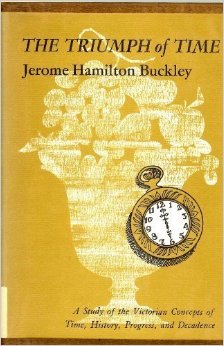 Jerome Hamilton Buckley’s The Triumph of Time (1966) is a “little book” with an enormous and exceedingly complex subject. It pretends to be no less than a survey of Victorians’ attitudes towards time. Buckley proposes to “test the truth” of John Stuart Mill’s suggestion, articulated in his The Spirit of the Ages (1831), that his own generation “had a quite unprecedented awareness of time,” and to view the Victorians’ “multiple concern with time.” Buckley defines at the outset two kinds of time—public and private. The former “involves the attitudes of the society as a living changing whole,” the idea of a Zeitgeist, of progress or decadence; the other relates to “the subjective experience of the individual,” through memories of a personal past, confrontations of public notions of time, and the effort to conquer time, to “escape from the tyranny of the temporal.” Time was either an objective entity or a subjective one. Private time is arbitrary, relative, continuous, variable; public time is the working out of patterns of history. “In tracing the characteristic Victorian attitudes toward both public and private time,” writes Buckley, “I have drawn largely upon the most eloquent of spokesmen—above all, the poets, and then the novelists and essayists—especially those who did most to determine the temper of their own culture or have had the strongest impact upon ours.”
To this end, Buckley’s The Triumph of Time is replete with felicitous references and quotations from Mill, Tennyson, Arnold, Swinburne, Ruskin, Carlyle, Hardy, Whewell, Thackeray, Macauley, Browning, Seeley, Newman, Eliot, Huxley, Clifford, Babbage, Spencer, and many, many others. The Victorian interest in time was unusually extensive and persistent. The age was an elaborate milieu, copious, overpowering in quantity and in quality. The Victorian age is indeed a vast and crowded landscape, and Buckley’s The Triumph of Time attempts to show that the Victorians were preoccupied with time in their novels and poems, in their scientific speculations and philosophy, and in their social thought.
In the first chapter, Buckley outlines the “four faces of Victorian time,” past, present, future, eternity. During the nineteenth century, “a new generation of historians, both literate and laborious, enlarged the limits of the human past and speculated on the possibility of finding patterns of recurrence or meaningful analogies with their own time.” Buckley cites approvingly from Han Meyerhoff’s Time and Literature (1955), where he observed that during the nineteenth century “all the sciences of man—biology, anthropology, psychology, even economics and politics—became ‘historical’ sciences in the sense that they recognized and employed a historical, genetic, or evolutionary method.” Uniformitarian geology; nebular astronomy; evolutionary biology; the new social studies—all were “governed by temporal methodologies.”
This trend was part of what Buckley labels an objective, “public time.” But there were others who perceived time as subjective and thus as “private.” “As seen by poet and novelist,” Buckley writes, “human time…defies scientific analysis and measurement; contracting and expanding at will, mingling before and after without ordered sequence, it pays little heed to ordinary logical relations.” But even those with a private sense of time could not ignore that the Victorian age was an “age in perpetual motion.” “So widespread and so rapid were the changes wrought by the nineteenth century in the material conditions of living that no one, however much he might wish to dwell in the spirit, could altogether escape a sense of almost physical exhilaration or bewilderment rushing in upon him.” Change came at an alarming rate, and some Victorians responded quite positively to it, such as Carlyle, Ruskin, and Hopkins. The latter, for example, saw change as the “daily renewed freshness of nature a testimony that the Holy Ghost still broods over the whole bent world.”
But as Buckley correctly observes, “other poets were less sanguine in their view of change, especially insofar as new modes and attitudes seemed to threaten the great traditions of art and society.” Here we find Tennyson and Arnold. Arnold especially was “troubled by the vision of universal change governing all human affairs of the past, present, and foreseeable future.” Change undoubtedly was “central to the intellectual life of the nineteenth century.” Some interpreted it as progress; others saw it as decline. Thus “the great polar ideas of the Victorian period were accordingly the idea of progress and the idea of decadence, the twin aspects of an all-encompassing history.”
Before discussing ideas of progress and decadence, Buckley, in chapter two, briefly considers “the uses of history.” Many Victorians expressed an retrospective nostalgia for the values of a lost culture. There was an immense fascination with the Greeks, as Frank M. Turner shows in his The Greek Heritage in Victorian Britain (1981). But there were also revivals of Gothic, Renaissance, and Georgian ideals as well.
This fascination with past societies and cultures inevitably encouraged a relativism in values, and that troubled some Victorians. As Buckley puts it, “since to understand is usually in some degree to condone, the deepening knowledge of other times and places engendered an increased relativity of judgment.” This historical relativism is nowhere more conspicuous than in its “assault on the absolutes of religious fundamentalism.” Higher criticism “raised problems of provenance, dating, authorship, stylistic consistency, and analogues in non-Hebraic literature—in short, questioned the reliability of the scriptural canon and the extent to which it might be regarded as inspired revelation.” The appeal to time by Strauss, Eliot, and Seeley, for example, “denied the sanction of eternity.” Even Newman, in his An Essay on the Development of Christian Doctrine (1845) “accounted for the presence of later Roman dogmas…by a theory of evolutionary growth: ideas at first merely implicit and undetected had been articulated and clarified over the ages, and new interpretations had been adopted to meet the needs not of a static institution but of an organic body growing steadily in time.”
Increasingly, Victorian historiography came to resemble a scientism. History took on the inductive approach of science, and thus became an “instructive laboratory.” According to Huxley, “Baconian induction was the only way to learn the causes of things.” In geology, catastrophism was usurped by Lyell’s uniformitarianism, revealing “the terrible vastness of a geological time.” Archaeologists also demonstrated the greater antiquity of mankind, ushering the “concept of prehistory.” Biology would also take into account the “deep time” of the earth. As Buckley puts it, “in the nineteenth century the natural scientist moved closer than ever before to the approach and concern of the historian.” Moreover, the mechanistic image of history came to be replaced by an organic one: “the world was no longer a machine operating on a set cycle, but a living body fulfilling itself in constant adaptation to new conditions.”
At the same, historians learned to “emulate the scientists.” Ranke, Bury, and Lord Acton promoted history as an inductive discipline. Buckle believed human affairs were “reducible to laws, and could be made intelligible as the growth of the chalk cliffs or the coal measures.” This transfer of ideas, practices, attitudes, and methodologies from the study of the natural world to the study of human history and social institutions receives extended analysis in Richard G. Olson’s Science and Scientism in Nineteenth-Century Europe (2008). Periodization in history led to periodization in the life sciences, as when Lubbock introduced the terms “Paleolithic” and “Neolithic” to designate successive ages. The new philosophies of Kant, Hegel, Marx, Comte, Macaulay, and others, presupposed a history moving in a “progressive direction.” As Buckley posits, the nineteenth century was the “golden age of the ideologists, intent on discovering or inventing patterns of growth and decay.” Buckley finds support in R.G. Collingwood, who, in his The Idea of History (1956), writes: “This distinction between periods of primitiveness, periods of greatness, and periods of decadence, is not and never can be historically true. It tells us much about historians who study the facts, but nothing about the facts they study.”
The “idea of progress,” which is the subject of chapter three, is found among many optimistic Victorians, and most eloquently expressed by Macaulay, who saw in history numerous signs of the natural progress of society. The new Baconian thought delivered “great and constant progress”:
it has lengthened life; it is the mitigated pain; it has extinguished diseases;… it has extended the range of the human vision; has multiplied the power of the human muscles; it has accelerated motion; it has annihilated distance; it has facilitated intercourse, correspondence, all friendly offices, all dispatch of business; it has enabled man to the descend to the depths of the sea, to soar into the air, to penetrate securely into the noxious recesses of the earth, to traverse the land in cars which whirl along without horses, and the ocean and ships which run ten knots an hour against the wind. These are but a part of its fruits, and of its first fruits. For it is a philosophy which never rests, which has never attained, which is never perfect. Its law is progress.
Unprecedented mechanical progress throughout the Victorian era was only the proscenium. According to Buckley, the “Victorians succeeded remarkably both in meeting the social challenge of industrialism and in widening the base of democracy. Despite the new horrors of the factor system, which were gradually mitigated or removed by legislation, most workers were better fed, clothed, and housed than their ancestors had been, and the improvement whetted their desire for further reform.” These ideas of reform hark back to the eighteenth century. Indeed, the emphatic avowals of Arnold, Mill, Morley, Kingsley, and Huxley, explicitly “reaffirmed the eighteenth-century idea of progress as a primary dogma of the Victorian period.” In many ways, the idea of progress became a “substitute religion” and thus became an “object of worship.” And as the “true religion,” it rejected all others as false.
Yet this kind of progress did not change “the quality of human life.” Men and women of literature “seldom received the idea of progress with the unqualified optimism of the rationalists and men of science.” Buckley gives evidence for this “recession of progress” in chapter four. In verse Tennyson mocked “the old dreams of a perfected world, without war or disease, a world cultivated like a paradisal garden…by the nightmare vision of vastly multiplied populations struggling hungrily for survival.” Morley “came to feel that material prosperity could impair ‘the moral and intellectual nerve’ and later to wonder whether it were more than an ‘optimistic superstition’ to believe ‘that civilized communities are universally bound somehow or another to be progressive,'” and thus questioning Spencer’s earlier claim that “progress is not an accident, but a necessity.”
For every thesis, Buckely provides an antithesis. The “idea of decadence” in the nineteenth century is as strong as that of progress. In 1898 Joseph Conrad wrote to his friend Cunninghame Graham: “The fate of a humanity condemned ultimately to perish from cold is not worth troubling about. If you take it to heart it becomes an unendurable tragedy. If you believe in improvement you must weep, for the attained perfection must end in cold, darkness and silence.” The new physics, with its theory of entropy, pointed to decay in the universe, rather than the progress inferred from biological evolution. “In other words, according to assured scientific theory, human time eventually must have a stop.” Ruskin, after reading Lyell, viewed the earth as now in “decrepitude.” But as Buckley correctly observes, the idea of decadence “was far older than any of the new scientific sanctions it could find in the late Victorian period.” The Greeks, Romans, Hebrews and Christians, all lamented in their own way the degeneration of their own times. Yet the “idea of decadence grew steadily more urgent and immediate throughout the Victorian age.” The image of a future wasteland and an encroaching barbarism appeared in the writings of Balfour, Froude, Hopkins, Morris, Jefferies, Tennyson, Arnold, Wells, and others.
This Victorian rendition of the Fall of mankind led many to a “passion of the past,” which is the theme of chapter six. Indeed, many shared “a habit of reminiscence,” explaining why the nineteenth century was the “great age of English autobiography.” And although the prime objective in much of the autobiographical writings was “detachment,” Victorian autobiographers selected at will from their pasts, leaving out “unpleasant or unduly intimate detail.” Others chose to remember the past for “remorse or self-recrimination or simply bitterness.” The most important point however is that “in an age of great changes and large uncertainties many clung to the memory of ‘lost days’ that they could admire or idealize or often quite unabashedly sentimentalize.”
The last two chapters of Buckley’s The Triumph of Time provides a dramatic turn from the past to the “living present”; indeed to the “eternal now.” The past decreased as the pace of change and innovation increased, for the present was a constant “peremptory demand.” Carlyle provides an answer to this new challenge to mankind’s present state, first in his “Signs of the Times,” which appeared in the Edinburgh Review in June of 1829, and again in his more developed Sartor Resartus (1836): “Love no Pleasure; love God. This is the Everlasting Yea, wherein all contradiction is solved: wherein whoso walks and works, it is well with him…Be no longer Chaos, but a World, or even Worldkin. Produce! Produce!…Work while it is called Today; for the Night cometh, wherein no man can work.” This was ultimately a secular gospel preached also by Emerson and Longfellow. Work endlessly to avoid modern skepticism and despair! Work will distract us from the more probing questions of life.
An awareness of the temporal relations and responsibilities of their time, however, did not deter Victorians from the “dream of eternity” and the “desire for transcendence.” But unlike previous generations, the Victorians searched for “tokens of permanence or stasis in or behind their passing impressions, and most came to regard their own deepest emotions and intuitions as partaking somehow of the timeless.” In other words, Victorians felled the “eternal”—or what they perceived as eternal—from heaven to earth. Some saw the eternal in human passion; others in art; still others saw it in nature itself.
Victorian literature exhibits an almost obsessive concern with the problems of time, history, progress, and decadence. Buckley’s The Triumph of Time provides a broad description of this phenomenon. It is a work as well written as it is succinct, lucid, and refined. Its value rests in its mass of allusions, generalizations, and quotes, showing the Victorians, in their poetry, fiction, criticism, science, and philosophy, steeped, intellectually and emotionally, in ideas of time and of history.
In the end, however, Buckley, in his organization and categorization, presents a “card file”: Victorians on history; Victorians on progress; Victorians on decadence; Victorians on eternity; and so on. The material is just too vast and varied and complex to reduce to a system. Buckley admits at the outset that his intention was merely to “describe,” and that the book “undertakes no detailed analysis of the literary techniques of registering time’s passage or quality.” But the reader may desire some sort of order out of the cacophony of materials.
Without sufficient analysis, the wealth of examples can be unsatisfying and even—as this reader experienced—somewhat confusing. But perhaps this is the point. Victorians were hypocritical, contradictory, optimistic, pessimistic, sensual, ascetic, and ultimately conflicted about their age. The Victorian period was an elaborate milieu, and Buckley has gone a long way toward laying out the problem of time. Buckley’s The Triumph of Time therefore serves rather well as a stimulus, a handbook. Assembled economically, his handbook increases one’s appreciation for the complexity of Victorian culture.
Publishing Conflict
Posted on February 6, 2014 Leave a Comment
 In 1873, John William Draper began writing his History of the Conflict between Science and Religion (1874). Draper did so at the request of Edward Livingston Youmans (1821-1887), America’s premier science popularizer and founder of Popular Science magazine (1872). As editor of the International Scientific Series, Youmans asked for Draper’s contribution. Later, Youmans brother, William Jay Youmans, published Andrew Dickson White’s Warfare of Science (1875) and his subsequent A History of the Warfare of Science with Theology in Christendom (1896) in serial form in The Popular Science Monthly beginning in 1876. William would later become editor-and-chief of the periodical upon Edward’s death.
Who were Edward and William Youmans? And what were their relationship to Draper and White? Here we are reminded of the importance of how publishers, the “circulation circuit,” and “book history” are central to any real understanding of history of science and religion.
Taking Long Views (1887), by May Kendall
Posted on February 5, 2014 Leave a Comment

Nebula of Stars and Colorful Gas
His locks were wild, and wild his eye,
Furrowed his brow with anxious thought.
Musing I asked him: “Tell me why
You look thus vacant and distraught?”
Sadly he gazed into my face:
He said, “I have no respite, none!
Oh, shall we wander into space
Or fall into the sun?
“Astronomers I’ve sought in tears,
And ah, ’tis terribly remiss
That after all these anxious years
They cannot even tell us this!
Though each man seems to prove his case.
Each contradicts the other one,
And—do we wander into space
Or fall into the sun?”
“Comfort!” I said, “I can’t discern
The nature of our planet’s end,
Nor should I greatly care to learn.
We’ve many aeons left, my friend!
Whether we last from age to age
A frozen ball, or turn to flame,
To me, at this inspiring stage,
Is very much the same.
“Observe Humanity’s advance.
And Evolution’s giant strides!
Remark on what a smooth expanse
The nation’s barque at anchor rides!
The march of Intellect retrace.”
He moaned: “I don’t care what we’ve done.
Oh, shall we wander into space
Or fall into the sun?
“If we should fall, you understand,
Such heat the crash would generate
The solar system might expand
Into its primal gaseous state.
It would be awkward, I maintain,
The same old cycle to renew;
For once let things come round again.
And we should come round too!”
I cried: “The prophecy forbear!
Of finite woes we have enough.
What, travel through the old despair,
Experience the old rebuff!
I’d rather haunt the void Afar
For endless ages, would rejoice
To be a harmless frozen star,
If I might have my choice!”
He gazed at me with aspect strange.
He only said: “How would it be
If this poor planet should derange
The solar system’s equity;
If when the sun our planet met
The sun himself began to fall,
Another system to upset,
And so on through them all?”
“Peace, peace!” I said. “However dark
The destiny the aeons bear,
You won’t be here the wreck to mark.”
He cried: “That causes my despair.
I want to know what will take place,
I want to see what will be done,
Oh, shall we wander into space
Or fall into the sun?“
Victorian Science in Context
Posted on February 4, 2014 Leave a Comment
 “Victorians of every rank, at many sites, in many ways, defined knowledge, ordered nature, and practiced science.” This introductory remark, in Bernard Lightman’s Victorian Science in Context (1997), unveils the aim of the volume as a whole. Presented as a series of connected vignettes, it focuses on the local and the contingent. Situating a range of natural knowledge in their cultural milieu, Victorian Science in Context is a fascinating jaunt through nineteenth-century British science.
Lightman’s introduction is brief, lucid, and pertinent. According to Lightman, science was central to Victorian culture. And whether sensational, ceremonial, or mundane, Victorian science was always political. This is evident in the strong interest in science by literary figures, such as Thomas Hardy (1840-1928), George Eliot (1819-1880), Alfred Lord Tennyson (1809-1892), Charles Dickens (1812-1870), and John Ruskin (1819-1900), to name only a few. The political nature of Victorian science is also evident among British scientists themselves, who “were deeply involved with general culture.” The realization that Victorian science was inextricably linked to powerful social and cultural forces drove historians away from intellectual history to contextualism, which sees the local, the context, the situated, or the particularities of historical events and figures as crucially important. Whose “truth,” “rationality,” “science,” “religion,” “ethics,” and so on, are the principle questions asked by contextualist historians. Lightman goes on to chart the development of the contextualist approach, tracing a detailed genealogy beginning with early attempts by Susan Faye (Walter) Cannon, John Greene, and the more recent work of Frank Turner, Robert Young, Jack Morrell and Arnold Thackray, Martin Rudwick, Adrien Desmond, James Moore, Nick Jardine, James Secord, Emma Spary, Robert Stafford, Crosbie Smith and M. Norton Wise, Cynthia Russett, Evellen Richards, Gillian Beer, and George Levine.
The contributors of Victorian Science in Context “examine the varied contexts of Victorian “biological thought, astronomy, field theory in physics, probability theory in mathematics, political economy, scientific nomenclature, instruments, laboratories, measurement, fieldwork, and the popularization of science,” including their “imperial, industrial, political, gendered, ideological, racist, literary, and religious nature.” Lightman provides an apt précis of their contents in his Introduction, tying a tremendously diverse collection of essays into a seamless argument—namely, that in defining knowledge, in ordering nature, and in practicing science “we not only find nature but also encounter ourselves as inquisitive, social, and political beings.”
Fittingly, the essays are grouped into three sections: Part 1 deals with “Defining Nature”; Part 2 with “Ordering Nature”; and Part 3 “Practicing Science.” This overview of Victorian Science in Context reflects my particular research interests.
Alison Winter’s essay on “The Construction of Orthodoxies and Heterodoxies in the Early Victorian Life Sciences” undermines the traditional image of early Victorian science. Science in the Victorian age was not made up of a homogeneous community; it was indeed “volatile” and “underdetermined,” indeed a “more fluid chaotic state of affairs” than traditionally reckoned. “We now know,” she writes, “that the practices, practitioners, contexts, and audiences that existed for early Victorian science were extremely diverse,” and that by the “late 1830s and 1840s there was a far wider range of specialist journals and societies, and a dizzying variety of other arenas in which science was practiced and communicated.” This diversity is indicative of the multifarious definitions of “science” proposed during the era.
As already mentioned, recent research has overwhelmingly demonstrated the political significance attached to claims about nature. Winter notes, for example, how “radical artisans adapted evolutionary thought to give a blueprint in natural law for their socialist and cooperative projects.” Indeed, the “life science supplied pedigrees for the conservative, liberal, and radical” alike. What is more, “issues of place, practice, and audience have been central to the construction of scientific authority and orthodoxy.” In the second half of her essay, Winter concentrates on the case of William Benjamin Carpenter (181-1885), who personally sought “to demarcate the legitimate from the illegitimate experiments and phenomena.” His 1839 Principles of General and Comparative Physiology claimed that physiology should become as lawlike as the physical sciences, thus reducing “physiology to a set of naturalist laws.” This claim was just as controversial as what the radical artisans had advocated in their evolutionary project; but unlike the radicals, Winter argues, Carpenter solicited the support of specific elite scientists who were also religiously orthodox. And when his Principles did come under attack, he “took immediate and vigorous action to vindicate himself,” publishing an appendix “to one of the moderate progressive medical periodicals a personal defense of the spiritual respectability of his work.” In this defense Carpenter described a world “run by laws that had themselves been ushered into existence by a single divine act.” But more important than his own defense, Winter explains, were the “letters of reference” from individuals who embodied orthodoxy in science and religion, defending Carpenter’s work as “theologically sound.” Carpenter’s act of “juxtaposing the names and statement of individually eminent personages” constructed them “as an authoritative and definitive community.” Thus the “specific work that was necessary to secure the status of orthodoxy for himself was the assertion of what counted as an authoritative community for him.” That is, by successfully soliciting the support of respected scientists of orthodox standing, Carpenter constructed his own definitions of what counted as heterodox or orthodox in his scientific work.
Martin Fichman’s “Biology and Politics: Defining the Boundaries” examines the rich interplay between biological and political speculation. Because “evolutionary biology was at an interface between the natural and social science, it was notoriously susceptible to sociopolitical influences and deductions.” T.H. Huxley and John Tyndall’s strategy for advancing the professional status of biologists, by isolating biology from politics and by proclaiming the ideological neutrality of science, failed. Evolutionary science become, unsurprisingly, “hostage to pervasive ideological manipulation by the scientific naturalists themselves.” In this essay Fichman focuses on the work of Herbert Spencer, Francis Galton, Huxley, and Alfred Russel Wallace.
Spencer, although one of the “grandest systematizers of evolutionary thought,” never fully embraced Darwinism, his perspective being more principally aligned with Lamarckian views. Spencer’s evolutionary synthesis “lent itself to the most diverse political readings,” mainly because his philosophy was not so much materialistic as it was socially progressive. Galton, Darwin’s cousin, “simply subsumed politics under biology.” Coining the term “eugenics” in 1883, he advocated “societal programs to foster talent, health, and other ‘fit’ traits (positive eugenics) and to suppress feeblemindedness and other ‘unfit’ traits (negative eugenics). In Galton’s mind, eugenics was a scientific “repudiation of conservative, aristocratic privilege; politically, he reflected the middle-class outlook of much of the liberal intelligentsia.” According to Fichman, Galton’s eugenics was “an evolutionary science constructed upon a political infrastructure.”
By the 1870s, science had increasingly gained ascendancy and cultural autonomy, largely at the hands of an influential coterie made up of Huxley, Tyndall, Galton, J.D. Hooker, John Lubbock, and other members of the X-Club. “With a combination of research achievements, polemic wit, and literary eloquence…” this group “helped create a largely secular climate of opinion in which the theories and metaphors of modern science penetrated the institutions of education, industry, and government.” Their “metascientific strategy,” as Fichman phrases it, was the promotion of ideological neutrality. But as Fichman demonstrates, the scientific naturalists, “rather than limiting and depoliticizing the authority of evolutionary science, subtly invoked it to support [their] own political views.” In short, “scientific naturalism had never been ideologically neutral.”
Alfred Russel Wallace (1823-1913) attacked any pretext to ideological neutrality. Indeed, for Wallace, evolutionary biology necessitated an ideological context. In his “Human Selection” (1890) and “Human Progress: Past and Future” (1892), Wallace unabashedly declared his socialist convictions, particularly towards sexual selection. “Socialism, by removing inequalities of wealth and rank, would free females from the obligation to marry solely on the grounds of financial necessity.” And as Fichman points out, “Wallace’s social progressionism informed his biological progressionism and reinforced his position that science did not function as a neutral blueprint for political philosophy.” That is, Wallace’s scientific views merged seamlessly with his advocacy of socialism and feminism.
The thought provoking “Satire and Science in Victorian Culture” by James Paradis examines the formation of attitudes towards claims of science and scientists themselves by focusing on the ways in which irony and its “militant” form, satire, was mobilized as a strategy for making sense of new claims about the world. Drawing from Punch (1841-1992), Figaro in London (1831-38), the Comic Almanack (1835-53), as well as Victorian literary pieces such as Thomas Carlyle’s Sartor Resartus (1833-34), Charles Kingsley’s The Water-Babies (1863), Matthew Arnold’s Culture and Anarchy (1869), and Huxley’s Lay Sermons, Adresses and Reviews (1870), Paradis argues that “literature became an important conduit for conveying scientific ideas of the day to the broad public.” What is more, the scientific elite themselves used cartoons, doodles, caricatures, and humor as “instruments of scientific infighting to contrast reform platforms with orthodox resistance.” This, of course, was stunningly reductive, to the point of irresponsible, incorrectly presenting figures and facts, often reinforcing crude prejudices, falsifying categories, and distorting significant truths. But as Huxley discovered, “irony and satire…could be used to privilege the emergent institutions of science.”
Perhaps more ominous, recent research suggests that at the same time as young adults are abandoning traditional news media, they are more likely to identify with late-night comedy programs, particularly Comedy Central’s The Daily Show with Jon Stewart and The Colbert Report with Stephen Colbert, or with humor websites such as BuzzFeed.com and Cracked.com and others, as a destination for learning about current events. This trend towards news as entertainment was pointed out long ago by Neil Postman. According to Fichman, “one who laughs not only directs criticism at the object of his laughter, but also invites his companions to share his sentiments. Irony and satire from the 1840s to the 1860s had increasingly become tools in the scientific community for shaping a minority cultural vision.” Huxley, with his mordant witticism, used his gift “to turn the direction of the irony against received tradition and to seize the moral high ground for a progressive intellectual culture associated with the sciences.”
Bernard Lightman’s “‘The Voices of Nature’: Popularizing Victorian Science” is similar to his more recent essay in Wrestling with Nature (2011). According to Lightman, Huxley and Tyndall “account only for a small portion of the works of Victorian popularizers of science.” Indeed, the popularizers of science played a far greater role in “shaping the understanding of science in the minds of a reading public composed of children, teenagers, women, and nonscientific males” than any of the scientific naturalists. Yet their comparative neglect by historians until most recently is the result of the successful campaign forged by the scientific naturalists, who convinced “future generations that scientists were the authoritative guides to deciphering the meaning of natural things—that they alone gave voice to mute nature.”
It is the contextualist approach that offers a necessary antidote. Recent work by contextualist historians, Lightman notes, reveals the “rich interaction between Victorian science and culture.” The contextualist approach also shows how Victorian popularizers of science experimented with the narrative form and the implicit “storytelling quality of all science.” “Both popularizers and professionals,” writes Lightman, “have continued to tell stories about the ultimate meaning of things as revealed by science, though this characteristic of science has been concealed in the scientific reports and papers of professional scientists.” Lightman then offers an account of Margart Gatty’s (1809-73) The Parables of Nature (1855), which was a series of fictional short stories for children designed to teach them about the natural world; Eliza Brightwen’s (1830-1906) Wild Nature Won by Kindness (1890) and other stories sought to “foster ‘the love of animated nature’ in her audience, especially ‘in the minds of the young'”; and Arabella Buckley’s (1840-1929) The Fairyland of Science (1879), likewise aimed to “awaken ‘a love of nature and of the study of science’ in ‘young people’ who more than likely ‘look upon science as a bundle of dray facts.'” Interestingly, Buckely does not shy away from introducing the story of evolution in The Fairyland of Science. Rather, she “reinterprets the story of evolution in way that emphasizes the moral dimensions of the process. The purpose of evolution was not, as Darwin had argued, merely the preservation of life, it encompassed the development of mutuality as well.” And like Gatty and Brightwen, Buckley “believed that science offered the means for ascertaining the true meaning of God’s works.” According to Lightman, all three authors are “part of the natural theology tradition.”
In the late nineteenth-century, “thousands of members of the public were introduced to astronomy” by the writings of Anthony Proctor (1837-88). His most popular work, Other Worlds Than Ours (1870), cast science into a “teleological framework” and encouraged the reading public to become amateur astronomers—for the astronomer, “imbued with the sense of beauty and perfection which each fresh hour of world-study instills more deeply into his soul, reads a nobler lesson in the skies.” Astronomy, according to Proctor, leads to God. Similar sentiments were shared by the Reverend John George Wood (1827-89) and Agnes Mary Clerke (1842-1907) in their many writings, who both declared that the natural world testified “to the existence and wisdom of God.” We may draw two important conclusions from the popularization of science during the Victorian era. The first is that “science continued to be contested territory in the latter half of the nineteenth century.” Second, the stories told about nature were also contested. Should stories about nature be told from a teleological, aesthetic, moral, or evolutionary perspective? The scientific naturalists fought for the hearts and minds of the reading public. But so did popularizers of science. Thus we may say that the professional scientist competed against the professional writer. Who won is still an open question, however.
The Agnostic Theology of Huxley and Tyndall
Posted on February 1, 2014 Leave a Comment
Earlier today I read Bernard Lightman’s short essay “Does the History of Science and Religion Change Depending on the Narrator? Some Atheist and Agnostic Perspectives” (2012) as a break from reading his edited volume Victorian Science in Context (1997). It was, as expected, excellent.
Lightman’s answer is a resounding yes. In his estimation, “during the seventeenth and eighteenth centuries the strategy of unbelievers revolved around attempting, without too much success, to draw out of Newtonianism some kind of justification for their materialism and their atheism.” But later, in the nineteenth century and after the publication of The Origins of Species, “evolutionary theory offered new opportunities to unbelievers for dealing with the Newton problem”—the problem being that Newtonian physics was inextricably intertwined with Newton’s theology. The strategy of nineteenth-century scientific naturalists like T.H. Huxley and John Tyndall, for example, was “separating science and religion into two separate spheres,” which allowed them to “construct a religiously neutral scientific system and to offer a re-interpreation of the history of science and region that relegated Newtonianism to the sidelines.”
Focusing on Baron d’Holbach (1723-1789), Lightman underscores how radical Enlightenment philosophes saw science, particularly Newtonianism, as providing intellectual support for atheism—that is, as long as it was “purged of religious concepts that Newton had enshrined in the heart of his physics.” Indeed, d’Holbach and other radical philosophes such as Denis Diderot, Jean d’Alembert, Claude Adrien Helvétius, and Pierre-Simon Laplace, “pressed Newton into service as an ally.” But in order to deify Newton, of course, he had to be defied. In order to explain away Newton’s religious commitments, for instance, he was reinterpreted as schizophrenic (d’Holbach) or mentally deranged (Laplace). For d’Holbach and his coterie, “the history of science and religion confirmed the validity of materialism.”
Transitioning to Herbert Spencer’s (1820-1903) System of Synthetic Philosophy, Lightman shows that Spencer actually sought the “basis of a complete reconciliation” between science and religion. This was, Lightman notes, the central aim of Spencer’s First Principles, published in 1862. For Spencer, “the basis for a total reconciliation between science and religion, is the idea of a mysterious power underlying phenomena.”
Likewise, Tyndall was actually “curiously conciliatory towards religion.” In a 1847 journey entry Tyndall rejected the “main doctrines of Victorian Christianity”:
I cannot for an instant imagine that a good and merciful God would ever make our eternal salvation depend upon such slender links, as conformity with what some are pleased to call the essentials of religion. I was long fettered by these things, but now thank God they are placed upon the same shelf with the swaddling clothes which bound up my infancy.
But as Lightman points out, “this rejection of Christian doctrines did not lead him to atheism.” Indeed, Tyndall actually “believed that science and religion, as he defined them, could exist in peaceful harmony.” He saw subjective religious feeling “as true as any other part of human consciousness,” and thus was safe from any kind of scientific attack. According to Lightman, Tyndall thought “religion, in its subjective dimension and its articulation through symbol, could be reconciled with the objective facts of science if the boundaries between the two ‘magisteria’, as Stephen Jay Gould referred to them, were maintained.” In this sense, Tyndall rejected the label “materialist,” arguing that “materialism was fruitful as a scientific methodology, but it could not be a complete philosophy of life.” (Incidentally, this seems to be contemporary philosopher Thomas Nagel‘s own position.) Rather, he ascribed to a “higher materialism” that “found in matter ‘the promise and potency of all terrestrial life.'” Religion was the “inward completeness and dignity of man.” And as pointed out by Ruth Barton elsewhere, “Tyndall voiced his debt to [Thomas] Carlyle” for much of his understanding of science-religion relations.
Although a physicist, Tyndall made little mention of Newton in his history of science and religion. As Lightman puts it, Tyndall displaced Newton “from the centre of the story of the making of modern science.” This is unsurprising as Newtonianism was central to nineteenth-century natural theology, which, like Carlyle, Tyndall completely rejected. Tyndall’s rejection of natural theology deserves closer inspection because it seems he did so on the basis that it led to deism. In 1849, for example, after reading William Paley’s (1743-1805) Natural Theology, Tyndall wrote in his journal that “the Great Spirit is not to be come at in this way; if so, his cognition would only be accessible to the scientific and to very little purpose even here,” and later wrote that he rejects “a detached God—a God outside his Universe who superintends the clockwork thereof.”
Huxley, the “self-styled ‘gladiator-general’ of evolutionary science,” took a surprisingly similar position on the science-religion relationship. Like Tyndall, “Huxley held to the idea that science and religion belonged to two distinct realms,” and once rightly conceived “science and religion could never come into conflict because each realm was distinct and without authority outside its proper sphere of interest.” What is more, Huxley argued that “atheism is as absurd, logically speaking, as polytheism.” For Huxley, agnosticism was the only legitimate course regarding religious questions. In Science and Hebrew Tradition (1893), Huxley declared that
the antagonism between science and religion about which we hear so much, appears to me to be purely fictitious—fabricated, on the one hand, by short-sighted religious people who confound a certain branch of science, theology, with religion; and, on the other, by equally short-sighted scientific people who forget that science takes for its province only that which is susceptible of clear intellectual comprehension.
However, when it came to understanding Newton, Huxley falls victim to his own short-sighted position, ignoring Newton’s “profound relationship between universal natural laws and a divine being” and simplistically arguing that “Newton stands as the exemplary empirical scientist.”
In conclusion Lightman highlights how contemporary atheists, particularly Steven Weinberg and Richard Dawkins, have “far more in common with Enlightenment philosophes like d’Holbach than they do with Victorian agnostics such as Huxley and Tyndall.” But unlike the philosophes, who tried to “finesse Newton, as did early modern unbelievers, their atheism, and their perpetuation of the conflict thesis in history…seems, to the uninformed, to have the complete backing of history.” In other words, the so-called “New Atheists” not only misread the history of science, they ultimately distort it for their readers. As Borden Painter points out in his reprimanding “New Atheism’s Old—and Flawed—History” article in Historically Speaking (2012), “the deficiencies of New Atheist history should be obvious to professional historians: choosing evidence to suit a predetermined and state ideology while ignoring the rest; lack of nuance and context; simplistic and monocausal explanations; anachronism and moralism; [and] poor choice or misrepresentation of secondary sources.”
Geographies of Nineteenth-Century Science
Posted on January 31, 2014 Leave a Comment
 “Science,” writes Nicolaas Rupke, “is not just a collection of abstract theories and general truths but a concrete practice with spatial dimensions.” It is, indeed, “situated knowledge.” Rupke comes to this conclusion in an Afterword for David N. Livingstone and Charles W.J. Withers’ (eds.) Geographies of Nineteenth-Century Science (2011). The essays in this volume “situate a range of scientific knowledge claims in civic, metropolitan, and even colonial island sites, and in such architectural spaces as museums and laboratories.” Its authors convincingly argue that “Nineteenth-century scientific knowledge…constituted a plurality of knowledges, each shaped by local customs and norms, dependent on locally generated authority and credibility, and serving partisan political purposes.”
Thinking geographically about nineteenth-century science, the editors argue, evinces a science practiced “in different ways in different places.” Accordingly, “scientific knowledge is differently spread across the surface of the earth, and moves from place to place through complex circulatory networks.” At the same time, “scientific institutions occupy distant locations in different settings.” A corollary to all this is that “scientific theories are shaped by the prevailing political, economic, religious, and social conditions, as well as a host of other cultural norms in different geographical localities, and…[thus] may bear the stamp of the environments within which they are constructed.”
Livingstone and Withers want to show how thinking geographically helps to disclose how “science—the sciences—became professional, popular, disciplined and discursively discrete, precisely institutionalized and widely instructive.” The volume contains 17 chapters and over 400 pages of text divided into three parts: “Sites and Scales,” “Practices and Performances,” and “Guides and Audiences.” All chapters work together in contributing to a continuing interdisciplinary debate about “the placed nature of science’s making and reception, about the processes that were adopted to make scientific knowledge mobile for whom and with what consequence…[revealing] that what has held to be science varied—but within institutions, at different scales, and for different audiences in different places.” Here I provide a synopsis of chapters I found particularly insightful.
Bernard Lightman’s “Refashioning the Spaces of London Science: Elite Epistemes in the Nineteenth Century,” turns to how space mattered. Following John Pickstone’s Foucauldian analysis of different “epistemes,” or ways of knowing, Lightman seeks to “identify broad epistemic patterns across disciplines and to see how they change over the course of time.”
Lightman begins by discussing sites of gentlemanly and utilitarian science. Under the helm of Sir Joseph Banks (1743-1820), a vast scientific network was constructed around the sites of the Royal Institution, Royal Society, and Kew Gardens. “All three were to play a significant role throughout the nineteenth century, but at that point they were spaces of the landed aristocracy and the upper class…” After Banks’ death, however, these scientific sites gradually began to shed their aristocratic layers. Whereas Banks and his supporters had exploited and reinforced relations of genteel patronage and obligation, a group of reformers—i.e., the “gentlemen of science” and the untilitarians—altered the politics of science. These were the “young Turks” of the nineteenth century, who pushed for reform of aristocratic spaces of science. For these reformers, science was a “professional tool to be used to create a body of knowledge useful in government and in the professions.” This vision of science was in embodied in the founding of the “Godless” University College London in 1827, “which was set up as a secular institution modeled on the universities of Berlin and Bonn, and, unlike Cambridge and Oxford, it opened up its doors to non-Anglicans.”
Banks’ network of scientific sites also underwent metamorphosis under the leadership of new men. At the Royal institution, for example, the chemist William Thomas Brande (1788-1866), who led the Institution from 1813 to 1831, embodied utilitiarian ideals, undertaking a series of activities that gave it the reputation of being a metropolitan powerhouse for the scientific management of social problems. Subsequently, Michael Faraday (1791-1867) had become an important figure by the end of the 1820s, and “Faraday and the Royal Institution were well suited to each other.” The establishment by Faraday in 1825 of the very successful Friday Evening Discourses gave the Royal Institution an even greater public presence. In 1840, the Kew Gardens was transferred to the British government, and thus by the time William Hooker (1785-1865) took charge of it, it was already a public institution. According to Lightman, “Hooker strived to transform it into a center for scientific research as well as a place for the amusement and edification of the nation.” Banks’ Royal Society was a bit more dogged, but by “1848 traditional loyalties to the Crown and Church were replaced by new contractual allegiances based on serve to knowledge and utility to the state.”
Refashioning aristocratic sites of science was only one part of a larger plan. Reformers also sought to create new sites of science. Along with the museum, which, according to Lightman, the “central institution of Victorian science, the “British Association for the Advancement of Science was created in 1831 as a peripatetic organization.” “Embracing natural theology, [members] pointed to a divine order behind both nature and society, and to the role of science as a neutral means for obtaining desirable ends.” And “like the Royal Institution and Kew Gardens, the BAAS reached out to the public.”
But as the founding of University College London makes clear, for some the “reformist inclinations of gentlemen and Utilitarians did not go nearly far enough.” Such thinkers were “enamored with French evolutionary theory,” using “radical Lamarckianism to challenge the Tory-Anglican establishment and argue for the [further] reform of aristocratic institutions.” Other thinkers thought the radicals went too far, particularly Henry Brougham (1778-1868), who attempted to counter radicals with establishing mechanics’ institutes and, more importantly, the Society for the Diffusion of Useful Knowledge (SDUK), which published inexpensive texts intended to adapt scientific material for a rapidly expanding reading public. The latter’s central aim, Lightman tells us, “was to undermine political radicalism with rational information.”
Apparently the radicals had been more effective, for after 1850, a new generation of practitioners arrived on the scene, their aim “included the secularization of nature, the professionalization of their discipline, and the promotion of expertise.” Lightman selects three man that epitomize this new aim: Thomas Henry Huxley (1825-1895), John Tyndall (1820-1893), and Joseph Dalton Hooker (1817-1911). These “scientific naturalists” were “sensitive to the power of place,” and set out to reconfigure, once again, several sites of science. Under Hooker, for example, “a fundamental change took place in Kew’s identity as an institution,” refashioning it into a research space as defined by scientific naturalists. As the mantle of leadership passed from Faraday to Tyndall, the Royal Institution too came to be defined under the rubric of scientific naturalism. And in his biological laboratory in the Science Schools Building in South Kensington, “Huxley was free to teach his students to view nature through secular eyes.” Ironically, the agenda of scientific naturalism, Lightman writes, “emphasized training, expertise, and laboratory research,” and thus led to “an even greater split between the public and professional spaces of science.”
There were, of course, contested spaces and sites of resistance to scientific naturalism. Although Tyndall used his presidential address in Belfast in 1874 to aggressively challenge the authority of Christian clerics, several men—Rayleigh (1884), Salisbury (1894), and Arthur Balfour (1904)—used the BAAS as a platform to deliver their defense of theism and criticism of scientific naturalism. Interestingly, it was the museum, however, that became the key space for “resisting the aims of scientific naturalists.” For example, the Oxford University Museum (1860) was embedded with “the principles of the natural theology tradition in its architecture.” Other museums, including the Natural History Museum in South Kensington, the Hunterian Museum, and the British Museum emphasized the “harmonious relationship between science and religion.” Laboratories and print culture were also generally hostile toward the agenda of scientific naturals, particularly the labs of the North British physicists and British publishers George Routledge (1812-1888) and Thomas Jarrold (1770-1853), who published a “steady stream of books containing theologies of nature that challenged the scientific naturalists’ secularized perspective.”
Lightman inspection of the places of London science reveals how different scientific sites operated different epistemes. These sites, and many others, were not simply physical locations; they were, as Lightman shows, symbolic urban places whose occupants were aligned for or against aristocratic privilege, radical reform, or scientific naturalism.
Charles W.J. Withers’ “Scale and the Geographies of Civic Science: Practice and Experience in the Meetings of the British Association for the Advancement of Science in Britain and in Ireland, c. 1845-1900” examines the geographical mobility of the BAAS, with a particular concern over what he calls “nineteenth-century civic science” in Britain. He asks, “how did the BAAS experience vary locally, by and perhaps even within, different towns?”
Withers begins by considering BAAS officers’ decision making process for choosing a host. This was a complex process that involved, among other things, apprehending “the scientific capacity of the location, the educational advantages for the local inhabitants, and the financial support that local civic bodies would give the association.” What is more, “hosting an annual meeting involved at least a three-year cycle of negotiations (often more) between BAAS General Committee officers and representatives of local civic and scientific bodies.”
The most interesting section of Withers’ chapter is his account of private responses to BAAS meetings, or how he terms it, “experiencing civic science.” According to Withers, “women formed a large part of BAAS audiences, especially from midcentury.” The diaries of Agnes Hudson, Caroline Fox, and Lady Caroline Howard are particularly instructive. Hudson attended the 1875 Bristol and 1879 Sheffield meetings, but complained about the intolerable heat because of the “insufficiently ventilated building” and the overcrowding. The Anthropological Section sessions in particular were so crowded that “several persons sat on the mantelpiece.” According to Withers, “attendance at a BAAS meeting could be tiring, require a change of clothes (for a women perhaps more than for men), and last well into the evening.” Fox attended meetings in 1836, 1837, 1852, and 1857. She too recalls the crowds at certain meetings, succeeding in gaining admittance only “by most extraordinary muscular exertions.” She also recalls problems of audibility: “people made such a provoking noise, talking, coming in, and going out, opening and shutting boxes, that very little could we hear.” Howard likewise complained about her inability to hear the speakers at the geography session at the 1857 Dublin meeting, particularly famous African explorer David Livingstone, who spoke “in a whisper.”
The BAAS promoted what Withers calls “civic science”—science as a public good, a unifying, moral vision under the banner of scientific and political neutrality. But particulars of this mission were moderated by the different urban and institutional contexts where the BAAS convened. “Different practices in different setting—waiting for a lecture whose timetabling and audience behavior meant that hearing particular topics was a matter of luck, conversing with one’s fellows, viewing specimens without comprehension, going to lectures to seek sensation or instrumental mediation through lantern slides not understanding of scientific principles—were all elements in the making and reception of association science.”
Diarmid A. Finnegan shares a similar emphasis on the location of locution. As he writes in his “Placing Science in an Age of Oratory: Spaces of Scientific Speech in Mid-Victorian Edinburgh,” in the mid-Victorian period, “logic and location along with propositions and performances were tightly bound together in the delivery of science lectures.” He supports his claim with a close examination of the Edinburgh Philosophical Institution (EPI). According to Finnegan, in EPI meetings, “science no less than any other subject was knotted together with local conditions, politics, and protocols.” The cultural significance of public speech during the Victorian period necessitated that “science had to sound right as well as look right to retain its place as part of intellectual culture in mid-nineteenth-century urban Britain.”
Founded in 1846, the EPI attracted many eminent speakers, including Ralph Waldo Emerson, John Ruskin, John Hutton Balfour, David Brewster, Samuel Brown, Hugh Miller, Edwin Lankester, Thomas Henry Huxley, John Tyndall, John Pringle Nichol, John Henry Pepper, John Lubbock, and Benjamin Waterhouse Hawkins. EPI lectures generally took place in Queen Street Hall, which was owned by the United Presbyterian Church. Much like the BAAS meetings, inadequate facilities, overcrowding, and poor acoustics were common maladies. But in addition to these “external” forces, internal forces pressed upon the lecturers. According to Finnegan, “tacit codes of behavior also applied to lecturers.” Indeed, “what could and could not be heard in the lecture hall was conditioned by the regulative ideals associated with the notion of a free platform.” Thus lecturers had to “position their scientific discourse” by taking in consideration “etiquette, aesthetics, and moral probity.”
This “positioning” is best seen in the 1850s popular lectures of Hugh Miller and George Wilson. Both Miller and Wilson “integrated literary charm and moral sobriety” into their scientific lectures. More importantly, both “held in common a commitment to creedal Christianity.” In his EPI lectures, Miller sought to “refute the charge that science lacked poetic power.” What is more, science affirmed theological orthodoxy: it was Miller’s belief, Finnegan writes, “that nature’s hieroglyphics, properly deciphered, would bring to light God’s own artistry and that the basis for the substantial harmony between geology and poetry was the identity between the aesthetic and musical sense in the mind of God and the mind of man.” This literary mode—modeled after Thomas Carlyle, albeit without his pantheism—appealed to the audience of the EPI. Similarly, Wilson’s lectures exhibited “a high strain of moral eloquence that linked every topic to man’s joys, and sorrows, and deep enduring interests.” As Finnegan puts it, “the earnest moral tone, the personal intensity of delivery, and the Carlylean tenor that characterized the scientific speech of Wilson and Miller resonated with the general intellectual and aesthetic sensibilities of members of the EPI.”
By the 1860s, however, there was a dramatic “change in the character of science lectures given to the EPI.” In the geology lectures by David Page, for example, he “actively opposed attempts to present science as a handmaiden to theology.” A more striking secular note were also delivered by Tyndall, Huxley, Lubbock, and Hawkins. Unsurprisingly, Huxley “caused the greatest stir both within and outside the institution…provoking the opprobrium of Edinburgh’s evangelical press.” All except for Hawkins, (who only spoke again in 1887) never returned to the EPI. The lectures of these men caused such a stir, that remaining science lectures of the decade had a decidedly more “combative and controversial tone.” There were even charges that the EPI had “contravened its own principles” of moral sobriety. These science lectures of the 1860s were “frequently suspected of instilling moral confusion and of severing the link between intellectual talk and moral culture.”
David N. Livingstone’s “Politics, Culture, and Human Origins: Geographies of Reading and Reputation in Nineteenth-Century Science” explores how “scientific meanings are imagined and reimagined through encounters with scientific texts and treatises,” drawing our attention particularly “to the cultural politics of origin narratives, whether creationist or evolutionary, throughout the nineteenth century.” Here the characterization of reputation become critical. Livingstone’s case study of Isaac La Peyrère (1596-1676), the father of anthropological polygenism, assessed as either heretic, hero, or harmonizer, demonstrates how persons, and their ideas, were made to stand for different things at different times and places.
Livingstone’s varieties La Peyrère, a “reputational geography,” is simply a prerequisite for his discussion of the varieties of Darwinism in the nineteenth century. In the final section of his chapter, Livingstone triangulates “a number of Irish readings of evolutionary theory,” namely Dublin, Belfast, and Londonderry. Presbyterian layman and distinguished Trinity College anatomist, Alexander Macalister, for example, although unconvinced about psychic, religious, moral evolution, he was nevertheless “enthusiastic about the power of natural selection to account for both animal and human physiological evolution,” and thus embraced Darwin’s Descent of Man. Yet another Presbyterian, professor of biblical criticism and later president of Queen’s College, Josiah L. Porter, “could find no empirical evidence in supper of the ‘essence’ of Darwin’s theory ‘that all forms of life, from the humblest zoophyte up to man, have evolved from one primordial germ.’” And yet another fellow Presbyterian, professor of mathematics and natural philosophy at Presbyterian Magee College, John Robinson Leebody, praised Darwin’s theory as the “most complete attempt to prove with absolute continuity of the chain which connects man with the lower animals,” but that it also reveals its empirical dearth and therefore “we must decline, in the interests of science, to accept the Darwinian view of the origin of man’s body, until it is proved.”
More than personal predilection and professional preoccupation directed these judgments. According to Livingstone, the spaces these men occupied, in Dublin, Belfast, and Londonderry, “critically implicated both in the stances they assumed and the rhetorical tones they adopted in their public declarations.” Macalister, for instance, was not only a part of progressive set of scientists congregating around Trinity College, he was also part of a local Presbyterian community that fostered a particularly “secular” education in opposition to a Catholic “religious” one. Porter’s judgment was no doubt a reaction to Tyndall’s presidential “Belfast Address” in 1874. Indeed, Porter’s comments on Darwin were collected, along with others, into a single volume “intended to rebut the president’s attack.” And again, Leebody occupied a different rhetorical space. As president of Magee College, he too wanted to distance his institution from Catholic pedagogy, once quipping that “there is no Protestant Mathematics or Chemistry as distinguished from that taught in a Catholic college.” In conclusion, “the geography of Darwinism in Ireland,” Livingstone suggests, “was the compound product of long-standing feuds over who should control the curriculum, the iconic impact of Tyndall’s attack, the institutional spaces occupied by commentators, and the relative security local spokesmen felt in their own sense of cultural identity.”
And finally Jonathan R. Topham’s “Science, Print, and Crossing Borders: Importing French Science Books into Britain, 1789-1815” demonstrates the critical importance of print. There are a number of discrete, but nevertheless inextricably linked, geographies operating here, including publishers, booksellers, translators, and editors. Key figures in the Franco-British book trade were Arnaud Dulau (1762/3-1813), Thomas Boosey, who established his Boosey & Company in London in about 1792, and most important Joseph De Boffe (1749/50-1807). De Boffe himself was the son of a French bookseller based in Fribourg, Switzerland. De Boffe followed in his father’s footsteps, and soon after moving to London he became a “significant figure in the supply of French-language publications.” Topham notes that “a catalogue issued by De Boffe in 1794 listed more than twenty-five hundred French books, many relating to the arts, sciences, travels, and natural history.”
The “decisions and activities of” De Boffe and others, Topham argues, demonstrates how “technicians of print affected the availability of French science books in Britain.” This is most visible in periodicals. The Monthly Review, Critical Review, Anti-Jacobin Review, British Critic, Analytical Review, Edinburgh Review, and Quarterly Review all included a section of reviews and notices on foreign literature, some, such as the Monthly seeking to “provide a regular retrospect of French literature.”
After discussing booksellers and periodicals in general, Topham turns specifically to four case studies of imported French science books: (1) Antoine Lavoisier’s Traité élémentaire de chimie, présenté dans un ordre nouveau et d’après les découvertes modernes (1789); (2) Pierre-Simon Laplace’s Traité de mécanique celeste (1799-1805); (3) Jean-Baptiste Lamarck’s Philosophie zooloqique (1809); and (4) Georges Cuvier’s Recherches sur les ossemens fossils (1812). In this section Topham introduces a cast of characters, including booksellers, translators, publishers, and reviewers. Despite the revolutionary war, and the subsequent mutual blockade between Britain and France, these events had little impact on the importation of French science books and their reading and reviewing in public periodicals. What becomes clear in these case studies, as Topham argues, “far from being automatic” the mechanism of publications “require the agency of a wide range of people, including not only scientific practitioners but also technicians of scientific print, often motivated by financial considerations.” It shows, in short, that all knowledge-making is a situated process, and thus “renders problematic any assumptions that scientific knowledge, either in its words or in its pictures, simply diffuses across the globe in a straightforward manner. Disruption of supply, translation between languages, selective reviewing of scientific literature, the local interpretations of meaning, all point to the salience of textual geography in the study of the forms of its representation in the movement of scientific knowledge.”
These essays and others in Geographies of Nineteenth-Century Science convincingly show “the placed nature of science’s making and reception”—its “practices and forms of communicative action are always grounded in particular settings, and questions regarding site, institutional organization, and social relationship in place will for that reason always continue to matter to an explanation of science’s cognitive content and variable reception.”
 James C. Ungureanu