
Science and Religion Around the World
Posted on December 10, 2013 Leave a Comment
 As we have seen, one of the most prominent, persistent, and popular myths about science and religion emerged in the nineteenth century. John William Draper (1811-1882), author of History of the Conflict Between Religion and Science (1874), followed by Andrew Dickson White (1832-1918), author of The Warfare of Science (1876) and A History of the Warfare of Science with Theology in Christendom (1896) held that science and religion were inherently opposed and necessarily in conflict, thus ushering what was to become the widely current views of today.
John Hedley Brooke and Ron L. Numbers in Science and Religion Around the World (2011) assemble essays aimed at challenging this “warfare” narrative with interactions between science and early Judaism (Noah Efron), modern Judaism (Geoffrey Cantor), early Christianity (Peter Harrison and David C. Lindberg), modern Christianity (John Hedley Brooke), early Islam (Ahmad S. Dallal), modern Islam (Ekmeleddin İhsanoğlu), early Chinese religions (Mark Csikszentmihalyi), Indic religions (B.V. Subbarayappa), Buddhism (Donald S. Lopez Jr.), African religions (Steven Feierman and John M. Janzen), including a chapter on “unbelief” (Bernard Lightman), and an comprehensive conclusion, bringing together previous chapters and distilling a “geography of science-religion relations” (David N. Livingstone).
The book opens with the Abrahamic traditions. Noah Efron claims that “there has been no single, enduring Jewish attitude toward nature and its study. In each age and locale, a mix of theological, social, and practical concerns determined how large a role natural knowledge would take in Jewish intellectual life and how creative and original the contributions of Jews would be.” Efron traces this ambivalence in early Judaism’s attitude toward the natural world in the Hebrew Bible, Talmud, and writings in the Middle Ages. Although the “Hebrew Bible records little about the nature of the cosmos,” the earth was a different matter. “Ancient Israelites,” Efron writes, “sought to divine the pattern behind the animals and plants they came across.” This is evident, he says, in the rule of kashrut—of what is prescribed to eat and what is proscribed.
Other prohibitions, against medicine, astrology, and magic, were not always followed. Astrology in particular found “purchase in ancient Hebrew culture.” Some scholars were impressed with the distinct elements of Hebrew tradition, such as Georg Wilhelm Friedrich Hegel, who observed that the Israelite religion altered the very nature of nature itself: “Nature [in the Old Testament] is now degraded to the condition of something powerless…it is made a means.” More recent commentators have also argued that the Bible desacralized nature, stripping it of the inherent and independent forces that pagan cultures had attributed to it.
Composed over hundreds of years and across thousands of miles, the Palestinian and the Babylonian Talmud reveal interesting tidbits of the cultures that produced them. Mathematics and astronomy, for example, served many practical ends because of its relevance in determining religious feasts and Sabbaths. There are also incidental references to illness and cure, disease and medicine. But as Efron notes, “the Talmud, like the Bible before it, served as a source for all of these attitudes toward nature and none of them.” The Talmud prohibits magic and sorcery, and physicians and surgeons were often treated with suspicion within its pages.
In the Middle Ages, we find intermittent Jewish cooperation in science and philosophy with Christians and Muslims. Particularly, Jews “found a place in Arabic mathematics, natural philosophy, and medicine. Isaac ben Solomon Israeli (ca. 855-955), Sa‘adya ben Yosef
al-Fayyūmī (882-942), Abraham Bar Hiyya (d. ca. 1145), Abraham ibn Ezra (1089-1167) were known by contemporaries as enthusiasts for natural philosophy. They were not without critics, however. Both Judah Halevi (ca. 1075-1141) and Moses ben Maimon (1135-1204) rejected astrology, the former warning: “Let not Greek wisdom tempt you, for it bears flowers only and no fruit.” The latter, known more commonly through his Latin name, Maimonides, “propounded a limited sort of natural theology, in which nature—God’s handiwork—bears testimony to God’s power. At the same time, he insisted that humans were incapable of achieving positive knowledge of God’s essence,” thus restricting man’s ability to know with certainty anything about the natural world. “Maimondies,” writes Efron, “would be an inspiration and a prooftext for Jewish scholars writing about natural philosophy for generations to follow.”
In the early modern period, Jews like David Gans (1541-1613), Joseph Solomon Delmedigo (1591-1655), Tobias Cohen (1652-1729), Jacob ben Isaac Zahalon (1630-93), David Nieto (1654-1728), Jacob Hamiz (d. ca. 1676) embraced natural philosophy, in part because they saw it as a sort of ecumenical wisdom, and, in part, because they recognized in nature traces of God’s handiwork.
Transitioning to the modern period of Jewish-science relations, “Jews continued to find science intertwined in complex patterns with their own identities.” In the first part of his essay, Geoffrey Cantor focuses on Sephardi and Ashkenazi Jews following the scientific revolution, relaying Jewish anxieties about natural philosophy possibly supplanting attention to Torah study. While the “Jewish enlightenment,” or the Haskalah, its proponents being maskilim (“those who possess understanding”) emerged in the late eighteenth century, its most eminent exponents being the self-proclaimed messiah Sabbatai Zevi (1626-76), Aaron Gumpertz (1723-70), Moses Mendelssohn (1729-86), Mordechai Gumpel Schnaber (1741-97), it peaked during the final two decades of the century, when many rabbis condemned it for fear that it would “erode traditional Jewish observance and that they would lose influences over their congregations.”
Cantor also surveys a spectrum of Jewish responses to Darwin, emphasizing the diversity of views in the Jewish tradition. English naturalist of Sephardi descent Raphael Meldola (1849-1915) “fell into the ranks of Darwinism.” Torah and Talmud scholar Naphtali Levy (d. 1894) wrote a book which argued that “Jewish thought and Darwin’s theory of evolution were in harmony with one another.” Enthusiasm for Darwin’s theory is also found among a small number of nineteenth-century rabbis, including Abraham Isaac Kook (1865-1935), the first Ashkenazi Chief Rabbi of Israel. Others, however, took the opposite view, such as Abraham Geiger, a leading reform rabbi in Germany, who rejected evolution in the 1860s because of “the gap he envisaged between humans and animals,” or Menachem Schneerson (1902-1994), who once told a “wavering student not to overrate the claims of science because it possesses a very limited factual base.”
Cantor closes his essay with a synopsis of “Jews in the Modern Scientific Community,” from Nobel Prize-winning physicist Albert Abraham Michelson (1852-1931), Manhattan Project director J. Robert Oppenheimer (1904-1967), sociologist Robert K. Merton (1910-2003), Albert Einstein (1879-1955), another Nobel Prize-winning physicist Steven Weinberg (b. 1933), Jewish biologists Robert Pollack (b. 1940), Stephen Jay Gould (1941-2002), and Richard Lewontin (b. 1929), to Austrian neurologist and psychoanalyst Sigmund Freud (1856-1939). One wonders, however, in selecting these “Jewish” actors, if family descent is a sufficient reason for their classification as “Jews.” Furthermore, in saying that there have never been an “antievolutionist movement among Jews comparable with the very hostile creationist opposition by some Christians and Muslims,” Cantor seems to have forgotten the recent theatrical release of Expelled! No Intelligence Allowed (2008), written, narrated, and hosted by Jewish actor and former Nixon/Ford presidential speechwriter, Ben Stein, which leans heavily on Jewish intelligent design theorists and/or creationists.
Turning to Christianity, Peter Harrison, David Lindberg, and John Brooke record “both opposition and encouragement between Christianity and science.” Beginning with the “advent of Christianity as an organized religion,” to the Patristic period, Middle Ages, and Reformation, Harrison and Lindberg demonstrate that there is abundant “encouragement” between Christianity and science. However Christianity’s cultured dispersers have obscured the evidence, “scientific activity flourished during a Middle Ages that was dominated by ecclesiastical institutions and an intellectual culture that was oriented primarily toward theology.” Later, the idea that science was a “handmaiden” to theology was the guiding principle of figures such as Isaac Newton and Robert Boyle. Beyond this, Francis Bacon suggested that natural philosophy was itself a form of religious activity. Indeed, Johannes Kepler once wrote, “I wished to be a theologian; for a long time I was troubled, but now see how God is also praised through my work in astronomy.” Harrison and Lindberg conclude that relations between science and Christianity from the Patristic period and through the Middle Ages were, for the most part, “peaceful” and that “Western Christendom actually provided the institutional and intellectual setting that made possible the emergence of modern science.”
Brooke begins his chapter on “Modern Christianity” by reminding the reader that there is no single “Christian tradition.” The Latin West, the Eastern Orthodox, the Protestant Reformation, and the ensuing multifarious traditions and denominations stemming from it, reveal numerous forms of Christian life, worship, and church governance. Thus in evaluating the relevance of scientific culture to the Christian faith it is often necessary to distinguish opinions from particular traditions, and beyond this to particular individual thinkers, as in the case of the famous controversy between Gottfried Leibniz (1646-1716) and Samuel Clarke (1675-1729) in the early eighteenth century. Most often, scientific activity had been “defended on the ground that it furnished evidence for the power and wisdom of God.” In this sense seventeenth-century science was sanctioned by Christian theology. During the eighteenth century “many attacks on the Christian faith were launched”; not by science, however, but by biblical criticism and certain radical philosophies.
But perhaps the biggest intellectual threat to Christianity came during the nineteenth century—”not only from the historical sciences of geology and evolutionary biology but also from the practice of history itself.” David Friedrich Strauss’ Life of Jesus (1835), for example, argued that the miracles of Christ were a fabrication of the early church, who used Jewish ideas about what the Messiah would be like in order to express the conviction that Jesus was indeed the Messiah. Bishop John Colenso of Natal published a controversial collection of Essays and Reviews (1860) in which several Anglican clergy argued that “the Bible must be read like any other book—a product of its time and therefore fallible in its cosmology.”
During the second half of the nineteenth century, both geologists and evangelicals, devised elaborate attempts to harmonize the new science with Scripture. Thomas Chalmers (1780-1847), William Buckland (1784-1856), Edward Hitchcock (1793-1864), and Hugh Miller (1802-56) were some of the most well known. But by the end of the century, “it would be rare to find theological references in technical scientific treatises.” This transformation was not caused by Darwin’s theory of evolution by natural selection—but it certainly served as a catalyst. Figures such as Thomas Henry Huxley (1825-95) and John Tyndall (1820-93) used it as a foil in their aggressive attacks against the clergy and the pretensions of theology. It was in this way that Darwin’s naturalistic account became a divisive force within Christendom. Perhaps weary from such aggressive polemics in the previous century, during the twentieth century “there were serious deterrents to combining Christian theology with scientific discourse.” Karl Barth (1886-1968) rejected natural theology as misguided and presumptuous. But Christian apologists were tempted by new scientific discoveries, particularly the indeterminacy of quantum mechanics, Big Bang cosmology, and the fine tuning underlying the laws of physics. The spread of intelligent design theory, Brooke concludes, “is indicative of a widespread popular disenchantment with liberal values associated with Darwinism and especially with the materialism superimposed on it.”
The chapters on “Early Islam” and “Modern Islam” offer a spirited perspective on the complex relation of Islam and the natural sciences. Ahmad Dallal argues that “Arabic science did more than simply preserve the Greek scientific legacy and pass it to its European heirs.” Because the legacy came in a package, including science and philosophy, astrology and astronomy, medicine and alchemy, “Muslims, for several centuries, tried to sort out the part that contradicted their faith.” This process came to be known as the “Islamization of science.” Key contributions of Arabo-Islamic science came through astronomy, mathematics, optics, and medicine. Dallal challenges the assertion that “the lack of institutional support in Muslim societies for the rational sciences is responsible for their marginalization and eventual demise.” He also challenges traditional accounts of al-Ghazali, who is “often considered an enemy of science and one of the main causes of its decline” in Islamic culture. Dallal examines Qur’anic references to nature, concluding that “religious knowledge and scientific knowledge are each assigned to their own compartments,” thus justifying “the pursuit of science, and even a limited use of scientific discourse in commenting on the Qu’ran.” Dallal ends his chapter with some brief comments on the intersection of science and religion in Islamic speculative theology, or kalam. “One of the consequences of the Islamization of science in medieval Muslim practice,” he writes, “was the epistemological separation of science and philosophy and thereby the separation of religion and science.”
Ekmeleddin İhsanoğlu extends this discussion into the relations between Islam and science to the modern period, describing the “selective transfer of ‘European’ science” to the Ottoman Empire, when Ottomans pursued geography, cartography, astronomy, technology, and even alchemy. His account is infused with the works of little-known figures, such as Piri Reis (1465-1553), Seydi Ali Reis (d. 1562), Matrakçı Nasuh (1480-1564), Abu Bakr al-Dimashqi (d. 1691), Ibrahim Müteferrika (d. 1745), Ibrahim Hakki of Erzurum (d. 1780), and many others. But in this montage of names, one wonders about the inclusion of some, such as Müteferrika, who “had once been a priest” and became “a Hungarian convert to Islam.” His voluntary affiliation with Islam may make him something other than a representative Muslim. This is the same problem with Efron’s inclusion of avowed atheists as “Jewish” actors in modern Jewish-science relations.
İhsanoğlu’s most interesting discussion in this chapter is the impact of Darwin’s evolutionary theory on Ottoman intellectuals. First, he says, the theory reached Ottoman intellectuals by way of the French, which often favored Lamarck over Darwin. Evolutionary theory was viewed, moreover, through Ludwig Büchner’s materialistic ideas in Kraft und Stoff (1855). Unlike Europe, Istanbul began with evolutionary and social Darwinist thought rather than biological Darwinism. Then there is Ahmet Midhat’s (1844-1912) translation of John William Draper’s Conflict between Religion and Science, in four volumes, 1895, 1897, and 1900. Midhat wanted to assure young Muslims that Draper’s arguments concerning Catholicism did not hold true for Islam, so he included long supplements in each volume. In the twentieth century, discord appeared between science and Islam. But, according to İhsanoğlu, the discord was “between Islam and modern philosophical currents like positivism, naturalism, and social Darwinism, which challenged religion and the belief in God.” There is, however, only scant reference to the rise of Islamic anti-evolutionary sentiment in the late twentieth century, the focus being only on Iranian University professor Seyyed Hossein Nasr, who has publicly dismissed evolution “as an ideology and not as a scientific theory which has been proven.”
The following chapters explore the relation of science and religion in Chinese, Indic, and African religions. Particularly interesting is Mark Csikszentmihalyi’s claim that Confucianism, Daoism, and Buddhism, and their wider religious-cultural matrix, influenced the development of natural sciences in different ways. B.V. Subbarayappa classifies Hinduism, Jainism, and Buddhism as “Indic religions,” casting traditional Indian astronomy, mathematics, medicine, and biological ideas as developing within or because of these religions. Indian astronomy, for example, “was essential for determining the timing of rituals and sacrifices…the construction of several forms of sacrificial altars…determination of celestial events such as solstices, when sacrifices had to be performed.” It is often said that a particular feature of Indian culture is a peaceful co-existence between science and its religious traditions. But this is, of course, not the whole story. Intriguing is Subbarayappa mention of Jawaharlal Nehru’s (1889-1964) convocation address at Allahabad University in 1946, where he expressed the conviction that “Science and Science alone could solve the problems of hunger and poverty, of insanitation and illiteracy, of superstition and deadening custom and tradition, of vast resources running to waste, of a rich country inhabited by starving people,” thus indicating a functional approach to science and technology as a guide to greater material prosperity. Despite the many claims that “Buddhism is most compatible with modern science” than any other religion, writes Donald Lopez Jr., Buddhism has existed in many forms and manifestations, and during the nineteenth century, attempts by Western scholars to reconstruct the life of Siddhartha Gautama, the Buddha, and his teachings, led to portrayals that would have been unrecognizable to Asian adherents. During the “colonial encounter,” where Europeans began investigating Buddhism in its original languages, Buddha was “exported back to Asia and sold to Asian Buddhists, who sent him into battle against the Christians.” Lopez cites Buddhists who see Buddhism as a science of the mind, “not only…compatible with modern science but superior to it.” “Once declared to be a science,” he writes, “Buddhism—condemned as a primitive superstition both by European missionaries and by Asian modernists—jumped from the bottom of the evolutionary scale to the top, bypassing the troublesome category of religion altogether.” He concludes that in “each of its periods of conjunction with science, a different form of Buddhism has been called upon to play its part.” Finally, Steven Feierman and John M. Janzen show that colonial African societies integrated science and spirits, “the idea of technical actions that have a powerful symbolic valence.” The efficacy of such technical processes as the smelting of iron, for example, “depended on the moral context in which they were performed.” A similar emphasis on moral and symbolic ways of constituting technical acts are also found in agricultural practices and the treatment of diseases through a combination of ancestral, holistic cosmologies and biomedical knowledge. Feierman and Janzen clearly demonstrate that examining science-religion relations in societies other than our own can be even more challenging.
Perhaps the most fascinating, and important, chapters—at least from this reader’s perspective— are the last two. Bernard Lightman covers some of the same material as Harrison, Lindberg, and Brooke, but focuses on a history of “unbelief.” Richard Dawkins, that enfant terrible of the so-called “New Atheism,” argues that Darwin’s theory of evolution by natural selection is “the ultimate scientific consciousness-raiser” for it “shatters the illusion of design within the domain of biology, and teaches us to be suspicious of any kind of design hypothesis in physics and cosmology as well.” It was Darwin, he wrote in The Blind Watchmaker (1996), that “made it possible to be an intellectually fulfilled atheist.” In short, “atheism lies at the heart of modern science.”
But according to Lightman, such an account of unbelief is far too simplistic. Not only were there a multiplicity of national contexts in which unbelief developed, its takes “more than just a new scientific theory to make unbelief acceptable to members of the intellectual elite and the public.” The social respectability of unbelief is crucial here. Lightman begins his account with Newton’s consent to Richard Bentley (1662-1742) and Samuel Clarke (1675-1729) to use his science for social purposes, “to shore up the newly reconstituted monarchy and the established church as the bulwarks of order and stability.” Newtonianism was therefore used as a “defense of the status quo.”
This alliance between Newtonian science and religious belief is nowhere more evident than in the career of Voltaire (1694-1778). Committed to a strongly providential deism, Voltaire “drew extensively on Newtonian science to undermine forms of unbelief based on Cartesian science and Spinozism.” In his Letter Concerning the English Nation (1733) and Elements of Sir Isaac Newton’s Philosophy (1738) he aimed to demonstrate that Newtonianism curbed materialism and Spinozism far more effectively than Cartesianism, and to defend Newton against accusations of atheism. Making Newton’s natural philosophy intelligible to a wider public, Voltaire made Newtonian science a “bulwark of Christianity against atheism not only in England but…throughout much of Europe.”
Others would take Newtonianism in the completely opposite direction. Radical enlightenment thinkers such as Denis Diderot (1713-84), Claude Adrien Helvétius (1715-71), Baron d’Holbach (1723-89), and others used Newtonianism as a foil in their cause for republicanism, personal liberty, equality, and freedom of thought and expression. Soon these thinkers would reject the British political system, along with the Newtonianism closely associated with it. Lightman credits Diderot and d’Holbach in particular as key players in the history of unbelief. Diderot, collaborating with Jean d’Alembert (1717-83), began producing the Encyclopédie (1751-72) as an “antidote to English cultural and intellectual hegemony.” D’Holbach’s System of Nature or Laws of the Moral and Physical World (1768) wanted to distinguish between Newton the natural philosopher and Newton the religious thinker. The “God of Newton,” he declared, “is a despot.” Newton, “whose extensive genius has unraveled nature and its laws has bewildered himself as soon as he lost sight of them.” According to d’Holbach, when Newton “left physics and demonstration, to lose himself in the imaginary regions of theology,” he was “no more than an infant.”
The French atheists were quickly criticized and condemned by British thinkers. The attitudes and reactions of Joseph Priestly (1733-1804), David Hume (1711-1776), and Edward Gibbon (1737-94) are nicely summed up in Horace Walpole’s (1717-87) pronouncement: “the philosophes—are insupportable, superficial, overbearing, and fanatic: they preach incessantly, and their avowed doctrine is atheism; you would not believe how openly—Don’t wonder, therefore, if I should return a Jesuit.” The attempt to link unbelief with Newtonian science was not widely received.
It was “only after the troubled social and political unrest of the 1830s and 1840s had passed in Britain and prosperity returned,” writes Lightman, that agnosticism was born. Ironically, the rapid growth of evangelicalism at the start of the nineteenth century gave way to a gradual drop in the rate of church attendance by mid-century. There were many concerns, about the absence of the working classes from church, a middle class that ceased to attend regularly, and a rejection of the social and moral authority of the church. More than anything else, the Victorian crisis of faith was a “moral rather than an intellectual matter.”
At the intellectual front, although Darwin did not attempt to construct a link between evolution and unbelief, others definitely—and defiantly—tried. These “architects of evolutionary agnosticism,” as Lightman calls them, consisted of Thomas Henry Huxley, Herbert Spencer (1820-1903), John Tyndall, William Kingdon Clifford (1845-79), Francis Galton (1822-1911), and others. It is important to note that unlike contemporary unbelievers, these evolutionary agnostics rejected atheism and offered a less militant version of unbelief. Huxley’s efforts, more than any of the others, “led to the public acceptance of agnosticism as a form of unbelief.” He advocated that science and religion were separate spheres and had to be kept apart from each other; in short, a declaration of the independence for scientists operating in a space dominated by the established Anglican Church. He even coined catchy names for this new vision: “scientific naturalism” and “agnosticism.” And by distinguishing agnosticism from atheism or materialism, he presented unbelief as both intellectually viable and eminently respectable.
Although Huxley averred that the respectable agnostic was not to be confused with the atheist, when evolutionary theory was applied to other disciplines, particularly anthropology, it proved to be corrosive to religious faith. The anthropological writings of Edward Burnett Tylor (1832-1917) and James George Frazer (1854-1941), for example, shows how the social sciences, when influenced by evolutionary theory, were used to understand religion in a way that was inimical to religion itself. Evolutionary theory was also applied in Spencer’s reconstruction of a new system of nature. After deducing that law of evolution was a unifying truth, Spencer “offered empirical proof drawn from astronomy, geology, biology, psychology, and sociology that ‘the Cosmos, in general and in detail, conforms to this law.'” In other words, all phenomena were subject to the evolutionary process.
In his conclusion Lightman states that it was a “post-9/11 environment” that “spawned the ‘New Atheists,’ an aggressive and militant group far more vocal” than their agnostic and unbelieving predecessors.
David N. Livingstone’s concluding essay brings together the previous chapters and articulates a series of imperatives: “pluralize, localize, hybridize, politicize.” The essays in this volume “disturb the presumption of a singular relationship between science and religion”; they “advertise complexity in science-religion discourses at different points in time and in different locations.” In pluralizing the discussion, these chapters reveal multiple “religions” and “sciences,” neither “tidily segregated” nor identical, but “delightfully” complicated. “The singularity that ordinarily attends public discussion of the subject needs to replaced by a recognition that it is more helpful to think in terms of the encounter between sciences and religious traditions.” In localizing the encounters between religions and sciences, social geography has been absolutely necessary. In hybridizing science, unbelief, and varied religious traditions, they have integrated, intertwined, and amalgamated in “cross-cultural syntheses.” This “impurity” writes Livingstone, alerts us to the ways “science” and “religion” have been mobilized in the interests of cultural politics. “All this serves to remind us that ‘science and religion’ are always embedded in wider socio-political networks and their relationship is conditioned by the prevailing cultural arrangements.”
In addressing the “relationship between science and religion,” the authors in this volume “pluralizes the entire enterprise,” identify “cross-cutting themes,” highlight “the role of cultural politics,” and attend to “difference and divergence from time to time and place to place.”
Science and Religion: Some New Historical Perspectives: Ways Forward
Posted on December 6, 2013 Leave a Comment
Having forayed into the complexity of the history of reading and publishing, we now return to the remaining chapters in Thomas Dixon et al., Science and Religion: New Historical Perspectives (2010). Noah Efron’s essay, “Sciences and Religions: What it means to take historical perspective seriously,” pays personal tribute to the influence of John Hedley Brooke. Efron discovered Brooke as a young historian, forcing him to rethink what he understood then about science-religion relations, gleamed from the pages of Robert Merton, Ian Barbour, Andrew Dickson White, and others. From Brooke he learned that the real lesson from science-religion relations turns out to be “complexity,” and to abstract these categories from their historical contexts leads to “artificiality as well as anachronism.” What Brooke achieved, according to Efron, was a de-reified science and religion.
This was of lasting consequence for anyone seeking to understand the engagements of science and religion. First, it becomes impossible for the historian to sympathize with projects aimed at uncovering some essence of “science” or “religion,” and, therefore, some timeless, inherent relationship between them. Further, the engagements of science and religion can only be understood by attending to context, which includes the historical, cultural, social, political, economic, and more. Further still, a new emphasis on individuals, rather than ideas of individuals, takes precedence. More recent studies on Isaac Newton, for example, have demonstrated the complicated integration of his natural philosophy with the uniqueness, idiosyncratic, heterodox, and oddity of Newton’s theology.
To be mindful of context, furthermore, is to dislodge certain prejudices. In their Reconstructing Nature: The Engagement of Science and Religion (1998), John Brooke and Geoffrey Cantor put it this way: “It helps us to break out of the tired moulds in which treatments of science and religion are routinely cast. If we are used to thinking only in terms of harmony, it can deliver uncomfortable shocks. If we are used to thinking in terms of polarity between extreme position, it can be liberating to discover other options through the many thinkers who have occupied middle ground and sought conciliation.”
Sophisticated and sympathetic readings of published and unpublished historical documents; a palpable delight in the richness and intricacy of intellectual histories; a rhetorical style which manages to convey caution and modesty at the same time as a certain steely resolve: this is the impression Brooke’s writings have on a reader.
But Brooke’s emphasis on complexity can bring out a radically pluralistic historiography. If there is no single “relationship between science and religion,” if each faith tradition has encountered the sciences in very particular ways, and if neither “science” nor “religion” has even had a stable meaning across time, then it become extremely difficult for a discussion to take place about common experiences and shared concerns. After all, master-narratives allow some lessons or morals to be drawn from accounts of the past; by contrast, the sort of “complexity” advocated by Brooke, focusing on the historically specific, the contingent, the unique, the sui generis, does not encourage such easy moralizing. Indeed, it may “demoralize,” in the literal sense of removing the “moral of the story” from history. On the one hand, it may indeed invalidate polemical uses to which the history of science and religion has so often been put, namely by Richard Dawkins, Daniel Dennett, but also by Rodney Stark and Chris Hedges, and others; but, on the other hand, by historicizing science-religion relations, it “provides neither aid nor solace” to religious believers as well.
But according to Efron, “it may be that the complexity Brooke seeks is not narrative complexity at all but moral complexity.” “The real lesson,” Efron continues, “turns out not be the complexity itself but the decency it demands of the historian dedicated to providing for the complexity an adequate account. The real lesson turns out to be a moral one.” Brooke’s method looks at the humanity of the individual. The moral behind Brooke’s method, says Efron, is that “it approaches its subjects with respect. It treats them with dignity. It applies compassion and empathy and sympathy and imagination painstakingly to understand the lives of its subjects. And it does this delicately and with humility.” It is a method that has the uncanny ability to uncover the humanity of individuals, discovering their “intentions, visions, memories, hopes, and moods, as well as their passions and judgements.”
Brooke’s method leaves little to the imagination, leaving many feeling emotionally and intellectually unsatisfied because “complexifying history seems to have little to recommend it besides its truth.” We need themes and patterns and Brooke’s method leaves us with neither.
Ron Numbers seeks to redress the balance in his essay, “Simplifying Complexity: patterns in the history of science and religion.” In this essay he identifies five mid-scale patterns, or mid-scale generalizations, that can be used to understand trends in the relationship between science and religion: naturalization, privatization, secularization, globalization, and radicalization.
Naturalization refers to the rise of methodological naturalism in the late eighteenth and early nineteenth centuries. The supernatural could no longer have any part in science and no scientist today, religious believer or not, thinks “divine agency” in scientific practice is a good idea.
A second, and related, pattern is the increasing number of scientists who do have religious beliefs keep them private or at least completely separate from their scientific work. “By the 1880s,” writes Numbers, “references to God were seldom appearing in the increasingly specialized literature of science, and scientists were saying less about their religions convictions.”
A third pattern seems to be the increasing secularization and loss of faith among scientists. For example, the majority of leading scientists, up until the turn of the twentieth century, were religious believer, and many of them were Christians. But today many scientists not only privatize their religious beliefs but abandoned them altogether. Interestingly enough, surveys of American men of science on the eve of the First World War show “belief was lower among biological scientists than among physical scientists and, as a subsequent survey showed, lowest of all among social scientists, such as psychologists and sociologists.” Some eighty years later, another survey shows virtually no additional loss of faith among ordinary scientists. But this time many traditional religious beliefs were being replaced with an amorphous “spirituality” among scientists. According to Numbers, “about 66 per cent of the natural scientists and 69 per cent of the social scientists consider themselves ‘spiritual’ people.”
Another pattern is that of globalization, and in particular the globalization of the anti-evolution movement. Anti-evolution has become “a global phenomenon, as distinctly American in its origins and yet also as readily exportable as hip-hop and blue jeans.” The movement’s most robust institution, Answers in Genesis (AiG), a Kentucky-based operation begun in 1994 by the Australian Ken Ham, has not only spawned other groups, such as Creation Science Foundation (CSF) and the Institute of Creation Research (ICR), but a network of organizations in Australia, New Zealand, Canada, the United Kingdom, Japan, and South Africa, distributing books in Afrikaans, Albanian, Chinese, Czech, English, French, German, Hungarian (Magyar), Italian, Japanese, Polish, Portuguese, Romanian, Russian, and Spanish, and maintaining websites in Danish, Dutch, Greek, and Korean as well. “Contrary to almost all expectations, geographical, theological, and political barriers had failed to contain creationism.”
A final pattern Numbers addresses is the increased intensification of debates about science and religion, which stems from the latter half of the nineteenth century. These extreme views were elevated to positions of high visibility at the neglect of more moderate ones. Irish physicist John Tyndall and English naturalist Thomas Henry Huxley were given wide press while more measured and thoughtful writers were ignored. In the United States the zealous historical polemics of Andrew Dickson White and John William Draper drowned out the voices of moderate harmonizers. “In the Sermon on the Mount,” Numbers concludes, “Jesus blessed ‘the meek: for they shall inherit the earth.’ Perhaps some day they will, but they seem unlikely ever to inherit the celebrity that assertive ideologues do.”
In the final essay of this volume, Geoffrey Cantor’s “What shall we do with the Conflict Thesis?” shows how the conflict thesis can be reconceptualized if we concentrate on what happened within the minds of individual religious believers grappling with new scientific discoveries. Using the example of eighteenth-century Dublin Quaker, physician, and naturalist, John Rutty (1697-1775), we see a man “assailed by inner conflict as he was repeatedly pulled between the opposing poles of the pursuit of science and of the pure spiritual life.” The case of Rutty, Cantor explains, raises two important issues. First, looking at sources such as diaries and letters make visible certain aspects of science-religion relations that rarely find expression in published work. And second, such sources manifest one specific form of conflict between science and religion. Rather than some meta-narrative of conflict, the case of Rutty clearly shows an inner conflict in trying to be both religiously pious and a man or woman of science.
What is more, the old, tired conflict thesis has never been a homogenous category, and has never had a consensus over precisely the nature of “conflict” involved. Was the conflict between science and religion epistemological, in the sense of conflicts between the worldviews of science and religion? Or does it involve different methodologies? Is it a conflict over values and applied science? Or does it reflect social conflict between competing groups of authority, as was the case between scientific naturalists and the Established Church in Victorian Britain? The contingency of conflict, rather than the necessity, therefore, cannot be emphasized enough.
In marked contrast to recent research, the traditional conflict thesis posits a necessary conflict. It is a master narrative which portrays science as inevitably pitted against religion, because of some essential difference between the two. Classic versions are found in John William Draper’s History of the Conflict between religion and science (1875) and Andrew Dickson White’s A History of the Warfare of science with theology in Christendom (1896). According to Cantor, “throughout the ensuing century this thesis has become part of our general culture, and it continues to be repeated ad nauseam in the popular media and even on academic contexts.” Although recent researches of historians have demonstrated “the immense diversity and complexity of the issues and arguments used by historical actors when discussing matters of science and religion,” the conflict narrative continues to prosper.
Cantor returns to why this is the case in his conclusion, but first he wants to preserve conflict by reconceptualizing it as a “potentiality or a situation, as a structure or a manifestation, as an event or a process.” Cantor focuses conflict within an existential framework. From the Quaker Rutty to many others, individuals have encountered what we might call “tensions or conflict arising from their joint engagement with science and religion.” Using American social psychologist Leon Festinger’s (1919-1989) two-part theory of cognitive dissonance—i.e., the incompatibility between two cognitions, where “cognition” is understood as any element of knowledge—we may begin to understand how, for example, Charles Darwin, “exercised by the doctrine of eternal damnation following the death of his father in 1848,” struggled with such inner tensions or conflicts. “He could not accept,” Cantor continues, “that his father would be subjected to eternal torment—that ‘damnable doctrine’, as Darwin described it—just because his father was not a true believer. This dissonance played a significant role in Charles Darwin’s loss of faith.”
The second element in Festinger’s theory of cognitive dissonance involves the attempt to frame new thoughts or beliefs, or to modify existing beliefs, in order to reduce the dissonance between parts of knowledge. An example of this is found in what synthesist Ian Barbour has called, in his Religion and Science: Historical and Contemporary Issues (1997), the Independence model, which views science and religion as “two enterprises as totally independent and autonomous” from one another. Specific examples of particular individuals modifying their existing beliefs, found in James Moore’s Post-Darwinian Controversies (1979), reveal how many Protestants in the post-Darwinian controversies made sophisticated moves towards resolution, while at the same time retaining significant parts of both their religion and the challenging theory of evolution. Cantor puts it like this:
Individuals try to make sense of their experience, which for each individual includes knowledge or beliefs concerning many diverse aspects of both religion and science. Individuals may perceive tensions within religion…and also within their view of science. Moreover, conflicts, tensions, dissonances, or whatever you want to call them are likely to occur between a person’s understanding of science and of religion. Historical actors who recognize these tensions will often try to minimize them (especially if the tensions lead to distress), one strategy being to frame a relevant problem for which a solution can be sought.
Conflict, in the sense that Cantor is arguing for, is not solely negative or destructive. “In the context of science and religion,” he argues, “conflict has been the engine of change, even perhaps of what we might call progress.” Cantor goes on to argue that conflict is “necessary for any innovation in science, in religion, but also in the science-religion domain.”
In addressing how internal conflicts morph into public controversy, Cantor examines the case of John William Draper. Following Festinger once more, he argues that one way to reduce dissonances is to reject compromise and instead try to convince others of the correctness of one’s own system. An example of this is found in Draper’s historical writings. As one of the first books to be structured on the idea of a preordained and necessary conflict between two opposing worldviews, Draper’s three-volume History of the American Civil War (1868-70) attributed the war to two hostile groups of states, the North and the South, the former being committed to freedom, the latter to slavery. This book was published only a few years before the publication of his more well-known History of the conflict between religion and science, this time postulating a preordained and necessary conflict between science and religion. Furthermore, Draper History of conflict “appeared very shortly after John Tyndall’s famous presidential address before the British Association in Belfast, for which Tyndall was widely criticized for endorsing materialism and therefore atheism.” The close temporal connection between Tyndall’s address and Draper’s back-to-back narratives of conflict makes one wonder whether individual psychology as well as social history needs to be employed in an explanation of the origins of our ideas of a conflict between science and religion.
Developments in both science and religion during the third quarter of the nineteenth century conspired to give the discourse of conflict a far higher cultural profile, extensive popularity, and social legitimacy than all the David Humes, Baron d’Holbachs, and Thomas Paines of the previous century.
This is but one course of conflict. More commonly, as in the cases of Nicolas Copernicus (1473-1543), Tycho Brahe (1546-1601), Francis Bacon (1561-1626), Galileo Galilei (1564-1642), Johannes Kepler (1571-1630), Rene Descartes (1596-1650), Robert Boyle (1627-1691), and Isaac Newton (1642-1727), conflict and tensions, far from undermining religion, is necessary for its intellectual development.
Cantor’s parting thoughts hits close to home, as it is relevant to my own research interests. If he is correct in suggesting that the conflict thesis gained prominence in the 1870s, “why were books like Draper’s and White’s so influential? And what has sustained this myth for the last century and a half? What functions does it perform? And, lastly, why has it proved so difficult for revisionist historians to eradicate?”
Answering these questions is the task I have chosen to pursue in my doctoral research, which I have already noted and will continue to discuss in forthcoming entries. But I stand on the shoulders of a giant. John Hedley Brooke’s project has emphasized the complexity of individuals and their intellectual commitments, cautioning historians against trying to group people or ideas into pigeon-holes labeled “science” or “religion,” or historiographical ones labeled “conflict” or “harmony.” In 1991, he wrote that “serious scholarship in the history of science has revealed so extraordinary rich and complex a relationship between science and religion in the past that general theses are difficult to sustain…Much of the writing on science and religion has been structured by a preoccupation either with conflict or with harmony. It is necessary to transcend these constraints if the interaction, in all its richness and fascination, is to be appreciated.” Addressing a group of scholars in his Presidential Address to the British Society for the History of Science in Leeds in 1997, Brooke maintained that “as scholars in the field we can map the multiple spaces in which the sciences have taken shape and we can relish the differentiation.”
Publishing, Reading, and Inventing Science in the Nineteenth Century
Posted on December 4, 2013 1 Comment
 Jonathan R. Topham’s chapter in Science and Religion prompts a more careful examination of the role of science within literature, as well as the cultural embeddedness of science itself. In several other places, Topham offers a more detailed account of the pivotal roles of author, publisher, and reader of nineteenth-century print media, particularly in his essays “Scientific Publishing and the Reading of Science in Nineteenth-Century Britain: A Historiographical Survey and Guide to Sources” (2000) and more recently “Scientific Readers: A View from the Industrial Age” (2004).
The Periodical as Medium of Science
The periodical press was without doubt the primary means of cultural circulation in the nineteenth century, having a greater impact and reaching far larger and more diverse reading audiences than books. Science permeated the content of periodicals in nineteenth-century Britain, appearing not only in dedicated scientific journals, but also in other forms, including fictional representation, glancing asides in political reports, and caricatures and comical allusions. “From the perspective of the readers of periodicals,” write Gowan Dawson and Topham in “Science in the Nineteenth-Century Periodical” (2004), “science was omnipresent, appearing even in recipes and advice on domestic pets, as well as strongly didactic fiction that was a mainstay of early nineteenth-century children’s magazines.” (See esp. Topham’s “Periodicals and the Making of Reading Audiences for Science in Early Nineteenth-Century Britain: The Youth’s Magazine, 1828-37″ [2004]) And as William H. Brock, in his chapter on “Science,” in J. Donn Vann and R.T. VanArsdel’s Victorian Periodicals and Victorian Society (1994), further notes, during the Victorian age “almost all initial scientific communication took place through…periodicals rather than books.”
The Intimate Relationship between Literature and Science
Furthermore, in nineteenth-century periodicals, magazines, and newspapers, articles on scientific issues were set side by side with fiction, poetry, and literary criticism. “In the popular press,” writes Laura Otis in her Literature and Sciences in the Nineteenth Century: An Anthology (2009), science and literature “commingled and were accessible to all readers. Scientists quoted well-known poets both in their textbooks and in their articles for lay readers, and writers we now identify as primarily ‘creative’ explored the implications of scientific theories.” Both literature and science, observes Gowan Dawson in “Literature and Science under the Microscope” (2006), are now “viewed as similarly constituted practices embedded in particular culturally and historically contingent formations, with neither privileged epistemologically as necessarily objective, rational or true, and earlier conceptions of scientific ‘influence’ have been replaced by an awareness that the interaction between literature and science is very much a reciprocal process—the intellectual ‘traffic’ is ‘two-way.'” By focusing on the complex embodied processes by which readers make sense of printed objects, new insights emerge into the manner in which meaning is both made and contested. Scientific texts are, in any case, just as amenable to critical analysis as any work of imaginative literature, and their authority-mandated meanings equally likely to be resisted or subverted in the actual reading processes of different audiences. This new approach, according to Dawson, raises “important questions regarding the production of meaning and the transmission of knowledge that have resonated in a variety of different disciplines, and in the study of literature and science most especially.”Like the constructivist approach to the history of science, Topham explains, “the new history of reading has shifted attention from disembodied ideas to the underlying material culture and the localized practices by which it is apprehended.”
The History of Reading
According to Topham, a profound series of changes occurred in the late eighteenth and early nineteenth century. These changes came with epistemological and rhetorical shifts, but most importantly it came with the circumscribing of communities, “from the logic of discovery, theoretically open to all…to a far more restrictive notion of disciplined ‘expertise.'” This was “boundary work,” the active self-fashioning, self-promoting, and restricting of scientific expert from passive public. It was, in short, the predetermining of audience relations to the new sciences.
This predetermining was accomplished, in part, by the popularization of science in nineteenth-century print. It is of considerable significance, Topham observes, “that the same period which witnessed the creation of specialist scientific disciplines, typified by trained cadres of ‘experts’ and increasingly arcane and technical vocabularies, also saw the potential readership for printed accounts of those sciences increase exponentially.” In attempting to understand how nineteenth-century scientists, authors, and publishers managed the new print media, Topham refutes the traditional “diffusionist notion of ‘popularization’ in which scientific ideas are viewed as being communicated in a basically linear process from the (expert) context of discovery and validation to the (lay) context of passive public consumption.”
Perhaps the most profitable approach to understanding nineteenth-century print culture is the discipline of the history of reading, which is derived from literary criticism, cultural history, media studies, and book history. This approach, Topham argues, shows us that however readers encounter texts—books, journal, periodical, newspaper, tract, pamphlet, poster, or even computer screen—it makes a difference to the meaning they derive from them. “Readers approach books with different expectations and interests, levels of skill, and reading conventions, and these substantially alter the sense they make.” The assumption that scientific ideas and practices operate in an unmediated, uni-directional manner from scientist to lay public, as many recent work in the history of science and the history of reading have demonstrated, is, in the final analysis, completely untenable.
The reader is never a passive reader. This point is conveyed nicely in Robert Darnton’s notion of a “communication circuit” of print, found in his essays “What is the History of Books?” and “First Steps Toward a History of Reading” in The Kiss of Lamourette: Reflections in Cultural History (1990) and, more recently, his “‘What is the History of Books?’ Revisited” in Modern Intellectual History (2007). According to Darnton, books generally pass through roughly the same life cycle:
from the author to the publisher (if the bookseller does not assume that role), the printer, the shipper, the bookseller, and the reader. The reader completes the circuit, because he influences the author both before and after the act of composition. Authors are readers themselves. By reading and associating with other readers and writers, they form notions of genre and style and a general sense of the literary enterprise, which affects their texts…A writer may respond in his writing to criticism of his previous work or anticipate reactions that his text will elicit. He addresses implicit readers and hear from explicit reviewers. So the circuit runs full cycle.
In the same vein, Roger Chartier, in his “Texts, Printings, Readings” (1989), calls for a triangular relationship between texts as conceived by author, as printed by the publisher, and as read (or heard) by the reader. Recognizing this “communication circuit” between author, publisher, and reader, therefore, reveals the multi-directional nature of nineteenth-century print culture. Topham’s aim in these articles and others is to discuss ways in which such an account could be developed regarding science in nineteenth-century Britain.
Production and Reception
The most obvious starting place in understanding audience-relations of scientific writing is its production and reception. James Secord argues that such an approach must begin “from the ground up, looking at the basic material products of cultural life,” obvious in the case of experimental instruments, natural history specimens, three-dimensional models, but also equally true of pamphlets, drawings, periodicals, journals, articles, notebooks, diagrams, paintings, and engravings (see Secord, “Knowledge in Transit” [2004]). Patterns of production are an important indicator of what was read and by whom. And here bibliographers, librarians, and collectors provide data on the output of books on different scientific subjects.
But as Topham points out, looking at book production alone is problematic. Books of much wider significance have been obscured by predispositions toward “great men” and their “great books.” Because of the difficulty in establishing the actual views of those outside the gentlemanly elite, focus has shifted toward bibliometrics. While bibliometric methods are most often found in library and information sciences, bibliometrics have wide application in other areas. Citation analysis of books, periodicals, libraries, institutions, and lectures can be used as determinants and indicators of popular science in nineteenth-century publishing. Trade lists from the London Catalog of Books, for example, provides a classified index to all contemporary books published in Great Britain published from 1816 to 1851. The copyright receipts of books in the Publishers’ Circular, which was a trade journal for the publishing industry first established in 1837, is the single largest printed source of information on books published in Britain in the nineteenth century. With over 70,000 pages of listings, publishers’ advertisements, statistics and editorial matter, it represents an immensely rich and detailed reference and repertoire of sources. These more inclusive sources help avoid what has been called “cultropomorphic distortion,” that is, the overt dependency on a few canonical works as representative of the whole. We must recover, Topham argues, this “vast body of forgotten works.”
Patterns of distribution were equally as important as patterns of production. High prices of books made libraries, reading rooms, book clubs—even pubs, parlors, and fashionable salons—central destinations of nineteenth-century print culture.
The Rise of Periodicals
Such “full publishing profiles,” as Topham calls them, is not only a largely unexplored area, but a dauntingly time-consuming and exhausting exercise. In recent years, however, historians have made a determined effort through the aid of technology, by the development of computerized bibliographical databases. This “electronic harvest,” as Secord termed it in an Essay Review (2005) of the same title, has given much more attention to periodicals than to books. And for good reasons. “Journals,” writes Topham, “played a particularly important role in defining reading audiences,” and even more important were non-specialist reviews, magazines, newspapers, which had much wider circulation than the more specialist periodicals. For example, Susan Elizabeth Darwin, Charles Darwin’s older sister, in the 1830s recommend her brother read the Penny Magazine to gain “a little smattering” of geology. Michael Faraday felt a personal indebtedness to Jane Marcet, author of Conversations on Chemistry (1805), as one of his inspirations to study in the scientific field. Marcet was determined to explain chemistry in a straightforward and clear way even though she herself was not a chemist. In a letter to Swiss physicist Auguste de la Rive, Faraday wrote:
Mrs Marcet was a good friend to me, as she must have been to many of the human race. I entered the shop of a book-seller and book-binder at the age of 13, in the year 1804, remained there eight years, and during the chief part of the time bound books. Now it was in those books, in the hours after work, that I found the beginning of my philosophy. There were two that especially helped me, the Encyclopaedia Brittanica from which I gained my first notions of electricity, and Mrs. Marcet’s Conversations on Chemistry which gave me my foundation in that science.
What is more, in comparison with the 1,250 copies of the first edition of Darwin’s On the Origin of Species that were printed and in circulation by the end of 1859, Darwinian ideas soon reached a vastly larger audience through the reviews and other commentaries carried by well over a hundred periodicals, several of which had print runs far in excess of 10,000. Newspapers and magazines, as Secord argues, often functioned as foils for readers’ own developing views: they might read them “not to agree with them, but to think with them.” Periodicals were also explicit forums of debate. Huxley, for instance, published much of his most important work in journalistic form, pictured himself and his adversaries as “dialectic gladiators, fighting in the arena of the Fortnightly [Review], under the eye of an editorial lanista, for the delectation of the public.” As Gawon and Topham put it, “such general periodical played a highly significant role, probably far greater than that of books, in shaping the public understanding of new scientific discoveries, theories, and practices.”
There is, then, the “need to recover the often faint traces of individual reading habits.” And thanks to such technological advances as the Waterloo Directory of English Newspapers and Victorian Society, Poole’s Index to Periodical Literature, 1802-1906, Wellesley Index of Victorian Periodicals, Science in the Nineteenth-Century Periodical (SciPer), Nineteenth Century Serials Edition (NCSE), Reading Experience Database (RED) and others, the staggeringly vast output of nineteenth-century periodicals is increasingly being put under bibliographical control. Indeed, “historians have never been in a better position to identify the actual patterns of reading historical actors, and it is only by reading the evidence of production and distribution…that an accurate picture can be obtained of who read what, and where.”
Reading Practices
This empirical approach to the history of reading is only a beginning. In addition to knowing the “what and where,” we also need to know “how and why readers read what they read.” Parsing authorial intentions and textual strategies of authors have traditionally been the main method of historians. In recent years scientific authors in particular have come under closer scrutiny. There is a “growing awareness that the thinking that scientists do, rather than being purely cerebral, is also a ‘practical activity, intimately bound up with other kinds of doing,'” leading into an interest in the sociological and rhetorical nature of scientific writing. In several places Steven Shapin alerts us to the rhetorical aims of scientific texts and writings about science (see esp. “History of Science and Its Sociological Reconstructions” [1982]; “Pump and Circumstance: Robert Boyle’s Literary Technology” [1984]; “A Scholar and A Gentleman: The Problematic Identity of the Scientific Practitioner in Early Modern England” [1991]; The Scientific Revolution [1996]; “Science and the Modern World” [2007]; and “The Image of the Man of Science” [2008]), as does Jan Golinski (see “The Theory of Practice and the Practice of Theory: Sociological Approaches in the History of Science” [1990] and Making Natural Knowledge: Constructivism and the History of Science [1998]), Peter Dear (see esp. The Literary Structure of Scientific Argument [1991]), Geoffrey Cantor (see “The Rhetoric of Experiment,” in D. Gooding, T. Pinch, and S. Schaffer, The Uses of Experiment: Studies in the Natural Sciences [1989]), and others (see also A.E. Benjamin, G.N. Cantor, and J.R.R. Christie, The Figural and the Literal: Problems of Language in the History of Science and Philosophy, 1630-1800 [1987]).
Related to this is what Topham calls the “semiotics” of books as objects of sign and symbol. A book’s physical structure played quite a significant determinant of reading experience. A book’s physical appearance reveals not only its intended audience but its intended meaning, “publishers increasingly sought to exploit different physicals forms for different audiences, often, indeed, producing multiple editions of the same work to suit the pockets and tastes of different readers.” Attention must be given, moreover, to the complex and changing semantics of typography, material paper, format, and binding. Leslie Howsam, for example, argues in “An Experiment with Science for the Nineteenth-Century Book Trade: The International Series” (2000) that “the bland package of a printed and bound book” conceals a “complex history of networking and power-broking among authors and publishers,” seldom hinting at “decisions to include or omit material” negotiated between publisher and writer. A case in point is the International Scientific Series, “whose ‘familiar red covers’ were described as ‘a guarantee of sound material within.'” But the readily recognizable packaging, according to Howsam, evoked “the illusory but still compelling insurance of textual quality,” and thus exists as a “triumph of nineteenth-century publishers’ marketing that continues to resonate in antiquarian bookshops and rare-book collections today.” Such an “analytical bibliography” of books will thus “recover crucial aspects of historical reading experiences.”
A text’s own self-definition, however, is never enough to tell us a reader’s motivations and experiences in reading. “Readers approach books with different expectation and interest, levels of skill, and reading conventions, and these substantially alter the sense they make.” What a book means thus frequently becomes a matter of contest between parties engaged in a struggle for cultural authority. One must consider the agency of readers in subverting authorial intentions and textual strategies in producing meaning.
But the reader is never a wholly free agent. Indeed, readers are not only greatly affected by the formal and textual strategies of printed objects; they are also obviously constrained by the culture of the communities to which they belonged. These communities of readers are distinguished, furthermore, by differences in reading ability, in norms and conventions that defined legitimates uses, ways to read, instruments and methods of interpretation, and by differences in their expectations and interests. “The historians task,” says Topham, is to chart the “differences in educational provision, by analysing the different conceptions of reading conveyed by such guides to reading as conduct manuals, periodical reviews, and sermons, by examining the different representations of reading in works of art and literature and in more personal sources like letters and autobiographies, and by considering the different spaces in which reading took place.” If reading practices are indeed embodied, then questions about what scientists read, when, and with what effect are just as important as public reading practices.
An example of what this might look like is provided by Topham in “Scientific Readers: A View from the Industrial Age” (2004), in the case of Charles Darwin. Darwin’s reading notebooks—recording books he intended to read or had read—have been transcribed and annotated, as have his marginalia and early theoretical notebooks by a generation of dedicated scholars. Darwin’s reading was a key element of his scientific work. His reading of Thomas Malthus’s Essay on the Principle of Population (1798) is well known. Less known is how Darwin set about reading books, making notes, where he learned those practices, and how he shared these personal practices of reading with his scientific peers. The recent collection of essays edited by Jonathan Hodge and Gregory Radick in The Cambridge Companion to Darwin (2009), attempts to fill this gap by examining Darwin’s main scientific ideas and their development; his science in the context of its times; and the influence of Darwinian thought in recent philosophical, social and religious debate. Hodge’s essay in particular, “The Notebook Programmes and Projects of Darwin’s London Years,” provides a sketch of Darwin’s reading habits during his most productive years in London following the Beagle voyage. It was during his time in London where Darwin formulated almost “all the main theories later published in the 1850s, 1860s, and 1870s: his theory of the origin of species; his theory of generation or reproduction and heredity; his theory of the origin of the moral sense in man from ancestral animal social instincts; and his interpretation of the expression of the emotions in man and animals.” All this work is collected in a series of small leatherbound notebooks which Hodge carefully dissects.
Topham also insists, following Secord, that reading for Darwin was a bodily activity. For Darwin, “books were not for ostentatious display, but tools for use.” According to Secord, Darwin “split them in half, ripped pages out of pamphlets, and never had anything rebound”; he had “accumulated a personal library of several thousand books, but was very selective and bought only those likely to prove valuable to his own work in specific ways.” Topham also relates a memory recalled by Darwin’s son, Francis Darwin, regarding his father’s procedures of note-making and annotation:
He had one shelf on which were piled up the books he had not yet read, and another to which they were transferred after having been read, and before being catalogued. He would often groan over his unread books, because there were so many which he knew he should never read. Many a book was at once transferred to the other heap, either marked with a cipher at the end, to show that it contained no marked passages, or inscribed, perhaps, “not read,” or “only skimmed.” The books accumulated in the “read” heap until the shelves overflowed, and then, with much lamenting, a day was given up to the cataloguing.
Martin Rudwick has also highlighted the social and spatial situatedness of Darwin’s scientific work during the years he spent in London. In his “Charles Darwin in London: The Integration of Public and Private Science” (1982), Rudwick argues that Darwin’s involvement and participation in the collective enterprise of the Geological Society shaped both his public and private theorizing on transmutation, as well as his scientific practices, which included his note-making. Darwin’s work, in other words, was not a solitary affair; it was “molded by social practices such as formal discussion in society meetings, private conversation and correspondence, and even practical cooperation in research.” Reading practices—especially scientific ones—are “craft skills,” learned by example and usually part of some pedagogical process.
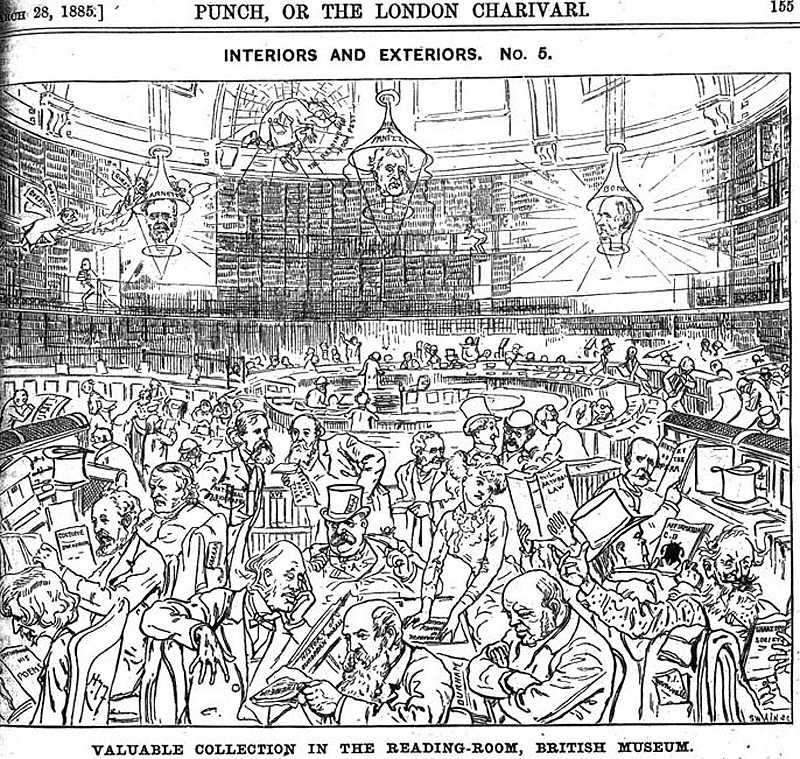 The evidence for reading practices which has received most attention from historians have been, of course, periodical reviews. In the early nineteenth century, periodicals were seen as important sources of advice on reading, informing readers not only about what but also how they should read. What is more, popular and more general periodicals like Wesleyan Methodist Magazine reportedly sold 25,000 copies monthly in 1820—far more than either the Edinburgh or Quarterly reviews—and provided authoritative guidance both on what and how to read. Other scholars have pointed to other sources as well, including conduct manuals, sermons and lectures, as well as personal sources of advice such as conversations and letters, for guidance as reading practices. The main point here is that reading is embedded in oral culture and serves as social intercourse, as social function; and because it is social it has to be practiced in particular ways.
Patterns of Publishing
Readers were largely dependent on the commodity market of the book trade. Indeed, publishers acted as creative agents, responsible for selecting and developing certain forms of scientific publication. Mention has already been made of the rhetorical strategies of the International Scientific Series. Historians of science have traditionally focused on the profound technological advances made in nineteenth-century print, including mechanization of paper manufacturing, national transportation, mass-produced cloth case bindings, and so on. But Topham wants to avoid slipping from a “‘soft’ form of technological determinism to a ‘hard’ form which make changes in print culture…follow ‘inexorably’ from the development of paper-making machines, stereotype moulds, steam presses, or binding cloth.” According to Topham, the development of these technologies were the result of commercial imperatives in the book-trade. These imperatives, moreover, included not only the practices and motivations of publishers, but the concerns of both authors and readers as well.
In a series of books (Judging New Wealth:Popular Publishing and Responses to Commerce in England, 1750-1800 [1992]; The English Novel 1770-1829: A Bibliographical Survey of Prose Fiction Published in the British Isles, 2 Vols.[2000]; and more recently, The Business of Books: Booksellers and the English Book Trade 1450-1850 [2007]), James Raven argues that dramatic changes in publication were chiefly due to fundamental changes in the commercial orientation of the book trade. The roots of these changes, he says, were the commodification of middle-class leisure. The middle-class demanded books, and the book trade in turn developed new genres to exploit the new emerging market, including the novel and the magazine, children’s books and “recreational” books of natural philosophy and natural history, anthologies, and new physical formats such as pocketbooks. “In the book trade of early nineteenth-century Britain,” writes Topham, “publishers were more than ever before innovative entrepreneurs, intent on creating and exploiting new markets with an increasing range of literary products.”
Authorship
All this leads to questions about the dramatis personae of nineteenth-century scientific books. Who were the scientific writers? It is now well-known that many of those who wrote on science were not scientific practitioners themselves. The range of individuals are considerable, including “hack writers,” “compilers”of miscellanies, “fashionable” authors, “professional” journalists, and the band of reviewers in weeklies and monthlies of the general and religious press. Some scholars have gone to great lengths in identifying where such “authors lived or worked, their dedicatees, their occupations, and their educational institutions, together with indexes of printers and publishers and of the places of publication.” Indeed, Bernard Lightman has claimed that “professional scientists…account for only a small portion of the works of Victorian popularizes of science,” and “may have been more important than the Huxleys and Tyndalls in shaping the understanding of science in the minds of a reading public composed of children, teenagers, women, and nonscientific males.”
But distinguishing scientific practitioner who was also scientific author from nonscientific writer is no easy task. Otis in her Literature and Sciences in the Nineteenth Century, often mentions the close relationship between scientific practitioner and literary writer: “anyone who read the works of successful scientists could see immediately that most good scientists were also imaginative writers…to win the confidence of educated readers, nineteenth-century scientists made frequent references to the fiction and poetry of the day and to that of earlier generations.”
But more than mere credibility, the scientific practitioner who was also scientific author had significant financial incentives in composing popular works. Indeed, authorship had been an increasingly valuable source of income for scientific practitioners, beginning in the eighteenth century and onwards, as the market for books on natural subjects greatly expanded.
As an example, Topham looks at the literary labors of Scottish physicist, mathematician, astronomer, inventor, and writer, David Brewster (1781-1868). For Brewster, the financial incentives of science were endless. He supported himself by writing, editing, tutoring, inventing, serving on scientific societies, occasional prizes, and government pension. “Like many of his contemporaries,” writes Topham, Brewster “particularly benefited from the burgeoning range of early nineteenth-century periodicals, becoming a regular reviewer for the heavy quaterlies and an editor of several of the new scientific magazines.”
There was clearly a living to be made from such work in the early nineteenth century. But this revenue came at a cost. Scientific writers were forced to develop a multifaceted persona in which they were both original and authoritative, exhibiting both genius and expertise. For the “aspiring man of science, learning to write within this genre was the prerequisite of success as a scientific author.” More importantly, as Richard Yeo has argued in his essay, “Science and Intellectual Authority in Mid-nineteenth Century Britain” (1989), with popular works like Chambers’ Vestiges of the Natural History of Creation, scientists were provoked in “writing self-conscious works of ‘popular science’ to enforce their claims to authority.” According Topham, it is only by situating scientific authors and their writings within the context of the ever-expanding print culture and the increased status and power of nineteenth-century authors that we can fully appreciate their role in the making of science.
Conclusion
If reading is to become a subject of serious and integrated historical scrutiny, it needs to combine the “external history of reading”—the who, what, where, and when of reading—with the “internal” history of how and why readers read. Alvar Ellegård’s Darwin and the General Reader (1958) relies on the publication of articles on evolution in the British periodical press, and thus is a good example of an entirely “external” reception study. Although Topham criticizes Ellegård as giving “no thought to how such articles were read or responded to by readers,” his chapter on “Science and Religion: A Mid-Victorian Conflict” provides important periodical sources that reveal conflict emerging from discussions of “Higher Criticism” rather than Darwinism; and his earlier work, “The Readership of the Periodical Press in Mid-Victorian Britain” (1957) provides a painstakingly researched directory of nineteenth-century newspapers, weekly reviews, quarterlies, monthlies, journals, and magazines.
To be sure, Ellegård’s attempt to codify public opinion on Darwinism by a statistical analysis of press reaction, classifying responses according to just a handful of possible positions, obscures the vibrancy of debate on the topic. In the final analysis, an external history of reading can only be partial. Sources for an internal history of reading include the book as a semiotic system, its material form as a printed artifact; individual encounters with works recounted in dairies, marginalia, notes, correspondence, and autobiographies; and a history of education, including studies on how habits of reading were instilled in grammar schools and university students.
The idea that the historian might be able to gain a fuller understanding of the experience of nineteenth-century readers of books and periodicals by combining evidence from production, distribution, and consumption with evidence from relating to textual strategies of authorship, and to contemporary reading practices, has far-reaching consequences for the historian of science. Indeed, as Secord puts it, such a pursuit is “a study of cultural formation in action.”
Science and Religion: Some New Historical Perspectives: The Book-history Approach
Posted on November 26, 2013 Leave a Comment
As a doctoral student, Jonathan R. Topham worked under the inspiring tutelage of John Hedley Brooke, coming under the influence of his “diversity of interaction” regarding science-religion relations, which became a central part of his own study of the Bridgewater treatises of the 1830s.
In his essay, “Science, Religion, and the History of the Book,” Topham returns to his initial insights discovered during that study; but, more importantly, he wants to explore the interdisciplinary, book-historical approach to understanding the scientific and religious life of nineteenth-century Britain.
Topham has discussed the field of book history in detail elsewhere, especially in his massively informative “Scientific Publishing and the Reading of Science in Nineteenth-Century Britain: A Historiographical Survey and Guide to Sources” (2000). I shall return to this essay later.
In his essay in Science and Religion, Topham relates how he viewed his work on the Bridgewater treatises as a “means of understanding more widely the interplay of scientific and religious concern in British culture of the period.” Rather than merely focusing on the authors and their ideas, Topham wanted to understand the “entire circuit or network of communication in which the treatises were enmeshed, including publishers, reviewers, libraries, and readers.” Accordingly, he discovered that the treatises were valuable for a range of reasons, from a religiously and politically safe account of the latest findings in several sciences, to a means of protecting religious sensibilities by directly relating scientific findings to divine agency. The latter was necessary, says Topham, for by the mid-nineteenth century there were increasingly new forms of secular “popular science” publishing, such as the sixpenny pamphlets of the Society for the Diffusion of Useful Knowledge (SDUK), which published inexpensive texts intended to adapt scientific and similarly high-minded material for the rapidly expanding reading public. The Bridgewater treatises for Topham “provided important and novel evidence of the manner in which religious (and irreligious) readers from a wide range of social and cultural backgrounds engaged with the sciences in the 1830s.”
Topham is not alone in emphasizing the importance of the history of reading in science-religion relations. James Secord’s Victorian Sensation (2000) shows how Robert Chambers’ (1802-1871) Vestiges of the natural history of creation (1844) developed the self-identity of freethinkers and evangelicals alike, and how, much more than Darwin’s On the origin of species (1859), it provided the “sweeping narratives of evolutionary progress” so central to British culture at the time. William Astore’s Observing God (2001) looks at the career of Thomas Dick (1774-1857), whose widely popular work on science and religion aimed to correct the secularizing trend among evangelicals and contemporary natural philosophers. “Through his many books,” Topham writes, “Dick developed [a] vision of the proper relation of scientific and religious concerns in direct opposition to more secular notions of popular science prevalent in the second quarter of the nineteenth century.” Aileen Fyfe’s Science and Salvation (2004) considers a wide range of publications under the auspices of the Religious Tract Society (RTS), which aimed to counter blasphemy and irreligion in the pauper presses. As Topham writes, “by the 1820s…cheap works of secular ‘popular science’ had begun to proliferate, and by the 1840s the society felt obliged to respond to what it felt to be a threat to Christianity by issuing its own works on science.” Fyfe perceptively concludes that “leading evangelicals in the mid-nineteenth century were concerned about the ‘distorting manner’ in which scientific discoveries were presented, rather than with ‘specific discoveries themselves.'” The RTS was by no means the only publishing house issuing works of popular science to counter secular trends. According to Bernard Lightman’s Victorian Popularizers of Science (2007), “a significant proportion of the most widely read science books in the post-Darwinian era presented the science within a Christian framework markedly at odds with the perspective of the secularizing ‘young guard’ of science typified by Thomas Henry Huxley and John Tyndall.”
Topham also notes, following Secord’s notion of “literary replication,” that important works in the history of science of the nineteenth century were also made known to the reading public through a range of printed and oral formats—including advertisements, excerpts, abstracts, reviews, conversations, lectures, and even sermons. Topham concludes that the book history approach helps to “refocus the history of science and religion from religious and scientific specialists,” to readers, who must be seen to be at least as significant as authors and publishers.
From “who read what, and where?” Topham turns to questions of “who read how, and why?” Like much recent contributions to the history of science, Topham suggests that a shift in historical focus from beliefs to practices is another important element of book history. “For many religious believers,” he writes, “science has been encountered primarily through the practice of reading rather than through experimental or observational practices.” Indeed, the practice of reading among nineteenth-century evangelicals came to reflect a spiritual exercise, “a crucial part of the process by which the individual soul came to know God.” This “religious self-fashioning” is reflected in scientific reading and devotional practices “found throughout evangelical and other Christian writings of the nineteenth century.” The authors Topham reviews all attest to this fact. David Livingstone and James Secord in particular emphasize what has been called the “geographies of reading,” arguing that where scientific texts are read has important bearing on how they are read. Both the practice and place of reading has historical antecedents. Hans-Georg Gadamer’s “fusion of horizons,” Edward Said’s “traveling theory,” Gillian Beer’s “miscegenation of texts,” Stanley Fish’s “interpretive communities,” and Nicolaas Rupke’s “geographies of reception” are a few examples of the latter. The former actually has quite a long history in the Christian tradition. From St Augustine tolle lege, the lectio divina of the Medieval period, to the sola scriptura of the Reformation, thinking by reading and reading by thinking were prominent spiritual exercises of Christian writers.
By focusing on readers, Topham does not want to abandon producers of books, publishers as well as authors. “By taking seriously the financial, vocational, and ideological circumstances in which works on science and religion were produced,” Topham argues, “the historian is better able to understand the motivations underlying the claims made, and therefore the claims themselves.” Thomas Henry Huxley, for example, wanted to establish a new identity of the man of science, in direct opposition to the clerical gentlemen of science. “Most of those involved in producing works on science and religion,” whether author or publisher, “stood to gain professionally or financially, and the focus of book history on the practices of authorship and publishing helps to highlight such concerns.”
Topham concludes that “by refocusing…attention on the everyday practices of a far wider range of people than have previously been considered, historians can recover the nuts and bolts of the cultural history of science and religion.” All communities, author, publisher, reader, were “enmeshed in an industrialized network of print, situated within particular communities, engaged in personal but community-oriented spiritual journeys, and exploring different possible futures for science that the dynamic of historical change took place.”
Science and Religion: Some New Historical Perspectives: Some Words on Evolution and the Politics of Publishing
Posted on November 24, 2013 Leave a Comment
Conflict occurs at multiple levels. Principally, it is a tension created within the mind of an individual when confronted with information and beliefs that appear to be in opposition. Preachers, teachers, writers, media and so on often reinforce dicotomies rather than look for middle ground. These conflicts are, as they have always has been, between competing sources of authority. Conflict, where it has existed, has never been and will never be as simple as “all religion against all science,” for the contest for authority is also being fought out within religions and amongst scientists.
At first glance the current conflict between evolution and creationism appears to be a clear exemplar of the “conflict thesis.” But under closer inspection, it involves setting Christian biblical literalism against religious liberalism as well as against evolutionary and geological science.
The origins of our modern situation are reviewed in Bronislaw Szerszynski “Understanding Creationism and Evolution in America and Europe.” “What was new and arguably more significant in Darwin’s work,” writes Szerszynski, “was the idea that the emergence of new and often more complex species could be explained by ‘natural selection’: by the way that environmental pressure will favour the reproduction of those individuals that possess certain characteristics, a process that over a long period of time can radically alter the characteristics of an interbreeding population.”
The influence of Darwin’s ideas are indisputable. But as his ideas circulated in wider society, they were used to legitimate an extraordinary range of socio-political ideologies, from Marxism to eugenics and ideas of racial supremacy. And since the 1940s, when genetics was combined with the idea of natural selection, producing what became known as “the modern synthesis” or neo-Darwinism, Darwin’s ideas have come to be seen as a hugely important part of our understanding of living things. With the success of rDNA technology in the 1970s and the reading of the human genome in the early twenty-first century, biological science attained an extraordinary symbolic significance as a potential basis for technological innovation, capital accumulation, medical advance, and environmental protection. Thus it is terribly important to keep in mind that Darwin and his theory of evolution have come to symbolize a cluster of cultural values (e.g. Enlightenment reason, anti-dogmatism, but also the modern project of mastering nature for the well-being of humanity); and that these values are threatened by the rise of creationism in the last few decades.
From the beginning, reaction to Darwin’s ideas among the religious were complex and varied, ranging from outright rejection to enthusiastic acceptance. But today “the polarized public contest between the advocates of naturalistic evolution and those of scientific creationism tends to mask the diversity and complexity of contemporary belief,” making it increasingly difficult to form a measured assessment of the doctrine of creation amongst religious thinkers. Thus Szerszynski wants to understand creationist beliefs, “not in the form of public polemics and campaigns but in terms of the private beliefs and opinion polls.” He says we need to “situate” these beliefs against the religious landscapes of Europe and America.
In trying to understand creationist beliefs, Szerszynski pursues three different types of studies. The first consists of mainly historical studies of the individuals and organizations that have been actively promoting creationist ideas over the last 100 years. According the Szerszynski, creationist ideas have evolved tremendously over the last century. William Jennings Bryan (1860-1925), for example, was not a strict biblical literalist, since he subscribed to a “day-age” creationism in which each day of Genesis was to be interpreted as a geological epoch. However, George McCready Price (1870-1963) insisted on a literal reading of Genesis, and thus a young earth. John C. Whitcomb and Henry M. Morris continued Price’s arguments in their own work. By the 1990s there was significant new development with the rise of a theory of Intelligent Design (ID). The key development of ID were worked out in Phillip E. Johnson’s Darwin on Trial (1991) and Michael Behe’s Darwin’s Black Box (1996). Soon thereafter Stephen Meyer established the Center for Science and Culture in Seattle, Washington, with funding from the Discovery Institute, a non-profit policy think tank best known for its advocacy of ID and “Teach the Controversy” campaign. According to Szerszynski, despite some temporary victories, ID has not been recognized as a credible scientific research program.
Another kind of study consists of quantitative data gathering, most common in America but also carried out elsewhere, which try to determine the distribution in different national populations of ideas about the origin and development of life, and of human beings in particular. Gallup polls, for example have found fairly consistent results over the last quarter-century, indicating a high incidence of creationist beliefs among Americans: in 2008 44% of those polled adhered to some form of creationism, whereas 36% adhered to theistic evolution , and only 14% supported evolution by natural selection. The numbers were markedly different elsewhere. In the EU, for example, an average of 70% polled adhered to evolution, “ranging from over 80 per cent in Iceland, Denmark, Sweden, and France to 50 per cent or less in Bulgaria, Lithuania, Latvia, and Cyprus.” Surveys and polls, however, are always problematic, and Szerszynski points out some issues. But “overall it appears from poll data that, while in America the ratio of young-earth creationists to theistic evolutionists to naturalistic evolutionists is approximately 45:35:15, in Europe it is probably more like 20:20:45.”
And finally, the third kind of study involves attempts to understand why people believe in evolution or creationism. In both cases, however, reductionistic reasons have been given for belief, failing to do justice to why people hold to an evolutionary perspective or the creationist one. In place of this kind of study, Szerszynski wants to “attend to individual sense-making processes.” Combing the historical, quantitative and qualitative studies, he says, might help to place creationist beliefs in socio-historical context, and thus offer a much better understanding of them.
It has become a commonplace in the literature on creationism to say that the main reasons creationism is less common in Europe than in America are, first that European society is more secular, and, second, that the religious life of the continent is dominated by churches that have broadly accepted the truth of Darwinian evolution. Szerszynski rejects such platitudes. According to such scholars as diverse as David Martin, Peter Berger, and José Casanova, European thinkers had developed their theories of inevitable secularization by generalizing inappropriately from a distinctively European experience of religious decline. In any case, it has become recognized that secularization is not “a single, unified, and linear process but one that proceeds in ways that are contextually specific.”
According to Szerszynski, “attending to the broadly contrasting nature of religion in America and Europe can not only help explain differential distribution of creationist beliefs but also provide insight into their differential societal meanings.” In Europe, for example religion is significantly woven into its tradition through binding symbols and rituals, whereas in America religion is shaped by pilgrimage and revolution, in the very rejection of old churches and their hierarchies.
Szerszynski also contrasts modern European and American educational systems and, using recent sociological research, suggests that religious education is just as important as scientific education in shaping popular attitudes to evolutionary science and to creationism. For example, Europe is characterized by greater levels of state control over educational systems than is the case in America. And, interestingly enough, polls conducted across European and American schools found that whereas most teachers in Europe favored discussing creationism in classrooms, American teachers did not. Even more interesting, recent statistical research on American and European “civic scientific literacy” showed that “28 per cent of American adults but only 14 per cent of European Union adults qualified as scientifically literate.”
But scientific literacy is not enough, says Szerszynski; religious literacy is just as important here—if not more. In stark contrast to American educational institutions, religious education has been a standard element of most European school curricula. In this context religious education has two goals: the first is confessional; the second is that of stimulating a reflexive understanding of religion and its place in history and contemporary society. This leads Szerszynski to the conclusion that “the strength of American creationism is not simply a product of the buildup of resentment among religious communities that their own teachings and values are not represented in education of the young; it is also a product of the lack of religious literacy in the second sense among the American population. So religious education is arguably as important as scientific education in creating the conditions for the public to understand and critically assess the significance of creationist ideas.”
The theory of evolution has indeed come to symbolize a cluster of cultural values, and in some sense has become a particular kind of “civil religion” for modern society. In the cultural conflict between the two worldviews of evolutionary theory and creationism, evolutionary theory became a boundary object: “the progressivists used evolution as a new salvation narrative which underscored progress and human achievement, the fundamentalists saw it as a symbol for a godless, immoral culture.” Thus it should be no surprise that American creationists see this “atheistic humanism” as reducing the human to mere biology. Europeans, on the other hand, have found an alternative way. In the European context, writes Szerszynski, “a very different humanism, grounded less in the natural sciences and more in the humanities and social sciences, has helped provide not just a vocabulary for thinking about…’the human condition’ but also its own critique of biological reductionism that has nothing to do with either biblical literalism or religious enthusiasm.” “Instead of interpreting the creationist controversy simply as an issue about science,” he concludes, “perhaps we should use it as an occasion for reflecting about the importance of the development of such rich vocabularies for the full flourishing of what is to be human.”
The aggressive American-style evangelism now spreading around the world has chosen evolutionism as a symbol of the modernizing social trends it abhors. Of course there are more localized issues involved too, illustrated keenly by Adam R. Shapiro’s “The Scopes trial beyond science and religion,” demonstrating that the Scopes “Monkey Trial” of 1925 was made possible only by political decisions concerning the buying of new high-school textbooks in Tennessee, the publicity of a small rural town, and American self-identity. Rather than seeing the Scopes trial as another episode in the inherent “conflict” or struggle between science and religion, Shapiro wants to situate its uniqueness in Dayton, Tennessee.
In 1923 Tennessee governor Austin Peay took note of existing contracts with textbook publishers, which were set to expire the following year. In 1919 the state had signed a contract fixing the prices of textbooks for the next five years. The timing was unfortunate. Tennesseans would have to pay an increased fee for classroom textbooks, two months before Peay would have to stand for re-election. Thus “Peay, along with his Commissioner of Education and political ally, Perry L. Harned, devised a strategy to avert this political difficulty.” In April 1924, the State Text Book Commission unanimously decided to defer the adoption of text books until 1925. “Thus a political difficulty was converted into a boon. Voters would not feel the effects of a price increase until after the election, preventing it from becoming an issue against Peay in the election.”
This deferment, however, left Tennessee schoolchildren with a ten-year-old biology textbook; namely, George W. Hunter’s 1914 book, A Civic Biology. But biology textbooks had changed significantly since Hunter’s book was first written. Indeed, Hunter’s book was central to the trial. One month before the trial, for example, William Jennings Bryan wrote to a colleague: “If you have not read the book in question, ‘Hunter’s Civic Biology’, I suggest you get it. It certainly gives us all the ammunition we need.” Shapiro notes that other textbooks published in 1923 and 1924 had adopted, unlike Hunter, a more cautious attitude towards evolution. The Civic Biology, moreover, focused on issues of quarantine, food safety, and the improvement of human society (including a substantial section on eugenics), and thus was geared towards urban schools, not rural areas like Rhea Country, Dayton’s county seat. Indeed, when Tennessee adopted Hunter’s book in 1919 it was adopted for all public schools in the state. Rural populations like the one in Dayton found it deeply offensive that they were compelled to use a biology textbook that touted the benefits of urban life, rather than the more traditional structure of botany, zoology, and physiology.
There was also some publicity at stake. Shapiro reminds readers that the “citizen of Dayton seized upon the opportunity to host a test of the anti-evolution law as a means to promote their town.” Indeed, after Scopes was indicted, other towns attempted to follow suite, when citizens of Chattanooga sought to co-opt the publicity of the trial by indicting a schoolteacher of their own. Dayton had experienced the boom and bust of industrialization, and thus needed to reinvent itself, to draw more people into their rural community. One way of drawing in the population was to portray Dayton as the typical American town, one pamphleteer declaring that Dayton was “America—a town of a few thousand, in a region of fruit and corn and dares and littler groves.” “In one sense,” Shaprio suggests, “claiming that Dayton was Main Street, USA, was an attempt to establish Dayton’s character as typically American.”
According to Shaprio, “the complex network of concerns over economy, culture, industry, demography, and education was aligned by competing groups in the Scopes trial and then replaced by the universalizing rhetoric of science-and-religion conflict.” The trial “created a science-religion conflict more than it ever accurately embodied a pre-existing one.” And finally, “it was people—not ideas—that fought in Dayton. The reasons they were fighting were much more complicated than whether ideas they held were incommensurable.”
A Brief Word on Nineteenth-Century Periodicals
Posted on November 22, 2013 Leave a Comment
Interrupting the flow of my synopsis of Dixon’s et al. Science and Religion: New Historical Perspectives, I want to briefly share some exciting research prospects.
I have been burying myself in recent weeks in literature on the popularization of science and the circulation of periodicals and newspapers in nineteenth-century Britain. A number of scholars have been at the forefront of this kind of research. Books of significant import include James A. Secord’s Victorian Sensations: The Extraordinary Publication, Reception, and Secret Authorship of Vestiges of the Natural History of Creation (2000), Bernard Lightman’s Victorian Popularizers of Science: Designing Nature for New Audiences (2007), and an anthology of scientific and literary material edited by Laura Otis, Literature and Science in the Nineteenth Century (2002). Other edited works include Geoffrey Cantor, Gowan Dawson, Graeme Goody, Richard Noakes, Sally Shuttleworth, and Jonathan R. Topham’s Science in the Nineteenth-Century Periodical: Reading the Magazine of Nature (2004); Louise Henson, Geoffrey Cantor, Gowan Dawson, Richard Noakes, Sally Shuttleworth, and Jonathan R. Topham’s Culture and Science in the Nineteenth-Century Media (2004); and Geoffrey Cantor and Sally Shuttleworth’s Science Serialized: Representation of the Sciences in the Nineteenth-Century Periodical Press (2004). Also very enlightening are Bernard Lightman’s Victorian Science in Context (1997), Aileen Fyfe and Barnard Lightman’s Science in the Marketplace: Nineteenth-Century Sites and Experiences (2007), and David N. Livingstone and Charles W.J. Withers’ Geographies of Nineteenth-Century Science (2011).
Important antecedents to this more recent surge in periodical research are found in J. Donn Vann and Rosemary T. VanArsdel’s Victorian Periodicals and Victorian Society (1994), Alvar Ellegard’s Darwin and the General Reader: The Reception of Darwin’s Theory of Evolution in the British Periodical Press, 1859-1872 (1990), John Christie and Sally Shuttleworth’s Nature Transfigured: Science and Literature, 1700-1900 (1989), George Levine’s Darwin and the Novelists: Patterns of Science in Victorian Fiction (1988), Sally Shuttleworth’s George Eliot and Ninteenth-Century Science: The Make-Believe of a Beginning (1984), and Gillian Beer’s Darwin’s Plots: Evolutionary Narrative in Darwin, George Eliot and Nineteenth-Century Fiction (1983). The work of such scholars show how numerous literary writers of the nineteenth century actively engaged with scientific themes in essays, novels, and poems. But they also show, according to Otis, how numerous scientific writers were also “imaginative writers,” depicting the world “imaginatively so that they could draw inferences about invisible phenomena based on observable effects.”
Included in this list are a host of articles and essays published in various academic journals. The Special Section of the 2000 issue of The British Journal for the History of Science contains essays exploring historical encounters of readers with printed matter, books, newspapers, magazines, almanacs, tracts, pamphlets and so on. Essayists include Jonathan R. Topham, “Book History and the Sciences”; Adrian Johns, “Miscellaneous Methods: Authors, Societies, and Journals in Early Modern England”; Leslie Howsam, “An Experiment with Science for the Nineteenth-Century Book Trade: The International Scientific Series”; and Nicolaas Rupke, “Translation Studies in the History of Science: The Example of Vestiges.” The nineteenth century is a field I am not particularly familiar with, so another essay by Jonathan R. Topham, “Scientific Publishing and the Reading of Science in Nineteenth-Century Britain: A Historiographical Survey and Guide to Sources,” published in Studies in History and Philosophy of Science (2000) has become an invaluable source.
More recently, James Secord’s astutely titled review essay, “The Electronic Harvest,” in The British Journal for the History of Science (2005) shows how “a digital scanner linked to optical character recognition software is the combine harvester of twenty-first century scholarship,” which has, in a few short years, reaped “electronically the results of centuries of literary production.” In 1999, the Division of History and Philosophy of Science in the University of Leeds and the Department of English Literature in the University of Sheffield, and under the guidance of Geoffrey Cantor and Sally Shuttleworth, initiated the Science in Nineteenth-Century Periodical project, known commonly as “SciPer.” The project’s aim “has been to analyse the representation of science, technology, and medicine, as well as the inter-penetration of science and literature, in the general periodical press in Britain between 1800 and 1900.” The project’s prodigious electronic index includes thousands of periodicals of nineteenth-century Britain: Youth’s Magazine, Nineteenth Century, Westminster, Quarterly, Fortnightly, Edinburgh Reviews, Cornhill Magazine, Illustrated London News, Punch, Comic Annual, Mirror of Literature, Review of Reviews, Englishwoman’s Domestic Magazine, Wesleyan-Methodist Magazine, Nature, North American Review, All the Year Round, Friend, Dublin Penny Journal, Evangelical Magazine, Contemporary Review, Philosophical Magazine, Philosophical Transactions, and much, much more. Other extremely helpful electronic indexes include Poole’s Index to Periodical Literature, 1802-1906 and the well-known Wellesley Index of Victorian Periodicals, 1824-1900.
“Periodicals,” write Dawson and Topham, “represent some of the most significant material and cultural forms through which the sciences were communicated and debated in the Victorian period.” Studying the intertextual field afforded by nineteenth-century periodicals will hopefully yield a better understanding of science-religion relations in that century and, more importantly for my own research, the origin, definition, and dissemination of the conflict narrative between the two.
Science and Religion: Some New Historical Perspectives: A Word on Narratives
Posted on November 21, 2013 Leave a Comment
Having discussed the implications of recent literature that categorizes both “science” and “religion” as nineteenth-century social constructs, the same argument is applied to the scientific revolution by Margaret J. Osler in “Religion and the Changing Historiography of the Scientific Revolution.”
The idea that there was a “Scientific Revolution” between 1500 and 1700 and that this marked a definitive moment of separation between science and religion was, Osler argues, the creation of nineteenth-century positivists and twentieth-century historians who read their own secularist aspiration and experiences back into the history of the sciences during a period when they were, in fact, pursued in a climate of diverse, serious, and vibrant theological concern.
Beginning in the eighteenth century, Denis Diderot (1713-1784) and Jean le Rond d’Alembert (1717-1783), in giving a historical account of the sciences, lauded thinkers of the seventeenth century for their scientific achievements while “scorning what they considered the irrationality and authoritarian attitude of religion.” During the nineteenth century, the ascendency of positivism, promoted by Auguete Comte (1798-1857) and Ernst Mach (1838-1916), predetermined how a retinue of historians of science would view the relationship between science and religion. Comte propounded a two laws. First was the “historical law” in which humanity passed through a theological, metaphysical and then culminating to a “positive” or scientific stage. The second was an “epistemological law,” which classified the sciences in a hierarchy determined by their sequence of arriving at the positive state and their increasing complexity. In all this “religion had to be eschewed before positive science could progress.” Mach rejected all metaphysical claims, arguing that such claims could not be proven empirically. He located the origin of modern science in Galileo. And like Comte, Mach accused religion of stifling the progress of science.
Osler argues that both Comte’s law of stages and Mach’s outline of history “profoundly influenced the formation of the history of science as an academic discipline in the twentieth century.” The other nineteenth-century influence came from American defenders of “secular” education in the sciences, namely John William Draper (1811-1882) and Andrew Dickson White (1832-1918). According to Osler, the “conflict” model of Draper and the “warfare” metaphor of White “dominated discussions of the relationship between science and religion” in the twentieth century.
Both the positivists and the Draper-White thesis influenced the work of, for example, George Sarton (1884-1956), who once wrote that “Auguste Comte must be considered as the founder of the history of science, or at least as the first who had a clear and precise, if not a complete, apprehension of it.” Sarton also referred to White’s warfare metaphor with approval. Other historians, including Edwin Arthur Burtt, Alexandre Koyré, Herbert Butterfield, Richard S. Westfall, and others agreed that the “scientific revolution” was a dramatic break with earlier ways of thinking and that it resulted in a profound change in the concept of nature and, indeed, in the relationship between science and religion. The end result, in short, is that “historians of science in the twentieth century tended to see what they considered a progressive separation of science from religion” and the gradual secularization of modernity.
According to Osler, these historians influenced others, further aggrandizing the unexamined assumptions formulated by the nineteenth-century positivists. In the late twentieth century, however, major challenges to this “classical” or “traditional” narrative emerged. Scholars began arguing that the “entire enterprise of studying the natural world was embedded in a theological framework that emphasized divine creation, design, and providence.” That is, seventeenth-century natural philosophers “believed that the study of the created world provided knowledge of the wisdom and intelligence of the Creator.” Many historians have contributed to what Osler characterizes as a major “sea-change” or “shifting tide,” including P.M. Rattansi, J.E. McGuire, B.J.T. Dobbs, Stephen D. Snobelen, Peter Harrison, and Jan W. Wojcik, only to give a small sample.
In her conclusion Osler asks what caused this sea-change? Osler suggests that the historiography of the scientific revolution of the middle decades of the twentieth century occurred within the optimistic environment of “big science” and “massive government funding.” However, fear of nuclear holocaust, awareness of environmental degradation, the revival of occult practices of New Age spirituality, a new emphasis on social history and feminist studies, and the growth of fundamentalist religion, in Christianity, Islam, and Judaism undermined unqualified faith in science in the late twentieth century. It was in this context, Osler suggests, that historians of science finally began recognizing the complex relationships between science and religion.
Nineteenth-century positivists and twentieth-century historians clearly read their own secularist aspirations and experiences back into the history of the sciences. Frank M. Turner, in the following essay, offers a closer analysis of the “conflict thesis” itself, with reference to its origins in the intellectual and cultural world of the late-nineteenth century.
According to Turner, the relationship of science and religion passed from “fruitful co-operation and modest tension to harsh public conflict, a situation that many observers have since come incorrectly to assume to be a permanent fact of modern cultural life.” Certain transformations occurred in the nineteenth century “within scientific and religious communities and changes in the structure of publication, education, and wider cultural discourse,” which more narrowly circumscribed “science” and “religion,” thus abstracting them from their historical context.
Between 1840 and 1890, Turner tells us, numerous controversies erupted between science and religion. Darwin’s theory of evolution by natural selection, Spencer’s cosmic evolution narrative, Tyndall’s materialism, anthropological theories of human pre-history and religion, and the rise of textual criticism all issued much debate amongst nineteenth-century thinkers. But we must recognize, Turner warns, that there is no necessary or existential conflict: “modes of idealism, naturphilosophie, natural religion, theism, and ethical progressionism informed the work and personal values of numerous natural philosophers. These metaphysical, theological, and moral factors were not extrinsic to their pursuit of natural knowledge but part and parcel of it and for many scientists…remained so certainly to the end of the nineteenth century, if not well beyond.”
But during the nineteenth century various scientific communities arose to compete with religious authority, defining “science” within a narrower professional and naturalistic framework. Likewise, social, institutional, devotional, and theological phenomena subsumed under the term “religion” experienced transformation, manifesting liberal, rational, or moderate associations, the rise of “bibliolatry” among evangelical Protestants, an aggressive Roman Catholicism asserting its theological and ecclesiastical authority, and a general hostility between and among Christian groups. “Thus by 1860,” writes Turner, “European churches were engaging with their cultures, asserting their authority, and championing the Bible much more intensely than their forebears had a century earlier.”
However, it is important to note that this hostility was not between “religion and science,” or more precisely Christianity and science; rather, it was between Christianity and materialism or atheism, skeptical rationalism, theological heterodoxy, ecclesiastical irregularity, or attacks by the secular state. This ideas eventually morphed into a new definition of science, for those who pushed for new notions of science also espoused materialistic or atheistic, skeptical rationalistic or theologically heterodox ideas. Harking back to the French Revolution, Turner reminds us that revolutionaries’ anthems for science were often simultaneously coupled with attacks on religion, which undeniably raised nineteenth-century apprehensions that “scientific thought or culture might endanger religion and the social status quo.” “Science could,” Turner suggests, “be socially, politically, and religiously dangerous, especially when it displayed connection or sympathy with French culture.”
Working within a propositional fallacy, many conservative religious figures of the nineteenth century argued that “if ideas bearing the whiff of French materialism, tranformationism, or religious heterodoxy were embraced, published, or advocated, then atheism, immorality, anti-clericalism, and social disruption might (or must) follow.”
From the 1840s to the 1860s, many thinkers abandoned religious and philosophical outlooks when they changed their view on the social status quo, for such outlooks were intimately intertwined with existing political and social structures. As Turner notes, British natural theology provided both a theological and a social theodicy. The Bridgewater Treatises (1833-1840), for example, combined “intricate theological explications of nature with arguments supporting the contemporary British social and political status quo.” But these theodicies were fragile indeed, and a younger generation of scientists, discontent or even disgusted with existing boundaries of thought and action, either abandoned or wholly rejected them.
Ironically, by the mid-nineteenth century works began appearing challenging the “morality of the churches, the elitism of the major scientific societies, and the idea that any elite could control the discourse of natural knowledge.” Turner summarizes this development with an extended quote from Martin Fichman’s An Elusive Victorian: The Evolution of Alfred Russel Wallace (2004), worth quoting at length here as well:
as advocates of a specific idea of science professionalization they were committed to constructing a definition of value-neutral and hence ‘objective’ science…The scientific naturalists recognized the professional gains to be had by proclaiming the ideological neutrality of science. Huxley and his camp could claim that they spoke as objective experts, not political or ideological partisans. This strategy involved erecting an epistemological divide between science and politics, ethics, religion, and other cultural forces. It also encouraged a distinction between elite and popular science…Such a strategy was brilliant but disingenuous. The scientific naturalists invoked an ‘ideologically pure’ science that concealed their own varied sociopolitical agenda behind the banner of rigorous professionalism.
New definitions of “science” were merely one side of the equation. The other side were new approaches to religion: “By about 1850 the contours of religious thought had undergone as much reconfiguration as science.” Protestant bibliolatry, with its growing emphasis on a literal reading of scripture, and an increased uncompromising attitude after the publication of Darwin’s Origins resulted in much sharper conflict over science. Roman Catholicism also underwent intellectual transformations that precipitated outright conflict with scientists. Pope Pius IX in 1864, for example, issued the Syllabus of Errors, putting the Roman Catholic Church in direct opposition not only to liberal politics but also science. In turn, the Tractarian Movement, led by John Henry Newman (1801-1890), argued that the authority of the Church should principally direct the faith of Christians, but in so doing he only cast further doubt on the historical authority on the Bible. The German philosophy of Friedrich Schleiermacher, with his emphasis on a “theology of feeling,” provided another context for men of science and others to question older, traditional modes of religious life. Finally, voices of liberal biblical interpretation looked to advances in the physical sciences to aid them in their efforts to transform the reading of scripture and to challenge ecclesiastical authorities. “Just as the emerging generation of scientists sought to pursue new professional independence in thought and organization,” Turner writes, “various religious groups and theologians sought to establish their own intellectual and institutional independence.”
The medium in which this emerging conflict entered the public sphere were various. First was the unprecedented expansion of journals, scientific publications, religious papers and magazines, and Bible production. The learned periodical, according to Turner, “came to constitute a world of self-referential exchange and debate.” Second, the expansion of education, with the growth of government expenditures fostered conflict as different interest groups fought for resources and institutional authority. Finally, the prosperity and optimism of the mid-nineteenth century made the social dangers stemming from materialism no longer seemed necessary.
Turner thus reminds us that we should not discount the existence of real conflicts between science and religion in the nineteenth century. The fact that a strong public sense of a conflict between science and religion emerged when it did still itself needs to be explained. Particularly important for Turner is an appreciation of the history of religious life and thought during the nineteenth century, the emergence of a new sphere of state education, and the expanding literate sectors of transatlantic intellectual life.
Science and Religion: Some New Historical Perspectives: A Word on Categories
Posted on November 20, 2013 1 Comment
 Borrowing a line from Steven Shapin’s The Scientific Revolution, Dixon, Cantor, and Pumfrey’s Science and Religion: New Historical Perspectives (2010) may be said to argue that “there is no such thing as a conflict between science and religion, and this is a book about it.” Whenever the words “science” and “religion” appear together in a sentence, they are likely to conjure up other words like “debate,” “conflict,” and “inevitable.” That set of associations, real or imagined, is the underlying subject of this book. A fascinating set of subjects, including discussions on “categories,” “narratives,” “evolution and creationism,” and “the politics of publishing,” are all brought together in honor of John Hedley Brooke, celebrating his work in redefining the narrative of conflict between science and religion.
Dixon, in his introduction, describes the narrative as embodying “the hackneyed but popular idea that, ever since the Scientific Revolution, ‘science’ and ‘religion’ have been locked in a deadly battle in which science emerges triumphant.” But as the work of Brooke clearly demonstrates, says Dixon, one should adopt a far more nuanced perspective.
The influence of Brooke is so great, Dixon admits, “one might be forgiven for thinking that there was some pro-religious apologetic intention lurking here. At the very least, whatever the intentions of particular historians, the scholarly destruction of the conflict thesis is of obvious utility to those seeking to argue for the reasonableness of religious belief on the basis of its compatibility with modern science.” Thus there is a real danger that the new history tends to paint science as the aggressor and religion as the victim, of confusing dismissal of narrative of conflict and denial of any actual conflict. But Brooke has always displayed remarkable balance here. Brooke argued against the overly simple assumption that conflict between science and religion is inevitable because of the essential nature of the two and that all interactions between the two must be adversarial. But that is different from saying that there is, or has been, no conflict. For Brooke there is not just one “science” or one “religion,” and any interplay between whatever science and religion was, is—and are—socially conditioned. In other words, both sides of the apparent debate must be seen as necessarily complex and contextualized.
Science and Religion is not a book about science and religion per se, for nowhere in the text do either terms receive definition (or even conflict). Rather, the authors remind readers, again and again, that science has changed since its eighteenth-century days as natural philosophy, and that religion is neither a set of beliefs nor a code of practices, but some undefined mixture of the two. The book is instead a work of historiography, that is, “the study of the way history has been and is written…the changing interpretation of those events in the works of individual historians.” While each chapter has its own particular subject, a key theme developed throughout is the insistence that there can be no simple one-to-one relationship between science and religion, because each area of science and each branch of religion will react to the interaction in different ways at different times.
Under the rubric of “Categories,” Peter Harrison starts things off with considering the historically conditioned nature of “science” and “religion.” He discusses the implications of recent literature that categorizes both terms as nineteenth-century social constructs. Presumed continuities in the history of science are called into question when we realize that the “sort of activities that are part of science at any one time are extremely heterogeneous, and they change through time.” He looks at the connotations of “science” in the ancient, medieval, and early modern periods, arguing that “science” was never independent from “religion.” In the early modern period, for example, the study of nature took place within the boundaries of “natural philosophy,” which was “frequently pursued from religious motives…based on religious presuppositions” and drew “social sanctions from religion.” The birth of the modern discipline of science took place during the nineteenth century, often serving the political purposes of those deploying “a rhetoric of conflict between theology and science.” The historizing of the term therefore shows that “science” is a human construction and reification.
But if “science” is a category that took on its characteristic form during the nineteenth century, “religion,” defined as a belief in certain propositions (about God, humanity, redemption and so on), is a category that first emerged amongst Enlightenment scholars grappling with the fragmentation of Christendom in the Reformation. Following the work of Wilfred Cantwell Smith, Harrison evokes the etymological origins of religio, arguing that during the medieval period “religion” had been “faith or piety—an inner dynamic of the heart” (see also Harrison’s ‘Religion’ and the Religions in the English Enlightenment [1990]). A shift occurred, however, beginning in the European Enlightenment and culminating during the nineteenth century with the creation of “religion” as a reified entity. This new conception, which was intended to model religion on the newly emerging sciences, “was less about emulating Christ than it was about giving intellectual assent to the doctrines that he had preached.” Not surprisingly, “religion” defined in these terms began to look like an inferior or immature version of science rather than a spiritual exercise. “The problem of the relation of Christianity to science is thus,” writes Harrison, “a problem generated to a large degree by the categories in question.” “It is the God of the philosophers,” he continues, “who figures in many discussions of the science-religion relation—the God who is necessary cause for the existence of the universe, who sustains the created order and its mathematical laws, who works, if necessary, within quantum uncertainties, in short the God in whom reason induces belief.”
Harrison concludes with some prospects of future science-religion discussions. First, those who deploy such abstractions as “science” and “religion” must do so with great sensitivity to their limitations and their inherent distorting affects. As such, it is important to also consider the political dimensions that each category and their relations has served. Moreover, the personal dimension of individuals espousing one view or the other ought to be taken more seriously. And finally, historical analysis is key in providing insight and visibility to such categories, events, and figures.
The suggestion that “religion” is better seen as spiritualizing practice or exercise, or the “inner dynamic of the heart,” rather than as belief systems is intended to challenge the way we have viewed its relationship with “science.” If we adopt an artificial definition of religion modeled on science, it is easy to see why the two areas have come to be depicted as mutually exclusive or hostile to one another—”science” is simply replacing an obsolete version of its own, perennial program. The implication seems to be that if we switch our definition of religion to focus solely on practice, the arena for conflict simply disappears because we are no longer looking at rival systems based on assent to proposition about the world.
But just how far can this approach take us in the area of science and religion? Can we really say that religion never focuses seriously on beliefs? This problem is highlighted in the following chapter by Jan Golinski on Bruno Latour’s religion. Latour, a sociologist of science and an anthropologist known for his work in the field of science and technological studies, is not widely known outside France that he is a practising Catholic who nevertheless insists that his religion is also non-propositional. According to Golinski, Latour sees a problem in belief-centered definitions of religion, “it assimilates religion to a scientific or factual model, in which it is taken to be primarily concerned with making claims about reality.” Religion is misunderstood “if it taken to operate in the same way science does. It does not share the aim of aligning representations so that information is transmitted effectively.” The notion that religious imagery and language represent a hidden reality behind that experienced by science is a double mistake: mistaken in its assumption that science grasps reality directly, and mistaken in ascribing the same aim to religion. Rather than a system of factual knowledge or beliefs, Latour argues, religion is performative, that is, it transforms both enunciator and audience. That is, religion “operates performatively by making something present in the act of enunciation; and what they make present is what Latour calls ‘the divine.'” “Religion is not about transcendence,” he writes, “a Spirit from above, but all about immanence to which is added the renewal, the rendering present again of this immanence.”
As Golinski points out, however, “those who hold certain theological doctrines as central to their faith will see Latour’s analysis as another version of the human sciences’ attempt to explain religion—and thereby to explain it away.” But more importantly, according to Golinski, Latour “overstates his case when he asserts that religion has only been construed as a system of beliefs since science established its epistemological primacy” in post-Reformation Europe. If this were true of all religion, particularly Christianity, why all those heresy disputes and trials in the past? According to scholars like Philip Schaff, Jaroslav Pelikan, J.N.D. Kelly, and John H. Leith, “Christianity has always been a ‘creedal’ religion in that it has always been theological.” It was rooted, writes Leith, “in the theological traditions of ancient Israel, which was unified by its historical credos and declaratory affirmations of faith.” Interestingly enough, the discomfort with creed or doctrinal statements is itself a byproduct of the modern consciousness. “The eighteenth and nineteenth centuries” were marked, Claude Welch observes in his Protestant Thought in the Nineteenth Century, by “the antidogmatic, antienthusiatic temper of an age tired and disgusted with religious controversies.” In turn an emphasis emerged on authentic “faith,” of personal feeling and experience. The fides quae creditur was subordinated by the fides qua creditur, the “faith which one believes” to the “faith by which one believes.” Defined most memorably by Friedrich Schleiermacher (1768-1834), in his The Christian Faith, as “the feeling of absolute dependence,” this revised definition of “religion” or “faith” replaced not only the traditional proofs for the existence of God, but of dogma, creed, and confession as well. Golinski also argues that “the notion that science provided an epistemic model that influenced conceptions of religion has more plausibility in the nineteenth century, when the cultural authority accorded to science had increased considerably.”
At any rate, “science” and “religion” are clearly products of the eighteenth and nineteenth centuries. “Science,” in the modern sense, was invented sometime between 1780 and 1850. The term “scientist” was first coined by William Whewell in 1833, but not widely adopted until the end of the century. Religion, particularly the Judeo-Christian kind, has historically been doctrinal, propositional, creedal, and confessional. After the Reformation, with the emergence of abundant new sects, it only became more confessional. Exhausted by the religious wars, a new emphasis soon emerged, encouraging a Christianity of more feeling and emotion than of intellectual assent to certain propositions. This new religion of feeling, however, was juxtaposed to a new understanding of science in the eighteenth and nineteenth centuries, and, in the end, came out lacking. The point is that both categories are products of long gestation that require detailed contextual and historical analysis in order to make sense of science-religion discussions.
Conflict in History: Science and Religion
Posted on November 19, 2013 Leave a Comment
Conflict Between Science and Religion
With this post I transition from historicizing the “scientific revolution” and into my own particular area of research, namely, on the relationship between science and religion in Victorian Britain. The two are closely related, however. When popular narratives of the “revolutions in science” first emerged, during the late eighteenth and early nineteenth centuries, they were often in conjunction with new definitions of “science” and “religion” and their respective relationship.
 One of the books that first caught my attention regarding the relations between science and religion was John Hedley Brooke’s Science and Religion: Some Historical Perspectives (1991). I had initially dabbled with the “conflict thesis” of John William Draper (1811-1882) and Andrew Dickson White (1832-1918) from my reading of Owen Chadwick’s The Secularization of the European Mind in the Nineteenth Century (1975), but it was in Brooke’s Science and Religion where I first learned of the complexity of science and religion relations. It was as an undergraduate when I located his book in the university library, my curiosity exponentially increasing as I studied its portentously lime-on-black cover, seemingly calling out to me tolle lege, tolle lege. Not waiting to return to my study carrel, I began reading its introduction, inevitably settling on the floor there between the stacks, where I would remain all day mesmerized by its contents.
Brooke’s Science and Religion masterfully demolished the hackneyed “conflict thesis.” This new history of science replaced simplistic master-narratives with a richer sense of the complexity of past engagements between science and religion; it placed those intellectual engagements firmly in their proper social and political contexts; and it undermined the very idea that “science” or “religion” could be reified as entities with timeless essences. Once I had stepped foot into this stream of Brookean historiography, I was swept away, becoming a confirmed and irredeemable history of science addict.
“Conflicts allegedly between science and religion,” Brooke suggests in the introduction of Science and Religion, “may turn out to be between rival scientific interests, or conversely between rival theological factions.” In other words, alleged conflicts between science and religion often times turn out to be issues of political power, social prestige, or intellectual authority. More importantly, the shifting nature of the boundaries between “science” and “religion” makes it impossible to analyze their relationship according to any one simple thesis or conventional historical narrative. As such, Science and Religion offers “a historically-based commentary” on a series of topics, covering roughly the period between 1543 to 1900, with a postscript on the twentieth century.
Brooke’s aim in the following pages is to “display the diversity, the subtlety, and ingenuity of the method employed, both by apologists for science and for religion, as they wrestled with fundamental questions concerning their relationship with nature and with God.” Each of the chapters of Science and Religion tackles themes which have been important in previous attempts to analyze the relation of science and religion. As Brooke observes, historians have identified a great diversity of ways in which, at different times, religious beliefs constituted “a presupposition of the scientific enterprise,” a “sanction” or “motive” for engaging in it, or had a role in “regulating scientific methodology,” providing means of selecting between competing theories, and even serving a “constitutive role” in the formulation of such theories. The most fundamental weakness of the “conflict thesis,” writes Brooke, “is its tendency to portray science and religion as hypostatized forces, as entities in themselves.”
To view the history of science and religion using such crude a priori notions of both science and religion is to distort our understanding of the past. Context and place matter, contingency reigns, and historical complexity abounds. Thus Brooke begins with a chapter stressing the relatedness of science and religion throughout his period, and the inappropriateness of treating them as “separate spheres.” Statements about God and statements about nature are closely interrelated in the works of such seminal figures as Descartes, Kepler, Brahe, Bacon, Sprat, Ray, Priestley, and many others, and as such illustrates the artificiality of discussing the “relationship between science and religion,” as if the province of each had already been established. But in rejecting the conflict thesis Brooke also rejects a thesis of harmony between science and religion. The problem, of course, is “that claims for inherent harmony are vulnerable to the same kinds of objections as claims for an inherent conflict,” leading to positions of cultural chauvinism or general myopia.
He moves on in chapter two to address a specific historical problem: the question of whether the so-called scientific revolution in early modern Europe led to a separation of science from religion. “The common view is that by the end of the seventeenth century, a recognizably modern science had emerged, separated at last from a preoccupation with matters of philosophy and religion.” This is indeed a seductive view, and many have embraced it in streamlining their historical narrative. But it is also deceptive and, in the final analysis, unsustainable. Brooke shows that although developments during the scientific revolution may have led to a differentiation and reinterpretation of the relationships between science and religion, they did not lead to a separation of the two. Scientific innovations continued to be presented and proffered in theological terms and divine attributes continued to be given physical meanings.
In chapter three, Brooke considers the question of whether there might be a parallel between movements for scientific and religious reform. “Certain developments in seventeenth-century science did prove more difficult for Catholic authorities to assimilate,” writes Brooke. But “while there is circumstantial evidence to suggest that certain Protestant societies were more tolerant toward new scientific learning, difficulties that arise in testing such generalizations can be formidable.”
Brooke discusses in chapter four the irony that mechanical philosophy, which was used to uphold the sense of the sacred in nature and enrich conceptions of divine activity, could also be reinterpreted into a secular creed, “for, if nature ran like clockwork, what room was therefore God’s direct activity or special Providence?” But of course the issue turns out to be far more subtle. In the case of Boyle, for example, mechanical images of nature were enlisted in the defense of Christianity and to demonstrate God’s sovereignty. The role of Providence in the mechanical philosophies of Descartes, Boyle, and Newton are incontrovertible.
This mechanical model of the universe, which in the seventeenth century was used to affirm God’s sovereignty, was utilized by deists of the eighteenth century in their irrepressible attacks on established religion, so Brooke discusses in chapter five. During the period of enlightenment the sciences were hailed as instruments of progress and were used to vilify superstition and priestcraft. Brooke demonstrates how, in the enlightenment, cultural relativism rather than science was the main cause of the rethinking of the authority of the Bible by deists like Tindal, who, more often than not, had a social political ax to grind, wishing to transform the sciences into a secularizing force.
Brooke discusses in chapter six natural theology, stressing the utility of design arguments for both Christians and deists, which only became stronger with advances of scientific knowledge. Yet the eventual shortcomings of arguments from design arose from their tendency to overburden scientific discoveries with religious meanings. In this sense natural theology dug its own grave; degrading religious feeling, on the one hand, and, on the other, convincing only those with preexisting faith. Science did not naturally lead to religion.
In chapters seven and eight, Brooke provides a detailed account of the background to Darwin’s ideas in the development of the historical sciences, and the religious meanings of those ideas found in the later nineteenth century. “As evolutionary models came to the fore in astronomy, geology, and biology, traditional beliefs about humanity’s place in nature were increasingly difficult to defend,” writes Brooke. He concludes these chapters with a detailed chronological treatment of natural history, beginning with Buffon’s history of the earth, Laplace’s history of the solar system, Lamarck and Cuvier’s evolutionary history of life, Lyell’s uniformitarianism in geology, and culminating in Darwin’s theory of evolution. Brooke continues the discussion with an analysis of the post-Darwinian debates in chapter eight, noting the differing perceptions of Darwinism in Britain, France, Germany, and the United States. “The use of Darwin to justify the whole gamut of social and political creeds,” he writes, “was a remarkably pervasive and enduring phenomenon.” In both Britain and the United States, for example, Darwinism was enlisted to support interests in conservatism, racism, and even sexism. Studying the reception of Darwinism in different cultures indicates that popularizing evolutionary science was rarely, if ever, a straightforward process. Darwin’s science was “vulgarized in the promotion of particular political goals and these, in turn, often reflected local circumstances.”
Brooke concludes his book with a postscript on science and religion in the twentieth century. Displaying continued tolerance and balance, Brooke argues that despite a prevailing ethos, in which science and secularization are seen as linked together in the constitution of modern culture, the twentieth century witnessed certain developments in the sciences—namely, the revolution in subatomic physics, the emphasis that reductionist accounts of natural phenomena must always be complemented by holistic perspectives, and the reintegration of science with questions of value—that have given much solace to the religious apologist.
More Recent Work
Since 1991, Brooke’s Science and Religion has become the standard textbook for budding historians of science, teaching students the value of historical particulars over grand theories. Brooke was by no means the first to reject the conflict thesis, but he went further than anyone else, replacing it with what has been dubbed a “complexity thesis.”
More recently, with his retirement, Brooke’s students and colleagues have gathered together a collection of new historical perspectives in his honor in Science and Religion: New Historical Perspectives (2010), edited by Thomas Dixon, Geoffrey Cantor, and Stephen Pumfrey. Like many such collections of recent date (including J. H. Brooke and G. Cantor, Reconstructing Nature: The Engagement of Science and Religion [1998]; G. Ferngren, Science and Religion: A Historical Introduction [2002]; D. C. Lindberg and R. L. Numbers, When Science and Christianity Meet [2003]; R. L. Numbers, Galileo Goes to Jail and Other Myths about Science and Religion [2009]; P. Harrison, The Cambridge Companion to Science and Religion [2010]; J. H. Brooke and R. L. Numbers, Science and Religion Around the World [2011]; and P. Harrison, R. L. Numbers, and M. H. Shank, Wrestling with Nature: From Omens to Science [2011]), the contents of this book are of varying usefulness and quality. In forthcoming posts, I will highlight certain chapters from Science and Religion: New Historical Perspectives, including some from other recent publications which are especially worth reading, namely J. H. Brooke and G. Cantor, Reconstructing Nature: The Engagement of Science and Religion, J. H. Brooke and R. L. Numbers, Science and Religion Around the World, and P. Harrison, R. L. Numbers, and M. H. Shank, Wrestling with Nature: From Omens to Science.
Unintended Consequences: Brad S. Gregory’s The Unintended Reformation
Posted on November 13, 2013 Leave a Comment
Peter Harrison argues in his The Bible, Protestantism, and the Rise of Natural Science (1998) that it was only after people began reading the Bible in a different way that they began reading “God’s other book,” that is, the “Book of Nature,” in a different way, and in consequence scientific knowledge began to increase as an indirect result of this new way of reading the Bible. The new way of reading the Bible was promoted, of course, by Martin Luther, John Calvin, and the other reformers. The Protestant emphasis upon rejecting intermediary authorities between oneself and God, and insisting upon a “priesthood of all believers,” meant that they encouraged the faithful to read the Bible for themselves.
The unforeseen consequence of this, Harrison argues, was that the literalist mentality of the Protestant readers led them to avoid, or even reject, assigning extra levels of meaning not only to the words of Scripture, but also to objects in the Book of Nature. Where previously flora and fauna were seen in allegorical terms and assumed to be invested with moral and spiritual meanings for the benefit of mankind, Protestant observers of nature began to look at the world for its own sake, developing in turn a more naturalistic way of seeing the world. Consequently, the new literalist approach to reading Scripture developed by Protestants played a central role in the emergence of natural science in the early modern period, and accounts for the increasing dominance of Protestants in the development of the sciences throughout the seventeenth century.
 The historian of science, therefore, cannot avoid discussing the Reformation in accounting for the rise of modern science. “The Reformation,” Harrison argues elsewhere, “was a major factor in creating the kind of world in which a particular kind of natural philosophy could take root and flourish,” one which would eventually lead to the emergence of scientific culture in western civilization. Thus when a book like Brad S. Gregory’s The Unintended Reformation (2012) appears, the historian of science must engage it. Gregory’s Unintended Reformation is not limited to students of history of science, however. It will also interest those students of the history of Christianity, Reformation studies, philosophy and philosophical ethics, the social sciences, or anyone interested in the rise of modern western civilization. Breaking out of conventional molds, The Unintended Reformation is a hybrid work of history, philosophy, and contemporary moral and political commentary. According to Carlos Eire, Gregory brazenly challenges the guiding principles of current historiographical orthodoxy. “It was written,” says Eire, “to incite debate, and also to sway minds and hearts, but the author’s erudition and his impeccable scholarship also make it an unavoidable must-read in every early modernist’s reading list.”
Indeed, there has already been a massive response to this book, ranging from highly appreciative to rather dismissive and, as another reviewer put it, sometimes even “venomous reviews.” The journal Historically Speaking devoted a forum to it in June 2012. More recently The Immanent Frame has published several responses to the book on their website. There have been a wide range of reactions—many of them with conflicted impulses. Alexandra Walsham, for instance, praises Gregory’s book as “a persuasive and subtle analysis of many aspects of his subject,” and that his “adoption of a ‘genealogical’ method…yields many suggestive ideas and fruitful insights,” but then goes on to say that he has made “rather large logical leaps,” and that the book is “curiously reminiscent of the grand analyses produced by early members of the Annales School.” Walsham concludes that The Unintended Reformation is a “sermon, a manifesto, and a tract for our times…a piece of Christian apologetic that pits absolute truth against relativizing secular reason.”
Bruce Gordon, although he commends Gregory on writing a powerful and persuasive book, ultimately concludes that “the manner in which he treats religion is, however, unsatisfying,” arguing that the diverse forms of Catholicism and Protestantism “deserve to be heard more loudly.”
Euan Cameron calls The Unintended Reformation “extraordinary and fascinating,” a work that is “phenomenally learned, intricately and ingeniously argued…with astonishing intellectual virtuosity as well as erudition,” a work that impresses its readers with “intricate chains of logic…stacked one upon another, such that the argument appears to sweep one along with the irresistible force of a mountain torrent.” However, according to Cameron, it is also “deliberately provocative and sometimes exasperating.” Cameron, a professor of Reformation Church History at Union Theological Seminary, claims he does “not recognize [Gregory’s] portrait of the Reformation.” He argues that “Gregory’s underlying assumption throughout the book appears to be that medieval Western Catholicism constituted a ‘correct’ understanding of Christianity, and that all other belief systems are therefore profoundly erroneous.” In this sense, Cameron seems to imply that The Unintended Reformation is a “Catholic historiography blaming the reformers for breaking up the medieval synthesis.” It is, in the end, a “long threnody for a lost age of grace, specifically, the lost age of medieval Western European Catholicism, or even more specifically that of Thomist philosophy and medieval monastic/sacramental piety.”
And according to Eire, although it challenges current historiographical orthodoxy, his take on The Unintended Reformation is “overwhelming positive,” mainly because he appreciates Gregory’s “eagerness to challenge prevailing assumptions, especially those that have governed Reformation studies.”
The essays published on The Immanent Frame are less conflicted, however. James Chappel, for instance, argues that The Unintended Reformation is a “deeply anti-democratic work.” “It is not,” writes Chappel, “a serious work of history.” It is a work written in an “imperious intellectual style,” and refuses “to engage in dialogue.” Perhaps most harshly, Chappel compares Gregory’s “persistent closed-mindedness” to Jonathan Israel’s Radical Enlightenment: Both scholars are “convinced that the die of modernity were cast somewhere around 1650…both are inordinately long…both are obsessed with Spinoza…and both authors adopt the pose of a Cassandra, howling obvious truths into a world too blinkered by its iPhones to understand.”
If Chappel’s verdict can be deemed as “much too harsh,” Ian Hunter‘s review is downright acerbic. He maintains that Gregory’s “narrative of the modern world is precommitted to the historical centrality of the Catholic and Protestant churches,” and his “portrayal and solution to the problem of modern cultural pluralism is thus wholly internal to his own confessional-intellectual position.” The Unintended Reformation, as Hunter’s entitled essay clearly states, is a “return to sacred history”; it is ahistorical and absolute, an example of a “particular faith commitment jostling for space alongside a plurality of others.”
The reviews of Peter E. Gordon, Victoria Kahn, Adrian Pabst, Paul Silas Peterson, Guido Vanheeswijkck, and Thomas Pfau are less severe, more measured, and even congenial. In the Historically Speaking forum, Gregory offers a defense—if not blistering correction—against his critics (he has not responded to his critics in The Immanent Frame).
The Unintended Reformation aims “to answer a basic but very big question: How did contemporary ideological and institutional realities in North America and Europe come to be as they are?” In answering this “very big question,” Gregory traces the complex historical legacies of the religious revolution inaugurated by Protestant reformers in sixteenth-century Europe. He centers on the paradox that a movement that was designed to renew and purify religious truth and to intensify spirituality had the unforeseen consequence of creating the increasingly secular societies in which we live today, and which, according to Gregory, reveals the absence of any substantive common good
Gregory wants to discredit what he calls “supersessionist” models of historical change: narratives predicated upon teleology and upon the assumption that the steady displacement of “medieval” (read: primitive) by “modern” (read: progressive) ideas, practices, and structures is a wholly positive development. These modern, sophisticated, or enlightened ideas, Gregory notes, always seem to bear a striking similarity to those of the historian and his or her like-minded colleagues in the faculty lounge. The problem with supercessionist histories is that the overwhelming majority of westerners, unlike most historians, are not disenchanted, secularist intellectuals, and any serious interpretations of history claiming to explain how we got to the present day must also describe the present as it actually is—not as the historian thinks it should be or soon will be.
The Unintended Reformation is, therefore, a “damning critique and a salutary admonition that narratives of progress…have failed to give an adequate account of the contemporary world.” Following in the footsteps of Herbert Butterfield and others, Gregory recognizes the roots of this whiggish historical vision in the very eras under his examination and regards its tenacious success as a reflection of “ideological imperialism.” “Prevailing periodization and parceling of the past,” Gregory argues, “reflect institutionalized assumptions about change over time, which are in turn related to other intellectual discipline with their own aims and presuppositions, all of which are also part of what needs to be explained because they, too, are historical products.” “It seeks to show,” he goes on, “that intellectual, political, social, and economic history cannot be neatly separated from one another, because human beings embedded within social and political relationships enact desires in relationship to the natural world influenced by beliefs and ideas.” And finally, pivotal to his narrative is “the Reformation era because its unresolved doctrinal disagreements and concrete religio-political disruptions are the key to answering the book’s central question. The ongoing consequences of these controversies and conflicts,” he says, “continue to influence all Western women and men today regardless of anyone’s particular commitments.”
In this way The Unintended Reformation uses historical analysis to highlight and speak to contemporary concerns. “I hope the book will convince colleagues,” Gregory pleads, “that the exclusion of intellectually sophisticated religious perspectives from research universities is inconsistent with the open-mindedness that should characterize the academy’s ostensible commitments to academic freedom and intellectual inquiry without ideological restrictions.”
Chapter one traces how a metaphysical system in which God was regarded as a transcendent being separate from his creation and outside the normal order of causation was displaced by a “univocal” one in which He is seen as an integral part of it and conceived of in spatial terms. It is intended, Gregory writes, to explain “why so many highly educated people today think that the truth claims of revealed religion per se are rendered less plausible in proportion to the explanatory power of the natural sciences.” It is this chapter that should interest historians of science the most, for Gregory “challenges an all-too-complacent textbook narrative about the relationship between religion and science.” Chapter one argues that this assumption is a function not of scientific findings, but rather derives from a metaphysical view with its origins in the later Middle Ages.
The roots of this mindset reach back centuries, Gregory says, to the late-medieval theologian John Duns Scotus (1265-1308), who argued that God and man both exist in the same essence of things and that therefore man may speak of God with univocal as opposed to analogical language. In Scotus’ thinking, the word “wise,” for example, might apply to God in the same sense in which it applies to man. This had the effect, says Gregory, of defining God as if He were bound by the material world rather than transcendent over it. And when this view combined with William of Occam’s (1285-1349) “razor”—the principle that the best argument is the one with the fewest unnecessary parts—philosophers eventually felt emboldened to exclude God from any explanation of natural phenomena: and, in time, from any argument at all.
Chapter two explores the relativization of religious truth in the wake of the Reformation and the origins of what Gregory calls “Western hyperpluralism.” Gregory expands on a familiar contention of Catholic intellectuals: that the Protestant reformers, by placing more emphasis on Scripture than on ecclesiastical authority, paved the way for modern moral relativism. The reformers, who clashed over scriptural interpretation even as they championed it as the sole authority in matters of faith, in effect tempted later generations of philosophers and intellectuals to replace Scripture with reason. When reason later failed, it was replaced in the guise of “tolerance.” “The anti-Roman appeal to scripture alone yielded an open-ended range of rival interpretations of God’s truth.” The point is not whether or not Protestants could agree on anything, but “the historical impact of the disagreements that were in fact doctrinally, socially, and politically divisive regardless of whatever else was still held in common.”
Gregory’s third chapter explores the evolving relationship between church and state since the late Middle Ages. His argument in this chapter is that “what had been a jurisdictional rather than a doctrinal contestation in the late Middle Ages, one in which secular authorities were indeed increasingly exercising temporal control over ecclesiastical institutions, was actually intensified and transformed as a result of the doctrinal disagreements that accompanied the Reformation.”
Chapter four and five analyzes the “subjectivizing of morality” and, closely related, “manufacturing the goods life.” He traces the long-term transition from virtue ethics (moral behavior as an outgrowth of personal character) to an ethics centered on individual rights. The multiplication of mutually exclusive moral communities sowed the seeds of the idea that morality is contingent and constructed. This was assisted by Protestantism’s distinctive soteriology: its insistence that human behavior and will play no part at all in salvation, which is entirely dependent upon the gift of divine grace. When the reformers propounded their belief that salvation could be achieved by faith alone, they prepared the way for moral individualism and consumerism. The result being our “modern Western moral philosophy and political thought.” In turn, all this has created the conditions for rampant consumerism, for “the cycle of acquire, discard, repeat,” which is “the default fabric of Western life.”
In chapter six Gregory argues that knowledge itself has become secularized. The Reformation’s central tenet of sola scriptura meant that the parameters of intellectual life were essentially defined by the content of the Bible. By problematizing the relationship between theology and human understanding, Protestantism laid “the first paving stones of the twisting path that led to the secularization of knowledge.” Instilling “a carefully calibrated skepticism” in students became the chief aim of higher education. Indeed, as he argues in his defense, Gregory sees that “specialized academic research tends to discourage critical inquiry about the character and presumptive neutrality of intellectual assumptions that are routinely taken for granted. One cannot be aware of problems one does not see, and one cannot see what is occluded by the very disciplinary boundaries and research agendas we are supposed to accept.”
Gregory’s descriptions at times are partial and exaggerated, but there is a great deal of truth in them, too. The trouble sets in when he tries to trace the “genealogy” of our lamentable state back to the Reformation. That is, Gregory attempts to show a direct and causal link between two moments in history, dissected by centuries of complexity, of intermingling, interfering, and intervening events. Gregory’s argument is quite plausible, but his analysis is too truncated by his selection of figures and events.
 James C. Ungureanu