
Unintended Consequences: Brad S. Gregory’s The Unintended Reformation
Posted on November 13, 2013 Leave a Comment
Peter Harrison argues in his The Bible, Protestantism, and the Rise of Natural Science (1998) that it was only after people began reading the Bible in a different way that they began reading “God’s other book,” that is, the “Book of Nature,” in a different way, and in consequence scientific knowledge began to increase as an indirect result of this new way of reading the Bible. The new way of reading the Bible was promoted, of course, by Martin Luther, John Calvin, and the other reformers. The Protestant emphasis upon rejecting intermediary authorities between oneself and God, and insisting upon a “priesthood of all believers,” meant that they encouraged the faithful to read the Bible for themselves.
The unforeseen consequence of this, Harrison argues, was that the literalist mentality of the Protestant readers led them to avoid, or even reject, assigning extra levels of meaning not only to the words of Scripture, but also to objects in the Book of Nature. Where previously flora and fauna were seen in allegorical terms and assumed to be invested with moral and spiritual meanings for the benefit of mankind, Protestant observers of nature began to look at the world for its own sake, developing in turn a more naturalistic way of seeing the world. Consequently, the new literalist approach to reading Scripture developed by Protestants played a central role in the emergence of natural science in the early modern period, and accounts for the increasing dominance of Protestants in the development of the sciences throughout the seventeenth century.
 The historian of science, therefore, cannot avoid discussing the Reformation in accounting for the rise of modern science. “The Reformation,” Harrison argues elsewhere, “was a major factor in creating the kind of world in which a particular kind of natural philosophy could take root and flourish,” one which would eventually lead to the emergence of scientific culture in western civilization. Thus when a book like Brad S. Gregory’s The Unintended Reformation (2012) appears, the historian of science must engage it. Gregory’s Unintended Reformation is not limited to students of history of science, however. It will also interest those students of the history of Christianity, Reformation studies, philosophy and philosophical ethics, the social sciences, or anyone interested in the rise of modern western civilization. Breaking out of conventional molds, The Unintended Reformation is a hybrid work of history, philosophy, and contemporary moral and political commentary. According to Carlos Eire, Gregory brazenly challenges the guiding principles of current historiographical orthodoxy. “It was written,” says Eire, “to incite debate, and also to sway minds and hearts, but the author’s erudition and his impeccable scholarship also make it an unavoidable must-read in every early modernist’s reading list.”
Indeed, there has already been a massive response to this book, ranging from highly appreciative to rather dismissive and, as another reviewer put it, sometimes even “venomous reviews.” The journal Historically Speaking devoted a forum to it in June 2012. More recently The Immanent Frame has published several responses to the book on their website. There have been a wide range of reactions—many of them with conflicted impulses. Alexandra Walsham, for instance, praises Gregory’s book as “a persuasive and subtle analysis of many aspects of his subject,” and that his “adoption of a ‘genealogical’ method…yields many suggestive ideas and fruitful insights,” but then goes on to say that he has made “rather large logical leaps,” and that the book is “curiously reminiscent of the grand analyses produced by early members of the Annales School.” Walsham concludes that The Unintended Reformation is a “sermon, a manifesto, and a tract for our times…a piece of Christian apologetic that pits absolute truth against relativizing secular reason.”
Bruce Gordon, although he commends Gregory on writing a powerful and persuasive book, ultimately concludes that “the manner in which he treats religion is, however, unsatisfying,” arguing that the diverse forms of Catholicism and Protestantism “deserve to be heard more loudly.”
Euan Cameron calls The Unintended Reformation “extraordinary and fascinating,” a work that is “phenomenally learned, intricately and ingeniously argued…with astonishing intellectual virtuosity as well as erudition,” a work that impresses its readers with “intricate chains of logic…stacked one upon another, such that the argument appears to sweep one along with the irresistible force of a mountain torrent.” However, according to Cameron, it is also “deliberately provocative and sometimes exasperating.” Cameron, a professor of Reformation Church History at Union Theological Seminary, claims he does “not recognize [Gregory’s] portrait of the Reformation.” He argues that “Gregory’s underlying assumption throughout the book appears to be that medieval Western Catholicism constituted a ‘correct’ understanding of Christianity, and that all other belief systems are therefore profoundly erroneous.” In this sense, Cameron seems to imply that The Unintended Reformation is a “Catholic historiography blaming the reformers for breaking up the medieval synthesis.” It is, in the end, a “long threnody for a lost age of grace, specifically, the lost age of medieval Western European Catholicism, or even more specifically that of Thomist philosophy and medieval monastic/sacramental piety.”
And according to Eire, although it challenges current historiographical orthodoxy, his take on The Unintended Reformation is “overwhelming positive,” mainly because he appreciates Gregory’s “eagerness to challenge prevailing assumptions, especially those that have governed Reformation studies.”
The essays published on The Immanent Frame are less conflicted, however. James Chappel, for instance, argues that The Unintended Reformation is a “deeply anti-democratic work.” “It is not,” writes Chappel, “a serious work of history.” It is a work written in an “imperious intellectual style,” and refuses “to engage in dialogue.” Perhaps most harshly, Chappel compares Gregory’s “persistent closed-mindedness” to Jonathan Israel’s Radical Enlightenment: Both scholars are “convinced that the die of modernity were cast somewhere around 1650…both are inordinately long…both are obsessed with Spinoza…and both authors adopt the pose of a Cassandra, howling obvious truths into a world too blinkered by its iPhones to understand.”
If Chappel’s verdict can be deemed as “much too harsh,” Ian Hunter‘s review is downright acerbic. He maintains that Gregory’s “narrative of the modern world is precommitted to the historical centrality of the Catholic and Protestant churches,” and his “portrayal and solution to the problem of modern cultural pluralism is thus wholly internal to his own confessional-intellectual position.” The Unintended Reformation, as Hunter’s entitled essay clearly states, is a “return to sacred history”; it is ahistorical and absolute, an example of a “particular faith commitment jostling for space alongside a plurality of others.”
The reviews of Peter E. Gordon, Victoria Kahn, Adrian Pabst, Paul Silas Peterson, Guido Vanheeswijkck, and Thomas Pfau are less severe, more measured, and even congenial. In the Historically Speaking forum, Gregory offers a defense—if not blistering correction—against his critics (he has not responded to his critics in The Immanent Frame).
The Unintended Reformation aims “to answer a basic but very big question: How did contemporary ideological and institutional realities in North America and Europe come to be as they are?” In answering this “very big question,” Gregory traces the complex historical legacies of the religious revolution inaugurated by Protestant reformers in sixteenth-century Europe. He centers on the paradox that a movement that was designed to renew and purify religious truth and to intensify spirituality had the unforeseen consequence of creating the increasingly secular societies in which we live today, and which, according to Gregory, reveals the absence of any substantive common good
Gregory wants to discredit what he calls “supersessionist” models of historical change: narratives predicated upon teleology and upon the assumption that the steady displacement of “medieval” (read: primitive) by “modern” (read: progressive) ideas, practices, and structures is a wholly positive development. These modern, sophisticated, or enlightened ideas, Gregory notes, always seem to bear a striking similarity to those of the historian and his or her like-minded colleagues in the faculty lounge. The problem with supercessionist histories is that the overwhelming majority of westerners, unlike most historians, are not disenchanted, secularist intellectuals, and any serious interpretations of history claiming to explain how we got to the present day must also describe the present as it actually is—not as the historian thinks it should be or soon will be.
The Unintended Reformation is, therefore, a “damning critique and a salutary admonition that narratives of progress…have failed to give an adequate account of the contemporary world.” Following in the footsteps of Herbert Butterfield and others, Gregory recognizes the roots of this whiggish historical vision in the very eras under his examination and regards its tenacious success as a reflection of “ideological imperialism.” “Prevailing periodization and parceling of the past,” Gregory argues, “reflect institutionalized assumptions about change over time, which are in turn related to other intellectual discipline with their own aims and presuppositions, all of which are also part of what needs to be explained because they, too, are historical products.” “It seeks to show,” he goes on, “that intellectual, political, social, and economic history cannot be neatly separated from one another, because human beings embedded within social and political relationships enact desires in relationship to the natural world influenced by beliefs and ideas.” And finally, pivotal to his narrative is “the Reformation era because its unresolved doctrinal disagreements and concrete religio-political disruptions are the key to answering the book’s central question. The ongoing consequences of these controversies and conflicts,” he says, “continue to influence all Western women and men today regardless of anyone’s particular commitments.”
In this way The Unintended Reformation uses historical analysis to highlight and speak to contemporary concerns. “I hope the book will convince colleagues,” Gregory pleads, “that the exclusion of intellectually sophisticated religious perspectives from research universities is inconsistent with the open-mindedness that should characterize the academy’s ostensible commitments to academic freedom and intellectual inquiry without ideological restrictions.”
Chapter one traces how a metaphysical system in which God was regarded as a transcendent being separate from his creation and outside the normal order of causation was displaced by a “univocal” one in which He is seen as an integral part of it and conceived of in spatial terms. It is intended, Gregory writes, to explain “why so many highly educated people today think that the truth claims of revealed religion per se are rendered less plausible in proportion to the explanatory power of the natural sciences.” It is this chapter that should interest historians of science the most, for Gregory “challenges an all-too-complacent textbook narrative about the relationship between religion and science.” Chapter one argues that this assumption is a function not of scientific findings, but rather derives from a metaphysical view with its origins in the later Middle Ages.
The roots of this mindset reach back centuries, Gregory says, to the late-medieval theologian John Duns Scotus (1265-1308), who argued that God and man both exist in the same essence of things and that therefore man may speak of God with univocal as opposed to analogical language. In Scotus’ thinking, the word “wise,” for example, might apply to God in the same sense in which it applies to man. This had the effect, says Gregory, of defining God as if He were bound by the material world rather than transcendent over it. And when this view combined with William of Occam’s (1285-1349) “razor”—the principle that the best argument is the one with the fewest unnecessary parts—philosophers eventually felt emboldened to exclude God from any explanation of natural phenomena: and, in time, from any argument at all.
Chapter two explores the relativization of religious truth in the wake of the Reformation and the origins of what Gregory calls “Western hyperpluralism.” Gregory expands on a familiar contention of Catholic intellectuals: that the Protestant reformers, by placing more emphasis on Scripture than on ecclesiastical authority, paved the way for modern moral relativism. The reformers, who clashed over scriptural interpretation even as they championed it as the sole authority in matters of faith, in effect tempted later generations of philosophers and intellectuals to replace Scripture with reason. When reason later failed, it was replaced in the guise of “tolerance.” “The anti-Roman appeal to scripture alone yielded an open-ended range of rival interpretations of God’s truth.” The point is not whether or not Protestants could agree on anything, but “the historical impact of the disagreements that were in fact doctrinally, socially, and politically divisive regardless of whatever else was still held in common.”
Gregory’s third chapter explores the evolving relationship between church and state since the late Middle Ages. His argument in this chapter is that “what had been a jurisdictional rather than a doctrinal contestation in the late Middle Ages, one in which secular authorities were indeed increasingly exercising temporal control over ecclesiastical institutions, was actually intensified and transformed as a result of the doctrinal disagreements that accompanied the Reformation.”
Chapter four and five analyzes the “subjectivizing of morality” and, closely related, “manufacturing the goods life.” He traces the long-term transition from virtue ethics (moral behavior as an outgrowth of personal character) to an ethics centered on individual rights. The multiplication of mutually exclusive moral communities sowed the seeds of the idea that morality is contingent and constructed. This was assisted by Protestantism’s distinctive soteriology: its insistence that human behavior and will play no part at all in salvation, which is entirely dependent upon the gift of divine grace. When the reformers propounded their belief that salvation could be achieved by faith alone, they prepared the way for moral individualism and consumerism. The result being our “modern Western moral philosophy and political thought.” In turn, all this has created the conditions for rampant consumerism, for “the cycle of acquire, discard, repeat,” which is “the default fabric of Western life.”
In chapter six Gregory argues that knowledge itself has become secularized. The Reformation’s central tenet of sola scriptura meant that the parameters of intellectual life were essentially defined by the content of the Bible. By problematizing the relationship between theology and human understanding, Protestantism laid “the first paving stones of the twisting path that led to the secularization of knowledge.” Instilling “a carefully calibrated skepticism” in students became the chief aim of higher education. Indeed, as he argues in his defense, Gregory sees that “specialized academic research tends to discourage critical inquiry about the character and presumptive neutrality of intellectual assumptions that are routinely taken for granted. One cannot be aware of problems one does not see, and one cannot see what is occluded by the very disciplinary boundaries and research agendas we are supposed to accept.”
Gregory’s descriptions at times are partial and exaggerated, but there is a great deal of truth in them, too. The trouble sets in when he tries to trace the “genealogy” of our lamentable state back to the Reformation. That is, Gregory attempts to show a direct and causal link between two moments in history, dissected by centuries of complexity, of intermingling, interfering, and intervening events. Gregory’s argument is quite plausible, but his analysis is too truncated by his selection of figures and events.
Geographies of Scientific Knowledge: Site, Region, Circulation (Part 3 – Final)
Posted on November 11, 2013 1 Comment
Livingstone’s chapters on “Site” and “Region” followed recent scholarship, showing how historians have begun addressing the significance of the publication and spatial differentiation of science. In his final chapter on “Circulation,” he looks at the ways science moves from location to location and to how fundamentally local knowledge has taken on the appearance of universality.
On Circulation
“Circulation” considers the transmission of scientific knowledge from the local site to the validating authority, or from one experimental observation location to another. Livingstone challenges the idea that the movement of scientific knowledge is a function of its transcendent, neutral, and disembodied character, or, more fundamentally, it inherent universality. For Livingstone, what looks like universality has a great deal to do with the standardization practices across locales.
All aspects of science diffuse differently in different contexts. Take the diffusion of the Copernican theory throughout Europe during the early seventeenth century. While copies of Copernicus’ De Revolutionibus were censored in Italy, elsewhere it found little suppression. In France, for example, most copies were available in Jesuit libraries.
The means of transmission of scientific knowledge varied greatly. Scientific societies, learned academies, field clubs, and circulating libraries diffused “ideas and instruments, texts and theories, individuals and inventions” from one place to another. Alongside these organizations there were peripatetic mathematical practitioners, public lecturers, merchants, itinerant clergyman, journalists, and a host of others who acted as conduits in the flow of knowledge.
But the transmission of scientific knowledge is never a straightforward process. Livingstone uses the case of the air pump, invented by Robert Boyle. In the 1660s various efforts were made throughout Europe to construct replicas of Boyle’s celebrated air pump. But the “air pump was in constant alteration: transmission meant transformation.” Because circulation required calibration, disputes arose. According to Livingstone, the knowledge acquired from the air pump experiments depended on “craft knowledge of the working of experimental devices.” “Its circulation beyond the confines of one venue is not simply the story of universal truths being manifest in particular settings.”
Scientific knowledge, for scientist and non-scientist alike, is often inextricably bound up with traveling reports from distant realms. Sciences like observational astronomy, geography, natural history, surveying, meteorology, hydrology, medicinal botany, and so on, depends on eyewitness accounts detached from the controlled environment of the laboratory. Travelers experience necessarily created problems for the ways of knowing for the new science. Who could be trusted? According to Livingstone, “finding out about distant things required discernment about people.” Traveling reports, moreover, were rarely composed spontaneously. They were usually the product of lengthy compositional revision. They were the outcome, writes Livingstone, of “editorial fashioning and rhetorical flourish…a composite product of stylistic convention, personal experience, and travelogue heritage.” The circulation of scientific knowledge, then, raised profound cultural and conceptual challenges.
Livingstone pursues in the next section the problem of verifying the credibility of scientific knowledge presented by local informants, maps, drawings, and photographs. Each of these “objective” formats, he argues, are constrained both by the local conditions of their making and by the community conventions that govern their interpretation.
The challenge of eyewitness testimony encouraged early scientists to develop certain techniques to circumvent these cognitive difficulties. Guaranteeing the trustworthiness of knowledge was supposed by “properly trained eyewitnesses.” This meant disciplining the senses through suitable instruments, instruction in technique, and data gathering. During the sixteenth and seventeenth centuries, a slew of texts were published intended to instruct travelers in the art of geographical observation. “Just what should be observed and how such observation should be taken were rehearsed in detail.” But acquiring trustworthy knowledge depended on more than technical know-how—it required moral fiber. “Trustworthiness and personal character,” writes Livingstone, “was all of a piece with trustworthiness in scientific reporting.” The mental, the moral, and the material of scientific traveler were thus merged. The circulation of knowledge, therefore, was an “inescapably social affair involving judgments about people.”
Maps, seemingly objective representations of reality and repositories of trust, were more than just typographic mapping of terrain. They charted magnetic deviation, atmospheric circulation, ocean currents, linguistic families and climate patterns, distribution of animal species, poverty and disease, mammal migration, and religious affiliation. But the idea that the map is a straightforward representation of reality is a deception. According to Livingstone, “every map is a controlled fiction.” When Christopher Columbus produced a new world map he effectively dissolved the local geography of its natives. When James Cook named hundreds of Australian capes, bays, and isles after European naturalists, he at once effaced local designations and brought those spaces into European vernaculars. More examples are readily available, but suffice it to say, “the maps uses of projection and simplification render it a useful fiction.” The map is thus a cultural production.
In the 1800s, photography became yet another strategy for accurately depicting reality. Artistic renderings, just as eyewitness testimony, were quickly called into question and thus untrustworthy. As a consequence, the photograph was a much welcomed instrument, for it was not only empirical, simple, and precise, it also provided vicarious travel, ecstatic visual experience, accurate representation, and unvarnished truth. In reality, however, photographic evidence created as many problems as it solved. Photography is undoubtedly an “artistic craft.” In reproducing the world, travel photographs constructed an imagined world through the lens of the camera. There was much deliberate set up to give the impression of something more visually appealing. “Photographs, then, like paintings and maps, have always been the work of situated observers.”
In the final section of “Circulation,” Livingstone turns to examining the mechanism by which science standardized its findings. What looks like the universality of science turns out to have much to do with replicating, standardizing, or customizing of local procedure. Instruments, training, questionnaires, maps, and images are the techniques of trust that instills knowledge as dependable. All of these techniques help create the illusion of “placelessness,” a requirement to give “universal science” credibility and objectivity.
In conclusion Livingstone offers suggestions for further work, the biographical, or life geographical studies, of the mutual making of scientist and science. Most provocatively, Livingstone calls for a closer examination of rationality itself, “the customary conventions of practical reasoning” as adapted and employed in local settings. “Rationality,” he says, “is always situated rationality. And it is always embodied rationality.”
Science for Livingstone is not a transcendental entity; it is a human invention that necessarily has a history and geography. The implication of this emphasis on social processes erodes naively realistic beliefs about the progress of science. “Bringing science within the domain of geographical scrutiny seems disquieting. It disturbs settled assumptions about the kind of enterprise science is supposed to be.” It complicates the taken for granted division between science, society, and nature. “It [even] renders suspect the idea that there is some unified thing called ‘science.'” Science is not about culture; it is part of culture. For all the rhetoric that science is independent of class, politics, gender, race, religion, and much else besides, Livingstone’s Putting Science in its Place demonstrates how science indeed bears the marks of these very particularities.
Geographies of Scientific Knowledge: Site, Region, Circulation (Part 2)
Posted on November 9, 2013 2 Comments
In his first chapter on “Site,” Livingstone demonstrated that science embraces a huge range of activities carried out in many venues. In heterogeneous spaces, nature is differently experienced, objects are differently regarded, claims to knowledge are adjudicated in different ways. It is only when the practices and procedures that are mobilized to generate knowledge are located—sited—that scientific inquiry can be made intelligible as a human undertaking. In important ways, scientific knowledge is always the product of specific spaces. To claim otherwise is to displace science from the culture of which it is so profoundly a part. In his chapter on “Region,” Livingstone considers the making and reception of scientific knowledge within defined political boundaries, prefaced with the observation that those boundaries are themselves human constructions.
On Region
We live on a highly differentiated planet, divided by regional mosaics. “Traditions of thought, channels of intellectual exchange, linguistic heritage, educational customs, codes of cultural communication, forms of religious belief, and numerous other constituents of human consciousness are decisively operative in producing regional identity.” Moreover, these regions are not fixed, static entities; rather, region is dynamic, “constructed through the tangled circuits of social relations.” As such, the conduct and content of scientific endeavor, from “styles of patronage, pedagogic traditions, and conduits of intellectual transmission to networks of communication, patterns of social organization, and expressions of religious devotion has conditioned local practices of scientific inquiry and the reception of scientific knowledge.”
At the regional and national scale, Livingstone links scientific practices to issues of cultural identity. The practices of science are interrelated to the cultural practices of the people in their homeland. Both the facilitation of scientific enterprises and the receptivity the scientific claims vary regionally and nationally.
Thus the “European Scientific Revolution” must be understood not only in terms of linear histories of science that highlight the common rationalistic elements of the scientific enterprise but also in relation to the cultural specifics of religion and politics of relevant geographies. Livingstone finds the category troublesome. First, the idea that there was some single event called “the” scientific revolution is the product of self-conscious labeling on the part of apologists and historians. Second, the idea of a momentous “revolution” suddenly inaugurating modernity fails to do justice to the lengthy historical transformations connecting the medieval with the modern. And third, that imagined regional unity—Europe—may be usefully prised open to disclose external influence and internal variation. Thus the idea of an autonomous European science is sustainable only at the expense of a series of strategic exclusions.
According to Livingstone, one must take seriously the regional geography of science. Indeed, particular and cultural circumstances and different national settings all influence scientific ideas in significantly different ways. Early modern science, he says, “followed the contours of geocultural variation.”
Livingstone supports his argument drawing our attention to the ways science was conducted in several geographical regions. On the Italian peninsula in the 1500s, for instance, scientific practice was chiefly cultivated by princely patronage. Such was the case with Galileo, who managed to acquire the munificence of the powerful Medici family. Galileo had moved from the University of Padua (in the Venetian Republic) to Florence in order to become philosopher and chief mathematician to the grand duke of Tuscany, Cosimo II de’ Medici, in 1610. It was during his stay in Florence when Galileo first became seriously involved in the heliocentric debate, publishing his treatise, Sidereus Nuncius (1610), which was the first published scientific work based on observations made through a telescope. Galileo dedicated this work to Cosimo II. Interestingly enough, the courtly culture of the Medici dynasty had a theatrical style in which controversial subjects were unfettered, but would have been seen as improper elsewhere. According to Livingstone, “Galileo’s clash with the church is not to be thought of as an inevitable confrontation between science and theology; rather, it was an embodied struggle between religious authorities and new ways of knowing in a specific regional setting.”
In any case, the Galileo affair was not representative of Italian science. The Jesuits, for example, pursued observational astronomy, electricity, medicine. hydraulics, and natural history without dispute. As John W. O’Malley has observed, “Jesuits taught mathematics, astronomy, physics, and other sciences, wrote on these subjects, ran observatories and
laboratories, and attained renown in these fields.”
Another Italian site of knowledge were anatomy theaters, where public dissections of cadavers were carried out. “The defilement ordinarily associated with dead bodies,” writes Livingstone,” was sanctified by having its social meaning inverted. What was criminal outside became science inside. What was profane was made sacred.”
Cultural conditions and knowledge making enterprises were correspondingly different along Europe’s western fringe, the Iberian peninsula of Spain and Portugal. Here we see most profoundly Islamic influences, notably in works of astronomy and medicine. Another distinguishing feature was its maritime imperatives, stimulating a scientific tradition conspicuously different that of Italy’s courtly culture. Indeed, founded on the tradition of exploration, science in this region was “stamped by imperial utility.” Thus Iberian science, stemming in large part from the imperatives of empire, was a markedly different pursuit from that practiced in the Italian court under the patronage of powerful family dynasties.
This brings Livingstone to the conclusion that “scientific inquiry in the Italian and Iberian peninsulas meant very different things—in what was investigated, who had the power to make knowledge, and why certain lines of inquiry were pursued.”
The same is true of England. Similar to its Iberian counterpart, but nevertheless conspicuously distinct, overseas voyages contributed to a remarkable transformation in regional consciousness. What made English navigational concerns so distinct was its post-Reformation setting, and thus its political and religious geography. In England the “triumph of experimental philosophy took place in the midst of religious turmoil.” Protestant impulses in England directed scientific endeavors in a variety of ways. First, Protestant aversion to ecclesiastical control nurtured an anti-authoritarian stance in matters of natural knowledge. Second, the virtues of hard work, an inclination toward social improvement, and dedication to a life of personal piety fostered a philosophy of self-reliance and harmony with the utilitarian thrust of new scientific enterprises. And third, Protestant expectations of the imminent return of Christ in the ushering in of his millennial kingdom fostered misgivings about abstract, speculative disputes of precisely the sort that typified thought elsewhere, particularly France.
These sentiments inclined English science and scientists toward a “physicotheology,” in which nature was investigated for evidences of God’s handy work, His design. “The character of God was to be found in the orderliness of his creation. Natural philosophers from Boyle to Newton consistently used their investigations to disclose the regularity that the creator had built into the fabric of the universe and to demonstrate the ways he intervened to preserve its stability.”
Another characteristic feature of science—or, more properly, natural philosophy—in Protestant England was a propitious exegesis of God’s two books, the Book of Scripture and the Book of Nature. Inaugurated by the Reformation, allegorical biblical interpretation was replaced by a more literal and historical exegesis. This move also bore on how the text of nature was read.
And finally, in England it was the gentleman who constituted the culture paradigm of truth teller. “Because gentlemen enjoyed financial independence, they had no need to fabricate falsehoods.” The economic subservience of the poor made them suspect as truth tellers. Merchants and traders were in the same boat: because the economic survival required material advantage, their word was not to be trusted. “To the extent that Italian science was a spectacular courtly affair, its English counterpart was a subdued gentlemanly pursuit.”
But Livingstone wants to revel in more complexity. “In different towns and cities, in different counties and provinces, in different municipalities and parishes,” he writes, “scientific endeavors have been molded by subregional particularities.” Looking at the circumstances of Victorian Britain, political conditions directly impress themselves on the culture of science. Manchester, Bristol, Newcastle, and Sheffield all attest to scientific practices that were constituted in different ways by different urban cultures.
The consumption, or reception, of science is also marked by local circumstances.”The meaning of particular scientific texts and theories has varied from place to place.” Here Livingstone briefly examines the work and reception of Alexander von Humboldt (1769-1859), Robert Chambers (1802-1871), and, most importantly, Charles Darwin (1809-1882). Different Victorian cities met the challenges of Darwinism in different ways. For instance, Robert Rainy, the principal of the Free Church College in Edinburgh, “openly accepted the legitimacy of evolutionary speculation,”while J.L. Porter, in Belfast, was telling his students that evolutionary theory “threatened to quench every trace of virtue.” Charles Hodge, principal of Princeton Theological Seminary from 1851-1878, insisted that it eliminated purpose and plan; to Hodge Darwinism was atheism.
Rainy’s sentiment is characteristic of Edinburgh thinkers who thought about the issue of Darwinism. This was largely because Darwinism paled in comparison to other intellectual assaults on the religious mind, most conspicuous among them was the new Biblical criticism. In a retiring presidential address to the British Association for the Advancement of Science, in Belfast, John Tyndall, proclaimed that religious beliefs should be subject to scientific constraints:
All religious theories, schemes, and systems, which embrace notions of cosmogony, or which otherwise reach into the domain of science, must, insofar as they do this, submit to the control of science, and relinquish all thoughts of controlling it…Every system which would escape the fate of an organism too rigid to adjust itself to its environment must be plastic to the extent that the growth of knowledge demands.
Tyndall’s claims understandably produced a flood of angry responses from clerics and layperson alike. But most importantly, and perhaps the perspective taken by Porter and others, many who had strongly supported scientific activity as long as they believed that it would support religious ends now withdrew their support of what they perceived as a heartless, soulless, and anti-Christian science.
While Hodge proclaimed Darwinism as atheism, another Princeton scholar, namely James McCosh, read evolution as a story of divine design. Thus even within Protestantism, regional cultures and concerns led to different responses to evolutionary ideas. “The reception of Darwinism thus displayed an uneven regional geography. In some cases religious commitment was crucial. In others racial neuroses or political fixations controlled the diffusion of the Darwinian mind-set…Whatever the particulars, local circumstances were decisive in shaping how regional cultures encountered new theories. In the consumption of science, as in its production, the distinctive regionalism manifests itself.”
Science has been, and continues to be, promoted as a universal undertaking untouched by the vicissitudes of the local. This account, however, is historically misleading. “Science has borne the stamp of the regional circumstances within which it has been practiced.” Science has served dramatically disparate agendas in different ideological spaces. Treating scientific knowledge as a universal phenomenon, untouched by the particulars of location, fails to accurately depict its development and immense power in society.
The “Scientific Revolution” as Narratology (Part 3)
Posted on November 7, 2013 1 Comment
Following a suggestion from my supervisor, I have looked at a collection of essays contained in European Review‘s (2007) forum Focus: Thoughts on the Scientific Revolution. Some of the essays in this journal were reproduced, albeit modified, in Recent Themes in The History of Science and Religion: Historians in Conversation (2009), edited by Donald A. Yerxa, which were conversations selected from a series of forums appearing in the journal Historically Speaking from 2005 to 2008.
Donald A. Yerxa begins the discussion by assessing the “turmoil” within the historical profession caused by postmodernist thinking and literary theory. The postmodernists “dismissed as epistemological naivety the notion that historians employing detached empirical methods can arrive at narratives that reasonably correspond with the past.” The past only reaches us “configured, troped, emplotted, read, mythologized and ideologized.” As a compromise, practicing historians are now more “open to almost any aspect of human experience,” yet have rejected the “nihilistic tendencies of postmodernism in favor of a commonsensical approach to their craft.”
These challenges and changes in the historical profession calls for “revisiting the question of whether there was such a thing as a Scientific Revolution in the sixteenth and seventeenth centuries.” According to Yerxa, recent historiography has not been kind to the concept of a coherent and momentous scientific revolution. He fears a historiographical “climate that celebrates novelty, the particular, the local, in a word, complexity.” Why? He says that “if the quest for a coherent Scientific Revolution is deemed a fool’s errand, what then of other historical frameworks like the Renaissance and the Enlightenment?” “Absent the search for coherence,” he goes on, “historical inquiry as a meaningful intellectual enterprise flirts with bankruptcy and historians risk becoming guardians of antiquarianism.” One should not however overemphasize these fears. Yerxa himself comes to a more measured conclusion in his introduction to Recent Themes, aided by a closer reading of John Hedley Brooke’s Reconstructing Nature: The Engagement if Science and Religion (1998), who maintained that “paying attention to complexity does not eliminate the historical patterns needed to make coherent historical narratives; it just yields ones that are more intricate.”
The following essays in European Review “maintain that the Scientific Revolution, refined in various ways, remains a functional historical framework.” Peter Harrison, for example, asks “was there a Scientific Revolution?” and responds with a resounding “yes,” but adds it was more philosophical in nature than scientific. Following Pierre Hadot’s recent suggestion, who understood pre-modern philosophy “‘as a way of life’ rather than a body of philosophical doctrines,” Harrison argues that in the early modern period we see “a major reorientation of the goals of philosophy, a reorientation that will eventually produce not only something more akin to modern science, but also something more like modern philosophy.” This philosophical reorientation begins with Francis Bacon’s new vision of knowledge. According to Bacon, the study of nature should not be a passive, contemplative activity; rather, it should be a collective and cumulative endeavor. As Harrison rightly points out, “although Bacon is generally regarded as having made no substantive contribution to science, his ideas about its goals and method were influential and served as the inspiration for scientific societies both in England and Continental Europe.” In the end, Harrison sees in the seventeenth century the appearance of “new attitudes and values that will promote…’the emergence of scientific culture.'”
William R. Shea’s essay argues that the scientific revolution is best “described not by imposing a twentieth-century template on the seventeenth-century, but by attending to the actual unfolding of science against the background of the richness and the idiosyncrasies of human nature.” The work of Paolo Rossi and Frances Yates, Shea tells us, offers a fresh interpretation of that great philosophical innovator, Francis Bacon. According to Rossi, Bacon was an alchemist and was inspired by the Hermetic tradition. Indeed, his “experimental science” was partly rooted in the “occult philosophy” of the Renaissance. Thus in Sylva sylvarum (Forest of Forests), a natural history book that emphasized the necessity of practical experiments, Bacon stated that he considered experimental science as a “high kind of natural magic.”
Shea also argues that new technology opened new vistas. The telescope and microscope, the thermometer and the barometer, changed the philosophers’ attitude toward their craft. This new attitude was that knowledge is power, and that “power is to be used not only to contemplate nature but to modify and improve it.” Shea concludes his essay by admitting that the desire of achieving mastery over nature was present in the Hermetic tradition, but during the scientific revolution achieving that mastery was “profoundly different.” “Modern science,” he says, “favoured logical rigour, experimental control and public debate where hermeticism merely dreamt of leaping over rationality itself.” Shea’s tendentious language here reveals his partiality. Such seemingly innocuous terminological (“misguided,” “irrational,” “dangerous,” “ridiculous,” and the like) conventions are often the reflection of hidden or implicit ideological agendas. Often this perception of “modern science” has led to serious distortions of the historical record, usually in the form of simplified pictures of complex realities and the creation of imaginary “enemies.” It is odd that Shea would come to such conclusions while being familiar with the exceptional and path-breaking work of Rossi and Yates. Ideologies die hard.
John L. Heilbron rejects the advice of Tore Frängsmyr, who had argued that historians are better off avoiding the metaphor “scientific revolution” because it can only serve as a model, a heuristic approximation, not a literal truth, and thus cannot be used unambiguously. Heilbron, in contradistinction, wants to distinguish between revolutionary ideas, revolutionary situations, and revolution. By revolutionary ideas, Heilbron banally says “where they are encouraged and rewarded, there is no end to them.” By revolutionary situation, he means an event where “people lose confidence in existing law and authority, when they reject obligations as impositions, regard respect for superiors as humiliation, and condemn privilege as unfair and government as irrelevant.” And by revolution he means the lost sense of unity a community once held.
There was no scientific revolution in the sixteenth century, despite an amazing array of developments. Why? One reason, according to Heilbron, was that the best minds were engaged with doctrinal disputes and the wars of the Reformation and not the knowledge of nature. Its aftermath, the Counter Reformation and the Council of Trent, “enforced a doctrinal conformity little conducive to innovation in natural philosophy.” The political situation of the Thirty Years War was not conducive to attaining natural knowledge either. It was not until the second half of the seventeenth century when “an exhausted Europe was able to devote what energy it had left to improving and dissemination natural knowledge.” Thomas Sprat (1635-1713), for instance, in his History of the Royal Society in London (1667) stressed the importance of equanimity, of a time and place “where people who might not agree on politics or religion could meet civilly and productively over a common interest” of natural knowledge. We see this same emphasis, Heilbrin asserts, in Louis XIV’s Académie Royale des Sciences and the Grand Duke of Tuscany’s Accademia del Cimento. From the founding of these scientific academies we may infer a revolution in ideas and practices. “That is what happened in natural knowledge in the second half of the seventeenth century, when ideas opposed to established learning took root in experimental academies.”
The “ingredients” that led to this revolution were “a powerful program to supplant established ways and teachings, the existence of vigorous well-educated cadres devoted to the program and the creation of new institutions and instrumentalities with which to preserve the gains of the cadres.”
This powerful program, Heilbron begins, appeared with the advent of Descartes and Cartesion physics, only reinforced by the rejection of scholastic forms, the privileging of quantifiable concepts, and a comprehensiveness in explanation. Indeed, Cartesianism quickly gained recruits, including Queen Christina, Elizabeth of Bohemia, physicians and doctors in medical schools of Utrecht, Leyden, and Naples. In France cadre were found among both Cartesian doctors and lawyers. In 1699, the Paris Academy of Sciences reorganized under its Cartesian secretary Fontenelle. In his éloges of deceased members, Fontenelle developed a standard account of enlightenment beginning with the discovery of Descartes and ending with admission to the pantheon of science. These ideas and the memory of these figures were preserved and multiplied in the academies and institutions built up around princes and prelates, librarians, lawyers, and professors. Heilbron maintains that these academies fought censorship on many levels, ushering a kind of “guerrilla warfare.” “Against this process of recruitment and cooptation, sterner censors and other guardians of the past could try to mobilize the church’s formidable machinery of repression.” The church, however, was forced to “modernize” on account of princes appointing “men more open to modern ideas to chairs of medicine” and the like. Heilbron ends with fustian praise for Isaac Newton, the “Napoleon of the piece, the Prince of Physics, the Emperor of Science.” Indeed, Newton, like Napoleon, “consolidated the gains of a revolution fought by others and extended it beyond their wildest dreams.” Heilbron leaves out Newton’s alchemical, theological, and hermetic influences, however. Indeed, in almost every way, Heilbron’s account is question begging and contested by most modern historians of science today. Heilbron certainly keeps the traditional framework of the “Scientific Revolution,” but offers little refinement.
Another essay comes from H. Floris Cohen, a scholar we have come across in previous posts. In relating how the master narrative of the scientific revolution was challenged, starting in the 1960s, Cohen tells us that many scholars began questioning an earlier generation of historical work as unreflective, often identifying present day definitions and classifications of scientific disciplines with their apparent seventeenth-century counterparts. Even the term “science” is disputed, as it carries too many associations far removed from seventeenth-century realities . Strikly speaking, science in its modern form did not appear until the nineteenth century. Modern scholars have placed scientific ideas in institutional and other sociocultural contexts, in local particularity over and against the claims of universal validity of the most seminal ideas of the scientific revolution.
The result, according to Cohen, has been skeptical resignation. “Numerous historians of science have…given up the very idea that…something identifiable holds so complex an event as the Scientific Revolution…” But this is no celebration. Indeed, Cohen laments this resignation, and that it is tantamount to giving up the quest for coherence. The general message is that the advent of modern science in our modern world was in “effect due to chance.” But in following Joseph Needham, Cohen argues that to “attribute the origin of modern science entirely to chance is to declare the bankruptcy of history as a form of enlightenment of the human mind.”
Historical scholarship requires concepts and carefully delineated theories and hypotheses. But historians often keep their conceptulaizations “fuzzy,” to avoid clear-cut, black-and-white explanations, for historians work with a fugitive called “change.” And “change over time cannot be captured well by means of fixed concepts over time.” Thus historians, Cohen argues, sometime borrow conceptual apparatuses from other disciplines. In the 1980s, for example, historians borrowed social-constructivist conceptions. But Cohen wants historians to develop their own apparatus, from the “inside,” so as to avoid a propri limitations on historical figures.
Cohen wants to replace the Euro-centric account of the history of science with a globalized account, or a “world history of science.” Previous attempts have been made by a few scholars, including Harold Dorn and Toby E. Huff, but by and large these attempts have been “unidirectional.” What Cohen calls for is a “full-scale comparative approach.” Comparison, he tells us, is “indispensable for coming to grips with the big questions.” And then, quoting Huff— who he just criticized—Cohen argues that “from a comparative and civilizational point of view, the rise of modern science appears quite different than it does when seen exclusively as an intra-European movement.” By the comparative approach, Cohen believes, historians can once again discover underlying patterns, and, therefore, coherence in their craft.
The final essay in the forum is by Theodore K. Rabb. Rabb begins with some personal reflections of his time as a PhD student in the 1950s. During that time he learned about the basic divisions of the past (e.g. the Middle Ages, the Renaissance and Reformation, Early Modern, Enlightenment, and Modern). “The boundaries may sometimes have been vague,” he writes, “but the essential contours were clear.”
But all that changed in the intervening half century. Added to this basic division was Buterfield’s pioneering construction of the “Scientific Revolution.” Other scholars, such as Charles Gillispie, Marie Boas Hall, Richard Westfall, and others, soon followed suit. Rabb recounts how in the 1970s he attempted to integrate the scientific revolution into the crisis literature so as to create a comprehensive interpretation of the structure of sixteenth- and seventeenth-century European history. “In my view,” he writes, “the discoveries in astronomy, physics, and anatomy were not only integral to the era, but were essential to its definition.” It is undeniable that remarkable changes took place between the 1530s and the 1690s: “objects no longer had a natural resting place; the crystalline spheres were gone; the moon was not in fact smooth and unchanging; the heart was no longer a strange organ of unknown function.” Here was a “revolution in knowledge and outlook.”
The scientific revolution, according to Rabb, “offers a means of organizing the period whose implications go well beyond the specifics of astronomy, anatomy, or physics.” It is, he says, “a shift in mentality of immense import.” This shift, or change, was from a reliance on the authority of the past to reliance on observation, mathematics, and certain kinds of reasoning. The forces at work during the scientific revolution was an increase of skepticism and the establishment of scientists as new authority figures. The religious wars of the previous century saw Europe searching to restore a sense of confidence. That confidence was found, according to Rabb, in the reassurance and tangible certainty of the increasingly united claims for the new truth about the physical world. But there is more. “What the Scientific Revolution accomplished was not merely to provide the underpinnings for a reassertion of confidence in the culture of the late seventeenth century. It achieved such status by helping shift that culture away from the assumptions it had held to be virtually inviolate for some 400 years.”
Rabb recounts a familiar narrative. In saying that “Europe would not move on from the assumptions of the Renaissance until the hold of the ancient past was broken, until it became clear that the ‘moderns’ might be able to move past these masters and establish their own authority,” he repeats the simplistic narrative of the philosophes.
This collection of essays achieves some important refinements to the scientific revolution narrative (particularly Harrison’s emphasis on a new understanding of “philosophy), but most, it seems to me, simply repeat the commonplace of a previous generation of historical scholarship. This commonplace is entrenched not only in popular interpretations but, as we have just seen, among scholars of repute as well.
Geographies of Scientific Knowledge: Site, Region, Circulation (Part 1)
Posted on November 5, 2013 2 Comments
Steven Shapin has called historians of science to take up the task of providing a more “contextulaized” historiography of the history of science. Since then there has been much progress in putting science in its historical context. In his well-written small book, Putting Science in its Place: Geographies of Scientific Knowledge (2003), David N. Livingstone sets out to evince scientific knowledge and practice as deeply embedded in specific times, places, and local cultures—science, in fact, is always “a view from somewhere.” Documented by an extensive bibliography, Livingstone’s Putting Science in its Place convenes much of the best recent research in history, geography, and social studies of science.
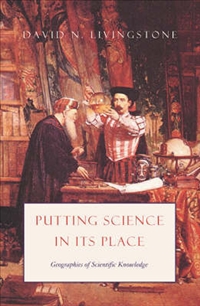 Livingstone divides his book into three sections: “Site,” “Region,” and “Circulation.” In his introduction, “A Geography of Science?” Livingstone relates the inherent bias in studying the enterprise of science. “Science, we have long been told, is an enterprise untouched by local conditions. It is a universal undertaking, not a provincial practice.” Science is not to be touched, not to be reduced to the social, to its locality. Livingstone questions this bias. He argues that “space matters,” that place is central to the constitution of society. One’s life is greatly controlled by environment, “human life” has a “spatial dimension, and where an individual, a social group, a state, or a subcontinent is located in material space is therefore highly significant.”
But there are also “abstract spaces.” “We also occupy a variety of abstract spaces, and we infer in spatial ways to the intellectual, social, and cultural arenas through which we move.”
The “social” is another important, ever shifting and overlapping, space. The factory floor, the sports field, the dinner party, the dance floor, the office, the home are all sites that provide “repertories of meaning that facilitate communication.”
Space thus enables and constrains us; dictates what we can say and do; allows only a range of possible, permissible, and intelligible utterances and actions. This is Livingstone’s emphasis of “location and locution”: the positions we speak from are crucial to what can be spoken.
Space is thus significant to the scientific enterprise. In 1863, for example, the Southern Monthly Magazine of New Zealand proclaimed Darwinism as “demonstrating how a ‘weak and ill-furnished race’ inevitably had to ‘give way before one which is strong,'” thus justifying New Zealand imperialism. In the American South, on the other hand, Darwinism was opposed by racial politics because it “threatened traditional beliefs about the separate creation of the different races and the idea that they had been endowed by the Creator with different capacities for cultural and intellectual excellence.” As Livingstone puts it, Darwinism enjoyed remarkably different fortunes in different places, “in one place it supported racial ideology; in another it imperiled it.” Darwinism meant different things in Russia and Canada; in Belfast and Edinburgh; in clubs and church halls. “Scientific theory,” according to Livingstone, “evidently does not disperse evenly across the globe form its point of origin. As it moves it is modified; as it travels it is transformed…[thus] scientific theories [are] not stable; rather, [they] are mobile and varies from place to place.”
Space is thus not immune to the vicissitudes of international exchange. This is particularly important in how we imagine distant people and places, and how we choose to represent them to ourselves and to others. This is of immense moral and political significance, as was the case with Europe’s rendezvous with the New World, or the construction of the South Pacific or the “Orient” by Victorian imperialists. “What is striking about these representations,” Livingstone writes, “is the complicity of scientific endeavor in their propagation.” As such, science did not reveal “truth”; it only continued stereotypes.
Science is concerned with things that have spatial dimensions, with ideas and institutions, with theories and practice, with principles and performance. But who imagines this space? What are its boundaries? Who is allowed access? Can certain types of scientific inquiry be correlated with certain social classes, or with those of a particular religious persuasion, or with metropolitan or provincial cultures? Has scientific work been used to sustain the ideology of particular groups and to promote their interests over those of others?
According to Livingstone, “What is known, how knowledge is obtained, and the ways warrant is secured are all intimately bound up with the venues of science.” Investigating the local, regional, and national features of science means that science is not to be thought of as some transcendent entity that bears no trace of the parochial or contingent. “We must work,” writes Livingstone, “with a less fixed conception of what science is.” What passes as science is contingent on time and place; it is persistently under negotiation. After all, science is a human enterprise: “it is not some preordained entity the fulfilling an a priori set of necessary and sufficient conditions for its existence; it is a human enterprise, situated in time and space.”
These are some of the geographical questions central to Putting Science in its Place. Livingstone is aware that this little book is not exhaustive in scope. His focus is rather on and around historical examples drawn from the sixteenth century to the early twentieth. Although brief and concisely written, each chapter discloses a considerable amount of information and erudition. In this post we will look at the content of chapter one, “Site.”
On Site
In the first chapter, “Site,” Livingstone surveys a spectrum of locations where scientific work is done—the laboratory; the cabinet, which evolves into the museum; the field; botanical and zoological gardens; the hospital; and the human body.
Scientific practice is undoubtedly influenced by spatial settings. Equipment regulates human behavior in one way or another. The scientific site is often constructed so as to restrain or promote certain interactions. It is also within these sites that students socialize with their respective scientific communities; here they learn the questions to be asked, the appropriate methods of tackling problems, expected codes of conduct, and interpretation. “Here decisions are settled about what passes the scientific knowledge, how it should be acquired, and the means by which claims are warranted.”
The most common scientific site is the laboratory. A long-standing tradition in the West was the idea that retiring from society was a precondition for securing knowledge that was of universal value. “Ironically, to acquire knowledge that was true everywhere, the seer had to go somewhere to find wisdom that bore the marks of nowhere.” This tradition originates from the monastic life of solitude and was central to the practice of science.
But during the emergence of English science in the mid-to late seventeenth century laboratories were erected in homes. This change was significant, because while solitude was still important, these “houses of experiment” instilled scientific knowledge as public. “In order to achieve the status of knowledge, claims had to be produced in the right place and had to be validated by the right public.” Where science was conducted was thus a crucial ingredient in establishing whether an assertion was warranted. But these “houses of experiment” were not public in today’s sense. They were only open to “the experimental public,” privileged gentlemen “whose presence was essential to the confirmation of empirical findings.” Women, children, laborers, and the like were not allowed entry.
Establishing experimental claims, however, was simply not just a matter of disclosing them; it was frequently necessary to dramatize. This meant that experimental display inhabited a space poised between conjuring tricks and scholarly authority, between theater in the academy. Serving at theater and microworld, manipulated, controlled, and reconstructed nature, the laboratory was an “emblematic space replete with cultural meaning,” functioning only in the “presence of the geographically privileged who were permitted to cross the threshold.”
Predating the laboratory were spaces of accumulation such as the museum and the archive, where specimens and samples were collected and organized according to the prevailing norms. These “cabinets of curiosities” served as an insignia of a civilized household. It was a social standing to have a collection of the “wonders of the world.” When these cabinets transformed into museums they were more than just collection sites; they were a synthetic space, a place for scholarly conversation. Thus while museums exhibited real world objects, they refashioned reality, through classification, location, and genealogy. In this sense they were more than the accumulation of global objects to gain knowledge; they were a form of global control: “by accumulating, reorganizing, and reproducing information on the remotest corners of the earth, the Victorian archive played its part in shaping worldwide geopolitical relations.”
The museum performed a variety of roles in the historical unfolding of scientific inquiry. “In the museum people learned how to look at the world, to value the past, and how to visualize relations between specimens.”
Yet no matter how extraordinary the exhibit, no matter numerous the specimens, no matter how categorized its contents, the museum was not the world itself. To view that required moving outside the confines of laboratories and collection cabinets and into the open spaces of the field. But the field, according to Livingstone, turns out to be anything but the obvious scientific site. It was often characterized by ambiguity. “The observations of the field worker were broken and fleeting; by contrast the bench-tied student of nature had time to spread out samples to collate and analyze them, and thereby to come to reliable conclusions.” The field was fragmentary, precarious, and unprofessional. The laboratory encouraged patient comparison, correlation, and contemplation. Indeed, “the rhetoric of adventure dominated the culture of field science: adventurousness conveyed its own authority. Laboratory opponents, by contrast, thought that high adventure and uncontrolled wilderness delivered nothing like the precision good science demanded.”
Between the archive and the field, the world of the museum and the world of nature, stands the garden. “Enclosed yet expansive, open yet delimited, natural yet managed, the garden occupies a place between the great outdoors and the cloistered cabinet.” Gardens “depended on its capacity to represent order over against chaos, cultivation in opposition to wilderness, art as opposed to nature.” They were an attempt to return to the Paradise of Eden, an escape from the postlapsarian world. In the wake of the European voyages of reconnaissance in the New World, the conception of the garden as a hollowed refuge from the world began to be supplemented by a vision of the garden as a “living encyclopedia.” But as well as being sites for accumulating botanical specimens, gardens also became maps of both social status and buying power. Indeed they were increasingly seen in political metaphors. Botanical gardens were agents of Empire. Insofar as zoological gardens were bound up with animal domestication, they were invariably implicated in colonial projects. Gardens, then, were multifarious spaces. They “hankered after the Garden of Eden; they sought to reproduce global biogeography; they exhibited social standing; they wielded biomedical power.”
Like the museum, the garden, and the zoo, the hospital stands somewhere between the worlds of science and public culture. In the beginning the hospital was feckless and friendless — it served in general as a correctional facility, for paupers and petty criminals. “The history of the modern hospital can be traced back to the monastic infirmary, almshouse for the hopeless, army barracks adapted to attend to tend the wounded in wartime, plague houses, and various other institutions that from time to time had to care for the sick.” Hospitals, in other words, was a place of more harm than good.
Hospitals were also moral spaces, manifesting the values of their surrounding cultures. According to Livingstone, “medical prescription and moral orderliness” went “hand in hand” with hospital care.
The meaning of hospital space moved with social judgment as well as changing architecture. The “hospital,” writes Livingstone, “was a sermon in bricks and mortar on the medical benefits of moral discipline as fundamental to healing.” The idea that hospital interiors are readable cultural spaces is perhaps nowhere more closely disclosed then what were called insane or lunatic asylums. “Asylums have regularly been sites of surveillance dominated by the imperatives of supervision and control.” In the Middle Ages asylums were spaces of exorcism; in the seventeenth century they were used for reestablishing political order; and during the enlightenment they were used for disciplining “unreason.”
In the final section of chapter one Livingstone considers the body, human or otherwise, as a space for scientific knowledge. Rabbits used in toxicology work, rhesus monkeys for experimental surgery, rats in polio research, horses in investigations of emphysema, tests carried out on women in Puerto Rico using oral contraceptives in the 1950s, racial hygiene in Nazi Germany, are all examples of embodied scientific knowledge. “Given that bodies are resolutely located in space, there are grounds for suspecting that scientific knowledge is always positioned knowledge, rationality always situated rationally, inquiry always local inquiry” (my emphasis). Accordingly, “science displays rather than transcends human particularity—in terms of race, gender, class, and in all likelihood a host of other factors.” Whether science is practiced in a laboratory, a museum, a garden, a field station, a hospital or whatever, “these spaces are always occupied by embodied investigators.”
There are other spaces Livingstone considers. From cathedrals, ships, tents, royal courts, coffeehouses, lecture theaters, to salons, what all these spaces share is that they are made. “Space is therefore not dead, inert, and fixed; rather it is lively, shifting, fluid. Space is animated by events. It is always a production. And scientific space is no exception.”
Social Uses of Science
Posted on November 3, 2013 Leave a Comment
The intellectual history of the eighteenth century, including the history of eighteenth-century science, used to be summed up in the term “Enlightenment.” However, as we have seen, no one has been able to define the term with any precision; nevertheless, most historians continue to use it to identify a set of opinions that characterized the century. In The Ferment of Knowledge: Studies in the Historiography of Eighteenth-Century Science (1980), edited by G. S. Rousseau and Roy Porter, the term scarcely makes an appearance. This is deliberate. The editors and authors of this collection of essays believe that historiography of science of the eighteenth century has been utterly changed by the advent of “contextual” scholarship in a number of disparate disciplines, from the history of ideas, mythology, new approaches within Marxism and French structuralism, techniques of historians of art, religion, philosophy, and ideology, to the seminal writings of anthropologists and psychologists and others.
In their introduction the editors rightly emphasize that we can “no longer ignore the fact that the eighteenth century ‘geography of knowledge,’ the relations between the sciences, was then markedly different from our own.” The introduction explains:
The last generation has wrought a revolution in the history of science…Certainties have given way to questions. The history of science is no longer a scientist’s hymn to science: it has become part of history itself…The development of science can no longer be served up as the sure tread towards truth. But exactly how it should be viewed is a question on which no consensus is in sight…This revolution is, of course, very familiar. Its relevance here is that this profound change in the orientation—one riddled with methodological anxieties—has as yet done little for the eighteenth century.
The aim, and hope, of the present volume is thus to present a “contextual historiography” of the eighteenth century as a corrective:
…we now take it as axiomatic—and correctly—that eighteenth-century science can be properly grasped only if its “external” relations to other intellectual and cultural systems, such as theology and epistemology, are tackled head-on…It seems elementary to us (now!) that eighteenth-century scientific ideas cannot adequately be translated one-to-one into twentieth-century terminology. Indeed, one of the aims of this book is precisely to distil and evaluate this substantial body of empirical research that has been conducted in the last generation.
To achieve its ends, the editors have compiled a series of twelve essays by twelve knowledgeable authors. Of all the contributions in this volume, Steven Shapin’s “Social Uses of Science” is perhaps the most provocative and stimulating contribution.
Shapin discusses the social uses of science by analyzing a number of studies which deal with the social significance of Newtonianism, “it is in the area of Newtonianism and its career in the eighteenth century that such perspectives show their greatest inadequacies and where new notions of science and its uses display greatest promise.” An essay by Arnold Thackray looks at political interpretation of the Leibniz-Clarke debate, “The priority disputes between Newton and Leibniz…cannot be understood without examining the dynastic politics of the period from the 1680s to the 1710s.” According to Thackray, “Newton set in motion a sustained collective effort to discredit the worth, religious significance, and originality of the German’s [i.e. Leibniz] science.” An essay by Frank Manuel supports Thackray’s account that Newton was an “autocrat of science.” And George Grinnell’s argument that Newton’s own motivation was not merely proprietary but party-political interprets Newton as an anti-Catholic Whig. Shapin concludes from these contextualist interpretations that “one cannot understand scientific judgements without attaining to the context wherein scientific accounts were deployed.”
In several articles Margaret Jacob sets out to develop a connection between Newtonian natural philosophy and Low Church politics. Shapin positively evaluates M. Jacob’s view that “conceptions of nature are tools, instruments which historical actors in contingent settings pick up and deploy in order to further a variety of interests, social as well as technical.” According to James R. Jacob and Christopher Hill, “natural philosophy in the late seventeenth and early eighteenth century was powerfully shaped by the social uses of natural knowledge during Civil War, Interregnum, and Restoration” periods.
From the contextualist interpretations of M. Jacob, J.R. Jacob, and Hill, Shapin offers a number of suggestions to explain how eighteenth century matter theory could be given a social interpretation:
First, it is to be noted that philosophies of nature were routinely seen by the actors as imbued with social meaning. This is not because of “mere” metaphorical glossing, but because in these (and later) cultural contexts nature and society were deemed to be elements in one interacting network of significances…Second, groups with conflicting social interests developed and sustained interestingly different natural philosophies; moreover, these philosophies were often produced explicitly to combat and refute those of rival groups. Third, the distribution of attributes between “matter” and “spirit” was an issue of intense concern in all these philosophies; the relations between the two entities seemed to be something upon which all cosmologies “had to” decide, and the boundaries between “matter” and “spirit” were treated as having particularly strong social significance.
Thus “contextualism” for Shapin is the study of natural philosophy “entirely in terms of its uses in specific historical contexts,” or, as his title suggests, its “social uses.”
In the next section of the essay Shapin wants to juxtapose this new contextualist approach, of which he is a member, against the historiographic theories of post-Koyréan “intellectualist” practice, which includes, he argues, Gerd Buchdahl, Henry Guerlac, P. M. Heimann, Robert Kargon, David Kubrin, J. E. McGuire, Ernan McMullin, P. M. Rattansi, and Richard Westfall. In short, Shapin concludes that while traditional intellectualist histories of science situate scientific thought in the seventeenth and eighteenth centuries firmly within the intellectual context of metaphysics and religion, the context of ideas, both in their formation and in their use, has not been treated adequately. At best, he argues, we have been given “footnote contextualism,” an “apparent stipulation that such context impinged peripherally or in some unspecified, but insignificant, way.” In other words, the intellectualist historiographic approach relegates the effects of social-political context on scientific ideas to footnotes and asides, therefore to an implicitly peripheral and unimportant role. Shapin disagrees and argues that in the contextualist historical research: “what we begin to see in work of this kind is a sensitivity to a variety of conceptions of nature distrubuted among different social groups. We see how divergent bodies of natural knowledge were used to further social interests and were produced in processes of social conflict.”
In the final sections of his essay, Shapin provides a contextualist interpretation of the “new science” of the early and mid-eighteenth century as a strategy reflecting its social-political uses. He maintains, for example, following M. Jacob, “where the Newtonian cosmology of the Boyle Lectures was developed partly as a defense of the Protestant succession and the court which underpinned the moral and social authority of the latitudinarian Low Church,” the hylozoist cosmology—in which outside, immaterial forces are unnecessary to move matter—of “freethinkers” such as John Toland “was the voice of conflicting social tendencies.” The latter were at odds with the Newtonians because they “perceived them to be ‘propagandizers for a science of God that would enhance the authority of ruling oligarchies and established churches.'”
Although M. Jacob’s thesis has received criticism, particularly from Christopher Wilde, who provides similar historiographic techniques to show an important English anti-Newtonianism of High Church divines, both work demonstrate that “‘dialectical’ processes of social conflict in the cultural domain may be needed to account for historical changes in dominant cosmologies.”
But intellectualists and the new contextualist can work together, according to Shapin. For example, there has been some major historiographic bridge-building between the two in accounting for Joseph Priestly’s natural philosophy. The work of J.G. McEvoy and J. E. McGuire have demonstrated that “Priestly was not embarked upon any ‘atheistical’ or ‘secularizing’ enterprise,” but a cosmology of “rational dissent,” one specifically committed to “undermining the authority of the state Church and justifying liberalism and toleration in religious matters.” Thus Priestly’s materialist monism becomes a “hierarchy-collapsing strategy.”
In conclusion Shapins lists three themes that emerge from social studies of uses of scientific knowledge in the seventeenth and eighteenth centuries. First it shows the important role for social interests in scientific change or in sustaining scientific accounts. Second, science is revealed to us only in some context of use; “science” is never disembodied—it is always put to use in some particular social context. And third, historians of science are revealed to be implicit anthropologists, considering “collective representations of nature…to be institutions inextricably bound up with the social affairs of the communities which generate and sustain them; they are explained by identifying the ‘social work’ the beliefs do in these communities.”
Finally, this anthropological perspective, according to Shapin, represents a non-deterministic sociology of scientific knowledge. “By emphasizing that cosmologies are constructed in the contexts of use, they replace the ‘automaton-actor’ of metaphysical-influence studies with an active, calculating actor whose intellectual products are crafted to further the variety of his interests.”
Our Pervasive Stories about Science
Posted on October 31, 2013 Leave a Comment
 In an oft quoted sentence, Steven Shapin opens his The Scientific Revolution (1996) with dramatic flourish: “There was no such thing as the Scientific Revolution, and this is a book about it.” He begins his introduction with a brief historical survey, citing the scholarly opinion of generations past. A familiar cast appears. Koyré had judged the scientific revolution as a “profound intellectual transformation” and a “dissolution of an older worldview.” Likewise, Buttefield had said that the scientific revolution “outshines everything since the rise of Christianity,” reducing the Renaissance and Reformation to the “rank of mere episodes.” A. Rupert Hall also claimed that it was “an a piori redefinition of the object of philosophical and scientific inquiry.” These scholars would go on to influence and shape historical scholarship of the next generation. There was something truly “revolutionary,” “cataclysmic,” and “coherent” that occurred in seventeenth-century Europe, something that “irrevocably changed what people knew about the natural world and how they secured proper knowledge of that world.”
But his introduction Shapin also lists reasons why today’s historians of science, himself included, are reluctant to embrace such pronouncements. First, historians are no longer satisfied with treating ideas as if they were autonomous, disembodied, free-floating conceptions, and as a result have insisted on the importance of cultural and social context. Second, and related to the first, ideas ought to be understand in the context of human practices. And finally, it follows that historians now look more closely into the “who” of the scientific revolution, those who wrought such changes.
Claiming to take full account of recent scholarship about the period of the scientific revolution, he posits that science is a “historically situated and social activity and that it is to be understood in relation to the contexts in which it occurs.” He does not consider that there is “anything like an ‘essence’ of seventeenth-century science or indeed of seventeenth-century reforms in science.” He observes that important as developments in mathematical physics were in the seventeenth century, this does not provide a model adequate for explaining developments in every other area of science. For these reasons he rejects the possibility of providing a “single coherent story that could possibly capture all the aspects of science or its changes.”
In short, the historiographic notion of the scientific revolution is mistaken. The development of the modern scientific worldview was a complex process contested by many seventeenth-century practitioners (note that this is an altogether distinct argument than what I. B. Cohen and D. Lindberg have put forward): experimentalism was both advocated and rejected; mathematical methods were both celebrated and treated with doubt; mechanical conceptions of nature were seen both a defining proper science and as limited in their intelligibility and application; and the role of experience in making scientific knowledge was treated in radically different ways.
But like his predecessors, Shapin losses some nerve, claiming that his aim is not a full-scale rejection of the scientific revolution. For starters, many key figures in the late sixteenth and seventeenth centuries saw themselves as “modern.” Secondly, and quite simple, historians—like most of people—want to find meaning in history, we “want to know how we got from there to here.” The key, according to Shapin, is recognizing that “intellectual change occurred while at the same time recognizing that change is not necessarily linear or self-evident progress toward our modern way of thinking.” Shapin thus settles for the following understanding of the scientific revolution: “We can say that the seventeenth century witnessed some self-conscious and large-scale attempts to change belief, and ways of securing belief, about the natural world. And a book about the Scientific Revolution can legitimately tell a story about those attempts, whether or not they succeeded, whether or not they were contested in the local culture, whether or not they were wholly coherent.”
Shapin divides his book into three substantive chapters: “What Was Known?” “How Was It Known?” and “What Was the Knowledge For?” In “What Was Known?” Shapin gives an account of some of the major scientific advances , from Galileo to Newton, from cosmology to microscopy, from the mechanical philosophy to the mathematization of nature. It was Copernicus and Galileo who established a new cosmology. Boyle and Descartes popularized the new mechanical philosophy. And Kepler and Newton ushered in a mathematical framework for natural philosophy.
But Shapin also wants to divulge the complexity in what was known. Galileo’s discovery of sunspots, along with a body of other observations and theorizing, “profoundly questioned a fundamental Aristotelian distinction between the physics of the heavens and that of the earth.” According to that tradition, the sun, stars, and planets obeyed different physical principles than did those objects on earth. In their domains there was no change and no imperfection. Galileo was not simply documenting observational data from his telescope, he was undermining the “traditionally accepted belief that the sun was immaculately and immutably perfect.” Thus when some (careless) historians claim that Copernicanism demoted humans from their egocentric center, what heliocentrism actually did was wrest the immutable to the mutable, to an earthly existence which was regarded as miserable and corrupt.
Aristotelian physics also came into question. Aristotle and his followers believed that natural motion had a developmental character. “Bodies naturally moved so as to fulfill their natures, to transform the potential into the actual, to move toward where it was naturally for them to be.” In some sense, Aristotelian physics was modeled on biology and employed explanatory categories similar to those used to comprehend living things. Thus with Copernicus and Galileo the teleological and animistic features of the traditional physics of motion were rejected.
The framework that modern natural philosophers preferred was one that explicitly modeled nature on the characteristics of a machine. Descartes, for instance, announced that “there is no difference between the machines built by artisans in the diverse bodies that nature alone composes.” And of all mechanical constructions whose characteristics might serve as a model for the natural world it was a clock more than any other that appealed to many early modern natural philosophers. Kepler, for instance, described his aim as the attempt to “show that the machine of the universe is not similar to a divine animated being, but similar to a clock.” Boyle likewise wrote that the natural world was “as it were, a great piece of clockwork.” Thus Boyle, Kepler, Descartes and other mechanical philosophers recommended the clock metaphor as a philosophically legitimate way of understanding how the natural world was put together and how it functioned. But this mechanical account of nature was anything but atheistic. In fact, mechanical philosophy was used to defend monotheism, and was explicitly contrasted with the anthropomorphism and animism, or occultism, of much traditional natural philosophy.
The mathematization of reality was just as a complex process has its mechanization. Early modern natural philosophers turned to Pythagoras and especially Plato to legitimate a mathematical treatment of the world, quoting Plato’s dictum that “the world was God’s epistle written to mankind” and that “it was written in mathematical letters.” Thus Shapin concludes in the first chapter that there can be no “facile generalizations” about Copernicanism, mechanical philosophy, or the mathematization of nature.
In “How Was It Known?” Shapin deals with experience, experiment, and authentication. Among the topics covered are Bacon’s advocacy of a new method, Boyle’s pump experiments, observational methods, development of experimentalism, and the formation of the Royal Society. Shapin argues that the seventeenth century’s supposed emphasis on experience and observation over authority was not as clear-cut as banal versions of the scientific revolution have always insisted. Modernist rhetoric embracing a totally new and wholly rejecting the past does not adequately describe historical reality. The very identity and practice of early modern astronomy, for example, depended on observational data compiled by the ancients. Copernicus himself, and many of his followers, liked to argue that heliocentrism was in fact an ancient view, corrupted over the centuries, and only renewed or restored in modern times. Newton likewise believed that natural philosophy had been corrupted over generations, and that his life work would restore it to its original, pristine quality.
But what was said to be overwhelmingly wrong with existing natural philosophical traditions was its dependence on textual authority. “The proper object of natural philosophical examination,” Shapin writes, “was not the traditionally valued books of human authors but the Book of Nature.”
This is the root idea of modern empiricism, the view that proper knowledge of nature is derived from direct sense experience. But as Shapin is careful to note, both the practice of observation and the credibility of observation reports in the early modern period could be intensely problematic. “It is important to understand how precarious experience might be and how much work was required to constitute it as reliable.” Christian theology, for example, proclaimed that the senses of human beings following the Fall were utterly corrupt, and that reliable knowledge could not be trusted by such debased sources.
One way of resolving this problem has already been mentioned: one was to get ahead by going back, progress through restoration. Newton, for example saw his task as recovering the lost wisdom of the ancients, and he undertook painstaking philological studies to support this enterprise.
What kind of experience was to be sought? How was it reliably attained? And how was one to infer from experience to general principles about the natural order? As Shapin points out, “what counted in one practice as reliably constituted experience, and reliable inference, was commonly identified by another as insecure or unphilosophical.” Indisputable and universal conclusions require indisputable and universal premises. The testifying person might be lying or deluded; the instruments used might distort rather than merely observe the natural order of things; the events reported might be not ordinary but anomalous.
According to Shapin, many seventeenth-century practitioners developed a new and quite different approach to experience. Bacon, for example, argued that the condition for a proper natural philosophy was its foundation in a laboriously compiled factual register of natural history — a catalog, compilation, a collection of all the effects one observed in nature. Yet the emblematic feature of modern natural philosophical practice was that it relied for its empirical content not just on naturally available experience but also on experiments artificially and purposefully contrived to produce phenomenon that might not be observed in the normal course of nature.
This brings us to Shapin’s discussion of “controlling experience.” Bacon judged the ills of contemporary natural philosophy, and then proffered a set of rules for “careful and severe” examination. One rule was collection, thus justifying the programmatic “cabinets curiosities” then fashionable in gentlemanly circles throughout Europe. But perhaps most important rule, for Bacon and others, was proper method. Method was what made knowledge about the natural world possible. Despite the stress on direct sensory experience, Bacon argued that uninstructed senses were apt to deceive and that the senses needed to be methodically disciplined if they were to yield proper knowledge. Thus one can only arrive at proper knowledge through a disciplined or instructed mind. What is meant by “discipline” and “instructed”? It depended on the natural philosopher you asked. This is, according to Shapin, the fragmented knowledge-making legacies of the seventeenth century.
In the third and final chapter, “What Was the Knowledge For?” Shapin treats the cultural uses of natural knowledge. In an extended discussion of natural knowledge and state power, he considers Bacon’s views on the ways that natural philosophy could increase such power, which provides the context for his examination of the establishment of the Royal Society and the Académie des Sciences. He demonstrates the ways in which natural knowledge was used to reinforce religious belief and theology. He concludes by asserting that this contextualized understanding of early modern science “as the contingent, diverse, and at times deeply problematic product of interested, morally concerned, historically situated people” seems paradoxical, because it was the interests of such people that led to the modern separation between science and religion and between science and society.
In the end, what remains of the scientific revolution? According to Shapin, it was “a diverse array of cultural practices aimed at understanding, explaining, and controlling the natural world, each with different characteristics and each experiencing different modes of change.” Consequently, nothing remains here of the idea the Scientific Revolution. Shapin’s Scientific Revolution is not a critique of science. Rather, it is a critique of “pervasive stories we tend to be told about science.”
The “Scientific Revolution” as a Fifteenth- and Sixteenth-century Humanist Invention
Posted on October 31, 2013 1 Comment
Our discussion thus far has focused on the historiographic category of the scientific revolution as the invention of eighteenth-century thinkers. But some years ago David C. Lindberg had argued, in his “Conceptions of the Scientific Revolution from Bacon to Butterfield: A preliminary sketch,” D. C. Lindberg and R. S. Westman, Reappraisals of the Scientific Revolution (1990), that modern conceptions of the scientific revolution are actually an “outgrowth and continuation of historiographic traditions and European self-perceptions rooted in fifteenth- and sixteenth-century Italian humanism.” In works of Petrarch (1304-1374), Boccaccio (1313-1375), and others, for example, we see what would become the “standard humanist account, the decline and fall of Rome introduced a thousand-year period of cultural darkness and stagnation,” during which the classics succumbed to religious dogmatism under the “rude vulgarity of the scholastics.”
Petrarch found solace in the works of the ancients, seeing the return to antiquity among his contemporaries as ushering in the beginning of the new, improved age, a “rebirth.” Indeed, a number of authors saw in their “new” work a return to the “old.” This included Nicholaus of Cusa (1401- 1464), Marsilio Ficino (1433-1499), his associate Pico della Mirandola (1463-1494), Johann Reuchlin (1455-1522), Francesco Patrizi (1529-1597), Jean Bodin (1530-1596), Peter Ramus (1515-1572), and many more. “The forward movements of the Renaissance,” once wrote Frances A. Yates, “all derive their vigor, their emotional impulse, from looking-backwards.”
Sixteenth-century Protestant authors were also apt to see a connection between the return to ancient sources and the reformation of Christianity. Criticism of the institutional Catholic Church and an emphasis on the original Christian gospels promoted by sola scriptura called for a quest for “true Christianity,” a return to a pristine religion. For example, Jacques Lefèvre d’Etaples (1455-1536), John Calvin’s teacher and the man who paved the way for the Reformation in France, was a Christian humanist who advocated not only a reformation of religious life and the dissemination of the Bible in the vernacular, but also a return to the ancient teachings of Hermes Trismegistus and the Hermetic Traditon.
Thus when, in the course of the seventeenth century, the new science came in for appraisal, that appraisal was powerfully shaped by historical categories and terminology devised by Renaissance humanists. According to J. B. Bury (1861-1927) and R. F. Jones (1886-1965), seventeenth-century scholars repudiated antiquity for the “new philosophy,” advanced by the constant invocation of “the new” in their works, such as Kepler’s New Astronomy, Bacon’s New Organon, Galileo’s Two New Sciences and so on.
But Bury and Jones read these titles at face value. “Seventeenth-century attitudes toward antiquity,” writes Lindberg, “looked at as a whole rather than scoured for ‘proof texts,’ are more complex and nuanced, and far more positive in tone.”
In other words, Bury and Jones—and still many today—were deceived by appearances. Dan Edelstein has demonstrated that the seventeenth-century was not a quarrel between the Ancients and the Moderns; no, it was the formation of an idea—or more accurately, a narrative—of progress that thinkers like Voltaire, Condorcet and others constructed, and that later scholars took up without question. Voltaire, for example, in his Essay on the Manners and the Spirit of Nations (1747-1751) and his Age of Louis XIV (1752) aimed to “write a history of the human spirit, of manner and customs, based on the premise of indefinite progress.” Although he never offered a connected account of the development of natural philosophy, “his many passing comments added up to an influential interpretation” that saw history as stages of progress.
This optimism of progress reached a crescendo in Condorcet’s Esquisse d’un tableau historique des progrès de l’esprit hamain (1795), where he pronounced the triumph of Christianity as “the signal for the complete decadence of philosophy and the sciences.” Thus the progress we see in the seventeenth-century, according to Condorcet, was quite dramatic, revolutionary in fact. Key figures in his scheme are, of course, Copernicus, Galileo, Bacon, and Descartes.
What is remarkable about this scheme, says Lindberg, is its “unanimity of opinion.” “Everybody who addressed the question accepted a tripartite division of cultural history into ancient, medieval, and modern periods.” Antiquity was a glorious period of vast learning, only to be followed in the medieval period by total darkness, and now finally, in their own, modern period, the light of the ancients have returned, alongside the new lights of Copernicus, Galileo, Bacon, Descartes, and Newton.
This same schema of progress and periodization continued in historiographic developments of the nineteenth century. We see it, for example, in Auguste Comte (1798-1857), William Whewell (1794-1866) and others. According to Comte, all sciences pass inevitably through three stages: the theological, or fictitious, in which the human mind seeks essences and ultimate causes; the metaphysical stage, in which nature and abstract forces are substituted for divinity as the causes of phenomena; and finally the stage of “positive” science which the mind gives up the quest for absolute notions, the origin and destination of the universe, and the causes of phenomena and applies itself to the study of their laws.
For Whewell science proceeds by progressive generalization, from bare facts to general truths. Old truths are never truly overturn but are modified by subsequent discoveries and become a permanent part of the body of knowledge. According to Lindberg, Whewell’s purpose was to “establish his philosophy of science on the basis of historical investigation.” As such Whewell ventured a detailed history of the sciences—from Greek natural philosophy to the achievements of his own era. But predictably in his account the accomplishments of antiquity were followed by the long, stagnate, Middle Ages, a time of darkness, subservience, and dogmatism.
Lindberg then follows with an account of how medieval science was rehabilitated by scholars such as Pierre Duhem (1861-1916), Charles Homer Haskins (1870-1937), and Lynn Thorndike (1882-1965), and, as a result, for the first time in over three hundred years, the traditional schema and periodization came under serious historical attack.
But this new group of scholars encountered stiff opposition from the outset. The counterattack, led by Burtt, Koyré, and Butterfield, reasserted the significance of the scientific revolution, and thus the schema and periodization of a previous generation of scholars.
Therefore what distinguishes Lindberg’s account of the historiographic history of the scientific revolution from others, including I. Bernard Cohen’s, is his interest in the conceptions of sixteenth- and seventeenth-century science and natural philosophy. This conception of the progress of knowledge and a shared periodization of history is, according to Lindberg, a remnant of the humanist vision and not simply a creation of Enlightenment philosophes.
The “Scientific Revolution” as Narratology (Part 2)
Posted on October 29, 2013 Leave a Comment
In 1948 English historian Herbert Butterfield presented a series of lectures for the History of Science Committee at the University of Cambridge. There he argued that historians have overlooked an episode of profound intellectual transformation—one apparently comparable in magnitude to the rise of Christianity and that was deeply implicated in the very formation of the “modern mentality.” This episode was of course the Scientific Revolution. But as we have seen from previous posts, the idea of the “scientific revolution,” or, more precisely, “revolutions in science,” had its origins in eighteenth century thought.
Butterfield’s Cambridge lectures, published as The Origins of Modern Science: 1300-1800 (1949), were limned from a tradition of other twentieth-century historians and philosophers—scholars such as Pierre Duhem, Ernst Cassirer, E.A. Burtt, and, most importantly, Alexandre Koyré, who regarded history as a special resource for illuminating the evolution and progress of science. In fact, it was Koyré who, in 1943, appraised the conceptual changes at the core of the “scientific revolution,” as “the most profound revolution achieved of suffered by the human mind.” It was so profound that human culture “for centuries did not grasp its bearing or meaning; which, even now, is often misvalued and misunderstood.”
 These traditional narratives by early twentieth-century scholars have customarily focused on a list of canonical figures. These figures usually include Nicholas Copernicus, Tyco Brahe, Johannes Kepler, Galileo Galilei, Rene Descartes, Robert Boyle, and Isaac Newton. Margaret J. Osler’s (ed.) Rethinking the Scientific Revolution (2000) problematizes this canonical list. Questioning the canon leads, according to Osler, to inquire why and how it was formed in the first place. Rethinking the Scientific Revolution is in memory to Betty Jo Teeter Dobbs and Richard S. Westfall, best known for their studies on Isaac Newton and the scientific revolution in the seventeenth century.
Osler’s introduction frames and outlines the discussion in this illuminating work. She argues that one must seek balance, recognizing that intellectual change occurred while at the same time recognizing that change is not necessarily linear or self-evident progress toward our modern way of thinking. Historians, then, need to “recognize the role that their own assumptions play in their constructions of the past. There is no escaping them, but consciously acknowledging them staves off the temptations of claiming objectivity and progress.”
This new approach, Osler argues, is at odds with traditional accounts of the scientific revolution. From nineteenth-century positivist Ernst Mach, historians have told a story that stresses radical discontinuity of the scientific revolution from what came before. This is the story Westfall reiterates. This assumption also embodies an “essentialism” about science, according to which science it defined as unchanging and unambiguously identifiable in every historical era. This essentialism creeps into the interpretation of the scientific revolution itself: having defined the nature of the scientific revolution, historians, such as what H. Floris Cohen has done in his The Scientific Revolution, searched this event and explanations of it. Cohen, who undertook the daunting task of examining the entire historiography of the scientific revolution, as we have seen, nevertheless remained committed to both the reality of the revolution and to its historiographical utility.
Following the work of Quentin Skinner, Osler argues that taking agency seriously means using actors’ categories to account for the development of ideas. She means, in other words, to appropriate ideas of historical actors, to work within their particular social, ideological, and intellectual contexts. Osler argues that “future research must address the interests and concerns of subsequent generations, which created the perception that a scientific revolution occurred in the sixteenth and seventeenth centuries and then bequeathed it to us.”
Since historians of science have interpreted Newton’s work as the climax of the narrative they call the scientific revolution, this radical shift in understanding of the meaning of his work forces us to reconsider may of the received opinions about the nature of the scientific revolution.
The first essay by Betty Jo Teeter Dobbs, presented at the Annual Meeting of the History of Science Society in 1993, opens the discussion by stating her intention “to undermine one of our most followed explanatory frameworks, that of the scientific revolution.” Following I.B. Cohen’s work, Dobbs argues that the narrative of the scientific revolution was constructed in the eighteenth century, when natural philosophers selectively took up Newton’s physics and mathematics while ignoring his alchemical and theological views. Newton, according to Dobbs, is key: “as science accumulated more and more social prestige in the later eighteenth, nineteenth, and twentieth centuries, the image of Newton as principal cultural hero of the new science was handed on and further polished by succeeding generations of scientists and historians.” Indeed, Newton is “the hidden end toward which the whole narrative [i.e. the scientific revolution] is inexorably drawn.” Newton is not only the First Mover in historians’ account, he is also the Final Cause of the scientific revolution.
But this is not the Newton of history. Dobbs summarizes the central problem in a long passage, worth quoting at length:
But to my mind the issue of the proper interpretation of our scientific heroes has been the most pressing problem of all, a problem that was at least in part generated by the concept of the Scientific Revolution. I think the problem arises somewhat in this fashion: we choose for praise the thinkers that seem to us to have contributed to modernity, but we unconsciously assumed that their thought patterns were fundamentally just like ours. Then we look at them a little more closely and discover to our astonishment that our intellectual ancestors are not like us at all: they do not see the full implications of their own work; they refuse to believe things that are now so obviously true; they have metaphysical and religious commitments that they should have known were unnecessary for a study of nature; [and] horror of horrors, they take seriously such misbegotten ideas as astrology, alchemy, magic, the music of the spheres, divine providence, in salvation history.
Newton, alleged epitome of austere, scientific, mathematical rationality, pursued alchemy, apocalyptic theology, hermetism, and other occult practices. The problem, then, according to Dobbs, is a historiographic one. Newton’s “system was very quickly co-opted by the very -isms he fought [i.e. mechanism, materialism, deism, atheism], and adjusted to suit them. He came down to us co-opted, an Enlightenment figure without parallel who could not possibly have been concerned with alchemy or with establishing the existence and activity of a providential God.” In the end, Newton was not one of history’s all-time winners; rather, he is one of history’s great losers, “a loser in a titanic battle between the forces of religion and the forces of irreligion.”
In short, Dobbs calls historians of science to understand the presuppositions and assumptions of their historical actors rather than searching for anticipations of modern ideas in their thought.
Richard S. Westfall, on the other hand, wants to defend the traditional historiography. He argues that the historian’s task is not mere antiquarianism, “We are called to help the present understand itself by understanding how it came to be. We strive to find a meaningful order in the multifarious events of the past and thus, explicitly or implicitly, we pass judgment on the relative importance of events.”
In defending the historiography for which he was one of the most distinguished spokesmen, Westfall responds with reasserting the scientific revolution as “our central organizing idea,” because without it “our discipline will lose its coherence and, what is more, the cause of historical understanding take a significant set backward.” Thus Westfall, Osler argues in her introduction, is “fundamentally forward-looking, based on the assumption that what is interesting in the past are those developments that led to our present understanding of the world.” The crucial difference between Westfall and Dobbs, then, is that Westfall assumes that thinkers in the past are similar to us and that what is important for the historian is that aspect of the thinkers works that has survived until the present or that had led to our present way of looking at things.
Peter Barker agrees that Dobbs’ work “not only shifted the boundaries of Newton scholarship, she changed its center.” In his essay Barker wants to reexamine the “role of religion in the Lutheran response to Copernicus.” According to Barker the doctrine of the Real Presence, stipulated in the Augsburg Confession of 1530, article 10, that “Christ’s body and blood is truly present in, with, and under the bread and wine of the sacrament,” encouraged Lutherans to study any and all aspects of nature, for to do so was coming to know more about God. “For Luther and his followers, the Real Presence was distributed throughout all objects.” These Lutherans became known as the “Wittenberg Astronomers,” and including Philipp Melanchthon (1497-1560), Joachim Rheticus (1514-1574), Andreas Osiander (1498-1552), Erasmus Reinhold (1511-1553), and Hilderich von Varel (1533-1599). In short, according to Barker, Lutherans expressed an early and strong interest in Copernicus’ work, even arranging for it publication. By the end of the sixteenth century, if you were a Protestant studying almost anywhere in German-speaking Europe, you would have been taught the Copernican system. By the time of Kepler’s education at Tübingen in the 1580s, for example, distinct positions on Copernicus’ work had emerged in northern Europe.
Another compelling essay in Rethinking the Scientific Revolution comes from Jan W. Wojcik’s “pursuing knowledge: Robert Boyle and Isaac Newton.” Wojcik is concerned with the different views of Boyle and Newton regarding the power and scope of human reason. “I think that the most important difference between these two natural philosophers is that they had dramatically different conceptions of God’s intentions concerning human understanding…to what can be known in both natural philosophy and theology, and how that knowledge can best be attained, exactly who can attain this knowledge, and when it might be learned.” Boyle, for example, was content to assent to mysteries, and that God never intended any human beings to a complete understanding of either nature or theological truths during this lifetime. Newton, on the other hand, insisted that God had revealed Christian doctrine with the intent that it be understood in a plain and natural sense, and that God in fact intended at least some individuals to achieve a complete understanding during this lifetime. Despite their differences, Wojcik argues, “it is clear that for both men theological concerns was an absolute priority.”
Moving into their more esoteric studies, Lawrence M. Principe discusses “the alchemy of Robert Boyle and Isaac Newton: alternate approaches and divergent deployments.” His title already suggests that Newton and Boyle—much like everything else—approached alchemy from different angles. According to Principe, those seeking the secrets of alchemy approach the subject through three kinds of sources: (1) the written record left by past adepti; (2) direct communication with living sources; and (3) laboratory investigation. Newton’s alchemical manuscripts, for example, consists of material not his own. “By far the great part of Newton’s alchemical output is in the form of transcriptions, translations, extracts, collations, and compendia of various alchemical authorities. By contrast, most of Boyle’s alchemical tracts are in fact gifts from their authors or copies made by others, rather than copies made specifically by Boyle.
Principe also examines what specific benefits these two students of alchemy expected to reap from such activity. In the case of Boyle, for example, the rewards were increased natural philosophical knowledge, medicinal preparations, and defense of orthodox Christianity. Boyle also expected to obtain the alchemical summum bonum, the secret of the preparation of the Philosopher’s Stone. Newton, on the other hand, expressed doubt in the real existence of the Philosopher’s Stone. Rather, for Newton the study of alchemy was a search for the existence and means of divine activity in the world. Thus an area of relative commonality between Boyle and Newton’s alchemical investigations lies in the service they believed alchemy could render to religion. Indeed, both men “sought alchemy as a corrective to an overly mechanized and potentially atheistic worldview.” Principe shows the ways in which alchemical ideas were important to Boyle and Newton, who are frequently considered to be mechanical philosophers.
By elucidating the similarities between Athanasius Kircher (1601-1680) and Isaac Newton, Paula Findlen raises the question why Newton was incorporated into the canon and Kircher was not. “Both were deeply religious men, committed to the study of nature as a sure path toward the revelation of divine wisdom, who began their academic careers as professors of mathematics. Both valued the learning of the ancients, searching ever further into pagan and Christian past in hope of illumination.” And no where is their commonality most clearly evident, says Findlen, than in their alchemical investigations. Thus “it is only the judgment of later generations that forged our distinction between genius and crackpot.”
In an essay by James G. Force, “the nature of Newton’s holy alliance between science and religion: from the scientific revolution to Newton (and back again),” he argues that we must cease to consider Newton as a cause for the final product of the scientific revolution, agreeing with Dobbs in large part in her astute moderation of the extreme generalities of the grand theorists of the scientific revolution. Newton was not some “protodeist who did not realize the paradoxical nature of his own thought”; rather, he is “a far more complex thinker for whom the Lord God of supreme dominion constitutes the key to understanding the nature of his particular ‘holy alliance’ between science and religion.”
J.E. McGuire, known for co-authoring the oft-cited “Newton and the ‘Pipes of Pan'” (1966), a fascinating and important study of Newton’s belief in the ancient wisdom of Neoplatonic and Pythagorean traditions, underscores in his essay, “the fate of the date: the theology of Newton’s Principia revisited,” the connection between Newton’s alchemy, theology, and natural philosophy. According to McGuire, “God is the ground of all being,” the “spiritual tonos,” the “structuring structure” of Newton’s cosmos, and therefore the Principia acts as a “conduit through which that structure is disclosed.”
While twentieth-century scientists and historians may value Newton’s contributions to mathematics and physics, religious fundamentalists, as Richard Popkins demonstrates in his “Newton and Spinoza and the Bible scholarship of the day,” are more impressed by his approach to biblical scholarship. But Newton, Baruch Spinoza (1632-1677) and Richard Simon (1638-1712) all took seriously the problems that had arisen in the collection, editing, and transmission of Scripture, and that Newton was not committed to claiming the inerrancy of the biblical texts.
Margaret C. Jacob concludes the collection by arguing that the “revolution in science” was constructed in the eighteenth century when natural philosophers selectively took up Newton’s physics and mathematics while ignoring his alchemical and theological views.
At this juncture it is worth mentioning the tireless, and more recent, work of Stephen D. Snobelen, whose main scholarly area of interest is Isaac Newton’s theological and prophetic writings. In several places, beginning with “Isaac Newton, heretic: the strategies of a Nicodemite,” The British Journal for the History of Science 32 (December 1999): 381-419; “‘God of Gods, and Lord of Lords’: the theology of Isaac Newton’s General Scholium to the Principia,” Osiris 16 (2001): 169-208; “‘A time and times and the dividing of time’: Isaac Newton, the Apocalypse and 2060 A.D.,”The Canadian Journal of History 38 (December 2003): 537-551; “To discourse of God: Isaac Newton’s heterodox theology and his natural philosophy,” in Science and dissent in England, 1688-1945, ed. Paul B. Wood (2004), pp. 39-65; “Lust, pride and ambition: Isaac Newton and the devil,” in Newton and Newtonianism: new studies, ed. James E. Force and Sarah Hutton (2004), pp. 155-181; “Isaac Newton, Socinianism and ‘the one supreme God’,” in Socinianism and cultural exchange: the European dimension of Antitrinitarian and Arminian Networks, 1650-1720, ed. Martin Mulsow and Jan Rohls (2005), pp. 241-293; “‘The true frame of Nature’: Isaac Newton, heresy and the reformation of natural philosophy,” in Heterodoxy in early modern science and religion, ed. John Brooke and Ian Maclean (2005), pp. 223-262; “‘Not in the language of Astronomers’: Isaac Newton, Scripture and the hermeneutics of accommodation,” in Interpreting Nature and Scripture in the Abrahamic Religions: History of a Dialogue, ed. Jitse M. van der Meer and Scott H. Mandelbrote. Vol. 1 (2008), pp. 491-530; “Isaac Newton, heresy laws and the persecution of religious dissent,” Enlightenment and Dissent 25 (2009): 204–59; “The Theology of Isaac Newton’s Principia mathematica: a preliminary survey,” Neue Zeitschrift für Systematische Theologie und Religionsphilosophie 52 (2010): 377–412; “The myth of the clockwork universe: Newton, Newtonianism, the the Enlightenment,” in The persistence of the sacred in modern thought, ed. Chris L. Firestone and Nathan Jacobs (2012), pp. 149-84; and “Newton the believer,” in The Isaac Newton Guidebook, ed. Denis R Alexander (2012), pp. 35-44, Snoblelen reveals Newton as a true Renaissance man, who spent decades delving in the secrets of alchemy and even longer studying the Bible, theology and church history. Leaving behind four million words on theology, “Newton was one of the greatest lay theologians of his age.” In his essays, Snobelen’s explores Newton’s theology, prophetic views and the interaction between his science and his religion.
Reading Newton in light of his own preoccupations rather than those of twentieth-century historians forces us, as Dobbs concluded in her essay, to reconsider many of the received opinions about the nature of the “scientific revolution.”
The “Scientific Revolution” as Narratology (Part 1)
Posted on October 27, 2013 2 Comments
Roy Porter’s essay, “The scientific revolution: a spoke in the wheel?” in R. Porter and M. Teich (eds.) Revolution in History (1986) led me to I. Bernard Cohen’s “The Eighteenth-Century Origins of the Concept of Scientific Revolution” (1976), and then his expanded Revolution in Science (1985). In the next several posts, I want to address Cohen’s argument and compare it to several other recent work on the historiography of the “scientific revolution.”
 According to Cohen, “for some three centuries there has been a more or less unbroken tradition of viewing scientific change as a sequence of revolutions.” But the term “revolution” only came into general use during the eighteenth century to denote a “breach of continuity or a secular change of real magnitude.” It was only after 1789 that a new meaning came to surround the term “revolution,” imbibed with “radical change and a departure from traditional or accepted modes of thought, belief, action, social behavior, or political or social organization.”
This new understanding of “revolution” replaced its older sense, as a cyclical phenomenon, a continuous sequence of ebb and flow. Its origins lie in scientific jargon, as applied to works of astronomy and geometry. This definition would then be applied to a range of social, political, economic, and cultural activities. In this context the term would gain a new definition diametrically opposite to the original, strict etymological sense of “revolution.”
During the eighteenth century, writes Cohen, “the point of view emerged that scientific change is characterized by an analog of revolutions that alter the forms of society and the political affairs of the state.” Understanding the transformation of the term “revolution,” then, from the cyclical, revolving view to a radical, discontinuous breach in history, is crucially important for the historian of science, for it construes our perspective on the development of modern science.
Cohan asks whether or not Galileo, seen by many as a revolutionary figure, considered himself to have been a revolutionary? Did Newton? When did the value of progress become linked to the concept of change by revolution? Such questions shed light on the nature of scientific change by making precise the scientists’ image of himself, which is directly related to the public image of the scientist.
Steven Shapin has discussed the “image of the scientist” in several places and his comments are worth reviewing. But what makes Cohen’s argument unique, if not prescient, is the question of whether the scientists allegedly participating in such supposed revolutions may or may not have considered themselves to be active in a “revolution.” Newton, for instance, did not see himself so much as a revolutionary as a “reformer,” rediscovering the knowledge of nature that had been known among certain ancient sages. We will return to these images of Newton later.
Cohen sketches out how “revolution” was understood during the Middle Ages and the Renaissance. In both instances “revolution” was understood to be the “rise and fall of civilizations or culture, as a kind of tidal ebb and flow.”
Those who wrote about revolutions in political affairs in the late seventeenth century most often had in mind some kind of “restoration,” or “reform,” a return to a former or original state, or at least the completion of a cycle. Thus it was during this time that some ambiguity arose with the term “revolution.” As Cohan points out, “revolution” could and did mean a dynastic change or a dynastic restoration, or a change in the actual form or system of government rule, as well as a cyclical change in administration, economics, and the social life of a people. English philosophers and political theorists Hobbes (1588-1679) and Locke (1632-1704), for example, used the term “revolution” in this double sense.
Early in the eighteenth century, however, “revolution” gained currency as a radical or significant change. A characteristic revision to “revolution” as a “radical change” occurs, unsurprisingly, among French writers. For example, Bernard Le Bovier de Fontenelle (1657-1757) credits Newton (1642-1727) and Leibniz (1646-1716) with ushering in a “total revolution in mathematics,” emphasizing that this “revolution was progressive or beneficial to mathematical science.” Elsewhere, in his éloge of mathematicians, Fontenelle would continue to use the term in the sense of “radical change.”
Another Frenchmen in the eighteenth century, Alexis Claude de Clairaut (1713-1763), also made reference to Newton as ushering a “revolution” in the sciences, arguing that Newton’s Principia marked an “epoch of great revolution in Physics.”
 The Encyclopédie (1751-1772) of Denis Diderot (1713-1784) and Jean le Rond d’Alembert (1717-1783) contains a number of notable references to “revolution.” According to d’Alembert, in science Newton brought to fulfillment a revolution that Descartes had prepared but had never actually achieved. D’Alembert makes this even more explicit in the article in the article entitled “experimental.” Here he not only expresses a philosophy of historical development in science according to generation, he also centers the great revolution in science on the work of Newton. Diderot’s own article on “Encyclopédie” leaves no doubt as to the significance of “revolution,” conceiving that the progress of science is marked by a succession of revolutions.
In short, “by the time of the publication of the Encyclopédie, ‘revolution’ had gained currency…in its new meaning of a secular, rather than a cyclical, change of great magnitude.”
The writings of Jean Sylvain Bailly (1736-1793), published in the decade before the French Revolution, introduced revolutions of several sorts and magnitudes: they range in scope all the way from revolutionary innovations in the design and use of telescopes to the elaborate Copernican system of the world and the Newtonian natural philosophy. In Bailly’s writings there revolution is often a two-staged process, in which there is first a destruction of an accepted system of concepts, followed by the establishment of a new system. According to Bailly, Copernicus fulfilled these two necessary functions of revolution, as well as Newtonian natural philosophy.
By the 1780s, there is no difficulty in finding French authors who refer explicitly to one or another revolution in the sciences.
Condorcet (1743-1794) uses the concept of revolution in science in his éloges of deceased academicians. The major work of Condorcet in which the term and the concept of revolution figure most prominently is his Sketch for a Historical Picture of the Progress of the Human Mind, first published in 1795. It is in this work where Condercet spells out the “pre-conditions” of a revolution.
According to Cohen, we also find this concept in the writings of the Immanuel Kant (1724-1804), who once compared his “own philosophical revolution with initiated by Copernicus,” and Joseph Priestley, who was among those who transferred the concept of revolution from the political realm to science.
At the end of the eighteenth century, the concept of revolutions in science had become firmly established. The first overall review of the intellectual accomplishments of the eighteenth century, Samuel Miller’s (1769-1850) Brief Retrospect, published in 1803, stated this plainly in its subtitle: a Sketch of the Revolutions and Improvements in Science, Arts, and Literature. Miller’s use of “revolution” to denote progressive steps is notable, according to Cohen, for he was an American clergyman.
Within a decade of Miller’s book there was a further recognition of the existence of revolutions in science, in the fifth edition of the Dictionaire de l’Academie Francoise, revu, corrigé et augmenté par l’Academie ell-méme, published in 1811. “Thus formally entered into the lexicographic record,” writes Cohen, “the expression ‘revolution’ in science obtained official recognition as the name of an accepted concept to characterize scientific change.”
Cohen wants to point out the fact that “these earliest references to a revolution in science occur in relation to Newton.” It is also important to note that most of these earliest references come from French authors. This is not mere coincidence. Long ago Butterfield claimed in his The Origins of Modern Science (1949) that the construction of so-called “Newtonianism” was not primarily the work of scientists; rather, the translation of Newton’s scientific achievements into a comprehensive materialistic worldview was wrought primarily by literary men, who wrote for a rapidly expanding educated reading public. The works of popularizers, such as the French Fontenelle, Clairaut, Diderot, d’Alembert and others, more than scientists, constructed a revolutionary image in Newton.
The focus on Newton and Newtonianism is indeed important, but we ought to take into account the claims of Dan Edelstein, particularly in his The Enlightenment: A Genealogy (2010), and J.B. Shank’s The Newton Wars (2008). For example, although it was in the 1720s that Newtonianism emerged as a coherent physical and metaphysical philosophy, and only in the 1730s that one began to find self-identifying French “Newtonians,” none of them were to be found among the académiciens. According to Edelstein, Fontanelle remained throughout his life “the most famous defender of Cartesian physics.”
I have elsewhere commented on Edelstein’s The Enlightenment, so here my comments will be brief. The Enlightenment, Edelstein contends, was first and foremost a “story” that eighteenth-century men told about themselves. Yes, the Enlightenment was a story, a grand “master narrative” and “myth.” Edelstein traces its telling to a specific time and a contingent place. The narrative of the Enlightenment, he contends, was forged in France between roughly 1675 and 1730 in the context of the quarrel of the Ancients and the Moderns, which “opened up a period of intense self-reflection in which the present was thoroughly studied and contrasted with the past.” Put another way, the quarrel invoked a new régime de historicité that bid contemporaries to reflect on what it was that distinguished their own time from those that had come before. The present age was “enlightened,” they came to believe, distinguished by a “philosophical spirit” that derived from new methods of critical inquiry elaborated since the “Scientific Revolution.” Crucially, that spirit had taken hold among important segments of the educated elites and was slowly infiltrating civil society at large. The narrative of Enlightenment gave society a starring role, subtly supplanting older accounts that afforded prominence to kings, heroes, Providence, or God in shaping human history.
Given a succinct and early articulation in Jean-Baptiste Dubos’ (1670-1742) Réflexions critiques sur la poésie et la peinture (1719), this narrative, in Edelstein’s estimation, was no simple tale of the new vanquishing the old. The Ancients and the Moderns shared a good deal in common, he insists, with defenders of the Ancients like Dubos frequently embracing modern science even as they praised the virtues of ancient art. Conversely, defenders of the Moderns took pains to claim their own reverence for the Classical age. The result of this convergence was a unique form of “modern paganism” that allowed eighteenth-century intellectuals to situate themselves in reference to those previous ages in which the philosophical spirit reigned (ancient Greece and Rome, the Renaissance), while at the same time permitting them to mark their distance from times of barbarism and superstition (Middle Ages).
Enlightenment thinkers’ hero worship of Descartes, Newton, and others is well known. The key French contribution to the genealogy of the Enlightenment, writes Edelstein, “was not epistemological but rather narratological: it simply happened that it was in France that the ramifications of the Scientific Revolution were interpreted as having introduced a philosophical age, defined by a particular esprit, and having a particular impact on society.” “This espirt philosophique,” he goes on, “allowed scholars both to identify a unity among the variegated scientific work and technological breakthroughs of the seventeenth century (a unity that we would come to call the Scientific Revolution) and to describe the transformation caused by the reception and effects of these breakthroughs in contemporary society—a transformation that led them to characterize their own age as enlightened.”
Indeed, what the Enlightenment narrative highlights is how the first theories of the Enlightenment started out as celebratory histories of “the Scientific Revolution.” In other words, these French thinkers needed the narrative, the story, of the “Scientific Revolution” to bolster their own self-fashioning as an “enlightened age.” So they set out to construct one, culminating in the figure of Isaac Newton.
 The case of Newton is paradigmatic: often hailed as a founding father of the Enlightenment. In Shank’s The Newton Wars, he argues that the philosophes spun a mythology in promoting Isaac Newton’s theories. The philosophes, notably Voltaire (1694-1778), took far too much credit for having established Newtonianism as a new scientific orthodoxy, and even today some historians are all too ready to accept the philosophes‘ self-congratulations at face value. Shank contends, however, that Newton’s ideas had acquired a strong following within the French academy well before Voltaire and the “party of humanity” undertook to explain and champion them during the 1730s.
Shank teases apart the multiple strands of Newtonian thought to demonstrate how various factions within the French academy came to weave one or more of them into their pre-existing philosophical, scientific, religious, and methodological outlooks. He finds no single Newtonian party in France, but many, each with its own stake in Newton’s victory. Similarly, he shows that far from representing a clear and present danger to established religion, Newtonianism, at least in some of its versions, was perceived as a bulwark against the dangerous, allegedly Spinozist tendencies of the competing philosophy of Leibniz. In that light, Newton’s eventual victory now appears, if anything, overdetermined.
Voltaire was not the only French anglophile of this period, and Shank singles out as his major comrade-in-arms the mathematician Pierre-Louis Maupertuis (1698-1759). None was a match for the ideological vigor brought to the dispute in the 1730s by Maupertuis and Voltaire. Maupertuis used a genteel skepticism to avoid the issue of pantheism and mathematics to validate the Principia, while Voltaire became satirical and openly anti-church, a deist. According to Shank, Voltaire turned Newtonianism into “a creed or an intellectual identity…more than a scientific or philosophical position.” And the philosophe, “a new kind of critical, libertarian intellectual” was born in the French version of Voltaire’s Lettres philosophiques.
Newtonianism, in other words, is conceived of by Shank as a “discourse”; what mattered was the manner in which such ideas were deployed by Voltaire and “the particular self-fashioning he accomplished with them, a self-fashioning that led to the definition of a new kind of critical, libertarian intellectual in France.”
In short, the engrained notion that Newton’s genius can account for the advent of scientific modernity and the subsequent French Enlightenment is seriously misguided. Shank rejects the narrative of self-serving philosophes, whose version of events was accepted de facto and then perpetuated by generations of scholars.
Cohen, Edelstein, and Shank reveal that the transformation of the scientific movement of the eighteenth century into a comprehensive materialistic philosophy was largely achieved by literary men, who “invented and exploited a whole technique of popularisation.” As Butterfield concluded, “the great movement of the eighteenth century was a literary one—it was not the new discoveries of science in that epoch but, rather, the French philosophe movement that decided the next turn in the story and determined the course Western civilisation was to take.”
 James C. Ungureanu