
An Elegy for the Sacramental Imagination
Posted on March 22, 2025 Leave a Comment

Karen Armstrong (b. 1944)—British author, scholar, and former Roman Catholic nun—has spent a lifetime interrogating the modern world’s estrangement from the sacred. Since leaving her religious order in 1969, she has emerged as one of the most accessible and thoughtful voices in comparative religion, blending scholarly range with spiritual urgency. Her wide-ranging works—A History of God (1993), The Battle for God (2000), and The Case for God (2009), among others—challenge modern caricatures of religion as irrational relic or private fantasy. Instead, Armstrong presents religion as a dynamic, evolving response to humanity’s deepest existential questions, rooted in ritual, myth, and the experience of transcendence.
In Sacred Nature: Restoring Our Ancient Bond with the Natural World (2022), Armstrong brings her longstanding themes to bear on the ecological crisis. The book is part lament, part spiritual manifesto. She mourns the Enlightenment’s disenchanted cosmos—stripped of divine presence by Bacon’s empiricism, Descartes’ dualism, and Newton’s clockwork mechanics—while retrieving older cosmologies that revered nature as sacred, animate, and interconnected. Drawing on Daoist philosophy, Vedic ritual, indigenous spirituality, Benedictine practice, and Romantic poetry, Armstrong argues that ecological restoration requires more than policy reform. It demands a spiritual revolution: a recovery of what she calls a “participatory consciousness” that sees the earth not as raw material, but as a mystery to be revered.
This is not merely a plea for green theology. Sacred Nature reframes climate collapse as a sacramental failure—a breakdown not only of systems, but of imagination. Armstrong contends that the myths, rituals, and ethical practices that once bound us to the natural world have withered, leaving us morally and spiritually disoriented. To heal the earth, we must recover its soul. In this sense, the book reads as both a culmination of Armstrong’s intellectual journey and a summons to reawaken the sacramental imagination.
The Lost Radiance
Armstrong begins with a memory: as a young nun, she stood in the British Museum, transfixed before manuscripts of the Romantic poets. It was a moment of silent wonder—an encounter not just with beauty, but with something holy. That inner stillness, she suggests, is nearly lost to us now. Modernity, with its distraction economy and mechanistic worldview, no longer trains us to see nature as radiant with mystery. Instead, we measure, monetize, and manage.
This alienation, she argues, has philosophical roots. The Enlightenment’s elevation of empirical reason—Bacon’s utilitarianism, Descartes’ split between mind and matter, Newton’s dead cosmos—replaced a sacramental vision with a functional one. Nature became inert. Indigenous traditions, shamanic participation, and Axial Age cosmologies once saw the world as alive with spirit. The Dao, Brahman, esse seipsum, and other metaphysical frameworks bound humans to a living, divine order. Now, nature is commodity.
Armstrong’s response is neither sentimental nor technocratic. The crisis, she insists, is not merely environmental but spiritual. It is a crisis of reverence, a failure of awe. She calls for a return to the wisdom of the Axial Age—Confucian li, Buddhist mindfulness, Hebrew covenantal ethics—traditions in which human flourishing was inseparable from cosmic harmony.
This is Armstrong at her most lyrical, writing an elegy for the sacramental imagination. Beneath her prose lies a longing for the Logos—the Word shimmering beneath the ruins of Cartesian rubble. Wordsworth’s “visionary gleam” flickers through her pages, echoing Augustine’s cor inquietum, the heart restless until it rests in God. Hildegard’s viriditas, the greening power of divine life, feels close at hand. And yet, she resists nostalgia. The way forward, she insists, lies in rekindling participation: learning once again to kneel before the earth, as Francis of Assisi kissed the leper—not out of sentiment, but out of recognition of the divine hidden in the lowly.
And yet, Armstrong’s diagnosis, for all its poetic power, occasionally veers into abstraction. The loss of enchantment was not merely an epistemic shift—it was historical, material, and violent. Bacon’s “knowledge is power” was not just a philosophical slogan; it became the rallying cry of empire. Newton’s “dominion” lent theological legitimacy to slavery, extraction, and colonization. The shaman’s song was not silenced by Descartes’ cogito alone, but by the musket and the plantation ledger.
Even Aquinas—so often invoked by Armstrong as a bridge between reason and reverence—wrote within a feudal order that sanctified hierarchy. The Axial traditions she uplifts were shaped within imperial contexts and are not innocent of complicity. Today, nature’s spectacle is repackaged by the BBC, commodified as sublime content. Even our awe is for sale.
Armstrong’s call to re-enchantment is compelling, but it must reckon with the systems that profit from disenchantment. Wordsworthian epiphanies cannot, on their own, challenge the neoliberal gospel of endless growth. If the earth is sacred, then markets, policies, and infrastructures must be reimagined accordingly. To truly heed the Axial sages is to confront not only Bacon’s heirs, but the myths of progress that canonize them. Let us not only contemplate the Dao, but stand with the Water Protectors at Standing Rock. As Dante glimpsed in the Paradiso, it is love that moves the stars—but love must also move our hands.
Mythos and Logos
In the opening chapter, Armstrong returns to one of her most enduring themes: the distinction between mythos and logos. The former, she explains, is the realm of metaphor, ritual, and timeless meaning—the language of poetry, religion, and the imagination. Logos, by contrast, is the domain of reason, analysis, and problem-solving. In premodern cultures, these two modes of knowing were not at odds but held in tension: myth illuminated the why, while logos handled the how.
But with the Enlightenment, the balance collapsed. Logos, once the humble servant of mythos, became master. Bacon’s empirical method, the triumph of mechanism, the industrial revolution—all elevated logos to the governing principle of modern life. Mythos, meanwhile, was relegated to superstition or artful distraction. Armstrong sees this loss not just as an aesthetic impoverishment, but as a civilizational trauma: a rupture in the human capacity for reverence, presence, and meaning.
Her proposal is not to reject logos but to restore mythos. Ritual, storytelling, and contemplative practice, she argues, must once again animate our ethical life. Ancient myths—be they indigenous creation stories or the hero’s descent into the underworld—are not escapist fantasies. They are spiritual technologies, shaping how we live and what we love. If the ecological crisis is in part a failure of imagination, then mythos must be rehabilitated as a vital form of praxis.
Here, Armstrong gestures toward a recovery of what the Church Fathers once called sacra doctrina—a wisdom that unites reason with contemplation, doctrine with mystery. Mythos, like Aquinas’s sacra pagina, opens onto the vestigia Dei scattered throughout creation. The hero’s journey, descending into the depths, echoes the soul’s descent in Dante’s Inferno and its ascent toward divine union in the Paradiso. Armstrong’s call for ritual as ethical formation finds an analogue in liturgy: the Eucharist as cosmic drama, where bread and wine disclose eternity in time. To revive mythos, in this sense, is to reattune the modern soul to the music of the spheres.
She also echoes the patristic synthesis of Jewish revelation and Greek philosophy, where mythos and logos are not rivals but partners. Origen, Gregory of Nyssa, Maximus the Confessor—all saw creation not merely as material fact but as symbolic text, a theophany layered with meaning. The Logos of John 1 is not reducible to rationality; it is the source of all order, beauty, and life. For these thinkers, the cosmos is not a machine, but a liturgy in motion.
And yet, Armstrong’s framing, for all its elegance, sometimes flattens the terrain. The Enlightenment’s victory of logos was not an intellectual accident—it was a political and economic project. The rise of capitalism demanded the subjugation of mythos. Bacon’s “knowledge is power” was not an abstract proposition—it was the logic of enclosure, extraction, and control. Mythos was not forgotten; it was suppressed. Not by argument, but by the slave ship, the factory bell, the colonial ledger.
Even Aquinas, so often cast as the paragon of synthesis, wrote within a medieval system that baptized hierarchy and order. The sacred stories of indigenous peoples were not lost to Descartes’ cogito, but to the expansion of empire. Today, the same pattern continues under new guises: corporate greenwashing, ESG branding, and sustainable slogans—all logos in mythos’s clothing, co-opting reverence to sustain exploitation.
Armstrong calls us to retrieve the “good myths”—but which myths, and whose? It is not enough to sing the Benedicite if we ignore the systems that choke the rivers and raze the forests. True mythos must be insurgent, not decorative. It must confront the idolatries of growth, speed, and profit. To revive the mythic imagination is not to escape the world, but to reclaim it—ritually, ethically, and politically. As Bonaventure taught, the journey into God is not merely inward—it is through the book of creation, read with wonder and walked with justice.
Sacred Nature
In her next chapter, Armstrong explores a central thesis of the book: that the world’s premodern traditions—across cultures and continents—once regarded nature as sacred. Drawing from Daoist Dao, Indian Rta and Brahman, Mahayana Buddhism’s Buddha-Nature, Kabbalistic Ein Sof, and Christian mysticism, she sketches a vision of reality where the divine pulses through the natural world. This immanence, she contends, was not abstract philosophy but a lived experience: discerned in ritual, cultivated in contemplation, and embedded in the rhythms of daily life.
By contrast, the post-Enlightenment West cleaved the world in two. Nature became matter: measurable, malleable, mute. God became distant—an architect, not an indwelling presence. To recover ecological sanity, Armstrong urges a return to contemplative practices that reawaken a sacramental awareness of creation. She points to Zen’s “quiet sitting,” Benedictine ora et labora, and Wordsworth’s “wise passiveness” as antidotes to our restless, extractive age.
This vision resonates strongly with the patristic tradition, which saw creation not as mere backdrop, but as icon. For John’s Gospel, the Logos is the living principle through whom all things were made (John 1:3), and in whom all things hold together (Col. 1:17). Dionysius the Areopagite wrote of God’s presence shining through the multiplicity of being, with every creature participating in divine beauty. Gregory of Nyssa spoke of nature’s inner logoi—rational seeds—each one a glimmer of the divine intellect. Augustine, too, heard the heavens and earth crying aloud that they are made.
Armstrong’s call to contemplative attention—stillness, reverence, receptivity—echoes the Desert Fathers, whose asceticism was not flight from the world, but deeper entry into its hidden radiance. The Daoist sage, attuned to qi, finds a surprising harmony with Isaac of Nineveh, who wept at the sight of even a wilted leaf. For these traditions, to see rightly is to see sacramentally.
Yet here, too, Armstrong’s synthesis blurs crucial distinctions. Her embrace of immanence sometimes verges on flattening difference into a universal spiritualism. The Dao and Brahman, however rich, are not metaphysically interchangeable with the Christian understanding of the Logos. Where Daoism teaches return and balance, Christianity teaches redemption and new creation. Where the cosmos in many Eastern traditions is cyclical, in Christian theology it is teleological: history has a goal, and the world groans for transfiguration.
Moreover, the Church Fathers insist on a delicate but decisive distinction: God is both immanent and transcendent. As Gregory Palamas argued, God’s essence remains unknowable (apophatic), even as His energies permeate creation. This distinction guards against the collapse into pantheism. The divine is present in all things—not because the world is God, but because God graciously sustains and illuminates it.
Armstrong’s portrait of sacred immanence is moving, but without this theological tension, the sacred can become a diffuse glow—beautiful, but ultimately inert. What the patristic tradition offers is not merely a sense of mystery, but a drama: a Creator who enters creation, who assumes flesh, who suffers, dies, and rises, thereby sanctifying matter from within. The Eucharist is not merely reverence for bread and wine, but their transformation into the Body and Blood of Christ. This is not just contemplation—it is participation.
Still, Armstrong’s longing for a world re-enchanted through reverence, silence, and ritual finds rich resonance in the Church’s own liturgical and contemplative life. To sit quietly in the woods is not merely therapy—it is a kind of vigil. As Basil the Great once said, creation sings a polyphonic hymn. Armstrong helps us to listen again. But the Christian tradition invites us not only to listen, but to sing along—to join that hymn as participants in the cosmic liturgy of the Logos.
The Holiness of Nature
In Chapter 3, Armstrong shifts focus from nature’s sacred immanence to its radical otherness. Drawing on the biblical idea of qaddosh—the holiness of God as absolute, untamable, and beyond comprehension—she explores how certain traditions resisted the urge to domesticate the divine. Theophanies such as Moses’ burning bush and Elijah’s “still small voice” suggest not a God who explains, but a God who overwhelms. For Armstrong, this vision reaches its most unsettling expression in the Book of Job, where divine speech erupts not in moral clarity but in a whirlwind—a poetic monologue about wild animals, sea monsters, and the inscrutability of creation.
It’s a daring move. Unlike Genesis, where order and goodness reign, Job’s cosmos is ungovernable, indifferent, even terrifying. And yet it is precisely this strangeness, Armstrong argues, that invites reverence. Nature is not sacred because it is useful or beautiful or harmonious. It is sacred because it is not ours. The ecological crisis, in this light, is not merely a failure to see nature as divine, but a refusal to accept its autonomy. To heal, we must recover a posture of humility before nature’s ineffable alterity.
This vision of holiness—as mystery, limit, and restraint—offers a crucial corrective to the modern obsession with mastery. Armstrong draws from multiple traditions to support this ethic of reverent unknowing: Brahmodya’s contests of silence in the Vedas; the Christian practice of hesychasm; the Sufi embrace of divine ungraspability. All gesture toward a spiritual ecology rooted not in control but in awe.
The patristic tradition, too, knew how to tremble before the unknowable. Dionysius the Areopagite’s Divine Names is structured as a slow descent into divine silence. Gregory of Nyssa’s Life of Moses ends not in vision, but in darkness. And for Augustine, the God “more inward than my innermost self” is also forever beyond comprehension. Holiness, in this tradition, was not just immanence shining through creation, but transcendence breaking in—shattering our categories and undoing our certainties.
Yet Armstrong’s treatment of Job, for all its power, stops short of grappling with its theological scandal. God’s speech from the whirlwind does not offer comfort. It offers a vision of creation in which human suffering is decentered, even trivialized. Leviathan is not a metaphor—it is a problem. To claim that such imagery leads straightforwardly to reverence risks aestheticizing divine cruelty. What do we make of a God who seems to mock human fragility in the face of cosmic indifference?
Here, the patristic response differs in tone and aim. Maximus the Confessor reads the logoi of creation not merely as signs of divine power, but as invitations to communion. Basil the Great’s homilies on the hexameron teach reverence for animals not because they are wild, but because they are wise. The holiness of nature, for the Fathers, is not simply its strangeness—it is its orientation toward Christ. Nature is alien, yes, but never arbitrary. It groans not in self-enclosure, but in anticipation (Rom 8:22).
In Armstrong’s framing, silence becomes the final gesture. For the patristic tradition, silence is penultimate. It prepares the heart for the Word—Christ Himself—who enters the very world that overwhelmed Job. The Incarnation is not a softening of divine otherness but its most startling form: the Word made flesh, the unknowable clothed in the particular. God’s transcendence is not abandoned; it is transfigured.
To speak of nature’s holiness, then, is not only to bow before mystery, but to participate in a drama of redemption. Armstrong is right to resist sentimental theology. But her recovery of awe would be stronger if joined to the Church’s sacramental vision—where the burning bush is not just a symbol, but a type of the Virgin; where the quiet breeze is fulfilled in Pentecost; where Leviathan, in the words of the Fathers, becomes Christ’s plaything in the sea.
Holiness is not merely what interrupts us. It is what calls us to be made new.
Our Broken World
Armstrong next turns to the theme of cosmic fracture. Unlike Genesis’s ordered and serene beginning, many ancient traditions portray creation as a site of rupture and sorrow. In the Vedic hymns, Prajapati sacrifices himself to generate the world; in Kabbalistic mysticism, Luria’s zimzum speaks of divine withdrawal, a shattering of vessels and the scattering of divine sparks; in Islamic Sufi tradition, Ibn al-Arabi describes creation as the exhalation of the divine sigh. These myths, Armstrong suggests, reflect a world fundamentally marked by vulnerability—and therefore call forth empathy, reverence, and moral responsibility.
For her, these stories are not simply cosmologies. They are spiritual grammars of grief. They teach that wholeness is not a given, and that healing requires attention, compassion, and ritual. She connects these ancient intuitions to our own broken world: ecological devastation, racial injustice, economic inequality. What we lack is not only policy, but ritual forms of repair. Vedic fire altars, Kabbalistic midnight vigils, Qur’anic recitations—they model ways of living in response to fracture, not denial of it.
It is a moving vision, one that treats sorrow not as a failure, but as a doorway. Armstrong calls us to see the world not just as damaged, but as sacred even in its damage—a place where lament can become liturgy.
This sense of cosmic brokenness finds deep resonance in the Christian patristic tradition, though framed in a markedly different theological key. For the Fathers, creation’s fracture is not a mythic backdrop but a consequence of the Fall. Irenaeus’s doctrine of recapitulation sees Adam’s failure as a rupture in creation’s very structure—one that only Christ, the new Adam, can repair. Cyril of Alexandria speaks of the Incarnation as the mending of a torn garment; Maximus the Confessor describes the cosmos as riddled with logoi—divine words now obscured by sin, awaiting their reintegration in the Logos.
Here, suffering is not merely a shared human reality—it is drawn into the economy of salvation. Christ’s Passion is not one story among many; it is the crux of the cosmic drama. The Cross does not symbolize brokenness. It absorbs it. And in doing so, it transforms lament into hope—not by minimizing grief, but by transfiguring it through divine love.
Where Armstrong highlights symbolic rituals of repair, the Christian tradition centers on sacramental participation in Christ’s redemptive act. The Eucharist is not a metaphor of healing—it is the medicine of immortality. Baptism is not a poetic enactment—it is rebirth into a new creation. The liturgy is not a reenactment of myth—it is entry into the eternal now, where creation begins again in Christ.
Armstrong’s pluralism has undeniable breadth. She moves gracefully between Hindu cosmology and Sufi metaphysics, from Lurianic Kabbalah to the Qur’an’s evocation of divine sorrow. But in this breadth, she occasionally blurs the distinction between stories that express longing for repair and a theology that enacts it. Her framework, rich in empathy, risks remaining in the register of the symbolic. The patristic witness insists: healing is not merely imagined. It is accomplished—historically, sacramentally, cosmically—in the death and resurrection of Christ.
Moreover, Armstrong’s vision of divine suffering, while evocative, needs theological calibration. The Fathers wrestled with the paradox of a suffering God without collapsing into pantheism or sentimentality. God’s apatheia—His impassibility—is not cold detachment, but the assurance that His love is unchanging, His being unthreatened by creaturely contingency. The Logos suffers in the flesh, not because He is mutable, but because He chooses solidarity with the mutable. The divine sigh becomes, in Christ, the human cry of Eli, Eli, lema sabachthani—a cry that breaks open the tomb.
To lament a broken world is necessary. But for the patristic tradition, lament without resurrection remains incomplete. Armstrong offers us a sacred sorrow. The Church offers a sorrow that is pregnant with joy.
Sacrifice
In this chapter, Armstrong revisits the ancient ritual of sacrifice—not to condemn its violence, but to retrieve its spiritual logic. Across traditions, she notes, sacrifice was not merely about appeasement or exchange. It was a transformative act, a sacred offering in which the individual was symbolically united with the cosmos. In the Vedas, the sacrificer becomes Prajapati, the cosmic self; the ritual replays the act of creation. Later Vedic reforms emphasized inner transformation over ritual precision, giving rise to the Pancha Mahayajnas—five daily sacrifices rooted in hospitality, study, care for animals, and reverence for ancestors and nature.
For Armstrong, this evolution reveals sacrifice not as cruelty, but as sacred disruption—an act that reorients desire, honors interdependence, and grounds ethics in humility. Modern ecological collapse, she argues, stems from our refusal to sacrifice anything for the sake of others—especially the non-human others. The world is in crisis not because we sacrifice too much, but because we no longer know how to sacrifice at all.
Armstrong calls for a return to this ethos—not through blood offerings, but through daily acts of restraint, generosity, and reverence. A life of ecological sacrifice, in this vision, is a life lit by attention: to the stranger, the soil, the silence. It is, in a word, sacred.
This vision finds striking resonance in the Christian tradition, where sacrifice is not merely a moral metaphor but the axis of salvation. The Church Fathers understood Christ’s Passion as the fulfillment of all sacrifice. As Athanasius declared, “God became man so that man might become god.” Christ’s offering on the Cross is not symbolic; it is efficacious—uniting heaven and earth, time and eternity, matter and spirit. The Eucharist, as Irenaeus wrote, is the medicine of immortality: bread and wine offered, transformed, and returned to the faithful as divine life.
In the patristic imagination, sacrifice is not extinguished by Christ—it is transfigured. Basil the Great’s Longer Rules describe the monastic life as a continuous offering: work, prayer, hospitality, and ascetic simplicity as a living liturgy. The Desert Fathers gave up comfort not as punishment, but as participation in the self-giving life of Christ. For Maximus the Confessor, every act of kenosis—every turning away from egotism and toward the divine—becomes a micro-sacrifice, a step in the reintegration of the cosmos.
Armstrong rightly sees that sacrifice is inseparable from sanctification. But her account, while evocative, remains largely within the ethical and symbolic register. What it misses is the ontological weight of sacrifice in the Christian tradition. In the Eucharist, the material world is not merely honored—it is elevated. Sacrifice does not just express reverence; it effects union. The altar is not a memory—it is the threshold of a new creation.
Moreover, Armstrong’s emphasis on sacrifice as humility before nature, while admirable, sidesteps the deeper drama at the heart of Christian theology: the Cross. Christ’s self-offering is not simply a moral exemplar—it is the means by which sin, death, and disintegration are overcome. Gregory of Nyssa saw in the Passion a divine inversion: the Victim becomes Victor; the offering swallows the power of the grave. Sacrifice, then, is not only about giving up—it is about giving back what has been redeemed.
Armstrong calls us to live sacrificially in the face of ecological breakdown. The Church calls us to live eucharistically—offering not only what we have, but who we are. Her vision demands that we change our habits. The Christian vision demands that we be made new.
Kenosis
Armstrong next explores kenosis—self-emptying—as a spiritual principle found across global traditions. In Daoism, it appears as wu wei, effortless action; in Buddhism, as anatta, the non-self; in Islam, as islam, surrender; in Christianity, as the descent of Christ in Philippians 2: “He emptied himself, taking the form of a servant.” For Armstrong, kenosis names the path away from ego, domination, and separation. It is the antidote to the modern cult of self-assertion.
She finds its expression not only in theology, but in figures like Gandhi, Mandela, and Jesus—individuals who chose humility over power, suffering over vengeance, compassion over control. In a world enthralled by conquest—of land, of people, of the biosphere—kenosis becomes a radical ethic of relinquishment. We must learn, she writes, to let go: of our illusions of mastery, our cravings for more, our blindness to interdependence. Ecological healing begins where ego ends.
As in earlier chapters, Armstrong proposes a moral-spiritual remedy for a material-spiritual catastrophe. To empty oneself is to be filled with compassion. To surrender is to be restored. Kenosis, in this framework, is a disposition of the soul—a movement from grasping to giving.
The Christian tradition affirms this path but anchors it in something more: not just ethics, but ontology; not just example, but event. For the Church Fathers, kenosis is not merely a spiritual metaphor—it is the mystery of the Incarnation. The eternal Logos enters time. God becomes flesh. As Maximus the Confessor writes, Christ does not just appear humble—He “empties Himself into the very condition of His creation,” uniting the divine and human without confusion.
This is not wu wei, or anatta, or even moral heroism. It is the scandal of a God who stoops, who suffers, who dies. The kenosis of Christ is not about loss of being, but the fullness of love. As Gregory Nazianzen insists, “What has not been assumed cannot be healed.” In the self-emptying of the Word, all creation is gathered in and lifted up.
For the Desert Fathers, kenosis shaped the monastic life: not escape from the world, but a stripping away of false self in order to be filled with divine light. Hesychia, stillness, was not detachment for its own sake—it was the space in which grace could act. The Christian’s self-emptying is never isolation. It is the precondition for communion.
Armstrong’s emphasis on ego-transcendence is compelling, especially as a critique of modern hyper-individualism. But without the theological density of the Incarnation, kenosis risks becoming a spiritual posture unmoored from the drama of redemption. The problem is not just the ego—it is sin, disintegration, death. And the solution is not only surrender—it is resurrection.
Her comparative lens sees kenosis as a universal principle of wisdom traditions. Christianity agrees—but goes further. Kenosis is not simply what the mystic does. It is what God has done. The Cross is not just the final test of compassion. It is the axis of the cosmos—the place where divine love pours itself out, and where the world is remade.
To follow Christ in kenosis is not to dissolve the self, but to be re-formed in love. Armstrong offers us a vision of humility as healing. The Church offers a kenotic humility that leads to glory: a descent that becomes ascent, a dying that leads to life.
Gratitude
Armstrong turns next to the theme of gratitude, not as sentiment, but as spiritual practice. Across traditions, she finds expressions of this attitude in daily rituals, sacred texts, and poetic sensibility. In Islam, the Qur’an calls creation ayat—signs—meant to provoke wonder and praise. Taqwa (mindfulness) and mizan (balance) are ethical extensions of this perception: to see the world rightly is to treat it rightly. In Christianity, she turns to St. Francis of Assisi, whose Canticle of the Creatures offers a cosmic hymn of kinship. In modern poetry, she highlights Gerard Manley Hopkins and Mary Oliver, whose lines catch flashes of divinity in birdsong and shoreline, in morning light and moss.
Gratitude, Armstrong suggests, is a way of seeing. It is a refusal to take the world for granted—to see in the ordinary the gift. And this, she argues, is precisely what our technological, consumerist culture erodes: reverence. In place of attention, distraction; in place of awe, utility. Gratitude, then, is not only a virtue—it is resistance. It is how we become human again.
Her insight here is both beautiful and practical. To say thank you—to the earth, to each other, to the divine—is to disrupt the logic of accumulation and control. In a world built on extraction, gratitude is countercultural. It slows us down. It softens the heart. It opens the door to reverence, and from there, to care.
Yet in the Christian tradition, gratitude is not merely the result of wonder—it is the engine of the world. The Greek word eucharistia means thanksgiving, and it names the very center of the Church’s life. In the Eucharist, the created world—bread, wine, water, oil—is offered back to God, and in return becomes the medium of divine presence. Irenaeus called this the “medicine of immortality.” Maximus the Confessor saw it as the reweaving of all creation into the Body of Christ.
For the Church Fathers, gratitude was not a passing mood. It was the rhythm of creation. Basil the Great’s Hexaemeron sees the cosmos as a school of praise. Ephrem the Syrian’s hymns turn stars and rivers into choristers. For Augustine, even the inanimate things—rocks, winds, silence—are part of the divine liturgy, testifying to the Creator.
What distinguishes this vision is its sacramental depth. Gratitude is not merely how we feel about the world—it is how we participate in its renewal. To give thanks is not only to acknowledge the gift; it is to enter into the divine economy, where everything is received, blessed, broken, and shared. Gratitude becomes transformation.
Armstrong’s interfaith approach captures this beautifully on a poetic and ethical level. But without the Eucharistic center, her vision risks remaining affective and aesthetic. Thanksgiving is treated as response, rather than revelation; as attitude, rather than action. In the Christian tradition, gratitude does not only follow from grace—it is the form that grace takes in the world.
Moreover, Eucharistic gratitude is eschatological. As Paul writes, creation longs to be “liberated from its bondage to decay” (Rom 8:21). The giving of thanks is not nostalgia—it is anticipation. The Church does not just bless the world as it is. It offers it up, broken and beautiful, for transfiguration.
Armstrong invites us to recover gratitude as reverence. The Church calls us to live eucharistically—to become thanksgiving in the flesh. Not merely contemplatives, but participants in the healing of all things.
The Golden Rule
In this chapter, Armstrong reflects on the Golden Rule—“Do not do to others what you would not have done to you”—as a moral thread woven through the world’s wisdom traditions. From Confucius’s ren (humaneness) and shu (sympathetic understanding), to the teachings of Hillel, Jesus, and the Buddha, the principle of mutual regard emerges as a near-universal ethical imperative. In Armstrong’s reading, these traditions do more than urge decency; they cultivate an ethos of interconnectedness—ritualized, internalized, and extended beyond the human.
She lingers on Neo-Confucian thinkers who developed the idea of haoran zhi qi—a “flood-like energy” that connects all things—and jingzuo, or “quiet sitting,” which trains the mind to dwell in sympathy with all beings. These practices, Armstrong argues, offer more than moral instruction. They form the person in empathy, shaping the moral imagination through attentiveness, discipline, and interior harmony.
The modern crisis, she suggests, is not only a failure of ethics but a collapse of relational perception. We no longer see ourselves as part of one body—human and non-human, visible and invisible. The recovery of the Golden Rule, in her view, must be ecological as well as interpersonal: a reawakening of our participation in the whole.
Her framing here is elegant and humane. She locates the heart of ethical life not in rigid codes, but in cultivated perception—habits of seeing and feeling that nurture compassion, restraint, and humility. To live by the Golden Rule, rightly understood, is to move from self-enclosure to moral permeability. It is to feel the suffering of others as one’s own.
Yet in the Christian tradition, this movement goes further still. The Golden Rule, taken up by Christ, becomes a command not merely of reciprocity but of agape—divine, self-giving love. “Love your enemies,” Jesus says, “and pray for those who persecute you” (Mt 5:44). This is not enlightened empathy. It is cruciform charity. It is the refusal to let enmity define the moral horizon.
The Church Fathers grounded this love not in principle, but in participation. For Paul, Christians are not merely ethical actors—they are members of one Body (Rom 12:5). For Gregory of Nyssa, to love one’s neighbor is to love the image of God. For Maximus the Confessor, charity is the manifestation of Christ within the soul, the sign of deification in progress. The moral life is not only a social project—it is an ontological transformation.
Armstrong’s emphasis on ritual formation—on practices like jingzuo that shape character—is deeply compatible with Christian asceticism. The Desert Fathers did not trust mere moral intention; they prayed, fasted, kept vigil, and confessed their thoughts because they knew that love must be trained. But for the Church, such practices are not just preparation. They are sacraments-in-miniature—embodied signs of the divine life breaking into human form.
And this is where Armstrong’s universalism, for all its grace, feels incomplete. The Golden Rule, lifted from its theological context, risks being reduced to ethical symmetry. But Christianity, especially in its patristic expression, proclaims a love that breaks symmetry. Christ does not treat us as we deserve. He loves us beyond measure, unto death. The Eucharist is not fairness—it is gift. It is the excess of divine hospitality.
To love the world, in the Christian sense, is not to affirm its balance, but to carry its wounds. The Golden Rule becomes kenosis. The ethical becomes sacramental. Compassion becomes communion.
Armstrong invites us to see the Golden Rule as a civilizational wisdom worth recovering. And it is. But the Church calls us further: to become icons of the God who gave Himself without condition. To love not only as we wish to be loved—but as Christ has loved us.
Ahimsa
In this chapter, Armstrong turns to ahimsa, the ancient Jain principle of nonviolence. For Mahavira, every being—animal, plant, even element—possesses jiva, a soul worthy of reverence. To harm another is to violate the sacred fabric of existence. In Jainism, this commitment is not metaphorical: monks sweep the ground before each step, strain water to avoid killing microscopic life, and embrace ascetic disciplines that train the body to live gently in a world of mutual vulnerability.
Armstrong traces the influence of ahimsa beyond Jainism, into Hinduism, Buddhism, and the ethical vision of figures like Ashoka and Gandhi. In each, she finds a radical ethic of compassion—one that calls humanity not merely to minimize harm, but to reimagine moral responsibility as planetary kinship. In the context of ecological devastation, ahimsa becomes a summons to empathy, restraint, and tenderness toward all living things.
It is a noble and urgent call. In a world built on violence—structural, economic, environmental—nonviolence is not passivity. It is resistance. Armstrong insists that true nonviolence must be interior as well as external. It must arise not only from rule but from perception: to see the other, even the smallest creature, as neighbor.
The Christian tradition affirms this in part, but frames it differently. Where Jainism begins with jiva as the inherent sacredness of all beings, Christianity begins with creation as gift and the image of God. To harm another is to deface that image. But nonviolence, in the Christian sense, is not merely abstention from harm—it is the active work of peace. It is the reconciling power of divine love made manifest in Christ.
For the Church Fathers, peace was not merely the absence of conflict. It was the harmony of all things restored in Christ. Gregory of Nyssa spoke of the human soul as capacious enough to embrace the whole world. Isaac of Nineveh wept over animals because his heart had become, through grace, the heart of God. The ascetic life, for these figures, was not a withdrawal from the world, but a training in divine compassion—precisely so that the monk could become a vessel of mercy.
Armstrong’s presentation of ahimsa is ethically compelling, but in her universal framing, the sharp contours of Christian nonviolence risk becoming blurred. The Cross is not simply a symbol of radical empathy—it is the cosmic act of reconciliation. Christ does not merely teach nonviolence; He absorbs violence and, in doing so, breaks its power. The early martyrs did not merely refrain from retaliation—they bore witness to a new kingdom in which death no longer reigned.
Moreover, nonviolence in the Christian tradition is inseparable from theosis—the transformation of the self into the likeness of Christ. This is not only moral development. It is participation in the divine life. To become nonviolent is to become like the Lamb: not weak, but strong in meekness; not passive, but active in redemptive love.
Armstrong rightly critiques the modern world’s moral numbness. But the patristic tradition offers something more than moral awakening. It offers ontological healing. In Christ, even the enemy is no longer the other, but the neighbor. Even the predator is called to lie down with the lamb.
Ahimsa, in this light, becomes not merely an ethical principle, but a Eucharistic practice: refusing to dominate, choosing instead to bless. The Christian vision does not merely restrain the hand—it transfigures the heart.
Epilogue
Armstrong closes Sacred Nature with a meditation on silence, wonder, and the lost art of attention. She recalls Wordsworth’s early vision of nature as suffused with a “celestial light”—a perception that, though it faded with age, could be recovered not through effort but through stillness. This quiet openness, she writes, is the threshold to reverence. It is not what we do to nature that will save it, but how we see it.
She turns to the contemplative traditions of Confucianism, Daoism, Hinduism, Buddhism, and Sufism, where stillness is not escapism but discipline: a training of the heart to receive the world as sacred. Samuel Taylor Coleridge’s Frost at Midnight offers a similar posture—a gaze shaped not by utility but by awe, attuned to the “secret ministry of frost.” In The Rime of the Ancient Mariner, Armstrong finds a parable of moral awakening: the Mariner’s casual act of violence against the albatross ruptures the moral fabric of the world, and only through a moment of gratuitous love—his blessing of the water-snakes—does redemption begin.
The message is clear: healing begins not with mastery, but with metamorphosis. We must become contemplatives of the earth—people who listen, grieve, and bless.
Armstrong’s final appeal is quiet but insistent: recover the sacred. Learn to see. Learn to love. Like the Wedding Guest in Coleridge’s poem, readers are invited to leave her book “sadder and wiser”—not with easy hope, but with a renewed sense of ethical and spiritual responsibility.
It is a powerful ending, and in many ways a fitting summation of Armstrong’s project: not doctrine, but disposition; not dogma, but reverence. But the Christian tradition, especially in its patristic form, offers something more: not only a transformation of perception, but a transfiguration of the world.
The stillness Armstrong commends finds its place in the Church, too—but it is the stillness before the altar, the hush before the consecration. The ancient liturgies did not only teach attentiveness—they enacted a cosmic reconciliation. Nature’s elements—bread and wine, water and oil—were not simply signs of grace, but its very vessels. In the Eucharist, the world is not merely contemplated. It is offered, broken, blessed, and returned as divine life.
Where Armstrong ends with poetry and myth, the Church ends with Incarnation and resurrection. Christ is not the sacred metaphor, but the sacred made flesh. The water-snakes of the Mariner’s vision are not only beautiful—they are creatures that “groan in travail” (Rom 8:22), awaiting the freedom of the children of God. The New Creation is not a dream—it is the telos.
Still, Armstrong’s voice matters deeply. In an age of noise, her call to silence is prophetic. In a culture of consumption, her recovery of reverence is essential. She reminds us that the earth is not our possession, but our teacher. And if her theology remains too diffuse to satisfy the Christian imagination, it remains sharp enough to awaken it.
To read Sacred Nature alongside the Church Fathers is to see a path converge with a road already long traveled. Armstrong urges us to attend to the world with love. The tradition urges us to go further: to receive the world as a gift, and then give it back—transfigured, eucharistically, to the Giver.
Only then do we truly live liturgically. Only then do we see what Wordsworth glimpsed and the Mariner learned too late: that nature is not only sacred, but sacramental. And the proper response is not only awe—but adoration.
The Weight of Ancient Myths and the Dawn of Genesis
Posted on March 8, 2025 Leave a Comment
This week we completed a brief section on Greek and Ancient Near East mythology in the IF program. As they head into Spring Break, I shared these closing thoughts with them, which I hope will help them as we begin to transition to the Book of Genesis.

In the world of ancient myth, humanity crouched beneath the weight of capricious gods and cosmic terror. The Enuma Elish, like the myths of Greece, reveals a world born not of love, but of violence—a universe where order emerges from chaos only through divine bloodshed, where humans are an afterthought, fashioned from the blood of a rebel god to bear the yoke of eternal servitude. These myths are not mere stories; they are mirrors of the societies that birthed them, reflecting a cosmos ruled by the same brutal logic that governed earthly kingdoms: power as the ultimate truth, hierarchy as the natural order, and humanity as expendable collateral in the divine games of ambition and revenge.
For the ancients, these tales were both sacred and terrifying. They explained the world but also imprisoned it. The gods of Babylon and Olympus were not saviors but magnified tyrants, their whims as arbitrary as a desert storm, their justice as transactional as a marketplace. To live in such a world was to tread lightly under the gaze of deities who demanded appeasement but offered no redemption. The Enuma Elish ends with Marduk’s fifty names—a litany of power that consolidates divinity into a single, unassailable sovereign. Yet even this triumph feels hollow, for it is a sovereignty built on conquest, a peace secured by threat. The gods rest, but humanity toils. The cosmos is ordered, but it is an order of fear.
This is the discouragement of ancient myth: it binds the human spirit to a vision of existence as a pyramid of power, where the many labor to sustain the few, where divinity is not a promise of transcendence but a reminder of subjugation. The Greek tragedians understood this well—their heroes rage against fate only to be crushed by it, their gods aloof and pitiless. In the Enuma Elish, even Marduk, the hero-king, rules not by love but by the sheer force of his “irresistible weapon.”
A Revolution in the Cosmic Story
As we step back from the primordial battlegrounds of the Enuma Elish—where gods rise from chaos, power is seized through violence, and humanity is born from the blood of a vanquished rebel—we stand at the edge of a cliff. But beyond this cliff lies a narrative so radical, so subversive, that it will shatter the ancient world’s assumptions about divinity, creation, and human destiny. This is the Book of Genesis.
Genesis is a lightning bolt in that dim sky.
Imagine a story where the universe is not born from divine warfare, but spoken into being by a God who needs no rival, no consort, no chaos to conquer. A God who does not emerge from the cosmic soup but transcends it, whose first act is not violence but light. A God who pauses, at each stage of creation, to declare His work good—not “efficient” or “useful,” but good, as if beauty and harmony were the point.
Imagine a world where humans are not an afterthought, forged from the blood of a guilty god, but the crowning act of creation—crafted in the image of the divine, entrusted with stewardship, invited into partnership. Here, humanity is not a slave caste but a priesthood, mediating between heaven and earth.
And imagine a God who does not demand appeasement through fear, but walks in the garden in the cool of the day, seeking relationship rather than submission.
This is the revolution of Genesis. It is not merely a different creation myth; it is a different ontology—a different vision of what is. Where the Enuma Elish answers the question “Why is there suffering?” with “Because the gods are violent,” Genesis whispers, “Because love risks freedom.” Where Babylonian myth imprisons humanity in a cosmic caste system, Genesis proclaims a dignity so inherent that even the Fall cannot erase it. The God of Genesis does not rule by threat but by covenant. He is not a magnified warlord but a Father. His authority is not secured through conquest but through constancy.
Why this Matters
The ancients lived in a world where the divine mirrored human tyranny—gods who were petty, jealous, and transactional. Genesis dares to propose a God who is holy—utterly other—yet intimately present. A God who is not a symbol of power but the source of love. A God who needs no temple because the whole earth is His sanctuary.
This is not theology as usual. This is a manifesto against the empires of fear. When we turn to Genesis after Spring Break, we will not just compare myths; we will witness a Copernican shift in consciousness. The Hebrews did not merely reject the gods of Babylon; they unmasked them as idols, projections of human insecurity. In their place, they offered a vision of divinity so transcendent it transcends religion itself—a God who cannot be bribed, manipulated, or contained, yet who stoops to breathe life into dust.
As you reflect on the Enuma Elish and Greek mythology over break, ask yourself: What does it mean that the Hebrews—a band of slaves and shepherds—dared to rewrite the cosmic story? What does it mean that they replaced a universe of fate with a universe of promise?
In Genesis, we will meet a God who does not ask for your fear, but your trust. A God who does not demand your service, but invites your love.
The ancients saw the divine in the storm. The Hebrews heard God in the stillness of the night.
Carthage College Intellectual Foundations Panel Talk
Posted on February 22, 2025 1 Comment
I’m speaking on the revamped Intellectual Foundations panel series for Carthage College next month. The idea is to share more publicly the kind of discussions we have in our classes. The first panel is based on the text of Genesis, and is entitled “Must we choose between science and religion?” I’ve approached it, naturally, as an intellectual historian. Below I have posted the script of what I intend to say, more or less.

Opening
Genesis isn’t science. But science isn’t just science. It’s a story—one that began with a theological revolution. Genesis 1 isn’t a failed textbook; it’s a manifesto. It’s also not just a myth. It’s a cultural artifact—one that radically reimagined humanity’s relationship with nature. Unlike its Ancient Near Eastern neighbors, where creation emerged from divine bloodbaths (see: Marduk vs. Tiamat), Genesis presents a world spoken into order by a transcendent God. No cosmic wars, no gods to appease. Just a deliberate, rational act.
This isn’t primitive science. It’s subversive theology. The sun and moon, worshipped as gods across the ancient world, are demoted to “lamps.” Humanity isn’t slaves to capricious deities, but image-bearers entrusted with stewardship. Genesis strips creation of divinity to reveal it as a gift—a cosmic temple where God dwells, and we serve as priests.
This matters because how we narrate creation shapes how we treat creation. In Babylon, humans were slaves to temperamental gods; in Genesis, we’re stewards of a “very good” world. The sun isn’t a deity—it’s a tool. Rivers aren’t gods—they’re resources. This desacralization wasn’t a license to exploit, but a call to responsibility.
Science’s Debt
Modern science owes much to this worldview. Early scientists like Newton and Kepler assumed nature was lawful because they believed in a Lawgiver. The universe wasn’t a capricious deity—it was a coherent text to decode. The “Two Books” metaphor—Scripture and Nature as twin revelations—drove curiosity without exploitation. These earlier scientists believed nature was lawful because a Lawgiver exists; intelligible because our minds mirror His; contingent because it’s a gift, not a given.
Compare this to ancient China. Taoists and Confucians studied nature for millennia—inventing gunpowder, seismographs, star charts—but never sparked a Scientific Revolution. Why? Their cosmos was a self-regulating organism, cyclical and eternal. No Creator meant no reason to seek universal laws. Only the Christian West, haunted by Genesis’ logic—creation as a free act of a rational God—dared to dissect the world like a text.
So yes—Genesis clashes with modern science if read literally. But literalism misses the point. Science itself is a fruit of Genesis’ imagination. The very idea that nature obeys laws, that humans can discern them, that the universe is good and ordered—these are theological claims.
The Faustian Bargain
But somewhere along the way, the metaphor got edited. The Industrial Revolution recast nature as a machine, and science as its operator manual. Lynn White Jr. famously blamed Christianity for the ecological crisis, but that’s a half-truth. The real shift came when science divorced itself from ethical frameworks and married profit. Corporations didn’t just adopt science—they co-opted its language. “Progress” became synonymous with extraction, and “dominion” morphed into domination.
But here’s the twist: the same theology that birthed science also birthed its crisis. Liberal Protestants in the 19th century, eager to marry faith and progress, reduced God to a “spirit of innovation” and creation to a resource. Capitalism became a liturgy—Eugene McCarraher calls it “the enchantment of growth”—and science its high priest. Rivers became “hydroelectric potential,” forests “carbon sinks,” animals “commodities.”
Zygmunt Bauman names this era “liquid modernity”: a world where truth melts into power, and science becomes a tool of control. Big Tech’s surveillance, agribusiness’s monocultures, Big Oil’s denialism—all justified as “progress.” We mastered nature so thoroughly, we forgot why we sought mastery.
Genesis vs. the Spreadsheet
Here’s where Genesis might offer a corrective. Its vision of stewardship—imago Dei as caretakers, not conquerors—stands in stark contrast to what historian Carolyn Merchant calls the “death of nature.” Modern science, in its corporate incarnation, often reduces the world to a spreadsheet: forests are “carbon credits,” animals are “data points,” and humans are “consumers.” Genesis, meanwhile, insists creation has intrinsic value. It’s not a ledger, but a gift—one that demands reciprocity, not just ROI.
Even secular environmentalism echoes this intuition. When we speak of “saving the planet,” we’re invoking a sacredness Genesis embedded in Western thought. The irony? The same text accused of licensing exploitation might hold the key to a sustainable vision of science—one that sees nature as a partner, not a patent.
When we secularized science, we kept the fruit but poisoned the roots. We marvel at quantum physics while ignoring its metaphysical mystery: Why is nature comprehensible? Why is there something rather than nothing? Science can’t answer these questions—but Genesis does.
The Paradox of Literalism
Read literally, Genesis clashes with cosmology. But literalism misses its genius. This isn’t a Bronze Age “how-to” guide—it’s a polemic against ideologies that reduce the world (and humans) to a resource. The ancients feared chaos; we’ve normalized it. Climate change isn’t just a chemical equation—it’s the collateral damage of a story that forgot creation’s value.
Science doesn’t need Genesis to function. But without narratives that root humans in ethical relationships with nature, science becomes a tool of what Wendell Berry called “the tyranny of the profit motive.”
Closing Thought
Genesis won’t fix the climate crisis. But its subversive anthropology—humans as stewards, not stockholders—challenges us to ask: What story is driving our science? Are we narrating nature as a machine to mine, or a mystery to honor? The answer might determine whether we survive our own ingenuity.
We stand at a crossroads. The climate crisis isn’t just a failure of policy—it’s a failure of story. We’ve treated the world as a machine to hack, not a gift to cherish.
The solution isn’t to worship Genesis or abandon science. It’s to recover the sacramental vision that birthed both: to see creation not as a battlefield or a warehouse, but as a communion of creatures. Every equation, every experiment, every theory is part of a story—one that began with a divine whisper, “Let there be light,” and ends with us answering: How will we steward the gift?
Science maps the mechanics of the universe. Genesis maps its meaning. We need both—or we’re left with a world that’s rich in data, but starved of wisdom.
After all, even the best science needs a better story.
The Failure of the Modern Project: Part 1 of 4
Posted on January 20, 2025 1 Comment
O what a world of profit and delight,
Of power, of honour, of omnipotence,
Is promis’d to the studious artizan!
All things that move between the quiet poles
Shall be at my command: Emperors and Kings
Are but obey’d i’ their sev’ral provinces,
Nor can they raise the wind or rend the clouds;
But his dominion that exceeds in this,Stretcheth as far as doth the mind of man;
A sound magician is a mighty god.
Here, Faustus, tire thy brains to gain a Deity.
Remi Brague is a French philosopher and historian of ideas, celebrated for his incisive critiques of modernity and his exploration of humanity’s relationship with the divine and the cosmos. In his earlier work, including The Law of God (2007) and The Wisdom of the World (2003) —which I will examine later—Brage traced the evolution of how human beings have understood moral law and their place in the universe. Yet, it is in his later masterpiece, The Kingdom of Man: Genesis and Failure of the Modern Project (2018), that Brague delivers his most profound and unsettling analysis of modernity’s trajectory.

In this work, Brague scrutinizes the philosophical underpinnings of the “modern project,” identifying its audacious attempt to center humanity as the sovereign arbiter of meaning and value. By illuminating the roots of this project in Renaissance and Enlightenment thought, and charting its subsequent unraveling in the face of ecological and moral crises, Brague offers both a critique and a call for reevaluation. His argument is as urgent as it is elegant, challenging us to consider whether the “kingdom of man” has led us not to freedom but to disorientation.
The Fragile Majesty of the Best of Beings
Brague begins by exploring the unique status humanity has claimed for itself within Western intellectual and religious traditions. These are the philosophical and theological frameworks that have shaped our understanding of human singularity, superiority, and dominion over other forms of life. Brague meticulously traces a progression in thought, from recognizing human distinctiveness to asserting human supremacy, and ultimately, to the belief in humanity’s right to mastery over the natural world. These stages, though seemingly seamless, each rest on fragile and historically contingent foundations.
Antiquity, of course, grappled with the question of what sets humanity apart. While early thinkers acknowledged human fragility, they also pointed to humanity’s unique connection to the divine. From Egyptian wisdom texts proclaiming humans as reflections of God, to the biblical declaration that humanity was made in the image of God (Genesis 1:27), an enduring tradition emerged that affirmed human exceptionalism. However, even within this tradition, voices like the Stoic philosopher Chrysippus (c. 279-206 BC) cautioned against the hubris of imagining that humanity had no superior, while Chinese philosopher Xunzi (c. 310-238 BC) attributed human preeminence to moral sensibility rather than innate dominance. Brague deftly weaves these strands together to reveal the diverse yet interconnected ways human superiority was justified.
Brague also examines how humanity’s self-valorization evolved in three key dimensions: dignity, nobility, and perfection. The concept of human dignity, he argues, found its clearest articulation in Christian thought, where it was linked to divine grace and the economy of salvation. Church fathers such as Aquinas emphasized the microcosmic nature of humanity, seeing humans as a synthesis of material and spiritual realms and as participants in a cosmic order prefiguring divine union with creation. Nobility, initially a social construct tied to lineage, transformed into a metaphysical idea accessible to anyone embodying virtuous conduct. Finally, the notion of human perfection, though marginally developed in Christian traditions, became central in Islamic and mystical thought, where figures like the Prophet Muhammad were regarded as archetypes of perfected humanity, reflecting divine attributes in their fullness.
Perhaps most fascinating is Brague’s exploration of the “primordial man” or archetype—a transcendent ideal that served as the model for human existence. Traditions as diverse as Jewish mysticism’s Adam Qadmon, Islamic thought’s “Perfect Man,” and the Hermetic writings converge on this idea of humanity as both divine reflection and cosmic intermediary. These archetypes underscore a profound harmony between humanity and the divine, positioning humans not merely as creatures but as co-creators, bearers of divine intention. However, this exalted vision carries an inherent tension: humanity’s aspiration to transcendence can veer into hubris, where the image of God is distorted into self-deification.
Brague’s opening establishes the philosophical and theological groundwork for his broader critique of modernity. By illuminating humanity’s long-standing self-perception as unique and central, he reveals both the cultural depth and the perilous instability of this view. The exploration of humanity’s dual nature—both fragile and divine—foreshadows Brague’s central argument that the modern “kingdom of man,” with its anthropocentric hubris, risks unraveling under the weight of its own contradictions. As humanity continues to enthrone itself at the center of the cosmos, it risks losing sight of the humility and harmony that once tempered its ambitions.
Man the Master
Brague then examines humanity’s historical and philosophical quest for mastery over the natural world, skillfully tracing this concept across ancient civilizations, biblical traditions, and philosophical discourses, revealing how humanity’s dominion has been framed, justified, and challenged.
The concept of human domination over nature is far from universal. Ancient Eastern civilizations often emphasized harmony and adaptation to natural rhythms rather than asserting control. In these cultures, humanity was understood as part of an interconnected whole that included plants, animals, and celestial bodies. Exceptions, such as certain Chinese texts or the mythic exploits of heroes like Gilgamesh, hint at ideas of dominion but do not culminate in the comprehensive mastery envisioned in later Western thought. The shift toward domination, Brague suggests, begins with the invention of writing and the emergence of centralized states, where human ingenuity and organization began to reshape both societies and the environment.
Brague contrasts these ancient perspectives with the anthropomorphic vision of the Greeks and the dominion-driven narratives of biblical traditions. In Greece, human reworking of nature was sometimes viewed as an improvement, reflecting an inherent value in human creativity. Philosophers like Aristotle and Antiphon explored humanity’s capacity to overcome natural constraints through art and technology. Similarly, biblical traditions introduced the idea of human dominion over nature as a divine mandate. While Genesis 1:26-28 famously grants humanity dominion over animals and the earth, Brague notes that this command was not interpreted as carte blanche for exploitation. Early Christian thinkers like Augustine framed human mastery as stewardship rather than ownership, emphasizing respect for creation’s inherent order and limits.
Yet the idea of domination was not without critique. Brague highlights a tradition of skepticism regarding humanity’s presumed superiority, found in figures ranging from Diogenes and Montaigne to biblical texts like Ecclesiastes, which declares that “the advantage of man over the animal is nothing.” These challenges underline a recurring tension: humanity’s aspiration to dominate is tempered by its shared mortality and contingency with other living beings. Moreover, Islamic thinkers like Ibn Arabi reframed human dominion as participation in God’s sovereignty rather than independent mastery, while mystical traditions saw human superiority as grounded in divine grace rather than intrinsic merit.
Brague also explores the complex interplay between humanity and the angelic realm, where domination is reimagined as judgment. St. Paul’s assertion that humans will “judge the angels” (1 Cor. 6:3) exemplifies the belief that human beings, through history and moral growth, possess a dynamic potential exceeding the static perfection of angels. However, this superiority is symbolic rather than coercive, reflecting humanity’s capacity for development rather than a right to subjugate.
Brague concludes by examining the shift from cosmocentric to anthropocentric thinking, particularly in the Christian Middle Ages. Figures like Aquinas framed humanity as willed for its own sake, signaling a move toward the modern emphasis on human subjectivity. Brague critiques this anthropocentric turn, suggesting it laid the groundwork for the modern project of domination, where mastery over nature becomes an autonomous enterprise, disconnected from divine order or cosmic harmony.
The Seeds of Sovereignty
In the following chapter, Brague reveals how ancient and medieval visions of human supremacy were constrained by their rootedness in divine order, virtue ethics, and self-restraint. These frameworks acknowledge human potential but temper it with humility, recognizing the limits of human agency and the necessity of aligning with higher principles. Modernity’s break from these traditions—by making human dominion an autonomous project—is thus both unprecedented and precarious.
Brague identifies three key conceptual strands—messianism, divinization, and self-mastery—which each point toward humanity’s aspiration for supremacy, yet stop short of fully anticipating modernity’s vision of unbounded mastery. The first strand, messianism, centers on biblical and eschatological ideas of a coming kingdom. Brague traces the expression “kingdom of man” to the book of Daniel, where the “son of man” represents the Jewish people triumphing over oppressive empires through divine intervention. However, this triumph is moral and political, not technological or natural, and it is entirely dependent on God’s initiative rather than human action. Similarly, St. Paul’s vision of Christ’s victory over cosmic powers (Ephesians 1:20-21) places humanity’s redemption in an eschatological framework, removing it from the sphere of human effort. Gnostic interpretations, which emphasize escape from worldly corruption rather than control over it, further underscore the limitations of messianic thinking as a precursor to modernity’s ambitions.
The second strand, divinization, explores the idea of humanity ascending to godlike status. In ancient pagan contexts, divinization often involved achieving virtue, intellectual excellence, or mystical union with a divine principle. Early Christianity redefined this concept, emphasizing that divinization is not a human achievement but a gift of divine grace, epitomized by the incarnation of Christ. Brague highlights Augustine’s critique of “perverse imitation,” where humanity corrupts the model of divine omnipotence by divorcing it from divine benevolence. This tension between divine grace and human hubris reveals the challenge of pursuing godlikeness without falling into destructive self-aggrandizement, a theme that prefigures modernity’s quest for self-sufficient mastery.
The final strand, self-mastery, focuses on the philosophical ideal of internal sovereignty. Ancient traditions, from the Stoics to Plato, prioritized mastery over one’s desires, emotions, and body as the pinnacle of human freedom. This internal dominion, reflected in metaphors of sculpting oneself into the image of the divine, was seen as an end in itself. Brague contrasts this ancient model with the modern project, where mastery over the self increasingly serves as a prelude to external domination over nature. The transition from internal to external mastery parallels the decline of slavery and the rise of mechanization, which redirected human efforts toward the subjugation of the natural world.
Creators in the Image of God
According to Brague, the modern project of dominion emerged through intellectual and metaphorical frameworks long before material domination over nature became possible. He identifies three domains—construction, fiction, and invention—where humanity began to assert creative sovereignty over ideas, structures, and representations. While these developments did not yet translate into the direct conquest of nature, they laid the groundwork for the paradigm of human mastery.
The first domain, construction, reveals a shift from ancient understandings of knowledge to a modern emphasis on creativity and control. Ancient geometers used construction to demonstrate preexisting properties of mathematical objects, moving them from potential to actuality. In contrast, early modern thinkers like Hobbes and Kant reimagined construction as a creative act, where humans, like divine creators, imposed order and meaning onto their subjects. This paradigm extended beyond mathematics to encompass intellectual and practical endeavors, culminating in the idea that true understanding requires the capacity to make. Figures like Vico and Marx reinforced this view, suggesting that human creativity was a defining characteristic, elevating humanity above other beings.
The second domain, fiction, illustrates humanity’s capacity to create entities and systems that, while not real in a physical sense, wielded tangible power. Legal fictions, for instance, transformed abstract groups into corporate entities capable of action, while Renaissance jurists and rulers explored sovereignty as a creative force akin to divine authority. Brague argues that this legal framework influenced artistic creation, where poets and artists began to see their work as analogous to divine acts of making. Over time, this concept of fiction expanded to include aesthetic and imaginative expressions, granting the artist a privileged position as a creator who reshaped the boundaries of reality.
The third domain, invention, focuses on the artistic assertion of mastery through representation. While classical art emphasized imitation of nature, the Renaissance and early modern periods introduced a conception of art as a creative act. Artists like Leonardo da Vinci and Dürer characterized their craft as a form of dominion over the visible world, where they could construct new realities in their imaginations before manifesting them. Brague highlights how this shift in artistic perception paralleled broader cultural movements that celebrated originality, individuality, and the power of human ingenuity. Romanticism, in particular, exalted the artist as a creator whose vision transcended natural and divine constraints.
These popular metaphorical dominations underscores how intellectual and cultural shifts redefined humanity’s relationship with creation. The transition from imitation to invention, from discovery to creativity, reveals a profound transformation in how humans conceived of their role in the cosmos. By claiming a divine-like authority over knowledge, representation, and systems of meaning, humanity set the stage for the modern project of domination. However, Brague’s analysis also reveals the dangers of conflating metaphorical creativity with material mastery, as this shift risks severing humanity’s creative endeavors from ethical and metaphysical foundations.
The Rise of Humanity as Lord of Creation
Soon, a transformative shift emerged in human self-understanding from a being with innate dignity to an active creator and master of nature. This shift, emerging from Renaissance humanism, reframes the relationship between humanity, nature, and divinity, placing human creativity and mastery at the center of the world.
Brague contrasts two views of what he calls “human singularity”: a static view, where dignity is intrinsic and rooted in nature or divine salvation, and a dynamic view, where dignity unfolds through historical progress and mastery over the non-human world. The Renaissance marked a pivotal moment when human dignity came to be associated with action and transformation, replacing the contemplative ideals of antiquity with the productive ideals of modernity. This shift redefined humanity’s place in the cosmos, emphasizing technical and creative endeavors as a means of fulfilling human potential.
The reimagining of human dignity during the Renaissance was fueled by two major developments: the rehabilitation of work and a new representation of the divine. In Christian thought, work had traditionally been a means of personal discipline and spiritual growth. Renaissance thinkers, however, began to view work as a reflection of human ingenuity and as a way to assert mastery over nature. This revaluation found support in theological, Islamic, and Hermetic traditions, which increasingly celebrated human creativity as an imitation of divine activity. For instance, texts like the Corpus Hermeticum framed humanity as God’s co-creator, tasked with shaping and perfecting the world (a central theme in the work of Frances Yates and her student Allison Coudert—incidentally, the latter was my undergraduate mentor).
This fusion of dignity and domination gave rise to a paradigm where humanity’s ability to transform nature became both the proof and the means of its self-realization. The technical and artistic achievements of the Renaissance, from architecture to navigation, symbolized humanity’s growing dominion over the material world. Brague highlights figures such as Pico della Mirandola, Marsilio Ficino, and Giordano Bruno, who celebrated humanity’s capacity to alter nature and even surpass its limits. For Bruno, this power elevated humans to the status of “gods of the earth,” capable of forming “other natures.”
Brague also notes a new conception of fortuna, particularly in Machiavelli’s writings, where fortune becomes an object of human mastery rather than submission. This reconceptualization prefigured the broader modern ambition to dominate not only nature but also contingency itself. The Renaissance thus planted the seeds for modernity’s technological and theoretical revolutions, where tools like the telescope extended humanity’s dominion into previously unreachable realms, embodying the shift from passive observation to active control.
In short, by linking human dignity to creativity and control, Renaissance thinkers laid the groundwork for the Industrial Revolution and the anthropocentric worldview that followed. Brague’s analysis reveals both the transformative power and the hubris of this shift, as humanity’s newfound freedom often came at the cost of severing its connection to traditional ethical and metaphysical anchors.
Man the Magician
Brague expands on this linkage by examining how humanity’s aspirations to dominate nature found expression in theories of miracles, magic, and alchemy long before the technological means to achieve such control existed. He reveals how these attempts were not merely practical but deeply symbolic, embodying humanity’s desire to transcend limits and rival divine power. Essentially, the intellectual and cultural precursors to modernity’s technological mastery are based on the psychological and philosophical shifts that reoriented humanity toward action and control.
Brague dwells on the concept of “Thaumaturgic Man,” where domination over nature is demonstrated through miraculous acts. In classical and religious traditions, miracles were understood as signs of divine intervention or salvation, not human achievement. Yet, philosophers like Avicenna and Marsilio Ficino speculated that extraordinary human souls might possess the power to influence nature directly, blurring the line between divine and human capacities. Figures such as Roger Bacon and Albert the Great further theorized about the imagination’s ability to affect the material world, suggesting that certain individuals could command external things through superior intellect and faith.
The transition from miracles to magic marked a significant shift in how humanity conceptualized its role in the cosmos. Unlike miracles, which depended on divine will, magic sought to harness and control natural forces directly, often through esoteric knowledge and rituals (the influence of E. B. Tylor is important here, but Brague offers a much more nuanced view). Brague notes how Renaissance thinkers, influenced by Neoplatonism, revived the ancient belief in theurgy—the practice of invoking higher powers to manipulate the material world. This revival gave magic a newfound dignity, transforming it from a relic of folk superstition into a serious philosophical pursuit. Yet, as Brague observes, the ultimate goal of magic was not harmony with nature but domination over it, foreshadowing the ambitions of modern technology (although Brague does not cite them, the work of Yates, D. P. Walker, Charles Burnett, Antonie Faivre, Charles Schmidt, Wouter J. Hanegraaff are essential for understanding these developments).
Brague also highlights alchemy as a precursor to the modern conquest of nature. While ancient technology aimed to optimize natural processes within their limits, alchemy sought to transmute one substance into another, breaking the boundaries of natural kinds. This ambition to modify and even rival nature mirrored the broader human aspiration to imitate divine creativity. However, critics like Avicenna and theologians of the Middle Ages challenged alchemy’s claims, accusing its practitioners of hubris and impiety. The alchemist’s desire to transgress nature’s fixed order was seen as both a philosophical and theological threat, embodying humanity’s dangerous tendency to rival God.
The final section concludes with the figure of “Man the Magician,” embodied in literary and cultural archetypes such as Marlowe’s Dr. Faustus. Brague interprets Faustus’s ambition to “gain a deity” as emblematic of modernity’s drive for omnipotence through knowledge and control. Faustus’s declaration that “a sound magician is a mighty god” encapsulates the psychological shift toward viewing mastery over nature as humanity’s highest aspiration. Brague argues that this ambition predated the technological capabilities to achieve it, revealing a deep-seated desire to redefine humanity’s place in the cosmos.
“They Want Awakening”
Posted on January 16, 2025 Leave a Comment
Education, at its core, has historically been a journey into the profound questions of human existence. Among the most vital of these is the search for life’s meaning. Once central to higher education, this pursuit framed knowledge as more than an intellectual endeavor—it was a deeply personal and existential one. As Ralph Waldo Emerson wrote,
“The whole secret of the teacher’s force lies in the conviction that men are convertible. And they are. They want awakening.”

Universities and colleges were once vibrant arenas for discussing what constitutes a significant and valuable life. Through philosophy, literature, history, and the arts, students engaged critically and reflectively with the mysteries of human existence. This inquiry nurtured not only intellectual acumen but also moral and spiritual growth, offering students the tools to define their own sense of purpose and value.
The ancient Greeks understood this well. Plato’s Academy emphasized cultivating the soul through philosophical dialogue. Aristotle, his student, developed the concept of eudaimonia—human flourishing—as life’s ultimate goal, achievable through virtue and wisdom. These classical ideals shaped liberal education for centuries, highlighting self-examination and aligning life with higher principles.
The Decline of Existential Inquiry
In recent decades, the emphasis on life’s meaning in education has waned. Two major forces contributed to this shift: the dominance of the modern research ideal, prioritizing technical expertise over existential reflection, and cultural trends that question the legitimacy of such inquiries in academic settings. Together, these forces have relegated life’s meaning to the periphery of education.
Max Weber’s concept of the “disenchantment of the world” offers insight. With the rise of scientific rationality, traditional frameworks for exploring meaning—rooted in religion, philosophy, and the arts—lost their centrality. Weber highlighted the tension between modernity’s focus on efficiency and humanity’s enduring need for existential depth.
The Consequences of Neglecting Life’s Meaning
The sidelining of existential questions has profound consequences. Without exploring life’s purpose, students risk missing an essential part of education: cultivating a holistic worldview that integrates knowledge with values and aspirations. This neglect has also left a cultural void, with secular education ceding the authority to address life’s purpose largely to religious institutions.
Nietzsche’s critique of the “death of God” warned of such consequences. He foresaw the difficulty of constructing meaning in a fragmented world, a task education must embrace to prepare students for lives of depth and purpose.
Restoring Existential Inquiry in Education
To address this imbalance, education must reclaim its role as a forum for existential exploration. Reinstating life’s meaning as a central theme will enrich students intellectually and equip them with purpose and resilience. John Henry Newman, in The Idea of a University, argued for cultivating intellect while shaping character. He envisioned the university as a place where students confront life’s great questions in dialogue with past wisdom.
By reimagining education as a space for existential inquiry, we can reinvigorate the humanities and strengthen their relevance. Engaging deeply with great works of thought and imagination allows students to rediscover timeless questions: What is life for? As Augustine writes in Confessions, the restless heart finds rest only when oriented toward its ultimate purpose. This is the journey education must inspire.
What is Living For?
Unlike other questions, the quest for life’s purpose defies definitive, external answers. It cannot be solved like a mathematical theorem or settled through historical consensus. The value of the answer lies in its personal authenticity. Each individual must grapple with this question, drawing from their own values, experiences, and circumstances. While we may find inspiration in the lives of others, from Socrates to modern thinkers, the answer remains uniquely ours to discover and own.
Socrates exemplified this lifelong engagement with purpose, famously declaring that “the unexamined life is not worth living.” His relentless questioning of himself and others emphasized the necessity of personal reflection in pursuing a meaningful existence. Similarly, Kierkegaard argued for the importance of individual choice and responsibility in defining life’s meaning, urging each person to take a “leap of faith” toward their highest commitments.
Life can be understood as a series of commitments, ranging from the routine to the profound. These commitments form a hierarchy, with everyday decisions resting on deeper, more significant values. At the apex of this pyramid lies the essence of what we hold most dear—our ultimate purpose. Yet, even seemingly trivial choices have the potential to reveal or challenge these foundational commitments.
Consider a simple dilemma: Should I take the day off work? The question might evolve: Why do I care about this job? What does success mean to me? Such reflections can cascade into a deeper inquiry about life’s meaning, demonstrating that even the mundane is connected to our highest aspirations. Gabriel Marcel, a philosopher of existentialism, might describe this process as a journey of “being over having,” where our commitments move us toward authenticity and transcendence.
The Necessity of Living Beyond the Self
A meaningful life demands more than self-interest. Purpose arises from committing oneself to something greater—whether family, art, justice, or faith. These transcendent commitments offer stability and direction in a chaotic world. Without them, life risks becoming hollow, a mere exercise in personal gratification.
This principle resonates across cultures and traditions. Parents sacrifice for children, artists devote themselves to craft, and activists pursue justice at personal cost. Meaning emerges from dedication to something enduring. Nietzsche, despite critiquing traditional values, argued for creating one’s own values through the Übermensch, transcending norms to forge purposeful lives.
Once, the pursuit of life’s meaning was central to education. Yet modern institutions now prioritize specialization over reflection, career preparation over wisdom’s cultivation. But as Hannah Arendt observed, education must bridge past and future, equipping students to confront personal questions of meaning with inherited wisdom. This task is not nostalgic but vital for human flourishing.
Education’s Shift from Purpose to Utility
Historically, American higher education unified around engaging life’s meaning. Puritan colleges, for example, prepared students for discernment and piety. By the mid-nineteenth century, liberal arts curricula expanded this vision to foster intellectual and moral growth through studying civilization’s history and achievements.
However, the rise of the research ideal and vocationalism displaced this existential mission. Weber’s “Scholarship as a Vocation” describes the tension between academic specialization and the need for purpose. Weber described the scholarly life as a calling, even in “our godless and prophetless time.” Originally, the research ideal promoted a vision of scholarship as a “calling,” imbuing academic work with moral and spiritual significance. This aspiration draws from the German concept of Bildung, which emphasizes self-cultivation and the development of one’s unique talents for the benefit of humanity. Scholars like Thomas Mann and Weber saw Bildung as a secularized form of Christian stewardship, urging individuals to cultivate their gifts in service of a larger purpose. Yet, in detaching itself from theological foundations, Bildung risks becoming a hollow exercise, emphasizing personal refinement without offering a coherent vision of the good.
While the research ideal encourages originality, it also isolates the scholar, replacing the communal pursuit of wisdom with an “ethic of supersession”—the relentless drive to outdo one’s predecessors. This ethic undermines the sense of continuity and shared purpose that characterized the older classical tradition. In doing so, it deprives scholars of the consolations once found in the timeless conversation between generations.
The modern research ideal is rooted in the German universities of the nineteenth century, where scholars pursued highly specialized studies to advance their fields. This model brought unprecedented rigor to academic inquiry, transforming disciplines through systematic research and methodological precision. Yet, as Weber observed, specialization inevitably narrows the scholar’s perspective, cutting them off from a holistic understanding of human knowledge. Adam Smith’s analogy of the pin factory illustrates this dynamic: while specialization increases efficiency, it fragments the worker’s connection to the whole.
This fragmentation is particularly problematic in the humanities. When research becomes the sole criterion for academic success, the broader existential questions that once animated humanistic inquiry are marginalized. The scholar’s commitment to producing new knowledge often comes at the expense of engaging with timeless questions about justice, love, and the purpose of life. Secular humanism sought to bridge this gap, emphasizing human dignity and ethical inquiry. Yet without metaphysical grounding, it struggles to sustain a coherent vision of the good.
The Allure of Science and Technology
The natural sciences command unparalleled authority today. Their intellectual frameworks are robust, and their practical value is universally acknowledged. Teachers and students in these fields pursue their work with clarity of purpose, confident that their efforts contribute meaningfully to human knowledge and its application. Even amidst occasional debates over methods or goals, the broader faith in the scientific enterprise remains unshaken.
In stark contrast, the humanities are plagued by a pervasive sense of doubt and insecurity. Since the 1960s, talk of a “crisis” in the humanities has been widespread, citing a lack of direction, cohesive purpose, and confidence in their relevance. While university administrators may ceremonially reaffirm the value of these disciplines, the humanities lack the shared conviction and collective self-assurance that buoy the sciences. Humanities faculty often face a bemused or even dismissive attitude from their peers in the natural and social sciences, who prioritize “objectivity” and “practical” results.
This crisis has roots both within and outside academia. Internally, the humanities have faltered by adopting the research ideal of the sciences, sidelining their traditional focus on meaning and values. Externally, the ascendant authority of science—especially its technological offspring—has marginalized the humanities, rendering them seemingly obsolete in an era defined by empirical precision and utility.
The dominance of science in contemporary life stems largely from its technological achievements. These advancements, from medical innovations to communication tools, shape modern existence and foster an implicit trust in scientific knowledge. As a result, science and technology now set the standard for truth and progress, relegating other forms of knowledge to the periphery. This deference extends beyond utility; it affirms humanity’s ancient desire for control over the natural world, which modern science has increasingly fulfilled.
The Emptiness Beneath Progress
Yet this triumph comes at a cost. The relentless pursuit of technological mastery often blinds us to the intrinsic limits of human existence—our mortality, finitude, and the moral and spiritual dimensions of life. Technology’s promise of liberation from constraints risks eroding the very framework within which human life gains its meaning. The humanities, by contrast, have historically explored these boundaries, offering insights into the human condition that science alone cannot provide.
Aristotle’s claim that “all men by nature desire to know” highlights a fundamental human impulse: the pursuit of understanding for its own sake. While science excels at unraveling the mechanics of the natural world, the humanities investigate the deeper questions of purpose and value. They remind us that the human desire to understand is not solely about control but also about the joy and wonder of contemplating our place within the cosmos.
To address the spiritual and existential void created by an overreliance on science and technology, the humanities must reclaim their central role in higher education. They alone can provide the reflective space necessary to grapple with life’s ultimate questions and to reassert the value of the limits that define human existence. By fostering a renewed appreciation for the humanities, we can cultivate a more balanced and meaningful engagement with the modern world.
The Enduring Role of the Humanities
Despite these trends, the humanities retain a unique capacity to explore life’s ultimate questions. Unlike the natural and social sciences, which often aim for objectivity and detachment, the humanities demand a personal engagement with values, ethics, and meaning. A student reading Plato’s Republic or Tolstoy’s Anna Karenina is not merely analyzing texts but confronting questions of justice, love, and purpose. This personal dimension of the humanities fosters a kind of education that transcends mere technical proficiency.
John Stuart Mill argued that the worth of a person’s life should be measured by the quality of their reflections and commitments. Similarly, Hannah Arendt emphasized the importance of education as a bridge between the past and future, enabling students to inherit and critique a world of inherited meanings. Both thinkers underscore the critical role of the humanities in nurturing thoughtful and purposeful lives.
To revitalize the role of existential inquiry in higher education, we must reaffirm the value of the humanities. This involves more than preserving “great books” programs or offering isolated courses on ethics and philosophy. It requires a concerted effort to integrate the question of life’s meaning into the broader curriculum, fostering spaces where students can grapple with their deepest concerns.
Such a shift would not only enrich students’ intellectual and personal lives but also address the broader cultural malaise stemming from a loss of shared purpose. By restoring the question of what living is for to its rightful place in education, we can prepare students to navigate the complexities of modern life with wisdom, resilience, and a sense of higher calling.
Rediscovering Wholeness in Scholarship
To address modern education’s fragmentation, we must reclaim a sense of wholeness in inquiry. Augustine argued that the restless heart finds rest in its highest purpose. By grounding academic work in transcendent frameworks, we restore scholarship’s dignity. A balanced approach integrates specialization’s strengths with a renewed commitment to existential questions. This renewal enriches learning and equips students for lives of depth and wisdom.
What is College For?
From its earliest days, college was envisioned as a space to foster character and explore life’s most profound questions. But as contemporary forces reshape the educational landscape, we are confronted with a critical question: what should a college seek to do for its students?
One of the peculiarities of the teaching profession is that every year, the teacher grows older while students remain perpetually young. This cyclical renewal mirrors the ancient story of Baucis and Philemon, who hosted gods in disguise. Their ever-replenished goblets symbolized the continuity of knowledge across generations. Teaching, at its best, becomes an act of defying mortality, transmitting wisdom to the next generation so that it doesn’t perish with us.
The relationship between teacher and student is delicate and transformative. Henry James captured this dynamic in his story The Pupil, which explores the subtle interplay of ignorance and emerging understanding. The teacher’s task, James implies, is to unlock latent knowledge, guiding students toward self-awareness. This Platonic ideal frames the teacher as a catalyst for intellectual and moral growth, though such a role requires both patience and rigor.
Figures like Joseph Schwab, the famously demanding professor at the University of Chicago, exemplified this rigor. Schwab’s “tough love” approach, placing students in the “hot seat,” fostered deep learning but also anxiety. Today, such methods might clash with the consumer-oriented ethos of modern education, where end-of-semester evaluations often deter teachers from challenging their students too strenuously.
The Foundational Mission of College
The foundational mission of American colleges was both pragmatic and visionary. Harvard’s original “mission statement,” penned by Puritan founders, sought to “advance learning and perpetuate it to posterity,” driven by the fear of leaving an “illiterate ministry.” Faith and dread, hope and mortality—these tensions originally defined the college ideal. College was imagined as a pastoral retreat, a sanctuary for reflection and growth, yet always shadowed by the urgency of life’s fleeting nature.
Despite the pastoral ideal, today’s colleges serve a vastly different student population. According to recent numbers, fewer than 100,000 students out of 18 million attend traditional liberal arts colleges. Most students are commuters, online learners, or adults balancing education with work and family. For them, college is less a retreat and more an extension of their demanding lives.
This shift challenges the idea of shared self-discovery. At elite institutions, students navigate a labyrinth of opportunities and expectations, often shaped by parental pressures or financial constraints. For many, the central question is no longer “What do I want?” but “What’s worth wanting?”
Rediscovering Purpose
Amidst these changes, the core question remains: What is college for? Colleges must be places of reflection, helping students learn how to think and how to choose. This entails more than networking or credentialing; it requires fostering an environment where students grapple with life’s fundamental questions.
The American college’s unique contribution lies in its commitment to democratizing liberal education, a tradition rooted in the artes liberales of Greece and Rome. Figures like Newman and Matthew Arnold defended this vision, arguing that education must cultivate both the intellect and the soul. As I noted in another post, Newman described liberal knowledge as “knowledge which stands on its own pretensions,” independent of utility, offering a sanctuary for contemplation in a frenetic world.
In a society driven by metrics and outcomes, colleges must resist the temptation to reduce education to mere vocational training. They should strive to create spaces where students can reflect, question, and grow. As Walt Whitman wrote, “I loaf and invite my soul,” an invitation that every college ought to extend to its students. Only then can higher education fulfill its promise: to prepare individuals not just for work, but for a thoughtful and meaningful life.
From Pastoral Retreats to Intellectual Communities
History may serve as a guide in this endeavor. The notion that young adults should pass through a period of higher education before embarking on their professional lives is ancient, predating even the English colonies that later became the United States. Aristotle, for example, identified the years between puberty and twenty-one as formative for both mind and character. In ancient Greece and Rome, young men attended lectures and gathered in intellectual communities resembling modern colleges. By the Middle Ages, educational centers like Paris and Padua formalized this structure, laying the groundwork for the modern university system.
However, the American college as we know it is fundamentally an English invention, transplanted to New England by Puritans in the seventeenth century. These English Protestants modeled their institutions after Cambridge and Oxford, where colleges served as retreats for scholars devoted to divinity and moral inquiry. Originally, these scholars performed religious duties in exchange for sustenance, but by the fifteenth century, they began teaching and housing younger students, giving rise to the modern concept of undergraduates. These institutions combined rigorous study with a cloistered environment, fostering both intellectual growth and social formation.
The physical layout of early English colleges reflected this dual purpose. Students lived and studied within enclosed courtyards, their days structured by worship, lectures, and disciplined study. This regime of intellectual rigor and spiritual reflection produced figures such as John Milton and Isaac Newton. Yet, these institutions also offered recreation, with gardens, bowling greens, and archery ranges providing relief from their austere schedules.
The Puritan Vision
When Puritans established Harvard College in 1636, they carried this vision to the New World. John Harvard’s bequest of half his estate and his library symbolized the intertwining of intellectual and moral aspirations. Early fundraising appeals emphasized the importance of “advancing learning” and “perpetuating it to posterity.” While theological study was central, the curriculum also included logic, ethics, and mathematics. Harvard’s library held works by Augustine, Calvin, Erasmus, and even the comedies of Plautus, reflecting a broad intellectual scope.
Central to this vision were the contributions of the Mather family, particularly Increase Mather and his grandson, Cotton Mather. Increase Mather, a president of Harvard, viewed scholarship and religious devotion as inseparable. For him, intellectual pursuits were acts of piety, reinforcing the belief that knowledge of the natural world illuminated God’s wisdom. Cotton Mather expanded this idea in his extensive writings, portraying the scholar as a servant of both truth and faith. In works like Magnalia Christi Americana, Cotton celebrated the intertwining of academic and spiritual endeavors, asserting that learning was a divine mandate and a means of glorifying God.
For the Puritans, education was not merely about doctrine but about shaping the whole person. The historian Samuel Eliot Morison described their goal as developing “the whole man—his body, soul, and intellect” for a life of “unity, gentility, and public service.” Religion remained foundational, with the Bible serving as the ultimate source of truth. Yet, they also viewed natural phenomena as manifestations of divine wisdom, fostering an integrated understanding of knowledge that encompassed history, natural philosophy, and theology.
The Unity of Knowledge
The early American college embraced an interdisciplinary vision, aspiring to unify all branches of knowledge as reflections of the Creator’s work. This “university of things,” as Jonathan Edwards described it, was a place where all subjects were interconnected. Frederick Barnard, the namesake of Barnard College, echoed this sentiment, urging students to uncover “the beautiful truths” within the natural world. Unlike today’s fragmented academic disciplines, early colleges sought to integrate knowledge into a cohesive whole, fostering a comprehensive worldview.
The founders of America’s first colleges also saw character formation as central to education. To them, “character” encompassed both moral integrity and the capacity for self-discipline. While the term has been misused and abused—sometimes to exclude or discriminate—its essence remains vital. Education should cultivate empathy, civic responsibility, and an enlarged perspective.
Today, the American college faces significant challenges: rising costs, shifting demographics, and increasing vocational pressures. Yet its original purpose—to form individuals capable of thoughtful reflection and public service—remains as urgent as ever. By revisiting the principles that guided its founding, colleges can reclaim their role as spaces for intellectual growth and moral awakening. They can once again become, in Newman’s words, places where “all branches of knowledge” are “connected together” in the pursuit of truth.
The Enduring Question
A number of recent publications have claimed that “going to college” might soon become a relic of the past, much like newspapers torn apart by digital disruption. While such dire forecasts often miss the mark, one aspect has already materialized: the traditional vision of college as a “community of learning” has eroded for many students. Only a small fraction of American undergraduates experience the residential liberal arts model. For millions, college life is a commuter school reality, far removed from the autumnal imagery of dorm move-ins and tenured professors.
Despite these challenges, the “college idea”—a place for intellectual and personal growth—retains its vitality. Programs like Carthage College’s Intellectual Foundations program seeks to demonstrate the transformative power of education, even in unconventional settings. These efforts underscore the connection between ethics and learning, a cornerstone of the liberal arts tradition.
To preserve and revitalize this ideal, colleges must recommit to fostering vibrant intellectual communities. They must support faculty who view teaching as a calling and invest in creating environments where students can engage deeply with life’s fundamental questions. As Emerson reminded us, colleges “gather from far every ray of various genius to their hospitable halls” and set the hearts of their youth aflame. By embracing this mission, higher education can sustain its role as a beacon of democracy and human flourishing.
A Pedagogy of Love
Posted on January 15, 2025 Leave a Comment
Despite my continued failure to secure a full-time university position—a reflection of broader challenges in higher education—I have spent considerable time reflecting on the nature and purpose of education, particularly within my Intellectual Foundations course at Carthage College.
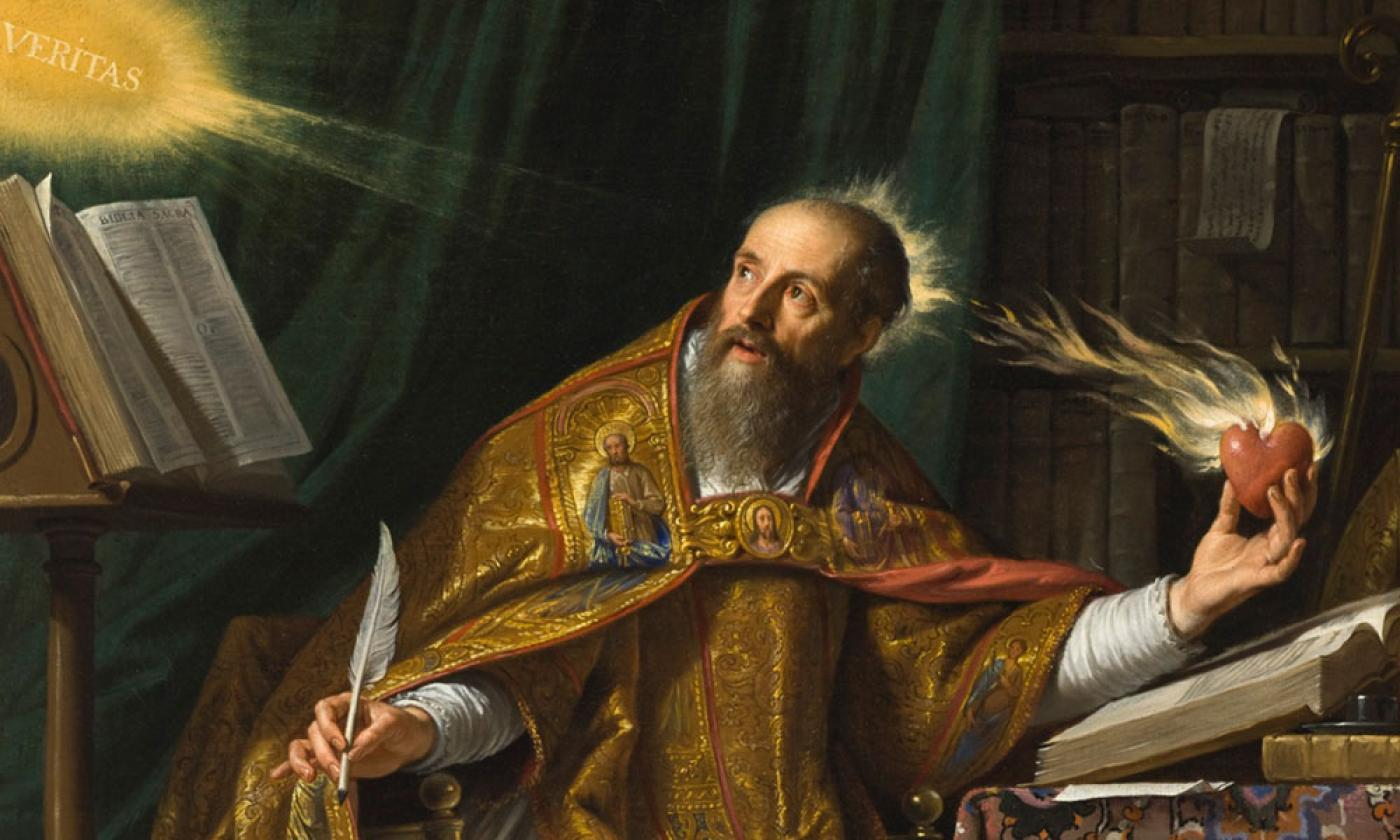
In this post, I explore Augustine’s thought and its implications for modern education. His Confessions, particularly the pear tree incident in Book 2, offer rich material for examining the dynamics of individuals, groups, and the concepts of good and evil. These reflections carry profound pedagogical significance, challenging educators to consider the deeper purposes of teaching and learning.
In class discussions, students consistently focus on the role of peer pressure in Augustine’s theft. Despite my attempts to redirect them toward the broader point—to illustrate humanity’s innate capacity for evil and to challenge Platonic notions of misdirected good—students repeatedly emphasize peer influence. Indeed, Augustine’s admission reinforces their view:
“Yet alone, by myself, I would not have done it” (Confessions 2.8.16).
Why does Augustine, while aiming to illustrate the nature of evil, dwell on the seemingly ancillary matter of peer pressure? This question prompts a broader exploration of how Augustine portrays evil in relation to individuals and groups, with significant implications for education.
Bad Company
The pear tree incident encapsulates Augustine’s paradoxical view of evil. Initially, his companions are barely mentioned:
“Late night—to which hour, according to our pestilential custom, we had kept up our street games—a group of very bad youngsters set out to shake down and rob this tree” (Confessions 2.4.9).
Their influence seems minor; Augustine’s subsequent analysis emphasizes his love for evil itself:
“Behold my heart, O Lord…I sought nothing from the shameful deed but shame itself” (Confessions 2.4.9).
The act reveals Augustine’s deliberate embrace of evil, challenging Plato’s idea that evil stems from pursuing lesser goods. Augustine contends that he chose evil knowingly, reflecting humanity’s profound perversion. This episode highlights the paradox of evil: it is both non-existent (a privation of good) and yet powerful. Augustine draws from both Platonic and Manichaean traditions to articulate this paradox, ultimately rejecting their inadequate explanations. For Augustine, evil cannot be reduced to error or external influence; it reveals humanity’s need for Christ and God’s grace.
Augustine’s friends, while not the cause of the theft, play a facilitative role. He acknowledges the role of companionship—
“Therefore, I also loved in it my association with the others” (Confessions 2.8.16).
Yet, he insists this companionship was itself “nothing.” Such friendship mirrors the emptiness of the theft, illustrating the destructive nature of both sinful acts and relationships. Augustine’s description of these friendships as “itching”—not a cause, but a symptom of sin—reinforces the addictive and compounding nature of evil.
Bad Habits
Augustine’s critique of education reflects his view of society as fostering sin. His education, driven by earthly ambitions and pride, prioritized success over wisdom. Even his parents contributed to this trajectory:
“Their only care was that I should learn to make the finest orations and become a persuasive speaker” (Confessions 2.2.4).
Teaching, for Augustine, was often a debasing exercise in vanity and error:
“For the same period of nine years…we were seduced and we seduced others, deceived and deceiving by various desires, both openly by the so-called liberal arts and secretly in the name of a false religion” (Confessions 4.1.1).
However, Augustine acknowledges one positive moment in his teaching: the transformation of Alypius, who renounced his love for the circus after a classroom discussion. Augustine views this incident as a divine intervention:
“You who make use of all men…made coals of fire by which you cauterized a mind of such high promise and healed it” (Confessions 6.7.11).
This episode underscores the limited but significant role of the teacher as a facilitator of learning. In The Teacher, Augustine elaborates that true learning occurs when students confront inner truth:
“Those who are called students consider within themselves whether what was said is true, each consulting that inner truth according to his own ability” (De Magistro 14.45).
Learning, like conversion, is ultimately a solitary act of encountering truth.
For Augustine, education’s potential for good hinges on humility. Teachers must recognize their limited role, focusing on assisting students in discovering the truth themselves. This humility counters the pride and vanity that Augustine criticized in his educational system. Students are not passive recipients or consumers of knowledge but active participants in their own learning.
Furthermore, education must aim at truth, not practical or emotional gains. Augustine’s insights challenge educators to pursue truth for its own sake, making education both a selfless and fulfilling endeavor. By embracing this vision, education transcends its inherent group dynamics and becomes a profound act of personal and communal transformation.
The Pedagogy of Ancient Philosophy
Pierre Hadot’s seminal work Philosophy as a Way of Life urges modern readers to reconsider ancient philosophical texts not as abstract theories but as practical handbooks for self-transformation. Hadot’s redefinition of ancient philosophy highlights its nature as a form of spiritual exercise, aiming at the internalization and lived practice of a specific worldview. This pedagogical framework aligns closely with Augustine’s Confessions. In recounting his transformative reading of Cicero’s Hortensius, for instance, Augustine describes a pivotal moment:
“All my hollow hopes suddenly seemed worthless, and with unbelievable intensity, my heart burned with longing for the immortality that wisdom seemed to promise. I began to rise up, in order to return to you” (Confessions 3.4.7).
Hadot emphasizes the practical aim of ancient philosophy: the attainment of a perfected state of being and knowledge, embodied in the “sage.” Each school offered tools—meditation, self-attentiveness, and self-control—to guide individuals toward this ideal. Philosophy was holistic, involving academic, athletic, and medical dimensions. It combined intellectual pursuit, rigorous training, and therapeutic care, creating a comprehensive discipline for personal growth. The oral nature of ancient texts reinforced their transformative intent. Read aloud, these works were meant to be experienced, not merely analyzed.
True education, according to Hadot, required dialogue—a personal and communal process of discovering truth through dynamic interaction. This method, exemplified by Socratic dialogue, aimed to turn the learner’s attention inward, cultivating self-awareness and moral responsibility.
Learning to Live, Dialogue, Die, and Read
Hadot outlines four key learnings in ancient philosophy:
- Learning to Live: This involves adopting a lifestyle rooted in philosophical wisdom, demanding discipline, meditation, and self-mastery.
- Learning to Dialogue: Central to this learning is an inner dialogue, fostering self-examination and openness to truth. Socratic questioning serves as a model, challenging interlocutors to remain on the path of truth.
- Learning to Die: Ancient philosophy viewed the contemplation of death as essential for transcending fear and achieving a universal perspective. Socrates, in particular, embodied the ideal of preparing for death through philosophical reflection.
- Learning to Read: Reading was not a passive activity but a formative exercise. Texts were tools for transformation, designed to guide the soul inward and upward toward wisdom.
The Confessions as Spiritual Exercise
Augustine’s Confessions exemplify Hadot’s model of spiritual exercises. Indeed, one can read Augustine’s journey as framed by four transformative learnings:
- Learning to Live: Augustine’s struggle to align his life with divine wisdom reflects the ongoing challenge of living authentically. His narrative invites readers to examine their own lives, pursuing spiritual renewal.
- Learning to Dialogue: The work’s dialogical structure includes conversations with God, self, and the reader. This layered dialogue invites readers into their own transformative conversations.
- Learning to Die: Augustine’s reflections on mortality—from the death of his friend to Monica’s passing—frame life as a preparation for eternal rest. This contemplation deepens his resolve to seek God.
- Learning to Read: Augustine’s evolving engagement with texts—from Cicero to Scripture—demonstrates the transformative power of disciplined and prayerful reading.
Later, in his Retractations, Augustine describes the Confessions as a work meant to inspire its audience, not just to reveal his own story. He explicitly aims to awaken the reader’s intellect and affections, urging them to reflect on their own spiritual journey. The Confessions thus function as a mirror, inviting readers to recognize their dependence on God’s grace and to embark on their own exercises of self-transformation. Augustine’s pedagogical intent is evident in his direct addresses to the reader, encouraging them to shift focus from his narrative to their own lives.
Augustine’s Confessions still offers a profound model of education as spiritual formation. Rooted in ancient traditions of philosophical pedagogy, the work transforms the reader through exercises in living, dialoguing, dying, and reading. These learnings converge in a Christocentric vision, where education becomes an act of love and surrender to divine wisdom. For Augustine, true learning is inseparable from the pursuit of God, culminating in a transformative journey of self-discovery and spiritual renewal.
Study as Love
For Augustine, study was not merely an intellectual pursuit but a profound expression of love—a yearning to understand what one does not yet fully grasp. This love of learning mirrored the human longing for God, who is the ultimate Truth. In On the Trinity, Augustine writes:
“Unless you believe, you shall not understand”
This dictum encapsulates his belief that intellectual inquiry begins with trust—in both divine revelation and human teachers. Learning thus becomes an act of faith, rooted in the desire to align oneself with eternal wisdom.
Moreover, study requires three essential virtues: purity, humility, and charity. Purity involves a disciplined focus on truth, free from the distractions of sensory pleasures or worldly ambitions. It is a form of asceticism that sharpens the intellect and prepares the soul for deeper understanding. Humility, on the other hand, is the recognition of one’s dependence on both God and others. Augustine’s own journey exemplified this: he initially resisted the simplicity of Scripture but later submitted to its authority as a gateway to divine wisdom. Charity, or rightly ordered love, is the crowning virtue that prioritizes love for God above all else. In education, charity manifests as a teacher’s love for truth and their students, guiding them patiently toward enlightenment.
Augustine saw these virtues not as abstract ideals but as the foundation of a pedagogy that transforms both the teacher and the student. Teaching, in his view, was a collaborative journey toward truth, where both parties grow in wisdom and virtue. By framing study as an act of love, Augustine elevated education beyond mere skill acquisition to a lifelong pursuit of spiritual and intellectual fulfillment.
For Augustine, study is an act of love—a desire to know what one does not yet understand. In his treatise On the Trinity, he likens study to interpreting obscure texts, where the movement from confusion to clarity embodies the love of truth. Augustine’s approach to interpretation exemplifies this: he delights in wrestling with challenging texts, as the process itself strengthens the mind’s love for truth.
Teaching, too, is an act of love but differs in its object. While study expresses love for truth, teaching reflects love for others. Augustine situates both within his broader ethical framework, emphasizing the same three virtues essential for pedagogy: purity, humility, and charity. These virtues concern the right ordering of love—toward external things, oneself, and God, respectively.
Challenges for Professors in Augustine’s Pedagogical Model
Augustine challenges professors to view themselves as facilitators, not ultimate sources of knowledge. They must guide students toward intellectual discipline and contemplation without succumbing to the vanity of self-importance. This approach contrasts with “bad professors” who prioritize entertaining or dazzling their students over fostering true intellectual growth.
For Augustine, the pedagogical relationship must be rooted in honesty. Professors should openly acknowledge their limitations and encourage students to do the same. This mutual respect builds trust, creating a learning environment where students feel safe to explore, question, and grow.
Unlike traditional views that prioritize disciplinary content, Augustine emphasizes the student’s intellect as the true subject of education. Professors use content as a means to develop students’ intellectual capabilities, guiding them toward independent contemplation of truth.
The Problem of Motive
These reflections on study and teaching as an act of love paves the way for a broader discussion on the motives and challenges of liberal education. Liberal education aims at the liberation of the whole person, distinguishing itself from vocational training or practical skill acquisition. It addresses fundamental questions of human existence: Who am I? What is freedom? What is the meaning of life? Yet, its purpose often faces skepticism. Why should anyone withdraw from productive labor to engage in disinterested inquiry? The challenge lies in articulating a compelling motive for liberal education—one that transcends mere utility.
Justifying Liberal Education Implies Cultural Criticism
Aristotle provided a countercultural justification for liberal education in the classical world. His Nicomachean Ethics critiques the common association of happiness with political power, emphasizing intellectual contemplation as the highest good. Similarly, Augustine viewed liberal education as a path to wisdom, yet cautioned against its potential to inflate the ego. He called for a purification of the liberal arts, subordinating them to the pursuit of divine truth.
By mediating disputes between proponents of political activism and those advocating withdrawal, Aristotle highlights the value of thoughtful inquiry. He contends that happiness consists in practical life, and thought itself is a form of activity. This differentiation allows him to argue that philosophical contemplation provides a deeper satisfaction than political ambition.
Sources of Resistance
Modern liberal regimes, shaped by early thinkers like Hobbes and Locke, prioritize autonomy and security, often at the expense of intellectual inquiry. Higher education increasingly serves as a pathway to career success, reducing learning to a consumer-driven enterprise. Tocqueville warned of the “tutelary power” of modern states, which, in their quest to manage lives, undermine intellectual freedom and moral independence.
As liberal societies prioritize individual choice and material success, higher education becomes a utilitarian training ground for careers. Colleges transform into consumer-driven institutions, focused on enrollment and marketability. This undermines their mission to cultivate independent thinkers and instead enslaves students to cultural conformity. Liberalism’s emphasis on autonomy paradoxically results in dependence on impersonal forces.
How Liberalism Undermines Liberal Education
Furthermore, liberalism’s skepticism about the intelligibility of the cosmos fosters complacency, eroding the conditions for inquiry. By prioritizing autonomy and material gain, it stifles the pursuit of wisdom. Augustine’s model offers a corrective, emphasizing faith in the world’s intelligibility and the transformative power of love in education.
The Judeo-Christian tradition provides a profound motivation for liberal education. The opening of John’s Gospel reveals a cosmos created through the Word, suggesting that all creation is imbued with intelligibility. Human inquiry participates in this divine intelligibility, transforming even seemingly mundane pursuits into acts of worship. Christian liberal education presupposes a theology, cosmology, and anthropology that affirm the world’s order and human dignity. Human inquiry, seen as participation in divine wisdom, elevates even mundane tasks into acts of worship. Augustine’s Christocentric vision integrates intellectual and spiritual growth, fostering a sense of interdependence and communal responsibility.
Werner Jaeger’s Early Christianity and Greek Paideia (1961) offers valuable insights into the broader interplay between Christian thought and classical education. Jaeger explores how early Christian thinkers, including but not limited to Augustine, engaged with the intellectual traditions of Greek paideia. He demonstrates that Christian education did not reject classical learning but rather sought to adapt and transform it. This synthesis of Hellenistic and Christian ideals aimed at cultivating a holistic vision of the human person, one oriented toward both intellectual and spiritual excellence.
Jaeger’s work emphasizes the continuity between Greek philosophical inquiry and Christian pedagogy, highlighting how figures like Augustine inherited and reshaped classical ideas to serve theological purposes. This historical perspective enriches our understanding of Augustine’s approach, situating his educational philosophy within a larger tradition of integrating reason and faith.
Liberal education seeks to liberate the human person through reflective inquiry and the pursuit of wisdom. Yet modern liberalism’s emphasis on autonomy and productivity undermines its very foundations. Christianity, by contrast, offers a compelling framework for sustaining liberal education, emphasizing the intelligibility of creation and the transformative power of divine grace. By cultivating wonder, humility, and love, Christian liberal education fulfills its mission of forming whole persons capable of thoughtful and meaningful lives.
The Challenge of Modern Education
Modern education must grapple with the tension between Augustine’s Platonic epistemology and contemporary pedagogical practices. While Augustine’s vision emphasizes the intrinsic connection between love of truth and human flourishing, its implementation today requires adaptation. The challenge lies in fostering environments where students can experience the transformative power of study while navigating the complexities of modern academic and cultural contexts.
Augustine’s vision of education, grounded in love and humility, challenges modern pedagogy to prioritize wisdom over utility. His approach integrates reflective inquiry with spiritual transformation, offering a timeless model for meaningful and transformative learning. By embracing this model, education can become a profound act of personal and communal renewal, centered on the pursuit of truth and the cultivation of the whole person.
Wisdom of the Ages
Posted on January 10, 2025 Leave a Comment
David Curtis Steinmetz (1936–2015) was a distinguished historian of Christianity, renowned for his pioneering work in the field of Reformation studies. Born in Schenectady, New York, Steinmetz earned his Ph.D. from Harvard University under the mentorship of the eminent church historian Heiko A. Oberman. His academic career was defined by a commitment to understanding the theology and practice of the early Protestant reformers, particularly figures like Martin Luther and John Calvin.

One of Steinmetz’s most influential contributions was his advocacy for the “pre-critical” interpretation of Scripture, a perspective that sought to recover how early modern theologians read and understood the Bible before the rise of modern critical methods. This approach is best exemplified in his landmark essay, “The Superiority of Pre-Critical Exegesis,” which challenged modern assumptions about biblical interpretation and highlighted the rich theological insights of the reformers and their medieval predecessors. A number of his important essays were collected in Taking the Long View: Christian Theology in Historical Perspective (2011).
According to Steinmetz, medieval and patristic approaches offer a richer understanding of Scripture. He begins by critiquing Benjamin Jowett’s (1817-1893) 19th-century insistence that biblical texts have a single, original meaning intended by their human authors. Jowett’s approach sought to reduce Scripture to its historical context, dismissing the theological and spiritual interpretations embraced by pre-modern exegetes.
Steinmetz counters Jowett by defending the multi-layered hermeneutics of medieval theologians. These scholars, drawing on Pauline distinctions between “letter” and “spirit” (2 Cor. 3:6), believed that a text could possess multiple valid meanings—historical, allegorical, moral, and anagogical. For instance, they interpreted Psalm 137’s lament over Babylon as a metaphor for the Christian’s spiritual exile and hope for God’s eternal kingdom, transcending its historical context.
Steinmetz highlights a number of notable figures, such as Augustine and Thomas Aquinas, who grounded spiritual interpretations in the literal sense of Scripture while expanding its significance. He also discusses Nicholas of Lyra’s (1270-1349) theory of a “double literal sense,” where a biblical passage could hold both an immediate historical meaning and a prophetic one.
To illustrate medieval exegetical rigor, Steinmetz analyzes their interpretations of the Parable of the Workers in the Vineyard (Matt. 20:1–16). From Thomas Aquinas to Martin Luther, exegetes offered varied but theologically coherent readings, emphasizing God’s generosity and grace. Steinmetz contrasts this with modern exegesis, which often limits itself to the intentions of the original author, a method he critiques as historically naive and spiritually impoverished.
Ultimately, Steinmetz defends pre-critical exegesis as a holistic approach that meets the spiritual needs of the Christian community. He argues that the historical-critical method, while valuable, cannot fully capture the theological depth of Scripture without a broader hermeneutical framework.
Miss Marple, Mystery, and Meaning
In another essay, “Miss Marple Reads the Bible,” Steinmetz draws an engaging analogy between mystery novels and biblical interpretation. He argues that both traditional Christian exegesis and detective fiction involve constructing “second narratives” to make sense of seemingly disordered stories. This essay extends the themes of his earlier “The Superiority of Pre-Critical Exegesis,” contrasting modern historical-critical methods with premodern approaches that integrate theological insights into scriptural interpretation.
Steinmetz compares the concluding explanations of detectives like Miss Marple or Hercule Poirot to the New Testament’s retelling of Old Testament narratives. In a mystery, the investigator’s final revelation retroactively organizes the story’s scattered details, revealing the plot’s true coherence. Similarly, the life, death, and resurrection of Jesus Christ reframe Israel’s narrative, giving it deeper theological meaning.
Traditional exegesis reads earlier biblical texts in light of later developments, while historical criticism resists such retrospective interpretation, striving to situate texts in their original contexts. Steinmetz critiques this division, suggesting that historical criticism, like a detective story without resolution, leaves readers with fragmented narratives rather than a unified understanding of Scripture.
Indeed, Steinmetz notes that the early Church’s rule of faith functioned as a “second narrative,” guiding Christians in interpreting the Bible. Figures like Irenaeus and Tertullian rejected heretical reinterpretations that lacked this cohesive framework. The Church Fathers’ confidence in their second narrative stemmed from their apostolic succession, which guaranteed continuity with the teachings of the apostles.
Interestingly, he also observes that historians, like detectives, construct second narratives to explain historical events. He challenges the notion that Scripture has a single, original meaning tied to its author’s intent. Instead, Steinmetz asserts that historians must account for how events unfolded, drawing meaning from their consequences. This method parallels how early Christians read the Old Testament in light of Christ’s fulfillment.
Steinmetz concludes by emphasizing that biblical scholars who are also theologians should focus less on avoiding anachronism and more on constructing compelling second narratives. While Old Testament figures like Isaiah could not foresee Christ, their writings gain fuller meaning in light of the gospel. This layered interpretation reflects the complexity of Scripture and honors its theological depth.
Designing the Debate
In another excellent essay in this volume, Steinmetz examines the contentious discussion surrounding the theory of intelligent design (ID) and its implications for theology and biblical interpretation. This essay connects with themes from “The Superiority of Pre-Critical Exegesis” and “Miss Marple Reads the Bible” by emphasizing the importance of interpretation frameworks and questioning the limits of reason in understanding divine truths.
Steinmetz defines intelligent design as the theory that the universe’s complexity necessitates a designing intellect. Although proponents claim it is religiously neutral, its strongest advocates are often conservative Christians, who see Genesis as a scientific account. Steinmetz highlights the tension between a literal reading of creation and the broader theological understanding of God as Creator.
Drawing on Origen, Steinmetz critiques the assumption that Genesis offers a straightforward historical account. Origen argued for reading creation as “truth in the semblance of history,” rejecting literal interpretations of details like God walking in Eden. This perspective parallels Steinmetz’s earlier defense of multi-layered scriptural meanings, emphasizing that theological truths often transcend historical facts.
Steinmetz contrasts Thomas Aquinas and John Calvin on the possibility of knowing God through natural theology. Aquinas believed reason could infer a First Cause, but Calvin was rightly skeptical, arguing that sin distorts human perception of divine truth. For Calvin, nature’s testimony to God’s glory requires the “spectacles of Scripture” to be properly understood, reinforcing the dependence on faith and divine revelation.
While ID proponents claim their arguments are based solely on empirical evidence, Steinmetz identifies their work as a form of natural theology, implicitly theological despite attempts to avoid religious identification. He critiques their claim that evidence for design leads to belief in a designer, suggesting instead that faith shapes how evidence is interpreted.
Nevertheless, Steinmetz concludes by affirming the world as “the theater of God’s glory.” He encourages Christians to celebrate creation intelligently and rejects the antagonism between evolution and theology.
Why the Past Matters to the Church
Perhaps the most important essays in this collection are those toward the back of the book. In “The Necessity of the Past,” Steinmetz explores the importance of historical consciousness for both the church and society. He contrasts America’s forward-looking ethos with the church’s reliance on past events, arguing that a proper understanding of the Christian faith requires an acknowledgment of the past’s decisive role.
The American tendency to disregard the past has led to something like a cultural amnesia. This forward-looking ethos contrasts sharply with the church’s dependence on historical events, such as the life, death, and resurrection of Jesus Christ. The church’s identity is inseparable from these foundational moments, which remain central to its faith and mission.
Memory, according to Steinmetz, is essential for the church’s identity and mission. He argues that Christian faith is rooted in historical events rather than abstract philosophical or ethical systems. The resurrection of Christ, for instance, is not merely a symbolic story but a concrete event upon which the church’s theology and practice are built. Forgetting this past risks undermining the church’s present and future relevance.
Steinmetz acknowledges that the church’s understanding of Scripture is shaped by its historical traditions. For example, the doctrine of the Trinity is a product of the church’s reflection on biblical texts, not a direct scriptural teaching. While tradition can clarify the Gospel, it can also obscure it if left unexamined. The study of church history provides Christians with the tools to critically assess their inherited beliefs and practices.
Indeed, Steinmetz presents church history as a vital theological discipline that liberates Christians from narrow parochialism. By engaging with diverse traditions and examining their historical development, Christians gain a broader and more self-critical perspective on their faith. This historical awareness enables the church to balance fidelity to its origins with the demands of contemporary contexts.
Steinmetz warns that losing touch with the past results in aimlessness and despair. Just as individuals lose their identity without memory, so too does the church risk losing its mission if it forgets its historical foundations.
History as a Lens for Faith and Understanding
In the final essay of this collection, Steinmetz reflects on the historical methodologies of Jaroslav Pelikan and Heiko Oberman, two eminent 20th-century historians of Christianity. Steinmetz uses their contrasting approaches to illuminate broader themes about the role of history in theological reflection and the importance of engaging with the past on its own terms. This essay ties together themes from Steinmetz’s previous works, particularly the necessity of historical awareness, the interplay between faith and reason, and the value of tradition in understanding Scripture and doctrine.
Steinmetz contrasts Pelikan’s expansive vision of the entire Christian past with Oberman’s focused study of the late medieval and Reformation periods. Pelikan sought to correct Adolf von Harnack’s reductionist view of Christian history, which emphasized ethics over theology. In response, Pelikan presented a richer, more theologically grounded narrative that included Byzantine and post-Reformation traditions. Oberman, on the other hand, emphasized historical context and intellectual rigor, advocating for a “social history of ideas” that situates theological developments within their broader cultural and political environments.
Steinmetz also more directly critiques Harnack’s attempt to distill Christianity into a simple moral message, arguing that this approach neglects the theological richness of doctrines like the Trinity and Christology. By stripping Christianity of its metaphysical framework, Harnack flattened its historical and doctrinal complexity, a mistake Pelikan sought to rectify through his multivolume history of doctrine.
Both Pelikan and Oberman emphasized the importance of “going native” when studying the past—immersing oneself in the languages, customs, and intellectual frameworks of historical figures. Steinmetz underscores that empathy for the past enables historians to present an accurate and nuanced picture, avoiding the temptation to impose modern categories or values onto historical narratives.
For Steinmetz, history is not merely an academic exercise but a vital resource for the church. By engaging critically with the past, the church can recover forgotten insights and navigate contemporary challenges with a deeper understanding of its traditions. While love for the subject can provide unique insights, it must be tempered by rigorous analysis. This interplay between commitment and critique enables historians and theologians to engage the past faithfully and constructively.
Taking the Long View serves as a capstone to Steinmetz’s reflections on the importance of historical consciousness in theology. It ties together his critiques of modern reductionism, his defense of pre-critical exegesis, and his call for a deeper engagement with tradition. By highlighting the methodological rigor of Pelikan and Oberman, Steinmetz underscores the transformative power of history to enrich both scholarship and faith.
Cultivating the Whole Person: Newman’s Vision for Higher Learning
Posted on January 7, 2025 Leave a Comment

In his seminal work The Idea of a University (1852), John Henry Newman (1801-1890) critiques the rising utilitarian approach to education, which sought to align learning with the demands of the Industrial Revolution. For Newman, education was not merely about acquiring practical skills for economic progress; rather, it was about cultivating the intellect, character, and moral virtues of individuals. Newman’s vision for a liberal education stands as a counterpoint to the utilitarianism of Jeremy Bentham (1748-1832) and John Stuart Mill (1806-1873), as well as the secular humanism of Auguste Comte (1798-1857), both of which sought to supplant traditional religious frameworks with an empirical and rational worldview.
Newman’s Critique of Utilitarian Education
Utilitarianism, as espoused by Bentham and Mill, focuses on maximizing human happiness through rational calculation and empirical observation. Similarly, Comte’s positivism emphasizes scientific progress and seeks to establish a “religion of humanity” that replaces traditional faith with a scientific ethos. Newman saw such frameworks as reductive, arguing that they neglected the deeper purpose of education: the formation of the whole person. He writes,
“Education is a higher word; it implies an action upon our mental nature, and the formation of a character; it is something individual and permanent, and is commonly spoken of in connexion with religion and morality” (Discourse 5, Knowledge Its Own End).
For Newman, a liberal education should foster critical thinking, moral discernment, and intellectual breadth, enabling individuals to engage meaningfully with the world. He believed that reducing education to mere vocational training ignored the importance of intellectual and moral formation, which he saw as essential for a flourishing society.
The Influence of Secular Humanism and Hegelian Philosophy
Newman’s critique of utilitarianism also reflects his engagement with the broader intellectual currents of his time, particularly the ideas of Comte and German philosopher Georg Wilhelm Friedrich Hegel (1770-1831). Hegel’s philosophy, with its emphasis on reason, history, and culture as the unfolding of Absolute Spirit, can be seen as a precursor to secular humanism. This worldview often elevates human achievements and rational progress as the ultimate expressions of the divine. Newman resisted this Hegelian tendency to conflate human progress with spiritual fulfillment, arguing instead for the necessity of theological and metaphysical inquiry in education.
While Newman did not explicitly mention Hegel in The Idea of a University, his earlier essay, “On the Introduction of Rationalistic and German Philosophy into England” (1832), critiques the “German philosophy”—a veiled reference to Hegel—for its overreliance on reason and its neglect of the spiritual dimensions of human existence. Similarly, Newman’s criticisms of Comte’s positivism highlight the dangers of excluding theology and ethics from the academic curriculum. “The goal of education is not merely to impart knowledge, but to form the soul in wisdom and virtue,” Newman’s vision asserts, aligning him more closely with the patristic tradition than with the secular philosophies of his contemporaries.
Augustinian Foundations: Education as Eudaimonia
Indeed, Newman’s educational philosophy is deeply rooted in the thought of St. Augustine, whose writings emphasize education as a path to eudaimonia, or human flourishing. Augustine, in works like De Doctrina Christiana and De Magistro, saw education as a means of cultivating wisdom, virtue, and spiritual growth. He writes,
“For the sake of the soul, which is the true self, we should not neglect the cultivation of the mind, which is the seat of wisdom” (De Doctrina Christiana, Book 2, Chapter 36).
Echoing this, Newman believed that education should aim at forming the whole person—mind, character, and moral virtues. He argued that a liberal education must expose students to a broad range of disciplines, including literature, history, philosophy, and theology, to develop their intellectual and moral faculties. In The Idea of a University, Newman asserts,
“A University is not merely a place of instruction, but a place of education. Instruction is the process of imparting knowledge; education is the process of forming the mind and character” (Discourse 5, Knowledge Its Own End).
How the Modern University Lost Its Way
Enlightenment thinkers, such as John Locke and Jean-Jacques Rousseau, emphasized education as essential for developing free, rational individuals and a stable civil society. Education was viewed as a means of shaping human nature, cultivating virtue, and reinforcing social bonds. These philosophical ideas influenced the rise of state-sponsored education systems in countries like Prussia and the United States, where education was seen as crucial for fostering public virtue and moral character.
In the nineteenth century, universities embraced a vision of the “unity of truth,” which held that all branches of knowledge—scientific, moral, and theological—were interconnected and ultimately reconcilable. Education was seen not only as the pursuit of knowledge but as a pathway to moral and spiritual formation. Knowledge of the true was equated with knowledge of the good, reflecting a cosmology where the universe, as God’s creation, was seen as rational and harmonious. The colonial colleges, modeled after medieval scholasticism and Christian humanism, emphasized the integration of all fields of study into a unified whole. Moral philosophy and natural theology were central to the curriculum, aiming to produce individuals who could act ethically and rationally in accordance with divine laws. The study of nature was imbued with moral significance, reinforcing the compatibility of science and religious revelation.
Yet this ideal, as Julie A. Reuben traces in her book, The Making of the Modern University: Intellectual Transformation and the Marginalization of Morality (1996), began to erode with the rise of new scientific paradigms and social philosophies that challenged traditional frameworks. The advent of Darwinian evolutionary theory, for instance, disrupted the Baconian emphasis on immutable natural laws, introducing a dynamic, progressivist view of science. Knowledge came to be seen as provisional and ever-evolving, weakening the link between scientific inquiry and theological truths.
As science gained prominence, the curriculum shifted. Courses in moral philosophy and natural theology, once central to higher education, were replaced by a focus on empirical studies and specialized disciplines. Moral philosophy, once a theistic discipline, began to align more closely with empirical studies of human behavior, contributing to a gradual secularization of knowledge. Theology was increasingly relegated to the margins, and moral questions were reframed as sociological or psychological phenomena. This fragmentation reflected a broader cultural shift in which intellectual pursuits were divorced from their religious and moral roots.
Theologians and scientists attempted to reconcile these theories with religious doctrines, but the process often led to disputes and growing skepticism. This tension culminated in the late nineteenth century with the decline of natural theology as a credible means of unifying science and religion. Reuben highlights the increasing separation of academic disciplines as a key development in the formation of the modern university. The emphasis shifted from moral and religious integration to specialized, empirical investigation. Reformers like Francis Wayland (1796-1865) and Henry Tappan (1805-1881) called for educational systems that prioritized practical and scientific instruction, leading to the establishment of new institutions and the gradual decline of the traditional, religiously oriented college.
Attempts to integrate religion into the modern university persisted but often took the form of the so-called “science of religion.” This approach sought to study religious phenomena objectively, using historical and sociological methods, but in doing so, it reduced religion to cultural and psychological functions. Meanwhile, the rise of evolutionary ethics and the “ethic of science” promised to provide moral guidance, further marginalizing traditional religious frameworks. Between 1870 and 1890, during which required courses in moral philosophy, natural theology, and the “evidences of Christianity,” were phased out. Reform-oriented institutions like the University of California, Harvard, and the University of Michigan eliminated such courses, often replacing them with electives on ethics or the history of philosophy. University leaders, such as Daniel C. Gilman of Johns Hopkins and Charles W. Eliot of Harvard, grappled with how to incorporate religion into the university while maintaining academic freedom and scientific credibility. They sought philosophers and theologians who could harmonize religious thought with modern scientific perspectives but often faced difficulty finding candidates who met these expectations.
As scientific methodologies evolved, so too did the perception of religion. The traditional view that science could reveal divine truths through natural theology began to erode. Progressivists criticized theology for its dogmatism and lack of openness to inquiry, proposing that religion and science occupy separate spheres. While this distinction allowed for peaceful coexistence, it also entrenched the division between natural and supernatural knowledge. As philosophy departments professionalized, younger philosophers moved away from theistic concerns toward technical and specialized studies in epistemology, logic, and psychology. This shift reflected broader trends in academia, where religious and moral questions became increasingly marginalized.
This period also saw the emergence of progressivist views of science, which rejected the notion of fixed natural laws and embraced a dynamic understanding of scientific progress. Thinkers like John Dewey and William James emphasized that science was not about discovering immutable truths but about framing hypotheses and solving problems. Scientific knowledge was seen as provisional, evolving alongside human understanding.
These shifts had profound implications for universities. Scientific inquiry was increasingly associated with intellectual freedom and progress, while theology was marginalized. This laid the groundwork for the modern secular university, where knowledge was fragmented into specialized disciplines and religion was no longer seen as central to the pursuit of truth. These fields often avoided theological questions, focusing instead on the psychological and social functions of religion. While these studies affirmed the value of religion, they largely reduced it to an inspirational and psychological role, further widening the gap between science and faith. Reuben argues that the “scientific” study of religion ultimately failed to reintegrate religion into the intellectual life of the modern university. By sidelining theological and doctrinal concerns, the discipline contributed to the secularization of higher education, relegating religion to the realm of personal belief and cultural history.
In the early twentieth century, scientific methodologies became the dominant paradigm, and education was increasingly seen as a tool for societal progress rather than personal moral development. Social reformers like Dewey championed a pragmatic, child-centered approach to learning, linking education to democratic ideals. Yet even this progressive vision often neglected the deeper spiritual and moral dimensions of human life, focusing instead on practical outcomes and social efficiency. University reformers argued that science could serve as an indirect form of moral education by instilling virtues such as honesty, discipline, and objectivity. They also posited that certain scientific disciplines—especially biology and the social sciences—could offer direct moral guidance. For example, evolutionary theory was framed as a unifying concept that linked various branches of knowledge and provided insights into human behavior and social organization.
The professionalization of education further entrenched its secular character. Schools of education emerged as distinct entities, emphasizing pedagogical training over philosophical or theological reflection. These changes solidified the modern university’s turn away from its religious foundations, leaving behind Newman’s holistic vision of intellectual and moral cultivation.
Contemporary Relevance
Newman’s critique of utilitarian education and his emphasis on intellectual and moral formation remain profoundly relevant in contemporary debates about the purpose of education. In an age where education is increasingly oriented toward job preparation and technological proficiency, Newman’s vision calls us to reconsider the deeper aims of learning. Should education merely serve the economy, or should it also seek to cultivate wisdom, virtue, and the capacity for self-reflection? Newman’s philosophy invites us to restore the balance by valuing education as a means of shaping thoughtful, well-rounded individuals capable of contributing to the common good.
Roberto J. De La Noval, in his recent essay “Teaching for Intellectual Conversion,” introduces Bernard Lonergan’s concept of intellectual conversion as a transformative process that reorients students toward truth and the transcendent. This aligns closely with Newman’s vision of education as the formation of the whole person. De La Noval argues that intellectual conversion helps students move beyond relativistic attitudes, fostering a deeper engagement with theology and other liberal arts disciplines. He critiques the modern mindset that relegates moral and existential questions to the realm of subjective opinion. He describes relativism as a “life-feeling” (Lebensgefühl) characterized by self-doubt and a retreat from objective truth. Newman’s insistence on integrating theology and ethics into education counters this relativism by grounding students in a framework that affirms the validity of both subjective experience and universal truth.
I’m also reminded by another commentator on Newman’s Idea of the University, renowned historian of Christianity Jaroslav Pelikan (1923-2006). In his 1960 commencement address to Wittenberg University, he identified three key characteristics of a Christian intellectual: (1) a passion for being, (2) a reverence for language, and (3) an enthusiasm for history. These qualities not only reflect the theological richness of the Christian tradition but also serve as a blueprint for integrating faith and intellect in a fragmented educational landscape.
A passion for being recognizes the inherent goodness of creation, even amidst its corruption by sin. Pelikan highlights the Christian doctrine of creation as a foundation for intellectual inquiry and environmental stewardship, echoing the doxology: “The world is charged with the grandeur of God.” This vision calls the Christian intellectual to love and respect the material world as the bearer of God’s grace, bridging faith with scientific inquiry.
Reverence for language underscores the power and responsibility of words. Pelikan argues that language, as a divine gift, lies at the heart of both human uniqueness and Christian theology. By cultivating clarity and precision in speech and writing, the Christian intellectual safeguards the truth and combats the muddiness that leads to confusion and error. As Pelikan notes, “In the beginning was the Word: the capacity for words is still the point at which God contacts man.”
Finally, an enthusiasm for history embraces the dynamic and transformative work of the Holy Spirit throughout time. The Christian intellectual is called to engage with historical insights, acknowledging both the variety and unity of human experience. This openness to the Spirit’s activity provides the courage to work for social improvement while maintaining a sober recognition of its limits.
Pelikan’s reflections resonate with Newman’s vision of a university, calling for a reintegration of faith and intellect. Together, they challenge the modern academy to recover its spiritual and moral mission, fostering a generation of Christian intellectuals who embody wisdom, virtue, and a love for truth.
Reviving Newman’s Vision
The secular humanism that Newman critiqued has only deepened its influence, often sidelining metaphysical and ethical concerns in favor of empirical and technological advancements. Revisiting Newman’s ideas offers a counter-narrative, reminding us of the importance of integrating theological and moral inquiry into education to address the complexities of the human condition.
Newman’s philosophy of education, deeply influenced by the patristic tradition and a response to the intellectual currents of his time, challenges the modern reduction of education to utilitarian ends. His vision calls for a holistic approach to learning that prioritizes intellectual and moral formation. By drawing on the wisdom of Augustine and engaging with the challenges posed by Hegelian and Comtean thought, Newman provides a compelling framework for reimagining the role of education in contemporary society. His insights continue to inspire those who seek to cultivate not just skilled workers, but thoughtful, virtuous, and flourishing human beings.
Natural and Supernatural Worlds in the Age of Revolution and Empire (1789–1920)
Posted on December 31, 2024 Leave a Comment
Between 1789 and 1920, the relationship between Christianity and the concepts of the natural and supernatural underwent dramatic transformations. As most historians have contended, this period saw the rise of modern science, the secularization of society, and a resurgence of supernaturalism in new forms. Understanding how Christianity navigated these shifts requires a careful consideration of the historical and conceptual evolution of the “supernatural,” as well as its interplay with emerging scientific and cultural frameworks.
The Supernatural: Historical Evolution of the Concept

As Henri de Lubac detailed in Surnatural (1946), the term supernaturalis did not enter theological discourse until the ninth century, emerging from Carolingian translations of Pseudo-Dionysius (c. fifth century) and John Scotus Eriugena (c. 810-877). Even then, its usage remained rare until the thirteenth century and did not become widespread until after the Council of Trent in the sixteenth century. The late adoption of the term reflects the premodern worldview, where the “natural” was understood in a theological sense. For early Christians, “nature” referred to the pristine, prelapsarian state of creation—a condition reflecting the uncorrupted image of God.
De Lubac argues that the notion of a self-sufficient human nature, complete with its own natural end, is a relatively recent theological construct that diverges from the unified vision of the Church Fathers and Scholastics. In the early Christian tradition, there was no conception of a purely natural end for human beings separate from the supernatural destiny intended by God. De Lubac contends that theologians like Michael Baius (1513-1589) and Cornelius Jansenius (1585-1638), in their efforts to defend the gratuity of the supernatural, inadvertently introduced a separation between nature and grace that was foreign to earlier Christian thought. This separation led to the hypothesis of a “state of pure nature,” wherein human beings could achieve a natural end without divine grace—a concept that de Lubac finds problematic.
De Lubac’s critique extends to the idea that human nature possesses an intrinsic desire for the beatific vision, a desire that cannot be fulfilled by any natural end. He emphasizes that this innate orientation toward a supernatural destiny does not imply that human nature is already graced; rather, it highlights the gratuitous nature of divine grace that elevates humanity beyond its natural capacities.
By challenging the “system of pure nature,” de Lubac sought to restore a more integrated understanding of the nature-grace relationship, one that acknowledges the inherent openness of human nature to the supernatural without positing an autonomous natural order complete in itself. If true, this approach challenges modern theological constructs that compartmentalize human destiny into natural and supernatural ends, urging a return to a more holistic vision of humanity’s ultimate calling.
The Historical Foundations of “Natural” and “Supernatural”
Alister McGrath, in his recent Natural Philosophy: On Retrieving a Lost Disciplinary Imaginary (2023), highlights Albertus Magnus’s (c. 1200-1280) pivotal role in shaping this dichotomy in the 13th century. Drawing on Aristotle, Albertus argued for the autonomy of natural philosophy (later synonymous with science), which could be pursued through human reason without the need for divine grace. As McGrath observes, Albertus maintained that “natural philosophy was concerned with natural truths, and theology with supernatural ones.” This delineation allowed natural philosophy to flourish as an independent discipline while safeguarding theology’s authority in matters of divine revelation.
Albertus’s intellectual vision, supported by Gregory IX’s 1231 bull Parens scientiarum, reshaped university culture, encouraging the study of Aristotle’s Libri naturales. His successor, Thomas Aquinas (1225-1274), built on this framework in works like Summa contra Gentiles, using natural philosophy as a common language to engage with non-Christian audiences. For Aquinas, philosophy and theology were distinct yet convergent fields, each operating within its own methods while arriving at truths that complemented one another. He wrote of God as the “supernatural cause of all things” and described creation’s participation in the divine as the sacramentum mundi. Yet, even for Aquinas, the natural and supernatural were not sharply opposed; rather, the former participated in the latter.
By the 17th century, the rise of scientific rationalism and the Reformation’s emphasis on faith over reason reconfigured these categories. Nature became a closed system governed by observable laws, and the supernatural came to signify phenomena that disrupted or transcended these laws. As de Lubac observed, “the supernatural could only gain currency as that which was natural came to be understood as the order of things in the postlapsarian, rather than the prelapsarian, world.”
Secularization, Disenchantment, and Science
The Enlightenment and the scientific revolution brought new challenges to Christianity’s understanding of the natural and supernatural. Max Weber’s concept of “disenchantment” aptly captures the secularizing trajectory of modernity, where the mystical and divine dimensions of the world were increasingly supplanted by rational explanations and empirical observations. This process, however, was neither straightforward nor universally embraced, as it generated complex interactions between faith, science, and society.
The Reformation’s Attack on Catholic Supernaturalism
The Reformation’s attack on Catholic liturgical practices and doctrines accused the Church of promoting “superstition” through its supernaturalism. Reformers like Martin Luther and John Calvin sought to purify Christian worship and doctrine by eliminating what they perceived as medieval Catholicism’s excessive reliance on supernatural phenomena, which they condemned as superstitions. This critique targeted key aspects of Catholic devotional life. For instance, Catholicism had long emphasized the intercession of saints and the miraculous power of relics. Pilgrimages to shrines housing relics, such as those of St. Peter or St. James, were central to medieval piety. Luther and other reformers rejected these practices, arguing that they detracted from Christ’s singular role as mediator between God and humanity.
Catholic theology had historically upheld a sacramental view of the world, where physical objects and actions (e.g., the Eucharist, holy water) were imbued with divine grace. Reformers rejected the notion of transubstantiation—the belief that the bread and wine of the Eucharist become the literal body and blood of Christ—as irrational and unsupported by Scripture. Calvin, for instance, advocated a symbolic understanding of the Eucharist, emphasizing the spiritual rather than physical presence of Christ.
Reports of Marian apparitions, miraculous healings, and visions were common in Catholic devotion. Protestants dismissed these as fabrications or demonic deceptions, arguing that miracles had ceased with the apostolic age. This cessationist theology effectively reduced the scope of the supernatural in everyday life.
Furthermore, Catholic exorcisms, deeply rooted in the belief in demonic possession, were viewed with suspicion by reformers. While both Protestants and Catholics engaged in witch hunts, Protestants increasingly associated such practices with Catholic superstition, distancing themselves from the supernatural rituals of their opponents.
The Reformation and the Rational Turn of the Enlightenment
The Reformation’s critique of Catholic supernaturalism helped pave the way for the Enlightenment’s emphasis on reason and empiricism in several ways. First, by challenging centuries-old Catholic practices and doctrines, reformers cultivated a spirit of skepticism that extended beyond theology. The Reformation’s principle of sola scriptura (Scripture alone) encouraged individuals to question religious authorities and traditions, emphasizing personal interpretation and rational engagement with the Bible. This critical attitude toward authority will resonate with Enlightenment thinkers, who extended it to secular institutions, scientific inquiry, and natural philosophy.
The Protestant rejection of sacraments, relics, and miraculous phenomena also contributed to a “demystification” of the world. The sacred was no longer seen as present in material objects or physical acts but confined to the spiritual realm. This desacralization aligned with the Enlightenment’s materialist and mechanistic views of nature, where divine intervention was considered unnecessary for explaining physical phenomena.
Reformers like Calvin emphasized the role of human reason, tempered by divine grace, in interpreting Scripture and understanding God’s will. While they subordinated reason to faith, this emphasis nonetheless affirmed the value of rational inquiry—a position Enlightenment thinkers adopted but stripped of its theological constraints. Figures like Immanuel Kant (1724-1804) would later argue that religion must conform to the dictates of reason, encapsulating this trajectory in his Religion within the Limits of Reason Alone.
Weber famously linked Protestantism to the rise of capitalism through the so-called “Protestant work ethic,” but this ethos also extended to scientific inquiry. The Protestant emphasis on discipline, individual effort, and the mastery of nature encouraged engagement with empirical investigation, further supporting the Enlightenment’s rationalist agenda.
Finally, the Reformation’s focus on God’s transcendence reinforced a naturalistic worldview, where God acted through immutable laws rather than ad hoc interventions. This idea became extremely popular with the emerging scientific revolution, as thinkers like Isaac Newton and Robert Boyle framed their studies of natural laws as a way to understand God’s orderly creation.
The Enlightenment’s Rational Turn
The Reformation’s theological critiques provided a foundation for the Enlightenment’s broader assault on the supernatural. In his Enquiry Concerning Human Understanding (1748), David Hume applied skeptical reasoning to miracles, arguing that they were improbable violations of natural laws, often perpetuated by ignorance or deception. Hume’s critique reflected a growing trend of viewing supernatural claims through the lens of empirical evidence.
A fierce critic of the Catholic Church, Voltaire also decried its reliance on miraculous narratives as a means of control. His deist philosophy presented a rationalized, naturalistic conception of God, rejecting supernatural phenomena as relics of a benighted past. Similarly, as editor of the Encyclopédie, Denis Diderot championed secular knowledge and reason, framing religion—and particularly Catholicism—as an obstacle to progress. Catholicism, with its commitment to sacraments and the miraculous, was targeted as incompatible with the modern world.
The Enlightenment advanced a worldview that privileged reason, observation, and human autonomy over divine revelation and traditional authority. Figures like René Descartes emphasized the power of human reason to comprehend reality independently of theological frameworks. Descartes’s dualism—distinguishing between the mind (spiritual) and body (physical)—helped set the stage for understanding nature as a mechanistic system governed by laws, rather than a creation imbued with divine purpose.
This rationalist ethos was evident in the works of deists like Voltaire and Thomas Jefferson, who rejected miracles and divine intervention as inconsistent with the natural order. Deism recast God as a distant creator who established natural laws but did not interfere with them, thereby marginalizing the supernatural in favor of a purely naturalistic explanation of the world.
The Reformation’s attack on Catholic supernaturalism dismantled many of the traditional beliefs and practices that had long defined the sacred in Western Christianity. By desacralizing the natural world and emphasizing Scripture and reason, Protestantism laid the groundwork for the Enlightenment’s rational turn. While this trajectory alienated many from traditional Christian faith, it also created space for new forms of engagement with the natural and supernatural, as seen in the revivalist movements and Romantic re-enchantment of the 19th century.
The Rise of Empirical Science
The scientific revolution further accelerated this disenchantment. Pioneers like Isaac Newton revealed a universe governed by mathematical laws, diminishing the need for supernatural explanations. Newton’s Principia Mathematica (1687) demonstrated that celestial and terrestrial phenomena could be explained through universal gravitation, challenging earlier cosmologies that attributed such phenomena to divine or angelic intervention.
By the 19th century, this mechanistic view of nature was firmly entrenched. Charles Lyell’s Principles of Geology (1830–1833) introduced the idea of deep time, challenging biblical chronologies by proposing that geological processes operated over millions of years. Similarly, Charles Darwin’s On the Origin of Species (1859) revolutionized biology by explaining the diversity of life through natural selection, undermining literal readings of the Genesis creation narrative. Responses varied. Fundamentalists defended literal interpretations of Scripture, rejecting Darwin’s evolutionary theory as incompatible with faith. Theistic evolutionists, such as John Henry Newman, reconciled evolution with divine providence, arguing that natural processes could be seen as instruments of God’s creative will. Liberal theologians reinterpreted Genesis as allegory, emphasizing its theological rather than scientific significance.
In any event, the rise of empirical science marked a transformative shift in how the natural world was understood and studied, reshaping Christian theology’s interaction with nature and the supernatural. This shift was not confined to England but was a pan-European phenomenon with global implications. Figures from Italy, Germany, France, and beyond contributed to a growing confidence in reason and observation as tools for unlocking the mysteries of nature. The legacy of this movement had profound consequences for Christianity’s relationship with science, often leading to tensions between the explanatory power of empirical methods and theological claims about divine action.
Popular Responses and Countercurrents
While secularization and disenchantment dominated elite intellectual circles, popular culture retained a fascination with the supernatural. The 19th century saw the rise of spiritualism, with mediums and séances capturing the public imagination. Figures like Emanuel Swedenborg blended Christian mysticism with metaphysical speculation, while the gothic imagination produced ghost stories, haunted tales, and works like Mary Shelley’s Frankenstein (1818), which explored the ethical implications of science encroaching on divine prerogatives.
While these debates raged, Romanticism offered a counterpoint to disenchantment. Poets like William Wordsworth and thinkers like John Ruskin celebrated nature as a manifestation of the divine, seeking to re-enchant the natural world by emphasizing its beauty and spiritual significance.
The resurgence of supernaturalism extended beyond Christianity. As Henri de Lubac notes, the supernatural “as that which transcends the natural” became a focal point for Romanticism and the gothic imagination. Ghost stories, mystical experiences, and tales of hauntings captivated popular culture, blending older Christian themes with new secular and literary expressions.
Revivalism and the Persistence of the Supernatural
Despite the growing influence of secularization and rationalism in the 18th and 19th centuries, belief in the supernatural not only persisted but was reimagined in new and often contentious ways. Revivalist movements, particularly within Protestantism, emphasized direct experiences of divine power, spiritual gifts, and miracles. However, as Henri de Lubac warns in Surnaturel, this new kind of supernaturalism, emerging in the wake of modernity’s dualistic separation of nature and grace, risked distorting the integrated Christian understanding of creation and redemption.
Revivalist movements arose as a reaction to the rationalism of the Enlightenment and the perceived deadening of traditional liturgies. These movements emphasized a personal and immediate experience of God’s power, often marked by miraculous signs. In the United States and Britain, revivalist preachers like Jonathan Edwards and George Whitefield preached emotional, heart-centered faith. The Second Great Awakening (1790–1840) brought a heightened emphasis on supernatural phenomena, such as physical healings and ecstatic spiritual experiences. Revival meetings became sites of intense emotional and physical displays, often interpreted as evidence of the Holy Spirit’s presence.
Outdoor gatherings, particularly in the American frontier, became a hallmark of the Second Great Awakening. At these meetings, attendees reported supernatural occurrences, including visions, trances, and mass conversions. Critics, however, questioned whether these displays reflected genuine divine action or psychological manipulation.
The turn of the 20th century witnessed the birth of Pentecostalism, which placed an even greater emphasis on supernatural gifts. Led by African American preacher William J. Seymour, the Azusa Street Revival in Los Angeles marked the emergence of Pentecostalism as a global movement. Participants spoke in tongues (glossolalia), prophesied, and performed healings, believing these gifts were a restoration of the apostolic age’s supernatural power. Building on Pentecostal themes, the Charismatic Renewal spread across denominational boundaries, bringing supernatural practices like speaking in tongues and healing ministries into Catholic, Anglican, and mainline Protestant contexts.
These movements often framed the supernatural as a disruption of the natural order, a rupture that manifested divine power in extraordinary ways. While these practices reinvigorated many believers, de Lubac’s critique is relevant here: this conception of the supernatural, as entirely external to the natural order, risks reducing the supernatural to isolated phenomena rather than integrating it into the broader sacramental understanding of creation.
The Rise of Spiritualism and Popular Supernaturalism
Parallel to revivalist movements, the 19th century also saw a rise in spiritualism and occult practices, which secularized the supernatural in ways that often conflicted with Christian theology. Figures like the Fox Sisters in the United States popularized spiritualism, claiming to communicate with the dead through séances and other supernatural means. Spiritualism offered a form of supernaturalism detached from traditional Christian doctrines, framing the spirit world as accessible through human effort rather than divine grace.
Helena Blavatsky’s Theosophical Society blended elements of Eastern mysticism, esotericism, and Western occultism. Her writings, including The Secret Doctrine (1888), reinterpreted the supernatural as a system of cosmic laws accessible through esoteric knowledge rather than faith.
Henri de Lubac’s critique of “supernaturalism” as a rupture rather than a fulfillment of the natural sheds light on the theological challenges posed by these developments. For de Lubac, the supernatural is not a separate domain that intrudes upon the natural; rather, it is the grace-filled elevation of the natural to its ultimate destiny in God. The new supernaturalism of revivalism, spiritualism, and popular culture risks several distortions. First, by emphasizing miraculous interventions as interruptions of the natural order, these movements may inadvertently reinforce the secular dichotomy between nature and the supernatural. Second, the focus on extraordinary phenomena—whether miraculous healings or séances—can reduce the supernatural to spectacle, obscuring its deeper theological significance as the transformative work of grace. Finally, the rise of spiritualism and occultism reflects a secular reimagining of the supernatural, detached from its Christian roots and reframed as a naturalistic or esoteric phenomenon.
The persistence of the supernatural in revivalist Christianity and popular culture demonstrates humanity’s enduring longing for transcendence. However, as de Lubac warns, this longing must be directed toward a coherent vision of nature and grace. The challenge for Christianity in the modern era is to articulate a supernaturalism that does not merely rupture the natural order but fulfills it, restoring creation to its divine purpose.
Conclusion: Christianity in an Age of Tension
Between 1789 and 1920, Christianity navigated profound tensions between the natural and supernatural. By engaging with emergent science, addressing secular critiques, and embracing revivalist movements, the faith adapted to the forces of modernity while preserving its spiritual core. The supernatural, far from fading away, evolved alongside these changes, offering believers a framework for interpreting both the mysteries of existence and the challenges of a disenchanted world.
“Enframing” Modernity: Heidegger, Technology, and the Human Condition
Posted on December 30, 2024 Leave a Comment

Spent some time this morning reading Martin Heidegger (1889–1976), one of the most influential philosophers of the 20th century. In several places of his work, Heidegger offers a profound critique of modernity, science, and technology. His concept of “enframing” (Gestell) is particularly relevant today, as it describes how technology has become a dominant framework for understanding and interacting with the world.
In his essay The Question Concerning Technology (1954), Heidegger argues that technology is not merely a collection of tools but a way of revealing the world. This “revealing” prioritizes efficiency, control, and manipulation, but it also obscures deeper truths about existence and the human condition. Heidegger cautions that this technological mindset reduces human life to calculations and objects, neglecting what he called the “question of being” (Seinsfrage). For Heidegger, rediscovering a more authentic way of understanding the world requires moving beyond the reductionist tendencies of modern science and technology.
At the heart of Heidegger’s philosophy is a deceptively simple yet profound question: What does it mean to be? This question of Being (Sein)—what it means for something to exist—drives his magnum opus, Being and Time (1927). Heidegger argues that the question of Being has been neglected or misunderstood throughout the history of Western philosophy, and his work seeks to recover and rethink this foundational issue.
What Is Being?
When Heidegger talks about Being (Sein), he does not mean a specific thing or entity. Instead, he refers to the fundamental nature or “is-ness” of existence itself. For example, a chair, a tree, and a person all are, but their Being—the way they exist and are understood—differs. Heidegger’s question is not about the properties of things, but about the underlying condition that makes it possible for anything to exist or be experienced in the first place.
Heidegger distinguishes Being (Sein) from individual beings (Seiende). Beings are the things we encounter in everyday life: objects, people, and experiences. Being, however, is the deeper reality that allows beings to appear and have meaning. This distinction can be summarized as the difference between what exists and what it means for something to exist.
Why Has Being Been Forgotten?
Heidegger claims that Western philosophy, starting with Plato and Aristotle, has progressively “forgotten” the question of Being. Instead of asking what it means to be, philosophers have focused on categorizing and explaining beings—specific entities and their properties. For example, scientific inquiry tells us how things work or what they are made of, but it does not address the more fundamental question of why and how anything exists at all.
“The question of Being is the most universal and at the same time the most fundamental of questions.”
This neglect of Being has profound consequences for how we understand ourselves and the world. Heidegger argues that by focusing only on what we can measure or control, we lose sight of the deeper, more mysterious dimension of existence.
Dasein: The Human Relationship to Being
Central to Heidegger’s exploration of Being is his analysis of human existence, which he calls Dasein (literally “being-there”). Humans, unlike other beings, have a unique relationship with Being: we are aware of our own existence and can reflect on what it means to be. Heidegger describes this as the “openness” of Dasein to Being. This openness allows us to question, interpret, and give meaning to the world around us.
However, Dasein is not always fully attuned to the question of Being. In our everyday lives, we are often absorbed in mundane tasks and concerns, losing sight of the deeper realities of existence. Heidegger calls this state of distraction fallenness (Verfallenheit). To confront the question of Being requires us to break free from this everyday mode and face the more profound dimensions of existence.
Being and Time
Heidegger’s insight is that our understanding of Being is inseparable from our experience of time. For humans, existence is always shaped by temporality—we exist in the present, but we are constantly interpreting the past and projecting ourselves into the future. This temporal structure gives meaning to our lives and shapes how we engage with the world.
“Time is the horizon for the understanding of Being.”
By linking Being and time, Heidegger challenges static or abstract notions of existence. Instead, he emphasizes that existence is dynamic and unfolding, always shaped by context and history.
While Heidegger’s analysis of Being may seem abstract, its implications are deeply practical. He argues that modern life, dominated by technology and efficiency, has led us to forget the question of Being. This forgetfulness results in a shallow, instrumental view of the world, where everything—including human life—is reduced to a resource or tool. Heidegger’s work invites us to rediscover a more authentic relationship with Being, one that recognizes the richness, mystery, and interconnectedness of existence.
Rediscovering the Question of Being
For Heidegger, asking the question of Being is not about finding definitive answers but about awakening a sense of wonder and attentiveness to existence itself. It’s about resisting the urge to reduce life to mere functionality and instead cultivating a deeper appreciation for the complexities of what it means to be.
“The fundamental question of metaphysics is: Why is there something rather than nothing?”
This question, simple yet profound, encapsulates the enduring relevance of Heidegger’s philosophy. By reawakening the question of Being, we can confront the challenges of modernity with a renewed sense of purpose and possibility.
Echoes of Heidegger in Religious Critiques of Technology
Heidegger’s concerns resonate with religious thinkers who critique the cultural dominance of technology. Jacques Ellul (1912–1994), for instance, offered a sobering analysis of the modern world in his seminal work The Technological Society (1954). He argues that technology, once a means to achieve human goals, has become autonomous—a force dictating its own evolution and reshaping society in its image. For Ellul, this “technical autonomy” erodes human agency, devalues traditional moral frameworks, and prioritizes efficiency over human well-being.
“Technique has taken over all of man’s activities, not only his productive activities but his leisure activities as well, and all his social relations.”
Ellul’s critique resonates with Heidegger’s warning about enframing: both view the dominance of technology as a dehumanizing force that obscures deeper existential questions.
We may also turn to Wendell Berry (b. 1934), the American farmer, poet, and philosopher, who has written passionately about the impact of industrial and technological systems on rural life. In The Unsettling of America: Culture and Agriculture (1977), Berry argues that industrial agriculture undermines the relationship between humans and the land, reducing the natural world to a resource for exploitation.
“The industrial mind is the mind of a fugitive, determined to escape the constraints of marriage, of community, of nature, and of the body.”
Berry’s work complements Heidegger’s critique by illustrating how enframing plays out in agriculture, transforming practices once rooted in care and interdependence into cold, mechanistic processes.
I’m also reminded of Pierre Teilhard de Chardin (1881–1955), French Jesuit priest, paleontologist, and philosopher, who viewed technology through a more spiritual lens. In The Future of Man (1959), Teilhard explores how humanity’s technological advancements could contribute to its spiritual evolution—or lead to its moral degradation. He saw technology as a tool that reflects the intentions of its users.
“The Age of Technology is inevitably the Age of Anxiety. But we must transform this into an Age of the Spirit.”
For Teilhard, the potential for technology to uplift humanity depends on its alignment with higher spiritual purposes—a perspective that echoes Heidegger’s concerns about authenticity.
Finally, we see echoes of Heidegger in Gilbert Cesbron (1913–1979), a French Catholic novelist, who explored the alienation wrought by technology in works like The Lost Generation (1948). Cesbron lamented how technological advances disrupted human relationships, eroded traditional values, and fostered a sense of disconnection from the sacred.
“In gaining the machine, we have lost the human. And in losing the human, we risk losing the divine.”
Cesbron’s reflections highlight the spiritual and relational costs of technological enframing, enriching Heidegger’s philosophical critique with vivid, human-centered narratives.
The Historical Roots of Enframing
Heidegger traces the roots of enframing to the ancient Greek concept of technē (τέχνη), which encompassed both practical skills and a way of knowing. This form of understanding, focused on human mastery, laid the groundwork for modern technology. Heidegger also sees Platonic and Aristotelian ideas, such as the separation of ideal forms from material reality and the emphasis on purpose (telos), as precursors to the modern technological worldview.
However, the Greek notion of technē underwent significant development before it became the kind of enframing that Heidegger critiques. During the Middle Ages and the early modern period, key cultural shifts accelerated the development of enframing. Heidegger himself doesn’t provide such a clear, linear account of how technē developed into enframing. However, some scholars have argued that the key developments occurred during the Middle Ages and the early modern period that set its foundations. Nominalism in the 14th century, for instance, emphasized individual observation over universal truths, paving the way for empirical science. The Protestant Reformation in the 16th century, with figures like Martin Luther (1483–1546) and John Calvin (1509–1564), emphasized labor, stewardship, and efficiency, fostering a mindset conducive to technological innovation.
Influential Figures in the Rise of Modern Technē
The instrumental view of technology gained further momentum through the works of early modern thinkers. Francis Bacon (1561–1626), for example, often called the “father of modern science,” championed empirical observation and the systematic study of nature. In Novum Organum (1620), he famously declared that knowledge should be pursued to “command nature in action.” While Bacon’s emphasis on experimentation laid the groundwork for modern science, we might see this as an early manifestation of enframing.
“The task and duty of human power is to restore and exalt the sovereignty of man over the universe.”
Bacon’s vision of progress aligns with the technological mindset Heidegger critiques—a drive to control and manipulate nature for human purposes.
One can argue that René Descartes (1596–1650) further solidified the modern approach to nature in Meditations on First Philosophy (1641). His dualistic view separated mind and matter, reducing the physical world to quantifiable mechanisms. This perspective is emblematic of enframing.
“We must become masters and possessors of nature.”
For Descartes, reason and mathematics were the ultimate tools for understanding reality—an approach that shaped the technological worldview Heidegger critiques.
Finally, we may draw attention to John Locke (1632–1704), in works like Two Treatises of Government (1689), which emphasized individual rights, property, and the pursuit of happiness. Locke’s ideas encouraged the exploitation of natural resources for economic growth, further entrenching the instrumental view of nature critiqued by Heidegger.
“The earth, and all that is therein, is given to men for the support and comfort of their being.”
Locke’s utilitarian ethos aligns with the instrumental rationality of enframing, which prioritizes utility over deeper engagement with the natural world.
Enframing and the Fall
Interestingly enough, some scholars see parallels between Heidegger’s concept of enframing and the biblical account of the Fall. Both suggest a kind of “fallenness” in human existence, where pride and the desire for control lead to alienation from more authentic ways of being. A prominent theologian influenced by existentialism, John Macquarrie (1919-2007) often connected Heidegger’s philosophy with Christian theology. In works like Existentialism and Theology (1955) and Principles of Christian Theology (1966), Macquarrie interprets Heidegger’s concept of enframing as analogous to the Fall, particularly in how it describes human alienation and forgetfulness of Being. For Macquarrie, enframing reflects humanity’s fallen state—an estrangement from God and authentic existence through a self-imposed fixation on control and domination. Similarly, Richard L. Rubenstein (1924–2021), in his work on the intersections of existentialism and theology, reflects on the technological domination of nature as a form of alienation akin to the Fall. His writings, such as The Cunning of History (1975), draw on Heidegger’s critique of modernity to explore how technological enframing can be understood as humanity’s attempt to “play God,” echoing the biblical Fall narrative. More recently, David Bentley Hart (b. 1965) critiques the mechanistic and reductionist tendencies of modernity in ways that resonate with Heidegger’s philosophy. In his The Experience of God: Being, Consciousness, Bliss (2013), Hart indirectly draws connections between the Fall and the technological domination of nature, framing both as expressions of human pride and alienation from Being. While Heidegger did not explicitly make this connection, his critique of technology echoes theological concerns about human hubris and its consequences.
Heidegger’s philosophy does not outright reject technology but seeks to uncover its deeper implications. His work invites us to reconsider our relationship with the world and strive for a more authentic way of being. By understanding how technology shapes human existence, we might find paths toward greater balance and responsibility in our technological age.
 James C. Ungureanu