
Images of the Man of Science
Posted on June 10, 2013 2 Comments

What images do we have of the man of science?
Historian and sociologist of science Steven Shapin is one of the leading practitioners of constructivist historiography. Constructivitism assumes that scientific knowledge is locally created, produced, and situated. The local in scientific knowledge and the processes by which it becomes universally accepted are the two central issues in constructivist historiography. Constructivists, moreover, view scientific knowledge not as revealed, but rather as “made” using methods, tools, and materials available in culture. In Constructivism, truth does not figure; perceptions of the strengths and weaknesses of the epistemic foundation of knowledge do.
Dominated by local studies, constructivist historiography marginalizes “big picture” studies of universally accepted and acquired scientific knowledge. Shapin, for instance, challenges prevailing traditions about a reigning grand narrative, that of the Scientific Revolution. In anticipating my review of Shapin’s The Scientific Revolution, I want to address some points he makes in another context, in writing about images of the early man of science.
According to Shapin, there was no such thing as the early man of science. He was not a “scientist,” for the English word did not exist until the nineteenth century. Nor did he define the social and cultural position in modern discussions. According to Shapin, “the man of science did not occupy a single distinct and coherent role in early modern culture. There was no one social basis for the support of his work.” Everywhere the social role of the man of science was heterogeneous, the pursuit of natural knowledge adventitiously attached in all sorts of ways to preexisting roles. The representations and expectations bearing on those who happened to pursue different sorts of natural knowledge within those roles were not those of the professional scientist—that social kind did not, of course, exist—but rather were predominately those of what Shapin calls the “host social role.”
In two different places, Shapin identifies these roles as either the university professor or scholar, the medical man, the gentlemen, the courtier, the crown or civil expert, the godly naturalist, or the moral philosopher, among many others. These roles, moreover, are always substantially constituted, sustained, and modified by what members of the culture think is, or should be, characteristic of those who occupy the roles. Thus the very notion of “social role” implicates a set of norms and representations—ideals, prescriptions, expectations, and conventions thought properly, or actually, to belong to someone performing an activity or a certain kind. Such images are part of social realities. The images of the early man of science were very significantly shaped by appreciations of what was involved in the host roles: what sorts of people occupied such roles, with what characteristics and capacities, doing what sorts of things, and acquitting what sorts of recognized social functions, with what sorts of value attached to such functions? What representations were attached to the person of the seventeenth- and eighteenth-century man of science? What virtues, vices, dispositions, and capacities was such a person thought to possess, and in what combinations?
Shapin argues that “to do science—as current sensibilities recognize it—was not necessarily the same thing as to be a man of science, to occupy that social role. What historians recognize as crucially important scientific research might be, in contemporary terms, only a moment or an element—among others—in a life fundamentally shaped by other concerns and lived out within other identities.”
Indeed, there were a whole range of roles important for acquiring natural knowledge. There was, for example, the clerical role. A number of key figures spent their whole lives, or very considerable portions, working within religious institutions or sustained by clerical positions: among them were Nicholas Copernicus (1473-1543) in his Ermland chapter house, Marin Mersenne (1588-1648) in the order of Minims in Paris, and Pierre Gassendi (1592-1655), whose canonry at Digne assured his financial independence. “The significance of the priestly role for contemporary appreciations of the proper relationship between natural knowledge and religion,” contends Shapin, “cannot be overemphasized.”
Other key figures spent much of their careers as amanuenses, clerks, tutors, or domestic servants of various kinds to members of the gentry and aristocracy. Thomas Hobbes (1588-1679), for example, functioned in a variety of domestic service roles to the Cavendish family for almost the entirety of his adult life, and one of John Locke’s (1632-1704) first positions was a private physician, and later as general secretary, to the Earl of Shaftesbury.
Of course, the man of science represented a subset of the early modern learned class. But not all noteworthy early modern men of science were systematically shaped by university training. Among those who did not formally attend university at all were Blaise Pascal (1623-1662), Robert Boyle (1627-1691), and Rene Descartes (1596-1650). For others, university education was part of a background preparation for roles in civic life, and the acquisition of scientific expertise occurred elsewhere. The mathematician Pierre de Fermat (1601-1665) and the astronomer Johnannes Hevelius (1611-1687) studied law at a university; William Gilbert (1544-1603) and mathematician and physicist Isaac Beeckman (1588-1637) studied medicine; and Johnannes Kepler (1571-1630) studied mainly theology.
In their mature careers, however, many men of science in the sixteenth and seventeenth centuries were professionally engaged by universities or related institutions of higher learning. Andreas Vesalius (1514-1564), Galielo Galilei (1564-1642), and Isaac Newton (1642-1727) were professors. Others, however, never acquired any professional affiliation. For example, Copernicus, Kepler, Bacon, Descartes, Mersenne, Pascal, Boyle, Tycho Brahe (1546-1601), and Christiaan Huygens (1629-1695) were never professors. As Shapin puts it, “although for late twentieth-century scientists a permanent university appointment generally represents a natural career culmination, this was not necessarily the case for the early modern man of science.”
What’s more, professional affiliation with institutions of higher education included a variety of other social roles. First, the professorship was often consorted with organized forms of Christianity. Second, the university combined curatorial and culturally reproductive roles, and its professors’ activities and identities were primarily understood in that context: “universities signified both responsible custodianship of the knowledge inherited from the past and its reliable transmission to future generations.” Third, affiliation with the university associated the man of science with specific hierarchical social forms. Thus, as Shapin puts it, “the identification of scientific work with the professorial career was significant but tenuous and patchy during the early modern period.”
The profession of medicine also joined the pursuit of natural knowledge with recognized and authoritative early modern social roles, and many medical men pursued scientific investigations within the rubric of a professorial role, such as Vesalius (1514-1564) (at Padua) and Marcello Malpighi (1628-1694) (at Bologna). Unlike the role of the university scholar in general, however, the social role of the medical man strongly linked natural knowledge with practical interventions. Moreover, medical roles were centrally concerned with the description, explanation, and management of natural bodies. This naturally gave way toward the study of anatomy and physiology. The participation of medical men was not confined to subjects strictly related to medical practice, however. Physicians such as Gilbert, Nicholaus Steno, and Henry Power studied magnetism, geology, and experimental natural philosophy respectively. John Locke earned a medical degree prior establishing himself as a political philosopher. Nor was substantial interest in medical subjects restricted to those occupying the social role of physician or surgeon: Bacon, Descartes, and Bolye lacked professional qualifications but either theorized on medical subjects or dabbled in medical therapeutics and dietetics.
Often, both professorial and medical roles were sustained by the imperative role of the “pious naturalist” and, more specifically, of the parson-naturalist, especially in Protestant culture. The argument that God had written two books by which His existence, attributes, and intentions might be known was foundational for a “natural theology.” The “argument from design” seemed overwhelmingly persuasive to such English clerics such as John Ray in the 1690s, Stephen Hales in the 1720s, Gilbert White of Selborne in the 1780s, and of course William Paley in the 1800s. “The naturalist-parson,” writes Shapin, “belonged to the century’s inventory of recognized characters, and the scientific portion of his activities was understood to flow from some version of what it was to be a minister. And, in the parson’s self-understanding, doing science might not be a mere avocation; it might be counted as a legitimate and important part of his priestly vocation.” He continues, “The parson-naturalist’s scientific inquiries were surrounded by the aura shed by his priestly role.”
But natural theological justifications and motives were never confined to clerics alone. Both the virtues and capacities of the priest were available to those “godly investigators,” the “priests of nature.” These justifications and appreciations were a ubiquitous feature of eighteenth-century culture, again especially in Protestant culture, and they might be importantly expressed by the occupants of a great range of roles: the university professor, the medical man, the gentleman, the instrument-maker, and the popular lecturer, writer, and showman, as well as by those whose roles were contained within formal religious institutions. In England, the Unitarian chemist Joseph Priestley summed things up well when he wrote that “a [natural] Philosopher ought to be something greater, and better than another man.” If the man of science was not already virtuous, then the “contemplation of the works of God should give a sublimity to his virtue, should expand his benevolence, extinguish every thing mean, base, and selfish in [his] nature.”
A natural order bearing the sure evidence of divine creation and superintendence was understood to edify those who dedicated themselves to its study. “Godly subject matter made for godly scholars.” This was the major way in which the culture of natural theology sustained an image of the man of science as virtuous beyond the normal run of scholars. And eighteenth-century cultures that were not marked by natural theology borrowed such imagery to produce a man of science as specially or uniquely virtuous. The eloges presented in commemoration of recently deceased members of the Paris Academy of Sciences offer the most highly developed and influential portraits of the virtuous man of science. Composed by Bernard le Bovier de Fontenelle (and his successors Jean-Jacques Dortous de Mairan, Jean-Paul Grandjean de Fouchy, and the Marquis de Condorcet) from 1699 to 1791, these eloges drew upon Stoic and Plutarchan tropes to establish both the special moral qualities possessed by those drawn to science and the additional virtues that a life dedicated to scientific truth encouraged in its devotees. By the 1770s these sentiments were supplemented by Condorcet’s Renaissance-humanist preferences for a life of action and civic benevolence. The man of science, in Condorcet’s image, had the capacity to benefit the public realm both materially and spiritually.
The same images of vocation, dedication, and detachment that testified to the virtue of the man of science also constituted a potential handicap to his membership in polite society. Scholars might in many cases be genuinely respected by polite society, but that society importantly distinguished the roles of the gentleman and the professional scholar. Particular targets of criticism were, for example, the scholar’s traditional isolation, his “morose” or “melancholic” complexion, his tendency toward disputation, and his pedantry. On the other hand, the polite classes were widely literate, sometimes well educated, and often disposed to act as patrons to men of science—in the case of the mathematical sciences because of their acknowledged utility to the arts of war, wealth-getting, and political control, and, in the case of other scientific practices, such as astronomy or natural history, because they lent luster to the patron and sparkle to civil conversation. The gentry, aristocracy, and nobility therefore controlled an enormously important pool of resources for supporting the work of men of science.
Beginning in the late sixteenth century, Bacon, Descartes, Hobbes, Boyle and others all proposed to remedy scholarly wrangling by arguing for methodological, conceptual, and organizational reforms in natural knowledge that would at once make that knowledge an effective arm of state power and render it a pursuit suitable for civically engaged gentlemen. According to Shapin, “natural knowledge was to be hauled out of the privacy of the traditional scholar’s study—which made science disputatious, wordy, and barren—and into the bright light of real-world phenomena and practical civic concerns.” The reformed man of science was thus called to live vita activa, and science was to be done in public places.
This point of living vita activa will have tremendous ramifications for the pursuit of natural knowledge, up to our own day. To some extent, natural knowledge had always had a place in courtly and commercial society, and it continued to enjoy that place through the eighteenth century. Wonder, weapons, gadgets, glory, and natural legitimation had long been socially desirable, and these goods might be supplied at least as visibly and efficiently by eighteenth-century scientific practitioners as by their predecessors.
To varying extents each of the characters of the early modern man of science succumbed to this emerging civic role. When nature was no longer conceived as a divinely written book, the study of nature had diminished power to edify, and the credibility of ancient conceptions of philosophic disengagement and heroic selflessness was undermined by the professionalization and bureaucratization of scientific research and teaching. As Shapin writes, “both the receipt of government subvention and the institutionalization of scientific research in the professorial role made it harder to portray the man of science as fulfilling his calling through ascetic self-denial.”
With the advent of the eighteenth century we witness a vast expansion in the numbers of scientifically trained people employed as civic experts in commerce, the military, and the government settings. The character of the man of science as godly naturalist and moral philosopher buckled under the emerging identity of valued civic expert. Throughout eighteenth-century Europe and North America, governments increasingly drew on the services of scientifically skilled people and thus helped to constitute the character of the man of science as civic expert. Examples of civic expertise for hire in the context of trade, war, and imperialism could be multiplied indefinitely in a wide range of scientific disciplines: mathematics, astronomy, geography and cartography, geology and mineralogy, meteorology, medicine, chemistry, and physics. Although the role of the man of science as civic expert was not new in the eighteenth century, the numbers occupying that role were increased concomitantly with the expansion of trade, war, and imperialism. “Everywhere men of science were employed by governments to standardize weights and measures.” Governments became the paymasters for scientific inquiry.
A number of examples can be cited. Since the 1960s, many have identified modern universities with radicalism, sexual libertinism, and moral relativism. That is certainly part of the crisis of modern higher education. Less publicly, though, scientific and technical research has been coopted to a remarkable extent by the military-industrial complex. In America alone $277 million of Carnegie Mellon’s $315 2006 research budget came from the federal government, and 23% of that total is from the Department of Defense (DoD). In March, the Air Force granted University of Dayton Research Institute $45 million for research in the “Quick Reaction Evaluation of Materials and Processes Program.” Penn State received $149 million in defense grants in 2003. A 2002 study found that over three hundred colleges and universities engage in Pentagon-funded research, universities receive more than half of the DoD research funds, and over half of the funding for university research in electrical engineering and computer science comes from the DoD. The DoD funds Duke research in mathematics, engineering, and biology. According to the DoD, “expenditures at Duke University increased from $17.7 million in fiscal year 2008 to more than $30 million by 2011.” It is indeed disquieting, but perhaps inevitable, that the DoD holds the purse strings of American higher ed.
Although heterogeneous in his social roles, it is undeniable that the man of science was brought into being in a deeply religious context. Today, however, he is largely detached from those presuppositions and motivations that sustained his initial development. Today’s scientists are increasingly becoming the civic experts (servants?) of governments and corporations.
How Thinking Feels
Posted on June 6, 2013 Leave a Comment
The mind ranges to and fro, and spreads out, and advances forward with a quickness which has become a proverb, and a subtlety and versatility which baffle investigation. It passes on from point to point, gaining one by some indication; another on a probability; then availing itself of an association; then falling back on some received law; next seizing on testimony; then committing itself to some popular impression, or some inward instinct, or some obscure memory; and thus it makes progress not unlike a clamberer on a steep cliff, who, by quick eye, prompt hand, and firm foot, ascends how he knows not himself, by personal endowments and by practice, rather than by rule, leaving no track behind him, and unable to teach another. It is not too much to say that the stepping by which great geniuses scale the mountains of truth is as unsafe and precarious to men in general, as the ascent of a skillful mountaineer up a literal crag. It is a way which they alone can take; and its justification lies in their success. And such mainly is the way in which all men, gifted or not gifted, commonly reason,—not by rule, but by an inward faculty.
— John Henry Newman
Myths about Science and Religion: That the Scientific Revolution Liberated Science from Religion
Posted on June 5, 2013 1 Comment
 On May 12 of 2010, the general reading public witnessed a robust, if not at times acerbic, exchange between two prominent scholars of modern European history. It began with the publication of a review essay entitled “Mind the Enlightenment” in The Nation magazine by Samuel Moyn, professor of modern history at Columbia University. In that article he attacks Jonathan Israel’s massive multivolume history of the Enlightenment. Israel, professor of the Institute for Advanced Studies at Princeton University, is a recognized expert on early modern European history. Much of his work is concerned with European colonial history, with a particular emphasis on the history of ideas. He is an authority on the Dutch Golden Age (1590-1713), including the Dutch global trade system, seventeenth-century Dutch Jewry and Baruch Spinoza (1632-77), and the Glorious Revolution (1688-91) in Britain. In his article, however, Moyn’s primary concern is Israel’s recent multivolume series on the Enlightenment, beginning with his Radical Enlightenment (2001), Enlightenment Contested (2006), and his latest, which happens to be only an interlude, A Revolution of the Mind (2010).
Israel’s thesis in this series of writings is that the impetus for the “radical” Enlightenment was largely “Spinozist.” That is, a great number of eighteenth-century philosophes adopted Spinoza’s materialist monism and his critique of revelation and religion. For Israel, Spinoza acts as the progenitor of modern thought, who seemingly dismissed all authority grounded in tradition. In other words, Spinoza’s thought was the sui generis which propelled the “general process of rationalization and secularization” that produced “modernity.” Other scholars, however, have recently not only pointed to the overall moderate nature of the eighteenth-century Enlightenment, but have also demonstrated a preference for a “family” of Enlightenments, distinguished by geographical boundaries.
Israel, by contrast, dismisses both positions. It was the radical, monist, incredulous, and antireligious wing that emerged victorious from the intellectual crisis of the eighteenth century. In the Radical Enlightenment, Israel believes that the unity of the European Enlightenment can and should be defended, arguing that there was indeed a single, unified Enlightenment, a movement with a general intellectual integrity and unity, and one which transcended national boundaries. And the prime mover of this Enlightenment was Spinoza. What was so radical about Spinoza’s philosophy? According to Israel, “the essence of the radical intellectual tradition from Spinoza to Diderot is the philosophical rejection of revealed religion, miracles, and divine Providence, replacing the idea of salvation in the hereafter with a highest good in the here and now.” In Enlightenment Contested, Israel continues this narrative by accentuating the controversies and polemics between the radical and moderate wings of the Enlightenment. As thoroughly documented as the first volume, Israel attempts to demonstrate two central themes: first, that the radical positions were philosophically more consistent than those championed by the moderates; and, second, that the radicals were universalistic, egalitarian, and democratically minded, while their moderate opponents acceded various modes of exclusion along sexual, racial, religious, social, and political lines. Indeed, in a lengthy Postscript Israel defends the radical wing unreservedly, not only in the historical context of the eighteenth century, but also in the intellectual debates of today. Israel concludes that the thinkers of the radical Enlightenment were the veritable trailblazers of modernity, freedom, and equality. Finally, Israel explicitly follows this thought in his A Revolution of the Mind, arguing that the
Radical Enlightenment is the system of ideas that, historically, has principally shaped the Western World’s most basic social and cultural values…democracy; racial and sexual equality; individual liberty of lifestyle; full freedom of thought, expression, and press; eradication of religious authority from the legislative process and education; and full separation of church and state.
In short, Israel’s work on the Enlightenment expresses the conviction that the revolution in thought, which seemingly received its impetus from the atheistic, deistic, or materialist philosophy of Spinoza, ultimately inspired a profound and deeply progressive advance in society and culture.
But “after a number of years of stunned silence,” Moyn proclaims in his article, “critics have begun to circle Israel’s colossus, even as he finishes the extraordinary task of raising it to completion.” Indeed, Moyn claims that his critics, like vultures, are “gnawing at the flesh of Israel’s creation.” Moyn begins by arguing that “Israel’s monomaniacal Spinoza worship…leaves him without a story of the Enlightenment’s intellectual or cultural origins.” Citing French historian Antoine Lilti, one of Israel’s most outspoken critics, Moyn’s first contention is that “it strains credulity to organize what was a massive and century-long cultural phenomenon around the philosophical breakthrough of a single thinker.” While Spinoza did defend a more robust version of freedom of thought than that of Locke and others, Moyn objects to Spinoza and his followers as “chiefly responsible for the rise of wider toleration of speech and opinion.”
Further, Moyn finds Israel’s A Revolution of the Mind supported by a faulty premise: namely, “that a philosophy of naturalism and liberal-democratic politics are inextricably linked.” By arguing that the universe was only one substance, Spinoza, as it were, “knocked the legs out from under priests and kings alike.” But according to Moyn, this “leitmotif” is deeply flawed. Israel ignores the impact of other thinkers, for example, Thomas Hobbes (1588-1679), who, a whole generation before Spinoza, declared a politics likewise based on a materialist metaphysics. On a methodological level then, Moyn contends that Israel selectively subordinates all thinkers under a categorical “Spinozism.” This has led another critic, Anthony J. La Vopa, to argue that Israel’s central fallacy is a sort of “package logic.” As Moyn puts it, “the result of evaluating a century’s worth of thought according to how closely it conforms to a checklist is strange history, and arguably not history at all.” Constrained by his own constructed categories, Israel has evoked not only with a presentist, metahistory of the Enlightenment, but an oversimplified classification of the “radical” and “moderate” camps.
Indeed, it is this “package logic” that concerns Moyn most in his article. He sees Israel as working under presuppositions that are “dogmatic” and which act as “a profession of faith.” As a result, “Israel is tempted to cast those with alternative views as enemies not of his argument but of the Enlightenment itself.” Moyn again cites another critic for support, historian J.B. Shank, who has said that “Israel’s works breathe the spirit of Richard Dawkins and Christopher Hitchens.” Moyn’s central complaint against Israel, therefore, is his belief that “the moral horizon of today’s partisans of Radical Enlightenment is crystal clear.” On the contrary, says Moyn, there was profound ambiguity of what counted as radicalism to seventeenth- and eighteenth-century thinkers. In saying this Moyn depends most exclusively on Dan Edelstein’s recent work, The Terror of Natural Right (2009), which argues, contra Israel, that Enlightenment naturalism or materialism “turned out to be a recipe for terrible wrongs.” In short, Moyn wants readers to see that the “Enlightenment had many rival features from the outset, and could still have many possible versions to come.”
Israel, in turn, has directly responded to Moyn’s criticisms. His first response “Spinoza and Vultures and Gnats, Oh My!” was published in the “Exchange” column in The Nation’s 2010 July issue. It is a biting rejoinder, calling Moyn’s interpretation of his argument “unbelievably inaccurate.” Israel responds first by saying that his work accounts for the Enlightenment’s origins and development by “setting out various social and cultural factors pivoting on the philosophical revolution of the late seventeenth century,” with contributions from Descartes, Hobbes, Spinoza, Locke, Bayle, and Leibniz. All shaped, Israel maintains, “the moderate and radical wings of the Enlightenment.” Yet he continues to uphold Spinoza, who “surpassed the others in contributing to the Radical Enlightenment.” He argues that there is no “faulty premise” in his connection of naturalism with liberal-democratic politics: “The only way to break the ancient régime system conceptually…was to destroy the notion that the existing order was divinely authorized, directed by divine providence and legitimately presided over by the clergy and monarchy.” He concludes by saying that Moyn’s understanding of the French Revolution is “absurdly wrong,” and accuses him of not having the “faintest clue” of the argument of the books under his review.
In the same “Exchange” column, Moyn tersely responds that Israel has missed the point of his original criticism. Israel not only continues to measure the thoughts of other philosophers “against the singular yardstick that Spinoza [allegedly] provided,” but fails to see the “Enlightenment’s multiple possible versions, and therefore its continually problematic character, now and in the future.”
But Israel was not quite finished with Moyn. The exchange continued—and still very publicly—on George Mason University’s online newsletter, History News Network. In a piece as long as Moyn’s original review article, Israel provides an extended response to Moyn’s criticisms. And once more Moyn responds to it. Rehearsing both responses here is unnecessary. What needs to be emphasized however is twofold. First is Israel’s continued espousal of Spinozism as the basis for not only the Enlightenment, but political revolution: “the radical encyclopedism that underlay their ideology [viz. Diderot, d’Holbach, Helevétius and Raynal] was what in the eighteenth century was called Spinozism.” Second, and related to it, is Israel’s unabashed “package logic,” which he maintains is simply the recurring “package logic” of the radical thinkers he studies. These thinkers, Israel argues, promoted equality, individual liberty, freedom of the press and expression, basic human rights, and democracy, whereas the more moderate thinkers quite often capitulated to aristocratic domination of society. Accordingly, Spinoza’s radical influence was undoubtedly subversive, politically as well as religiously, and thus lies as the foundation of modern democratic values. In his turn, Moyn facetiously claims that Israel is “one of the most Christian historians of the day.” He writes (perhaps unfairly, however) that “the point of writing church history is not to complicate the past but to show how it might inspire new victories, as Israel clearly wants his project to do,” and it is in this sense that Israel “fails entirely to reflect on the Christian template for his plot.”
Besides these many criticisms hurled at Israel’s multivolume work, Margaret J. Osler too, her entry in Galileo goes to Jail, takes a jab at Israel’s “package logic.” She begins by quoting from his Radical Enlightenment: “It was unquestionably the rise of powerful new philosophical systems, rooted in the scientific advances of the early seventeenth century and especially the mechanistic views of Galileo, which chiefly generated that vast Kulturkampf between traditional, theologically sanctioned ideas about Man, God, and the universe and the secular, mechanistic conceptions which stood independently of any theological sanction.”
This amounts to the belief that the scientific revolution liberated science from religion. After the scientific revolution, the story goes, it was inevitable that God would eventually be pushed entirely out of nature and that science would deny the existence of God. But according to Osler, these are ultimately unsubstantiated claims. “A closer look at history,” she writes, “reveals an entirely different story.”
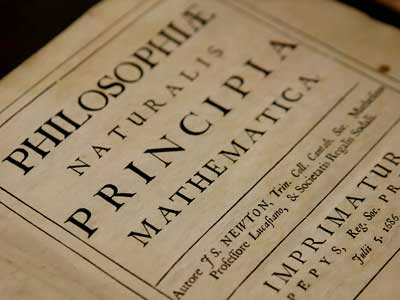
To begin with, science and religion as terms did not have the same meanings then that they do today. There was no such creature as the scientist (see forthcoming post on Steven Shapin’s Images of the Man of Science). Physics, and science in general, was called natural philosophy (as the title cover of Newton’s Philosophiæ Naturalis Principia Mathematica, translated Mathematical Principles of Natural Philosophy, demonstrates), and its study included consideration of God’s creation of the world, the evidence of divine design in the world, and the immortality of the human soul. Indeed, “natural philosophy encompassed many topics now considered theological or metaphysical.”
The close relationship between natural philosophy and theology is evident in almost every area of inquiry about the natural world during the scientific revolution. The debates about the new heliocentric astronomy, the arguments for a new philosophy of nature to replace medieval Aristotelianism, the development of a new concept of the laws of nature, and discussions of the scope and limits of human knowledge were all infused with religious commitments and theological presuppositions.
For example, many seventeenth-century natural philosophers rejected Aristotelianism and adopted some version of the mechanical philosophy. But virtually all the mechanical philosopher claimed that God had created matter and had set it into motion. “God infused his purposes into the creation either by programming the motions of the particles or by creating particles with very particular properties.” As Osler puts it, “even a mechanical world had room for purpose and design.”
Another common theme in seventeenth-century discussions was expressed in the metaphor of God’s two books: the book of God word (the Bible) and the book of God’s work (the created world). Natural philosopher regarded both books as legitimate sources of knowledge.
Thus despite the claims of Israel and other modern commentators, that the seventeenth century witnessed the “rise of powerful new philosophical systems,” theology and natural philosophy were closely aligned. The entire enterprise of studying the natural world was embedded in a theological framework that emphasized divine creation, design, and providence. “Newton himself,” writes Osler, “took seriously both God’s work and God’s word, as he demonstrated by devoting even more effort to the understanding of Scripture than he did to the natural world.”
Natural philosopher undoubtedly disagreed about exactly how God related to the world. But to study the created world produced knowledge both of the phenomena and the laws of nature and revealed God’s relationship to his creation.
In the final analysis, seventeenth-century natural philosophers were not modern scientists. Reading the past from the standpoint of later developments, as Israel certainly does, leads to serious misunderstandings of not only the scientific revolution but these seminal historical figures as well. “For many of the natural philosophers of the seventeenth century, science and religion—or, better, natural philosophy and theology—were inseparable, part and parcel of the endeavor to understand our world.”
Graduate Study for the 21st Century
Posted on June 4, 2013 Leave a Comment
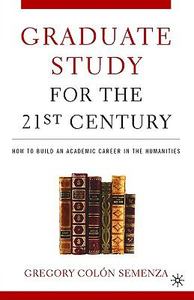 During my down time I’ve been paging through Gregory Colón Semenza’s Graduate Study for the 21st Century: How to Build an Academic Career in the Humanities (2005). It is an ideal book for the graduate student. It covers topics such as the culture of graduate programs (teaching, research, and service), the politics of academic life (the “high priests” and “priestesses,” the “deadwood,” the “black sheep,” the “careerists,” the “service slaves,” the “curmudgeons,” the “young Turks,” the “hall-talkers,” the “theory boy or girl, “the “long-life learners,” and “everyman” and “everywoman”) organization and time management, outlook of the graduate seminar, the seminar paper, teaching, comprehensive exams, the dissertation, attending conferences, publishing strategies, service and participation, and prospects of the job market. Written with enthusiasm and much wisdom, Semenza’s book should be the premier textbook for any graduate student in the humanities. What I found particularly insightful were his chapters on the dissertation and publishing. His recommendation that “you think of your dissertation as a book and that you write it in the form and style of a published scholarly monograph” was both enlightening and necessary.
Although amusing and entertaining in many places, Semenza’s book is not for the faint at heart. It is a heavy book, in the sense that it unabashedly reveals the intensity of the graduate program in the humanities. The onerousness and rigorousness of the graduate program is, however, made less burdensome thanks to the guidance and insights of this book.
Desecularizing the World
Posted on June 2, 2013 2 Comments
 Continuing the trend from the last post, in this post we will be looking at a different book, The Desecularization of the World: Resurgent Religion and World Politics (1999), edited by Peter L. Berger. Few scholars have contributed so much to our understanding of religion and modernity as Berger. Beginning in the 1960s, he advanced the argument that the collapse of “the sacred canopy” provided by religion has created a crisis for faith, forcing it into a position of “cognitive bargaining” but ultimately ends up bargaining away religious substance in order to survive in a relentlessly secular and secularizing modern world. These thoughts were first published in his widely popular book The Sacred Canopy: Elements of a Sociological Theory of Religion (1967).
In this more recent book, however, Berger has changed his mind, reproves his earlier thoughts on the subject, and tells us why in the introductory essay. Indeed, what needs explanation, he tells us, is not the continued vitality of religion, a phenomenon that puzzles so many modern intellectuals, but why so many modern intellectuals are puzzled by it! The present collection of essays emerges from a conference sponsored by the Ethics and Public Policy Center, which includes a leading essay by Berger, along with other expert sociologists George Weigel, David Martin, Jonathan Sacks, Grace Davie, Tu Weiming, and Abdullahi A. an-Na’im.
What needs to be said at the outset is that this book is dated. Most of the essays, moreover, are unremarkable and thus most are not worth detailed exposition. To summarize its contents is a simple task. In the opening essay, Berger refutes the link between secularization and modernity; Weigel writes about Roman Catholicism, telling us that the Catholic Church “has reacquired a certain critical distance from the worlds of power, precisely in order to help those worlds accountable to universal moral norms;” Martin writes about the Evangelical upsurge, assigning its political implications to its individualistic approach and pragmatism; Sacks, who focuses on Jewish identity in the context of post-modernity and secularization, says that Jews live “in a condition of ambivalence about themselves and trauma about their relationship with the world”; while the rest of the world tends toward desecularization, Europe seems to be the exception to the rule, says Davie; in communist China Weiming writes that “as China is well on it sways to becoming an active member of the international society, the political significance of religion will continue to be obvious”; and writing about political Islam, an-Na’im says that the principle of pluralism and the protection of basic human rights, which is and always has been an Islamic imperative, should be followed.
Out of the seven essays, two stand out. Berger’s essay was the keynote lecture of the series, and of course, he is interested in doing more than just describing the current state of play of world politics. Berger begins by musing over the recent interest in the Fundamentalism Project. Sponsored by the American Academy of Arts and Sciences and the MacArthur Foundation, the Project was an international scholarly investigation of conservative religious movements throughout the world. The Project, which began in 1987 and concluded in 1995, was directed by Martin E. Marty and R. Scott Appleby. Why, Berger muses, exert resources to studying religious fundamentalism? The most obvious answer was that because “fundamentalism” is such a strange and hard-to-understand phenomena, the purpose of the Project was to delve into this alien world and make it more understandable.
But understandable to whom? This crucial questions leads Berger to an epiphany: the concern that must have led this Project was based on an upside-down perception of the world, according to which “fundamentalism” is a rare, hard-to-explain thing. But a look either at history or at the contemporary world reveals that what is rare is not the phenomenon itself but the knowledge of it. That is to say, it is this elite group of intellectuals that is a rare, and hard-to-explain thing. “The world today,” writes Berger, “is a furiously religious as it ever was, and in some places more so than ever.” Thus the assumption of secularism, and the secularization theory, is both mistaken and false. The key ideas of the theory, traced back to the Enlightenment, is that modernization necessarily leads to religious decline, both in society and in the minds of individuals. It is this key ideas, Berger maintains, that has turned out to be wrong. “To put it simply, experiments with secularized religion have generally failed: religious movements with beliefs and practices dripping with reactionary supernaturalism have widely succeeded.”
Turning to the global religious scene, Berger observes that, on the one hand “it is conservative or orthodox or tradtionalist movements that are on the rise almost everywhere,” and, on the other, that “religious movements and institutions that have made great efforts to conform to a perceived modernity are almost everywhere on the decline.” From the remarkable revival of the Orthodox Church in Russia following the collapse of the Soviet Union, to the rapidly growing orthodox Jewish groups in Israel and the Diaspora, to the vigorous upsurges of Islam, Hinduism, and Buddhism, “taken together they provide a massive falsification of the idea that modernization and secularization are cognate phenomena.”
While the world today is massively religious, there are, however, two exceptions, one somewhat unclear, the other very clear. The first apparent exception is of course Europe. In Western Europe, if nowhere else, the old secularization theory seems to hold true. There are indeed increased indications in secularization both in expressed belief and personal codes of behavior. Yet there are a number of recent works, Berger notes, that make this exception deeply problematic. Notably in France, Britain, and even Scandinavia, there is a body of literature indicating strong survivals of religion. What’s more, it seems that there has only been a shift in the institutional location of religion, rather than secularization. That is, there has been a shift away from organized religion, to personal, “spiritual” religious attitudes. Thus Europe as secular is a rather ambiguous assertion, requiring much qualification, detailed and careful analysis.
The other, and definitely clearer, exception to the upsurge in religious movements is the existence of an international subculture composed of people with Western-style higher education, especially in the humanities and social sciences, that is indeed secularized. “This subculture is the principal carrier of progressive, Enlightened beliefs and values. Although relatively thin on the ground, they are widely influential, providing the ‘official’ definitions of reality, notably the educational system, the media of mass communication, and the higher reaches of the legal system.” Berger calls them the a “globalized elite culture,” and the plausibility of secularization theory owes much to this elite subculture, for when they travel they usually touch down in isolated, intellectual circles, i.e. among people much like themselves. But because of this, they easily fall into the misconception that these people reflect the overall society, which is, of course, a mistake.
What are the origins of this new religious upsurge? Berger hints at two possible answers: first, religion provides certainty when so much of our taken-for-granted certainties have been undermined by modernity, or it appeals to people who resent the social influence of that small, cultural elite. But the most satisfying answer, Berger says, and the most historically accurate, is that “strongly felt religion has always been around; what needs explanation is its absence rather than its presence.” Thus the so-called “religious upsurge” simply serves to demonstrate continuity in the place of religion in human experience.
What are the prospects of this new religious upsurge? Berger argues that there is no reason to think the world of the twenty-first century will be any less religious than the world of past generations. But it is also true that many of these religious movements are linked to non-religious forces of one sort or another, and thus the future course of the former will be at least partially determined by the course of the latter.
The “new” religious upsurge is, of course, particular, differing in their critique of modernity and secularity. But what most of these religious movements do seem to agree upon is the shallowness of a culture that tries to get along without any transcendent points of reference. “The religious impulse, the quest for meaning that transcends the restricted space of empirical existence in this world, has been a perennial feature of humanity” from time immemorial. The critique of secularity common to all the resurgent movements is that “human existence bereft of transcendence is an impoverished and finally untenable condition.”
The other essay worth noting in the collection is Davie’s “Europe: The Exception that Proves the Rule?” Davie takes secularization theory quite seriously, and it seems that data proves that in Europe the old secularization thesis hold true. But data, she points out, never explains anything. It is the interpretation of data that explains. The data from Europe, for instance, provides several interpretations, and that some explanations are more nuanced than others. Davie proposes that “might it not be the case that Europeans are not so much less religious than citizens in other parts of the world as differently religious?” Her emphasis.
Davie disentangles various meanings behind the term secularization, specifically as used by Steve Bruce, José Casanova, and Daniele Hervieu-Léger, evaluating them against recent data from the European Values System Study Group (EVSSG), survey findings of 1981 and 1990. In her estimation, it is not so much that there is less religion but that European religion is now expressed differently from how it used to be expressed: hence, Europe is less “secular” than it is “unchurched.” She writes, “while many Europeans have ceased to participate in religious institutions, they have not yet abandoned many of their deep-seated religious inclinations.”
In interpreting the data, Davie finds the approach of French sociologist Hervieu-Léger most promising. Hervieu-Léger argues that modern societies (especially modern European societies) are less religious, not because they are increasingly rational (they are not), but because they are less and less capable of maintaining the memory that lies at the heart of the religious existence. In other words, they are “amnesiac societies.”
While modern societies may well corrode their traditional religious base, they also open spaces that only religion can fill. Hervieu-Léger calls this “utopian” spaces. Modern individuals are encouraged to seek answers, find solutions, and make progress. Such aspirations become an increasingly normative part of human experience. But the image of utopia must always exceed reality, and the more successful the projects of modernity, the greater the mismatch becomes. “Hence the paradox of modernity, which in its historical forms removes the need for the sense of religion, but in its utopian forms must stay in touch with the religious.”
In the end, religion, and churches in Western Europe, still function as a kind of “vicarious memory.” Many Europeans remain grateful rather than resentful of their churches, recognizing that the churches perform a number of tasks on behalf of the population as a whole. One of the most obvious risks of operating vicariously, Davie notes, is the lack of direct contact between the churches and the population. This dramatically leads to a generation-by-generation drop in religious knowledge. Davie concludes that “an ignorance of even the basic understandings of Christian teaching is the norm in modern Europe, especially among young people; it is not a reassuring attribute.”
Rethinking Secularism: José Casanova’s The Secular, Secularizations, Secularisms
Posted on May 30, 2013 Leave a Comment
José Casanova’s exemplary essay in Rethinking Secularism is one of the best I have read on the subject. Casanova, a professor of Sociology at Georgetown University and a Senior Fellow at Georgetown’s Berkley Center for Religion, Peace, and World Affairs, engages secularism from a critical analytical angle. Because there are multiple and various ways of experiencing the secular, what we need is to differentiate between such experiences, as the “secular,” “secularization,” and “secularism.”
The Secular
There has been a radical—if not paradoxical—reversal in how the term “secular” is understood. The secular as a modern epistemic category is used to construct, codify, grasp, and experience a realm or reality differentiated from the “religious.” That is, the secular has often been assumed to be simply the “other of the religious,” that which is non-religious. As such it functions as a residual category, something left over from the “religious,” a remainder. But in our modern “secular age,” as Taylor puts it, the secular encompasses the whole of reality, in a sense replacing the “religious” altogether. This naturalization of the non-religious, of unbelief, of the secular, completely reverses the traditional view. The secular is no longer the residual category, it is the category, the norm. Understood as a natural reality, the secular is the true natural social and anthropological condition or substratum that remains when the “religious” is lifted or disappears.
Casanova remarks that this reversal is quite the paradox. “Rather than being the residual category, as was original the case, the secular appears now as a reality, tout court, while the religious is increasingly perceived not only as the residual category, but also as a superstructural and superfluous additive, which both humans and societies can do without.”
But according to Casanova, such a reversal is the uncritical and unreflexive functionalist ideologies of theories of secularization and secularist worldviews. Such ideologies often disregard—and indeed sometimes mask—the particular and the contingent historical process of the secular, projecting instead a universal human development. In the end such ideologies of the secular as a natural and universal substratum “avoid the task of analyzing, studying, and explaining the secular.”
Casanova takes up the task in the remaining pages of his essay. He begins by pointing out that the term “secular” first emerged as a theological category, as a unit of a dyadic pair of religious/secular, as mutually constitutive. In its original theological meaning, to secularize meant to “make worldly,” to convert religious persons or things into secular ones, as when a religious person abandoned the monastic rule to live in the saeculum, “the worldly age,” or when monastic property was secularized following the Protestant Reformation.
From this point of historical origins, Casanova draws our attention to at least two dynamic forms of “secularization.” First, there was an internal Christian secularization, a process which aims to spiritualize the temporal world, bringing the religious life of perfection out of the monasteries and into the secular world, the countryside, the urban, the court. This was the chosen path of those associated with the devotio moderna, with medieval movements of Christian reform, eventually receiving a radicalized form by Protestant reformers. Second, there was a converse process, that of anticlericalism and laicization, a liberation of all secular spheres from ecclesiastical control. This was the chosen path of the French Revolution and later subsequent liberal revolutions. “Its aim was the explicit purpose of breaking the monastery walls to laicize those religious places, dissolving and emptying their religious content and making religious persons, monks and nuns, civil and laic before forcing them into the world, now conceived as merely as secular place emptied of religious symbols and religious meanings.” Such as path of laicization, argues Casanova, could well serve as the basic metaphor of all subtraction narratives of secular modernity. It is important to note that in both forms the “secular” means the same thing, as the worldly age.
Closer to our own day, Casanova points another, and narrower, way of conceiving the “secular” as that of self-sufficient and exclusive secularity. We mentioned this point in Taylor’s essay, so we will be brief here. The secular in this sense is a self-enclosed reality, where people are simply “irreligious,” closed to any form of transcendence beyond the purely secular immanent frame. Taylor describes this phenomenological experience of the immanent frame as constituting an interlocking constellation of the modern differentiated cosmic, social, and moral orders. That is, all three orders are understood as purely immanent secular orders, devoid of transcendence and thus functioning etsi Deus non daretur, “as if God would not exist.”
This understanding of the secular, however, is deeply problematic. This naturalization of unbelief, or non-religion, as the normal human condition in modern societies corresponds to the assumptions of dominant theories of secularization, which postulate a progressive decline of religious beliefs and practices with increasing modernization, so that the more modern a society happens to be, the more secular, and thus the less religious. But the connection between secularity and modernity becomes questionable, according to Casanova, when we realize that in many modern non-European societies are fully secular yet their populations are also at the same time conspicuously religious (e.g. the United States or South Korea). Thus this second, and modern, meaning of the term “secular,” as being devoid of religion, the secular does not happen automatically as a result of processes of modernization or even as the result of the social construction of a self-enclosed immanent frame; rather, it needs to be “mediated phenomenological by some other particular historical experience.”
Casanova finds this particular historical experience in the “stadial consciousness” inherited from the Enlightenment narrative, which understands the change in the condition of belief as a process of maturation and growth, as a “coming of age,” and as progressive emancipation. It was the construction of this quasi-natural process of development, this philosophy of history, which has functioned as confirming the superiority of our present modern secular age over other supposedly earlier, and therefore primitive, religious forms of understanding. “To be secular means to be modern, and therefore, by implication, to be religious means to be somehow not yet fully modern.” Thus any remnant of thus “surpassed” condition, to a primitive mode of thinking, becomes an “unthinkable intellectual regression” in our modern times.
The function of the secular as a philosophy of history, and thus as ideology, is to turn secularization into a universal teleological process of human development from belief to unbelief, from primitive irrational or metaphysical religion to modern rational post-metaphysical secular consciousness.
Casanova’s core criticism against this second, modern definition of secular (i.e. as ideology) is that in places where such secularist historical stadial consciousness is absent or less dominant, as in the United States or in most non-Western post-colonial societies, the process of modernization is unlikely to be accompanied by a process of religious decline. Indeed, Casanova persuasively argues that it was this secularist stadial consciousness that was the crucial factor in the widespread secularization that has accompanied the modernization of western European societies. “Europeans tend to experience their own secularization as a natural consequence of their modernization. To be secular is experienced not as an existential choice, but, rather, as a natural outcome of becoming modern.” This consisted, according to both Casanova and Taylor, as stadial accounts or conceptions of history, which emerged first in the Scottish Enlightenment from thinkers such as Adam Smith (1723-1790) and Adam Ferguson (1723-1816). According to these and subsequent thinkers, human society passes through certain stages, e.g. hunter-gatherer, agricultural, commercial. These stages, usually defined ultimately in economic terms, describe an advance. Higher ones represent development, a gain, from which it would be quite irrational to try to retreat once they have come about. But as we have seen in the work of Dan Edelstein and others mentioned in these posts, such a narrative is a modern myth.
Secularization
While the “secular” may be a central, modern epistemic category, “secularization,” usually refers to actual or alleged empirical-historical patterns of transformation and differentiation of the”religious” and the “secular” institutional spheres from early-modern to contemporary societies. As Casanova explains, although the social sciences view secularization as a general theory, it actually consists of distinct and, ultimately, disparate parts: (1) institutional differentiation, such as state, economy, and science, from the religious; (2) the progressive decline of religious beliefs and practices as a result of modernization; and (3) the privatization of religion as a precondition of modern and democratic politics.
The tendency of social scientists to view all three processes as intrinsically interrelated components of a single general teleological process of secularization and modernization, is, however, deeply problematic. In recent years two of the sub-theses of the theory of secularization, namely, the decline of religion and the privatization of religion, have undergone numerous critiques and revisions. Yet the core of the thesis, the single process of functional differentiation of institutional spheres, remains relatively uncontested.
Why? Answering this question once again leads us to another paradox. As already mentioned, the “secular” first emerged as a particular Western Christian theological category. Yet its modern antonym, the “religious” is itself a Western-European modern secularist category. By recognizing this paradox, we begin to comprehend the critical significance of the colonial encounter in European developments, the concomitant globalization of the category of religion, and the hotly disputed and debated how, where, and by whom the proper boundaries between the religious and the secular ought to be drawn.
Indeed, the very category of secularization becomes deeply problematic once it is placed in this historical context, as Eurocentric. European secularization should be seen, according to Casanova, as provincial, as the exception and not the rule (but even here there is some ambiguity—see my forthcoming Grace Davie post, Europe: The Exception that Proves the Rule?). This historical process was exceptional, and is unlikely to be reproduced anywhere else in the world with a similar sequential arrangement and with the corresponding stadial consciousness. “Without such a stadial consciousness,” writes Casanova, “it is unlikely that the immanent frame of the secular modern order will have similar phenomenological effects on the conditions of belief and unbelief in non-Western societies. Secularization thus requires—indeed, needs—a stadial consciousness, a narrative of progressive stages from the primitive to the modern.
Secularism
Finally, there is “secularism,” viewed as a worldview and ideology, or more broadly to a whole range of modern secular worldviews and ideologies which may be consciously (or unconsciously) held and explicitly (or implicitly) elaborated into philosophies of history and normative-ideological state projects or cultural programs. But “secularism” may also be viewed, as we have seen, unreflexively or be assumed phenomenologically as a taken-for-granted normal structure of modern reality, as modern doxa or an “unthought.”
Casanova finds it fruitful to draw a distinction between secularism as statecraft doctrine and secularism as ideology. By statecraft Casanova means the principle of separation of church and state, between religious and political authority. Such a principle neither presupposes nor entails any substantive theory of religion. But when the state hold explicitly a particular conception of religion, one enters the realm of ideology.
There are at least, according to Casanova, two basic types of secularist ideologies. The first we have already mentioned, which is grounded in some progressive stadial philosophies of history that regulate religion to a superseded stage. The second is related to the first, in that it presuppose religion as either an irrational force or a non-rational form of discourse that should be banished from the democratic public sphere.
Reformed philosophers such as Alvin Plantinga, William P. Alston, Nicholas Wolterstorff, William J. Wainwright, George I. Mavrodes, and many others have shown the latter to be utterly bankrupted and no longer tenable. For his part, Casanova, being the sociologists and not the philosopher, is more interested in examining the extent to which secularist assumptions permeate the taken-for-granted assumptions and thus the phenomenological experiences of ordinary people. Such secularism “stands for self-sufficient and exclusive secularity, when people are not simply religiously ‘unmusical’ but are actually closed to any form of transcendence beyond the purely secular immanent frame.”
At this point Casanova returns to the crux of his argument, that in places where secularist stadial consciousness is absent, processes of modernization are unlikely to be accompanied by processes of religious decline. It follows that there must exist a normative self-image, a narrative, a belief that being religious is not modern. “To be secular is this sense means to leave religion behind, to emancipate oneself from religion, overcoming the non-rational forms of being, thinking, and feeling associated with religion.” Indeed, it is this assumption that entails both “subtraction” and “stadial” theories of secularity.
It is this essentializing of “religion,” of the “secular,” and even of the “political,” that is the fundamental problem of secularism as ideology. The whole idea of “religion is intolerant,” or “religion is in conflict,” with various modes of modernity is a construct that functions to positively differentiate modern secularists from the “religious other,” either from premodern religious Europeans or from contemporary non-European religious people, particularly Muslims. But such a view, as numerous historians of science have discovered, can hardly be grounded empirically in the collective historical experience of Europeans societies.
Why has this view nevertheless persisted? Casanova perceptively suggests that such a view of religion as the source of violent conflict is actually connected to “retrospective memory.” By viewing religion in the abstract, detaching it from historical reality, secularist ideology places modern secularist problems on the “religious other.” Indeed,
from 1914 to 1989, twentieth-century Europe can be characterized as one of the most violent, bloody, and genocidal centuries in the history of humanity. But none of the horrible massacres—not the senseless slaughter of millions of young Europeans in the trenches of WWI; or the countless millions of victims of Bolshevik and Communist terror through revolution, civil war, collectivization campaigns, the great famine in Ukraine, the repeated cycles of Stalinist terror, and the gulag; or the unfathomable of all, the Nazi Holocaust and the global conflagration of WWII, culminating in the nuclear bombing of Hiroshima and Nagasaki—can be said to have been caused by religious fanaticism and intolerance. All of them were, rather, products of modern secular ideologies.
Yet contemporary Europeans, and many worldwide “intellectuals,” obviously prefer selectively to forget the more inconvenient recent memories of secular ideological conflict and retrieve instead a fictionalized account of religious wars or conflict with modernity. As Casanova puts it, “one may suspect that the function of such selective historical memory is to safeguard the perception of the progressive achievement of Western secular modernity, offering a self-vindicating justification of secular separation of religion and politics as the condition for modern liberal democratic politics, for global peace, and for the protection of individual privatized religious freedom.”
But nothing could be further from the truth.
Myths about Science and Religion: That Christianity Gave Birth to Modern Science
Posted on May 16, 2013 Leave a Comment
In these posts I have often focused on the close interaction between science, or natural philosophy, and Christianity. But as Noah J. Efron helpfully reminds us in his entry in Galileo goes to Jail, “Christian ideas about nature were not exclusively Christian ideas.”
Efron admits that the claim that Christianity led to modern science captures something true and important. In this context he makes reference to Baylor University sociologist Rodney Stark, who in his recent book, For the Glory of God (2003), asserts:
Christianity created Western Civilization. Had the followers of Jesus remained an obscure Jewish sect, most of you would not have learned to read and the rest of you would be reading from hand-copied scrolls. Without a theology committed to reason, progress, and moral equality, today the entire world would be about where non-European societies were, say, 1800: A world with many astrologers and alchemists but no scientists. A world of despots, lacking universities, banks, factories, eyeglasses, chimneys, and pianos. A world where most infants do not live to the age of five and many women die in childbirth—a world truly in “dark ages.”
As Stark sees it, without Christianity, chimneys and pianos, and all the more so chemistry and physics, would not exist. Despite the implausibility of this passage, Stark makes a valid point. Numerous historians and sociologists have found that some forms of Christianity provided the motivation to study nature systematically. “Although they disagree about nuances,” writes Efron, “today most historians agree that Christianity (Catholicisim as well as Protestantism) moved many early-modern intellectuals to study nature systematically.”
Historians also note that many notions borrowed from Christian belief are found in scientific discourse. The very notion of “laws of nature,” for instance, is borrowed from Christian theology. There are laws because there is a Law Giver. Further, many historians point out that Christian convictions also affected how nature was studied. For example, Peter Harrison has argued that St. Augustine’s notion of original sin was embraced by sixteenth- and seventeenth-century advocates of experimental natural philosophy. Fallen man cannot understand the inner workings of the world through reason alone, and thus required painstaking experiment and observation to arrive at knowledge of how nature truly works. As Efron puts it, “Christian doctrine lent urgency to experiment.”
Historians have also found that changing Christian approaches to interpreting the Bible affected the way nature was studied in very important ways. The Reformers, for instance, rejected the allegorical reading of the biblical text, seeking a more straightforward interpretation. This same straightforward approach was simultaneously applied to understanding nature. Many sixteenth- and seventeenth-century founders of modern science also found in Christianity legitimation of their pursuits. Seminal figures like Rene Descartes (1596-1650) and Isaac Newton (1642-1727) believed that their “new philosophy” was in agreement with the truths of faith, and that Christianity in fact bolstered their scientific discoveries—and that these discoveries in turn bolstered Christianity.
A final example Efron provides is that Christian churches, far from neglecting or oppressing approaches to understanding nature, were leading patrons of natural philosophy and science, “in that they supported theorizing, experimentation, observation, exploration, documentation, and publication.”
But despite all of this supporting evidence, it “does not mean that Christianity and Christianity alone produced modern science.” Indeed, Christian ideas about nature were clearly not exclusively Christian ideas. In the early centuries of Christianity, for instance, the views and sensibilities of Christian thinkers were shaped by the “classical tradition,” an intellectual heritage that included art, rhetoric, history, poetry, mathematics, and philosophy, including the philosophy of nature. For this reason Efron argues that “excluding the place of classical philosophers from an account of the history of modern science is an act of intellectual appropriation of breathtaking arrogance, and ones that the forefathers of modern science themselves would have never agree to.”
Christian philosophers of nature were also indebted, directly or indirectly, to Muslim and, to a lesser degree, Jewish philosophers of nature who used Arabic to describe their investigations. Indeed, it was in Muslim lands that natural philosophy received the most careful and creative attention from the seventh to the twelfth century. As Efron notes, “many of these Muslim achievements were, in time, eagerly adopted by Christian philosophers of nature.” (Although, I would contest Efron’s use of the word “Muslim,” for many were simply Arabs, whether pagan, Jew, or Christian, and not necessarily devotees of Islam.)
Borrowing a illustration from anthropologist Clifford Geertz, Efron posits that “modern science rests on early-modern, Renaissance, and medieval philosophers of nature, and these rested on Arabic natural philosophy, which rested on Greek, Egyptian, Indian, Persian, and Chinese texts, and these rested, in turn, on the wisdom generated by other, still earlier cultures.”
In his final comments on the subject, Efron narrows his view toward the so-called Scientific Revolution. Religion, he says, was only one part of that revolution. Commerce, voyages of discovery, technological developments, political organizations, new and revised legal systems, all spurred the development of modern science in complicated ways. “Yes, Christian belief, practice, and institutions left indelible marks on the history of modern science, but so too did many other factors, including other intellectual traditions and the magnificent wealth of natural knowledge they produced.”
This leads Efron to conclude with an absolutely crucial point, that all of us, believers, nonbelievers, scientists and non-scientists, ought to mull over: we must see science for what it really is: a marvelous human invention, a human institution. “For better and for worse, science is a human endeavor, and it always has been.”
Now this…Neil Postman’s Amusing Ourselves to Death
Posted on May 14, 2013 2 Comments
 We live in a world of distractions. A world infiltrated by a cacophony of Internet sites, memes, and social networks; a world of cell phones and smart phones and iphones; an influx of cable channels by the hundreds, flat-screens, DVDs, HDTV and Blue-ray. In other words, a world of instantaneous and constant noise.
Neil Postman’s Amusing Ourselves to Death, first published in 1985, was a work ahead of its time. It is a twenty-first century book published in the twentieth century. In it Postman argues that television, and media in the larger context, has generated a seismic shift in our epistemology, adversely affecting our public discourse.
The book opens with a Foreword that relates two literary dystopic visions—that of George Orwell, who in his book 1984 warned about a despotic state that would ban information to keep the public powerless, and that of Aldous Huxley, who in Brave New World depicted a population too amused by distraction to realize that they had been made powerless. Postman wants to argue that discourse inspired by television has turned our world into a Huxleyan nightmare. “What Orwell feared,” writes Postman, “were those who would ban books. What Huxley feared was that there would be no reason to ban a book, for there would be no one who wanted to read one.”
Postman divides his book into two parts. Part I is concerned with background and historical analysis. In the first chapter, “The Medium is the Metaphor,” Postman introduces the concept of “media-metaphors.” “Culture is a conversation, or, more precisely, a corporation of conversations, conducted in a variety of symbolic modes.” And conversation, or discourse, is necessarily limited by the form of the medium it employs. That is, the limitations of a particularly medium affects what can be realistically communicated. Postman suggests, for instance, that the “smoke signals” of Native Americans conveyed only a limited amount of information. You can’t have an abstract, philosophical discussion using smoke signals. Thus form excludes content.
Postman gives additional examples of how the form of discourse limits content, but perhaps most crucial for his argument is what he calls “the news of the day.” Postman observes that the “news of the day” could not exist without the proper media to give it expression. Even though atrocities have always occurred in human history, for example, they were not a facet of a person’s everyday life until the telegraph (and subsequent technologies) made it possible for them to be communicated at a faster rate. This idea of instantaneous, decontextualized information will be central to later chapters.
Postman wants to show how today’s denizens are “undergoing a vast and trembling shift from the magic of writing to the magic of electronics.” By proposing our media-metaphors as powerful forces that influence our means of thought, he means to say that form subjugates content. “Our languages are our media. Our media are our metaphors. Our metaphors create the content of our culture.” In the reminder of the book Postman intends to reveal the effect of the media-metaphor of television on our minds.
In Chapter Two, Postman examines how media determines the way in which we define truth. Although Postman rejects relativism, he does believe a civilization will identify truth largely based on its forms of communication. An oral culture, for example, will likely put great stock in a man who remembers proverbs, since truth is passed on through such stories, whereas a culture of the written word will find oral proverbs only quaint, and the permanence of written precedent far more important. What concerns Postman about the television is not that it provides non-stop entertainment; rather, it has limited our discourse to where all of our serious forms of discussion have turned into entertainment.
“Truth,” writes Postman, “does not, and never has, come unadorned.” It must appear in its proper clothing or it is not acknowledged. The way a culture defines “truth” is largely contingent on the means, mediums, and technologies through which they receive it. Postman speaks of truth as a “cultural prejudice,” and goes on to illustrate some of our own prejudices. Our society, for instance, is largely reliant on numbers to illustrate our truth, to the point that we often consider no other source as capable of communicating economic truth. Something relatively more recent is satire. We watch shows like SNL, The Colbert Report, and The Daily Show not only to laugh but to find out the latest information. Thus such sources of information determines how we derive truth. Our media has become our epistemology. And from that Postman wishes to show “that the decline of a print-based epistemology and the accompanying rise of television-based epistemology has had grave consequences for public life, that we are getting sillier by the minute.”
In Chapters Three through Four, Postman discusses the way that “Typographic America” influenced the “Typographic Mind.” During the colonial period and through about the mid-nineteenth century, the American populace was markedly literate and thus accustomed to approaching the world from a rational—or, at least, expository—perspective. Because the written word is based around a series of rational propositions that challenge a reader to judge them as true or false, the whole of society during this period was founded around the idea of rational discourse.
To engage the written word means to follow a line of thought, which requires considerable powers of classifying, inference-making and reasoning. It means to uncover lies, confusions, and overgeneralizations, to detect abuses of logic and common sense. It also means to weigh ideas, to compare and contrast assertions, to connection one generalization to another. To accomplish this, one must achieve a certain distance from the words themselves, which is, in fact, encouraged by the isolated and impersonal text.
The printing press was not simply a machine of the industrial age: it was a “structure for discourse,” delimiting and establishing rules, insisting upon certain kinds of content, and inevitably a certain kind of audience.
This period transitioned into “The Peek-a-Boo World, which Postman discusses in Chapter Five. With the invention of the telegraph and the photograph in the middle years of the nineteenth century, transportation and communication became disengaged from each other, “that space was not an inevitable constraint on the movement of information.” The sudden access to instantaneous information resulted in society being less driven by contextual understanding of information and more involved with the collection of irrelevant “facts” divorced from context.
Everything Postman describes in this chapter is doubly true about the Internet. Much Internet humor derives from decontextualizing artists or politicians from their primary context, and the prevalence of photo manipulation allows a subterfuge of authority. As newspapers become part of a dying industry, replaced by a prevalence of less-researched and accountable Internet sources, one would be remiss to heed the warning that information without context can only serve to make us less informed and less driven towards any type of real action.
With Part II Postman begins discussing the television media-metaphor in more detail, examining how it has slowly infected every aspect of our public discourse. In Chapter Six, “The Age of Show Business,” he explains how “The Age of Exposition” was replaced by a spectacle that prizes flash and entertainment over substance. Entertainment has become the content of all our discourse, to the point where the message itself is trumped by the entertainment value of its delivery. “Only those who know nothing of the history of technology,” he writes, “believe that a technology is entirely neutral.” Television as medium demands heavy editing, non-stop stimulation, and quick decisions rather than rational deliberation. These are the inherent biases of television.
In Chapter Seven, “Now…This,” Postman uses the “news of the day” to provide a metaphor for how we now receive all information. He decries how we are now “presented not only with fragmented news but news without context, without consequences, without value, and therefore without essential seriousness; that is to say, news as pure entertainment.” The most horrific story only gets a short bit of attention, and then is separated from the next story. There is no time for reflection, and the entertaining aspects of the news—attractive newscasters, pleasant music, clever transitions—only reinforce the idea that the information we receive is not to be considered in the context of our lives.
In Chapters Eight through Ten, Postman examines other modes of important public discourse that have been affected, and denigrated, to entertainment under the media-metaphor of television. Chapter Eight, “Shuffle Off to Bethlehem,” examines how religion has become an empty spectacle on television—which to some degree has also transferred into the church—and thus lacks the power to deliver a truly religious experience.
Chapter Nine examines how political elections have simply become a battle of advertisements, in which candidates develop images meant to work in the same way that commercials do: namely, by offering an abstract image of what the public feels it lacks. Politicians market themselves as celebrities, meaning they are not only well-known but also seen explicitly as figures of entertainment. The Obamas are just the most recent manifestations of this, as is evidenced with both Michelle and Barack Obama appearing on numerous day-time talk shows, night-time late shows, and even syndicated comedy programs. Postman notes how over time notions of fame and celebrity has infected the political scene. Candidates do commercials, star on television shows, and present themselves as bastions of certain values regardless of the issues they claim to represent. “Television,” he writes, “does not reveal who the best man is. In fact, television makes impossible the determination of who is better than whom.” Much like the way a product is advertised, a candidate is presented as an image of who the audience wants to be: “This is the lesson of all great television commercials: They provide a slogan, a symbol or a focus that creates for viewers a comprehensive and compelling image of themselves.” But this is not an entirely new phenomena. “Tyrants of all varieties have always known about the value of providing the masses with amusements as a means of pacifying discontent.”
Chapter Ten, “Teaching as an Amusing Activity,” explores how even education is transitioning into an entertainment industry. Postman begins with a discussion of the iconic Sesame Street. When it first premiered in 1969, it quickly became a hit, largely because children saw in it the principles of television commercials, while parents loved it because it had the potential to educate in a form that children embraced. Its use of cute puppets, celebrity appearances, catchy songs, and heavy editing assuaged a society’s ever-deepening thirst for entertainment.
However, according to Postman, Sesame Street “encourages children to love school only if school is like ‘Sesame Street.'” Sesame Street, accordingly, undermines traditional pedagogy. A child cannot ask questions of what is presented on television; she learns more about images than about language; and is held to no standard of social behavior or expectation. “Whereas in a classroom, fun is never more than a means to an end, on television it is the end in itself.”
Postman ends his book with “The Huxleyan Warning,” in which he reiterates that Huxley was right. Our culture is becoming a burlesque, and will ultimately shrivel. In this concluding chapter Postman is aware that he might come off as some cantankerous Luddite, but time is proving him right.
The question should be asked if whether Amusing Ourselves to Death remains relevant for a world less defined by the media-metaphor of television than by the media-metaphor of the Internet. To this we can give a resounding yes. The concept of channel surfing has reached a new apex with the Internet, where one can find more fragmented, decontextualized information than even Postman could have imagined. His warning remains one worth considering.
Current Research
Posted on May 8, 2013 Leave a Comment
I have finished a number of books recently, all of which I hope to post some comments on soon. These books include Neil Postman’s classic epistemological critique of a technologically obsessed culture, Amusing Ourselves to Death. I have also finished Steven Shapin’s The Scientific Revolution, where in the Introduction he provocatively states, “There was no such thing as the Scientific Revolution, and this is a book about it.” Another beautifully written book I have recently come to appreciate is David N. Livingstone’s Putting Science in its Place: Geographies of Scientific Knowledge, where he argues that “Like other elements of human culture, science is located.”Although at times turgid, Richard G. Olson’s Science and Scientism in Nineteenth-Century Europe also found space on my reading list and I was pleased with its overall argument. The last book I recently polished off was a rereading of Science and Religion: New Historical Perspectives, a collection of papers dedicated to the pioneering work of John Hedley Brooke, edited by Thomas Dixon, Geoffrey Cantor, and Stephen Pumfrey.
My next course of books to read will keep me occupied for some weeks. This list includes three works by Peter J. Bowler, his The Invention of Progress: The Victorians and the Past, Evolution: The History of an Idea, and a work co-written with Iwan Rhys Morus, Making Modern Science: A Historical Survey. Also on the list is an anthology of nineteenth-century literature which, I think, will provide wider orientation to that era of ideas, edited by Laura Otis, Literature and Science in the Nineteenth Century. Bernard Lightman’s Victorian Popularizers of Science: Designing Nature for New Audiences, and James A. Secord’s Victorian Sensation: The Extraordinary Publication, Reception, and Secret Authorship of Vestiges of the Natural History of Creation, will serve the same purpose. As I continue to tackle Rethinking Secularism, I have also picked up Michael Allen Gillespie’s The Theological Origins of Modernity. These books will helpfully give me a better sense of where my research interests are going.
Peter Dear’s Historiography of Not-so-Recent Science
Posted on May 2, 2013 Leave a Comment
I came across Peter Dear’s “Historiography of Not-so-Recent Science” (Hist. Sci. 1, 2012) while doing some research last week at University of Wisconsin-Madison’s Memorial Library. It is a fine article, reviewing some of the most recent themes and trends on the historiography of science on the period c. 1500-c.1700; that is, on the late Scientific Revolution.
What I found interesting about the article, and worthy of a post here, is the attention Dear gives to recent work on Francis Bacon and Empiricism, Alchemy and Anatomy, Networks and Circulation, Ideas and Intellectual Culture, and Big Names.
To start with, Dear draws our attention to recent work by Sophie Weeks, who “presents a Bacon who sought above all, not just a systematized way of producing by artifice the properties of natural bodies, but whose ambition extended to a kind of ‘magic’ that would create novel things hitherto unheard-of, by forcing nature into paths that it had never followed by itself when ‘free and unconfined.'”
There has also been a “renewed focus on alchemy.” In particular, Dear notes the prolific writings of “William Newman and Lawrence Principe,” who “have striven to establish a particular thread of alchemy as having been central to the intellectual history of science in the seventeenth century.” Although these two authors have played down the spiritual significance of the alchemist’s search for the Philosopher’s Stone, their scholarly work has shown, however, “that both practical techniques and theoretical alchemical doctrines concerning atomism and corpusculariansism played important roles informing the work of such natural philosophers as Robert Boyle and Isaac Newton.”
Pamela Smith’s recent work reveals the movement of material objects as well as of instrumental practices (including such items as plants, instruments, books, astronomical data, ethnographic reports) along the trade routes of the modernizing world, especially those of the Atlantic and Indian Oceans, and thus creating the first “global networks.”
An “intellectualist history of science,” as Dear calls it, is perhaps the most vigorous modes of history of science writing. This is a history of ideas, a history of a specifically intellectual culture. We find this mode in authors such as Steven Nadler, Christa Mercer, Roger Ariew, Stephen Gaukroger, and Dan Garber. He draws attention to Peter Harrison’s most recent work on the “importance of the Fall from Grace as an element in seventeenth-century evaluations of the potential of human knowledge” and the emergence of modern science.
Finally, Dear still recognizes the importance of the biographical approach to the history of science. John Heilbron’s recent work on Galileo is one example. There is also a veritable cottage industry of work buzzing around the life and work of such men as Robert Boyle and Isaac Newton. Michael Hunter, for example, has made a career on Boyle, whereas Rob Iliffe has created a remarkable website dedicated to publishing in full an online edition of all of Newton’s writings—whether they were printed or not, “The Newton Project.”
Dear aptly concludes that “grand overviews survive in the pedagogically necessary genre of the textbook, but the days of the large scale historical account of the Scientific Revolution seem to be almost gone.”
 James C. Ungureanu