
Lessons from King Thamus
Posted on December 19, 2024 Leave a Comment
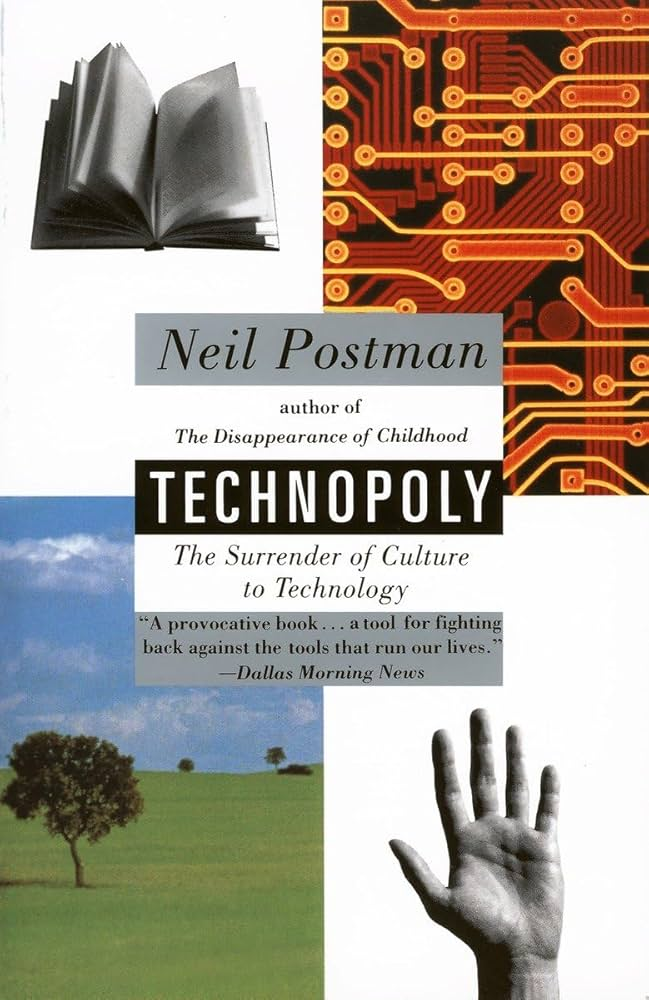
Neil Postman (1931–2003) was a media theorist, cultural critic, and educator who spent his career interrogating the societal impacts of communication technologies. Best known for works like Amusing Ourselves to Death (1985), Postman argued that media forms fundamentally shape cultural values, behaviors, and institutions. Technopoly: The Surrender of Culture to Technology (1992) extends this critique, presenting a compelling case against uncritical technological adoption. In an age where algorithms shape political discourse, artificial intelligence mediates creativity, and smartphones govern attention, Technopoly feels more prophetic than historical.
By examining how technologies alter not only what we do but who we are, Postman offers a lens to understand today’s tech-saturated world. Chapter 1, “The Judgment of Thamus,” serves as the book’s cornerstone, anchoring its arguments in a timeless parable that underscores the transformative power of tools.
Postman opens with Plato’s dialogue between King Thamus and the god Theuth, found in the Phaedrus. Theuth presents “writing” as a gift that will enhance memory and wisdom, but Thamus rebukes this claim, asserting that writing will weaken memory by externalizing it, fostering the illusion of wisdom rather than its reality. Postman uses this tale to introduce his central thesis: technologies are never neutral. They shape not only actions but also values, perceptions, and social structures.
He critiques what he calls the “one-eyed prophets” of technological optimism—those who see only benefits while ignoring consequences. Technologies, Postman argues, do not operate in isolation; they create “ecological change.” Like the introduction of a new species into an ecosystem, a single technological innovation can reconfigure entire cultural and institutional landscapes.
Postman also explores the concept of “knowledge monopolies.” He contends that those who control new technologies amass power, often at the expense of others. Television, for example, privileged its producers and broadcasters while sidelining print-based educators, transforming the way knowledge was valued and disseminated. Similarly, the computer revolution empowered institutions but often left individuals feeling alienated and surveilled.
The Dual-Edged Sword of Technology
Postman’s framing of technology as inherently ideological is one of the chapter’s strongest insights. Technologies, he argues, do not merely provide new tools but redefine the contexts in which those tools operate. Writing, for instance, redefined memory as externalized recollection rather than internal retention. Likewise, the mechanical clock—originally designed to structure monastic devotion—became the foundation for capitalist productivity, imposing rigid schedules on human activity.
One of Postman’s most poignant observations is that technologies alter the meanings of fundamental concepts:
“Technology imperiously commandeers our most important terminology. It redefines ‘freedom,’ ‘truth,’ ‘intelligence,’ ‘fact,’ ‘wisdom,’ ‘memory,’ ‘history’—all the words we live by. And it does not pause to tell us. And we do not pause to ask.”
Postman’s critique of “Technophiles” resonates deeply in an era dominated by tech evangelism. His ecological metaphor—likening technological change to environmental transformation—reinforces the systemic nature of these shifts. Technologies, he asserts, do not simply add or subtract; they transform. The printing press, for example, did not create “old Europe plus books”; it created an entirely new Europe, with altered religious, political, and social landscapes.
Postman’s discussion of “knowledge monopolies” also proves strikingly relevant. Those who master new technologies—whether television executives or data scientists—inevitably gain disproportionate power, leaving others marginalized. The losers, ironically, often cheer the winners, succumbing to the illusion of progress.
As a historian of science and religion, one might draw intriguing parallels between Postman’s critique and broader discussions about the interplay of faith, knowledge, and technology. The printing press, for example, democratized access to sacred texts but also fragmented religious authority, mirroring the challenges of integrating innovation into established belief systems. Similarly, contemporary technologies challenge foundational epistemologies, reshaping how individuals understand the divine, the natural world, and their place within it.
Postman’s reflections also invite deeper theological considerations. If technologies redefine the meaning of wisdom, memory, and truth, how might this affect religious practice and interpretation? These questions feel particularly urgent in a digital age that often conflates information with understanding.
The Rise of Technocracy
In the second chapter of Technopoly, Neil Postman expands his critique of technology by charting its historical evolution from tool-using cultures to technocracies. Drawing on historical examples and philosophical insights, Postman introduces a taxonomy that captures the shifting relationship between technology and culture. This chapter examines how tools, once subordinate to the values and beliefs of a society, increasingly began to dictate and redefine those very structures. For historians of science and religion, this analysis offers fertile ground for reflecting on how technological innovation has reshaped humanity’s understanding of authority, meaning, and the divine.
Postman begins by referencing Karl Marx’s observation that technological advancements shape societal structures, such as the steam engine’s role in the rise of industrial capitalism. He adopts this insight to propose a taxonomy of cultures based on their relationship with tools: tool-using cultures, technocracies, and technopolies.
In tool-using societies, technology serves two main purposes: solving practical problems and supporting cultural values, such as religion and art. Tools are integrated into the existing worldview without challenging its core principles. For instance, the medieval mechanical clock was initially a religious instrument for regulating monastic prayer, illustrating the subordination of technology to theological imperatives.
In a technocracy, tools begin to take a central role in defining cultural norms. Postman identifies the printing press, mechanical clock, and telescope as pivotal inventions that disrupted traditional ways of knowing. The telescope, for example, shattered Aristotelian cosmology, which had long been integrated into the Judeo-Christian worldview through medieval theology. This worldview, rooted in Greek natural philosophy, emphasized an Earth-centered universe. The discoveries of Copernicus, Kepler, and Galileo overturned this framework, displacing Earth from its central position in the cosmos and destabilizing the theological narrative of humanity’s unique place in creation.
Postman briefly hints at technopoly—a stage where technology overtakes culture entirely—but reserves detailed discussion for later chapters. He notes that while technocracies still wrestle with the tension between tradition and innovation, technopolies fully embrace technology as the defining force of society.
Postman’s taxonomy is both insightful and provocative. The distinction between tool-using cultures and technocracies sheds light on the interplay between technology and belief systems. In tool-using cultures, technologies are governed by religious or metaphysical frameworks, as seen in the medieval Church’s oversight of inventions. However, the rise of the telescope exemplifies how certain tools can challenge these frameworks. Postman poignantly illustrates this with Galileo’s discoveries, which destabilized the theological worldview by proving that Earth was not the universe’s center—a revelation that Milton later encapsulated in Paradise Lost:
“Before [his] eyes in sudden view appear / The secrets of the hoary Deep—a dark / Illimitable ocean, without bound, / Without dimension…”
This shift, Postman argues, marked a turning point where technology began to reshape human self-perception.
The chapter’s ecological metaphor further strengthens its argument. Technologies do not simply extend human capabilities; they transform how people live, think, and interact. However, Postman’s reliance on historical anecdotes occasionally risks oversimplification. For instance, while he attributes the decline of medieval theology to technological advancements, he underestimates the role of broader intellectual, political, and economic shifts.
Nevertheless, for scholars of science and religion Postman’s taxonomy offers profound insights into how technological innovation has historically intersected with theological frameworks. The shift from tool-using cultures to technocracies mirrors the secularization thesis, where technological and scientific advancements progressively displace religious authority. Yet Postman’s narrative also challenges simplistic readings of secularization. Innovations like the printing press did not merely undermine religious structures; they also facilitated the dissemination of religious texts, sparking movements like the Reformation.
Postman’s reflections invite deeper theological questions: How can religious traditions adapt to technological disruptions without losing their essence? Can tools like AI or genetic engineering be reconciled with theological principles, or do they inevitably challenge the metaphysical underpinnings of faith?
When Progress Becomes the Gospel
Postman’s third chapter charts the cultural transformation from technocracy—where technology coexists uneasily with traditional values—to technopoly, a state in which technology becomes the organizing principle of society, marginalizing alternative worldviews. By grounding his analysis in historical developments such as the Industrial Revolution, the rise of capitalism, and the emergence of scientific management, Postman offers a compelling critique of how technology’s promise of progress became a self-justifying ideology. For scholars of science and religion, this chapter illuminates the tension between technological determinism and the human longing for meaning, autonomy, and purpose.
Postman traces the rise of technocracy to late 18th-century England, with the invention of the steam engine and Adam Smith’s Wealth of Nations (1776). The steam engine revolutionized manufacturing, ushering in mechanized production, while Smith’s economic theories justified large-scale, impersonal systems of labor and capital. Together, these developments laid the groundwork for a culture increasingly organized around technological progress.
Technocracy, Postman explains, prioritized efficiency, standardization, and objectivity, often subordinating human values to technical imperatives. This shift is epitomized by Frederick W. Taylor’s Principles of Scientific Management (1911), which sought to replace human judgment with technical precision and to structure labor around measurable outputs. Taylor’s philosophy, according to Postman, marked a turning point: in technocracies, humans adapted to machines rather than vice versa.
Postman contrasts technocracy with technopoly, a more extreme cultural condition. Technopoly eliminates competing value systems, redefining concepts like truth, religion, and privacy to align with technological imperatives. In technopolies, technology is not merely a tool or cultural force—it becomes the culture itself. Postman singles out 20th-century America as the first technopoly, where technology redefined humanity as consumers and progress as the unassailable ideal.
Postman’s exploration of technocracy and technopoly is rich with historical insight. His portrayal of technocracy highlights how technological advances are rarely neutral; they reshape societal values and human relationships. For example, Taylor’s scientific management, while ostensibly aimed at industrial efficiency, introduced a dehumanizing philosophy that reduced workers to cogs in a machine:
“Taylor’s system relieved workers of any responsibility to think. The system would do their thinking for them.”
This observation resonates in contemporary debates about artificial intelligence and automation, where algorithms increasingly dictate human decision-making. Postman’s analysis suggests that such trends are not new but are extensions of a technocratic mindset that privileges efficiency over human dignity.
The transition to technopoly, as Postman describes it, is marked by the erosion of alternative worldviews. His critique of the 20th century’s “technological theology” is particularly compelling. He observes that Americans, disillusioned with traditional belief systems, found solace in technology’s tangible successes:
“Airplanes do fly, antibiotics do cure, radios do speak… and computers never make mistakes—only faulty humans do.”
Postman’s historical framing is particularly effective when he links technopoly’s rise to cultural conditions unique to America: the frontier ethos, the entrepreneurial spirit of figures like Henry Ford and Andrew Carnegie, and the triumph of convenience and consumption. Postman’s argument is provocative and prescient. His critique of technocracy as a precursor to technopoly sheds light on the ideological underpinnings of technological progress.
Information Glut
In Chapter 4 of Technopoly, Postman examines the consequences of information overload, a phenomenon that emerged alongside the rise of modern technological systems. He contends that the sheer volume and speed of information in a technological society have severed the connection between knowledge and purpose, creating what he dubs “The Improbable World.” Postman argues that while earlier societies grounded their understanding in cohesive narratives and worldviews, modern culture has become increasingly fragmented, inundated with context-free data. For historians of science and religion, this chapter offers profound insights into the disconnection between technological advancement and human meaning.
Postman opens with an experiment to demonstrate contemporary credulity, where absurd claims—so long as they are framed with an air of authority—are often met with belief rather than skepticism. This highlights a cultural shift: where once people believed in the authority of religion, they now unquestioningly trust the authority of science and technology. Postman argues that this is symptomatic of a deeper problem: a lack of coherent worldviews in an age dominated by technological and informational flux.
“Technopoly deprives us of the social, political, historical, metaphysical, logical, or spiritual bases for knowing what is beyond belief.”
He contrasts the medieval world, where events were understood within a theological framework, with the modern era, where information proliferates without discernible patterns or purposes. The advent of the printing press, which democratized knowledge, is both praised and critiqued as the beginning of this shift. Innovations like pagination and the modern school system initially sought to organize information, but as technological advancements accelerated, the volume of data began to overwhelm society’s ability to contextualize and prioritize it.
Postman introduces the concept of “information glut,” noting that the modern world suffers not from a lack of information but from an excess of it—much of it irrelevant, contradictory, or disconnected from meaningful frameworks. He critiques the modern celebration of information technology, arguing that its emphasis on speed and quantity often comes at the expense of wisdom and coherence.
Postman’s critique of information overload is as relevant today as it was when the book was published. His metaphor of a shuffled deck of cards, where information appears randomly and without order, aptly captures the disorientation of modern culture. This imagery contrasts starkly with the structured worldview of premodern societies, where religious and metaphysical systems provided coherence.
This loss of coherence is directly connected to the rise of “technopoly,” a cultural condition where information is elevated to a metaphysical status. In technopoly, information is both the means and the end, a pursuit for its own sake. Postman’s observation that information has become “a form of garbage” highlights its paradoxical role: while it inundates us, it often fails to address fundamental human concerns such as suffering, morality, or meaning.
The decline of theological frameworks and the rise of technological determinism challenge traditional narratives about progress and human purpose. Postman’s observation that information without context is dangerous echoes theological concerns about the loss of metaphysical grounding. If, as he argues, modern culture lacks a “transcendent sense of purpose,” then the challenge for religious traditions is to provide frameworks that can integrate technological advancements without succumbing to technopoly’s dehumanizing tendencies.
When Gatekeepers Fall
According to Postman, the rise of technopoly coincided with the collapse of the mechanisms that societies traditionally used to control the flow of information and maintain cultural coherence. In a technopoly, these mechanisms brake down under the weight of information glut, leaving institutions like religion, law, and education unable to filter, prioritize, or contextualize knowledge effectively. Postman uses this chapter to argue that as traditional defenses falter, societies increasingly rely on technical solutions—bureaucracies, experts, and standardized tests—that exacerbate rather than resolve the problem. The chapter offers a sobering reflection on how the erosion of shared narratives impacts humanity’s moral and intellectual foundations.
He identifies the collapse of a number of traditional “defenses.” Religious systems like Christianity provide comprehensive worldviews, helping individuals filter information and assign it moral significance. However, the advent of science and technology weakened these narratives, reducing their authority. Courts also had control of information by enforcing rules on admissibility and relevance, excluding extraneous details to maintain due process. Postman argues that the erosion of these principles mirrors the broader breakdown of institutional defenses. Schools and families also once functioned as gatekeepers of cultural values and norms. Curricula excluded irrelevant or controversial topics, while families shielded children from inappropriate knowledge. Both institutions now struggle to manage the flood of unregulated information.
As traditional defenses collapse, societies increasingly turn to technical solutions like bureaucracies, experts, and standardized tests. While these mechanisms aim to impose order on chaos, Postman contends that they often oversimplify complex realities, further alienating individuals from meaningful engagement with knowledge.
Postman’s use of the immune system metaphor is particularly effective in illustrating how societies manage the tension between tradition and innovation. He argues that institutions like religion and law act as cultural “immune systems,” maintaining a balance between novelty and coherence. When these systems fail, information proliferates unchecked, leading to what Postman describes as a “general breakdown in psychic tranquility and social purpose.”
Postman’s critique of technical solutions is incisive. Bureaucracies, he argues, prioritize efficiency over humanity, reducing individuals to data points. Experts, meanwhile, often wield disproportionate authority while lacking the holistic perspective needed to address moral or existential questions. Postman captures the theological dilemma poignantly:
“Sin and evil disappear because they cannot be measured and objectified, and therefore cannot be dealt with by experts.”
This observation resonates with contemporary debates about the limitations of technocratic governance, where moral and philosophical considerations are sidelined in favor of data-driven decision-making. However, the tools designed to impose order on chaos often amplify it, as Hartmut Rosa observed more recently in his The Uncontrollability of the World (2018). The “expert” is the new priest, but not a very good one.
Machines of Meaning
In chapters 6 and 7 of Technopoly, Postman explores how medical and computer technologies exemplify the ideological power of machines in a technopoly. While no doubt dated, both chapters nevertheless serve as case studies illustrating how technological systems redefine cultural values, reshape human agency, and create unintended dependencies. While medical technology prioritizes technical intervention over holistic care, computer technology extends its influence to nearly every facet of human life, promoting metaphors that equate humans with machines.
Postman critiques the American healthcare system as a paradigm of technological excess. He argues that medical technologies, while lifesaving, foster dependency and alienation. Instruments like the stethoscope and CAT scans shift the focus from the patient’s subjective experience to objective data, reducing the doctor-patient relationship to a technical interaction. Postman highlights the systemic factors driving this trend: (1) cultural predispositions toward conquest and technical mastery; (2) the economic and legal structures that incentivize technological interventions; and (3), the displacement of traditional medical skills by machine-dependent diagnostics. In short, medical technology has redefined health care, making it less about patient well-being and more about technological mastery.
Postman extends his critique to computer technology, describing it as the quintessential machine of technopoly. Computers, he argues, promote metaphors that redefine humans as “information processors” and nature as data to be manipulated. Unlike medical tools, which operate within specific domains, computers integrate into every aspect of life, from education to bureaucracy.
Postman’s critique in these chapters illuminates the pervasive ideological power of machines. His examination of medical technology highlights how tools, once subordinate to human needs, increasingly dictate the terms of human interaction. The stethoscope, for instance, not only extended the doctor’s diagnostic capabilities but also diminished the value of the patient’s narrative. As Postman observes:
“Medicine is about disease, not the patient. And what the patient knows is untrustworthy; what the machine knows is reliable.”
Similarly, his analysis of computer technology exposes its role as a cultural metaphor. By equating human thought with computation, Postman argues, computers devalue the emotional, moral, and spiritual dimensions of human life. He critiques the hubris of artificial intelligence advocates who claim machines can replicate or surpass human intelligence. In a particularly biting remark, he writes:
“The computer, in its capacity to smooth over unsatisfactory institutions and ideas, is the talcum powder of the mind.”
Postman’s critique of computers extends to their role in reinforcing bureaucratic structures. The “agentic shift” he describes—where decisions are attributed to machines rather than humans—parallels broader cultural trends of deferring responsibility. This dynamic erodes accountability, as illustrated by his observation that bureaucrats armed with computers claim authority while disclaiming responsibility.
These chapters raise profound questions about the metaphysical assumptions embedded in technological systems. Medical and computer technologies challenge traditional notions of human agency, morality, and spirituality. Postman’s critique also resonates with theological concerns about the limits of human mastery. The metaphor of humans as machines echoes the caution from a host of religious writers, from Augustine to Ratzinger, against hubris and the loss of spiritual grounding.
Unseen Engines
In Chapter 8, Postman shifts focus from tangible machines to subtler cultural mechanisms that function as technologies without being recognized as such. He identifies systems like language, statistics, and management as “invisible technologies” that shape thought, behavior, and institutions as powerfully as physical machines. Postman’s argument underscores how these tools, concealed in their ubiquity, reinforce the dominance of technopoly by subtly dictating the terms of human engagement with the world. For scholars of science and religion, Postman’s insights highlight the ideological undercurrents of ostensibly neutral tools and their influence on the metaphysical fabric of society.
Postman begins by examining language, which he describes as the most pervasive ideological technology. Language structures thought, divides the world into categories, and dictates what can be named and understood. Using examples like the aggressive subject-verb-object structure of English, Postman argues that language biases perception in ways that remain largely unconscious.
Postman’s discussion of language as an ideological technology is both insightful and provocative. His claim that language shapes perception aligns with linguistic relativity theories, such as those proposed by Edward Sapir and his student Benjamin Lee Whorf. For example, Postman references how the Japanese language differs ideologically from English, influencing scientific reasoning and clarity. This connection underscores the cultural specificity of tools often assumed to be universal.
He then explores the ideological power of mathematical symbols, particularly the concept of zero and its role in enabling advanced calculations and statistics. Statistics, Postman contends, functions as a tool for creating “new perceptions and realities” but also as a mechanism for reifying abstract concepts like intelligence or beauty into quantifiable entities. He critiques the misuse of statistics in areas such as eugenics, intelligence testing, and polling, arguing that it often masks subjective biases under the guise of scientific objectivity.
The critique of statistics is equally compelling. Postman’s examples, from Francis Galton’s eugenics experiments to modern intelligence tests, reveal how quantification can distort complex realities. His use of Stephen Jay Gould’s critique of reification is particularly effective in illustrating how abstract ideas are transformed into “things” that can be measured and ranked, often to the detriment of human understanding.
Management is another invisible technology Postman critiques, tracing its origins to educational and military systems in the 19th century. He argues that the hierarchical and calculative structures of modern management, while effective, promote dehumanization and the illusion that organizations cannot function without such systems. By tracing its roots to military and educational reforms, he highlights how management systems, designed for efficiency, often become ends in themselves. Postman’s analysis resonates with critiques from figures like Max Weber, who warned against the “iron cage” of bureaucratic rationality.
Postman concludes by emphasizing the autonomy of these technologies in a technopoly, where their origins and purposes are obscured, leading to uncritical acceptance and dependence. This analysis has significant implications for understanding the ideological power of science and its tools. The reification of abstract concepts, such as intelligence or morality, through statistics parallels broader concerns about the scientization of ethics and spirituality.
The Myth of Certainty
This leads Postman, in the following chapter, to his critique of “scientism,” which he defines as the elevation of scientific methods and metaphors to the status of a comprehensive belief system. He exposes how scientism appropriates the prestige and authority of natural science to assert unwarranted moral and philosophical claims, reducing human complexity to quantifiable data and procedural absolutes. Postman situates scientism within the broader cultural framework of technopoly, revealing its role as both an intellectual refuge and a source of societal distortion. This chapter therefore offers critical insights into the cultural consequences of scientism, particularly its implications for moral authority and the human search for meaning.
Postman begins with a satirical reflection on the “discoveries” of social science, such as the fear of death or the correlation between family stability and academic success. He uses these examples to highlight the trivialities often presented as profound findings under the banner of science.
This sets the stage for his broader critique of scientism as a cultural phenomenon. Postman attributes the origins of scientism to figures like Auguste Comte and institutions like the École Polytechnique, which championed the application of scientific methods to human behavior. He outlines three core tenets of scientism:
- Application of Natural Science to Human Behavior: The belief that scientific methods can uncover universal truths about human life.
- Social Engineering: The idea that society can be rationally organized through principles derived from social science.
- Science as a Comprehensive Belief System: The view that science can provide ultimate answers to moral, existential, and philosophical questions.
Postman accuses scientism of conflating natural processes with human practices, ignoring the subjective and moral dimensions of human experience. He contrasts the empirical rigor of natural sciences with the storytelling nature of social sciences, arguing that the latter is closer to imaginative literature than to science.
According to Postman, scientism undermines moral authority by displacing traditional sources of meaning, such as religion, with procedural and technical solutions. Postman calls this the “illusion of scientism,” a misguided hope that science can fulfill humanity’s deepest moral and existential needs.
Postman’s critique of scientism is both incisive and culturally resonant. His discussion of the trivial findings of social science highlights the overreach of scientific language into domains better served by philosophy, literature, and theology. He writes:
“In Technopoly, precise knowledge is preferred to truthful knowledge, and science is used to solve the dilemma of subjectivity.”
This observation underscores the reductionism inherent in scientism, where complex human realities are flattened into data points and procedural outcomes. Postman’s example of Freud’s exchange with Einstein—where Freud insists his work is science—illustrates the allure of scientific authority, even for disciplines that lack empirical rigor.
Postman’s exploration of the moral implications of scientism is particularly compelling. He critiques the displacement of moral reasoning by scientific procedures, arguing that science, while powerful in explaining natural phenomena, is ill-equipped to address questions of meaning, purpose, and value. His critique aligns with broader philosophical concerns about the limits of scientific naturalism, particularly its inability to provide a foundation for ethics.
The Price of “Progress”
Postman goes on to examine how technopoly trivializes and drains cultural symbols of their meaning and power. He argues that sacred and serious symbols, which once grounded societal narratives, are now exploited for commercial and trivial purposes, leaving cultures impoverished and adrift. This phenomenon, he argues, is not blasphemy but trivialization—a more insidious assault on the potency of symbols. Postman identifies advertising, mass media, and technological progress as the primary forces driving this symbolic depletion, and he explores how this process undermines education, religion, and civic identity. This erosion, he contends, disrupts humanity’s capacity to construct cohesive worldviews and sustain moral frameworks.
Postman traces this symbolic erosion to the “graphics revolution” of the 19th century, which democratized access to images through prints, photographs, and later, movies and television. While these technologies expanded the reach of symbols, they also diluted their potency by turning them into commonplaces.
He also highlights how schools increasingly prioritize technical skills over moral and intellectual development. Postman critiques the technocratic focus on efficiency and economic utility, which he contrasts with the rich narratives of thinkers like Jefferson, Dewey, and Locke, who saw education as a means of cultivating civic responsibility, ethical reasoning, and intellectual freedom.
What are the broader consequences of the symbolic drain? Without meaningful symbols, Postman argues, societies lose their narratives—the stories that give coherence to culture, provide moral direction, and inspire collective purpose. In their place, Technopoly offers the narrative of progress, with technology itself as the central symbol.
The Guardians of Meaning
In the final chapter of Technopoly, Postman addresses the perennial question faced by cultural critics: “What is the solution?” His response avoids prescriptive formulas, instead advocating for individuals to become “loving resistance fighters”—those who resist the dominance of technopoly while affirming the values and symbols that make life meaningful. Postman argues that such resistance requires intellectual courage, moral clarity, and a commitment to nurturing cultural narratives that transcend the technological mindset.
These “resistance fighters” must maintain a critical distance from technology, viewing it as an artifact of cultural and political contexts rather than as a natural or inevitable force. This involves skepticism toward efficiency, progress, and data-driven solutions that disregard human judgment and morality. They must also view the task of education as character development, cultivating in students a sense of coherence, purpose, and intellectual depth, counteracting the fragmented and superficial nature of technopoly on education. Postman critiques well the technocratic bias in modern curricula, which prioritize marketable skills over intellectual and moral development. Instead, Postman advocates for a curriculum centered on the “ascent of humanity,” integrating history, philosophy, science, and the arts. The “loving resistance fighter,” in short, is someone who cherishes cultural traditions and narratives while resisting the dehumanizing effects of technological domination.
By framing resistance as a moral and intellectual stance rather than a reactionary rejection of technology, he offers a path forward that balances critique with affirmation. His emphasis on love as a guiding principle—love for humanity, for tradition, for the transcendent—grounds his critique in a vision of hope and renewal.
Technopoly and the Future of Human Meaning
Postman’s work reminds us that resistance to Technopoly begins with awareness. Recognizing the biases and assumptions embedded in technological systems is the first step toward reclaiming agency. His call for “loving resistance fighters” is not a rejection of technology but a call to ensure that it serves human values rather than undermining them.
The task ahead is to balance the undeniable benefits of technological innovation with a commitment to preserving the cultural, moral, and spiritual dimensions of human life. This requires fostering education that reconnects students with history, philosophy, and the arts, institutions that uphold ethical accountability, and communities that prioritize human relationships over mechanized interactions.
As Postman warned, technology must never become the end in itself. Instead, it should remain a tool in the service of human flourishing. In an age dominated by artificial intelligence, data-driven governance, and algorithmic culture, Postman’s insights remain as urgent as ever, challenging us to think critically, act morally, and resist complacency. His vision of “loving resistance fighters” is a clarion call for our time—a reminder that humanity’s future depends not on technological advancement but on the preservation of its soul.
“It is love that believes the resurrection.”
Posted on October 15, 2024 Leave a Comment
I finally finished Wright’s History and Eschatology, based on his 2018 Gifford Lecture. Wright takes us on a jaunt through 18th-century optimism about nature and divinity—a time when thinkers like Joseph Butler thought the natural world sang of a benevolent, orderly God. But then comes the Lisbon earthquake of 1755, a disaster that tore through Portugal and the hearts of Europe’s philosophers. Suddenly, the beautiful tune of nature clashed with a bitter dissonance, raising the uncomfortable question: If God created this world, is He good, or even paying attention?
Wright is keen to show how this cataclysm shifted the philosophical tide toward skepticism and its sidekick, Epicureanism—a worldview that relegates gods to the sidelines of a universe that basically runs itself. Here begins the “secularization” of the Western mind, with the rise of Deism as a halfway house. Deism, which pictures a God who creates the world and then checks out, gave philosophers the excuse they needed to slip further away from traditional theism.
The Philosophical Context of Skepticism
With an eye on the fallout, Wright critiques this secular shift, warning of a culture stranded between a deity who’s an absentee landlord and a universe that appears utterly indifferent. This first chapter is as much an invitation as a warning to modern readers: Don’t let natural theology be sanitized of God’s vitality, or we may wind up with a narrative where humanity bears the burden of purpose alone.
Wright then switches gears and begins to examine the academic habit of doubting the Gospels. This Epicurean worldview is connected to the so-called quest of the historical Jesus. Thanks to figures like Reimarus, Schweitzer, and Hume, modern thinkers are convinced that Jesus the miracle-worker needs a serious fact-check. Wright presents these critics as the 18th and 19th-century celebrity skeptics who basically throw Jesus under the (historical) bus. Their approach? Take the Gospels at arm’s length, treat their miracles as myth, and leave Jesus looking like a nice, possibly disillusioned prophet who wanted the world to end—probably.
But Wright is having none of this. He labels their approach as “Docetic”—an early Christian heresy that downplays Jesus’ humanity—suggesting that some of these scholars, in their desire to strip out the miracles, actually stripped out Jesus’ historical impact as well. This has left us with a strange cultural dichotomy, Wright argues: the secular view of Jesus as a failed prophet and the religious view as a miracle-worker suspended over history, disconnected from the grit of everyday life.
Through it all, Wright’s critique sharpens on the Enlightenment’s legacy of turning the Gospels into suspect documents—neither entirely trustworthy nor easily dismissed. He warns that modern Christian theology cannot afford to ignore Jesus’ historical context if it wants to present a coherent view of God’s interaction with the world.
The Theological Necessity of History
In chapter 3, Wright tackles what he calls “the shifting sand” of history itself. What do we mean when we say “history”? For Wright, it’s a question that’s seen many a career fall into the quicksand of assumptions. History can mean (a) events that happened, (b) the stories we tell about those events, (c) the work historians do to piece it all together, or (d) the big, often philosophical meanings we attach to these events. And, he notes, confusion arises when we start switching these meanings willy-nilly.
Wright argues that history must be more than abstract ideas and must be anchored in tangible events. He contrasts “Docetic” approaches (which abstract Jesus as a symbolic or divine figure without historical grounding) with the historical engagement required for a meaningful understanding of Christian claims about God. For Wright, history is indispensable to Christian thought and practice; it provides the grounding for doctrines like the Incarnation and salvation.
Wright argues that Enlightenment rationalism and Epicureanism separated God from human history, leading to a fragmented worldview. This shift, Wright notes, led to a cultural tendency to view history as an ongoing, inevitable progress toward secular “liberty” rather than a divinely orchestrated narrative. As history was secularized, it began to favor narratives that depicted human autonomy over divine agency. He links this separation to figures like Hume and Gibbon, who promoted historical narratives that advanced secular ideals and criticized religious influences. Wright warns that this approach often lacks balance, dismissing theological insights in favor of an Enlightenment-driven view of history as a march toward secular progress. For Wright, this Enlightenment project has left us in a conundrum where history is often expected to “prove” its own secularity—a self-fulfilling prophecy that has shaped modern historical methods.
In the end, Wright doesn’t just want history to be a subject; he wants it to be a dialogue. He champions a “critical realism” approach, an empathy-driven method that tries to understand historical figures on their own terms, without the smug superiority of hindsight. This approach, he argues, requires humility, love, and (unsurprisingly) a generous dose of patience.
In summary, Wright challenges both secular and theological communities to consider history as an arena of divine-human interaction. He argues that the secularization of history in Enlightenment thought has limited modern understanding and insists that true theology must engage deeply with history to avoid reducing Jesus and his impact to mere symbols devoid of historical substance.
Untangling Eschatology
In chapter 4 Wright focuses on how Jesus and his followers interpreted eschatology and the concept of an impending “end.” Wright tackles the common assumption that early Christians expected an imminent apocalyptic end to the world. He proposes that while Jesus spoke of the “kingdom of God” arriving in power, he wasn’t predicting the literal end of the physical universe but rather a profound transformation in human history through God’s intervention.
He points out that “apocalyptic” language, particularly within Jewish literature, served as metaphorical and symbolic expressions of political and social upheaval rather than predicting literal, cosmic destruction. Wright argues that early Christians believed in a radical, this-worldly renewal led by God’s intervention rather than a cataclysmic end. Drawing from the Jewish two-age view (the present age and the age to come), Wright explains that Jesus and his followers saw themselves as living at a crucial juncture between these two ages. This transition period, he says, did not imply the end of the physical world but rather a transformation toward divine justice and peace, echoing themes of exile and return central to Jewish hope.
Wright criticizes modern theologians who interpret “apocalyptic” as solely a worldview focused on divine “breakthroughs” from beyond time and space. Instead, he suggests understanding it as a genre where symbolic imagery speaks to contemporary events. For example, references to stars falling from the sky or earthquakes are metaphors for political shifts and upheavals, not literal predictions of the end. Particularly important for Wright is the writings of Paul. He notes how Paul anticipated a transformative future but never implied that this would involve the literal destruction of the cosmos. Paul’s vision, according to Wright, is one of cosmic renewal rather than annihilation. In Wright’s view, Jesus spoke of the “kingdom of God” arriving within his followers’ lifetimes. This “kingdom” involved God’s rule manifesting in the present world, reshaping it rather than obliterating it. Wright proposes that this interpretation allows us to read Jesus’ sayings as forward-looking without assuming an end-of-the-world prophecy.
Epicureanism’s Intellectual Grip
The next chapter serves as a critical juncture in his overall argument. Here, he asserts that Western thought, shackled by centuries of quasi-Epicureanism, has skewed our understanding of both “natural theology” and the historical Jesus. His task now? To reset the stage by recovering a robust Second Temple Jewish worldview—a worldview Jesus and his early followers inhabited and that, according to Wright, provides the essential lens through which to understand Jesus’ claims about the Kingdom of God.
On his understanding, the Temple was seen as the microcosmos, a place where God’s presence bridged the divine and earthly realms. Sabbath, likewise, was the weekly “in-breaking” of God’s eschatological promises, a foretaste of the renewed creation. For Jews of the Second Temple period, both were profound symbols of God’s commitment to dwell with His people, a message carried forward and radically reinterpreted by Jesus and early Christians.
Wright refutes the notion that Jesus preached about a literal “end of the world.” Instead, he presents Jesus as embodying a radical eschatology—a vision not of the world’s destruction but of its renewal. When Jesus proclaimed the arrival of God’s Kingdom, he was talking about a transformative new age, a re-creation of the world in which God’s justice and mercy would become tangible. The “stone rejected by the builders,” as Wright interprets it, symbolizes Jesus’ countercultural message that challenged the political and religious expectations of his day.
Wright highlights how Jesus embodies the ultimate vision of humanity as God’s image, standing at the intersection of heaven and earth. He argues that Jesus’ life, death, and resurrection were the “Temple-event” par excellence—a final, transformative meeting place of divine and human. For Wright, the implications are massive: Jesus redefines what it means to be human by drawing people into this new creation, where they, too, reflect God’s image within a redeemed cosmos.
Wright concludes by asserting that any future discourse on “natural theology” must start with this re-grounded worldview. For him, studying God’s presence in creation isn’t about proving abstract truths; it’s about understanding how Jesus, the “cornerstone,” has redefined the world as a place where heaven and earth can meet through him.
Epistemology of Love
In chapter 6, Wright shifts the focus to a radically transformative concept: that the resurrection of Jesus isn’t merely an astonishing event but the launchpad for a “new creation.” Here, Wright argues that this new reality requires a fresh approach to knowing—what he terms an “epistemology of love,” through which resurrection redefines both the physical and spiritual cosmos.
Wright borrows Ludwig Wittgenstein’s cryptic phrase, “It is love that believes the resurrection,” using it as a springboard to argue that love, far from being sentimental, represents a comprehensive mode of knowledge. This epistemology goes beyond mere intellectual assent and reaches into an embodied, historical knowledge that captures the resurrection’s transformative essence. Love, in this framework, isn’t just an emotion; it’s a way of knowing that respects the distinctness of reality without forcing it into preconceived molds.
Wright critiques Western culture’s “split-world” approach, rooted in Epicureanism and modern rationalism, which dismisses “love” as a subjective, irrational perspective unsuitable for serious epistemology. He argues that modernity’s obsession with “knowing as control”—the need to categorize, explain, and dominate—has marginalized an authentic engagement with the divine and the mysterious, effectively sidelining any notion of resurrection as either impossible or irrelevant.
The resurrection, Wright contends, isn’t just a miraculous oddity but inaugurates a new reality where heaven and earth intersect in a unique way. Jesus’s resurrection, therefore, creates its own epistemic framework, which brings a new lens for understanding history, nature, and even knowledge itself. This “new world” of the resurrection, according to Wright, requires a knowledge that combines historical rigor with an openness to transcendence.
Wright sees historical research as critical in “defeating the defeaters,” dismantling alternative explanations like cognitive dissonance or metaphorical resurrection. He argues that a bodily resurrection was the foundation for early Christian belief, even as it defied both Jewish and Greco-Roman expectations. The persistence of the belief in a physical resurrection amid such skepticism suggests that the disciples truly believed they had encountered a risen Jesus, a conviction so strong that it reoriented their worldview.
For Wright, the resurrection is God’s resounding affirmation of the physical universe, which modern secularism often ignores. By rising bodily, Jesus underscores that creation is good, redeemable, and integral to God’s ultimate plan. This “new creation” doesn’t negate the old but transforms it, offering an ultimate “Yes” to the value of material existence and human embodiment within it.
In this chapter, Wright presents a sophisticated, almost poetic, reimagining of knowledge that challenges the sterile categories often forced upon theological concepts in a post-Enlightenment world. His “epistemology of love” is both provocative and refreshing, asking readers to reconsider not only the resurrection but the very way they perceive reality.
Revisiting Natural Theology
Wright then pivots toward redefining natural theology by focusing on human experiences that hint at transcendence, even though they often fail to deliver on their promise. Wright refers to these experiences as “broken signposts”—aspects of human life that seem to point toward deeper truths but fall short due to the fractured nature of human experience.
Wright critiques traditional natural theology approaches for attempting to prove God’s existence through reason alone, arguing instead for a “retrospective reading” of creation that considers how human longings reveal something about divine reality. He proposes that natural theology should reflect the “Emmaus Road” moment from Luke 24, where Jesus reframes the disciples’ understanding of the Old Testament in light of his resurrection, showing how past narratives pointed towards something greater.
Wright identifies seven fundamental areas of human life as “broken signposts”—Justice, Beauty, Freedom, Truth, Power, Spirituality, and Relationships. Each one resonates with something crucial but remains incomplete, like a melody that never quite resolves. According to Wright, these signposts are not simply empty aspirations; they contain fragments of divine reality, revealing humanity’s deep-rooted yearning for fulfillment.
The quest for justice, for instance, represents a universal but often elusive desire. We all recognize its importance, yet it remains perpetually out of reach, as human societies are riddled with inequities and systemic failings. Beauty, too, is universally cherished, whether in nature, art, or daily life. However, beauty’s fleeting nature creates a sense of longing rather than fulfillment, pointing beyond itself to an enduring beauty found in God.
Freedom is a fundamental aspiration yet is often constrained by societal structures or personal limitations, hinting at an ultimate freedom only achievable in relationship with God. Truth, though sought after, is often distorted by lies, leaving humanity in a maze of subjectivity. Power, while necessary for human governance, is frequently corrupted, underscoring humanity’s inability to wield authority without divine guidance.
Wright sees spirituality as a universal human impulse, a reach toward transcendence that modern secularism struggles to explain. Similarly, relationships reflect humanity’s need for connection and love but are often marred by selfishness, betrayal, or misunderstanding. These broken signposts of spirituality and relationships reveal our need for a deeper fulfillment, achievable only through union with God.
For Wright, these signposts are only fully understood in light of Jesus’ resurrection, which reinterprets and fulfills human longings. He suggests that by understanding these areas through the lens of Christ’s life, death, and resurrection, natural theology moves beyond abstract reasoning to a concrete, lived reality that resonates with human experience. Jesus, then, becomes the ultimate “broken signpost,” whose life and death appear as defeat but point to the profound truth of God’s redemptive plan.
Natural Theology and the Missio Dei
In his conclusion, Wright brings together the themes explored throughout the book, setting forth a vision of “natural theology” as both profound and profoundly practical. Using Gerard Manley Hopkins’s poetry as a thematic anchor, he reflects on how the world’s beauty and brokenness reveal the grandeur of God, even as they point to a deeper reality yet to be fully realized. He frames his argument around a central image—the chalice, which though empty, symbolizes potential meaning and fulfillment.
Wright argues that conventional natural theology has been stunted by the modern secular divide that separates the sacred from the secular, heaven from earth. Instead, he proposes a “new” natural theology that starts from the premise of resurrection and eschatology, embracing the idea of “new creation.” This perspective doesn’t seek to prove God in the abstract but to reveal divine presence through an understanding of history and vocation grounded in Jesus’s resurrection and mission.
Expanding on his metaphor of “broken signposts,” Wright reflects on how the beauty and pain in the world act as a paradoxical call toward God. The “empty chalice” symbolizes creation’s longing to be filled with divine presence. He argues that Hopkins’s famous line, “The world is charged with the grandeur of God,” captures the reality of a world that hints at God’s grandeur yet remains marred by suffering.
Wright envisions the church’s mission not as an isolated, otherworldly endeavor but as a continuation of God’s work in the world, especially through justice, beauty, and love. The resurrection calls Christians to be active in creation, embracing their role as “image-bearers” who stand at the intersection of heaven and earth, embodying God’s presence through action.
Love remains central in Wright’s vision of knowledge; he emphasizes that understanding God and creation requires a knowledge rooted in relational, empathetic engagement rather than detached rationality. This “epistemology of love” embraces both the reality of suffering and the hope of redemption, aligning with a theology that looks beyond natural evidence alone to a relationship with God through Christ.
Wright’s History and Eschatology is both poetic and challenging. He urges readers to approach natural theology with humility and commitment to the “missio Dei”—God’s mission in the world. This is a natural theology of action, informed by love, justice, and an eschatological hope grounded in resurrection. This is a compelling vision for a new natural theology.
Milton’s Theological Process
Posted on July 24, 2024 Leave a Comment
Jason A. Kerr’s book, Milton’s Theological Process, offers a method for interpreting Milton’s De Doctrina Christiana as a reflection of his evolving theological thought process, rather than merely a compilation of his established doctrinal views. Kerr gives a close examination of the manuscript’s complex material state, as well as Milton’s diverse ways of engaging with scripture and various theological interlocutors. Such a reading uncovers significant shifts in Milton’s theological approach throughout his work on the treatise. Initially, Milton aimed to use Ramist logic to organize scripture, intending to reveal its intrinsic doctrinal structure. However, this method had two unexpected outcomes: it led Milton toward an antitrinitarian perspective on the Son of God, and it compelled him to reflect on his own authority as an interpreter, prompting the development of an ecclesiology that could distinguish divine truth from human error. Thus, the book examines the intricate interplay between Milton’s preconceived theological ideas and his readiness to revise them, as evidenced by the manuscript’s layers of revision. The book concludes by examining Paradise Lost as a medium for Milton’s continued reflection on theological foundations, demonstrating how the epic itself challenges the outcomes of these reflections. Interpreting Milton theologically requires more than identifying his doctrinal views; it involves critically engaging with his complex process of evaluating and reconsidering the doctrines shaped by his earlier studies.

In his introduction, Kerr discusses the significance and methodological considerations of reading John Milton’s theological treatise De Doctrina Christiana. This manuscript, unearthed in the 19th century, has sparked extensive debates regarding its connection to Milton’s epic poem Paradise Lost and its contentious Christological views. Historically, scholars have concentrated on its doctrinal content, authorship, and theological implications. By the early 21st century, these debates had largely settled, establishing a consensus around the text’s importance and its alignment with Milton’s broader theological perspectives.
Kerr introduces a novel approach by proposing that De Doctrina Christiana be read not as a static collection of Milton’s beliefs but as a dynamic document reflecting his evolving theological process. The manuscript, characterized by numerous revisions and expansions, demonstrates the fluid nature of Milton’s thoughts. These changes, coupled with transitions in literary genre and rhetorical style, underscore Milton’s progression from logical argumentation to a more rhetorical and literary expression. Kerr’s analysis aims to reveal how these shifts mirror Milton’s theological journey, particularly in the controversial chapter concerning the Son of God.
The introduction outlines three primary components of Kerr’s argument. First, he posits that the treatise represents an evolving theological process. Second, he examines how the manuscript’s material state, including its revisions, reflects a shift from logical to rhetorical approaches, especially in its treatment of the Son of God. Third, Kerr discusses Milton’s theological method, which involved a dynamic interaction between scripture, human interpretative faculties, and ecclesial dialogue. This interplay significantly influenced both De Doctrina Christiana and Paradise Lost. Kerr’s goal is to establish a methodology for reading De Doctrina Christiana as a literary work, thereby enhancing its theological and literary significance.
Kerr’s introduction to Milton’s Theological Process offers a fresh and insightful perspective on De Doctrina Christiana. His proposition to read the treatise as an evolving process rather than a static doctrinal text is a significant contribution to Milton studies. This approach allows for a deeper understanding of Milton’s theological and literary development, shedding light on the dynamic nature of his thoughts as reflected in the manuscript’s numerous revisions and expansions. By focusing on the material state of the manuscript, Kerr adds a layer of depth to his analysis, emphasizing the treatise’s fluidity and Milton’s evolving theological process.
However, the dense scholarly language and frequent references to specialized debates may pose challenges for readers who are not well-versed in Milton studies or theological discourse. While Kerr’s thoroughness in addressing these debates is commendable, simplifying some explanations could enhance the text’s accessibility without compromising its academic rigor. Additionally, while Kerr aims to reframe De Doctrina Christiana in relation to Paradise Lost, a more detailed comparative analysis would further illustrate the specific points of continuity and divergence between the two works. This comparative perspective would strengthen Kerr’s argument and provide a clearer picture of Milton’s theological and literary journey.
Moreover, Kerr’s assertion that the treatise reflects Milton’s crisis in theological methodology and his confidence in scriptural interpretation is intriguing but would benefit from additional evidence. Exploring Milton’s personal and historical context in greater detail could bolster this claim and provide a more comprehensive understanding of the factors influencing his theological process. Despite these areas for improvement, Kerr’s interdisciplinary approach, bridging literary and theological studies, offers a comprehensive framework for analyzing De Doctrina Christiana. This approach not only enriches both fields but also invites scholars to reconsider the intersections between literature and theology.
Kerr’s approach stands in contrast to traditional readings of De Doctrina Christiana, which often focus on its doctrinal content and its relationship to Paradise Lost. Traditional interpretations tend to view the treatise as a static document that encapsulates Milton’s established theological positions. In contrast, Kerr sees it as a dynamic text that embodies Milton’s theological and rhetorical evolution. This perspective aligns with recent trends in Milton studies that prioritize the interpretive and processual aspects of Milton’s writings. Scholars such as Jeffrey Alan Miller and Stephen B. Dobranski have explored the fluidity and complexity of Milton’s thought, but Kerr’s focus on the manuscript’s material state and its implications for understanding Milton’s theological process offers a unique and valuable perspective.
In chapter one, Kerr discusses the intricate relationship between scripture and literary form within Milton’s De Doctrina Christiana. The primary focus is on the discrepancy between Milton’s stated intention to let scripture dominate the text and the actual presence of extensive argumentative prose. According to Kerr, this tension highlights the dynamic interplay between Milton’s theological aims and his literary execution.
The foundation for this discussion is laid out in the chapter on “Holy Scripture,” where Milton differentiates between “external scripture” (the written word) and “internal scripture” (the holy spirit’s inscription on believers’ hearts). This duality forms a continuum of literary forms in the treatise, ranging from scriptural citations organized under Ramist logic to Milton’s rhetorical prose. The latter, in particular, reflects Milton’s personal engagement with scripture and his theological reasoning.
The chapter then explores how Milton’s thoughts on Christian liberty, as discussed in sections I.26-27, challenge Augustine’s rule of faith. Milton replaces this principle with the idea that all things should ultimately be referred to the spirit and the unwritten word, highlighting his preference for internal scripture over traditional ecclesiastical authority.
The concept of internal scripture is further examined through Milton’s “Art of Logic,” which distinguishes between exterior (vocal) and interior (mental) speech. Milton’s preference for intuitive judgment over syllogistic reasoning suggests a nuanced understanding of internal scripture as both a personal, wordless conviction and a basis for rhetorical argumentation when needed.
Kerr concludes the chapter by discussing the implications of Milton’s approach for understanding judgment and critical thinking. Unlike the French humanist Petrus Ramus (1515-1572), who saw judgment as a subset of logic, Milton views it as a broader concept that includes rhetorical skills. This divergence underscores Milton’s unique blending of logic, rhetoric, and theological insight in his work.
The exploration of scripture and literary form in Milton’s treatise offers a look into the complexities of his theological and literary methods. Kerr’s focus on the tension between Milton’s scriptural intentions and his argumentative prose aligns with broader scholarly discussions on Milton’s theological evolution and his engagement with contemporary theological debates.
Comparatively, this analysis can be juxtaposed with other works on Milton’s theology, such as Barbara Lewalski’s Milton’s Brief Epic or Michael Bauman’s Milton’s Arianism. Lewalski emphasizes Milton’s narrative strategies and theological convictions in Paradise Lost, highlighting his use of epic form to explore doctrinal themes. Bauman, on the other hand, focuses on Milton’s Arian beliefs and their impact on his theological writings.
Both Lewalski and Bauman offer insights that complement the Kerr’s focus on De Doctrina Christiana. Lewalski’s attention to narrative and form resonates with the discussion of literary techniques, while Bauman’s exploration of Arianism parallels the theological shifts observed in Milton’s treatise. Together, these works provide a multi-faceted understanding of Milton’s theological and literary landscape.
Chapter two looks into the intricate relationship between human rhetorical authority and theological interpretation in Milton’s De Doctrina Christiana. This chapter builds on the first, which examined Milton’s use of logic and rhetoric in engaging with scripture, and focuses on the theological foundations underpinning human rhetorical authority. Milton scrutinizes the tension between scriptural authority and human interpretation, a familiar Protestant polemic often linked with the Roman magisterium’s claims to authority. Milton’s nuanced position on this issue is highlighted through his comparison of enforced human interpretation to violent enslavement.
Milton’s perspective on human activity in religious matters is not entirely negative. He juxtaposes inhuman tyranny with a liberty that is both Christian and human, while recognizing the potential problems associated with human law. This paradox is evident in his discussion of human interpretative capacity in De Doctrina Christiana I.17, which addresses the renewal of this capacity from its fallen state.
Milton’s theological methodology emerges from his deep commitment to scripture as the foundation of theology. He employs Ramist logic and rhetoric to argue for a human evaluative capacity focused on the rhetorical delivery of the Word through preaching. This approach also addresses interpretative difficulties arising from the biblical scholarship of his time, such as issues of corrupt textual transmission. While these concerns contributed to the rise of religious rationalism and the destabilization of biblical authority, Milton’s methodological rigor was more influential in shaping his theological views.
The chapter challenges binary readings of Milton’s work, such as debates over his orthodoxy or heresy and the zero-sum contest of authority between scripture and Milton’s words. Instead, Kerr argues that Milton’s heresies evolved organically from his orthodoxy and that he sought to speak with the authority of scripture, even in his own words. His anti-Calvinist stance on human participation in their own renewal, which underpins his concept of a church characterized by constant human activity, remains deeply rooted in Reformed theology.
Milton’s views on the interpretation of scripture are best understood by closely examining his concrete practice of reading. The manuscript revisions in chapters I.17 and I.18 provide insights into his changing theological perspectives. These revisions reveal his shift from external/internal renewal to natural/supernatural renewal, facilitating a broader understanding of human capabilities in their natural state. Milton argues that God has renewed all humans to the extent that they can understand and evaluate scripture, enabling them to consent to further acts of grace for salvation.
The chapter also addresses the theological context of Milton’s time, particularly the debates on human capacity for scriptural interpretation and renewal after the Fall. It examines the differing views of theologians like the Swiss Protestant Johannes Wolleb (Wollebius) (1589–1629) and English Puritan minister William Ames (1576-1633) and how Milton’s revisions reflect his struggle to align his theology with scriptural language. The theological significance of renewal, the distinction between will and intellect, and the nuanced definitions of “natural” in Calvinist and Arminian perspectives are explored in depth.
TO BE CONTINUED…
Thinking about “Intellectual Foundations”
Posted on July 17, 2024 Leave a Comment
This Fall I will be teaching in the Intellectual Foundations program at Carthage College. There are five texts in common in all sections of the course, grouped into three themes: (1) Gods and Myths, (2)Nature and Technology, and (3) Justice and Society. Additional readings are assigned by each instructor. I want to use this post today to draft out some thoughts on how each theme is connected and proceeds from the other. I will build on this post over the next few weeks, adding what I think should be required and recommended readings.

Gods & Myths, Nature & Technology, and Justice & Society:
1. Gods & Myths
Humanity’s relationship with the divine has undergone significant transformations from the earliest mythologies to the establishment of monotheism. Ancient Near Eastern mythology, Greek mythology, and the monotheistic traditions of Judaism and Christianity offer a rich tapestry of beliefs and narratives that reflect humanity’s quest to understand the cosmos and our place within it.
1.1 Ancient Near Eastern Mythology
In Ancient Near Eastern mythology, for instance, gods were often seen as powerful but capricious beings who controlled natural forces and human fate. The Sumerian god Enlil was the god of air and storms, while Enki was associated with water and wisdom. These deities were deeply intertwined with the natural world, representing its unpredictable and often threatening aspects. The Babylonian creation epic, Enuma Elish, narrates the story of Marduk, who defeats the chaos monster Tiamat and creates the world from her dismembered body. This myth reflects a worldview where the cosmos is born from conflict and divine intervention, emphasizing the gods’ control over nature and society.
1.2 Greek Mythology
Greek mythology continued this theme of divine interaction with the natural world but introduced more anthropomorphic gods with human-like emotions and flaws. Zeus, the king of the gods, wielded thunderbolts and maintained order among gods and humans. Myths such as the Iliad and the Odyssey depict gods intervening directly in human affairs, guiding, punishing, and sometimes deceiving mortals. Greek myths also explored the concept of fate, with deities like the Fates determining the destinies of gods and humans alike. The transition from the chaotic divine pantheon of the Near East to the more structured hierarchy of the Greek gods reflects a growing human desire to find order and meaning in the world.
1.3 Transition to Monotheism: The Genesis Narrative
The development of monotheism marked a significant shift in humanity’s understanding of the divine. The Genesis narrative presents a singular, omnipotent God who creates the world ex nihilo (out of nothing) and establishes order through divine will. Unlike the gods of earlier mythologies, the God of Genesis is not capricious but purposeful and moral. The creation story in Genesis 1 emphasizes the goodness of creation, with God declaring each part of the created order “good.” This monotheistic perspective offers a more unified and benevolent understanding of the divine, where God is both transcendent and immanent, intimately involved in the world but also beyond it.
2. Nature & Technology
The shift to monotheism profoundly influenced humanity’s relationship with nature. In ancient mythologies, nature was often seen as an extension of the gods’ power, something to be feared and appeased. However, in the monotheistic traditions of Judaism and Christianity, nature is viewed as a creation of a single, benevolent God.
2.1 Nature in Ancient Mythology vs. Judaism and Christianity
In ancient Near Eastern and Greek mythologies, nature was often depicted as chaotic and threatening, requiring divine intervention to maintain order. The natural world was a realm of unpredictability, where gods wielded their power to control and manipulate natural forces. This view is evident in myths like the Enuma Elish and the Greek tales of Zeus’s thunderbolts.
In contrast, the monotheistic view presented in Genesis portrays nature as inherently good and orderly. The creation narrative emphasizes God’s intentional and purposeful design, with humanity created in the image of God to steward and care for the earth. The command to “have dominion” over nature (Genesis 1:28) has often been misinterpreted as a license to exploit the natural world. However, traditional Christianity emphasizes stewardship and responsibility. The Hebrew word for “dominion” (radah) implies care and governance rather than exploitation. This understanding aligns with the broader biblical theme of humanity’s role as caretakers of God’s creation.
2.2 Nature and Technology: The Scientific Revolution
During the Scientific Revolution, thinkers like Francis Bacon and René Descartes interpreted the biblical mandate to “subdue” the earth as a justification for the systematic exploration and control of nature. Bacon’s Novum Organum and Descartes’ Meditations promoted a mechanistic view of the natural world, where nature was seen as a resource to be studied, manipulated, and utilized for human benefit. This perspective laid the groundwork for the technological advancements that would follow, but it also contributed to the exploitation of natural resources and environmental degradation.
However, this interpretation diverges from traditional Christian teachings. Theologians like Thomas Aquinas and later environmental ethicists argued that humanity’s dominion over nature should reflect God’s care and love for creation. The exploitation of nature for human gain is seen as a distortion of the biblical mandate, influenced more by secular and progressive ideologies than by genuine Christian principles.
3. Justice & Society
The understanding of justice and society in the context of monotheism, particularly within Christianity, is deeply rooted in the nature of God as just and loving. If God is good and just, then human society should reflect these divine attributes in its structures and interactions.
3.1 Justice in Philosophy: Plato
Philosophers like Plato have long explored the concept of justice. In his work “The Republic,” Plato defines justice as a harmonious order where each part of society fulfills its proper role. Justice, for Plato, is both an individual virtue and a social principle, ensuring that everyone receives what is due and that society functions smoothly. His ideal society is one where rulers, soldiers, and producers each contribute according to their abilities and receive according to their needs.
3.2 Justice in Christianity
Christianity builds on these philosophical foundations but introduces a distinctively theological dimension. Justice in Christian thought is rooted in the character of God and the teachings of Jesus. The biblical concept of justice (tsedakah in Hebrew) encompasses not only legal and distributive justice but also righteousness and mercy. Jesus’ teachings, particularly in the Sermon on the Mount, emphasize love, forgiveness, and caring for the marginalized as essential aspects of justice.
The Christian understanding of justice also extends to social structures. The early Christian community, as described in the Acts of the Apostles, practiced a form of communal living where resources were shared, and no one was in need. This model reflects the biblical call to love one’s neighbor and to act justly in all relationships. The idea of justice in Christianity is not limited to retributive justice but includes restorative justice, seeking to heal and reconcile broken relationships.
Conclusion
The exploration of gods and myths, nature and technology, and justice and society reveals a complex and evolving human understanding of the divine, the natural world, and our social responsibilities. From the chaotic and capricious gods of ancient mythologies to the purposeful and moral monotheism of Genesis, humanity’s quest for meaning and order has shaped our interactions with nature and each other. The transition from a mechanistic exploitation of nature to a more holistic and responsible stewardship reflects a deeper understanding of our role as caretakers of God’s creation. Similarly, the pursuit of justice, rooted in both philosophical and theological traditions, challenges us to create societies that reflect the divine attributes of love, mercy, and righteousness. In this interconnected exploration, we find a call to live in harmony with the divine, nature, and each other, striving for a just and flourishing world.
Theistic Evolution
Posted on June 27, 2024 Leave a Comment
Mariusz Tabaczek’s book explores the relationship between classical Aristotelian-Thomistic philosophy and contemporary evolutionary theory. He aims to show that the theory of evolution, if true, does not contradict the classical philosophical and theological perspectives of Aristotle and Thomas Aquinas. Instead, it can be harmonized with them. Tabaczek presents a constructive proposal that integrates the metaphysics of evolutionary transitions, the interplay of chance and teleological order in evolutionary changes, and the concurrence of divine and contingent causes in speciation.

Theology, Science, and Life
Posted on June 26, 2024 Leave a Comment
Carmody Grey, assistant professor of Catholic theology at Durham University, argues in her new book that a strong division between theology and science is unsustainable. She applies this idea in particular to the study of biology. In this post I will review and assess her argument in Theology, Science and Life.
In her first chapter, Grey presents a vision of theology as an all-encompassing intellectual framework that shapes our understanding of reality. She contrasts this with the modern perception of theology as merely another academic discipline. Grey challenges the modern idea of autonomous, secular reason by arguing that all reason is inherently theological, illuminated by the divine logos and rooted in the knowledge of God. She asserts that theology should not be compartmentalized but must inform and critique all areas of knowledge and existence, thereby challenging the so-called Enlightenment’s division between reason and faith.
A significant part of Grey’s metaphysical stance involves the idea of participation in God. She emphasizes that all creatures inherently participate in the divine, which denies any separation between the divine and the created order, both cognitively and ontologically. Grey blurs the line between transcendence and immanence, proposing that all human knowledge of God is mediated through creation, making theology relevant to every aspect of human enquiry.
Grey’s critique extends to other disciplines, particularly modern social theory, which claims to explain society purely in natural terms, thus marginalizing theology. She contends that no discipline can be neutral or autonomous from theological insight. She also criticizes modern theology’s “false humility,” where it accepts a secondary role to other disciplines. According to Grey, theology should position itself as a meta-discourse that critiques and qualifies other fields of knowledge.
This first chapter lays out a robust foundation for understanding Grey’s radical theological stance. Her critique of modern rationality and the compartmentalization of knowledge offers a compelling argument for the integration of theology into all areas of intellectual inquiry. By challenging readers to reconsider the boundaries between secular and sacred knowledge and the role of theology in contemporary discourse, the chapter effectively positions theology as an essential and overarching meta-discourse.
In her next chapter, Grey examines the concept of theological reason as an alternative to secular reason, emphasizing the narrative of Christianity which encompasses creation, redemption, and sanctification. Grey, through the lens of theologian John Milbank, explores how this narrative of peace is integral to theological reasoning and serves as the foundation for understanding differences peacefully, in contrast to secular rationality which often frames difference in terms of conflict.
Milbank’s argument centers on the idea that the Christian narrative is uniquely capable of mediating differences without resorting to violence, proposing that ultimate reality is fundamentally peaceful. This stands in opposition to secular perspectives that view difference through the lens of rivalry and conflict. He asserts that the Christian tradition is defensible precisely because it can envision a harmonious coexistence of differences, an idea rooted in the peaceful creation by God.
The chapter discusses the ontological significance of difference in Milbank’s thought, emphasizing that every individual is unique and that this uniqueness is valuable. Christian theology, according to Milbank, recognizes this ultimate difference as peaceful and non-conflictual. This theological perspective sees conflict as a secondary, privative intrusion rather than an inherent aspect of reality.
Milbank’s critique of secular reason is underscored by his assertion that secular reason’s inability to recognize an original peace leads to a worldview dominated by conflict and violence. In contrast, the Christian narrative of creatio ex nihilo (creation from nothing) underscores peace as essential and violence as an unnecessary deviation. This narrative provides a framework for understanding all existence as bookended by peace, from creation to eschatological fulfillment.
Grey further elaborates on how Milbank positions Christian theology as a “master discourse” not in terms of domination but in its unique ability to sustain peaceful difference. Theology, in this sense, is seen as a meta-narrative that can embrace all stories without reducing them to violent competition. This peaceful mastery aligns with the Christian belief in a harmonious creation and ultimate redemption.
Milbank contrasts the Christian perspective with that of Nietzsche, who views the beginning of all things as rooted in violence and the will to power. For Milbank, however, the beginning is marked by peace and gratuitous gift, with violence seen as a later corruption. This foundational peace, according to Milbank, is what enables the possibility of a truly peaceful society, as exemplified by the practices of the Christian church.
Despite the historical church’s failures to fully embody this peace, Milbank maintains that the church’s narrative and practices continue to offer a vision of a harmonious existence. The chapter concludes with an acknowledgment of the church’s shortcomings but emphasizes the ongoing relevance of its peaceful narrative.
I would like to pause for a moment and compare Grey with another work I recently reviewed here, Philip Goff’s Why?
Grey’s work in “theological reason” and Goff’s arguments in his exploration of panpsychism present two distinct yet thematically connected critiques of modern intellectual paradigms. Grey’s argument centers on the integration of theology into all aspects of intellectual inquiry, challenging the modern compartmentalization of secular and sacred knowledge. She contends that all reason is inherently theological, illuminated by the divine logos and rooted in the knowledge of God. Grey critiques modern rationality and the Enlightenment’s impact on theology, advocating for theology as a meta-discourse that critiques and informs other fields of knowledge. Her metaphysical stance involves the idea of participation in God, emphasizing that all creatures inherently partake in the divine, thus blurring the line between transcendence and immanence.
In contrast, Philip Goff’s work focuses on the integration of consciousness into our understanding of the physical world through the lens of panpsychism. Goff argues that consciousness is a fundamental and ubiquitous feature of the physical world, challenging both physicalist and dualist perspectives that fail to adequately explain consciousness. He posits that all matter has a mental aspect, thereby proposing panpsychism as a solution to the explanatory gap between physical processes and subjective experience. Goff’s philosophical critique centers on the inadequacies of traditional materialist views that consider consciousness merely an emergent property of complex physical systems.
The foundational concepts of Grey and Goff differ significantly. Despite these differences, both authors employ integrationist approaches. Grey integrates theology with reason, while Goff integrates consciousness with physical reality. This shared approach reflects a broader challenge to reductionist views in contemporary thought.
Grey’s epistemological approach uses a theological framework to critique modern rationality and secular reason. She argues that the Christian narrative of creation, redemption, and sanctification provides a framework for understanding and mediating differences peacefully, contrasting with the inherently conflictual nature of secular rationality. Goff’s epistemological approach, meanwhile, uses a philosophical framework to critique physicalist and dualist accounts of consciousness. Metaphysically, Grey assumes an inherent participation of all creatures in the divine, suggesting a seamless integration of the sacred and the secular. Goff assumes that consciousness is a fundamental aspect of matter. Both authors, through their respective metaphysical stances, offer critiques of modern paradigms that seek to reduce complex phenomena to simpler, more easily understood elements.
But it is Grey’s approach, deeply rooted in theological tradition, that offers a holistic integration of faith and reason. By advocating for the inclusion of theological reasoning in all areas of intellectual inquiry, she provides a framework that not only critiques modern secular rationality but also seeks to harmonize the sacred and the secular. Her emphasis on the inherent participation of all creatures in the divine and the peaceful mediation of differences through the Christian narrative offers a profound understanding of the interconnectedness of God, humanity, and the natural world. This perspective can be particularly enriching for those who value a theologically grounded worldview that transcends the limitations of purely secular rationality.
However, if your inclination is towards a comprehensive understanding that integrates spiritual, moral, and metaphysical dimensions, Grey’s theological framework is indeed more helpful. Her arguments not only address the limitations of modern rationality but also offer a vision of reality that is deeply interconnected and rooted in divine participation. This can provide a richer, more nuanced understanding of the relationship between God, humanity, and the natural world, aligning with a worldview that sees all aspects of existence as part of a coherent, divinely illuminated whole.
Let me return to Grey’s book. In chapter 3, she continues to expand on Milbank’s argument that theology holds a primary and unique position among the sciences. Grey assesses Milbank’s claims by revisiting methodological issues, addressing critical objections, and refining his position, particularly in the context of biology. She emphasizes that theology’s role is not to eradicate other disciplines but to disrupt and “make strange” other discourses, ultimately enhancing their distinctiveness. This disruption is seen as interrogative and judgmental, preserving the integrity of different disciplines while recognizing theology’s overarching narrative. “Milbank’s claim,” she writes, “is that theology has a prerogative on science; or rather, it ‘is alone certainty, alone science’; and that there is no self-contained ‘nature’ demarcatable from supernature.”
Milbank and Grey’s theological positions show similarities to Wolfhart Pannenberg. Unfortunately, there is no explicit acknowledgment of Pannenberg as an influence. This is a shame. Milbank and Grey’s approaches are less focused on engaging with empirical sciences and historical methodologies. Their framework emphasizes a theological critique and transformation of all knowledge, which can sometimes distance theology from the empirical and historical verification processes that are fundamental to the sciences. This can make their theology appear less accessible and defensible in contexts that prioritize empirical evidence and rational discourse.
Pannenberg’s emphasis on the historical nature of revelation and the integration of theology with science and philosophy addresses this gap. He provides a framework where theological claims are subject to historical and rational analysis, making his approach more relevant for interdisciplinary dialogues and for those who value empirical substantiation.
Pannenberg emphasizes the historical nature of revelation, asserting that the truth of Christian claims can be historically verified. He advocates for a theology that integrates insights from science and philosophy, maintaining that theology must engage with all forms of human knowledge. Pannenberg’s approach is marked by a commitment to the idea that theological truths can and should be substantiated through historical and rational analysis.
There are some notable differences between the three, however. In contrast, for example, Milbank challenges the secularization of theology and emphasizes the primacy of theological discourse. He argues for a “theological objectivism” where all knowledge is seen as theological because it participates in divine making. Milbank’s view places theology on the side of postmodern constructivism and relativism by historicizing both grace and nature. He suggests that human making, including knowledge, is a participation in God, thus defending the real through an analogical, participatory manner rather than through a straightforward correspondence theory of truth.
Grey echoes and extends Milbank’s ideas, particularly in how theology should interact with contemporary issues like science and ecology. She argues that theology provides the deepest insights into the nature of reality by incorporating a participatory metaphysics where all creation is seen as participating in the divine. Her approach suggests that theology not only critiques but also enriches other forms of knowledge by integrating them into a theological framework.
Despite these thematic intersections, neither Grey nor Milbank show explicit acknowledgments of Pannenberg as an influence. Instead, they focus on influences from other theologians and philosophers, such as Maurice Blondel for Milbank, who emphasizes the ubiquity of cultural and linguistic mediation, and the nouvelle théologie’s view of nature as always graced.
While Milbank and Grey offer a rich, holistic vision of theology that critiques and transforms secular knowledge, their approaches can be seen as less accessible, less empirically grounded, and more abstract compared to Pannenberg’s framework. Pannenberg’s emphasis on historical verification and rational coherence provides a more structured and verifiable approach, making his theology more practical and accessible, especially in interdisciplinary and empirical contexts. Each approach has its strengths, but the shortcomings of Milbank and Grey highlight the challenges of integrating their rich theological vision with the demands of empirical and rational discourse.
At any rate, in the following chapter, Grey focuses on exploring the relationship between theology and the sciences, particularly through an engagement with Michael Hanby’s work. The chapter sets out to delineate the differences between Milbank’s approach and Hanby’s, ultimately suggesting that Milbank’s narrative hermeneutic can offer a resolution to tensions identified in Hanby’s account. Grey emphasizes that Milbank’s idea of theology’s ‘mastery’ over the sciences is not inherently hostile but seeks to enable differences in their particularities.
Grey critiques in particular Hanby’s defense of a universal objectivity of reason and a genuine autonomy of the sciences. Milbank’s approach, on the other hand, views theology as the sole adequate manager of peaceful differences among disciplines. However, Grey notes that Milbank’s dedication to rescuing theology may neglect the distinct differences of the scientific disciplines, focusing instead on the disruptive difference theology makes. This chapter attempts to show how theological reason can approach sciences like biology without displacing them while maintaining theology’s disruptive difference.
Hanby, mostly known for his provocative book, No God, No Science, provides an extensive response to the relationship between theology and the sciences, particularly biology. He argues that modern science implicitly relies on theological and metaphysical foundations. He critiques the notion that science can be fully autonomous from theology, emphasizing that theological judgments are inherent in scientific practices. He supports the idea of legitima autonomia, where sciences have their own autonomy but remain underpinned by a doctrine of creation that ensures the intelligibility of the created order. Hanby asserts that the division between theology and the sciences is a false dichotomy and that a true understanding of the natural world cannot exclude theological perspectives. He contends that modern biology, for instance, is influenced by hidden (unorthodox) theologies and requires a theological critique to uncover these underlying assumptions. This approach aligns with Milbank’s call for theology to interrogate and illuminate the disciplines, but Hanby provides a Catholic perspective, emphasizing the doctrine of creation as central to this task. Moreover, while Hanby’s position shares similarities with Milbank’s Radical Orthodoxy, he also maintains distinct emphases, particularly in defending the intrinsic rationality and intelligibility of the natural order as a reflection of divine creation.
Grey uses Hanby’s position to contrast and complement Milbank’s views, ultimately seeking to protect the difference of the disciplines without granting them extra-theological status. However, Grey’s argument that Milbank’s conception of theology can enable differences while maintaining a masterful narrative might be seen as overly idealistic. The practical implications of this theological mastery in actual scientific discourse, particularly in contentious fields like biology, remain somewhat abstract. Grey’s reliance on Milbank’s framework might benefit from more concrete examples of how this peaceful difference has been or can be achieved in practice.
In chapter 5, Grey finally arrives at her “theology of biology.” She proposes a “vitalist agenda” for theology. “Knowing life is knowing God, and knowing God is knowing life,” she writes. The chapter recaps the book’s earlier discussions, emphasizing the theological perspective that God’s epiphany impacts everything and that revelation is a deeper visibility of creation’s inherent mediation of the infinite by the finite.
Grey argues that theology has a dual responsibility: to engage with the world’s mediation of God and to interrogate all forms of knowledge through its unique narrative of peace. This dual approach means that theology must engage with organic life as a theological object, embracing the narratives of other disciplines while redeeming any violent or conflictual elements within them.
The chapter suggests two moments in theology’s engagement with scientific knowledge of life. The first moment highlights the discontinuity between modern scientific and Christian understandings of life, making life “strange” when narrated theologically. It involves highlighting the discontinuity between modern scientific and Christian understandings of life. Grey argues that modern scientific views tend to reduce life to mechanistic and material processes, often stripping it of its intrinsic meaning and purpose. By contrast, Christian theology sees life as a reflection of divine creation, imbued with purpose and value beyond mere physical existence.
This moment of discontinuity, moreover, serves to “make life strange” by contrasting the reductionist views of modern science with the rich, purposeful narrative provided by theology. Grey emphasizes that theology should not merely accept scientific accounts at face value but should instead critique and reframe these accounts within a theological context. This reframing process helps to reveal the deeper, often overlooked dimensions of life that are intrinsic to the theological worldview. It challenges the notion that life can be fully explained through scientific mechanisms alone, instead asserting that life’s true nature can only be understood through its relationship to the divine.
The second moment involves recognizing noetic acts (acts of knowing) as conjectural and participating in God’s creative act, thus making scientific knowledge of life inherently theological. Grey posits that all scientific knowledge of life is not merely objective observation but a form of participation in the ongoing act of creation. This perspective aligns with a participatory metaphysics, where human knowledge is seen as a dynamic and active engagement with the divine reality. By viewing scientific inquiry as a participative act, theology can reframe scientific knowledge as an extension of theological insight. This participatory view suggests that scientific discoveries about life are not merely human achievements but also reflections of the divine mind. It places scientific endeavors within a broader theological narrative, asserting that understanding life scientifically is also a way of understanding God’s creative process. This approach encourages a harmonious relationship between theology and science, where both are seen as complementary means of exploring the mysteries of life and creation.
For this section Grey draws on German-born Jewish philosopher Hans Jonas. Jonas is known for his existential and phenomenological approach to biology, which emphasizes the inherent purposefulness and meaningfulness of life. He argues that life cannot be fully understood through reductionist scientific methods that ignore the qualitative, experiential aspects of living organisms. All living organisms, according to Jonas, exhibit a fundamental vitality that cannot be fully explained by physical or chemical processes alone. Grey uses Jonas’s idea that life is irreducible to non-life or death to argue against the reductionist tendencies in modern biology. This vitality points to an inherent purposiveness and self-transcendence in living beings, which Grey interprets as a reflection of divine life. She argues that life, as understood through Jonas’s existential biology, participates in a greater reality that transcends mere physical existence. This participation aligns with her theological perspective that all life is a manifestation of God’s creative act.
While the chapter is intellectually robust and provides a thought-provoking synthesis of theology and biology, it could benefit from more concrete examples to illustrate the practical implications of a theological vitalism. Moreover, Grey’s reliance on Jonas’s philosophical biology, while insightful, may not address all the contemporary issues and debates within the life sciences. A broader engagement with current biological research and its theological implications could strengthen the chapter’s relevance and applicability.
In chapter 6 Grey looks more closely at Jonas’s philosophical biology, with a particular focus on his approach to the living body as central to his inquiry. Grey outlines Jonas’s intellectual genealogy, emphasizing his use of Darwinism and the concept of metabolism to argue against a purely immanent reading of biological facts. Jonas’s philosophical biology is presented as both a critique and a continuation of theological narratives, stressing that without a Christian perspective, life remains conflictual and defined by suffering and death.
Grey highlights several key points in Jonas’s work. First, Jonas’s approach to biology is seen as implicitly theological, challenging Enlightenment models of knowledge by emphasizing desire, temporality, and embodiment. This theological undertone is evident in Jonas’s critique of metaphysical dualism and its monistic offspring, where he uses both negative and positive reasoning to expose inadequacies and demonstrate life’s inherent transcendence. Jonas employs Darwinism to rehabilitate teleology, asserting that metabolism is crucial for understanding the metaphysical implications of living organisms, showing that freedom, inwardness, and purpose are inherent in organic life.
Additionally, Jonas critiques modernity’s dualistic metaphysics, linking it to nihilism and the estrangement between humanity and nature. He argues for a reintegration of human and non-human life, promoting a ‘cosmic piety’ that acknowledges the kinship between all forms of life. Grey presents Jonas’s work as a significant contribution to theological discussions, offering a nuanced understanding of life that bridges philosophical and theological perspectives.
While Grey’s analysis of Jonas is comprehensive and insightful, there are areas where a more critical perspective could be beneficial. Grey’s assertion that Jonas’s work is implicitly theological might be seen as overstating the case. While Jonas does critique Enlightenment rationality and acknowledges the limits of purely scientific explanations, it is debatable whether his work can be fully integrated into a theological framework without some interpretative stretching. Grey notes the methodological differences between Jonas and Milbank, particularly Jonas’s use of dialectics. While she argues that narration should remain the primary framework, this critique may overlook the potential benefits of Jonas’s dialectical approach, which provides a rigorous way to engage with philosophical and biological questions.
In chapter 7 Grey applies Jonas’s philosophical biology to a Christian theological vitalism. Grey sees in Jonas’s philosophical biology a narrative that aligns with Christian theology’s emphasis on the finitude and conflict inherent in life. She proposes a Christian theological vitalism that emphasizes life as a continuous, self-assertive process inherently opposed to secular nihilism. However, Grey also undertakes a prophetic disruption of Jonas’s vitalism, challenging both its method and content from a theological standpoint. This disruption seeks to provide a fuller development of a theological vitalism that goes beyond Jonas’s framework, addressing the ultimate reality and prevalence of death and conflict in the natural world.
One of the key arguments in the chapter is that biological facts should be read as inherently linked to psychic phenomena, suggesting that life itself bears witness against secular reason. This perspective is proposed as a solvent for inadequate ontologies, asserting that life’s intrinsic properties can challenge the reductive explanations offered by secular modernity. By reading biological facts as theological testimonies, Grey attempts to offer a more comprehensive narrative that accounts for the complexities and conflicts of life.
Chapter 7 is significant for its attempt to merge biological insights with theological narratives, suggesting that a comprehensive understanding of life requires both scientific and theological perspectives. This integration aims to provide a deeper narrative that accounts for the complexities and conflicts of life in a way that purely scientific or purely theological accounts might miss. This critical engagement with Jonas’s work proposes an enriched narrative that blends biological and theological insights creatively addresses fundamental questions about life, death, and the natural world.
Before concluding, I want to mention another reviewer’s critique of Grey’s discussion about angels. She discusses the presence and role of angels in relation to the entire cosmos. This idea extends the natural desire for the supernatural and considers the beginning of prevenient grace not only from humans but also from angels, suggesting a cosmological influence. Grey indicates that life is characterized by a “habit,” a term which implies an ontological ultimacy that transcends explanation and is fundamentally expressive of grace. This habit encompasses both the spontaneous and the automatic, suggesting a middle ground that signifies life’s beginningless and inexplicable nature.
Critiques of Grey’s discussion of angels seemingly stem from a secular or naturalistic perspective that questions the real existence or influence of supernatural beings. Such critiques might argue that incorporating angels into theological discourse is an outdated or superfluous concept, irrelevant to modern understandings of the cosmos and human existence. However, from a traditional religious perspective, particularly within orthodox Christianity, this skepticism is problematic for several reasons. Quite simply, angels are extensively mentioned in the Bible, serving as messengers, protectors, and agents of God’s will. Second, in historical Christian belief, angels play a crucial role in the divine order. Denying angels’ existence reduces the richness of the Christian understanding of the spiritual realm. Christianity teaches that the spiritual and material worlds are interconnected, and angels are a vital part of this belief. Removing them diminishes the depth of the spiritual cosmology and the sense of divine mystery.
Carmody Grey’s Theology, Science, and Life is an ambitious and thought-provoking work that seeks to bridge the gap between scientific and theological understandings of life. Grey’s deep engagement with philosophical biology, particularly through the lens of Hans Jonas, allows her to construct a nuanced and robust theological framework that critiques and builds upon existing scientific narratives.
One of the book’s strengths is its interdisciplinary approach. Grey does not shy away from complex scientific concepts, instead embracing them to enrich her theological arguments. Her thorough examination of Jonas’s vitalism and its implications for understanding life, freedom, and purpose provides a solid foundation for her own theological propositions. By intertwining biological facts with theological narratives, Grey offers a fresh perspective that challenges reductive explanations and highlights the inherent transcendence and purposiveness of life.
However, the book is not without its challenges. Grey’s dense and highly intellectual writing style may be difficult for some readers to engage with fully. The depth of her analysis and the breadth of her references require careful and attentive reading. Additionally, while Grey’s arguments are compelling, some readers may find her theological assertions to be somewhat interpretative, especially when integrating Jonas’s philosophical biology into a Christian framework.
Nevertheless, this book is essential reading for those interested in the intersections of these fields and for anyone seeking to explore the deeper implications of life and its metaphysical dimensions.
Why? The Purpose of the Universe
Posted on June 24, 2024 2 Comments
In Western thought, there is an age-old distinction between traditional religion and secular atheism which has long dominated intellectual discourse. However, Philip Goff, in his new book, Why? The Purpose of the Universe challenges us to transcend this binary paradigm and attempts to offer an alternative. Drawing from contemporary cosmology and the forefront of philosophical research on consciousness, Goff champions the concept of cosmic purpose. He posits that the universe is inherently directed towards specific objectives, such as the emergence of intelligent life.

Breaking away from traditional religious views, Goff also refutes the notion of an “Omni-God”—defined as all-knowing, all-powerful, and perfectly good—as an adequate explanation for cosmic purpose. Instead, he explores a myriad of alternative possibilities, including the idea that the universe may have been fashioned by an evil or morally indifferent creator, or perhaps one with limited abilities. Goff also entertains the notion that we might exist within a computer simulation, or that cosmic purpose is rooted in natural inclinations towards the good, or in purposeful laws of nature. He even considers the possibility that the universe itself is a conscious mind, directing itself towards specific goals.
Goff’s first chapter explores the central existential question of whether life has meaning, especially in the absence of a divine or cosmic purpose. It starts with the perspective of the inevitable end of the universe, as argued by Christian philosopher William Lane Craig, who suggests that without God, life is ultimately meaningless. The atheist philosopher David Benatar is also discussed, who believes that from a cosmic perspective, our lives hold little significance. Benatar concludes that it would have been better if humans had never existed, advocating for anti-natalism—the idea that it is morally wrong to bring new life into existence due to its inherent suffering and lack of significance.
Goff examines the middle ground between complete cosmic purposelessness and the necessity of divine meaning, arguing that while our lives can be meaningful without a cosmic purpose, the existence of such a purpose could significantly enhance that meaning. He also tackles the horrors of value nihilism, the belief that nothing has inherent value, and suggests that the threat of nihilism is mitigated by the potential evidence of cosmic purpose.
The chapter briefly examines the various philosophical perspectives on the meaning of life. It effectively contrasts religious and atheist viewpoints, particularly highlighting the stark pessimism of Benatar’s anti-natalist position. The discussion is enriched by references to notable philosophers and thinkers, such as Pierre Teilhard de Chardin, who offers a hopeful vision of cosmic evolution and purpose. The chapter’s strength lies in its balanced approach, acknowledging the potential for meaning in a godless universe while also considering the profound implications of a purposeless existence.
The inclusion of personal anecdotes, such as the story of Raphael Samuel suing his parents for bringing him into existence, adds a relatable dimension to the philosophical discourse.
The chapter’s analysis of value and meaning in life is philosophically rigorous but not without its critiques. One key critique is its handling of subjectivism about value. Goff contrasts “value fundamentalism” with “value nihilism” to explore different perspectives on the existence of intrinsic values and meaning in life. Value fundamentalism is the belief that certain values are objective, inherent, and independent of human perception. Proponents of this view argue that values such as good, evil, beauty, and justice exist as fundamental aspects of reality. These values are not created by human minds but are discovered, much like scientific truths. This perspective often aligns with religious or metaphysical views that posit a higher purpose or divine order that imbues life with meaning and significance.
In contrast, value nihilism is the belief that values do not exist in any objective sense. Nihilists argue that concepts of good, evil, beauty, and justice are human constructs with no inherent meaning beyond what individuals or societies assign to them. This perspective often leads to the conclusion that life lacks intrinsic meaning or purpose, as any sense of value is ultimately subjective and arbitrary.
Goff presents these two extremes to frame his discussion on the meaning of life. He suggests that while value nihilism presents a bleak outlook on existence, value fundamentalism might seem overly rigid or dogmatic to some. Goff appears to seek a middle ground, acknowledging that while life may lack a cosmic purpose, it can still hold significant meaning within a human context. He argues against David Hume-inspired subjectivity about value, which he views as incoherent, and posits that the potential evidence of a cosmic purpose can help mitigate the threat of nihilism.
From a theological perspective, however, the chapter might be criticized for not sufficiently addressing the depth of religious arguments for meaning. While it acknowledges the Christian viewpoint that life without God is meaningless, it does not deeply engage with the extensive theological discourse on how divine purpose imbues life with significance. This omission could be seen as a gap, particularly for readers interested in a more comprehensive theological critique.
Indeed, from a Christian perspective, the notion that lives can have meaning without a cosmic purpose is untenable. Christianity posits that true meaning and value are derived from a relationship with God and the promise of eternal life, as opposed to temporal, human-centric achievements. St Augustine, for instance, stressed that true meaning and happiness are found in God. In his Confessions, Augustine famously stated, “You have made us for yourself, O Lord, and our heart is restless until it rests in you.” Augustine would argue that without a relationship with God, any search for meaning is ultimately futile, challenging Goff’s notion that life can be meaningful without a cosmic purpose. Similarly, Thomas Aquinas also argued that ultimate meaning and purpose are grounded in the existence of God. He believed that all things have an inherent purpose, which is rooted in the divine will. Aquinas’ concept of teleology asserts that true meaning and fulfillment can only be found in union with God. The French mathematician and religious thinker Blaise Pascal likewise viewed human life without God as inherently tragic and meaningless.
The central critique, in short, is that Goff’s position might be seen as a form of disguised despair, for by rejecting traditional sources of ultimate meaning (like God or a cosmic purpose), he still insists that life has meaning. Theologians might argue that Goff fails to provide sufficient or compelling reasons to believe in this subjective meaning without falling back into a kind of existential despair. Moreover, theologians might argue that Goff underestimates the transformative power of divine grace and the ultimate hope offered by the Christian narrative of redemption and resurrection. Thus Goff’s discussion of nihilism and value can be critiqued for not engaging deeply with the rich tradition of Christian ethics and moral philosophy, which provides robust frameworks for understanding value and meaning.
In summary, while the chapter offers a compelling examination of life’s meaning from both secular and religious perspectives, it needs a more nuanced engagement with theological arguments and a broader representation of atheistic thought.
In the next chapter Goff discusses how scientific discoveries, particularly those related to the fine-tuning of the universe, suggest the possibility of a purposeful design. In the early days of the scientific revolution, many scientists believed in God, seeing a divine order behind the universe’s workings. Over time, figures like Laplace and Darwin provided naturalistic explanations that seemed to remove the need for a divine designer, leading to the idea that science and religion are fundamentally opposed.
By the 1970s, another significant shift occurred with the advent of the “standard model” of particle physics, according to Goff. Scientists discovered that certain physical constants must fall within very narrow ranges for life to exist. This fine-tuning of the universe, particularly the precise values of constants like the strong nuclear force and the masses of fundamental particles, appears to be extremely improbable if left to chance.
Goff then introduces us to what he calls the “Value-Selection Hypothesis.” He suggests that these constants are as they are because they allow for a universe containing things of significant value. This hypothesis posits that some form of goal-directedness, possibly an impersonal force directed towards the good, played a role in shaping the early universe. He argues that the fine-tuning of the universe provides overwhelming evidence for this hypothesis, thereby supporting the idea of cosmic purpose.
The chapter provides a compelling narrative that combines historical context with contemporary scientific discoveries to argue for the possibility of purpose in the universe. By tracing the evolution of scientific thought from theistic interpretations to naturalistic explanations, Goff sets the stage for a modern reconsideration of cosmic purpose in light of fine-tuning.
However, critics might argue that the fine-tuning argument falls prey to the anthropic principle, which states that we observe the universe to be compatible with life because we are here to observe it. This self-selection bias does not necessarily imply purpose but rather that only in a universe capable of supporting life could there be observers. Moreover, the value-selection hypothesis, while intriguing, opens up philosophical questions about the nature of value and purpose. If an impersonal force directed towards the good is responsible, what defines “good” and “value”? What, exactly, is this “impersonal force” anyway!?
Thus from a theological perspective, there are still numerous problems with Goff’s argument. Aquinas’ argument from design posits that natural objects, which lack intelligence, act towards an end, which implies a designer (God). Aquinas would likely conclude that Goff’s impersonal force lacks the intentionality and intelligence attributed to God, making it an insufficient explanation for the universe’s fine-tuning. More recently, Christian philosopher Alvin Plantinga has argued or the compatibility of science and theism, specifically critiquing naturalistic explanations of fine-tuning. Plantinga might assert that Goff’s hypothesis does not adequately account for the intentionality behind the universe’s design, which he believes points more convincingly to a theistic God.
These problems are particularly present in Goff’s next chapter, which examines the profound and unique challenges that consciousness poses to science. He argues that while many scientific phenomena can be studied through public observation and experimentation, consciousness defies this approach because it is inherently private and subjective. Goff explains that consciousness is not something we can observe directly in others; we know it exists through our own immediate experiences.
Goff outlines two philosophical challenges related to consciousness: the “meaning zombie problem” and the “mystery of psycho-physical harmony.” Meaning zombies are hypothetical beings identical to humans in behavior and physical structure but lacking experiential understanding. Goff argues that evolutionary theories struggle to explain why humans are not meaning zombies, as experiential understanding does not seem necessary for survival.
To address these challenges, Goff proposes “pan-agentialism,” the idea that fundamental physical entities possess consciousness and are predisposed to respond rationally to their experiences. He suggests that this view implies a universe with inherent purpose at its core. Goff also provides a Bayesian argument for pan-agentialism and addresses objections to the coherence of libertarian free will.
Goff’s exploration of consciousness in this chapter is thought-provoking. He effectively highlights the limitations of traditional scientific approaches in addressing the subjective nature of consciousness. His proposal of pan-agentialism is bold and imaginative, extending the scope of panpsychism to include agency at the fundamental level of reality. This hypothesis challenges conventional views and invites readers to consider a more expansive and integrated understanding of consciousness and purpose in the universe.
But, once again, from a traditional theological perspective, Goff’s argument for a purpose-driven universe grounded in pan-agentialism might be seen as a secular attempt to provide meaning without recourse to a divine creator. Theologians will likely contend that Goff’s framework lacks the depth and coherence that comes from a theistic worldview, which posits God as the ultimate source of purpose and consciousness.
Traditional theology asserts that purpose is derived from God, who is an intentional and personal creator. Goff’s pan-agentialism attributes purpose to fundamental physical entities, which could be seen as an inadequate substitute for a theistic explanation. Moreover, theologians like Augustine and Aquinas have argued that consciousness and rationality are reflections of the divine image in humans. Goff’s model, which distributes consciousness across all fundamental entities, might be critiqued for diluting the unique status of human beings in creation.
Goff then explores the problem of evil and its implications for the existence of an all-knowing, all-powerful, and perfectly good deity, which he refers to as the “Omni-God.” He begins with a horrific account of a child’s brutal murder to highlight the existence of severe suffering in the world. Goff argues that if an Omni-God existed, this being would have the power and knowledge to prevent such suffering but chooses not to, raising doubts about the existence of a perfectly good God.
Goff then examines some theodicies, particularly the Augustinian free will theodicy, which claims that free will is a greater good that justifies the potential for evil. He critiques this by pointing out that not all suffering can be explained by human free will, particularly natural disasters and diseases. Furthermore, Goff challenges the idea that a loving God would allow suffering for greater goods or reasons beyond human comprehension.
He also addresses the skeptical theist’s position, which argues that humans cannot understand God’s reasons for allowing suffering. Goff finds this argument unsatisfactory, suggesting that if humans are too ignorant to judge God’s actions, then it becomes impossible to trust any moral intuitions or theodicies provided by religious doctrines.
Additionally, Goff discusses cosmological arguments for the existence of God, particularly the Kalām Cosmological Argument and Josh Rasmussen’s argument against arbitrary limits in the ultimate foundation of reality. He finds these arguments insufficient to establish the necessity of an Omni-God.
Goff attempts, in short, to challenge the coherence of traditional theistic explanations of evil. However, Goff’s approach may be seen as heavily reliant on the emotional impact of suffering, which can be a double-edged sword. While it effectively underscores his points, it might also be perceived as exploiting emotional responses rather than purely logical reasoning. For instance, the skeptical theist position maintains that human understanding is limited compared to God’s omniscience. Theologians like Alvin Plantinga argue that the complexity and scale of God’s knowledge mean that humans might not be capable of understanding the reasons behind divine actions. This counters Goff’s rejection of skeptical theism by emphasizing the vast epistemic gap between humans and the divine.
While Goff critiques the free will theodicy by pointing out natural evils, proponents argue that free will includes the natural world operating according to consistent laws, which can result in natural suffering. Theologians like Richard Swinburne argue that such consistency is necessary for free moral action, as it creates a predictable environment where humans can learn and grow. Moreover, John Hick’s “soul-making” theodicy posits that suffering is necessary for spiritual growth and development. This perspective suggests that challenges and suffering contribute to moral and spiritual virtues that would be impossible in a world without pain. Goff’s dismissal of this view might be seen as overlooking the potential long-term benefits of suffering from a theological standpoint.
Furthermore, some theologians argue that God’s reasons for allowing suffering might include the preservation of human free will and the opportunity for genuine faith. The idea is that overt divine intervention would undermine human freedom and the authenticity of faith, an argument Goff does not fully address.
Finally, Goff’s critique of cosmological arguments does not fully engage with teleological arguments for God’s existence, which focus on the purpose and design evident in the universe. As numerous theologians have argued, the fine-tuning of the universe for life provides strong evidence for an intelligent designer, which Goff does not adequately refute.
In the following chapter, Goff explores alternatives to the traditional concept of an omnipotent, omniscient, and benevolent God to explain the notion of cosmic purpose. He critiques the dichotomy that if one does not believe in the traditional God, then one must accept a meaningless universe. Instead, he suggests three alternative hypotheses that might account for cosmic purpose:
(1) Non-Standard Designers: These include intelligent cosmic designers who do not possess the perfect qualities attributed to the Omni-God. Goff examines different types of non-standard designers, such as an evil designer, an amoral designer, a limited designer, and the simulation hypothesis.
(2) Teleological Laws: These are impersonal laws of nature that inherently contain purposes or goals. Goff discusses how such laws could drive the universe toward certain ends, like the emergence of life.
(3) Cosmopsychism: This is the idea that the universe itself is a conscious entity with its own purposes.
Goff spends considerable effort discussing the limitations and plausibility of these hypotheses. For example, he rejects the simulation hypothesis on the grounds that a simulated universe would not contain consciousness. He also engages with the idea of an evil designer but finds it ultimately unsatisfying as a coherent explanation for cosmic purpose.
This chapter is intellectually stimulating as it challenges the reader to think beyond the binary choice of a traditional deity or a purposeless universe. Goff’s exploration of non-standard designers and teleological laws offers some new perspectives on the age-old question of cosmic purpose. However, Goff’s approach can be seen as entirely speculative. While he offers interesting alternatives, the lack of empirical evidence for these hypotheses leaves them in the realm of philosophical thought experiments rather than concrete theories.
From a traditional theological perspective, Goff’s alternatives might be seen as lacking in both coherence and explanatory power. The concept of non-standard designers, for example, raises questions about the nature of these designers and their limitations. Traditional theology often posits that a truly omnipotent and omniscient being is necessary to account for the fine-tuning of the universe and the existence of objective moral values. Goff’s limited designers, by contrast, seem arbitrary and ad hoc.
Aquinas might argue that Goff’s alternatives fail to provide a sufficient grounding for the existence of objective moral values and the fine-tuning of the universe. Aquinas’ Fifth Way, which argues for the existence of an intelligent being that directs all natural things to their ends, would see Goff’s teleological laws as insufficient without a guiding intelligence behind them. Moreover, St Augustine might critique Goff’s alternatives on the grounds that they do not adequately address the problem of evil. Augustine’s theodicy, which attributes the existence of evil to human free will and the greater good that God can bring out of it, finds no parallel in Goff’s discussion of an evil designer or teleological laws. And C.S. Lewis would likely find Goff’s proposals lacking in practical application. Lewis emphasized the experiential and relational aspects of faith, which Goff’s abstract hypotheses do not address. The personal relationship with a benevolent God, central to Lewis’ theology, is missing in Goff’s cosmic purpose.
Once again, Goff’s middle-of-the-road approach lacks concreteness and practicality. By trying to steer between atheism and traditional theism, he fails to offer a compelling reason for why one should accept his hypotheses over more established ones. His dismissal of the Omni-God hypothesis leaves a gap that his alternatives do not sufficiently fill, particularly when it comes to the origin and nature of objective moral values.
In chapter six Goff explores the concept of a conscious universe and its implications for understanding cosmic purpose. He begins by discussing the resurgence of interest in panpsychism, the view that consciousness is a fundamental aspect of reality. Goff draws on the ideas of Bertrand Russell, who noted that physics describes the world in purely mathematical terms without explaining the nature of the entities it describes. According to Goff, panpsychism provides a way to understand these entities as conscious beings whose interactions form the mathematical structures described by physics. “The mathematical structures of physics cannot produce consciousness,” he writes, “but consciousness can produce the mathematical structures of physics” (127).
Goff defends panpsychism as a solution to the mind-body problem, contrasting it with materialism and dualism. He argues that materialism has failed to explain how physical processes in the brain give rise to consciousness, while panpsychism can explain how consciousness underlies the physical world. Dualism, though coherent, is seen as less parsimonious. Goff also addresses the combination problem, the challenge of explaining how simple conscious entities combine to form complex conscious systems. He suggests that a hybrid approach, which allows for both reduction and non-reduction of consciousness, might be the most promising.
Finally, Goff considers whether panpsychism can account for cosmic purpose. He entertains the idea of teleological “cosmopsychism,” the hypothesis that the universe itself is a conscious entity with goals, and suggests that this view might offer the most comprehensive explanation of cosmic purpose.
Goff’s chapter is a thought-provoking exploration of panpsychism and its potential to solve deep philosophical problems. However, the chapter’s strength is also its weakness. Goff’s reliance on philosophical reasoning over empirical evidence may not satisfy all readers, particularly those who favor scientific approaches. While he addresses common objections to panpsychism, such as the combination problem, his solutions remain speculative and require further development.
But from a traditional theological perspective, Goff’s panpsychism might be criticized for its naturalistic assumptions and its departure from a theistic framework. Theologians like Aquinas or Augustine, who emphasize the necessity of a divine creator, would likely object to the idea of a conscious universe arising without reference to God. They might argue that Goff’s panpsychism, while innovative, fails to account for the personal and purposeful nature of a creator God as described in Christian theology. Moreover, Goff’s proposal of teleological cosmopsychism could be seen as insufficient for explaining moral and existential aspects of cosmic purpose. The idea of a conscious universe with goals might lack the personal and relational dimensions that many theological perspectives consider essential for understanding purpose. Theologians might argue that a purposeful universe is best explained by a personal God who imparts meaning and direction to creation.
Traditional theology, particularly within the Abrahamic faiths, posits a personal God who is the ultimate creator and sustainer of the universe. This God is not only conscious but also possesses will, intentionality, and the capacity for relationships. Teleological panpsychism, which suggests that the universe itself is a conscious entity with goals, fails to provide this personal dimension. Theological frameworks often emphasize a God who is actively involved in the world and human affairs, a view that panpsychism does not accommodate.
Theologians also emphasize a clear distinction between the creator (God) and the creation. Panpsychism blurs this line by suggesting that consciousness is a fundamental aspect of the physical world itself, potentially leading to a form of pantheism (the belief that everything is God). This is problematic for most traditional theologies that maintain God’s transcendence over creation.
Theistic frameworks, moreover, often ground moral values and duties in the character of a personal, moral God. Teleological panpsychism, by attributing purpose to a conscious universe rather than a personal deity, struggles to provide a robust foundation for objective moral values. Without a personal God who is the source of moral law, it becomes difficult to explain why certain actions are inherently right or wrong. Many theological traditions also hold that humans are created in the image of God (imago Dei), which provides a basis for human dignity and value. Panpsychism does not offer a clear explanation for why humans, as opposed to other conscious entities, would hold a unique status. This could lead to a more relativistic view of human worth.
Finally, traditional theodicies rely on the nature and purposes of a personal God. Goff’s panpsychism does not provide a satisfying account of why suffering and evil exist. If the universe is conscious and purposeful, it still leaves open the question of why this conscious entity would allow or produce suffering.
In his final chapter, Goff explores how one might live a meaningful life in light of his arguments for cosmic purposivism. He contrasts the ethical project of a cosmic purposivist with that of a humanist. While a humanist focuses on removing suffering and injustice, a cosmic purposivist aims to contribute to the broader unfolding of cosmic purpose, making reality progressively better. He argues that the potential significance of the cosmic purposivist’s ethical project is greater because it is tied to the advancement of cosmic evolution.
Goff also discusses discusses his personal practice of “prayer,” which he defines as a daily commitment to living for purposes beyond personal interests. This includes a broader concern for the good of ultimate reality, integrating personal and familial goals within a larger cosmic purpose. He describes how this commitment helps mitigate negative traits such as ego and personal ambition.
Goff also touches on the role of mystical experiences in understanding the deeper aspects of reality. He suggests that such experiences, although rare, provide a profound sense of connection with a greater presence in the universe. He discusses the use of psychedelics as tools for spiritual advancement, arguing for their potential to help people break through cultural conditioning and achieve higher states of consciousness. When “done carefully,” he writes, “taking psychedelics can be incredibly liberating and enlightening” (140).
Goff then reflects on the decline of traditional religion and the rise of spiritual but not religious individuals. He suggests that spiritual communities can still play a vital role in connecting individuals to the “More” — a term he borrows from William James to denote the deeper reality. He proposes the idea of religious fictionalism, where religious narratives are engaged with as useful fictions rather than literal truths. He suggests that it is rational to hope that our actions can contribute to the advancement of cosmic purpose, even if we cannot definitively prove this.
Goff’s attempt to integrate personal ambitions with a larger cosmic purpose offers an interesting vision of how individuals can find meaning in their lives, and would no doubt appeal to the rising Nones. His reflections on how this approach has personally made him a better person add a relatable and human touch to his philosophical arguments.
However, Goff’s arguments for cosmic purposivism are ultimately deeply wanting. Moreover, his discussion on psychedelics, while interesting, detracts from the overall argument. The advocacy for their decriminalization and use for spiritual purposes will no doubt alienate some readers who are skeptical (or personally know friends and family who have had their lives destroyed) of such substances.
Goff also seems to fundamentally misunderstand theology. His condescending tone towards religious leaders, such as “Fr Paul Fegan” (143), undermines his arguments by dismissing traditional religious wisdom without sufficient engagement or respect. Goff’s critique of Pascal’s Wager, moreover, reveals a fundamental misunderstanding of the argument’s purpose and nuances. Pascal’s Wager is not about the certainty of God’s existence but about the prudential bet on belief considering the potential infinite gains versus finite losses. Goff’s dismissal of this wager overlooks its value as a pragmatic approach to belief in God, particularly in the context of uncertainty. Goff also fails to acknowledge that Pascal’s Wager is part of a larger apologetic strategy within “Pensées,” where Pascal addresses both the rational and existential dimensions of faith.
Goff’s endorsement of Marcus Borg’s liberal theological position is problematic due to the inherent contradictions and ambiguities within liberal theology itself. Borg’s approach often treats religious narratives as symbolic rather than literal truths, which can undermine the foundational beliefs of traditional Christianity. Goff’s support for this view fails to address how symbolic interpretations alone can sustain a coherent and compelling worldview. By aligning with Borg, Goff risks promoting a diluted form of religion that lacks the doctrinal clarity and moral authority necessary to provide concrete guidance and purpose.
Goff’s advocacy for religious fictionalism, where religious narratives are engaged with as useful fictions rather than literal truths, is deeply problematic. Treating religious narratives as mere fictions erodes the authenticity of religious experience and belief. Faith traditions rely on the truth claims of their doctrines to provide a meaningful framework for understanding existence and morality. Religious fictionalism can weaken the communal and traditional aspects of religion, which are vital for fostering a sense of belonging and continuity. By reducing religious stories to fictions, Goff potentially undermines the cohesion and integrity of religious communities.
If Goff truly believes in a purposeful cosmos, it seems contradictory to dismiss the literal truth of religious narratives that offer comprehensive accounts of cosmic purpose. This inconsistency weakens his overall argument, and in fact ultimately leaves the reader wondering “Why?”
Curing Mad Truths
Posted on June 23, 2024 Leave a Comment
Rémi Brague is a prominent French philosopher and historian of philosophy, particularly known for his work in medieval Islamic, Jewish, and Christian thought. Brague’s academic work spans a wide range of topics, with a significant focus on the interplay between religion and philosophy. He is particularly interested in how different cultures—especially the Abrahamic traditions of Judaism, Christianity, and Islam—have understood and transmitted their intellectual heritage. His scholarship often examines the continuity and divergence among these traditions, exploring how they have shaped Western thought.
Brague’s general line of inquiry can be summarized as an exploration of how Western civilization has understood itself through the lenses of its religious and philosophical traditions. In particular, he is deeply concerned with the roots of modernity and its philosophical underpinnings, often critiquing the Enlightenment’s break from medieval thought. Brague argues for a return to a metaphysical and ethical framework that acknowledges the limitations of human autonomy and the necessity of transcendent values.
In his previous work, especially The Law of God, which explores the concept of divine law across different religious traditions and its implications for modernity, and his The Wisdom of the World, which examines how different cultures have understood the cosmos and humanity’s place within it, Brague is critical of the so-called “modern project,” which he sees as having abandoned the rich metaphysical and ethical traditions of the past. He argues that this abandonment has led to our current cultural and moral crisis.
As such, Brague emphasizes the importance of religion in providing a coherent and meaningful framework for understanding existence and guiding moral behavior. He believes that modern secularism fails to offer a satisfactory alternative.

In his latest book, Curing Mad Truths, Brague presents a rigorous critique of the modern project, advocating for a return to metaphysical foundations and virtue ethics. He provocatively begins with G. K. Chesterton, who once argued that the modern world is “full of the old Christian virtues gone made” (1). He traces the concept of the “modern project” to thinkers like Jürgen Habermas, who viewed the Enlightenment as an unfulfilled project. For his part, Brague highlights how the modern age has been characterized by experimentation and the quest for autonomy from divine or natural authority. However, like Habermas, he argues that this endeavor ultimately fell short, as it could not provide a satisfactory basis for human existence and purpose. The project has failed because it sought to build a society purely on the basis of human autonomy, severing itself from the metaphysical roots that give human life its true meaning. This lack of a foundation leaves humanity unable to provide a coherent sense of purpose or direction.
The critique of the modern project is compelling, especially in its historical framing. By exploring the philosophical roots and the subsequent evolution of Enlightenment ideals, Brague effectively illustrates the internal contradictions and the limits of modernity’s promises. The argument that the modern project cannot justify the legitimacy of mankind without metaphysical grounding is particularly thought-provoking, as it challenges readers to reconsider the foundational assumptions of contemporary thought. However, while the critique is well-founded, the chapter could have benefited from more concrete examples of modernity’s failures in practice to enhance its persuasive power. I was also surprised to see no direct interaction with the work of Charles Taylor, Alasdair MacIntyre, or Max Weber, who have, of course, also explored the development of secularism and its impact on Western society.
In the next chapter Brague argues that atheism, as a product of the modern project, has failed and is destined to disappear. He posits that atheism has been unable to provide a sustainable framework for meaning and morality. By examining historical and contemporary attempts to live without a divine foundation, the chapter contends that atheism ultimately leads to existential despair and societal decay. When atheism denies the transcendent, reducing all to the immanent, it leads to existential emptiness. Drawing from Joseph Conrad’s The End of the Tether, Brague argues our ship will wreak soon enough.
The strength of Brague’s argument here lies in its bold thesis and the rigorous logic used to support it. The discussion on the inherent weaknesses of atheistic frameworks in providing lasting meaning is insightful and aligns with the broader critique of modernity. I am reminded of atheist philosopher David Benatar’s book, The Human Predicament, which argues that while we may attempt to create meaning and significance for our lives, if we zoom out to a cosmic perspective, we will see that our lives have very little meaning in the grand scheme of things. All our hopes, fears, and plans for our lives are ultimately meaningless from the perspective of a materialistic universe. Bragues argument, however, could have been strengthened by engaging more deeply with contemporary atheistic philosophers who have already addressed these critiques. Additionally, while the chapter successfully highlights the limitations of atheism, it sometimes assumes a monolithic view of atheistic thought, which might oversimplify the diversity of secular perspectives. John Gray, for instance, in his Seven Types of Atheism, examines different forms of atheism and their philosophical underpinnings, which provides a broader context than Brague’s critique.
In chapter three, Brague emphasizes the importance of goodness as an essential aspect of human life, arguing that without a metaphysical basis, the concept of goodness becomes hollow. Goodness, according to Brague, cannot be merely a human construct; it must be rooted in something beyond us. The modern refusal to acknowledge this has led to a relativistic understanding of morality, which ultimately undermines the very concept of the good. Without a transcendent foundation, the concept of goodness becomes hollow, a mere echo of what it once signified when rooted in a higher, divine order. Brague explores various philosophical and theological perspectives on goodness, and ultimately advocates for a return to a transcendent source of moral values. One can see the influence of G.E.M. Anscombe, with her critique of contemporary moral theories and calls for a return to virtue ethics. By weaving together insights from different philosophical traditions, Brague presents a robust case for why goodness cannot be entirely subjective or situational. The critique of relativism is particularly strong, offering a clear and compelling argument for the need for objective moral standards.
The following chapter is by far my favorite. Brague discusses the relationship between humanity and nature, arguing against the modern tendency to view nature solely as a resource to be exploited. It advocates for a more harmonious and respectful interaction with the natural world, grounded in a recognition of its intrinsic value. According to Brague, nature should not be seen merely as a resource to be exploited. This view, a product of modern thinking, disregards the intrinsic value of nature and our responsibility towards it, leading to ecological and moral degradation. The environmental ethics presented in this chapter are both timely and necessary. I was particularly moved by his view that ancient cosmology was never merely descriptive. Rather, it was “an attempt at making sense of [the kosmos], at deciphering its meaning” (48). Nature had a logos. The modern scientific worldview has thus made us “strangers in the cosmos” (50). Brague’s approach to the universe is similar to Aldo Leopold’s classic, A Sand County Almanac, which emphasized a land ethic that promoted the intrinsic value of nature, calling for a respectful interaction with the natural world. This, of course, is the Patristic and Medieval Christian view as well. By critiquing the exploitative mindset fostered by modernity, the author calls for a profound shift in how we relate to nature.
In the following chapter Brague explores the concept of freedom in the context of creation, arguing that true freedom is found in alignment with a divine order. The modern conception of freedom as mere autonomy is critiqued as shallow and ultimately self-defeating. Brague thus offers a profound rethinking of freedom, challenging the prevalent notion of autonomy as the highest good. One can compliment Brague’s thinking here with Charles Taylor’s Sources of the Self and Hannah Arendt’s The Human Condition, which also explored the development of modern identity and autonomy. By linking freedom to a higher order and purpose, Brague provides a refreshing perspective that encourages deeper reflection on what it means to be truly free.
In chapter six, Brague argues that culture should not be seen as an end in itself but as a by-product of a higher pursuit of truth and goodness. The chapter critiques the modern elevation of culture to a quasi-religious status and calls for a reorientation towards more substantial values. When culture is idolized, Brague argues, it loses its true purpose and becomes subject to the whims of relativism. Brague goes on to offer a critical examination of contemporary cultural trends. Clifford Geertz’s anthropological approach to culture provides a comparative framework for understanding Brague’s general contention, as does the work of Raymond Williams and Edward Said. All these authors share Brague’s concern how the commodification of culture had led to imperialism and its abuse of others. Brague’s argument that culture should serve higher purposes rather than being an end in itself is well-articulated and persuasive.
The distinction between values and virtues is explored in chapter seven, with Brague advocating for a return to virtue ethics. The chapter critiques the modern focus on subjective values, arguing that virtues rooted in a transcendent order provide a more stable and meaningful moral framework. The discussion on values versus virtues is one of the highlights of the book, offering a trenchant critique of contemporary moral philosophy. By advocating for a return to virtue ethics, Brague provides a persuasive case for why virtues offer a more robust and enduring basis for morality. MacIntyre’s call for a return to virtue ethics directly complements Brague’s argument, as does Stanley Hauerwas’s The Peaceable Kingdom, which focuses on virtue ethics within a Christian framework. The historical and philosophical insights are well-integrated, although the chapter could address more explicitly how this shift can be realized in modern societies.
Brague then turns to a focus on the family as a cornerstone of society, which is, again, both timely and necessary. He argues that the modern undermining of the family structure has led to significant social problems. The family is the bedrock of society, Brague argues, and its erosion has dire consequences. Brague thus calls for a renewal of family values rooted in a metaphysical understanding of human relationships. Like Christopher Lasch’s Haven in a Heartless World and, more recently, Mary Eberstadt’s How the West Really Lost God, Brague effectively highlights the negative consequences of the erosion of family values and makes a strong case for their restoration.
The final chapter argues that civilization should be understood as a process of conservation and conversation, preserving valuable traditions while remaining open to dialogue and innovation. Civilization, Brague contends, must be understood as an ongoing conversation that conserves valuable traditions while remaining open to new insights. This balance is crucial for the health and continuity of any culture. Brague thus critiques both uncritical traditionalism and radical progressivism, advocating for a balanced approach. This concluding chapter provides a fitting summary of the book’s main themes, calling for a balanced and thoughtful approach to civilization, and particularly aligned with voices such as T.S. Eliot, Roger Scruton, and Jürgen Habermas. The emphasis on conservation and conversation is particularly insightful, offering a way forward that respects both tradition and innovation. “Conservative people,” Brague asserts, “are simply [more] conscious of the weight that lies on the shoulders of man as a free being” (114).
Curing Mad Truths presents a rigorous and insightful critique of the modern project, advocating for “medieval wisdom in the modern age.” The book is well-argued and thought-provoking, challenging readers to reconsider the assumptions of contemporary thought. While the critique is compelling, the book could benefit from more concrete examples and engagement with counterarguments to enhance its persuasiveness. At the same time, Curing Mad Truths is a summary of Brague’s corpus of previously published work. Overall, it is a valuable contribution to philosophical and cultural discussions, inviting readers to reconsider the foundations of Western thought and the importance of integrating religious and philosophical insights to address contemporary challenges.
Naturalism in the Christian Imagination
Posted on June 21, 2024 Leave a Comment
In Naturalism in the Christian Imagination, Peter N. Jordan examines the intellectual landscape of early modern England, where the realms of religion and natural philosophy were, perhaps surprisingly, inextricably intertwined. I say “surprisingly,” but most scholars in the field have long recognized the complex relationship between science and religion. But the key to Jordan’s contribution is his emphasis that naturalistic explanations had their origins in a theological debate. Indeed, Jordan’s meticulous research and engaging narrative offer a fresh perspective on how English Protestants in particular grappled with the complex interplay between divine providence and natural causality. This book not only contributes to the field of the history of science and religion but also challenges readers to reconsider the historical dynamics that have shaped our current understanding of these domains.
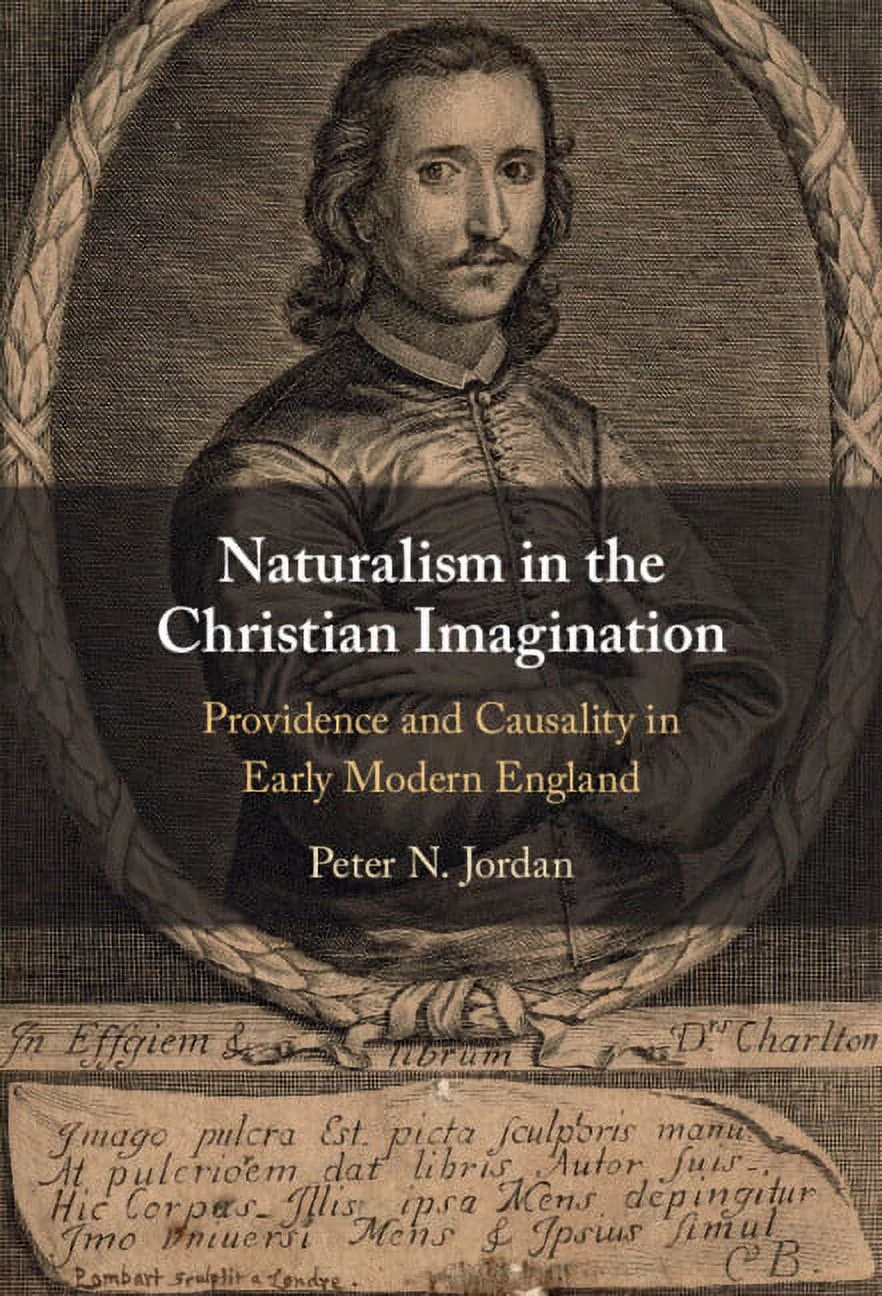
Jordan sets the stage in Chapter 1, outlining the concept of “providential naturalism.” Here, he captures the zeitgeist of a time when explanations for natural phenomena were predominantly theological, yet increasingly receptive to naturalistic interpretations. The early modern period witnessed, he writes, a profound intertwining of theological and natural explanations, where providential naturalism allowed for an understanding of natural phenomena as both divinely orchestrated and naturally explicable. His exploration of how early modern thinkers reconciled divine governance with natural causes is both insightful and illuminating, providing a robust foundation for the chapters that follow.
In Chapter 2, Jordan goes deeper into the doctrine of providence, dissecting its various categories—creation, conservation, concurrence, and government. Providence, in these various manifestations, formed the bedrock of English Protestant thought, shaping a worldview where every event was seen as both divinely willed and naturally caused. His clear exposition makes these theological concepts accessible, even to those not steeped in religious studies. However, one might wish for a broader comparative analysis that situates English Protestant thought within a wider religious context. Such an approach could enrich our understanding of the uniqueness or universality of these ideas.
Chapter 3 takes a surprising yet intriguing turn, examining the theological and moral debates surrounding chance-based activities like gambling. Through the contrasting views of clergymen like James Balmford and Thomas Gataker, Jordan illustrates how these debates were framed within a providential worldview. The theological debates surrounding gambling reveal a society grappling with the concept of chance within a providential framework, where even seemingly random events were believed to be under divine control. As Jordan writes, “On the surface, then, the debate between James Balmford and Thomas Gataker was about gambling and recreational activities in early modern England. But ultimately theirs was a disagreement over competing versions of providential naturalism, one driven by different sets of commitments of a scriptural, metaphysical, theological, ethical, and empirical kind” (71).
Prodigies and their interpretations take center stage in Chapter 4. Jordan masterfully navigates the tension between miraculous and naturalistic explanations of unusual phenomena. His focus on John Spencer’s efforts to reframe prodigies within natural philosophy offers a compelling narrative. “Spencer published an impassioned treatise in 1663,” he writes, “inveighing against those overly supernaturalistic interpretations of unusual phenomena in nature that characterised debased forms of the Christian faith” (72). According to Jordan, prodigies, once viewed as direct signs from God, began to be reinterpreted through a naturalistic lens, reflecting a shift towards understanding extraordinary phenomena as part of the natural order rather than as interruptions of it.
The revival of atomism, the subject of Chapter 5, posed a significant intellectual challenge to providential naturalism. Atomism presented a materialistic challenge to providential naturalism, proposing that the world operated through inherent properties of matter rather than continuous divine intervention, thereby sparking significant theological and philosophical debates. Jordan’s discussion is clear and concise, yet it leaves the reader yearning for more on the scientific advancements that bolstered atomistic thought.
Chapter 6 explores the ambitious theories of the earth proposed by Thomas Burnet and William Whiston. These theories of the earth represented bold attempts to harmonize geological observations with biblical narratives, highlighting the evolving relationship between scientific inquiry and religious belief. Jordan’s detailed analysis of their attempts to reconcile geological observations with biblical narratives is both fascinating and thorough. However, the chapter could be enhanced by exploring the reception of these theories within the scientific community and the general public.
The final chapter offers a reflective synthesis of the book’s themes. Jordan eloquently connects historical debates to contemporary issues, emphasizing the enduring questions about the relationship between natural causality and divine providence. “If providential naturalists are right,” he writes, “then one can embrace natural causality and naturalistic explanation—a core commitment of science and of its precursor, natural philosophy—without giving it metaphysical priority and thereby giving up on providence and the possibility of meaning” (195-96).
In conclusion, Naturalism in the Christian Imagination is a significant contribution to the history of science and religion. Jordan’s ability to weave complex theological and philosophical concepts into a coherent and engaging narrative is commendable. His work invites readers to reconsider the historical interactions between science and religion and their implications for contemporary discourse. While the book could benefit from broader contextualization and more extensive engagement with primary sources, it nonetheless stands as a valuable resource for scholars and students alike. Jordan’s work is a testament to the intricate dance between faith and reason, reminding us that the search for understanding is as old as humanity itself.
Living in God’s Creation
Posted on June 5, 2024 Leave a Comment
The “message is quite clear,” writes Philip Sherrard, one of the key translators of the Philokalia, “our entire way of life is humanly and environmentally suicidal, and unless we change it radically there is no way in which we can avoid cosmic catastrophe.” Sherrard goes on to say that the coming “crisis itself is not first of all an ecological crisis. It is not first of all a crisis concerning our environment. It is first of all a crisis concerning the way we think. We are treating our planet in an inhuman, god-forsaken manner because we see things in an inhuman, god-forsaken way. And we see things in this way because that is basically how we see ourselves.”
This arresting quote comes from a collected volume, edited by John Chryssavgis and Bruce V. Foltz, Toward an Ecology of Transfiguration: Orthodox Christian Perspectives on Environment, Nature, and Creation (2013).
I want to devote this post to several important essays in this volume. Another great volume on the topic is Elizabeth Theokritoff’s Living in God’s Creation: Orthodox Perspectives on Ecology (2009). I will also highlight key themes from this book here.
But today I want to focus primarily on a recent favorite of mine, Lydia Jaeger’s Ordinary Splendor: Living in God’s Creation (2023), which is a remarkably beautiful book.
Jaeger is a renowned philosopher and theologian, known especially for her work on the intersection of science and religion. She holds degrees in both physics and theology, and has been a prominent voice in discussions about the compatibility of scientific inquiry and Christian faith.
Jaeger serves as the Academic Dean at the Institut Biblique de Nogent-sur-Marne, a theological seminary in France. Through her scholarly work, Jaeger aims to demonstrate that scientific and religious worldviews are not mutually exclusive but can be harmoniously integrated, enriching both domains of thought.
Jaeger’s work can be compared to other theological explorations of Genesis, such as John Walton’s The Lost World of Genesis One and Walter Brueggemann’s Genesis. While Walton focuses on the functional ontology of Genesis 1 and Brueggemann offers a socio-political reading, Jaeger’s approach emphasizes the theological and ethical implications of the creation narrative.
In Ordinary Splendor, Jaeger begins by discussing the uniqueness of the biblical creation narrative, highlighting how it presents God as the absolute origin of everything. The implications of this belief are clear. “In the beginning, God created the heavens and the earth.” This statement sets the stage for understanding God as the sovereign creator who brings everything into being without any pre-existing materials. Jaeger contrasts this with ancient and modern misconceptions that fail to distinguish clearly between God and the world. The biblical perspective stands in stark contrast to the polytheistic views prevalent at the time of Genesis’s writing. She refers to the Babylonian creation story, Enuma Elish, to illustrate how the Bible’s monotheistic creation narrative diverges radically from the cosmogonies of other cultures.
Indeed, Jaeger emphasizes that the biblical account demythologizes the world, making it amenable to scientific exploration, as creation is an ordered system that humans can study and understand. This demythologizing also prevents the world from being given quasi-divine status, a tendency seen in both ancient mythologies and modern scientific overreach.
The implications of the biblical creation theology for human existence and worship are profound. Jaeger argues that recognizing God as the creator leads to a life centered on prayer and worship, directed towards the Creator who is the origin of all things. This theological framework prohibits idolatry, whether it be the worship of physical idols or the elevation of any created thing to ultimate importance.
Furthermore, Jaeger addresses the fallacy of living without acknowledgment of God. She contends that even those who claim to be atheists owe their existence to the Creator. Human life, according to Jaeger, only finds its true meaning when we acknowledge our dependence on God. This acknowledgment transforms our understanding of reality, leading to a life of gratitude, worship, and service to the Creator.
Jaeger then goes on to argue that existence, as such, is a gift. Creation is an act of divine generosity. She contrasts the biblical view with the existentialist perspectives that reject the notion of a divine origin. She focuses particularly on the ideas presented by Jean-Paul Sartre in his novel Nausea. For Sartre existence is contingent and thus devoid of inherent necessity. It is simply a “brute fact.” This of course leads to the sense that existence is superfluous, which becomes overwhelming and repulsive. Sartre’s character, Antoine Roquentin, epitomizes this existential dread, experiencing the world as a series of gratuitous events without any underlying purpose or origin.
By contrast, according to Jaeger, the theological perspective sees existence as a gift from God. She invokes the metaphysical framework of actuality and potentiality, used in medieval theology to describe the nature of beings and their dependence on a necessary, uncaused cause—God. In this view, all contingent beings (i.e., everything in creation) derive their existence from God, who is pure actuality and the source of all potentiality .
Jaeger argues that recognizing existence as a gift leads to a life of gratitude and purpose. This theistic view provides a foundation for seeing the world and life itself as meaningful and directed. By accepting our contingent existence as a gift from the Creator, humans can find a profound sense of value and purpose in life, contrasting sharply with the absurdity and meaninglessness of existence as portrayed by existentialist thought.
In the next chapter Jaeger expands on the concept of living within a created order. She affirms that creation is not merely a random arrangement but is imbued with purpose and meaning. This order reflects the wisdom and sovereignty of God. She emphasizes that acknowledging and respecting this order is fundamental to living a life in harmony with the divine plan.
A key aspect of this chapter is the discussion on technology and its impact on our relationship with the natural order. Jaeger recognizes that technological advancements have allowed humanity to exercise a degree of “dominion” over nature, as suggested in Genesis (see also my discussion here). However, she cautions against crossing the line from stewardship to outright rebellion. This rebellion is marked by attempts to completely control or alter the natural world, ignoring the inherent value and purpose imbued in it by the Creator.
Jaeger then discusses how totalitarian regimes, driven by the desire to reshape humanity and society according to their ideologies, exemplify extreme forms of rebellion against the created order. These regimes’ efforts to impose a new, arbitrary order, detached from the natural structures, often lead to catastrophic consequences, highlighting the dangers of such hubris.
Furthermore, Jaeger continues to contrast the biblical view with existentialist perspectives, particularly those of Sartre, who saw the world as devoid of inherent meaning and form. Sartre’s depiction of a world without origin or obligation starkly contrasts with the biblical view of a created, ordered universe, which demands a response of gratitude and obedience from humanity.
Another significant theme is the human pursuit of knowledge. Jaeger explores the mystery of why the human mind is capable of understanding the world. She points out that scientific inquiry often operates under the assumption that the world is intelligible and that human beings can uncover its laws and principles. This assumption, she argues, is deeply rooted in the belief in a rational Creator who made the universe comprehensible.
Finally, Jaeger also addresses the ecological crisis, linking it to humanity’s neglect or rejection of the created order. She suggests that the environmental challenges we face are, in part, a consequence of failing to respect the delicate balance and rhythms established by God. This neglect is not morally neutral but is a form of rebellion against the Creator’s design.
This naturally leads Jaeger to offer a theological basis for human dignity, and this chapter is particularly remarkable. All human dignity, she argues, is fundamentally rooted in the biblical creation accounts. According to Genesis 1, all humans are created in the image of God (Imago Dei), which bestows an inherent and equal dignity upon every individual. This theological foundation challenges and subverts the ancient Near Eastern practice where only rulers or elites were seen as divine representatives. In stark contrast, Genesis democratizes this divine representation, extending it to all humanity, thus laying a groundwork for equality and universal respect.
The assertion that all humans are made in the image of God carries profound implications for social justice and human rights. Jaeger emphasizes that this scriptural truth combats all forms of discrimination—be it social, racial, or gender-based. By grounding human dignity in the divine image, she argues for an inherent worth that demands respect and equitable treatment for all people. This theological view is revolutionary as it positions every person, regardless of status, as worthy of honor and ethical consideration.
Human dignity, according to Jaeger, also entails a moral responsibility. The Genesis narrative presents humans as not only bearers of God’s image but also as recipients of His commandments. This moral dimension is crucial; it means that dignity is coupled with ethical obligations towards God, each other, and creation. This responsibility manifests in the stewardship of the earth and the cultivation of the natural world, reflecting a partnership with the Creator.
Jaeger critiques contemporary secular views that often struggle to ground human dignity in a coherent and compelling manner. Without the theological underpinning, she argues, secular humanism fails to provide a robust basis for human worth that transcends utilitarian or functionalist considerations. By contrast, the biblical doctrine of creation offers a more profound and enduring foundation for understanding and upholding human dignity.
Jaeger aligns closely with traditional Christian anthropology as articulated by theologians like John Calvin and contemporary thinkers like Kevin Vanhoozer. However, her work also engages critically with modern philosophical ideas, such as those of Immanuel Kant, who posited that human understanding imposes order on an otherwise formless reality. Jaeger counters this by affirming that order and intelligibility are intrinsic to the created world, established by God and discoverable by human reason.
In the next two chapters Jaeger bridges the theological concepts of blessing and obedience with their practical outworking in everyday life. She argues that the act of procreation is a direct participation in God’s creative work. She highlights the miracle of conception and the unique individuality of each new life. Furthermore, Jaeger expands on the practical implications of understanding children as blessings. She suggests that this perspective should influence societal and familial attitudes towards children, viewing them not merely as responsibilities but as precious gifts. Jaeger also touches on the broader implications of God’s blessings in other areas of life, such as work and community. She emphasizes that recognizing God’s hand in these aspects leads to a more profound sense of gratitude and stewardship.
Jaeger then transitions from the reception of blessings to the active response of obedience to God’s commandments. She underscores the importance of understanding that God’s commandments are not arbitrary rules but guidelines designed for human flourishing. She suggests that obedience to these commandments is a way of aligning oneself with the order and purpose of creation. This alignment leads to a harmonious and fulfilling life, as envisioned in the biblical narrative. One key aspect Jaeger discusses is the enjoyment of the goodness of creation. She argues that God’s commandments include an invitation to enjoy His creation responsibly. This involves a balanced approach to life’s pleasures, avoiding both asceticism and hedonism. The challenge lies in maintaining this balance and living out the fear of the Lord in contemporary contexts, which Jaeger acknowledges can be difficult but is ultimately rewarding.
Building on obedience, Jaeger goes on to argue that we must accept our limitations. She argues that recognizing and embracing our limitations is essential for developing a healthy relationship with ourselves, others, and the world around us. She begins by addressing the misconception that restrictions in life are inherently negative. Instead, she argues that recognizing and embracing our limits allows us to live more fully and authentically.
Jaeger draws on the thoughts of the Jesuit theologian Hans Urs von Balthasar to illustrate that true knowledge and experience often come from embracing constraints. For instance, she cites the example of a monogamous marriage, where deep and genuine love is cultivated through commitment rather than through an endless pursuit of diverse experiences. She also references thinkers such as Socrates and Aristotle, who emphasized the importance of self-awareness and the recognition of one’s limits as foundational to wisdom and ethical living.
The chapter also integrates theological perspectives, particularly from Christian thought. Jaeger highlights how the Bible and Christian theology view human limitations not as a curse but as a natural and necessary aspect of creation. She draws on the concept of humans being created in the image of God, yet finite, to argue for a balanced view of human potential and constraints. Practically speaking, she discusses how this acceptance can lead to greater contentment, reduced anxiety, and more realistic goal-setting.
Jaeger’s critique of contemporary culture’s resistance to limits is compelling, as it highlights a significant issue in modern society: the endless pursuit of more at the expense of depth and quality in life. She critiques modern Western society’s tendency to resist limits, exemplified by the metaphor of channel-hopping with a remote control. This behavior reflects a broader cultural trend of avoiding deep commitments in favor of superficial engagements. Jaeger suggests that this restlessness and inability to commit is a form of rebelling against our finite nature.
Jaeger extends this discussion by emphasizing the significance of our embodied existence. Our bodies, with all their specific characteristics, anchor us in particular contexts and relationships. This embodiment is a reminder of our finite nature and should be seen as a source of gratitude rather than regret.
This embodiment also includes our personal history, culture, and character. The biblical creation narrative highlights the significance of being created as male and female, which symbolizes the broader finitude and individuality of human beings. This differentiation serves as a reminder of our limited perspective and our created nature. The narrative posits that human finitude is not an imperfection but a part of God’s good creation. Accepting our limits is essential for recognizing our unique role and serving God within the framework of our individual existence. By acknowledging our created status, we can joyfully accept our limitations as opportunities for God to bless us and for us to serve Him. This acceptance contrasts with the modern desire to live multiple lives or experience everything possible within a single lifetime.
Jaeger emphasizes that not all limitations are created by God; some are the result of sin, such as those imposed by disease or social injustices. However, she asserts that the proper response is not to revolt against finitude itself but to recognize and address the sinful distortions while accepting the fundamental limits of human existence. The challenge lies in distinguishing between these types of limits. Jaeger argues that faithfulness in commitments, such as marriage, brings deeper understanding and fulfillment than a life spent chasing varied experiences. The cultural tendency to avoid commitments reflects a broader resistance to human finitude.
Ultimately, recognizing our limits points us to our dependence on God as our Creator. This dependence is not a constraint but a source of liberation and purpose, allowing us to live fully within the scope of our created nature.
TO BE CONTINUED…
 James C. Ungureanu