
John W. Draper at the Cooper Union for the Advancement of Science and Art
Posted on July 3, 2016 Leave a Comment
 Before he went to Oxford for the 1860 meeting of the British Association for the Advancement of Science, John W. Draper delivered an address at the opening of the Cooper Union for the Advancement of Science and Art in New York in 1859. Most of the lecture was published in the New York Herald (Nov 3, 1859). In this lecture Draper’s background as a Methodist and his training at the University of London (esp. the influence of Henry Brougham and the Utilitarians) are clear. His focus is education and the advancement of civilization, and here we find hints of ideas and themes that will be expanded in his later work. The following is taken directly as it was printed in the Herald.
There are two different means by which a community may assert superiority over its contemporaries—by brute force and by intellect. In the old times nations attached supremacy by a successful exercise of physical force. Successful wars were the basis of their authority, disastrous battles often their end. But the affairs of men have gradually taken such a form that power must rest on intelligence. He who seeks the improvement of his fellow men, the ennobling of the community among whom he lives, or the true glory of the nation to which he belongs, can only accomplish his purpose by spreading forth the light of knowledge, and strengthening and developing the public understanding. In his letter to the trustees of the Cooper Union, the founder of this institution, whose princely magnificence we here enjoy, has said “that it is his wish that we should see, feel, understand and know that there are immutable laws designed in infinite wisdom, constantly operating for our good—so governing the destiny of worlds and of men, that it is our highest wisdom to live in conformity to them.” So, in truth, it has pleased God to place the government of this world, in its onward progress, under the same laws as the development of man. And what does it signify if the one completes his career in a few months whilst the other demands for its majestic progress scores of centuries? In these affairs, to Him who has eternity to work in, time is nothing—a day is with him as a thousand years, a thousand years are only as a day.
Ask the historian what is the impressive, the final conclusions to which he has come from his examinations of the life of nations, he has still the same story to tell. Nations, like individuals, are born, run through an unavoidable career, and then die, some earlier, some more maturely, some at a still later date. In their infancy some are cut off by mere feebleness, some are destroyed by civil diseases, some commit suicide, some perish of old age. But for every one there is an orderly way of progress—the same pursued by the individual and assigned to the globe. Empires are only sand hills in the hour glass of time; they crumble away of themselves, or are totally obliterated when he turns over his glass. Read, if you choose, the history of the race from which we are sprung—the white, the European race. Not long ago our forefathers were wild savages in the woods; finding refuge in caves, delighting in the adornment of ochre, and wore the red and blue daubed over their skins; some, the dwellers in the southeast of the continent, tattooed themselves; some, still worse, were accused by common fame of cannibalism. A few years elapsed; the social disposition emerges; villages and towns appear; there is an instinctive but not an intellectual life. Still a little time more, and the rudiments of religious perceptions are distinguishable; these, from mere fetish adorations, unfold in a definite way, and better and better ideas appear, until finally the age of truth and reason in which we live has come. We look back—the opinions that were entertained perhaps only a century ago strike us with the utmost surprise, and we are fain to deny that our grandfathers could ever have really believed such things: it matter not whether they are ideas in philosophy or maxims in politics. We turn to ourselves inquiringly, to see in what consists the difference between us and them, and forth comes the same grand truth that we have recognised in the individual and on the globe.
There has been an intellectual advance, and we can no more adopt the habits, the sentiments, the opinions that guided them, than the adult man can be swayed by the trivialities which have governed the conduct of the boy. So thus I approach the great truth that I wish to inculcate here tonight—that the life of the nation is meant for intellectual development. Intellectual development overrides all other things. I do not exclude even morals. Morality without intellect is superstition. Whoever designs to improve the people among whom he lives must do so by influencing their intellect. The voice of history proclaims that all other schemes are abortive. Our European ancestors for a thousand years tried other means, and the result was a total failure. Where did the fifteenth century find them? The only ruling powers were the military and the monastic. They had carried their influence to its full extent. Had they endured for a thousand years longer, they could have done no more. They had stood by while society rose from the abyss of barbarism; to a certain extent they had assisted it; but now their work was done. The appearance of the continent and the condition of human life show what their uses and what their failures had been. There were great forests extending over vast districts, fens reeking with miasm and fever; some, even in England, forty or fifty miles in length, though round and walls of the abbey there might be beautiful gardens, green lawns, shady walks and many murmuring streams. Over trackless woods where men should have been, herds of deer were straying; the sandy hills were alive with conies, the downs with focks of bustard. The peasants’s cabin was made of reeds, or sticks plastered over with mud, with a chimneyless fire, or perhaps of peal [?] in the object and manner of his life was but a remove from the industrious beaver, who was building his solitary dam in the adjacent stream. There were highwaymen on the roads, pirates in the rivers, vermin in abundance in the clothing and beds. The common food was peas, vetches, fern roots, and even the bark of trees: there was no commerce to put off the extremity of famines. Man was altogether at the mercy of the seasons; the population, sparse as it was, was perpetually thinned off by pestilence and want. Nor was the state of the townsman better than that of the rustic. His bed a was a bag of straw, with a fair round log for a pillow; if he was in easier circumstances his clothing was of leather—perennial in duration, but not conducive to personal cleanliness; if poor, a wisp of straw wrapped round his limbs kept off the cold. It was a social condition, sad to the last degree, where nothing intervened between the cabins built of reed in the fen, the miserable wigwams of villages and the conspicuous walls of the castle and monastery. Well might they who lived near those times bewail the lost of the age-stricken peasant, and point, not without indignation, to the troops of “pilgrims, mendicants, pardoners and ecclesiastics” of every grade, who hung round the monastery and the church; to the might wassail and rioting drunkenness in the castle hall, secure in its moats, its battlements and its warders. The local pivots round which society revolved were the redhanded baron, familiar with scenes of outrage and deeds of blood, and the abbot, indulging in the last extreme of luxury, magnificent in dress, exalting in his ambling palfrey, his hawk and hounds. Rural life had but little improved since the time of Caesar; in its physical aspect it was altogether neglected. As to the mechanic, how was it possible that he should exist where there were no windows of glass, no, not of oiled paper, no workshop warmed by a fire? There was no physician for the dying rustic, but, merciful as ever, the good monk was there with his crucifix. The aim was to smooth the sufferer’s passage to the next world—not to save him for this. In the cities the pestilence walked unstayed—its triumphs numbered by the sounds of the death cryer in the streets, or the knell for the soul that was passing away. No such thing as over population was heard of: it was considered to be singularly successful statesmanship if the number of the population was kept up to its average sparse amount.
Europe thus woke up at the end of the fifteenth century, and found, so far as the domestic comforts and family life of its common people were concerned, that since the days of Caesar absolutely nothing had been accomplished. It is commonly said that this was owing to the extinction of civilization by the barbarian overwhelming Italy and Greece. But that is not the truth. In those countries the sacred fire of learning was fast dying out. It would have spontaneously become extinct had no barbarian touched it. As when you add fresh coal to a fire that is burning low you may for a time still further diminish it, perhaps risk its entire putting out, but in due season, if all goes well, the new material will join in the contagious blaze. The countless savage barbarians of Europe thrown into the foci of Greek and Roman light perhaps did reduce for a time the general heat, but by degrees it spread throughout their mass, and the bright flame of modern civilization was the result. Such was the result of a thousand years. The really influential agent, the ecclesiastic, was a man animated by intentions just as good, by perseverance just as unwearied, by an energy just as vigorous as our own. The defect lay not in him, but in the system, which vainly tried to accomplish improvement through the morals, whilst it abased or ignored the intellect. The time came at last when a different principle prevailed, and men sought to improve the social state through intellectual development. We are witnessing the wonderful result. Though scarcely three hundred years have elapsed, how many of the powers of nature have been brought into servitude to us! Nor has the apprehension which many good men in the old times entertained—that if you instruct the mind you may injure the morals—been at all verified; indeed, we find that men are better in proportion as they were wiser. In whatever direction we look we see how vast is the improvement. The physical man is more powerful, the intellectual man more perfect, the moral man more pure. For the poor, in the midst of all this social activity, this business energy, is charity any the less overflowing? For him who is eager for knowledge is there not certain to be a helper?
What is it that the very building we are sitting in and the occasion that brings us together loudly proclaim? Benevolence, a love for our race and a desire for its amelioration are as strong as ever. For the enterprising is there not an open career to wealth and consideration? The system under which it is our lot to live mingles together all climates, and tends to bind together in the bonds of commerce men of all nations and of all opinions. Under the stormy Atlantic the old and the new world will soon be whispering to one another. Whoever, therefore, I repeat, desires to better his fellow man, must take care that there shall be no ignorant man. Ignorance is not as in the old times they used to say—and it was a double blasphemy against God and man—the mother of devotion; she is the mother of superstition and misery. Brute force holds communities together just as a nail binds pieces of wood by the compression it makes—a compression depending on the force with which it has been hammered in; it also hold more tenaciously if it is rusted with age. But intelligence holds like a screw; the things it has to unit must be carefully suited to its thread; it must be gently turned, not driven, and so binds the connecting parts firmly and well together. If we want to know how we may best clear from this continent the superabundant forests that encumber it, how we may best lay the iron rail and put the locomotive upon it, how we may most profitably dig the abounding metals from the veins, how we may instantaneously communicate with our most distant towns, how we may cover the ocean with our ships, we must provide for all classes of our population improved means for scientific and practical instruction—for every man and for every woman, too, we must provide occupation.
The morality of a nation is the aggregate of the morality of individuals; a lazy man is necessarily a bad man, an idle is necessarily a demoralized population. It was doubtless such reflections which led Mr. Cooper, the founder of this institution, to establish it as a seat of practical science and art, to devote it to the pursuit of philosophy and letters, to make it a depository for historical collections, physical apparatus, mechanical models, books, drawings, pictures; to give it essentially a practical direction, not forgetting , however, that theory in the short way to successful practice, and to bestow its privileges on all the inhabitant of the United States, but especially on the working classes and on women.
[…]
It is emphatically to these that the Cooper Union offers its privileges. For them indeed is it especially intended. It engages to provide for them when their daily duty is over nightly instruction, without charge, in the various sciences and in their application to the arts, and to the useful occupations of life. Here my be learned mathematics, chemistry, natural philosophy, the various branches of physics—sciences at the basis of all those pursuits which increase the manufactures, the trade, the riches of our country. Not only those does the Cooper Union manifestly offer to every one willing to avail himself of it a knowledge of the truths of science: it also furnishes the light and perhaps more pleasant information of what is going on in the world around us—contemporary events. In its free reading room, open to all, abundant provision is made in the way of newspapers, journals, magazines. I have said that this institution, beside providing for the mental improvement of the artisan, has likewise, so far as possible, devoted itself to the interests of a class too often overlooked, too often neglected—women. On many occasions our social requirements press with a melancholy severity on great numbers of the female sex. They cannot engage in the rough conflicts of life—God never intended them for it. Few are the occupations to which they can with propriety turn, and even in these few—to the disgrace of men be it said—they are jostled and crushed and crowded out. Yet often the friendless woman has duties to perform for herself and these dependent on her of the highest kind. Society inexorably binds her with all its rules and usages, yet society too often yields her but a feeble help. She asks no more than freedom for her hands, no more than opportunity; yet how often is that freedom, that opportunity, denied? How countless, also, is the number of women whom in like manner we compel to a profitless inaction? How many of the fearful evils of the great cities of America and Europe may be directly traced to this source! There is nothing which more solemnity, more imperiously, appeals to the philanthropist than to find suitable, and honourable, and remunerative occupation for females. By the establishment of a school of design for women, the Cooper Union has marked out one of the means by which this great evil may be abated. Yet, after all, it can only be regarded as worthily showing us the way. At this time a complete cure is far beyond the power of any man or of any institution. For our own city doubtless what is done in these walls will be of excellent use, but what is that when we consider our widespread country?
J.W. Draper’s Introductory Lecture in the Course of Chemistry at the University of New York
Posted on June 30, 2016 Leave a Comment
John William Draper is often accused of cribbing after Comte and Buckle. But Draper had formulated his own ideas years before these other men published their work. Draper was considered a popular lecturer by his contemporaries. Thus when he began lecturing at the University of New York in the 1840s, many of these lectures were immediately published. In his introductory lecture to the course of chemistry for the medical department, Draper spoke of the intimate relationship between chemistry and medicine. “There is not a force in nature which does not affect us,” he told his students. To understand the physical agent, we must have a “general idea of the structure of the earth, the ocean, and the atmosphere; the various laws which regulate each, and the phenomena they exhibit.” In other words, to understand the individual, one must know something of his environment.
Draper goes on to argue that “The changes that we see in living things, are the consequences of fixed and immutable laws.” To understand these laws is to enter the “house of REASON.” Anticipating T.H. Huxley’s later sentiments in his “On A Piece of Chalk,” Draper informed his audience that “in each single grain of tripoli, which is found in beds and strata many feet thick, and extending over areas of many miles, it is known that there are the remains of more than a hundred and eighty millions of individuals…There is not a spot on which you place your feet, that does not cover the remains of unspeakable millions.” The dead beneath our feet provides us with a moral lesson, Draper relates. “We see that not only have individuals passed away, but also whole species, tribes, and genera, have become extinct. In the periods of human record has not the same thing happened? Great empires and mighty republics have ceased to exist, and the specific tribes of men that founded them have vanished.” According to Draper, this has all come to pass through the “operations of general laws.” “The march of events in the human family, is as little under your control as the march of those planets in the sky.” Interestingly, Draper closed his lecture by stating that “the broad hand of an overruling PROVIDENCE is also plainly discovered, dispensing with an unerring justice the rewards of national merit and national crime.”[1]
[1] John William Draper, Introductory Lecture in the Course of Chemistry: University of New-York, Medical Department (New York: Hopkins & Jennings, 1841).
Hobbes (Sheehan) on Heresy
Posted on June 25, 2016 Leave a Comment
Yesterday I posted on Jonathan Sheehan’s recent article on Hobbes the theologian. Today I came across—entirely by coincidence—an article by Cees Leijenhorst on “Hobbes, Heresy, and Corporeal Deity,” published in John Brooke and Ian Maclean’s Heterodoxy in Early Modern Science and Religion (2005). Leijenhorst shows quite convincingly that Hobbes himself defended himself against charges of heresy and atheism. Using juridical arguments, for instance, Hobbes contended “that contemporary English law had neither the legal framework nor the proper juridical authorities for a formal charge of heresy.” He supported his claim by tracing a “history of the concept of heresy.” According to Hobbes, heresy came to “stand or an unpermitted false belief held by a minority, as opposed to ‘catholic’ orthodoxy.” But this opposition was the result of the paganization of the early Church. The introduction of Greek philosophy had a pernicious effect on the early Church. Hobbes wrote:
Most of the pastors of the primitive church were…chosen out of the number of these philosophers; who retaining still many doctrines which they had taken up on the authority of their former masters, whom they had in reverence, endeavoured many of them to draw the Scriptures every one to his own heresy…And this dissension amongst themselves, was a great scandal to the unbelievers, and which not only obstructed the way of the Gospel, but also drew scorn and greater persecution upon the church.
Now, I might be wrong in saying this, but this argument looks remarkably similar to the one Sheehan himself makes. Hobbes seems to be defending his “heresy” by declaring that heresy was present in the early church from the very beginning. In other words, there has never been orthodoxy. Leijenhorst also makes the interesting point that Hobbes also attempted to separate reason from faith, or philosophy from theology. Philosophy deals with things that are conceivable; theology with the inconceivable.
But to return to the main point, Leijenhorst admits that notions of orthodoxy, heterodoxy, and heresy were extremely complicated in seventeenth-century England. When Hobbes maintained that he his views were orthodox, he based this on his own criterion of orthodoxy, which was based on his history of heresy. So when Sheehan points out the “Christian archive” of heterodoxy, he seems to be following Hobbes’s own argument! But as Leijenhorst makes clear, “it is a historical fact that all the various sects, as well as most of the leading scientists [sic] in seventeenth-century England…agreed that Hobbes was either a heretic or an atheists.”
Was Hobbes a Theologian?
Posted on June 23, 2016 Leave a Comment
During lunch a friend reminded me about an article on Hobbes I sent him a few weeks back. I had only quickly scanned it at the time, sent it to him, and apparently forgotten all about it. The article is written by Jonathan Sheehan, and published in The Journal of Modern History (June, 2016). It asks the provocative (and perhaps “perverse”) question: Was Thomas Hobbes a theologian?
Sheehan begins by calling attention to the so-called “return of religion” or “religious turn” in modern scholarship, a term used by various scholars in recent decades, including Thomas Albert Howard, Thomas Ahnert, S.J. Barnett, James E. Bradley, Jonathan D. Clark, Dale K. Van Kley, Louis Dupré, Knud Haakonssen, Ian Hunter, Thomas Munck, Dorinda Outram, J.G.A. Pocock, Roy Porter, Mikuláš Teich, David Sorkin, Robert Sullivan, and Bruce Ward, among others, and mostly in the context of Enlightenment studies. Sheehan himself has participated in such work, particularly in his The Enlightenment Bible: Translation, Scholarship, Culture (2005), which argued that the Bible’s place in eighteenth-century German and English Protestantism was transformed rather than eclipsed. Earlier still was his important review essay, “Enlightenment, Religion, and the Enigma of Secularization,” published in American Historical Review (Oct, 2003).
According to Sheehan, asking if Hobbes was a theologian might seem perverse. Although he never claimed to be an atheist, countless commentators have called Hobbes’s philosophy atheistic. As he notes, “between the seventeenth and early twentieth centuries…there is complete consensus on the anti-Christian disposition of Hobbes’s thought.” Contemporaries were horrified by his impiety. Nineteenth-century thinkers also recognised Hobbes’s mechanistic metaphysics as atheistic. But by the early twentieth century, according to Sheehan, a number scholars were beginning to view Hobbes as “perfectly orthodox.” But how could this be? One scholar, e.g., A.P. Martinich, answered that most Hobbes scholars were secularists, and thus “bowdlerized his philosophy to match their prejudices.”
But according to Sheehan, the situation is more complex. Conventional critiques that Hobbes was an atheist or, more recently, assertions that he was entirely orthodox, miss a particularly important point about Hobbes’s religious context. Sheehan is worth quoting at length:
Hobbes teaches that, absent controlling authority, the Christian archive is heterodox, that it is not one tradition or one theology or one orthodoxy. Its pluralism goes back to the very dawn of its formation, built on layers of texts, authorities, traditions, and claims. There is, as Hobbes wrote about his own book, “nothing contrary to the Faith of our Church, though there ares several [doctrines] which go beyond (superantia) the teachings of private theologians.” As Hobbes understands it, however, the “Faith of our Church” was one hardly circumscribed—at least at the moment when the Leviathan was published—by orthodoxy. Rather, it was ill-formed, internally argumentative, variable, and agonistic.
So is Hobbes a theologian? We might be in a better position now to think about our opening question. Let us imagine with Hobbes that, absent institutions that guarantee certain statements as authoritative and orthodox, anyone can be a theologian. In fact, in a certain sense, everyone is a theologian—heterodox, perhaps, or even “ heretical, ” once external and political guarantees of right teaching disappear. In that case, what I called in the opening of this essay the “perversities” of Thomas Hobbes, D.D.—an atheist theologian, a mechanist theologian, an anti-ecclesiastical theologian — are suddenly no longer perverse at all. Instead, they are possibilities of thought unregulated by authority. They are only perverse in a world where a normative standard of orthodoxy can successfully be applied.
Leviathan was not written in such a world, and this invited Hobbes to practice a theology that was simultaneously mechanist and pious, anti-ecclesiastical and pro-establishment, atheist and Christian. We do not live in such a world either. In our world, the state takes little interest in regulating the unruly and messy Christian archive.
But Sheehan might be overstating his case. To be sure, the religious and political world of England was in much turmoil when Hobbes wrote his Leviathan. Indeed, it was penned while he was in self-exile, living in Paris, fearing for his life. When the Civil War ended, Hobbes returned to England in 1652 and settled down in the household of the earl of Devonshire. These circumstances no doubt are reflected in his writings. The fact that so many writers, as Sheehan himself points out, found Hobbes’s writings atheistic also questions his notion that the “Christian archive is heterodox.” That there was an almost “complete consensus” against Hobbes’s position is telling indeed.
Evelleen Richards and the Making of Darwin’s Theory of Sexual Selection
Posted on March 17, 2016 1 Comment
Tonight Evelleen Richards will be speaking at IASH on Darwin’s theory of sexual selection. In preparation for the talk, it has been suggested we read her 1983 essay, “Darwin and the Descent of Women.” It is a dated text, as many of her arguments have now become common parlance among Darwin scholars. Nevertheless, it is still relevant today, and thus worth familiarizing ourselves with its details.
Richards begins by pointing out that during the 1970s and 1980s social historians and sociologists were beginning to view scientific knowledge as a “contingent cultural product.” That is, scientific knowledge as socially constructed, as influenced by “non-scientific” content. She is careful to qualify the position, noting that “this is not to assert that science is merely a matter of convention…but rather that scientific knowledge ‘offers an account of the physical world which is mediated through available cultural resources; and these resources are in no way definitive.'” Richards supports this contention by citing work from M. Mulkay, B. Barnes, S. Shapin, R.M. Macleod, and a few others.
Using this new approach—i.e., that scientific knowledge is cultural constructed—Richards applies this method to Darwin’s conclusions on biological and social evolution, particularly his claims about women and sexual selection. Darwin has for too long (remember, this is a paper from the 1980s) been portrayed as an idealized, objective, “great man” of science. He has been “absolved of political and social intent and his theoretical constructs of ideological taint,” she writes.
But Richards wants to go beyond the feminist charge of sexism. Indeed, she aims to place “Darwin’s theoretical constructs and Darwin himself in their larger, social, intellectual and cultural framework.” In short, she wants to argue that Darwin was not merely a sexist or chauvinist, but that he was following an increasingly popular naturalistic explanation of nature—including human nature. Moreover, Darwin also derived his notion of sexual selection from the larger Victorian context, from socially sanctioned assumptions “of the innate inferiority and domesticity of women.” More interestingly, Richards wants to connect Darwin’s views on sexual selection to his relations with Emma Wedgwood, his wife, and their children. “I argue,” Richards writes, “that Darwin’s experience of women and his practical activities of husband and father entered into his concept of sexual selection and his associated interpretations of human evolution.” Finally, Richards wants to show how late-Victorian Darwinism was imposed on women, limiting their claims for social and political equality.
As soon as Darwin published his Origin of Species, he was feeling the pressure to apply his theory of evolution to humanity. According to his notebooks, Darwin had been thinking about human evolution since the 1830s. Indeed, “from the first he was convinced that humanity was part of the evolutionary process.” He delayed publishing his views once the storm over the Origin had subsided.
But that did not prevent others from making a go at it. Charles Lyell offered his own arguments in his 1863 Antiquity of Man. But Darwin was “bitterly disappointed” that Lyell did not “go the whole orang.” Darwin felt more assured by Alfred Russel Wallace, co-founder of the theory of natural selection. He was so confident in Wallace that he offered to share his notes on “Man” with him. Darwin was shocked when Wallace retracted his “belief in the all-sufficiency of natural in human physical, social, and mental development.” By 1869, Wallace had posited a “higher intelligence” guiding the development of the human race.
Richards suggests that these men, who seem to have lost their nerve, reinforced Darwin’s determination to demonstrate that the “human races were the equivalent of the varieties of plants and animals…and they were subject to the same main agencies of struggle for existence and the struggle for mates.” Human evolution, as with other species, could and should be explained by natural evolutionary processes.
Sexual selection was indeed the key for Darwin. When he published his Descent of Man in 1871, he subtitled it: or Selection in Relation to Sex. Sexual selection had been vital for Darwin’s theory of natural selection. In his Origin, Darwin distinguished the two. Sexual selection, he wrote
depends, not on a struggle for existence, but on a struggle between the males for possession of the females; the results is not death to the unsuccessful competitor, but few or no offspring. Sexual selection is, therefore, less rigorous than natural selection. Generally, the most vigorous males, those which are best fitted for their places in nature, will leave most progeny. But in many cases, victory will depend not on general vigour, but on having special weapons, confined to the male sex.
Perhaps more importantly, Darwin attributed sexual selection to another factor: female choice. This explained, for example, the seemingly useless and even disadvantageous colors of some male birds, or the long horns of the antelope. In other words, these elements made the male more attractive, and hence better at “wooing” the female during courtship.
Richards carefully notes that in his Origin, Darwin views females as mere spectators, entirely submissive to the males, who actively compete with one another. “Female choice” she writes, is still very much “passive.” Darwin’s “androcentric bias,” she adds, is even more pronounced when he considered human evolution. According to Richards, Darwin badgered “naturalists and breeders for corroborative evidence” to support his position. For Darwin, “human evolution and sexual selection had become inextricably linked.”
In his Descent of Man, Darwin divides his argument into three parts. In part one he sought to demonstrate “that there was no fundamental difference between humanity and the higher animals.” At the end of this first section, Darwin introduced his theory of sexual selection to explain racial differences, including “skin colour, hair, shape of skull, proportions of the body, etc.” But sexual selection was also much wider in scope. As Darwin put it
He who admits the principle of sexual selection will be led to the remarkable conclusion that the nervous system not only regulates most of the existing functions of the body, but has indirectly influenced the progressive development of various bodily structures and of certain mental qualities. Courage, pugnacity, perseverance, strength and size of body, weapons of all kinds, musical organs, both vocal and instrumental, bright colours and ornamental appendages, have all been indirectly gained by the one sex or the other through the exertion of choice, the influence of love and jealously, and the appreciation of the beautiful in sound, colour or form; and these powers of the mind manifestly depend on the development of the brain.
Sexual selection, in other words, account for the “higher” features of humanity, mental powers—emotional, intellectual, and moral.
In parts two and three of his Descent, Darwin concentrated on demonstrating sexual selection in the animal kingdom, and then extended it to human evolution. The point needs re-emphasizing: Darwin was not concerned with “sex” but with human evolution. Interestingly, Darwin reverses his theory on sexual selection when it came to humanity. While females, however passive, choose in the animal kingdom, it is male selection that predominated among humans. Indeed, in the course of evolution, “man had seized the power of selection from woman.”
In turn, male humans had become “more powerful in body and mind than woman.” Richards argues that Darwin’s understanding of sexual selection led him to the conclusion that the “higher education of women could have no long-term impact on social evolution and was, biologically and socially, a waste of resources.” She claims that Darwin derived some of his ideas on sexual selection from Carl Vogt’s Lectures on Man, which was first published in English in 1864 by the racist Anthropological Society of London. Indeed, Darwin cited Vogt’s morphological arguments on racial and sexual differences, which posited that “mature females, in the formation of her skull, is ‘intermediate between the child and the man’ and that woman’s anatomy generally, was more child-like or ‘primitive’ than man’s.” According to Richards, “it was an extension of Vogt’s woman-as-child-as-primitive argument that provided the sole scientific underpinning of Darwin’s conclusion on the futility of higher education for women.” As it was for Vogt, so it was for Darwin: sexual inequality was the hallmark of an advanced society.
Richards argues, however, that Darwin’s theory of sexual selection was supported by little actual empirical evidence, and that most of it depended social stereotypes. “The whole was a triumph of ingenuity in response to theoretical necessity in the face of a dearth of hard evidence,” she writes.
At the same time, this was not just some political ploy by Darwin. His theory of sexual selection was “part of a more general tendency of nineteenth-century thought to treat human mental and social development more scientifically or naturalistically.” Although Richards does not put it in these words, the obvious desire to explain everything naturalistically seems to derive from the abandonment or rejection of theological explanations. In an attempt to fill the void left behind when religious explanations were ousted, Darwin needed to find another way of explaining the course of human evolution. Darwin chose sex. In this new understanding of human evolution and human nature, woman took the backseat, stagnate and trapped in a childlike and primitive state. Man, by contrast, became the higher being, the breeder who selected, shaped, and moulded woman to his fancy. Richards contends that Darwin’s theory of sexual selection was part and parcel of Victorian bourgeoisie social and political assumptions about the sexes. But I would argue that it was more than this. As I mentioned above, it was also the attempt to support such assumptions, wittingly or unwittingly, naturalistically.
Richards now turns to how “Darwin, as an individual, came to hold his beliefs on feminine abilities and differences.” In the 1830s Darwin was looking for a “nice soft wife on a sofa.” He found her in Emma. Ironically, as Richards puts it, it was Darwin, who suffered from much ill-health, who often occupied the sofa. Yet Emma was entirely submissive to Darwin. She bore him ten children, wrote letters at his dictation, nursed him, and proofed his writings. She was also, as Richards notes, “deeply religious, and many of [Darwin’s] opinions were painful to her.” But Emma remained undeniably faithful to Darwin.
Darwin did not want an intellectual companion. He actually advised against it. When Emma picked up Lyell’s Elements of Geology, Darwin told her to put it down. For Darwin, “science was an exclusively male preserve, which women entered, if they entered at all, only as spectators.” Richards adds that Darwin “did not expect or want women to converse intelligently about science, but rather to be tolerant of masculine preoccupation with it.” Emma was expected to adhere to the stereotypes of Victorian feminine servitude, domesticity, and piety. And she did.
Richards also notes that although the Wedgwoods and Darwins held unconventional theological and political notions, they were entirely “orthodox” in their views of the role of women. It is, however, not entirely clear what Richards means by “orthodox.” That is, she never defines the term. Does she mean religiously orthodox? socially orthodox?
At any rate, Richards goes on to show how Henreitta, one of Darwin’s daughters, actually proofed and in fact edited his Descent. But it appears that she had no qualms about the section on woman’s intellectual inferiority. Like her mother Emma, her only concern was Darwin “putting God further off.”
Richards then turns to Darwinism and the social context. The nineteenth century, she says, experienced the “secular redefinition of the world.” She stresses—perhaps too much—that evolution was central to this redefinition. But as many scholars have pointed out since her paper was published in 1983, Darwin’s theory of evolution did not come into the “theological world like a plough into an ant hill.”
Richards is correct, however, in connecting evolution to a “secular ideology of progress,” one which was “assimilated to the capitalist requirements of industrial and economic growth, catch-cry of a rapidly advancing liberal and ‘progressive’ bourgeoisie.'” Darwin of course was not disinterested in this connection. Indeed, as is now well known, he did not take a neutral position on the topic. He had incorporated contemporaneous social thought in support of his theory. As Richards puts it, “it was an alliance that made for success.”
In the last decades of the century, many turned to evolution rather than religion to corroborate their views on social values. “Social Darwinism” appealed, for example, to the “robber barons” of America, to J.D. Rockefeller and other powerful businessmen. We have even seen something of a rebirth of Social Darwinism recently with the rise of Donald Trump and his supporters.
In a succinct paragraph, Richards puts it thus:
Darwin, in pushing his case against the divine origin of human mind and conscience, argued for their evolution according to the same processes that had produced all living things. His refusal to concede any but naturalistic explanations of human intelligence and morality, hardened into a biological determinism that rejected all social and cultural causation other than that which could be subsumed under the natural laws of inheritance and thus become innate or fixed.
After the publication of Darwin’s Descent, there was a notable increase in treatises attempting to moralize naturalism. We see this, according to Richards, in the work of Huxley, Romanes, Galton, Lubbock, Spencer, and other popular works. “Those Darwinian theorists,” she writes, “raised insuperable evolutionary barriers against feminine intellectual and social equality.”
As feminism was rising to power in the last decades of the nineteenth century, social Darwinists declared it a direct threat to the bourgeois family. According to Richards, Darwin’s Descent appeared just in time. His “growing authority and prestige were pitted against the claims by women for intellectual and social equality.” There was also a massive upsurge of anthropological and medical studies used to support Darwin’s theory of sexual selection, and more generally his views of women and their role in society.
Richards concludes that Darwin’s understanding of human sexual differences was “central to his naturalistic explanation of human evolution.” In this essay and her more recent work, Richards has demonstrated that scientific knowledge is not immune to the context of its reality. While science can transcend borders, it is also provincial. Science is situated knowledge; or, as David N. Livingstone has put it, it has a “place.”
Newcomb and the Religion of Today
Posted on December 26, 2015 Leave a Comment
Simon Newcomb responded to his theological interlocutors in the 1 January, 1879 issue of the North American Review, in an article entitled “Evolution and Theology: A Rejoinder.” He again defends himself as an impartial observer, entering the “list not as a partisan of either school, but only as an independent thinker desirous of ascertaining the truth.” After carefully reading their replies, he says, all prove to be unsatisfactory. According to Newcomb, their responses “leave nothing to be desired.” For the “scientific philosopher can have nothing to say against them, because, whether he admits them or denies them, it is entirely outside his province to pass judgment upon them.”
The whole debate rests upon “a differentiation made by the human mind in all ages between the processes of Nature and the acts of mind.” According to Newcomb, in the early stages of human thought all natural operations were believed to be those “of a directing mind having an end to gain by them, and were not the result of any law of Nature.” But as knowledge increased, more “careful thinkers” realized that the operations of nature belonged to a class of natural processes. Many of these thinkers were deeply religious, Newcomb admits. These early modern thinkers proposed that nature operated naturally, and only in certain circumstances the Supreme Will acted. Others “less devout or wholly irreligious” believed that as knowledge increased all operations will come to be seen as “purely natural processes.”
In short, what Newcomb offered as a rejoinder to his theological debate partners is a history of science and religion. It was indeed religious thinkers, the “monastic schools,” who ultimately trumpeted the position that “all event were to be explained by natural law.” They applied this to all aspects of the known physical world. But there was one area they refused to entertain: “the adaptation of living beings to the circumstances by which they are surrounded.” In other words, human evolution. In its place arouse “natural theology,” which attempted to show “final causes in Nature.” This theory held supreme sway until recently, however. What Newcomb seems to say is that Darwin’s theory of evolution had destroyed natural theology.
Newcomb’s central question, which he believes his theological interlocutors failed to properly address, is that of evolution. If evolution is true (which he believes no doubt is), “how far must we give up or modify religious doctrine?” Newcomb explains that he sees “no antagonism between the scientific postulate and the abstract doctrine of design in Nature.” But each must not entrench in the other’s domain. “It is one thing to say that there is design in Nature,” Newcomb writes, “but an entirely different thing to say that we know these designs, and are able to explain and predict the course of Nature by means of them.”
But here is the crux of the matter: how do the theologians account for God’s actions in nature? That is, in the natural world and evolutionary scheme that scientists have discovered? “The creation of all living beings and their adaptation to the conditions which surround them are the results of a process which we see going on around us every day, and which depend upon laws as certain and invariable in their action as those of chemical affinity or of gravitation.” If we ask, Whence this power? We might as well ask, Whence gravitation? Nature is a grand whole, “the basis of which is involved in mystery in every direction.” So the question Newcomb asks the theologians: is scientific truth consistent with religious truth? According to Newcomb, theologians have yet to give an answer.
Several months later, Newcomb attempted to give an answer for the theologians in an unsigned article, “The Religion of To-day,” again published in the Review on 1 July, 1879. He begins by declaring that the “intellectual world of to-day is drifting away from the religious belief and dogmatic theology of the past.” In France and Germany, for example, Christianity has “almost entirely disappeared from the intellect.” There is a “wave of skepticism” engulfing England. Thus it is a mistake to assume that this current, or movement of skepticism, will not reach the United States. This is a movement where we are seeing the “slow elimination of all those tenets which have heretofore been considered the essentials of religious belief.”
In this essay Newcomb essentially repeats his message from his earlier “An Advertisement for a New Religion,” but with more graveness or seriousness. The aim of this latest essay is to find the “nature and extent of the movement, considered as modifying the religion of the past, and the character of the new ideas which are now taking form.” The “Church” he says is largely unaware of this move towards general skepticism. It is like a “drifting ship, the passengers of which, seeing no change in the ocean, are unconscious of their change of position.” But the Church is ultimately mistaken. Theologians may believe they have yielded nothing to modern science or modern thought, but this belief is misplaced. The demand for doctrinal preaching has died. “Men have ceased to demand doctrines,” Newcomb explains, “not necessarily because they have ceased to believe in them, but because they have taken the first step toward unbelief by losing their interest in them. Their faith is dragging its anchors without their knowing it.”
One strong indication of growing skepticism is the increasing number of people who reject the doctrine of Hell. Hardly anyone, he says, continues to believe in the literal truth of “the punishment of the wicked.” There is now a tendency to interpret such doctrines as “less literal, and more mystic and poetical.” Such doctrines are thus dying, or “silently modified under the influence of a current of thought peculiar to our time to an extent which it is difficult to define.”
But perhaps the strongest and most striking example of the “readiness of theology to temporize with the irreligious thought of the day, and to explain away doctrines it once held dear, is seen in its attitude toward the now fashionable theory of evolution.” In this sense the Church has conformed to the world. “No other theory,” Newcomb claims, “is so directly opposed to the doctrine which lies at the basis of our orthodox system of theology.” Orthodoxy, says Newcomb,
teaches that man was created in a state of moral perfection; in the especial image of his Maker; not subjected to death; endowed with a conscience showing him the difference between right and wrong. From this state of perfection he fell into what we know he has been in past times by a single act of transgression, and has been again elevated only by the supernatural interference of his Maker.
But according to evolutionary theory,
man was not created at all, in any sense in which the word has ever been understood. Indeed, there never was any personal Adam, the human race being simply the descendants of an improved race of apes. Originally man had no more conscience than his brute progenitors, and right, wrong, or morality applied no more to his acts than to those of the tiger. If he was free from sin, it was only for the same reason that the lower animals are free from it: because no conscience told him the distinction between right and wrong…In on word, the theory pronounces the whole theological doctrine of the origin and fall of man to be a fiction as complete as anything in pagan mythology.
Initially considered subversive, Darwin’s theory of evolution now has—surprisingly— many sympathizers among the orthodox.
However, Newcomb argues that the orthodox cannot remain orthodox and still support evolution. These Christian evolutionists—or “Providential Evolutionists,” as Gregory Elder has called them in his Chronic Vigour (1996)—are essentially misguided. One cannot accept evolutionary theory and yet remain religiously orthodox. The belief that science and religion shall be at one “leads them into the dalliance which is so dangerous.” The two, in short, cannot be reconciled. Orthodoxy must die. This death comes not at the hands of the infidel, however; rather, it will come by the hands of those sincere believers wishing to adapt orthodoxy to modern thought.
With orthodox Christianity and other traditional religions dying, Newcomb believes the way is now clear for a “new religion.” “The great difference between the new religion and that current at the present time in our churches,” he says, “is to be seen not so much in its practical outcome as in the theory on which it is founded.” On the one hand, the old religion says:
I am virtuous, because I was taught in my infancy that the good would be rewarded in heaven and the wicked punished in hell. I have often been sorely tempted, but the thought of the consequences to follow temptation has always deterred me from sin. The feeling that my eternal happiness and my communion with God were involved in my life here below has been my staff and comfort through temptation and adversity.
On the other hand, the new religion (and likely Newcomb’s own personal belief) says:
I have no belief in a personal Deity, in a moral government of the universe, in Christ as more than a philosopher, or in a future state of rewards and punishments. But I was born with a sense of duty to my fellow man. I was imbued in infancy with the view that, as a member of society, it was my duty to subordinate my own happiness to that of others. My sense of right and wrong was thus developed at a very early age, and by the constant endeavor to do what was right my conscience acquired a constantly increasing development, and asserted more and more its power over my actions. I am not virtuous from any hope of reward or fear of punishment, but only because I feel that virtue is my highest duty, both to myself and to humanity. This feeling has developed to such an extent that the good of my fellow men is now my ruling motive, and vice is the object of my most extreme detestation.
This new faith, as we have seen, is another step away from what Draper, White, and the other scientific naturalists preached. It is their views taken to its logical conclusions. But is it atheistic? According to Edward Livingston Youmans, America’s premier science popularizer during the nineteenth century, not necessarily. In his Popular Science Monthly, for example, Youmans defended Newcomb against the charge of atheism in the October 1878 issue. The test question is this: “Is the general doctrine of causes acting in apparently blind obedience to invariable law in itself atheistic?” According to Youmans, “If it is, then the whole progress of our knowledge of Nature has been in this direction.” However, “if the doctrine is not atheistic, then there is nothing atheistic in any phase of the theory of evolution, for this consists solely in accounting for certain processes by natural laws.”
But this is far from orthodox Christianity. According to Newcomb, traditional Christianity is dead. It will be replaced by a new religion, one which “fears no false teaching, sets no limit on the freedom of human thought, and views with perfect calm the subversion of any and every form of doctrinal belief, confident that the ultimate result will tend to the elevation of the human soul and the unceasing progress of spiritual development.” So long as humanity endures, so will this faith in the “Religion of Humanity.”
Newcomb and the Christian Evolutionists
Posted on December 24, 2015 1 Comment
The North American Review, it should be clear, was founded and fostered by an Unitarian spirit. Most of its editors and owners, as we have seen, embraced a liberal theology, and many were Unitarian ministers themselves. Thus it is unsurprising that many of its leading contributors during the late-nineteenth century were men like Simon Newcomb (1835-1909). Like many of the scientific naturalists in England, Newcomb advanced a reconciliation between science and religion only by segregating them into opposite—and thus opposing—camps. But as we saw in his 1878 address to the AAAS, and his subsequent “Advertisement” in the 1 July issue of the Review, Newcomb also went beyond the Huxleys, Tyndalls, and Spencers.
After delivering the AAAS address, Newcomb encountered opposition from a number of theologians. In a forum published in the Review on 1 January, 1879, Newcomb discussed with Noah Porter, Joseph Cook, James Freeman Clarke, and James McCosh the “Law and Design in Nature.” Newcomb begins by noting, as he did in his “Advertisement,” that there exists two conflicting schools of thought when addressing the course of nature. While both sides assume that there exists a uniform plan and method in the universe, they cannot agree what that plan and method are. But whereas the “scientific school” criticizes the fundamental position of the “theological school,” without directly denying its veracity, the theological school refuses to give any credence whatsoever to the scientific school. Newcomb admits that this is not a “fair statement of the position they [the theological school] mean to occupy, but only that it is the manner in which their position presents itself to the other school [my emphasis].”
In presenting the divergent views between the so-called scientific and theological schools, Newcomb repeats the main points from his presidential address at the AAAS. When men study the operations of the world around them, they find a regularity so constant that the only logical conclusion is that the course of nature is determined by law. What seems arbitrary or mystifying, man has historically attributed these operations to supernatural agents, or gods. In turn man anthropomorphized these divine agents, ascribing to them aims and designs. At which point some men then claimed to be able discern these aims and designs in nature. But as knowledge advanced, these arbitrary events were also revealed to be determined by law.
To make his distinction between the schools clearer, Newcomb gives the example of the destruction of a theater by fire. The theological school, he says, will likely claim the fire was the work of a Higher Being, perhaps as punishment for the wicked. Another explanation sometimes offered by the theological school is that the cause is inscrutable, and therefore beyond human investigation. The scientific school, however, will say that “it occurred on one of the many ways by which every one knows that fires may occur, and that the character of the theatre or the intentions of the wicked people had nothing at all to do with the matter.” Newcomb then takes this same reasoning and applies to how one understands the motions of the planets. The scientific school, and especially the astronomer, “assumes that these motions take place in accordance with the law of universal gravitation,” and thus are able to “predict, years of centuries in advance, that the moon’s shadow will pass over certain regions of the earth at certain stated times.”
In his concluding remarks, Newcomb says this same thinking can apply to the debate surrounding evolution, which is at present “raging with most bitterness.” If the theologians can agree that the scientific schools have provided better explanations for the theater fire and the motion of the planets, why not accept their explanations for the genesis of living beings? The postulate of “final causes,” which the theological schools hold so dear, are, in Newcomb’s view, completely irrelevant to explaining natural phenomena.
The first to respond to Newcomb is Porter. He argues that Newcomb has created a “fiction,” that Newcomb’s understanding of the so-called theological school is totally “imaginary.” His conception of the “course of Nature,” moreover, is far too narrow. According to Porter, the course of nature includes “phenomena and facts of spirit as truly as those of matter.” We encounter constant examples of matter and spirit in the course of nature. Subjective thought is manifested in objective action. Indeed the spirit has greater significance, for “phenomena and effects of the physical universe proceed in subservience to ends which concern rational and sentient beings.”
Furthermore, Porter claims that “a universe of law is, ipso facto, a universe of design.” When Newcomb says that both schools assume a uniform plan and method in the universe, this implies, and even at an inductive level, design—“or at the least are best explained by design.” According to Porter, Newcomb ultimately goes half-way in his explanations. Merely attributing causes and effects to physical phenomena “overlooks the solution that the effect might be caused by physical agencies, and still be designed by God.” In Newcomb’s example of the motion of the planets, Porter says that “the constancy of the operations of Nature and the consequent possibility of foreseeing the minutest consequences are no more inconsistent with the belief in design in the future than an insight into these forces and operations of Nature is inconsistent with such belief at any present moment.” In concluding his response, Porter refers to German Emil Du Bois-Raymond (1818-1896), who had placed strict limits of our knowledge of nature. “After discoursing of what he calls the astronomical knowledge and foreknowledge of Nature’s forces and laws and events,” Porter writes, Du Bois-Raymond “draws a sharp line between the field of this astronomical knowledge and the agencies and relations in the course of Nature which can never be thus mastered. In respect to some of these questions he is content to say, ignoramus—in respect to others, ignorabimus.”
Cook, in his reply, begins with a story about Kepler found in Joseph Bertrand’s (1822-1900) Les Fondateurs de l’Astronomie moderne (1865).
Kepler relates that one day, when he had long meditated on atoms and their combinations, he was called to dinner by his wife, who laid a salad on the table. “Dost thou think,” said he to her, “that if from the creation plates of tin, leaves of lettuce, grains of salt, drops of oil and vinegar, and fragments of hard-boiled eggs were floating in space in all direction and without order, chance could assemble them to-day to form a salad?” “Certainly not so good a one,” replied his fair spouse, “nor so well seasoned as this.”
The point of this anecdote and others like it, Cook explains, is that Newcomb and those who follow his line of thought have failed to distinguish between “the laws of matter and the collocations of matter.” Natural phenomena are conditioned by laws, no doubt. But what accounts for these laws? Newcomb answers the “how?” but does not address the “why?” How and Why are not mutually exclusive, according to Cook. “The combination of millions of forces so as to produce sight is intelligible only on the principle that they have been combined in order to produce sight.” There is a “chasm between the primordial star-dust and the solar system.” This “chasm” can only be bridged “by the teleological as distinct from the mechanical theory of force.”
Clarke responds by carefully scrutinizing Newcomb’s initial propositions. The so-called theological school, he says, “admit the truth of the law of universal causation.” However, Newcomb’s second proposition, that in the action of causes “no regard to consequences is traceable,” Clarke emphatically denies. Final causes and design are in fact observable in nature, he says. Clarke gives the example of evolution itself. “Man is certainly a part of Nature, and those who accept evolution must regard him as the highest development resulting from natural processes.” Furthermore, eliminating God’s interventions in nature does not rule our design. Clarke then cites philosophers (e.g., Leibniz and Descartes) who rejected teleological statements but nevertheless believed in final causes. “The phenomena of the universe,” he concludes, “can not be satisfactorily explained unless by the study both of efficient causes and of final causes.”
The final response comes from McCosh. As president of Princeton University and as one of the leading philosophers of nineteenth-century America, McCosh attempted to bring about reconciliation between Christianity and evolution. But in addressing Newcomb’s arguments, McCosh accused him of succumbing to the “fallacy of interrogation.” According to McCosh, Newcomb “has mixed up no fewer than three questions, which are not the same, with each other, which have no necessary connection, and are not to be satisfied with one reply.” In attempting to make sense of Newcomb’s position, McCosh breaks it down into three propositions:
(1) “The whole course of Nature considered as a succession of phenomena is conditioned solely by causes.”
(2) “In the action of which causes no regard to consequences is either traceable by human investigation or necessary for foresee the phenomena.”
and
(3) “Is the above postulate consistent with sound doctrine?”
McCosh holds that he too believed that in the course of nature “every occurrence is produced by antecedent causes.” The third proposition is marred with vagueness, he says. What is “sound doctrine”? Religious doctrine? Scientific doctrine or the method of induction? Newcomb, McCosh says, does not specify. Thus he declares that “it is sound doctrine in science and in nearly all religions that God is traceable in his works.”
McCosh’s main contention with Newcomb is his second proposition. McCosh agrees that “physical causes do not in themselves have any regard for consequences.” But according to McCosh, “law and design” are not incompatible. For McCosh, “there is design in law.”
In the end McCosh accuses some scientists (rather uncharitably) of “derangement of mental vision produced by their gazing exclusively on some one object.” He further accuses Newcomb of setting the two schools, the theological and the scientific, against each other. “He is a narrow man who in inquiring into Nature can discover only mechanical force—while he overlooks vital and psychical agencies.” At the same time, the “religious man is so far a narrow man who will not allow scientists to discover physical cause.” The “truly enlightened man,” McCosh concludes, will delight in discovering both.
Simon Newcomb and An Advertisement for a New Religion
Posted on December 23, 2015 Leave a Comment
The North American Review was established in Boston in 1815 by co-founder and first editor William Tudor (1779-1830). The first issue was in fact almost written entirely by Tudor. Wanting to establish literary independence from Great Britain, Tudor designed the magazine to include strong literary intelligence, book reviews, reports of leading cultural societies, and inaugural addresses from elite universities, particularly from Harvard.
Changes to the structure of the Review came with new editors. Jared Sparks (1789-1866), appointed editor in 1817, introduced travel and history essays to the magazine. His editorship, however, lasted only a single year, as he resigned at the end of 1817 to take a pastorate of the Unitarian Church in Baltimore.
Under his successor, Edward T. Channing (1790-1856), brother of the famous Unitarian preacher William Ellery Channing (1780-1842), the Review discarded news notes, general essays, and poetry. Channing attempted to imitate more and more the literary reviews of England. But like Sparks, Channing’s editorship lasted only a year before he resigned. He was replaced with a young professor of Greek from Harvard, Edward Everett (1794-1865), who was also a popular Unitarian minister. Under his editorship the Review grew in circulation and popularity.
Sparks returned to the Review in 1824, when he purchased the magazine and thus became its chief editor and owner. Under his continued influence the magazine returned mostly to American topics. In 1830 Sparks sold the Review to Alexander H. Everett (1792-1847), brother of Edward Everett. Under his leadership the magazine reached new heights. He included articles and reviews on both American politics and European affairs.
In 1836 the magazine once again changed hands. Everett, immersed in politics during his editorship, sold his holdings in the Review to John Gorham Palfrey (1796-1881), yet another Unitarian minister. During his term, Palfrey introduced to the American public the writings of Emerson, Bowen, Holmes, Hawthorne, Whittier, Longfellow, Dana, Poe and others.
The next three decades several new editors came and went, including Francis Bowen, Andrew P. Peabody, James Russell Lowell, Henry Adams, and Charles Allen Thorndike Rice. With Rice (1851-1889) the Review reached a new turning point. When he was appointed editor in 1876, he brought the magazine (now a monthly) into a maelstrom of controversy.
It was during Rice’s editorship, for example, when Canadian-American astronomer Simon Newcomb (1835-1909) began writing regularly for the magazine. Newcomb had developed a reputation not unlike that of John Tyndall in Britain. In his 1878 presidential address to the American Association for the Advancement of Science (AAAS), Newcomb related to his audience that the AAAS was the sister society of the British Association for the Advancement of Science (BAAS). The connection seems to have been intentional, for Newcomb, like Tyndall’s infamous Belfast Address in the BAAS 1874 meeting, addressed the alleged conflict between religion and science. “We hear much at the present time of a supposed conflict between science and religion,” he observed. But according to Newcomb, “it is rather a conflict between two sets of men, who view Nature from opposite and irreconcilable standpoints.”
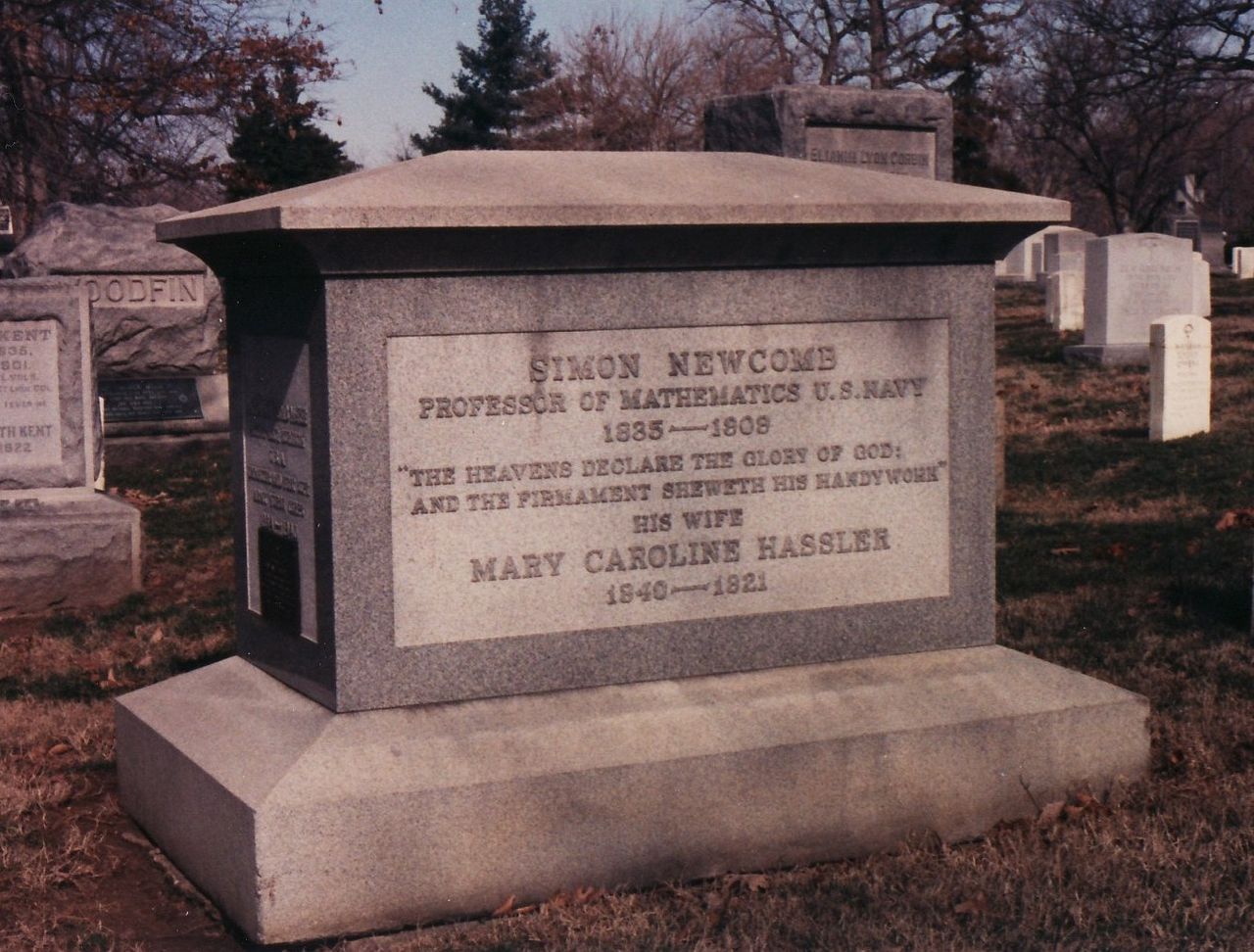
Newcomb wants to address these different points of view. On the one hand, the theologian, he says, is too invested. He cannot weigh arguments on both sides of a debate. “His idea of truth is symbolized in the pure marble statue”: unmovable, fixed, stagnant. The scientific idea of truth, on the other hand, is symbolized by an iron-clad turret, “which cannot be accepted until it has proved its invulnerability.” Truth for the scientist requires testing, even demolition. There are no sacred cows in science. “A countless host of theories have thus been demolished and forgotten with the advance of knowledge,” Newcomb notes. Therefore those which remain “can show us a guarantee of their truthfulness which would not be possible under any other plan of dealing with them.” The scientific man, in short, “recognizes no such attribute as orthodoxy in his doctrines.”
His main concern in this address is to present his views on “the course of Nature.” The doctrine of the uniformity of nature, he says, “is generally acquiesced in by the mature thought of intelligent Christendom, yet objections are frequently made to it, because it seems to run counter to some of our most cherished ideas.” For his part, Newcomb claims to be the peacemaker. “My desire,” he asserts early in his speech, “is to act the part of the peacemaker, rather than that of a combatant.” At the same time, in his discussion of “the course of nature,” Newcomb pitted natural law against the doctrine of Providence. He attributed the great advance of civilization to the “development of the understanding of the course of Nature.”
The great progress which the last three centuries have witness [he says] has been wholly in the field of phenomena…The progress here alluded to has been rendered possible only by entirely rejecting the mode of thinking about Nature which was prevalent in former ages, and into which the untrained mind is almost sure to fall at the present day.
The new understanding of nature, for example, “tells us that the whole course of Nature takes place in accordance with certain laws, capable of expression in mathematical language; that these laws act with more than an iron rigor and without any regard to consequences; that they are deaf to prayer or entreaty; that, if we would succeed, we must study them, and so govern ourselves that their action shall inure to our benefit.”
During the same month that Newcomb delivered his AAAS address, the North American Review published his “An Advertisement for a New Religion,” under the signature of “An Evolutionist.” Most of this article was written with tongue in cheek; however, Newcomb does make a serious proposition. “Among our advanced thinkers,” he begins, “two points are now happily settled beyond the need of further inquiry.” First, that all traditional religions, including Christianity (“in one sense the best and in another the worst of them”) are “waxing old, and must soon die.” Revealed religion has been undermined, so has “natural religion.”
But Newcomb also stressed that these same “advanced thinkers” maintain that humanity has a capacity for religion, that man has “religious instincts.” Indeed, great men have all been “profoundly religious.” Since the old religions are “sick, dying, or dead,” and since man must have a religion, it follows, according to Newcomb, that we must found a “new-born religion.”
This new religion must have certain conditions, however. Dealing strictly with the negative, Newcomb writes that this new religion “cannot have a God living and personal.” The God of the new religion cannot be anthropomorphized or personified. Moreover, this new religion cannot “insist on a personal immortality to the soul.” Another condition for the new religion is that “there must be no terrors drawn from a day of judgement.” These terrors only “frighten children, and men and women weak as children.” Highly-developed men, he says, are beyond them. Furthermore, there can be no “ghostly sanctions or motives derived from a supernatural power, or a world to come.” Finally, what cannot be understood by the senses must be “represented as unknown and unknowable.”
What, then, will be the basis for this new religion? The new religion, Newcomb declares, will have “humanity as its god.” He sees contemporary men of science as the new prophets of the people, and organs such as the Contemporary Review and the Nineteenth Century as the new platforms (pulpits?) of the new religion. But the new religion will take time to fully emerge. It will evolve slowly. Thus Newcomb desired to “advertise” among “our scientific doctors all over the world” to help with the birth of the new religion.
“This new religion must come” and it “must all come by development.” There is an urgency in Newcomb’s words here. Although he understands that this new religion will require time to blossom, he hopes that it will come speedily. Why? “We are at present,” he says, “in a transition state, which is a critical state; we are in danger of being crushed in a collision between two trains, one of which has come upon the other before it has started.” Newcomb in particular sees a problem with the morality of the next generation. “Our sons claim that in prosecuting their rights they are just as much entitled to advance beyond their fathers as their fathers did beyond their sires.” Whereas Darwin, Huxley, Tyndall, and others saw the continued need of religion for moral reasons, this new generation, according to Newcomb, wants to do away with it altogether. “We honestly tell them to be honest, and obliging, and chaste—always according to our ideas, which are surely liberal enough. But they puzzle us with questions which we have difficulty enough in answering satisfactorily to them in their present unsettled temper.” What Newcomb seems to be saying here is that when religion was undermined, so was morality.
Thus the new religion must come, and come quickly. And when it does come, “it will collect around it a faith and attractive associations; and it will generate an artistic worship full of glow; and the hearts of our young men and women will be drawn toward it, and we shall have a joyous religion, with a free and generous morality, rejecting all asceticism, and attracting by its own charms.”
Over a century later, we are still waiting for this optimistic vision of the future.
Transforming the Dominant Idea of Religion
Posted on December 21, 2015 Leave a Comment
In the Preface to his Culture and Anarchy (1869), Matthew Arnold (1822-1888), son of famous headmaster of Rugby School Rev. Thomas Arnold (1795-1842), asserts that “the world is fast going away from old-fashioned people.” Culture and Anarchy, it has been said, is an attack on English narrowness, on Victorian parochialism and philistinism. Arnold saw his fellow Englishmen consumed with themselves, a markedly individualistic and liberal attitude. The creed of the Victorian, he quipped, was “do as one likes.” Arnold considered himself a “liberal of the future,” thus justifying himself in his critique of contemporary liberalism.
In his chapter on “Hebraism and Hellenism,” Arnold writes
Everywhere we see the beginnings of confusion, and we want a clue to some sound order and authority. This we can only get by going back upon the actual instincts and forces which rule our life, seeing them as they really are, connecting them with other instincts and forces, and enlarging our whole view and rule of life.
In the first chapter, “Sweetness and Light,” Arnold claims that “religion” is the most “important manifestation of human nature,” more central to culture than art and poetry. But because Victorian society was at the “beginnings of confusion,” Arnold thinks it is time to transform this “dominant idea of religion.” This central element in human nature can never be abandoned. It is, he writes
the greatest and most important of the efforts by which the human race has manifested its impulse to perfect itself,—religion, that voice of the deepest human experience,—does not only enjoin and sanction the aim which is the great aim of culture, the aim of setting ourselves to ascertain what perfection is and to make it prevail; but also, in determining generally in what human perfection consists, religion comes to a conclusion identical with that which culture,—culture seeking the determination of this question through all the voices of human experience which have been heard upon it, of art, science, poetry, philosophy, history, as well as of religion, in order to give a greater fulness and certainty to its solution.
We see here the beginnings of Arnold’s equating of “religion with morality.” These ideas foreshadowed his later definition of “religion” in Literature and Dogma (1873). There he writes,
Religion, if we follow the intention of human thoughts and human language in the use of the word, is ethics heightened, enkindled, lit up by feeling; the passage from morality to religion is made when to morality is applied emotion. And the true meaning of religion is thus not simply morality, but morality touched by emotion. And this new elevation and inspiration of morality is well marked by the word ‘righteousness.’ Conduct is the word of common life, morality is the word of philosophical disquisition, righteousness is the word of religion.
Here Arnold united the themes in his earlier “Hebraism and Hellenism.”
In the nineteenth century, Matthew Arnold was merely one of many attempting to redefine Christianity by moralizing religion. Theologians, writers, and even men of science employed a vague, moralizing notion of “religion” in order to re-describe the essential features of Christianity. We see this particularly in the scientific naturalists, including the so-called co-founders of the “Conflict Thesis,” John William Draper and Andrew Dickson White. Draper, for instance, saw the politicization of Christianity as the end of “religion.” “True religion,” he maintained, is found in the teachings of Jesus Christ. Its doom came with Constantine. According to White, a pure and undefiled religion in found in the “recognition of ‘a Power in the universe, not of ourselves, which makes for righteousness,’ and in the love of God and of our neighbor.”
Huxley and Wilberforce at Oxford and Elsewhere
Posted on August 22, 2015 Leave a Comment
 In an amusing piece published for the Westminster Review in 1907, David Wilson provides readers with a “fanciful sequel” to the Oxford debate of 1860. Entirely satirical, irreverent, and missed by most scholars who have discussed the topic, Wilson begins by calling Oxford the “backwaters of the Universe.” These “collection of boarding-schools” are compared to “a stock farm with good fences, where foals and calves are fed and groomed and as far as possible kept out of mischief. From such a place while all goes well there is no news to be expected.” Nevertheless, some “adult visitors” occasionally “disturb the monotony of [its] adolescent existence.” He then goes on to repeat the traditional version of the “famous debate” between Huxley and Wilberforce, taken largely, he admits, from “the ‘Life of Huxley’ and the books.”
But then he turns to his “fanciful sequel,” comparing such stories to women: “they please best when they please by their intrinsic attractions.” I quote the story in full:
When Huxley died, he was agreeably surprised to find himself doing a journey in an electric railway underground, in a carriage better than the best Pullman cars but not unlike them, and just sufficiently filled to be pleasant. The train was incredibly fast, but went without a jolt. Only by feeling for it, so to speak, could he, when standing, discover a gentle wave of motion, which became imperceptible when he subsided into a chair. Before he could talk to any fellow-passenger, the train came to a stop. He got out with the others, and went through a long and spacious passage, bright with shining tiles and electric lamps. It was more like the nave of Westminster Abbey than any tunnel, and, long though it was, he had not ceased admiring it when he came out into what seemed to be an infinitely improved Crystal Palace, expanded into boundlessness. At any rate, the eye could see no bounds.
The light was bluish, but soft, abundant and agreeable. Circular fans were whirling above little round tables, at one of which he took his place and called for ice.
“I fear there must be some mistake,” he said to the smiling waiter, who stood rubbing his hands after fetching the ice-cream, and was asking what he wanted to drink.
“Mistake, sir?” asked the waiter, looking at the plate he had just put down.
“Oh, not in this; this is all right,” said Huxley, sipping, and looking again round the bustling scene, where every man and woman seemed to be cheerful and merrily employed. “What I fear is that some mistake has been made about my destination. The ticket I gave up at the door was for…” He paused.
“Hell, sir?” asked the waiter, briskly.
“Yes.”
“Then that’s all right; and even if it had been different, you could not have been better off anywhere than we are here.”
“But, but,” began Huxley, ” I don’t want to hurt your feelings, but in fact it was commonly reported and believed on earth that this place was,—well,—disagreeably warm.”
“Oh, to be sure, it used to be so, but so many scientific gentlemen have come down of late that we have now all the latest improvements, with additional advantages of our own. Besides, there’s nobody here against his will. You can extinguish yourself as easily as a candle, whenever you like. People stay here far longer than they used to do, and lots of those in the other place envy us now. I assure you that the Celestial Inspector who has just been down to look at our arrangements—they come regularly, you know, to prevent overcrowding and make sure the fires are equable—a mere excuse for an outing, I do believe—was saying to His Highness a few minutes ago—I heard it myself, I was taking him some liquor, as he felt thirsty in the heat of the furnace-rooms—I heard him say—and I don’t think it was politeness, for you know these people up there cannot make polite speeches, they have always to talk straight—so I’m sure he meant what he said, and says he: “I wish I could remain here altogether, you are so snug. The wet clouds on the way are not attractive.” Then His Highness said, “You cannot be afraid of sciatica, surely,” and they both laughed and laughed, and when they were done laughing, “It’s the company,” said the Inspector. “The company here would atone for any climate. It makes me hoarse to think of the eternal Hallelujahs, and these tiresome old women. They are in millions, like the sands of the desert, and every one of them thinks herself The Queen, and wants Jesus all to herself! It is as absurd and as monotonous as a lunatic asylum. Poor Jesus!” Look! There’s the Inspector passing now, sir,—not unlike yourself, if I may venture to say so.”
As everybody else was rising, in honour of His Highness and the Celestial Inspector passing, Huxley rose too, and the Celestial aforesaid happening to look round,—
“I hope to come back and see you another time, Huxley,” cried Wilberforce, for he it was! He waved his hand affectionately and smiled, as if he were alive again for a moment; and then as he looked elsewhere his countenanced gradually changed. Mephistropheles stood grinning sardonically while the sad Celestial turned reluctantly Heavenwards, and floated upwards and away with a look of constrained resignation on his features, an expression of infinite ennui, if that can be called an expression, which seemed to have become suddenly as unchangeable as the streak of the Milky Way.
 James C. Ungureanu