
The Cambridge Companion to the Victorians
Posted on March 3, 2014 Leave a Comment
The Cambridge Companion to English Literature, 1740-1830, edited by Thomas Keymer and Jon Mee, The Cambridge Companion to English Literature, 1830-1914, edited by Joanne Shattock, and The Cambridge Companion to Victorian Culture (2010), edited by Francis O’Gorman is yet another useful collection of smart, lucid, and engaging essays by British Victorianists.
 Keymer and Mee’s volume covers, in two parts, the context and modes, the writers and their circles of correspondence, and other traditions of English literature from 1740-1830. In part one we are introduced to readers, writers, reviewers and the professionalization of literature (Barbara M. Benedict); to criticism, taste, and aesthetics (Simon Jarvis); to literature and politics (Michael Scrivener); to national identities and empire (Saree Makdisi); to sensibility (Susan Manning); to English theatrical culture (Gillian Russell); and to the Gothic (James Watt). Part two focuses on different writers and their works, such as Richardson, Henry Fielding, and Sarah Fielding (Pater Sabor); Johnson, Boswell, and their circle (Murray Pittcock); Sterne and Romantic autobiography (Thomas Keymer); Blake and the poetics of enthusiasm (Jon Mee); Barbauld, Robinson, and Smith (Judith Pascoe); Wordsworth and Coleridge (Paul Magnuson); the invention of the modern novel (Kathryn Sutherland); Keats, Shelley, Byron, and the Hunt circle (Greg Kucich) and John Clare and the traditions of labouring-class verse (John Goodridge and Bridget Keegan).
Shattock’s volume offers “fresh perspectives on a literary period bounded at one end by the Romantic movement and by Modernism at the other.” The volume begins with a consideration of the status of authorship and the gradual professionalization of writing from the 1830s (Josephine Guy), then turns to the reader and the consumption of literature (Mary Hammond). The following essay emphasizes the variety of “life writing” in the period 1830-1914 (Alison Booth). As Shattocks notes in her introduction, “biography as we know it was largely the creation of Victorian biographers.” The growth of nineteenth-century periodicals are linked with the “increased opportunities offered to women writers” (Susan Hamilton). Another essay reminds us that “‘the past as we know it was largely created by the Victorians,’ that historical terms and concepts and the idea of periodicity were invented in the nineteenth century” (Hilary Fraser). There follows an essay on “radical writing,” covering the literature against the Poor Laws of the 1830s, the impact of Chartism, and the emergence of the Socialist movement in the 1880s (Sally Ledger). An essay on “popular culture” looks at the ways artists, critics, and audiences responded to a “fractured and contentious” Victorian national culture (Katherine Newey).
 In another section, one author writes about the “new cultural and political importance which science acquired during the nineteenth century” (Gowan Dawon). Another focuses on the ways in which medical discourse “influenced the work of novelists and also poets, in their attempts to render legible the inner, emotional life” (Jenny Bourne Taylor). The growing acceptance of gradual evolutionary processes, moreover, led to an increasing fascination with the “other,” particularly in terms of religion, and is widely displayed in the religious diversity of nineteenth-century novels (Andrew Sanders). A final essay in this section focuses on Victorian “visual culture,” the “creative cross-over” between literature and painting, and the “desire to be able to picture, and consequently observe, every detail of the physical environment” (John Plunkett).
The remaining essays in Shattock’s volume traces the concepts of empire and nation in Romantic and Victorian writing (Patrick Brantlinger), the interchange of literary texts and cultural models on both sides of the Atlantic (Bridget Bennett), and the ‘European exchanges,” particularly France and Italy, that challenged the “Anglocentric disciplinary formations” of Victorian literature (Alison Chapman). “Readers of the Companion,” Shattock concludes in her introduction, “will find fresh interpretations and perspectives on well-known authors and texts, together with an introduction to less familiar authors and writing in a range of genres, reflecting the constant revision and reconfiguration of the canon which has been, and continues to be, an ongoing process in nineteenth-century literary studies, and one which signals its intellectual health and vigour.”
As another reviewer has noted, many of the essays in Shattock’s volume complement the collection of essays in Gorman’s. In his introduction, Gorman considers various arguments in favor of and against the label “Victorian,” as well as the limits of “culture.” “The facts of the past,” he says, “have a habit of confounding intellectual speculation.” “It is as well to test the grandest theory against the humblest of facts,” he goes on, “to make some space for the sudden and strange and unpredicted; to remember that grave argument and deep thought are hardly the only motivations of human behavior; and that intellectually coherent analyses of the past are not guaranteed merely because they are intellectually coherent.” Gorman offers good advice for any historian:
We must not claim to know too much; we must retain some scepticism and readiness to change; be doubtful of what look like accepted terms that have not been thought about for a long time; in particular be doubtful about metonymy, about making single events or instances stand without qualification for larger wholes; be doubtful of coherence that persuades only because it is coherent; be wary of plausibility that resides only in rhetoric and not in the concepts and the rhetoric is struggling to describe.
 To this end, Gorman argues that his collection of essays assume that “‘Victorian’ is defined as a post hoc category, an idea that exists in the critical analysis of critics subsequent to its end.” It is a continually redefined label, by “critics examining different aspects of an exceptionally diverse set of possible knowledges.” The first essay aptly begins with the “age of scientific naturalists; the shift of authority in University education form the Anglican establishment to the men of science; the assertion of the experimental method; [and] the professionalization of science and its division into the disciplines and sub-disciplines that are still familiar today” (Bernard Lightman). There follows appropriately an essay technological innovations, particularly in the realm of communications technology (Nicholas Daly). Another essay discusses Victorian business and economics (Timothy Alborn). It is also worth remembering that “warfare…was an almost constant feature of Victorian life” (Edward S. Spiers). Just as prevalent was music, both public and private (Ruth A. Solie), and the theater (Katherine Newey). A related essay discusses how the notion of “popular culture” arose as a “realm of strategic contest through which the masses themselves were shaped in accord with middle-class interests and values.” But by the end of the century, “Victorians saw this edifying conception eroded not only by the acknowledged influences of the lower classes on English culture but also by the boom of consumerism” (Denis Denisoff).
Two essays on print culture focus on satire (John Strachan) and journalism (Mathew Rubery). Another considers the nature of Victorian painting (Elizabeth Prettejohn), and a subsequent essay examines the development of domestic crafts and arts, or, the “art of living” (Nicola Humble). An essay on “Victorian Literary Theory” concentrates on reviews and reviewers, and here we find such familiar names as Francis Jeffrey, George Henry Lewes, George Eliot, Matthew Arnold, and Walter Pater appear in both, but also the less familiar John Woolford, John Morley, Walter Bagehot, and Anthony Trollope. Gorman’s own essay “considers the retreating authority of Christian ideas of eternal life and resurrection, and examines how they were re-imagined and re-created in literary and visual texts and in ideas about how literary texts were, literally, readable” (Francis O’Gorman). A final chapter describes “our multiple appropriations of Victorian themes, images, texts, characters and material remains” (Samantha Matthews). “In the Victorians we find what we seek, and fabricate or ‘discover’ what we need.”
All three Companion volumes further illuminates the “varieties of the Victorian.” How one understands the Victorian derives from sustained research, and, as Gorman points out, research means “not only the tracking down of facts or sources in archives or online: it means reading and thinking.” “It may be that the best thing for a reader to do,” he concludes, “is to set this volume [and others] aside at once and turn to a novel, a poem, a play, a diary, a volume of correspondence, a biography from the nineteenth century.”
The Late-Victorian Agnostic Popularizers
Posted on March 1, 2014 2 Comments
 Bernard Lightman’s “Ideology, Evolution and Late-Victorian Agnostic Popularizers” in Moore’s History, Humanity and Evolution (1989) deserves special mention. He argues that agnosticism was presented as a religious creed that had evolved out of Christianity by agnostic propagandists such as Charles Albert Watts (1858-1946), William Stewart Ross (1844-1906), Richard Bithell (1821-1902), Frederick James Gould (1855-1938), Samuel Laing (1811-97), and others.
In the 1880s and 1890s, Victorian agnostics were facing mounting tensions. On the one hand, some agnostics wanted to appeal to the masses, and therefore had to attune their message to Victorian sensibilities. On the other hand, other agnostics were committed to the full force of their message, and therefore would not “debase” it, contenting themselves to the few who could grasp their complex scientific and philosophic concepts.
Yet during this time a new form of agnosticism emerged that would appeal to a wider English audience. It chief popularizer was Charles Albert Watts, son of English secularist Charles Watts (1836-1906). Both father and son were “immersed in the world of radical publishing,” particularly the writings militant atheist Charles Bradlaugh (1833-91). The elder Watts however had dissociated himself from Bradlaugh over the publication of atheist Charles Knowlton’s (1800-1850) pamphlet on birth control, The Fruits of Philosophy (1832). Watts was prosecuted under the Obscene Publications Act when his printing company, Watts & Co., published the pamphlet. In court Watts claimed he had never read the document. After breaking ties with Bradlaugh over his increasing militancy, Watts later he joined George Jacob Holyoake (1817-1906) in forming the British Secular Union (BSU) in 1877, a dissident group from Bradlaugh’s National Secular Society (NSS).
The son Watts respected his father’s non-militant approach. He also had a high regard for T.H. Huxley (1825-1895), Herbert Spencer (1820-1903), John Tyndall (1820-1893), and other scientific naturalists, who were “at the peak of their power during the 1880s.” According to Lightman, “Watts thought he could use elements of the successful strategy adopted by the scientific naturalists in combination with non-militant methods previously adopted by his father” in order to appeal to a wider audience, and to subvert the growing influence of the NSS. Unlike the “atheist,” “infidel,” and “freethinker,” Watts saw agnosticism as representing the “most up-to-date phase of scientific unbelief.” Watts thought that the best way to increase the influence of the BSU and other dissident secular groups was through the press, by “inundating the reading public with material on agnosticism and [particularly] evolution.” Watts thus focused “on reaching likely converts through the publication of quality pamphlets, books and periodicals.”
Watts took over his father’s publishing business in 1884. That same year he began publishing The Agnostic Journal, its aim was to establish “a monthly periodical of cultured liberal thought, which, by its moderation and ability shall commend itself to the attention and support of advanced thinkers of every grade.” The following year Watts published Albert Simmon’s Agnostic First Principles (1885), a summary of Spencer’s First Principles (1862). Also in the same year Watts published Watt’s Literary Guide, a publisher’s circular, “advertising publications of Watts & Co., reviewed current books, and, beginning in 1893, added a monthly supplement condensing important works on progressive thought and science.” Right before the turn of the century, Watts, in his continued collaboration with Holyoake, founded the Rationalist Press Association (RPA), an organization that acted as a “propaganda machine for freethought and agnosticism that would outdo any of Bradlaugh’s publication efforts and would rival the Society for Promoting Christian Knowledge and the Religious Tract Society.” Its central aim, as Lightman puts it, was the transform “dissident Secularism into a respectable, middle-class organization.”
Watts also had other collaborators. William Stewart Ross, who “belonged to the Holyoake tradition of non-militant dissident Secularism,” joined Watts in transforming The Secular Review of the 1880s, which he assumed full editorship in 1877 from Holyoake. Ross agreed with Watts that an “advanced thinker” is “like a scholar and a gentlemen, [and] that the best arguments for Secularism were drawn from philosophy and modern science, and that the less said about party politics the better.” Another collaborator was Richard Bithell, who through Watts & Co. published a number of agnostic tracts, including The Creed of Agnosticism (1883), Agnostic Problems (1887), The Worship of the Unknowable (c. 1889) and A Handbook of Scientific Agnosticism (1892). Another important collaborator and popularizer of dissident secularism was Frederick James Gould, who, along with Bithell, helped Watts found the Propaganda Press Committee, which later came to be known as the RPA. Samuel Laing was yet another collaborator and popular author, his repertoire included Modern Science and Modern Thought (1885), A Modern Zoroastraian (1887), Problems of the Future (1889), and Human Origins (1892), and was also a consistent contributor to Watts’ The Agnostic Review.
This “stable of agnostic propagandists” aimed their writings to younger readers and the working classes. They had a “missionary zeal” and “desired to demonstrate that modern science could present an integrated and rational world view, encompassing every realm of thought.” This world view was governed by the belief in “fixed and uniform laws” of nature. Evolution was “applied to the development of both the organic and the inorganic worlds; it applied to man as a physical being and to the products of man’s so-called spiritual being, including religion and ethics.” Indeed, as Lightman aptly observes, “the new agnostics were…primarily attracted to the cosmic evolutionism of Herbert Spencer, and they often ranked him as Darwin’s superior.” Evolution manifested the “power of the Unknowable.” Engaging the emotions and religious sensibilities of the Victorian reader, the new agnostics often exaggerated theistic themes found in Spencer, Huxley and other elite scientific naturalists. They even “tried to establish,” Lightman tells us, “an Agnostic Temple in southwest London.”
They were also rather politically conservative. With their increasing popularity, the new agnostics “entered the bourgeoisie.” They wanted to eliminate both radicalism and socialism from the social order. Most interestingly, they “used evolutionary theory to legitimate a conservative vision of social order.” Socialism, as they saw it, was maladaptive, contrary to nature and science. The political creed of Darwinism could only be Individualism. They developed an evolutionary theodicy to answer the problem of evil, seeing its existence as “part and parcel of the evolution process, an inevitably by-product of the laws of nature.” But evil would ultimately disappear, they maintained, with the progressive course of evolution. This theodicy appealed to those with either religious or from religious backgrounds, as it created a sense of “contentment in the current stage of a dynamic, self-adjusting, divinely sanctioned process.” It was indeed a “theodicy designed to engage the religious sensibilities of a lower middle-class audience.”
This undoubtedly religious agnosticism was often referred by Laing as a “reverent and devout agnosticism.” According to Lightman, this new agnosticism was thus not a “negation of Christianity, but as the next step in its orderly progressive development.” Interestingly, there was also a penchant for “Eastern thought, mysticism, spiritualism and theosophy” among these agnostic propagandists. Ross described evolution as “the upward passing through Karma to Nirvana.” Laing attempted to “rehabilitate the old Persian religion of Zoroastrianism.” But elite agnostics, such as Huxley, could not stomach the increasingly religious and liberal element in the new agnosticism. Huxley saw Laing’s agnostic creed as unscientific. In turn, the new agnostics saw Huxley as insensitive to the “religious and mystical dimension of the doctrine of evolution.” This eventually lead to the acute controversy between Laing and Huxley in 1890 over the politics of democracy and aristocracy. Laing read Huxley’s “On the Natural Inequality of Men” (1890) as an example of an elite naturalist using “scientific arguments against democracy.” Laing went so far as to accuse Huxley of propounding Tory principles. “The Laing/Huxley controversy,” Lightman concludes, “shows graphically how readily evolution could be adapted to suite the new agnostics’ social aspirations.” In the end, “the flexibility of evolutionary theory as a social dynamic made it a potent weapon for attacking elite scientific naturalists who temporized about democratic reforms, as well as for criticizing unscientific socialists and radical Secularists who were too impatient to wait for the inevitable.”
Science, Ideology, and World View
Posted on February 25, 2014 Leave a Comment
 I made brief mention of John C. Greene’s Science, Ideology, and World View (1981) in an earlier post. Greene’s volume is composed of six essays with an introduction. He argues that the essays collectively “constitute a fairly unified interpretation of the interaction of science, ideology, and world view in the development of evolutionary biology in the last two centuries.”
Greene maintains that science—as well as philosophy and theology—cannot pretend to be “insulated from the social, economic, psychological, and cultural contexts in which intellectual endeavor takes place.” In an oft-cited passage, Greene claims that “the lines between science, ideology, and world view are seldom tightly drawn.” Indeed, that modern science has a powerful ideological component is now clear to most historians today. But when it comes to evolutionary theory, admirers of Darwin find “it difficult to believe that he could have given credence to a social philosophy so repugnant to the mid-twentieth-century mind.” Greene hopes to “lay to rest the naive idea that Darwin was a ‘pure scientist’ uncontaminated y the preconceptions of his age and culture.” In the course of the six essays, he convincingly shows that Spencer, Darwin, Wallace, and Huxley all shared a particular “worldview,” one that he terms as “Spencerian-Darwinism.” Despite different intellectual temperaments, intellectual histories, and general opinions, these men, according to Greene, all shared a common outlook in the early 1860s. These essays in the history of evolutionary ideas “dispel, or at least should dispel, the dream of a purely scientific view of reality. Science is but a part, though an important one, of man’s effort to understand himself, his culture, his universe.”
In “Objectives and Methods in Intellectual History,” Greene argues that “the primary function of intellectual historiography is to delineate the presuppositions of thought in given historical epochs and to explain the changes that those presuppositions undergo from epoch to epoch.” Here he admits his intellectual debt to a previous generation of historians of ideas, including Alfred North Whitehead (1861-1947), Max Weber (1864-1920), Arthur O. Lovejoy (1873-1962), and Perry Miller (1905-1963). Greene is careful to note, however, that presuppositions are never fixed, that there are often “several, some dominant, others subdominant, incipient, or vestigial” is readily recognized. As a case example, Greene examines the views of nature in the eighteenth century. The historian of ideas must first concern herself with texts, for example, from Galileo, Descartes, Huyghens, Newton, Laplace and others. From these works we may draw the conclusion, says Greene, that nature was conceived as a “law-bound system of matter in motion.”
Once we have “marked out the movement of thought,” one must seek to “explain how and why it took place,” and here the “problem becomes infinitely more complicated.” For the “men of genius are only single strands in the complicated web of causes that produces a movement of thought.” The thought movement from, for example, John Ray’s The Wisdom of God Manifested in the Worlds of the Creation (1691) to Spencer’s First Principles (1862) is a case in point. According to Greene, the “drawing out of the implications of the seventeenth-century cosmology undermined many traditional conceptions…but it could not in itself suggest the idea of evolution, or progressive improvement, in nature.” While the growth of empirical knowledge certainly played its role, “an earlier and more pervasive influence on biological thought was the general sense of progressive improvement in society; and this in turn had economic and technological, as well as intellectual roots.” There was a growing sense of social and historical optimism, and this itself developed into a historical narrative of progressive growth.
The following essay, “The Kuhnian Paradigm and the Darwinian Revolution in Natural History,” is a critique of Thomas Kuhn’s model for understanding changes in scientific thought. Greene argues that
scientists share the general preconceptions of their time; that these preconceptions change not simply because of new scientific discoveries…but more through the influence of alternative views of nature coexisting with the dominant view; that crises generated by the discovery of anomalous facts are not prerequisite to the elaboration of counterparadigms; that anomalous facts challenge world views as well as specific scientific theories and encounter opposition, even among scientists, for that reason; that the typical response to the challenge to anomalous facts is a compromise theory that minimizes the damage to traditional assumptions; that a challenge to a reigning paradigm may develop largely outside the relevant scientific community; that national intellectual and cultural conditions may predispose the scientists of a given nation to push their speculations in one direction rather than another; and, more particularly, that British political economy played a significant role in the emergence of theories of natural selection in the first half of the nineteenth century.
The following two chapters trace some interactions between biology and social theory, revealing a continual interplay of science, ideology, and worldview.
In “Biology and Social Theory in the Nineteenth Century,” Greene observes that evolutionary theories in biology and sociology emerged simultaneously in the nineteenth century. Why? What was the particularly relationship between biological and social theory? Here Greene focuses on the writings of Auguste Comte (1798-1857) and Herbert Spencer (1820-1903).
“[E]volutionary speculations in modern social theory appeared at approximately the same time as the first transformist ideas in biology,” says Greene. This is evident in mid-eighteenth-century writers such as Pierre Louis Maupertuis (1698-1759), Denis Diderot (1713-1784), and Jean-Jacques Rousseau (1712-1778). In these works we find the idea that “the development of society, language, and the arts and sciences followed necessarily…that both nature and history were inherently progressive.” According to Greene, “nineteenth-century social science took its general character from these events and aspirations.” Indeed, nineteenth-century writers often took progress as a given, setting out to “discover the laws of historical development.” But to assume progress one had to not only assume what was modern (i.e. “science”) but had to assume what was primitive (i.e. “religion”), “whether of man or of the earth,” and thus one had to establish (i.e. construct) principles of development.
The construction of such principles of development are found in the writings of Comte.
In “Darwin as a Social Evolutionist,” Greene focuses on Darwin’s role in the development of a particularly British ideology of progress through relentless competition of individuals, tribes, nations, and races.
* * *
In a book review for The British Journal for the History of Science (1983), Mark Ridley, provides a helpful summary:
In the eighteenth century natural history was a science of static, ordered classifications. Towards the end of the century a competing, more dynamic, causal paradigm of ‘matter in motion’ was applied to natural history, particularly by Lamarck, to produce theories of evolution. In the next century the ‘matter in motion’ paradigm triumphed with Charles Darwin at the wheel. The ‘matter in motion paradigm was also applied to human society, producing Spencerism or social Darwinism (or Darwinism, for short). It became a world view. In the twentieth century, evolutionary biologists continued to try to apply their theories to humans, and begot much nonsense in the attempt.
By using the tools of intellectual history, one can see in the writings of great scientists the interplay of science, ideology, and worldview. And by applying those tools specifically to the works of Darwin and his contemporaries, it dispels, or at least should dispel, “the dream of a purely scientific view of reality. Science is but a part, though an important one, of man’s effort to understand himself, his culture, his universe.”
Reading the Magazine of Nature
Posted on February 22, 2014 2 Comments
 “For the Victorian reading public, periodicals played a far greater role than books in shaping their understanding of new discoveries and theories in science, technology, and medicine.” Indeed, not only were many notable nineteenth-century scientific texts first published in magazines and journals, the periodical press also provided an important source of income for many of its seminal practitioners. In a book edited by a host of scholars, Geoffrey Cantor, Gowan Dawson, Graeme Gooday, Richard Noakes, Sally Shuttleworth, and Jonathan R. Topham, Science in the Nineteenth-Century Periodical (2004) seeks the “common intellectual context” of nineteenth-century science in popular, religious, political, comic, juvenile, and monthly periodicals. As the editors write, “historians of science still often use periodicals as relatively transparent records of the opinions either of authors of individual articles or of particular publics, rather than considering periodicals as objects in themselves.” The editors thus refuse to consider the periodical as mere background. Their aim is to “reinterpret the place of science in nineteenth-century British culture by combining insights from the history of popular science, cultural and literary studies and periodical studies.” By locating science in more unlikely textual spaces, the editors map a much more complex and diffused science than would otherwise be encountered in highbrow quarterlies, such as Edinburgh Review, Quarterly, Blackwood’s, and Westminster Review.
 This title, in addition to two others, entitled Culture and Science in the Nineteenth-Century Media (2004) and Science Serialized: Representation of the Sciences in Nineteenth-Century Periodicals (2004) were written by the SciPer team, directed by Geoffrey Cantor and Sally Shuttleworth, a project that ran from 1999 to 2007 and was jointly organized by the Centre for Nineteenth-Century Studies in the Department of English Literature at the University of Sheffield and the Centre for the History and Philosophy of Science in the School of Philosophy, Religion and the History of Science at the University of Leeds.
 All three volumes substantially add to our knowledge about the role of science in a wide variety of magazines, journals, monthlies, and quarterlies.
* * *
Historical Essays on the Encounter between Christianity and Science
Posted on February 21, 2014 Leave a Comment
 Few subjects elicit stronger responses than the relationship between science and religion. How best to characterize this relationship? According to recent historical work, “No generalization has proved more seductive and tenacious than that of ‘conflict.'” Such generalizations, or assumptions, are widely prevalent in contemporary culture. In popular press, in journalism, and even among some academic circles, science and religion are either portrayed as engaged in warfare, or that their relationship is one of mutual independence.
Historians for some time now have questioned this “conflict” or “warfare” metaphor. In its place many recent historians have promoted what has been called the “complexity thesis,” the idea that individuals of the past did not think of the relationship between science and religion as a simplistic matter of conflict or concord, but rather exhibited diverse patterns of understanding.
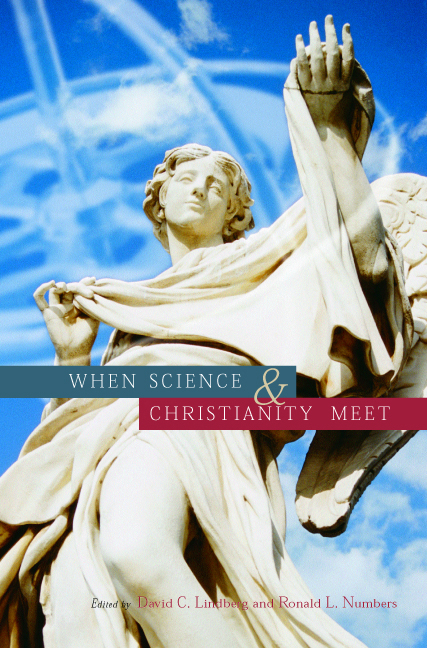 This message is reinforced in two books I have read this past week. The first is an earlier volume by David C. Lindberg and Ronald L. Numbers (eds.), God and Nature: Historical Essays on the Encounter between Christianity and Science (1986) and, more recently, and which has been quipped as the “Son of God and Nature,” their When Science and Christianity Meet (2003). Both books distance themselves from the warfare metaphor by providing case studies, ranging from “science and the early church” to “the Scopes Trial in history and legend,” that clearly demonstrate the complex—and often positive—interaction between science and religion. These studies are excellent history, correcting many past distortions, and can provide the basis for future scholarship.
Lindberg and Numbers begin their God and Nature with what has now become common parlance among historians of science. John William Draper’s History of Conflict between Religion and Science (1874) and Andrew Dickson White’s A History of the Warfare of Science with Theology in Christendom (1896) are accused of setting the “terms of the debate.” Draper had “abandoned the faith of his father for rational theism”; “Draper’s quarrel was almost exclusively with Roman Catholicism”; “Draper regarded the Protestant Reformation, with its insistence on the private interpretation of Scripture, as the ‘twin sister’ of modern science.” White, for his part, “began writing on science and religion as part of an effort to discredit religious critics envious of the funds given to his new university in Ithaca”; but he made a sharp distinction between religion and theology: “Religion…often fostered science; theology smothered it.”
While militaristic language continued unabated into the twentieth century, a number of scholars were beginning to downplay, or completely redefine, the conflict between science and Christianity. These included Alfred North Whitehead, Micheal B. Foster, Robert K. Merton, A. Hunter Dupree, Charles C. Gillispie, Paul H. Kocher, Giorgio de Santillana, Richard S. Westfall, John Dillenberger, Owen Chadwick, James R. Moore, Neal C. Gillespie, Frank M. Turner, Margaret C. Jacob, and numerous others. This recent work in the history science, according to Lindberg and Numbers, seeks “not only to describe the relationship between science and religion that prevailed at a given time but to ask, ‘Who put it forward, who used it, and what (and whose) interests did it serve?'” And the view most encountered throughout the chapters of God and Nature is that the relationship between science and religion “defies reduction to simple ‘conflict’ or ‘harmony.'”
* * *
The Cambridge Companion Series on Charles Darwin and The Origin of Species
Posted on February 21, 2014 Leave a Comment
 I have begun reading two related volumes on Charles Darwin (1809-1882) and his masterpiece, On the Origin of Species (1859). As part of the Darwin anniversary celebrations of 2009, the Cambridge Companion series issued two new volumes, Jonathan Hodge and Gregory Radick’s (eds.) The Cambridge Companion to Darwin (2009) and Michael Ruse and Robert J. Richards’ (eds.) The Cambridge Companion to the ‘Origin of Species’ (2009). As another reviewer has put it, these two volumes prove to be “caviar for professional scholars.”
The Cambridge Companion to Darwin aims to provide an “introduction to Darwin’s thinking and to the various and often contentious uses made of his legacies today.” It deals with historical and contextual issues relating to Darwin’s education and achievements, then outlines the ethical, metaphysical, and moral implications of his theory for present-day philosophy. One of Hodge and Radick’s primary objectives is to undercut popular interpretations of Darwin as a “naive, innocent, school-boyish, outdoor, nature-loving traveller and collector, whose theories emerged out of a conjunction of genius, luck and exceptional observational opportunity.” In historical reality, Darwin was indeed “a man of ideas, a thinker, even at times, yes, a philosopher…”
 The Cambridge Companion to the ‘Origins of Species’ likewise aims to subvert traditional images of Darwin’s masterpiece. Editors Ruse and Richards gather essays that reconstruct the main arguments of the book, as well as its religious, social, political, literary and philosophical, contexts. According to the editors, “the Origin is still today a work of vital significance and interest.” Indeed, this volumes reveals how the Origin was conceived, developed, and published in dynamic interaction with the broader cultural and social context.
* * *
What was Victorian Doubt?
Posted on February 20, 2014 Leave a Comment
 “There lives more faith in honest doubt,
Believe me, than in half the creeds.”
So writes Tennyson in his In Memoriam. According to Lance St John Butler, in his Victorian Doubt: Literary and Cultural Discourses (1990), Victorian doubt was not some “mere shadow of faith, a ghost prowling at the feast of the believers, but as the very condition of there being faith at all.” “Above all,” he continues, “doubt came to be seen, especially later in the century, as a corrective that religion offered to mere theology.” While Enlightenment skepticism seemed to put religion in jeopardy, doubt, after Romanticism, “became something positive as is apparent not only in an honest doubter such as Tennyson but also in many of the ‘deconversion narratives’ of Harriet Martineau and F.W. Newman, William Hale White, Samuel Butler and others,” including Lesile Stephen’s Agnostic Apology (1876) and A.J. Balfour’s Defense of Philosophic Doubt (1879). Numerous metaphors were used to express these “deconversions”:
“Mankind have outgrown old institutions and old doctrines, and have not yet acquired new ones” (Mill);
“The old has passed away, but, alas, the new appears not in its stead” (Carlyle);
“Wandering between two worlds, one dead The other powerless to be born” (Arnold).
There was much religious ambiguity during the Victorian period. It was “a puzzle to many Victorians how unbelief seemed to gain ground in spite of the greatly increased evangelistic effort.” The advances of science began to cause distress only later in the century, “after Buckle, Darwin and Colenso.” Evolution was not the problem. According to Butler, “religion quickly took on board the whole of evolution, at least in intellectual circles…[it had] no effect in halting the imminent decline in religious practice.”
“We need an account of the Victorians,” Butler argues, “that does not rely too heavily on our belief that we know the end of the story.” Butler’s purpose in the following chapters is to demonstrate that the “avowedly religious discourse of the Victorians is shot through with the lexicon, the syntax and the imagery of doubt while the avowedly unreligious or antireligious discourse of the period is shot through with metaphysical assumptions, and with vocabulary and imagery that betray the cultural pervasion of religion.” “The point at issue,” he goes on, “seems more to have been which religion (taking this word in its broadest sense) to pursue, or how to deal with the religious cultural baggage loaded onto the Victorian mind, rather than whether to both with religion at all.”
“Doubt is ubiquitous in the discourse of the Victorians.” An endemic doubt, a prevalence of metaphysical anxiety, is present in the vast majority of Victorian writers. But Victorian doubt should not be confused with unbelief or despair, “the prelude to atheism.” It is, as in the case of the honest doubter Tennyson, the faintly trusting of a “larger hope.” Many Victorian writers saw themselves as “living without God in the world.” This was not a personal choice; rather, it was a sense of “God’s absence from the world.” The writings of Antony Trollope (1815-1882), George Eliot (1819-1880), Thomas Hardy (1840-1928), Thomas Carlyle (1795-1881), Charlotte Brontë (1816-1855) and Emily Brontë (1818-1848) seem, at first glance, to be a radical secularization of the English novel. But according to Butler, they actually display a religious ambiguity, or, more generally, a deep desire for religion to work. Charles Dickens’ (1812-1870) Bleak House (1852-53), for example, treats the clergy as secular and strained: “Churches tend to be either decaying or out of place in some other way wrong.”
Even John Henry Newman (1801-1890), in his Essay on the Development of Christian Doctrine (1845), and then in his Apologia (1864), displays a move from relative optimism to a “black pessimism.” Man needs God. But he also needs a “guide to lead him to a knowledge of God and that that guide must be the Catholic Church.” As Butler surmises, “for Newman the fallen world is, per se, utterly bereft of the divine and man is encircled by gloom…Newman is working perilously closely alongside the classics of Victorian doubt.”
Many other Catholic poets shared Newman’s “metaphorical system of Victorian doubt.” G.M. Hopkins (1844-1889) “felt that God hid Himself from the world.” Francis Thompson’s (1859-1907) Hound of Heaven (1893) depicts the believer as wanting “escape not from the consequences of sin but from the consequences of unbelief. He tries to escape God in his own mind and by hiding under laughter (scoffing?) and by finding other ‘hopes’ and by plunging into despair, evidently a despair based on the fear that God does not exist.”
The loss of faith pervades Victorian poetry. The mourning, this nostalgia for lost love, is “a metaphor for another, deeper loss,” Butler tells us: “the loss of a more general certainty.” “Any anthology of Victorian poetry quickly reveals the obsession with loss, with death, with endings and with yearnings for greener grass elsewhere.”
Images of light in darkness are found in several places in the novels of Dickens. The darkness in, for example, Great Expectations (1860-61), Bleak House (1852-53) is a symbol that something has “gone terribly wrong with the world.” “[H]ell has risen and engulfed the earth.” As Butler astutely writes, “The fog, the mud, the nightmares, the darkness, the squalor, the disease, the poverty—these are not only social problems (they they are that), they are also emblems of spiritual wreck and images of a devilish possession of man’s abode.” This is the “infernalisation of the earth,” the “dark Satanic mills” of William Blake’s (1757-1827) Milton (c. 1804-10). Was this “hell-on-earth” the result of industrialization? Or was it punishment? Or the spiritual condition of Victorian humanity? Whatever it was, the central question on the minds of Victorian writers: Where is God? The answer: “God is absetn from the world as currently organised, he has disappeared; we are, are Hardy will put it, ‘God-forgotten’; the light is available only beyond the tomb or behind a veil.”
According to Butler, such imagery and language is first hinted at in Romanticism; but “in Carlyle and Dickens hell takes on its full industrial panoply of horrors and dominates the world.” Both authors had been inspired by Henry Mayhew’s (1812-1887) Labour and the London Poor, published as a series of articles in the Morning Chronicle in the 1840s. After reading these articles, one reader commented: “We live in a mockery of Christianity that, with the thought of its hypocrisy, makes me sick.”
Carlyle’s Latter-Day Pamphlets of 1850 added a “spiritual dimension to Mayhew’s sociological and economic picture.” The degradation of slums is a symbol for the moral degradation of England; the mud of the poison-swamp is London’s dirt and cosmic filth, “a symbol for the dire state of English society. Dragon and devils emerge from the mud; hypocrisy has come to dominate the nineteenth century; the gates of hell are prevailing. According to Butler, although the images of hell-on-earth are undoubtedly social commentary on the “poverty and injustice of the social system and its concrete effects,” Carlyle emphasizes the “inner man”: “Something must be wrong in the inner man of the world, since its outer man is so terribly out of square!”
Dickens had borrowed many aspects of the Carlylean mythology. In Dickens, too, hell is rampant among us and dominant on the earth, while “heaven has become a distant and highly speculative possibility.” Like other Victorians, Dickens is a radical doubter. Organized religion is “unable to combat either the physical or moral nightmares that surround it.” This world is damned. Images of decay, mud, fog, brutes, labyrinths, prisons, and hell-flames were, for Dickens and other Victorians, symbols “that could simultaneously asserts man’s abandonment by God (loss of faith, doubt) and remind him of his need to try to ward off the devil and become something like fully human (faith that there was somewhere a metaphysical guarantee, ‘behind the veil’, that the universe might still be ‘read’ as a morally significant structure even if the readings were almost universally negative).”
This “metaphysical guarantee,” this “surer basis for harmony,” was initially sought in the salvation of science. But the application of science only brought more questions and the relativising of European culture. Victorian geologists not only “demonstrated the uncomfortable longevity of the earth, they also prognosticated a catastrophic future for the planet, now in its ‘decrepitude.'” Astronomy had revealed a vast universe, but at the same time “you feel human insignificance too plainly.” One Victorian reader of the astronomy comments: “It makes me feel that it is not worthwhile to live; it quite annihilates me.”
Many negative images were, however, balanced with positive ones. What is important to note, and quite paradoxical, says Butler, is that “among the novelists at least, the more believing writers reach for the Satanic while the ‘unbelievers’ will reach for the figure of Jesus Christ.”
Victorian belief, writes Butler, was “shot through with elements of doubt or cosmic depression,” a “world cut off from God.” And in the work of Victorian writers, there is an “unmistakable fear that God has abandoned the earth and that it has been handed over to the forces of darkness.” But in writing about God’s abandonment, Victorians continued using the language of Christian tradition. In this sense, Christian vocabulary and symbolism were “hijacked” for other purposes. Indeed, Robert Owen (1771-1858), Carlyle, Arnold, and many other Victorian writers employed religious discourse in their writings.
Butler in chapter four, “the discourses of religion among Victorian doubters,” focuses on a few such writers. The influence of Auguste Comte (1798-1857) here is central. “Comte’s work was utterly (and deliberately) imbued with religious elements,” Butler tells us. Claimed to be the first female sociologist, Harriet Martineau (1802-1876), translated Comte’s The Positive Philosophy in 1853. British secularist George Jacob Holyoake (1817-1906) “welcomed her English version of Comte as his ‘Bible’ and said that it gave him his ‘creed.'”
Reaction to Comte and his Positivism was not as severe as one might expect. Many recognized that it “showed that orthodoxy had failed the people and that the earnest efforts of Comtists were going in the right spiritual direction.” With the alleged decline of Christianity, many sized upon a metaphysical replacement. This was readily admitted. When British liberal politician, William Ewart Gladstone (1809-1898), wrote to Holyoake in 1897, he said this much. He also “pointed out that the latter’s secularism (and secularism in general) could never have existed without a precedent Christianity and the ‘atheist’ Holyoake hinted at the possibility of immortality not only in this late correspondence with Gladstone (who was dying at the time) but also in his pamphlet of earlier and more fiery years, The Logic of Death of 1849.” Other so-called atheists or agnostics, including John Stuart Mill (1806-1873), in his posthumous essay on “Theism” (1874), “had not quite discounted personal survival.”
The employment of religious language among the religiously skeptical is so self-conscious that one must conclude that Victorian secularists were often Janus-faced. T.H. Huxley (1825-1895), for instance, in a letter to Kingsley in 1870, refers to his “sins,” the “sanctity of human nature,” the “sacredness” of human duty. Huxley also refers to Carlyle’s Sartor Resartus (1836) as leading him “to know that a deep sense of religion was compatible with the entire absence of theology.” “Above all,” writes Butler, “the faith in science and in the new post-Darwinian ‘truth’ was strongly asserted, with a fervour not unlike that of the evangelicals.”
Returning to Comte, Butler reminds us that many contemporaries saw his “Religion of Humanity” as Catholicism minus Christianity. Unitarian minister John Trevor (1855-1930) formed the Labour Church in the 1890s, for instance, and modeled it after Comte’s principles. Although a short-lived failure—apparently disappearing shortly after World War I—its first principle declared “That the Labour Movement is a Religious Movement.”
Interestingly enough, when the Labour Church disappeared, so did Comte’s “Churches of Humanity.” According to Butler, with the “departure of Victorian religion went the departure of Victorian unbelief too. The two were intimately bound together by their possession of a common discourse.”
Butler argues his case by focusing on two main examples, Victorian doubters Leslie Stephen (1832-1904) and Mary Anne Evans (1819-1880), otherwise known by her pen name as George Eliot. Stephen’s Agnostic’s Apology (1874) seems to model itself after Puritan autobiographies and conversion narratives. His doubt is a doubt expressed religiously. In her various writers, from the 1840s to the 1850s, Eliot imagined herself as either rationalist, theist, pantheist, or positivist. Her husband, English philosopher and critic of literature and theater George Henry Lewes (1817-1878) was, however, “Comte’s most ardent British disciple.” They first meet in the early 1850s, and by 1863, Eliot describes herself as “swimming in Comte.” According to Butler, Eliot had “turned not so much from religion to infidelity as from the religion of her father to the religion of her husband.” Butler follows Eliot’s religious development throughout a number of works, including the novella “The Lifted Veil” (1859), a poem “The Choir Invisible” (1867), supplied to Positivists for use as a hymn in their new liturgy, and her more well-known novels Middlemarch (1874) and Daniel Deronda (1876). According to Butler, Eliot’s writings is “dominated by religious discourse to the point that it cannot be read separately from the vocabularly, the symbolic systems, the codes and the narrative syntax of the Judaeo-Christian tradition.” This should come as no surprise, for the “Comtean religion is, after all, a lonely and elevated affair with little to cheer a soul still trying to wrap about itself the Hebrew old clothes.”
The period between 1869-74 is known for a number of important events, from the Franco-Prussian war, the rise of Prussian statesman Otto von Bismarck (1815-1898), the revolutionary and socialist Paris Commune (18 March-28 May, 1871), the unification of Italy, and the Pastor aeternus, or the proclamation of Papal infallibility (1870). Indeed, Butler sees the 1870s as a “fulcrum or watershed” moment for Victorian doubt.
Besides these important political events, there was a “surge of science publications in the 1870s.” Tyndall published his Lectures on Sound (1867) and his Lectures on Light (1873). Darwin not only published his Descent of Man (1871), but also his essays on “Variation of Animals and Plants under Domestication” (1868) and “Expression of Emotion in Man and Animals” (1872). Wallace published his Natural Selection (1870), The Geographical Distribution of Animals (1876), and his Tropical Nature (1878). Spencer published his Principles of Psychology (1870). Huxley published his Lay Sermons (1870) and spent the whole period from circa 1871-1880 as Secretary to the Royal Society.
The “scientific” study of religion was also gaining greater currency. Friedrich Max Müller (1823-1900), for instance, published in 1873 his Introduction to the Science of Religion and subsequently his 1878 Origin and Growth of Religion. Although Müller distrusted Darwin, Huxley, and Spencer, he was convinced that religion had “progressed” from the days of the Rig Veda. Higher Criticism was ever so popular in the 1870s. Besides Strauss and Renan, J.R. Seeley published his Ecce Homo in 1865, followed by George Macdonald’s Miracles of Our Lord (1870), Henry Ward Beecher’s Life of Jesus (1871), Eliza Lynn Linton’s “historical” novel The True History of Joshua Davidson (1872), F.W. Farrar’s Life of Christ (1874), and many others.
According to Butler, “religious novels were popular throughout the Victorian period…but whereas before 1870 these are mostly novels of inter-sectarian controversy, after 1870 the preponderant question is the question of doubt.”
Butler then goes on to show that the decade of 1870 is marked by “non-religious” novels. For example, he mentions the work of George Eliot, Anthony Trollope, Thomas Hardy, and Matthew Arnold. Butler also wants to point out that during this decade “religion had reached a high water mark.” It is indeed the decade of Dwight L. Moody (1837-1899) and his revivalism. It was also the decade of the Metaphysical Society (1869-1880), founded by James Knowles (1831-1908). Its membership included Tennyson, W.K. Clifford, Huxley, Stephen, but also many prominent clergymen. These men were to meet in London “nine times a year to discuss the problems of the coexistence of religion and science.” Knowles’ journal, The Nineteenth Century, published many of the writings of the members.
According to Butler, all this points to a growing “new consensus, a compromise.” This new “spirit of compromise” is apparent in Victorian literary works. John Morley’s On Compromise (1874) and Arnold’s St Paul and Protestantism (1870) and Literature and Dogma (1873) are case examples Butler provides the reader. Although religion is still dead for Morley, Butler’s point in including him is that more optimistic view is beginning to “creep into the sense of loss.” Morley calls “all forms of frivolity, all weak convictions, all vapidity and nihilism,” for example, “forces of darkness.” One should hold strongly to either belief, atheism, or agnosticism, and refuse to wallow in despair. What is more, each point of view “should learn to tolerate the other’s point of view.” Arnold’s God and the Bible (1875) sums up Morley position: “Two things about the Christian religion must surely be clear to anybody with eyes in his head. One is, that men cannot do without it; the other, that they cannot do with it as it is.” This, says Butler, the “compromise of disbelieving religiously.”
* * *
Darwin, Literature and Victorian Respectability
Posted on February 20, 2014 1 Comment
 When Richard Owen (1804-1892) denounced T.H. Huxley’s (1825-1895) paleontological methods at the Geological Society of London in 1856, he did so on peculiarly moralistic grounds. But this should come as no surprise, for Owen “drew upon a long, well-worn tradition connecting materialism and unbelief with moral corruption and debauchery, including the entwinement of pornography and materialist philosophies in the Enlightenment.” So writes Gowan Dawson in a striking study on Darwin, Literature and Victorian Respectability (2007). In this volume Dawson explores the curious relationship that Victorian reviewers and commentators drew between the ideas and advocates of scientific naturalism and the “Fleshly School of Poetry” of W. Morris(1834-1896), D.G. Rossettie (1828-1882), A.C. Swinburne (1837-1909), and their “coterie of licentious companions.” Darwin and other scientific writers were haunted by an anxiety that their ideas, theories, illustrative examples and subject matter in general, might be construed as violating the boundaries of Victorian sexual respectability. Indeed, Darwin, Huxley, Hooker, and others were at pains to protect evolutionary theory from attack by those who saw evolution as leading to dangerous political and social practices such as sexual immortality, birth control, and divorce. As Dawson points out, “those seeking to discredit the cultural authority of evolutionary science identified it with the alleged sensual indulgence of aestheticism, while those attempting to establish it as a respectable secular theodicy denied such as connection and instead emphasized links with more reputable literary writers.”
In his Introduction, Dawson notes that Darwin’s “particular conception of organic evolution…quickly became part of a wider political campaign” by the scientific naturalists to “wrest the last vestiges of intellectual and cultural authority away from the monopolistic Anglican Church establishment, as well as the gentlemanly amateurs who represented its interests in the scientific world.” Their goal was not the abolition of traditional religion, however; rather, the scientific naturalists sought to naturalize it, with “law and uniformity supplanting theology as the guarantors of order in both the natural world and human society.” To this end, scientific naturalism “had to be urgently sequestered from any hostile associations that might tarnish them in the eyes of the various audiences for science in Victorian Britain and consequently undermine the political aspirations of dissident secular intellectuals.” And more than any other vice, specific anxieties over sexual immortality emerged as the “most significant impediment to establishing a naturalistic worldview as a morally respectable alternative to earlier theological outlooks.”
Darwinian evolution was seen by many Victorians as unleashing a “torrent of immortality and corruption that would surpass the scandalous vices of even the pagan world.” Thus “in order to neutralize the charges of encouraging sexual immorality, the proponents of evolutionary theory, attempting to forge their own naturalistic social theodicy, had to shield Darwinism equally vigorously from any such invidious connections, in part by distinguishing a self-proclaimed ‘pure’ science—drawing on all senses of that overdetermined adjective—from the less reputable aspects of nineteenth-century general culture.”
Dawson also argues that while the scientific naturalists sought to publicly cultivate a reputation of unimpeachable respectability and character, in private correspondence, “sardonic and permissive attitude towards…profane topics…contravened conventional standards of middle-class respectability.” This was indeed a “masculine culture,” a “convivial fraternalist discourse” and “tolerant cosmopolitanism.” Of course, such “bawdy” anecdotes shared between scientific naturalists were not “generally divulged to wives or other female family members.”
The periodical of choice of scientific naturalists was John Morley’s (1838-1923) Fortnightly Review. Here Huxley, John Tyndall (1820-1893), and W.K. Clifford (1845-1879) and other leading exponents of evolution and scientific naturalism found a ready audience. And as Dawson points out, the magazine “encompassed both evolutionary science and aesthetic literature, and this shared mode of publication evidently emphasized the areas of potential similarity between them.”
Robert W. Buchanan (1841-1901) was one of the earliest to aver against the “fleshy” and materialistic poetry of Swinburne, Rossetti, Morris and others. Buchanan would also connect aesthetic poetry with the alleged materialism of contemporary science. In the 1876 issue of New Quarterly Magazine, for example, Buchanan contested the principles that Tyndall had advanced less than two years earlier in his Presidential Address to the BAAS at Belfast. For Buchanan, Tyndall’s materialistic science was “merely another version of the fleshy creed promulgated in the verse of Rossetti, Swinburne and their coterie of licentious companions.”
The scientific naturalists responded to such raucous accusations in two ways. First, they simply reiterated the “scrupulous standards of personal morality exhibited by scientific practitioners, as well as the strict discipline and moral propriety instilled—and indeed required—by empirical methods of experimentation and observation.” Another response, particularly and effectively employed by Tyndall, emphasized “the already existing connection between the leading advocates of scientific naturalism and older and more reputable literary writers, most notably the Poet Laureate Alfred Tennyson and the conservative Sage of Chelsea Thomas Carlyle.” But as Dawson suggests, Huxley, Tyndall, and other scientific naturalists might have deliberately misinterpreted the work of these literary figures for their own particular purposes.
In the remaining chapters of Dawson’s remarkable book, he examines and analyzes “sexualized responses to evolution,” “nineteenth-century revival of paganism,” “Victorian freethought and the Obscene Publications Act,” “the refashioning of William Kingdon Clifford’s posthumous reputation,” and “the pathologization of aestheticism” by Huxley and Henry Maudsley (1835-1913). Judiciously integrating “contextualist approaches to the history of science with recent work in nineteenth-century literary and cultural history,” Dawson exemplifies what research in both archival and manuscript sources should look like. He draws from a broad ranges of sources, including journalism, scientific books and lectures, sermons, radical pamphlets, aesthetic and comic verse, novels, law reports, illustrations and satirical cartoons, and private letters. Dawson provides a fascinating account of the reception of scientific ideas and further evidence that science is never neutral.
* * *
History, Humanity, and Evolution
Posted on February 19, 2014 1 Comment
 In a festschrift honoring John C. Greene, most well-known for his seminal volumes, The Death of Adam: Evolution and its Impact on Western Thought (1959) and Science, Ideology and World View: Essays in the History of evolutionary Ideas (1981), James R. Moore (ed.) has collected thirteen essays in History, Humanity and Evolution: Essays for John C. Greene (1989) that share Greene’s interest in the intellectual, cultural, and social history of evolution; and, in particular, the recurring interdependence of science and religion in the history of science. Beginning with a wonderful introductory interview with Moore, Greene describes his general approach to relating these two most powerful forces in history:
“Religion apart from science tends to become obscurantist, dogmatic and bigoted; science apart from some general view of human nature in its total context becomes meaningless and destructive. Unless science is practiced on the basis of a conception of human nature that does justice to our highest aspirations, the prospect for the future is bleak indeed.”
Although the essays range in quality, they collectively represent the growing trend of social constructivism among historians of science in the last decade of the twentieth century. Roy Porter begins with an intellectual portrait of Erasmus Darwin (1731-1802) and his concern “to rescue ‘man’ from the aspersions of being just a machine.” Erasmus’ biomedical background was “informed by the evidence of change, both in degree and in kind, running ubiquitously through Nature.” But as an interpreter of nature, Erasmus’ attention was drawn to “features indicative of unity, integration and interdependence.” He would eventually develop a “hylozoic vision of natural continuity,” where living bodies were “capable of entering into dialectical interplay with their external environment.” In explaining this adaptive behavior, Erasmus had in mind “something close to the classic conception of the association of ideas as spelt out in empiricist epistemology from Locke through Hartley and Hume.” But Erasmus’ vision of human nature was not the l’homme machine of the Enlightenment. According to Porter, “his physician’s vision was dominated by the living organisms he saw fighting disease, changing over time, involved in subtle interplay with the personalities they housed…it is a vision of man for the machine age, but it is not a vision of man the machine.”
Ludmilla Jordanova examines Jean-Baptiste Lamarck’s (1744-1829) separation of God from nature, “creation from production.” Lamarck repudiated disorder in nature, but rather than adhering to a God who is in sovereign control over nature, he appealed to universal natural laws. Also interesting is Jordanova’s observation that “Lamarck’s ‘psychology’ was central to his philosophy of nature.” Lamarck shared many interests with the Parisian idéologues, a loosely affiliated group of self-styled social scientists such as Antoine-Louis-Claude Destutte de Tracy (1754-1836), Pierre-Jean-Georges Cabanis (1757-1808), Jean-Baptiste Say (1767-1832), among others. “Lamarck’s commitment to this position is clearly vital,” writes Jordanova, “as it spurred him to think through a naturalistic account of the nervous system, and to reject any mental faculties, such as will and imagination, not strictly compatible with such an account.” By redefining terms such as creation, production, life and nature, “Lamarck tried to generate a language purged of unwelcome theological associations, to set himself apart from natural philosophical traditions that could not sustain a science of life rooted in change over time, that is, production.”
Adrian Desmond argues that “the doctrines of scientific naturalism, in comparative anatomy at least, originated in republican Paris, and were actively imported into London and incorporated into Benthemite and radical dissenting strategies at the time of the Reform and Municipal Corporations Acts” of 1835, long before the “scientific naturalism” of the Huxleys and Tyndalls of the 1860s. When these radical dissenters stripped nature of its supernatural content, it “served a powerful religious and political purpose.” That is, “it vitiated the clergy’s claim to moral authority based on their mediating role in natural theology, and was in line with the dissenters’ belief in the priesthood of all believers and the right to private interpretation of the Bible.” The “new naturalism,” as Desmond phrases it, “appealed most strongly to younger reformers, many socially handicapped nonconformists and secularists, who were attempting to break the traditional power of the old corporation and Oxbridge oligarchs.”
Simon Schaffer focuses the “nebular hypothesis” of Pierre-Simon Laplace (1749-1827) and how it gained greater currency in the 1830s through the work of John Pringle Nichol (1804-1859), becoming an “important site at which the Victorians worked out their differing views of the progress of their world.” The nebular hypothesis pretends to give an astronomical account of the origins of the solar system through natural laws. Both Robert Chambers and Herbert Spencer “gave the nebular cosmogony pride of place in their respective accounts of development in the world.” Indeed, Spencer said it exemplified “the law of all progress.”But as Schaffer argues, the nebular hypothesis was not imported from astronomy. It came to Britain through the writings of Auguste Comte (1798-1857) and William Herschel (1738-1822), as reported by David Brewster (1781-1868) and J.S. Mill (1806-1873). It was William Whewell (1794-1866), however, who first coined the term “nebular hypothesis” in his 1833 Bridgewater Treatise. Indeed, “Whewell baptized the nebular hypothesis by claiming that it still demanded ‘an intelligent Author, an origin proceeding from free volition not from material necessity.'” But Nichol and his allies, according to Schaffer, “made their nebular hypothesis an object of a moral and a natural science. Stellar progress was pressed into the service of political reform.” Astronomical data was malleable; its “message was always interpreted to fit the local interests of protagonists in the contests about progress in the Universe and in Society.” In this sense, astronomy was the “science of progress.” According to Charles Lyell (1797-1875), astronomy “gave the most violent shock to the prejudices and long-received opinions of men.” This “science of progress appeared in government offices, lecture theatres, journals and popular texts of the reform movement in politics and education that developed during the 1820s and 1830s.” These reformers stressed the inevitability and certainty of natural laws, and therefore progress. Nichol’s impact on Darwin, Chambers, Mill, and others is well attested. According to Schaffer, Nichol’s “version of the nebular hypothesis was not an isolated statement of an astronomical truth. It appeared alongside reflections on the origin of life, the progress of humanity and the future of society. His cosmogony was part of a sectarian view of history and it had stiff competition.”
James A. Secord provides an early essay on Robert Chambers (1802-1871) and his Vestiges of the Natural History of Creation (1844), which would be developed in full in his Victorian Sensation (2000). Secord wants to present a “new view of the Vestiges and how it came to be written.” Chambers publicly delineated his ideas on the development of the cosmos and life on earth in the Chambers’s Edinburgh Journal, a weekly periodical founded by William and Robert Chambers in 1832. “The tone of the Journal,” writes Secord, “is unmistakeable: self-improvement, the progress of society, and rational, non-sectarian entertainment.” The Vestiges can be seen as a consequence of the “progressive development” of the author himself. Initially, Chambers was a staunch Tory, but eventually shifting to liberal Whig in the 1830s. Religiously, Chambers was a moderate deist who disliked “evangelical enthusiasm and doctrinal controversy.” According Secord, the “explicitly religious aspects of the Vestiges were tacked on to placate those evangelicals he contemptuously referred to as ‘the saints.'” Further, his interest in natural science emerged from “a phrenologically inspired educational programme in publishing,” accepting the “essential tenets of phrenology and their significance for his growing interest in natural law.” It was Scottish phrenologist George Combe (1788-1858) and his Constitution of Man (1828) that came to influence Chambers the most in this regard. He was also influenced by Nichol’s Views of the Architecture of the Heavens (1837), which described the evolution of the universe and the formation of galaxies and stars. Nichol’s version of the nebular hypothesis compelled Chambers to apply the “law of progress to the whole realm of nature.” Much of these developing ideas, according to Secord, are present in Chambers’ Journal.
But how, exactly, did Chambers come to replace divine intervention with law-like regularities? “In the late 1830s,” Secord observes, “naturalistic physiological and anatomical doctrines were common currency among nonconformist medical men.” During this time, Chambers came under the influence of Perceval Lord’s Popular Physiology (1834) and John Fletcher’s Rudiments of Physiology (1835-7), and it appears that the “transmutation theory of Vestiges was initially constructed around the traditional concept of recapitulation available in the works of Lord and Fletcher.” At the time, of course, transmutation was a radical doctrine. But when Chambers composed Vestiges in the early 1840s, he utilized analogies of domesticity and human growth to disarm criticism. “Images of pregnancy, birth, childhood and the family were deeply embedded in the structure and language of the book.” Chambers used “generative images to bring the frightening notion of transmutation within the realm of the familiar.” The Vestiges was successful because Chambers employed such generative models of domestic virtues, which minimized or completely neutralized the fears of his audience.
In his own extraordinary and moving study, Moore traces Darwin’s gradual loss of faith to moral reasons rather than intellectual ones. He claims that the “prevailing view of Darwin’s loss of faith to be wrong.” This view holds that Darwin’s misgivings and eventual eschewal of the Christian faith are for the most part intellectual. Evidential considerations surely played some role, but the fact that this process was for so long protracted suggests that Darwin “was frankly reluctant to give up on Christianity.” In a 1879 letter to John Fordyce, author of Aspects of Scepticism: With Special Reference to the Present Time (1883), for example, Darwin writes
It seems to me absurd to doubt that a man may be an ardent Theist & an evolutionist.— You are right about Kingsley. Asa Gray, the eminent botanist, is another case in point— What my own views may be is a question of no consequence to any one except myself.— But as you ask, I may state that my judgment often fluctuates. Moreover whether a man deserves to be called a theist depends on the definition of the term: which is much too large a subject for a note. In my most extreme fluctuations I have never been an atheist in the sense of denying the existence of a God.— I think that generally (& more and more so as I grow older) but not always, that an agnostic would be the most correct description of my state of mind.
According to Moore, the most well-known account of Darwin’s loss of Christian faith comes from his Autobiography, written between 1876 and 1881. And it is here where we find a “different interpretation of Darwin’s loss of faith.” The Autobiography was written for no one but his family. There Darwin reveals that he had “gradually” come to distrust the Old Testament on empirical and moral grounds. Likewise, he “gradually came to disbelieve in Christianity as a divine revelation.” Here the reasons given “pertain chiefly to defects in historical evidence.” But Darwin also found the “damnable doctrine” of everlasting punishment to be morally repugnant as well. At any rate, he hastens to add, “I was very unwilling to give up my belief…disbelief crept over me at a very slow rate.”
Moore focuses on a section in the Autobiography entitled “Religious Belief,” which includes discussions on Christianity, natural religion, the existence of God and personal immortality, and the moral life of an agnostic. Theses sections were likely written sometime between 1876 and 1879. In 1879 Darwin also gave his full attention to “a biographical sketch of his grandfather, Erasmus Darwin.” As Moore writes, “the ‘constant inculcation’ of disbelief in the Darwin family, from his grandfather down to grandson, had produced neither moral obliquity nor guilt.”
Moore also makes the interesting observation that the life of Darwin’s wife, Emma, was marked full of death (her sister, Fanny, died in 1832; her infant and both parents died in the 1840s; two additional children and two aunts died in the 1850s; another sister, aunt, and nephew died in the 1860s; and yet another sister, brother, and a remaining aunt died in the 1880s), whereas Darwin “lost no one near and dear to him until his father’s death in 1848.” When his father died, Darwin entered a deep depression: “All the autumn & winter I have been much dispirited and inclined to do nothing but what I was forced to.”
It was also during this time that Darwin began reading some works on apologetics. According to his reading notebook, for example, Darwin read Andrews Norton’s The Evidences of the Genuineness of the Gospels (1837), Julius Hare’s Essays and Tales by John Sterling (1848), three books by Francis Newman, the younger brother of John Henry, including The Soul, Her Sorrows and Her Aspirations: An Essay towards the Natural History of the Soul, as the True Basis of Theology (1849), A History of the Hebrew Monarchy from the Adminstration of Samuel to the Babylonish Captivity (1847), and Phases of Faith; or, Passages from the History of My Creed (1850). Darwin recorded his highest accolade, “excellent,” for this last publication. The Phases of Faith “was a model of spiritual autobiography conceived as the outgrowth of one ‘phase’ of faith from another, forming a natural progression in which the abandonment of Christianity appears at the end of a plausible, grandualistic narrative.” Darwin followed a similar technique in his own Autobiography.
Moore then tells the emotional story of the death of Annie in 1851, “Darwin’s favourite child.” At only ten years old, Annie’s death shook him to his core. According to Darwin, “Annie did not deserve to die; she did not even deserve to be punished—in this world, let alone the next.” But “nature’s check fell upon her, crushing her remorsefully.” As Moore aptly puts it, “If contemplation of Dr. Darwin eternal destiny had spiked Christianity—Emma’s Christianity, the only living faith he really knew—Annie’s death clinched the matter a fortiori.” In conclusion, “the circumstances under which Darwin came at last to reject Christianity were full of pain…and his decisive objection was [ultimately] moral.”
Martin Rudwick discusses “nineteenth-century visual representations of the deep past.” He begins with some brief remarks on dioramas of natural history, found in our modern museums. The dinosaurs of the Cretaceous period; the ichthyosaurs of the Jurassic seas; the swamps of the Carboniferous; the trilobites and the nautiloids among the coral reefs. “Evolution,” he writes, has “replaced ‘elohim.” Our dioramas of natural history are “reconstructed scenes.” They are anschaulichkeit, that is, “clear,” “graphic,” “vivid” representations of “the prehuman and barely-human past,” reconstructed as “ideal views,” familiar, conceivable, and, most importantly, imaginable. They help make evolutionary interpretation plausible and persuasive, better than any scientific theory can.
Modern dioramas have a history, most conspicuously in illustrations in nineteenth-century books. These artists “visualized the long aeons of ‘deep time’ that lie beyond human history or even the origins of our humanity.” Rudwick works backgrounds, starting with Guillaume Louis Figuier (1819-94) and Edouard Riou’s (1833-1900) “profusely illustrated works, particularly their The World before the Deluge (1863). Figuier had borrowed many of the images from the work of a predecessor, Alcide d’Orbigny (1802-57), professor of palaeontology at the National History Museum in Paris. But according to Rudwick, “Figuier’s human beings, although primitive in time, and simple in tools, clothing and shelter, were no primitives in any other sense: they were unmistakably white and European, and wholly modern in physical appearance.”
Before Figuier there was Austrian palaeobotanist Franz Unger (1800-70) and his illustrator Josef Kuwasseg (1799-1859) in The Primitive World in Its Different Periods of Formation (1847). Their images of the Ice Age in Europe and the origins of humankind were obviously “imaginative achievements.” Other contributors to this genre include August Wilhelm von Klipstein (1801-94), Johann Jakob Kaup (1803-73), Oxford geologist William Buckland (1784-1856), and Henry De la Beche (1796-1855). What is important here is that among these early contributors, “the idea of constructing a whole sequence of scenes from the deep past” was readily available.
Why? Where did this fascination originate? According to Rudwick, when Buckland had asked De la Beche to draw scenes from the deep past, he asked for caricatures of scientific research. De la Beche’s Duria Antiquior (c. 1830) is a prime example. In this “half-humorous” lithograph of ichthyosaurs, pleisiosaurs, and other creatures found as fossils in the Liassic strata of Dorset, “almost every animal was shown eating, of being eaten by, another.” Such caricatures were initially privately and widely circulated among gentlemen geologists of London. Another example is William Conybeare’s (1787-1857) “The Hyaena’s Den at Kirkdale,” which celebrated Buckland’s analysis of the bone relics in a cave in Kirkdale in Yorkshire. In this lithograph Buckland emerges from the cave passage, candle in hand, with a “surprise” expression on his face. “The geologist became in caricature a participant in the scene he had soberly reconstructed in words.” The visual form had obviously been exaggerated for poetic effect.
Thus by the time we reach Darwin, says Rudwick, a “principle had been established.” By making “deep time” anschaulichkeit, “clear,” “graphic,” “vivid,” and, in the end, “entertaining” by visual representation, evolutionary theory seemed more plausible.
I have reserved an special post for Bernard Lightman’s essay on “Ideology, Evolution and Late-Victorian Agnostic Popularizers,” and therefore will pass over it here.
Paul Weindling discusses Ernst Haeckel (1834-1919) and the “secularization of nature,” connecting Haeckel’s acceptance of Darwinism to his views on German politics and social development.
According to Weindling, “Darwinism in Germany was a movement promoting liberal, rational and secular values in perceptions of nature and society.” These German Darwinists were less materialistic and more idealistic and pantheistic. It was, as Weindling puts it, a “secular religion.” In this sense, German Darwinism, or “Darwinismus,” was not “categorically hostile to religion.” By focusing on the career of Haeckel, Weindling wants to track how “Darwinisums moved from its early alliance with political liberalism to perform [a] corporatist and integrative social function.” The life of Haeckel thus “provides valuable insight into German culture and public opinion at the end of the nineteenth century.”
“It is a commonplace that Darwin’s theory of natural selection replaced a harmonious view of nature with one based on chance and struggle,” writes Weindling. But in Germany, Darwin’s theory was, he claims, viewed differently. In Darwinismus, “the theory did not entail a pessimistic philosophy of purposeless conflict.” In Haeckel’s thought, for instance, the view “emerged in which even the most minute beings reveal beauty, harmonious order and the germs of intellectual and social life.” Haeckel is often remembered for “having inspired a love of nature in a generation of biologists,” and indeed he “possessed a deep sensitivity for natural beauties.” As such during his career he “surrounded himself with patriotic and nature-loving cohorts.”
During Haeckel’s lifetime, Germany transformed from a “predominately agrarian and politically fragmented society to an industrial and imperial power.” Such technological and political advancements whetted an appetite “for more optimistic and relevant explanation of the world than that of traditional theology, which was promulgated by churches tied closely to archaic and repressive social forms.”
Though a leader with a following, Haeckel had a need for paternal guidance, thus gathering a series of father-figures. The first was physiologist and comparative anatomist Johannes Müller (1801-1858). Interestingly enough, Müller had nothing but contempt for materialism and its supporters, such as Carl Vogt (1817-1895) and Ludwig Büchner (1824-1899). Initially, Haeckel shared this contempt. Once Müller died Haeckel found another mentor and father-figure, Max Schultze (1825-1874). The influence of Schultze lead Haeckel to Darwin’s Origin of Species.
A major transformation occurred after the death of his wife in 1864. According to Weindling, “it was a traumatic shock, and Haeckel began to feel his character hardening.” Soon after Haeckel began work on Generelle Morphologie (1866), which presented a revolutionary synthesis of Darwin’s ideas with the German tradition of Naturphilosophie. After its publication Haeckel traveled to Darwin’s residence at Down House. After this visit Darwin became Haeckel new mentor and father-figure. Although Darwin warned him that “you have in part taken what I said much stronger than what I intended,” Haeckel thereafter regarded himself a committed Darwinist.
But for Haeckel Darwinism “functioned as an ideology of human progress” rather than a theory of organic evolution. His enthusiasm and obvious emotional character made him “vulnerable to scientific criticisms, and when these came,” Weindling tells us, “old friendships were broken, to be replaced with enmity and bitterness.” He broke ties with cellular pathologist Rudolf Virchow (1821-1902) over the politics of Prussian statesman Otto von Bismarck (1815-1898); Karl Gegenbaur (1826-1903), a colleague from the University of Jena, doubted Haeckel’s evolutionary synthesis, as did evolutionary biologist August Weismann (1834-1914). His own students began questioning and criticizing his “biogenetic law and monophyletic theory.” According to Weindling, Haeckel is clearly a “tragic [King] Lear-figure.”
Fortunate for Haeckel, some students remained attached to him, and his “chief compensation for his personal losses was increasing popular success.” During the late 1870s, Haeckel embarked on a campaign of determined propaganda, publicizing “Darwinismus as never before, first by issuing a popular edition of his lectures, then by advertising ‘Monism’ as a link between science and religion.” According to Weindling, the “rational and empirical features in evolutionary theory now gradually gave way to mystic idealism,” as particularly expressed in his Die Welträtsel (1895-1899), “the riddle of the universe.” These ideas were immensely popular, appealing not only to a general audience, but also to disciplines of psychology, sociology, and psychoanalysis. Haeckel’s ideas were also “avidly read across the political spectrum, among socialists and extreme nationalists alike, and they inspired new evolutionary ethics.”
Darwinismus gradually became the basis of Social Darwinism, promoting national unity and creating a “more sympathetic attitude to welfare reforms both within the state and among landowners, industrialists and the middle classes.” Weindling rejects the idea that Nazi racism stems from Haeckel. Although he used concepts of human hierarchy, of “lower” and “higher” races, and occasionally made anti-Semitic remarks, his ideas were too complex and ambiguous to be seen as the standard-bearer for national socialism. Haeckel was “deeply ambivalent.” As Weindling argues, “Haeckel used biology to shore up a form of corporatist social thought that differed fundamentally from the hereditarian social pathologies current under the Nazis.”
Evolutionary theory was undoubtedly threatening, for it seemed to make mankind the “byproduct of a meaningless natural process.” It was less threatening, however, if it was “portrayed as a process leading inexorably towards moral and intellectual improvement, with the human race at the forefront of the advance.” Thus in the nineteenth century ideas of progress came attached to theories of evolution. But by the following century, the notion of progress came under heavy scrutiny. At the same time, in the late nineteenth century, many became obsessed with the “threat of cultural degeneration.” In his essay, Peter J. Bowler argues that both “progressionists” and “degenerationists” exploited all available theories of evolution, including Darwinism, Lamarckism, and orthogenesis.
The idea of degeneration has its roots in the Christian tradition. Christianity portrays humanity as fallen, as “degenerated from an original state of moral perfection.” This was certainly not the only view within the Christian tradition, but the fall of mankind and its subsequent corruption and degeneration is clearly a predominant theme in western culture. But among mid-nineteenth-century evolutionists, human history was viewed quite differently. Banker, politician, and scientist John Lubbock (1834-1913), for instance, argued that “the progress of civilization” was a “continuation of the progress inherent in biological evolution” (my emphasis). Yet as Bowler points out, by the end of the century, some writers were beginning to doubt that the “triumphal development of Western culture could be maintained.”
What “facts” were causing these doubts? As early as 1857, French psychiatrist Bénédict Augustin Morel (1809-1873) had argued that certain environmental factors could lead to degeneration. In 1875, Italian criminologist and founder of the Italian School of Positivist Criminology Cesare Lombroso (1835-1909) posited that the criminal was a “degenerate throwback to an earlier stage of evolution.” And in 1895, German sociologist Max Simon Nordau (1849-1923) stressed that the artist and the criminal were “equivalent cases of arrested development.” These men, and Lombroso in particular, believed that the “environment caused the arrest of development that produced the subhuman criminal type.” Moreover, these men also “identified certain races as more inclined to degeneracy than others.” According to Bowler, “the growing strength of the eugenics movement in the early twentieth century indicates that many social thinkers had begun to doubt the inevitability of progress.”
Darwin had also stressed the role of environment in determining evolution. But Bowler claims that the notion of progress was not a “universal phenomenon in Darwin’s view.” That is debatable. Regardless of his actual views, Darwin “had never been the undisputed leader of the evolutionists, and his theory of natural selection was being challenged by a number of alternatives.” And these alternative theories were generally linked to theories of social degeneration. Lamarck’s theory of inheritance offered a ready explanation for degeneration: the cumulative effects of disuse. American “neo-Lamarckians” Edward Drinker Cope (1840-1897) and Alpheus Hyatt (1838-1902) claimed that progressive evolution consisted of “successive addition of stages to the growth process, produced by the inheritance of acquired characters as each generation became more specialized for the species’ chosen way of life.” According to Bowler, the analogy of “growth” allowed Lamarckian evolutionists to “treat evolution as a highly directed process, moving inexorably toward a predetermined goal.” Hyatt even advocated the notion of “racial senility,” in which the individual “degenerated toward simpler characters and ultimate extinction.” Hyatt also argued against female emancipation, claiming that “to give women equal political rights would diminish the psychological difference between the sexes and would thus encourage a degenerate trend in the species.” More broadly, some evolutionists, such as E. Ray Lankester (1847-1929), used analogies of human affairs to buttress their biological arguments. Whereas “Lubbock tended to assume that ‘primitive societies were relics of earlier stages in human progress…Lankester argued that ‘savages’ such as the bushmen and the Australian aborigines might be descendants of once-civilized peoples.” Lankester, in order words, viewed the contemporary “savage” as culturally degenerate. And according to Lankester, white man faces a similar fate. How does he prevent such a threatening state? By the cultivation of science.
In any event, both Darwinism and Lamarckianism were used to “stress the possibility of degeneration brought on by the adoption of a passive life-style.”An alternative theory was that of orthogenesis, “or evolution directed by internally programmed trends that would force variation inexorably in a certain direction, even when the results were non-adaptive.” What pieces of evidence convinced scientists of orthogenesis? For starters, the fossil record “seemed to reveal consistent trends in the development of certain structures,” such as the horn size on the “Irish elk.” But orthogenesis was also applied to human evolution, in the case of the trend towards increasing brain size. The human brain was seen as the “inevitable product of a longstanding evolutionary trend.” This was, of course, not Darwin’s view. Nevertheless, according to Bowler, orthogentic views became increasingly popular in the early twentieth century, advocated by such men as physical anthropologist Earnest A. Hooton (1887-1954), palaeoanthropologist Wilfrid Le Gros Clark (1895-1971), and palaeontologist Arthur Smith Woodward (1864-1944). Woodward even supported the view that “evolution was driven by forces somehow built into the germ plasm of the species.” Orthogenesis was essentially a degenerative theory, but most supporters turned it into “a progressive explanation of human origins.”
It is in this sense, as Bowler puts, “degeneration and progress went hand in hand,” or, as he puts it another way, “degeneration was indeed no more than an attempt to reassess the conceptual foundations of progressionism.” Thus the degeneration of the late-nineteenth century was only “skin deep.” Those scientists who studied the origins of the human race “automatically made progressionist assumptions.” Not until the mid-twentieth century was Darwin’s theory of natural selection fully embraced. No one wanted a totally undirected “evolution governed by ‘chance.'” According to Bowler, the “simplest ways of guaranteeing that evolution worked in an orderly, predictable manner, were to compare it with the growth of the embryo…or to postulate rigid variation trends.” In the end, “each theory was capable of being exploited by either side of the debate.”
As each essay in this festschrift honoring the scholarship of John C. Greene demonstrates, scientists are “constrained by professional as well as political interests, and if they make their decision first on professional grounds, they will always be able to find a way of adapting the theory of their choice to their wider beliefs.” As Bowler concludes, “any complex [scientific] theory can be turned into a panacea or a nightmare.”
The Scientific Revolution: A Very Short Introduction
Posted on February 17, 2014 Leave a Comment
 I have been reading Lawrence M. Principe’s The Scientific Revolution: A Very Short Introduction (2011) slowly and periodically for the last couple of months, mostly on Sunday mornings. Principe is the Drew Professors of the Humanities at Johns Hopkins University in the Department of History of Science and Technology and the Department of Chemistry. His essay in Isis, “Alchemy Restored” (2011), drew some heavy criticism recently from founder of Science 2.0 Hank Campbell, which also received a biting rebuttal from another blogger. Principe’s most recent work, The Secrets of Alchemy (2013) is a continuation of that earlier essay, bringing alchemy out of the shadows and restoring it to its important place in human history and culture.
This emphasis on alchemy or the more esoteric currents in western civilization is also found in Principe’s very readable The Scientific Revolution. At the outset of this wonderful little book, Principe states that the “‘scientific revolution’, now more frequently called the ‘early modern period’, was a time of both continuity and change.” In his first chapter, “New worlds and old worlds,” he convincingly argues that “early modern accomplishments drew upon intellectual and institutional foundations established in the Middle Ages.” He outlines this “rich tapestry of interwoven ideas and currents” with succinct and apt comments on “the Renaissance and its medieval origins,” the periodization of history by humanist historians Floretines Leonardo Bruni (1369-1444) and Flavio Biondo (1392-1463), the recovery of Greek and Roman learning in the fifteenth century, the invention and successful deployment of moveable-type printing by Johannes Gutenberg (c. 1398-1468), which “allowed for faster communication through broadsides, newsletters, pamphlets, periodicals, and a slew of other paper ephemera.” Principe continues with précis comments on the voyages of discovery and Christian reforms, all along the way emending and revising old, trite ideas of a “dark” and “stagnate” medieval period. By the 1500s, Europeans “inhabited a new and rapidly changing world.”
A cacophony of voices promoted a diversity of ideas, goods, possibilities. Throngs jostled elbows to test, purchase, reject, praise, criticize, or just touch the varied merchandise. Almost everything was up for grabs.
In chapter two, “The connected world,” Principe examines how early modern thinkers arranged and ordered the world. “There world,” he writes, “was woven together in a complex web of connections and interdependencies, its every corner filled with purpose and rich with meaning.” Working with certain categories of thought, early modern natural philosopher viewed everything in the world in a continuous hierarchy, a scala naturae or ladder of nature. “The scala envisions of a world in which every creature has a place, and each creature is linked to those immediately above and below it, such that there is a gradual and continuous rise from the lowest level to the highest, without gaps, along what has been called ‘the Great Chain of Being.'” This connectedness of the natural world gave the natural philosopher “wider vision,” one which included an imitate knowledge of theology and metaphysics.
Principe calls this the “cosmic perspective,” and it “undergirded a variety of practices and projects” in the sixteenth and seventeenth centuries. Most conspicuously in magia naturalis, or natural magic. “The goal of the practitioner of magia,” he informs the reader, “is to learn and to control the connections embedded in the world in order to manipulate them for practical ends.” To this end, magia naturalis promoted careful observation, reading of texts, networks of compilations, a interconnected world of sympathies and analogies—these early modern thinkers thus created complex webs of correspondences with objects of nature. According to Principe, “they were trying to understand the world; they were trying to make sense of things and to make uses of the powers of nature. They moved inductively from observed or reported instances to a general principle and then deductively to its consequences and applications.” Principe concludes chapter two with a brief word on “religious motivations for scientific investigation.” The early moderns saw “a cosmically interconnected world, where everything, human beings and God and all branches of knowledge, were inextricably linked parts of a whole.”
In chapter three, Principe discusses how the intellectual world of the sixteenth century divided the universe into the sublunar world and the superlunar world. The superlunar world, for example, was anything beyond the earth and moon. Here Principe discusses the historical background to early modern astronomical models, beginning from Plato (427-347 BC), Claudius Ptolemy (c. 90-168 AD), to Nicholas Copernicus (1473-1543), Tycho Brahe (1546-1601), Johannes Kepler (1571-1630), Galileo Galilei (1564-1642), and Isaac Newton (1643-1727). Principe peppers this discussion with short comments on the ubiquity of astrology and notions of divine harmonies among early modern natural philosophers. He also rightly argues that the “Galileo affair” resulted from a “tangle of intellectual, political, and personal issues so intricate that historians are still unraveling them. It was not simple matter of ‘science versus religion.'” He concludes by reminding readers that “Newton believed in the prisca sapientia, an idea popular among many Renaissance humanists of an ‘original wisdom’ divinely revealed aeons ago and corrupted over time.” Newton, moreover, believed “that gravitational attraction resulted from the direct and continuous action of God in the world.” He saw the “task of natural philosophy as the restoration of the knowledge of the complete system of the cosmos, including God as the creator and as the ever-present Agent.”
The sublunar world is the focus of chapter four, and Principe recounts how “early moderns re-examined the Earth, the elements, and the processes of change and motion, and formulated a range of systems for making sense of things.” Here he provides brief but apropos comments on William Gilbert (1544-1603), Nicholas Steno (1638-86), and Athanasius Kircher (1601-80). His pithy remark that the scientific revolution was the golden age of alchemy is well-attested in the historical record.
In chapter five Principe addresses “The microcosm and the living world,” that is, the early modern cataloging of living creatures as a result of “voyages of exploration but also to the invention of the microscope, which revealed unimagined worlds of complexity in ordinary objects and new worlds of life.” Here too Principe reveals the importance of astrology and alchemy in early modern medicine and anatomy. In studying the flora and fauna of plants and animals, early modern “natural historians” blended “naturalistic and descriptive details about various species with a mass of literary, etymological, biblical, moral, mythological, and metaphorical meanings that had accumulated around each animal or plant since antiquity.”
In his concluding chapter on “Building a world of science,” Principe concentrates on how the new scientific knowledge was used to control and change the world, giving “human beings greater power over it.” The sixteenth and seventeenth centuries “witnessed a special turn towards applying scientific study and knowledge to address contemporaneous problems and needs.” The “world of artifice constructed by technology” began in Renaissance Italy, transforming landscape and cityscape, but also altering, with the introduction of gunpowder and bronze cannons, warfare forever. The quest for property and the desire to “order the world” led to developments in cartography and navigation. In this sense, science, technology, and statecraft were inextricably linked.
According to Principe, the “linkage of scientific discovery to practical application” is most associated with Sir Francis Bacon (1561-1626). But what historians of a previous generation most negated is now made clear: “Bacon saw the goal of such operative knowledge as to regain the power of human dominion over nature bestowed by God in Genesis, but lost with Adam’s Fall.” This was Bacon’s motivation: the restoration of both nature and religion. The Christian community of Bensalem in Bacon’s The New Atlantis (1626), for instance, was the home of Solomon’s House, “a state-sponsored institution for the study of nature devoted to ‘the knowledge of causes and the secret motions of things; and the enlarging of the bounds of Human Empire, to the effecting of all things possible.” Many after Bacon attempted at building scientific societies modeled after Solomon’s House. The Royal Society of London for the Improvement of Natural Knowledge (1662), writes Principe, “can be seen as an attempt to realize Solomon’s House.” Other scientific groups and societies grow beyond the confines of the academy. In the end, however, “amid our enviable store of natural knowledge, the wise, the peaceable, and the orderly Bensalem continues to elude us, even if it has never ceased to inspire.”
In an Epilogue, Principe almost laments the dramatic change in contemporary scientific research. “The constant awareness of history, of being part of a long and cumulative tradition of inquirers into nature, has been largely lost…The vision of a tightly interconnected cosmos has been fractured by the abandonment of questions of meaning and purpose, by narrowed perspectives and aims, and by a preference for a literalism ill-equipped to comprehend the analogy and metaphor fundamental to early modern thought…The result is a scientific domain disconnected from the broader vistas of human culture and existence. It impossible not to think ourselves the poorer for the loss of the comprehensive early modern vision, even while we are bound to acknowledge that modern scientific and technological development has enriched us with an astonishing level of material and intellectual wealth.” Enriched? Perhaps a better word here is “distracted.” Solomon’s House is indeed a distant dream.
 James C. Ungureanu