
Laura Otis’ Literature and Science in the Nineteenth Century: An Anthology (2009)
Posted on January 24, 2014 Leave a Comment
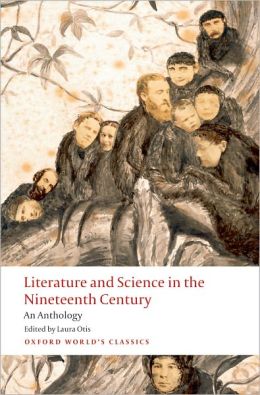 It is perhaps fitting that my 100th post on this blog should be Laura Otis’ Literature and Science in the Nineteenth Century: An Anthology (2009). My research began in September with historiographies of the Scientific Revolution, only to converge in recent months on nineteenth-century narratologies of “conflict” between religion and science, which, I believe, depended crucially on literature and the stories nineteenth-century figures told about what counted as “religion” or what counted as “science.” To this end, Otis’ collection of excerpts from novels, plays, poetry, essays, scientific articles, lectures, treatises, and textbooks written throughout the course of the nineteenth century offers a solid starting place.
At the 1833 meeting of the BAAS, William Whewell proposed the neologism “scientist” for investigators who until then had been known as natural philosophers. In the nineteenth century, “science” came to signify the study of the natural physical world. According to Otis, “the notion of a split between literature and science, of a gap to be bridged between the two, was never a nineteenth-century phenomenon.” Indeed, “the two commingled and were assessable to all readers.” Like Sleigh, Otis notes that “scientists quoted well-known poets both in their textbooks and in their articles for lay readers, and writers…explored the implications of scientific theories.” “As a growing system of knowledge expressed in familiar words, science was in effect a variety of literature.” In nineteenth-century periodicals, magazines, and newspapers, “articles on scientific issues were set side-by-side with fiction, poetry and literary criticism.”
At the same time, however, “as Western economies became more industrial and agricultural, educational reformers protested that the traditional curriculum of Greek and Latin literature…failed to prepare the new professional classes for modern life.” T.H. Huxley, for example, “claimed provocatively that for the purpose of attaining real culture, an exclusively scientific education is at least as effectual as an exclusively literary education.” This insistence on the cultural centrality of science disturbed English poet and literary critic Matthew Arnold (1822-1888), who protested that Huxley was defining literature much too narrowly. According to Arnold, “all knowledge that reaches us through books is literature.”
Otis intends this anthology “to illustrate both common and divergent patterns in the techniques of nineteenth-century authors.” Even a cursory reading of successful scientists in the nineteenth century shows that “most good scientists were also imaginative writers. The ability to express oneself articulately was essential for the communication and progress of science.”
Because scientific knowledge was spread most effectively through the printed word, “to win the confidence of educated readers, nineteenth-century scientists made frequent references to the fiction and poetry of the day and to that of earlier generations.” And by doing so, they declared an affinity with respected authors and, implicitly, with their readers. According to James Secord, for example, Charles Lyell’s Principles of Geology (1830-1833) “won a wide readership not just because he provided convincing evidence for gradual geological change but because he used literary references to Milton, Scott, and Wordsworth to present geology as a respectable, gentlemanly pursuit.”
At its most fundamental level, Otis argues, “scientific explanation of the world is akin to processes of reading and writing.” Whether studying skull structures, geological layers, or bird populations, scientists were deciphering sign systems and interpreting texts.
Images render vague ideas more clearly. Indeed, to complement his factual evidence for evolution in The Origin of Species, Charles Darwin offered readers a series of “imaginary illustrations,” scenes which encourage them to picture natural selection at work. “When Darwin presented his theory of natural selection, he knew that readers were used to such voyages [imaginary voyages and imaginary travelers were very popular in nineteenth-century periodicals], and he drew on their capabilities to re-create the evolutionary process. Like novelists who took readers into imaginary worlds, Darwin appealed to his readers to imagine the development of life as he described it.”
But “it would be inaccurate,” Otis warns us, “to depict nineteenth-century literature as a realm in which the imagination had comparatively free reign. As we have seen with Sleigh, novelists of the period greatly concerned themselves with the latest scientific “facts.”
Similarly, “nineteenth-century scientists found they could be more persuasive by using the storytelling techniques of fiction writers.” Darwin, who took a volume of Milton’s poems with him on his five year voyage on the HMS Beagle, described the struggle for life through references to Milton’s poetic images. “Milton’s poems allowed Darwin to imagine the creation as a long, continuous process, nurturing his developing concept of evolution.”
For most of the nineteenth century, scientists and literary writers shared a common vocabulary and common literary techniques. But as Otis argues, “it is also crucial to recognize that the same subjects occupied both scientific and literary writers.” The quest for origins developed simultaneously in studies of language, geology, zoology, and numerous other fields. Questions of individuality also preoccupied both scientist and writer. And more narrowly questions about what it meant to be human disturbed both nineteenth-century writers and scientists. “The rapid development of industrialization, physiology, evolutionary theory, and the mental and social sciences challenge the traditional view of people as uniquely privileged beings created in the divine image.”
Otis’ anthology ultimately “invites readers to explore the fertile exchange of images, metaphors, and narrative techniques among writers who today—though not in their own day—are regarded as members of very different disciplines.” It aims to “reveal dialogues and confluences.”
The selected bibliography following the introduction is indispensable, including sources on mathematics, physical science, and technology; sciences of the body; evolution; sciences of the mind; and the social sciences, which are all presented as major themes in the text. Also follows is a helpful chronology of events and publications from 1800 to 1900.
Literature and Science
The anthology begins with a prologue on Literature and Science, with excerpts from Edgar Allen Poe’s Sonnet—To Science (1829), who lamented over the dangers of science posed on poetry and creativity: “why preyest thou thus upon the poet’s heart, vulture, whose wings are dull realities?” There follows John Tyndall’s Belfast Address (1874), commanding scientists to “wrest from theology, the entire domain of cosmological theory,” yet maintaining that “some of the greatest [scientific] discoveries have been made under the stimulus of a non-scientific ideal.” Indeed, Tyndall called imagination “the mightiest instrument of the physical discoverer.” Thus “science desires not isolation, but freely combines with every effort towards the bettering of man’s estate.” Also included in this prologue are excerpts of the debate between Thomas Henry Huxley, from Science and Culture (1880), and Matthew Arnold, from Literature and Science (1882) mentioned earlier in introduction.
Mathematics, Physical Science, and Technology
Each collection of essays is guided by a particular theme, and here Otis offers helpful introductory comments. The guiding theme for the first set of writings, for example, is Mathematics, Physical Science, and Technology. In Mathematics, Otis argues that both mathematicians and literary writers used analogies, metaphors, and the malleability of language to convey meaning to new scientific discoveries. Here she includes excerpts from Ada Lovelace’s Sketch of the Analytical Engine (1843); Augustus de Morgan’s Formal Logic (1847); George Boole’s An Investigation of the Laws of Thought (1854); John Venn’s The Logic of Chance (1866); Lewis Carroll’s Through the Looking-Glass (1871) and The Game of Logic (1886); George Eliot’s Daniel Deronda (1876); and H.G. Wells’ The Time Machine (1895).
In the Physical Science, Otis claims that “both physicists and literary writers challenged the notion that humankind could anticipate a more civilized, prosperous future.” In introducing theories of gradual energy loss, some asked readers to “conceive of a being” who selectively opens portals between two compartments. Vision also became “a key metaphorical vehicle in nineteenth-century writing.” Imaginative journeys among the stars and within electrical and magnetic forces, invisible phenomena such as X-rays and literary allusions were all used to explain advances in the physical sciences. Otis includes excerpts from Sir William Herschel’s One the Power of Penetrating into Space by Telescopes (1800); Thomas Carlye’s Past and Present (1843); Sir John Herschel’s Outlines of Astronomy (1849); Michael Faraday’s Experimental Researches in Electricity (1839-55) (1852); William Thomson, Lord Kelvin’s On the Age of the Sun’s Heat (1862) and The Sorting Demon of Maxwell (1879); John Tyndall’s On Chemical Rays, and the Light of the Sky (1869) and On the Scientific Use of the Imagination (1870); James Clerk Maxwell’s Theory of Heat (1871), To the Chief Musician upon Nabla: A Tyndallic Ode (1874), Professor Tait, Loquitur and Answer to Tait (1877), and To Hermann Stoffkraft (1878); Thomas Hardy’s Two on a Tower (1882); Richard A. Proctor’s The Photographic Eyes of Science (1883); and Wilhelm Conrad Roentgen’s On a New Kind of Rays (1895).
In Technology (or Telecommunications?), Otis relates how Samuel F.B. Morse’s Letter to Hon. Levi Woodbury, Secretary of the US Treasury, 27 September 1837 presented his electromagnetic telegraph as “a national nervous system.” An anonymous reviewer from Westminster Review (1878) on The Telephone also utilized analogies of the human body. According to Otis, “for nineteenth-century inventors the resemblance between sensory organs and technical devices was more than an informative metaphor; it inspired the design of communications devices.” Also included in this section is Mark Twain’s satire, Mental Telegraphy (1891), “in which a narrator argues that thoughts can be transmitted from mind to mind.” Otis also includes excerpts from Rudyard Kipling’s The Deep-Sea Cables (1896) and Henry James’ In the Cage (1898), the latter arguing with prescience that “the telegraph fails to deliver the knowledge or relationships it promises, and the feeling of connectedness offered by technological communications proves illusory.”
In the final section, Bodies and Machines, Otis observes that “as mechanized industry developed, writers from all fields compared bodies to machines.” This, of course, is not unique to nineteenth-century thinkers. But unlike previous analogies, nineteenth-century Europe witnessed the rapid development of a great variety of technologies, encouraging “all those who used it to rethink their notions of mind, body, and identity.” Excerpts are drawn from Charles Babbage’s On the Economy of Machinery and Manufactures (1832); Charles Dickens’ Dombey and Son (1847-8); Hermann von Helmholtz’ On the Conservation of Force (1847); Samuel Butler’s Erewhon (1872); and Walt Whitman’s To a Locomotive in Winter (1876).
Sciences of the Body
The second theme of writings concerns the Sciences of the Body. “Both the scientific and literary writers represented here,” Otis tells us, “do their utmost to take readers into a scene so that the readers can experience it for themselves.” On Animal Electricity, Luigi Galvani’s De Viribus Electricitatis (1791) “offers vivid pictures of fluids circulating through tubes” in order to explain the nervous system, identifying “the principle of life” with electricity. Sir Humphry Davy’s Discourse, Introductory to a Course of Lectures on Chemistry (1802) also uses metaphors to describe the usefulness of chemistry. Mary Shelley’s Frankenstein (1818) uses the writings of Xavier Bichat and Galvani in her account of the irresponsible scientist Victor Frankenstein. Walt Whitman’s I Sing the Body Electric (1855) uses similar language of electromagnetism.
In Cells and Tissues and Their Relation to the Body, Otis brings together writings from Xavier Bichat’s General Anatomy (1801), who, in studying living tissues, ironically proposed “one must investigate death.” Rudolf Virchow’s Cellular Pathology (1858), using a microcosm-macrocosm analogy, compared the relationship between the cell and the body to that of the individual and society. George Eliot’s Middlemarch (1871-2) likewise viewed “bodies and societies has highly interconnected webs in which one could explain events only by comprehending the relations among individuals.” George Henry Lewes’ The Physical Basis of Mind (1877), although critical of “imaginary anatomy” used by some scientists, nevertheless argues, like Tyndall and Eliot before him, “that imagination played a central role in scientific thinking.”
On Hygiene, Germ Theory, and Infectious Diseases, Mary Shelley’s The Last Man (1826), using the metaphor of fire, “presents disease as something that both can and cannot be contained.” Sir Edwin Chadwick’s An Inquiry into the Sanitary Condition of the Labouring Population of Great Britain (1842) “demands that readers confront not just the sights but the nauseating smells of the slums…organizing his narrative so that the reader follows eye-witnesses into industrial cities’ forbidding alleys.” But having said this, Chadwick also rejects Shelley’s representation of diseases as an uncontrollable force in nature. Edgar Allan Poe’s The Mask of the Red Death (1842) also conveys a growing understanding of individual identity and responsibility in mitigating the spread of infectious diseases. Oliver Wendell Holmes’ The Contagiousness of Puerperal Fever (1843), Louis Pasteur’s On the Organized Bodies Which Exist in the Atmosphere (1861) and Sir Joseph Lister’s Illustrations of the Antiseptic System (1867) argue that bacterial infections can be greatly reduced, simply by “covering wounds, sterilizing instruments, and washing one’s hands.” The anonymous author of Dr Koch on the Cholera (1884) in The Lancet, likewise, argued that people are “responsible for their diseases not because they have incurred divine wrath but because they have failed to follow hygienic laws.” And H.G. Wells’ The Stolen Bacillus (1895) invites readers “to look through a microscope with his character so that they can see the cholera bacillus as a bacteriologist sees it.”
The last section in this collection of writings concentrates on Experimental Medicine and Vivisection, calling for greater responsibility and accountability on the part of scientists themselves. Excerpts from Claude Bernard’s An Introduction to the Study of Experimental Medicine (1865) and Sir James Paget’s Vivisection: Its Pains and Its Uses (1881) argue that “experiments must be responsibly designed.” Frances Power Cobbe’s Vivisection and Its Two-Faced Advocates (1882) quotes physiologists’ own metaphorical descriptions of a damaged brain “as a ‘lately-hoed potato field’…to alert readers to the ‘real’ nature of their experiments.” More polemically, Wilkie Collins’ Heart and Science (1883) and H.G. Wells’ The Island of Dr Moreau (1896) depict arrogant, sadistic scientists, “those who fail to think ahead and consider the value and consequences of their experiments.”
Evolution
The third theme of Otis’ anthology focuses on Evolution. “Forced to describe an inaccessible past, scientists and literary writers recreating natural history appealed to their readers’ imagination.” The challenge, of course, was to make “readers picture a thousand, ten thousand, or a million years of gradual change, periods that for most people were almost unimaginable.”
Under the section of The Present and the Past, selections from Jean-Baptiste de Lamarck’s Zoological Philosophy (1809) describes how “valuable new traits and habits could be directly transmitted to the next generation,” thus appealing to “people’s sense of self-worth.” Sir Charles Lyell’s Principles of Geology (1830-3) “compared himself to a historian, criticizing his opponents’ theories in terms that echo reviews of bad fiction.” Lyell was also anxious to appeal to conservative readers, and thus wrote his “story in the language of educated gentlemen, illustrating his ideas with quotations from Virgil, Horace, Shakespeare, and Milton.” William Whewell’s Philosophy of the Inductive Sciences (1840) relates the limitations of the English language when accounting for both space and time. According to Whewell, “the rhythm and metre of language suggested time’s passage far better than the spatial metaphors that language offered.” Alfred, Lord Tennyson’s The Princess (1847) challenges the notion that a fragmented past constitutes a coherent history: “Like the portraits of ancestors, fossils alone can tell no story. It takes imagination, not just memories, to create a meaningful narrative.” Charles Darwin’s The Origin of Species (1859) reminded readers of how breeders produced new animals, “summoning images from their memories.” What is more, despite numerous observations to support his theory, Darwin knew—ironically—he needed to tell readers a story for them to accept it as real. George Eliot’s The Mill on the Floss (1860) suggests, like geologists and naturalists, “novelists are retelling lost tales, recovering lives and events whose traces have been obliterated…[presenting] the relations between present and past in a manner quite similar to Lyell’s.” Thomas Henry Huxley’s On the Physical Basis of Life (1869) cites French novelist and playwright Honoré de Balzac (1799-1850), known for his interests in the relationship between animals (especially human beings) to their environment. According to Otis, “cultural debates about evolution encouraged observations of people’s similarity to animals.” Olive Schreiner’s The Story of an African Farm (1883), for example, “presents a scenario in which noble labour ends ‘in nothing’ because of an urge people and animals share.” Similarly, George John Romanes’ Mental Evolution of Man (1888) argues that “people and animals differ only in degree,” thus challenging the “uniqueness of the human soul.”
On Individual and Species, “in the intense debates that evolutionary theory provoked, the consequences for individual identity become immediately apparent.” August Weismann’s Essays on Heredity (1881-5), for example, argued against Lamarck, “individual organisms lived and died without influencing their ‘immortal’ germ plasm. Here we also have excerpts from Alfred, Lord Tennyson’s In Memoriam (1850), who used language to immortalize life that nature, “red in tooth and claw,” constantly threatens to obliterate. Herbert Spencer’s Principles of Biology (1864-7) argued that “selfhood made no sense on an evolutionary scale…the idea of a unique, representative individual loses its meaning” under evolutionary theory. Or as Otis puts it, “the human concept of individuality had no basis in nature. It was rooted in culture and was being imposed on nature by writers who failed to see humanity from a broader, evolutionary perspective.” Thomas Hardy’s Hap (1866) and A Pair of Blue Eyes (1873) “subversively suggests that it is more comforting to think of a world directed by a vengeful god than a world without direction or purpose.” Ernst Haeckel’s The Evolution of Man (1874) sees organisms as “texts in which one could read the past.” Samuel Butler’s Unconscious Memory (1880) “described the individual as a ‘link in a chain,’ a body that contained and often re-enacted the past.” Emily Pfeiffer’s Evolution (1880) and To Nature pictures nature as “dread Force,” churning the universe with mindless motion. May Kendall’s amusing, yet moving, Lay of the Trilobite (1885) “invites the reader to imagine life from the perspective of an extinct animal.” And Gerard Manley Hopkins’ Nature is a Heraclitean Fire (1888), like Tennyson’s In Memoriam, “resists science’s claim to replace religion as a provider of inspiration and enlightenment.”
In the final section on Sexual Selection, we see how both scientists and literary writers continued to reinforce cultural renderings of sex. Jane Austen’s Pride and Prejudice (1813) “suggested how much was at stake—socially and economically—in the search for a wealthy husband.” Charles Darwin’s The Descent of Man and Selection in Relation to Sex (1871) provided “anthropomorphic descriptions in which females choose their mates,” but when describing human beings, “Darwin’s account reinforced cultural readings of female desire as a dangerous force that threated the social order.” This is how Otis puts it: “When women did take the active role and select their mates, they were acting in a primitive fashion, revealing people’s animal origins.” Henry Rider Haggard’s She (1887), Constance Naden’s Natural Selection (1887), and Thomas Hardy’s Tess of the D’Urbervilles (1891) only further confirms these convictions, using Darwin’s theory of sexual selection to “formulate a problem they had long been describing.”
Sciences of the Mind
The forth theme within this magnificent anthology is Sciences of the Mind. According to Otis, the mental sciences emerged slowly, and amid much controversy. One reason for this is because studies of the mind retained much of their philosophical roots. “The main tenet of the nineteenth-century mental physiology, the conviction that the mind and body were interdependent so that any understanding of the mind must be based on neuroanatomical and neurophysiological knowledge, owes a great deal to John Locke’s belief that true knowledge must be gained through experience, and David Hume’s insistence that philosophy be inductive.” During the nineteenth century, the emergence of mental science came at the heels of several combined factors: “an increasing respect for knowledge gained through experimentation; a conviction that the methods of the physical sciences could be applied to other fields; and an idea that minds, like bodies, had evolved and could be scanned for traces of ancestral forms.”
There was, of course, resistance. But resistance came from those who thought the subject matter—namely, human perceptions, thoughts, and behavior—was “inherently subjective.” Mental scientists in turn sought efforts to persuade readers of the validity of their studies. “In their effort to create an authoritative voice,” Otis writes, “they quoted poets whose insights into the mind were culturally respected.”
In The Relationship between Mind and Body, for example, Thomas de Quincey’s Confessions of an English Opium-Eater (1822) describes his sensations after ingesting opium, thus using his “own personal testimony as ‘evidence’…of how changes to the body could alter one’s perceptions.” Marshall Hall’s On Reflex Function (1833) “demonstrated that the body could respond to stimuli through spinal reflexes alone.” James Cowles Prichard’s A Treatise on Insanity (1835) offers portraits of morally insane individuals through “histories, personal idiosyncrasies, and detailed narratives similar to those associated with fictional characters.” Nathaniel Hawthorne’s The Birthmark (1846) argues that “mind could affect the body,” and that “the body” was a mental construct, “subject to the projections…of the mind.” Herman Melville’s Bartleby the Scrivener (1856) “suggested the ways to describe the effects of food and alcohol on behavior, illustrating the complex interplay of constitution and environment.” Thomas Laycock’s Mind and Brain (1860) argues that both hemispheres of the brain are now seen as the seat of “teleorganic processes” and “noetic ideas” of the mind. Mary Elizabeth Braddon’s Lady Audley’s Secret (1862) “depicts a woman tainted by hereditary madness and is at time so suspenseful that it nearly maddens the reader.” S. Weir Mitchell “explored the mental and physical roots of personal identity by studying his patient’s phantom limb experiences,” illustrating such experiences in his fictional patient of The Case of George Dedlow (1866). Henry Maudsley’s Body and Mind (1870) observed how women’s reproductive system “powerfully influenced their mental state.” William B. Carpenter’s Principles of Mental Physiology (1874) contended that the interplay between mind and body was extremely complex, “so that no one could define no clear boundary between voluntary and involuntary phenomena.” And William James’ Principles of Psychology (1890), ever the moderate, attempts to steer a middle-way between the “associationists” and “spiritualists” account of our mental life, for both positions, in his estimation, are found wanting. James says, “The spiritualist and the associationist must both be ‘cerebralists,’ [his emphasis] to the extent at least of admitting that certain peculiarities in the way of working their own favorite principles are explicable only by the fact that the brain laws are a codeterminant of the result.”
“If the human mind was housed in a bodily organ, the brain, then, structural studies of that organ might yield valuable information about its function.” In this sense both Physiognomy and Phrenology became a “science of reading.” As skilled interpreters of bodily texts, George Combe’s Elements of Phrenology (1824) and Johann Gaspar Spurzheim’s Phrenology in Connection with the Study of Physiognomy (1826) argue that the relative size of the brain’s component parts act as indicators of potential character and behavior. Novels such as Charlotte Brontë’s Jane Eyre (1847) and George Eliot’s The Lifted Veil (1859) “integrated the language of phrenology into physical descriptions of their characters so as to play on readers’ assumptions.”
According to Otis, Mesmerism and Magnetism “gave the subject’s own testimony much greater importance.” Chauncey Hare Townsend’s Facts in Mesmerism (1840), besides quoting both “Coleridge and Newton side by side” to support his claims, sees mesmerism as another technique for exploring the mind. John Elliotson’s Surgical Operations without Pain in the Mesmeric State (1843) viewed his patients as both object and subject. “When literary writers used the same kind of detail, they sometimes convinced readers their imaginary patients were real,” such as in Edgar Allen Poe’s Mesmeric Revelation (1844). Turning to mesmerism to relieve her chronic pain, Harriet Martineau’s Letters on Mesmerism (1845) used “precise visual descriptions and innovative metaphors her readers would have encountered in good realist fiction.” James Esdaile’s Mesmerism in India (1847) reinforced fears of mind control in his reports of mesmerism in India. Robert Browning’s Mesmerism (1855) suggested that “both imagination and mesmerism offered opportunities for controlling the world around one.” And Wilkie Collins’ popular mystery novel The Moonstone (1868) transposed Esdaile’s findings into the British context.
In Dreams and the Unconscious, when Hall “demonstrated that the body could respond to stimuli through spinal reflexes alone,” scientific studies of the “unconscious mind” quickly emerged. These studies provoked wide interest in literary writers as well, such as Charlotte Brontë’s When Thou Sleepest (1837). Frances Power Cobbe’s Unconscious Cerebration: A Psychological Study (1871) also “combines scientific and literary accounts of dreams and sleep.” More importantly, Cobbe proposed that people commit immoral actions all the time in their dreams “without apparent attacks of conscience because consciousness is not needed for thought, and mental activity continues when the will is suspended.” “The existence of an unconscious mind that spoke when the will was relaxed suggested the potential for struggle between different parts of human consciousness,” as memorably played in the fictional case study of Robert Louis Stevenson’s The Strange Case of Dr. Jekyll and Mr Hyde (1886). Finally, August Kekulé’s Address to the German Chemical Society (1890) advised his listeners to “‘learn to dream,’ suggesting that rather than forging scientific ideas, reason might destroy them in the process of emergence.”
And in Nervous Exhaustion, Otis observes how nineteenth-century scientists contended that in an exhausted mind, “the will could no longer control emotional impulses, so that one might fall victim to hysteria.” Oliver Wendell Holmes’ Elsie Venner (1861) shows how “overwhelming environmental pressures can wear out a mind.” S. Weir Mitchell’s Wear and Tear, or Hints for the Overworked (1872) “maintained that women were especially vulnerable to nervous exhaustion.” Interestingly enough, both Holmes and Mitchell “wrote fictional as well as actual case studies to illustrate” their views. But Charlotte Perkins Gilman’s The Yellow Wall-Paper (1892) uses personal experience to challenge such scientific theories, often espoused from male physicians of “high standing.”
Social Sciences
The final theme is Social Sciences. During the nineteenth century, “new discoveries and theories increasingly indicated that human beings were subject to natural laws, so that the societies and legal systems they created might be seen to have a foundation in nature.” Like the mental sciences, “social phenomena had been a subject for philosophers.” And like those before them “while struggling to legitimize their field, early sociologists relied heavily on literary techniques.”
Under Creating the Social Sciences, Otis explains that the social sciences “originated not in the field’s scientific and literary allegiances, whose interplay stimulated its growth, but in the issue of government interference.” As such, “the social sciences attempted to build knowledge in order to control and improve societies.” Interestingly enough, while Jeremy Bentham’s Panopticon (1791) proposed an architectural panopticon, intended for prisons, workhouses, hospitals, and schools, “which allowed government supervisors to control every aspect of their subjects’ lives,” his Manual of Political Economy (1793) “advised governments not to interfere in economic matters.” This contradictory desire for both freedom and control makes sense when one considers whose freedom is being advocated and who needs to be controlled. According to Otis, “every social scientist sought to legitimize a system in which wealthy subjected managed their lives as they chose, but troublesome paupers were managed for their own good.” “If social laws were an extension of natural ones, then poverty was a natural phenomenon and could be viewed as inevitable,” and perhaps even necessary. Thomas Malthus’ An Essay on the Principle of Population (1798) “argued along these lines, proposing that charity, however well-intended, only added to human suffering.” J.R. M‘Culloch’s A Dictionary, Practical, Theoretical, and Historical of Commerce and Commercial Navigation (1832), inspired by Bentham, “offered readers volumes of facts, inscribing knowledge in terms of practical uses rather than intellectual value.” Auguste Comte’s Positive Philosophy (1853) “proposed that human thought had developed in distinct stages, progressing from the theological to the metaphysical to the scientific.” Charles Dickens hoped his novels, such as Bleak House (1852-3) and Hard Times (1854), would “stimulate social reform.” John Stuart Mill’s Utilitarianism (1861), like Bentham, advocated a “society that would please as many members [i.e. the wealthy elite] as possible.” And Thomas Hardy’s Jude the Obscure (1895) depict “overpopulation in a tragic, despairing light, as a biological fact that no social initiative can overcome.”
Under Race Science, Otis observes that imperial expansion “stimulated naturalists’ efforts to classify unknown plants and animals,” ultimately “encourage[ing] anthropologists to categorize human beings” as well. Both Robert Knox’s The Races of Men (1850) and Sir Francis Galton’s Inquiries into Human Faculty and Its Development (1883) set out a “racial science” of eugenics, which presented the “supplanting of one people by another as a natural, even compassionate process.” Arthur Conan Doyle’s The Yellow Face (1894), however, questions the validity of racial science, suggesting that racial characteristics are often “projected onto subjects by observers.”
In Urban Poverty, an excerpt from Friedrich Engels’ The Condition of the Working Class in England (1845) argues that “the rich have consciously constructed their city so that its leading citizens never see the slums in which their employees live.” Henry Mayhew’s London Labour and the London Poor (1851) and Walter Besant’s East London (1899) “described urban problems by creating semi-fictional protagonists, inviting readers to hear the poor ‘speak with their own voices.’” Elizabeth Gaskell’s North and South (1855) suggests that “impoverished workers frightened members of the middle classes.” Matthew Arnold’s East London and West London (1867) expressed the desire to “make middle-class readers see and hear the poor.” Thus J.W. Horsley’s Autobiography of a Thief in Thieves’ Language (1879) “envisioned himself a translator, converting the argot of the very poor into a language his readers would understand.” And George Bernard Shaw’s Mrs Warren’s Profession (1898) reinforces Engel’s claim that poverty sustains the wealth of the elite by focusing on an “unbreakable bond between the rich and the poor, implying that even the highest intellectual work is sustained by the sale of the human flesh.”
And the final section to this anthology ends, fittingly, with Degeneration. “When social scientists appropriated Darwin’s natural selection hypothesis…many began to attribute vice to hereditary factors.” Excerpts from Cesare Lombroso’s The Criminal Mind (1876) argues “that a third of all criminals were physical and moral degenerates who had reverted to earlier stages in human development.” Such studies “encouraged scientists all over the world to look for signs of inborn criminality.” George Gissing’s The Nether World (1889) relies heavily on French psychologist Benedict Morel’s argument that mental illness is the accumulation of successive generations of poor urban dwellings, malnutrition, bad air, alcohol, tobacco, ultimately leading to degeneration. Degeneracy was not restricted to the poor, as Oscar Wilde’s The Picture of Dorian Gray (1890) paints a picture of degeneracy among society’s most privileged members. Max Nordau’s Degeneration (1892) argues that “modern stresses like railway travel and urban crowding were overtaxing people’s nervous systems, leaving them unfit for the demands of everyday life.” Sarah Grand’s controversial novel, The Heavenly Twins (1893), depicts degeneration as an avoidable process, proposing that unfit Europeans should be forbidden from breeding, in the interest of maintaining an intelligent, physically healthy population. And Bram Stoker’s Dracula (1897) likewise sees a “dreaded emasculation as a literal draining.”
A cross-pollination of novels, scientific essays, poems, and textbooks, Laura Otis’ Literature and Science in the Nineteenth Century clearly demonstrates the “feedback loop” of influence between literary and scientific writers.
Charlotte Sleigh’s Literature and Science (2011)
Posted on January 24, 2014 1 Comment
Since my post on Huxley’s treatment of “Nature,” I have occupied my time with readings from Laura Otis’ Literature and Science in the Nineteenth Century (2009) and Charlotte Sleigh’s Literature and Science (2011). Otis’ work is an anthology of over 500 pages of excerpts and explanatory notes. Sleigh’s work is a sustained argument about the natural relationship between science and literature, covering a diverse range of topics, such as “Empiricism and the Novel,” “Epistolarity and the Democratic Ideal,” Idealism and the Inhuman,” Realism in Literature and the Laboratory,” Scientists, Moral Realism and the New World Order,” “Subjects of Science,” and “Says Who? Science and Public Understanding.” Both books serve well as introductions to the relatively recent field of science and literature.
 In this entry I begin with Sleigh. She starts by debunking several myths about science and literature, namely science as objective and literature as subjective, essentially the “two cultures” argument presented by C.P. Snow (1905-1980) in a 1959 lecture. Science, she says, is all about persuading others that certain hypotheses are true, and “persuasion is primarily an art of language and literature.” “Science,” she goes on to say, “cannot be conducted without language, and language is not a neutral tool. It actively shapes knowledge just as much as does the decision to dissect this animal, use that microscope, perform this test, and so on.” The advent of modern scientific knowledge, moreover, was “intimately connected to the gentlemanly trustworthiness of the reporter. Who did this? Who saw this? Was it someone they could trust?” Further, scientific knowledge is also representational, and thus depends on language. Scientific facts are only meaningful when they are made up of words and images, “and these words and images bring a host of allusions, history and connotations that themselves become part of the representation as the science is further developed.” Indeed, language constructs scientific discovery, “since no scientist can think through the process without the words and images of their culture.”
The distinction between an object science and a subjective literature also breaks down when “one considers the human identity of scientists.” Scientists, like everyone else, experience passion, curiosity, and awe that motivates their work. Again, these are human motivations. Indelibly, literary and scientific work “remain human activities undertaken for very human motives.”
During the nineteenth century, “the distinction between scientific writing and other kinds of publications blurs considerably.” Indeed, other scholars have argued that during the nineteenth century “science was literature.” “Knowledge was less specialized than it is today,” Sleigh explains, “and educated readers would respond to both the scientific and the literary elements of any text.”
In chapter one, Sleigh considers “the transition to modern science that took place in the later seventeenth century and the literary implications of the natural philosophers’ switch from textual to observational knowledge,” that is, “empiricism.” She focuses on Robert Boyle and the founding of the Royal Society of London in 1660. Recent scholarship shows, however, that “experimental science and novelistic prose were not merely parallel developments born of the social shifts of the seventeenth century.” Rather, “there was also a closer and more necessary relation between them, stemming from the fact that not all scientific witnessing could be done face-to-face.” Thus some scholars have “characterized Boyle’s writing as a ‘literary technology’ that was no less important than physical technology (the air pump) and social technology (the new gentlemanly codes of observation) in making knowledge.” She then compares these developments to several pieces of literature, particularly Jonathan Swift’s Gulliver’s Travels (1727), George Orwell’s Nineteen Eighty-Four (1949) and Primo Levi’s The Periodic Table (1975) and The Wrench (1978).
In chapter two, Sleigh shows how a Benthamite model of law in courtroom hearings is employed in the reading and writing of epistolary fiction, “the layers of the text allow[ing] the reader to hear multiple perspectives and even to simulate participation in the dialogue concerning the novel’s economy of virtue.” Mary Shelley’s lusus naturae, Frankenstein (1818), an “examination of the powers of reason and experience,” is “both epistolary in nature and presented for readers’ judgment” over heated debates regarding vitalism.
Chapter three looks at the early Victorian era, the British Association for the Advancement of Science (BAAS), and William Whewell’s model of scientific method. For Whewell, science was more “than the grindings of pure, mathematical, deductive logic.” “Induction, rather than deduction,” he says, “is the source of the great scientific truths which form the glory, and fasten on them the admiration of modern times.” The underlying assumption here, as Sleigh points out, is that “a person had to have the correct idea in mind before she or he could weigh up the claims of scientific observations.” Thomas Carlyle’s Sartor Resartus, first published in Fraser’s Magazine 1833-34, and then published as a single volume in Britain in 1838, and Edgar Allen Poe’s editorship of Southern Literary Messenger and other writings “did not conform happily” to Whewell’s agenda. Poe goes so far as to suggest that “science could be done by the power of imagination better than it could by either of Whewell’s methods; that is, by inductive or deductive logic.”
Chapter four discusses the origin of realism in literature and laboratory, situating it in the “political turbulence of mid-nineteenth-century continental Europe.” Here Sleigh works closely with the work of French novelist and critic Emile Zola (1840-1902), who “came to present the scientist as a heroic figure.” Zola, among many other mid-nineteenth-century writers, artists, and dramatists, “professed a commitment to reality in their work.” They espoused “naturalism,” who “claimed to describe [things] as they inevitably were.” The science of evolution, Sleigh points out, “provided yet more evidence for Zola and the realists that humans obeyed the laws of nature.” “From positivism, statistics and evolutionary theory,” she continues, “naturalists gained confidence that they could explain and predict human behaviour, through a mixture of hereditary and environmental factors.” Zola subsumed this confidence in his novels, particularly his Thérèse Raquin (1867), where its characters are depicted as “predictable as chemicals in a test tube.”
Chapter five develops these themes further, in the form that realism took in Victorian Britain. Unlike continental thinkers, “Victorian realism was essentially moral rather than ontological,” which transitioned from “a theological form in the nineteenth century to a rather more secular version of authoritarianism in the twentieth.” Here we find case studies on George Eliot (1819-1890), Charles Kingsley (1819-1875), and H.G. Wells (1866-1946). Like the continental realists, Eliot’s novels were packed with accurate details. But unlike Zola and continental realists, rather than just explaining the “how,” she concerned herself with the “why” of human behavior. Sleigh makes comments on Eliot’s translation of David Friedrich Strauss’ Life of Jesus (trans. 1860), Romola (1862-63), Middlemarch (1871-2), and Daniel Deronda (1876). According to Sleigh, these writings suggests “that it is not so much facts captured that matter as the spirit in which they are searched out,” a “kind of moral realism.” Similarly, Charles Kingsley’s writings, particularly his Two Years Ago (1857) and The Water Babies (1863) expresses the authority of the heroic scientist on firmly moral grounds. Indeed, the true scientist has Christ-like qualities, who courageously and selflessly pursues reform and truth.
In the later part of the nineteenth century, scientists became “more assertive in their efforts to dominate moral culture.” As Sleigh correctly points out, “histories of the supposed ‘conflict’ between religion and faith were written at this time.” The teaching—and, quite honestly—preaching of T.H. Huxley and John Tyndall are noted. As Ruth Barton pointed out, Tyndall’s 1874 Belfast Address “demonstrates an almost religious faith in science. “Believing, as I do,” writes Tyndall,
in the continuity of nature, I cannot stop abruptly where our microscopes cease to be of use. Here the vision of the mind authoritatively supplements the vision of the eye. By a necessity engendered and justified by science I cross the boundary of the experimental evidence, and discern in that Matter which we, in our ignorance of its latent powers, and notwithstanding our professed reverence for its Creator, have hitherto covered with opprobrium, the promise and potency of all terrestrial life.
Similar to Eliot, “there came for Tyndall a point where observations had to stop and only ‘veracious imagination’ could stand in. What governed this imagination was a moral economy of heroism: a lonely servitude to truth.” And here is where H.G. Wells comes in. He was, according to Sleigh, a “spokesman for the truth and social value of science.” It was Huxley’s views on evolution that guided his The Time Machine (1895). Other writings of Wells are more explicitly didactic in nature, including Anticipations (1901), A Modern Utopia (1905), The Outline of History (1918-19), The Open Conspiracy (1928), The Science of Life (1929-30), and The Work, Wealth and Happiness of Mankind (1932). Sleigh concludes this chapter with a brief look at William Morton Wheeler’s “The Termitodoxa, or Biology and Society” (1920), which she describes as “a thinly disguised demand for biologists to be given the social authority to practice their eugenics in human society,” and Aldous Huxley’s more ambivalent view of the value of science in his Brave New World (1932). Aldous Huxley and others began to “recognize that ‘pure’ science was in fact nothing of the sort, and that its alternative title, ‘high science,’ actually gave a great deal away about its class identity and purposes.”
Chapter six discusses the subjectivist reaction against the objective, realist perspective, particularly in subjectivist psychologies of associationism, Bergsonism, Freudianism, and beyond, producing literature and art that came to be known as “modernist.” According to Sleigh, the two brothers William (1842-1910) and Henry James (1843-1916) “form a happy pairing of science and literature.” Briefly discussed are William James’ “subjectivity of thought” in The Principles of Psychology (1890) and Henry James’ “The Jolly Corner” (1908), which is an example of “subjectivity without a subject.” Sleigh also includes May Sinclair’s Mary Olivier (1919), which more explicitly than the James’s combined “the relativistic insights of physics and psychology.” Joseph Conrad’s The Secret Agent (1905) is called “novel of modernity,” incorporating the science of thermodynamics, Darwinian and biological degeneration, and the subjectivity of time and space. Finally, and perhaps most interesting, is the subjectivity of William Golding’s 1955 novel The Inheritors, “an astonishing attempt to write a work of literature focalised by a character—whom we are given to understand is a Neanderthal—who barely possesses language.” Golding’s book “tapped into a specific debate of about fifty years’ standing regarding the order of mental and physical evolution.”
The final chapter brings us to the twenty-first century. The production of science is now inextricably linked to its consumption. Thomas Kuhn is noted for his “distrust of the big-progress story told by scientists.” The 1960s counterculture movement disputed scientific authority. “[The] promise of happiness, wrapped up in fake scientificity, together with the gabbled list, obligatory under the advertising code, of bizarre and occasionally horrific possible side-effects…undercuts the notion of heroic progress, and offers instead a cynical account of the promises of science in a climate of profit.” A crucial account of scientific hubris is told in Paul Theroux’s The Mosquito Coast (1981), the maverick scientist “Allie Fox is arguably more of a Frankenstein figure than Frankenstein himself.” This theme of uncertainty is also exemplified in Don DeLillo’s White Noise (1984) and Jonathan Franzen’s Strong Motion (1992) and The Corrections (2001), each responding to a number of man-made environmental incidents.
Sleigh offers at the end of each chapter a helpful selection of annotated relevant texts for further reading. This is extremely helpful as a reading list, encouraging readers to broaden or reconsider their existing arguments in light of the issues she raises. “Even though science and literature are more specialist fields than they were in Darwin’s day,” as Sleigh writes at the close of her introduction, “novels can still open up these questions about the credibility and value of science. Indeed, literature reveals that belief in science depends on many things—credibility, trust, rhetoric, representation and human motivation—beyond facts themselves.”
Lay of the Trilobite (1885), by May Kendall
Posted on January 21, 2014 Leave a Comment
A mountain’s giddy height I sought,
Because I could not find
Sufficient vague and mighty thought
To fill my mighty mind;
And as I wandered ill at ease,
There chanced upon my sight
A native of Silurian seas,
An ancient Trilobite.
So calm, so peacefully he lay,
I watched him even with tears:
I thought of Monads far away
In the forgotten years.
How wonderful it seemed and right,
The providential plan,
That he should be a Trilobite,
And I should be a Man!
And then, quite natural and free
Out of his rocky bed,
That Trilobite he spoke to me
And this is what he said:
‘I don’t know how the thing was done,
Although I cannot doubt it;
But Huxley—he if anyone
Can tell you all about it;
‘How all your faiths are ghosts and dreams,
How in the silent sea
Your ancestors were Monotremes—
Whatever these may be;
How you evolved your shining lights
Of wisdom and perfection
From Jelly-Fish and Trilobites
By Natural Selection.
‘You’ve Kant to make your brains go round,
Hegel you have to clear them,
You’ve Mr Browning to confound,
And Mr Punch to cheer them!
The native of an alien land
You call a man and brother,
And greet with hymn-book in one hand
And pistol in the other!
‘You’ve Politics to make you fight
As if you were possessed:
You’ve cannon and you’ve dynamite
To give the nations rest:
The side that makes the loudest din
Is surest to be right,
And oh, a pretty fix you’re in!’
Remarked the Trilobite.
‘But gentle, stupid, free from woe
I lived among my nation,
I didn’t care—I didn’t know
That I was a Crustacean.
I didn’t grumble, didn’t steal,
I never took to rhyme:
Salt water was my frugal meal,
And carbonate of lime.’
Reluctantly I turned away,
No other word he said;
An ancient Trilobite, he lay
Within his rocky bed.
I did not answer him, for that
Would have annoyed my pride:
I merely bowed, and raised my hat,
But in my heart I cried:—
‘I wish our brains were not so good,
I wish our skulls were thicker,
I wish that Evolution could
Have stopped a little quicker;
For oh, it was a happy plight,
Of liberty and ease,
To be a simple Trilobite
In the Silurian seas!’
T.H. Huxley’s Puzzling use of Nature
Posted on January 19, 2014 Leave a Comment
 Thomas Henry Huxley’s (1825-1895) use of the term “Nature” was curiously inconsistent. According to Oma Stanley, in his “T.H. Huxley’s Treatment of ‘Nature'” (1957), “all discussions of Nature made before 1871, Huxley treated the subject from the romantic point of view; and that from 1876 onward, his attitude was scientific.”
In 1869 Huxley had translated Johann Wolfgang von Goethe’s Aphorisms on Nature (c. 1786) for the first issue of Norman Lockyer’s (1836-1920) journal, Nature. At the end of the article, Huxley himself comments:
When my friend, the Editor of NATURE, asked me to write an opening article for his first number, there came into my mind this wonderful rhapsody on “Nature,” which has been a delight to me from my youth up. It seemed to me that no more fitting preface could be put before a Journal, which aims to mirror the progress of that fashioning by Nature of a picture of herself, in the mind of man, which we call the progress of science.
An earlier instance of Huxley’s metaphorical use of Nature occurs in his essay “On the Advisableness of Improving Natural Knowledge” (1866). Here Huxley insists that
Natural knowledge is no real mother of mankind, bringing them up with kindness, and, if needs be, with sternness, in the way they should go, and instructing them in all things needful for their welfare; but a sort of fairy godmother, ready to furnish her pets with shoes of swiftness, swords of sharpness, and omnipotent Aladdin’s lamps, so that they may have telegraphs to Saturn, and see the other side of the moon, and thank God they are better than their benighted ancestors.
In his “A Liberal Education and Where to Find it” (1868), Huxley argued that a true “education is knowledge of the laws of Nature.” Man plays a game of chess against Nature for his life, fortune, and happiness. But man must bring himself into “harmony with Nature.” He achieves this with self-discipline and trained passions. Stanley points out, “Huxley goes so far as to say here that the moral laws of men are grounded in Nature: ‘…there lies in the nature of things [Huxley writes] a reason for every moral law, as cogent and as well defined as that which underlies every physical law.'”
Another example of nature personified is found in Huxley’s essay “On the Formation of Coal” (1870). He writes, “Nature is never in a hurry and seems to have had always before her eyes the adage, ‘Keep a thing long enough, and you will find a use for it.'” Nature has “kept her beds of coal many millions of years without being able to find much use for them; she has sent them down beneath the sea, and the sea-beasts could make nothing of them…” and so on.
After 1876, Nature as animate surceases in Huxley’s writings. Why the change of heart? The mid-seventies is marked by an event of some significance, Stanley suggests: the posthumous publication in 1874 of John Stuart Mill’s essay, “Nature,” which had been completed in 1854. Although there is no direct evidence of Huxley having read Mill’s essay, Stanley ventures the position that “Huxley’s own handling of the subject before and after the appearance of Mill’s essay suggests that he knew it and that he changed his way of writing about Nature partly as a result of reading Mill.”
Like Mill, for example, Huxley, in his “The Three Hypotheses Respecting the History of Nature” (1876) claims that Nature is a “system of things of immense diversity and perplexity”; and of the “conception of the constancy of the order of Nature.” This point of view, Stanley tells us, is “scientific, [and] not at all romantic.”
In his Hume, With Helps to the Study of Berkeley (1878), Huxley writes that “‘nature’ means neither more nor less than that which is; the sum of phenomena presented to our experience; the totality of events past, present, and to come. Every event must be taken to be a part of nature until proof to the contrary is supplied. And such proof is, from the nature of the case, impossible.” According to Stanley, Huxley’s vocabulary here matches Mill’s essay.
In “The Struggle for Existence in Human Society” (1888), Huxley speaks of Nature as “the vast and varied procession of events…[it] is neither moral nor immoral, but non-moral…in the strict sense of the word ‘nature,’ it denotes the sum of the phenomenal world, of that which has bee, and is, and will be; and society, like art, is therefore a part of nature.”
In “Evolution and Ethics” (1893) Huxley makes no “suggestion of consciousness or purpose in Nature.” And in the later “Evolution and Ethics, Prolegomena” (1894) Huxley “maintains the scientific attitude toward Nature.”
Stanley concludes that “the changing intellectual climate, the general shift of informed opinion toward scientific views, especially after the publication of Darwin’s Origin in 1859, would have been enough in itself to impel Huxley to speak precisely rather than colorfully, even in popular lectures,” and, “in the absence of conclusive evidence,” he admits, “Mill’s influence must remain conjectural.” It is curious, however, that after the publication of Mill’s essay on “Nature,” there is indeed a dramatic change in how Huxley spoke about Nature. Given that Huxley “knew Mill’s other writings and had a high opinion of them,” and that his “later discussions reflect Mill clearly, sometimes to the extent of employing the same words,” such a conjecture encourages further reflection on the intimate relationship between science and literature in the nineteenth century.
A Brief Note on Cambridge’s History of Science Volume VII: The Modern Social Sciences
Posted on January 17, 2014 Leave a Comment
 Edited by Theodore M. Porter and Dorothy Ross, The Cambridge History of Science Volume VII: The Modern Social Sciences (2003) is the last of the current seven volume series. There is, however, a forthcoming eight volume, entitled The Cambridge History of Science Volume VIII: Modern Science in National and International Contexts, edited by Ronald L. Numbers and David Livingstone.
The volume under consideration examines “the history of the social sciences over some three centuries and many countries, attending to their knowledge and methods, the contexts of their origin and development, and the practices through which they have acted on the world.” Part 1 discusses the origins of the social sciences; Part 2 on modern disciplines in “western Europe and North America since about 1880”; Part 3 on the “internationalization of the social sciences”; and Part 4 consists of “a collection of case studies illustrating the larger importance of social science” in public and private life. My interests chiefly concern the contents of Part 1, and thus the following will concentrate there alone.
In his chapter on “Genres and Objects of Social Inquiry: From Enlightenment to 1890,” Theodore Porter offers a “loose periodization of the early history of social science.” He begins during the “period of the Enlightenment, when discourses of nature and reason began to be applied more systematically to ‘man’ and society.” Before the nineteenth century, there were recognizable “European traditions of thought and practice concerned with politics, wealth, the senses, distant peoples, and so on.” There were treatises on human epistemology; travel narratives; medical works; and important discourses on populations, economies, states, bodies, minds, and customs that resemble what we call today “anthropology.” Porter argues that the “birth of social science has much to do with the liberalizing political moves and the growth of a public sphere.” And here the Enlightenment played an important role in its advance, for “as an intellectual and social movement, [it] depended on increasingly free public discussion, on the mechanisms for the circulation of ideas.” Indeed, philosophes like Condorcet (1743-1794) saw the printing press “as a signal event in the history of progress, since it allowed knowledge to advance without ever being lost.” The growth of newspapers, coffeehouses, salons, and lodges in the eighteenth century “provided opportunities for relatively free discussion of issues and events.”
Eighteenth-century thinkers were concerned with the subject of “human nature,” or what we now call “psychology.” And this subject, Porter writes, “was closely linked to natural philosophy, especially because one of its central ambitions was to understand the human ability to acquire and use empirical knowledge.” The philosophes were so impressed with Locke’s Essay Concerning Human Understanding (1690), which sought a naturalistic account of human nature, that they used it as a weapon in “struggles against the moral and institutional power of the Church, as well as a rationale for systematic schooling.”
The French Revolution of 1789, Porter asserts, “marked an important shift, in which social progress came to seem both more powerful and more threatening.” Voltaire, Rousseau, Condillac, Turgot, d’Alembert, and Diderot all died between 1778 and 1784. “In the politically polarized climate after 1789, a career like that of Voltaire or Diderot, based on appeals to universal reason, was scarcely possible.” “Unruly passions,” Porter notes, “inspired a pervasive sense of danger,” which in turn gave way to a more urgent social science, “often more ideological, looking to the past, or to science, in order to comprehend what seemed the precarious circumstances of modernity.” In this sense, the social sciences moved beyond understanding to administration, particularly under the monarch. “The state, henceforth acting on the basis of full information and rational methods, would naturally advance the public good.” This was a social science in utopian form.
But this view was quickly rebuked by Edmund Burke in his Reflections on the Revolution in France (1790), arguing that the Revolution was the “consequence of irresponsible men, shallow ideologues, provoking abrupt changes in a social organism—the state—whose natural development is slow and gradual.” Similarly, Alexis de Tocqueville (1805-1859) “attributed the excess of the Revolution to the influence of detached intellectuals, men without actual experience in government.”
Utopianism, nevertheless, continued unabated. Condorcet’s Sketch of a Historical Picture of the Progress of the Human Spirit (1794) shifted utopian ideals “from somewhere in space (far away) into time, the near or distant future.” Condercet’s mentor, Turgot, had also written on the Successive Advances of the Human Mind (1750), a “systematic, secular, and naturalistic statement of the ‘modern’ idea of progress,” a genre that flourished in the nineteenth century. Key figures here, according to Porter, are Claude Henri de Saint-Simon (1760-1825) and his “most famous and rebellious disciple,” Auguste Comte (1798-1857). In their introduction, Porter and Ross summarize:
Comte initiated a massive effort to define the methods and historical progression of the sciences. His main purpose was to announce the discovery, and define the standing, of sociology. He rejected decisively the idea that social science should adopt the same methods as astronomy, physics, or physiology. Yet at the same time he defined a hierarchy of knowledge, with social science dependent for its formulation on all the sciences that had gone before. And despite his claims for the inclusion of social knowledge, he made of “science” something special and exclusive. There had been, he argued, no science of physics before the seventeenth century, no true chemistry before Lavoisier. The origins of physiology were still more recent, and the founder of scientific sociology was, to cast aside false modesty, himself. Theology and metaphysics were not part of positive science, but its predecessors and its antithesis. Law, literature, and rhetoric could never occupy this hallowed ground. Thus, while Comte formulated his philosophy in order to vindicate sociology and to define its place within science, he insisted also on a highly restrictive sense of “science,” a standard the social sciences could not easily meet.
Another transition occurred “roughly during the decade of the 1830s, as the economic and social changes of industralization became visible to everyone.” This pushed social science to becoming a “tool for managing as well as for understanding the problems” of the era. “Economic change brought economic dislocation,” Porter tells us. The “massive flow of people from farms to cities” altered family arrangements, increased epidemics of diseases, urban squalor, crime and thus threatened the “good order of society.” “Social science, then, developed during the middle third of the nineteenth century above all as a liberal, reformist answer to the upheavals of the era.”
Statistics became the characteristic social science of the mid nineteenth century, and was carried out largely by officials of the state. “During the 1830s, many of the leading nations of Europe…created permanent census offices.” According to Porter, this effort by the states were “very much a part of the history of social science, not only because they provided indispensable sources of data, but also because their leaders often took an active role in interpreting the figures—which often mean propagandizing for public education, for example, or for improved sanitation.” This movement was not without its critics, particularly when statistical data become closely associated with laissez-faire political economy.
In conclusion, Porter makes the interesting observation that “biology, not physics, was the crucial point of reference for the nascent social sciences in the nineteenth century.” “Throughout the nineteenth century, from Jean-Baptiste Lamarck to Ernst Haeckel and beyond, theories of biological evolution were less mechanical than purposeful, involving a teleological progression of species toward greater perfection.” Herbert Spencer, for example, “regarded biological and social progress as parallel instances of a more general law, a tendency for homogeneous matter to become increasingly complex and differentiated.” Indeed, biological evolution provided the “framework that many found satisfying for interpreting the diversity of human peoples.” It also manifested itself, Porter notes in conclusion, in “hybrids of biological and social theories and practices, such as Herbert Spencer’s evolutionary sociology, Francis Galton’s eugenic campaign to improve mankind by selective breeding, the racialism against which Franz Boas fought for anthropology, and the Lamarckian elements of Sigmund Freud’s psychoanalysis.”
Johan Heilbron’s “Social Thought and Natural Science” continues the discussion by focusing on how the “natural sciences have provided an enduring set of models for modern social science, models that go well beyond suggestive analogies and illustrative metaphors.” Heilbron claims that “natural philosophy” searched for “natural principles and laws, in place of supernatural agencies.” When natural philosophy was applied to the domains of moral philosophy and political thought in the eighteenth and nineteenth centuries, “it allowed for a shift away from Christian doctrines toward secular models.”
The “naturalistic quest for knowledge of human nature and human society,” Heilbron tells us, was initiated by natural law theorists such as Hugo Grotius (1583-1645), Thomas Hobbes (1588-1679), and Samuel Pufendorf (1632-1694), who “developed elaborate systems of moral duty and political obligation based upon what they took to be permanent features of human nature, such as the concern for self-preservation.” Invoking natural science involved use of mechanical metaphors, the primacy of observation and experience, measurement and quantification, and rational deduction. But such a process was neither uniform nor uncontested.
During the Enlightenment period, the “secular intelligentsia,” Heilbron writes, “explicitly claimed, and effectively exercised, the right to analyze any subject matter, however controversial, independent of established authorities and official doctrines.” Discourses on political, moral, and economic issues relied on “factual evidence and detail” provided by the natural sciences. This is the first of three distinct trends that Heilbron wants to point out.
The second trend was the differentiation of natural science, the demise of a unitary conception of natural philosophy, and a fundamental split between “animate and inanimate bodies.” Comte, for example, distinguished social science from biology, biology from chemistry, chemistry from physics. “Social science, for Comte, was a relatively autonomous endeavor, with a subject matter of its own and a specific method of study.”
The third trend was the opposition of prevailing forms of naturalism in the human sciences. Heilbron claims that the elaboration of “humanistic or cultural alternative made natural science, with its insistence on mechanical laws and causal models, an object of criticism.” Heilbron never expands on this third trend, so what he means here is not entirely clear.
The scientific conception of moral philosophy was strongest in England, Scotland, and France, reaching it apogee in the latter from about 1770 to 1830. In France, for example, we find the “most scientistic designation for the social sciences…’social mathematics,’ ‘social mechanics,’ ‘social physics,’ and ‘social physiology.'” Those espousing a scientific model of moral and political philosophy include Charles de Secondat baron de Montesquieu (1689-1755), David Hume (1711-1776), Adam Smith (1723-1790), Adam Ferguson (1723-1816), and John Millar (1735-1801). Montesquieu was particularly admired by the latter four for having demonstrated that “laws have, or ought to have, a constant references to the constitution of governments, the climate, the religion, the commerce, the situation of each society.”
Salient in France were thinkers conceptualizing the social world in language derived from the physical and life sciences, such as Turgot (1727-1781), Condorcert (1743-1794), Pierre-Simon Laplace (1749-1827), all to some extant stressing “the urgency of adapting scientific method to the analysis of state matters.”
Utilitarian philosophers would also reason “in a style that was equally modeled on the physical sciences.” From Claude-Adrien Helvétius (1715-1771), to Jeremy Bentham (1748-1832) and James Mill (1773-1836), proponents of the utilitarian view promoted a “calculus of pleasures and pains,” deductive reasoning, and physical analogies for understanding human nature. Drawing from the life sciences, Julien Offray de la Mettrie (1709-1751) argued that “human consciousness and conduct had to be explained by bodily arrangements and physical needs, and no longer in terms of immaterial substances.” Others, such as Paul-Joseph Barthez (1734-1806) rejected mechanical conceptions and advocated a type of vitalism as the basis of the science of man. This position was taken up systematically by Pierre-Jean-Georges Cabnis (1757-1808) in his psychophysiological research programs, which also became the basis of the work of the idéologues, “a group of moderate revolutionary intellectuals.” Antoine-Louis-Claude Destutt de Tracy (1754-1836), for example, wanted “the old metaphysics…to be replaced by a rigorously scientific program for which Cabanis’s biomedical theories provided the basis.” This was all appropriated by Saint-Simon within a physiological framework, “who proclaimed that human societies were also organized bodies.”
Heilbron next turns to evolutionary thought. He argues that “evolutionary thinking in the life sciences owed as much to the human sciences as it did to biology.” Notions of progressive change over extended periods of time first emerged, according to Heilbron, in “the late-seventeenth-century battle between what were called the Ancients and the Moderns.” In 1798, Thomas Robert Malthus (1766-1834) published his anti-utopian Essay on the Principle of Population. There is attacked Condorcet’s optimistic vision of indefinite perfectibility, arguing that “the operation of natural laws could well produce misery and starvation, not progress.” Malthus’ argument, as many have pointed out, “provided Darwin with the clue for his theory of natural selection.” In general, natural history reinforced the historicization of the social sciences. “Developmental or evolutionary theories in the broad sense became the prevailing form of the science of society in the nineteenth century.” But the best-known representative of evolutionism, of course, was Herbert Spencer, “an evolutionist before Darwin’s Origin.” Spencer would popularize the idea that “from the maturation of an embryo to the development of human society and the evolution of the solar system, all things evolve from the simple to the complex through successive differentiation.” Much broader than Comte’s sociology or Darwin’s biological theory, Spencer’s view of evolution “had the status of a cosmic law and formed the core of his all-embracing system of synthetic philosophy.”
But the “promise and prestige of the natural sciences,” Heilbron tells us, “did not remain uncontested. Countermovements to the naturalistic understanding of human society became an intellectual force in the course of the nineteenth century,” particularly in and through the writings of Johann Gottfried Herder (1744-1803). Herder argued that “each society, each people, is marked by a peculiar cultural spirit, a Volksgesit, expressed in its customs, myths, and folktales [and] the task of the human sciences is to uncover the peculiarities of this spirit.” According to Heilbron, Herder’s work “contributed to an emerging culturalist understanding of human socieites,” reinforced by the Romantic reactions of Chateaubriand, Coleridge, Wordsworth, Carlyle, and Bonald, among others.
The following essays examine the same movements and figures, only in more concentrated areas. Stephen Turner, for example, focuses on the “ideas of cause and teleology before and during the period of Mill and Comte, and its aftermath up to the early twentieth century.” Although Enlightenment thinkers agreed that arguments of teleology were problematic, “they were impressed with the idea that organisms are understandable only teleologically, only in terms of some internal principle or nature that cannot be reduced by mechanism; and they relied freely on the idea of human nature, characterized by inherent purposes, in their political reasoning.” Turgot, Comte, and Mill all wanted to eliminate final causes in their social sciences. But teleology survived the onslaught by these writers, in the form of purposive language, organic analogy, and historical directionality. As Turner concludes, “the project of stripping science of its teleological elements was difficult, perhaps impossible to carry through consistently.” Indeed, teleology persists today in many forms, particularly in rational choice theory in the social sciences.
Antoine Picon examines “Utopian Socialism and Social Science” during the nineteenth century. Under the direction of the “founding figures of utopian socialism” Saint-Simon, Charles Fourier (1772-1837), Robert Owen (1771-1858), and their disciples, a scientific understanding of society was a “prerequisite for its reconstruction.” The notion of progress was a key piece of utopian arguments. Whereas Thomas More’s (1478-1535) vision of utopia was the negation of place—literally to be found “nowhere”—eighteenth-century utopias shifted from “singularity to universality, from nowhere to everywhere…[and] relocated into the future, as the final stage of human progress.” The utopian socialists’ vision of history, Picon tells us, “was based on the identification of a series of organic stages…separated by periods of cultural and social uncertainty and unrest.” Ironically, while eighteenth- and nineteenth-century utopians rejected Christianity, they had no intention of rejecting religion tout court. In fact, they wanted to replace Christianity with a new religion, a “religion of humanity.” Although the attempt to found new religions was eventually abandoned in the social sciences, late-nineteenth- and twentieth-century “sociological literature was permeated by a dull nostalgia for what had been lost,” as seen in the work of Max Weber and Émile Durkheim. The cult of progress; the belief in absolutely positive social facts and permanent historical laws that could reveal the future of mankind, were a crucial part of the emerging social sciences.
Starting in the seventeenth century, Eileen Janes Yeo argues in her “Social Surveys in the Eighteenth and Nineteenth Centuries,” “voluntary enthusiasts as well as state bureaucrats were becoming concerned with statistics, in the sense not only of facts useful to the state but also of a tabulated facts that would depict ‘the present state of a country,’ often ‘with a view to its future improvement.'” Population surveys were thus a source of power for the state. Unsurprisingly, many of the surveys were contested. But by the mid-nineteenth century, “the state monopolized large-scale social inquiry.” The nineteenth century “was characterized by the involvement of a wider range of social groups and institutional settings, which made social surveys a more visible part of a contested politics of knowledge.”
Likewise, “Scientific ethnography and travel” in the eighteenth and nineteenth centuries, as Harry Liebersohn tells us, not only “facilitated accurate navigation over the thousands of miles of a world sea voyage”; it also opened a “new round of competition between the two great powers [i.e. British and French], who now played out their rivalry in the vast, hitherto imperfectly charted expanse of the Pacific.” Ethnographers of the late eighteenth and early nineteenth centuries did not simply transcribe their impressions of the things they have witnessed—rather, “they capture a many-sided drama involving actors across the world, all of them contending to dominate the ‘truth’ about encounters among strange people.” These were indeed “narratives of knowledge,” accounts of “independent-minded intellectuals who formed their own views of the things that they saw and…sometimes developed a belief that they were bearing witness to world-historical events for a European public.” The philosophes, for example, “drew on travel writing to validate their criticisms of politics at home and of colonial administration overseas.” The institution of slavery, equality, and liberty were a common topics encouraged by ethnographic works. Darwin, for example, in his 1839 account of the Beagle voyage, “attributed the wildness and poverty of the inhabitants of Tierra del Fuego to their insistence on an equal sharing of property and power, which checked, he though, any formation of a higher culture.” These works also encouraged comparative methods of inquiry, “evaluating the fantastic clutter of skulls, costumes, vocabularies, adventure stories, economic reports, and other souvenirs” of knowledge. This would led, as many other scholars have pointed out, to the development of comparative linguistics, but also the comparative study of religion.
Johnson Kent Wright argues in “History and Historicism” that historicism was not a distinctively nineteenth-century phenomenon, but one with an extensive genealogy connected to the Enlightenment. Moreover, he stresses “the close relations between historicism and conceptions of social science throughout the eighteenth and nineteenth centuries.” The “modernization” of historicism came from its chief architect, Leopold von Ranke (1795-1886), who rendered it “irreducible to any other discipline.” Ranke’s vision of “historical development, concentrated resolutely on the political histories of the great nation-states of western Europe, from their first appearances in the Dark Ages down to the present,” became the model of “scientific” historiography in the second half of the nineteenth century. François Guizot’s (1787-1874) History of Civilization in Europe (1828) is a prime example. But it also influenced, as is well-known, the work of Karl Marx (1818-1883), whose historical materialism was the conceptual centerpiece of “a historicist device par excellence.” And as Terrell Carver concurs in his “Marx and Marxism,” Marx “absorbed and modified, but never rejected, a German intellectual tradition concerning knowledge and science.”
Conclusion
The Cambridge History of Science series is a massive and comprehensive undertaking. Beginning with Medieval Science and concluding with the Modern Social Sciences, the books serve as invaluable and indispensable references to the historian of science. I have found them valuable for orientating my thoughts and its judicious survey of movements, figures, and ideas. One must however carefully and selectively sift through their contents. Most of the essays are excellent; but many are also meandering, unfocused, and varying in quality. The cost of each book may also deter those looking to add them to their private library. Despite this, the series provides an incontrovertible resource for those interested in the history of science.
A Brief Note on Cambridge’s History of Science Volume VI : Modern Life and Earth Sciences
Posted on January 14, 2014 Leave a Comment
 Perhaps the most engaging—and perhaps most relevant for my current research interests—installment of this series is Peter J. Bowler and John V. Pickstone’s (eds.) The Cambridge History of Science Volume VI: Modern Life and Earth Sciences (2009). This volume seeks to present an “overview of the development of a diverse range of sciences through a period of major conceptual, methodological, and institutional changes.” Carefully arranged and edited, the work is, nevertheless, “representative,” and “by no means encyclopedic.”
Bowler and Pickstone begin with an introduction on the history of science. Traditional approaches routinely linked history of science with philosophy of science (i.e., the study of the scientific method and the epistemological problems generated by the search for objective knowledge of nature), which was “invariably done by hindsight, using modern interests to determine the value of past science, often thereby doing violence to what the [contemporary] historian sees as crucial within the very different cultural and social contexts of past eras.” This “internalist” approach thought of the history of science as part of the history of ideas, seeing new theories as “integral to the emergence of new worldviews that had transformed Western culture.”
But scientific knowledge was always part and parcel of “external” forces, be it philosophical, religious, political, or practical. Thomas S. Kuhn’s Structure of Scientific Revolutions (1962) challenged internalist historians to take an interest in the workings of scientific communities, “arguing that the scientific community had to be understood in sociological terms.” As Bowler and Pickstone put it in their introduction, “social pressure helped maintain scientific conformity, and most research was done within paradigms that predetermined the projects that were relevant and the innovations that were acceptable.”
From the beginning, scientists have always held particular religious beliefs, philosophical opinions, and political views, “reflecting the less tangible influence of broader ideologies embedded within the societies within which they live.” Thus the “best modern historiography,” Bowler and Pickstone tells us, “seeks to integrate the ideological contexts with the detailed, technical work” of scientific practice. One of the most important consequences of the contextual approach has been the “recognition among historians that our own perception of the past is shaped by our viewpoint in the present.” For example, “the amount of attention focused on Charles Darwin by historians of evolutionism…reflects English-speaking scientists’ greater commitment to the genetical theory of natural selection as the defining feature of their field.” Such was and is not the case among French and German historians of science. The chapters that follow seek give a rich picture of “multiple dynamic interactions between changing conceptual structures, technical possibilities, and social formations” of life and earth sciences.
The volume is divided into four parts. Part 1, “workers and places,” focuses on “amateurs and professionals” (David E. Allen), “discovery and exploration” (Roy Macleod), “museums” (Mary P. Winsor), “field stations and surveys” (Keith R. Benson), “universities” (Jonathan Harwood), “geological”(Paul Lucier) and “pharmaceutical industries” (John P. Swann), and “public and environmental health” (Michael Worboys). Noteworthy are Allen, Macleod and Winsor’s essays.
Allen recounts the process of professionalization of science. In the early nineteenth century, the “professional” was despised. This aristocratic and upper middle class prejudice was based on the view that “a professional was someone who received money to do something that others did for pleasure, and to put one’s labor up for hire placed one in the position of a servant.” Respectable occupations were limited to “the armed forces, the church, and…branches of the law and medicine.” “So small was the community of science professionals in the pre-1880 era,” Allen writes, “and so slight the difference in outlook between that community and everyone else involved in scholarly pursuits, that the category of ‘professional’ can hardly be of much use for historical analysis.” Rather, there were amateur “researchers,” “practitioners,” and “cultivators.”
That the principles of exploratory settlement were part of an imperial strategy is now obvious, says Macleod. The “process of seeing, mapping, and impressing a European identity on places otherwise ‘unknown to science’ held a compelling fascination” for early explorers and discoverers. Exploration reflected great power rivalries and imperial conquest. “The scientific expedition drew on the language of the military expedition and the heroism of the expeditionary force.” As such, “an active commitment to scientific exploration was, to some, the highest measure of a nation’s claim to civilization.” Thus scientific exploration often came with an imperial presence. Yet “if many scientific expeditions had been imperial in motive and state financed in practice, they would have enjoyed far less public impact had they not been accompanied by expanding networks of collectors and patron and a new thirst for private exploration and discovery.” Exploration and discovery were in fact a “convergence of science, strategy, and commerce.”
Winsor shares Macleod’s emphasis on imperial motives. “During the second half of the eighteenth century, collections of natural specimens rapidly increased in number and size.” This was largely due to imperial exploration and expansion—and exploitation—but “the motives was sometimes scientific curiosity, sometimes competitive vainglory.” Natural history during this period was dominated by the work of Carl Linnaeus (1707-1778) and George-Louis Leclerc, comte de Buffon (1707-1788). Both men “shared the goal of making an inventory of every kind of living thing.” The “Paris model” found in the Muséum d’Histoire Naturelle followed the publications and teaching of Georges Cuvier (1769-1832), and would be imitated elsewhere, “where an avid naturalist teamed up with a generous monarch.”
During the mid- and late-nineteenth century, “all across the globe, wherever Europeans carried their culture and settled in sufficient numbers, natural history museums multiplied.” But at the same time, and perhaps naturally, “contested ideas of proper arrangement had plagued the process of designing the new natural history museum,” particularly in London. At this stage the art of taxidermy became central. Taxidermists William Bullock, Hermann Ploucquet, and Jules Verreaux were known for their theatrical designs: “a tiger wrestling with a boa constrictor, hounds pulling down a stag, and an Arab on his camel beset by lions.” By the late nineteenth century, there were artistic taxidermists commissioned by the British Museum of Natural History, the American Museum of Natural History, the United States National Museum, the World’s Columbian Exposition, and many others. In this sense, Winsor notes, “the museum movement was progressive; that is, that making exhibits more attractive was a good thing.” Whether or not such exhibitions were “scientific” was no longer the concern.
Altogether, the theme that consistently crops up in the essays of Part 1 is the profound effect government, politics, and industry has had on the modern development of life and earth sciences.
Part 2 looks more closely at particular disciplines, in “analysis and experimentation” within the fields of geology (Mott T. Greene), paleontology (Ronald Rainger), zoology (Mario A. Di Gregorio), botany (Eugene Cittadino), evolution (Jonathan Hodge), anatomy, histology, and ctyology (Susan C. Lawrence), embryology (Nick Hopwood), microbiology (Olga Amsterdamska), physiology (Richard L. Kremer), and pathology (Russell C. Maulitz). These essays provide a general reference to the origin, development, and expansion of these fields, intertwined as a “complex activity of scientists and sciences operating in larger philosophical, social, political, and economic” nineteenth-century contexts. Again, a few noteworthy essays deserve expansion and comment.
Rainger’s essay seeks to place paleontology within its social, cultural, and political context, covering such topics as extinction, stratigraphy, progress, and evolution, noting that “although many paleontologists studied evolution, few embraced Darwin’s theory of evolution by natural selection.” Rainger also includes an informative section on “paleontology and modern Darwinism,” which includes discussions on biogeography and fossil displays in modern museums. Here we see how Niles Eldredge and Stephen Jay Gould’s “powerful criticism of the evolutionary synthesis” of a previous generation sent paleontologists into the field to find evidence for “punctuated equilibrium.” Disappointing, however, is the omission of paleoart, where art and paleontology intersect in curious and sometimes problematic ways. Missing also is any discussion of the incredibly contentious field of paleoanthropology.
Hodge observes that today’s biologists view their field as a “historical continuity of succession.” This view, however, assumes “a sameness of enterprise, with everyone contributing to evolutionary biology as found in a current textbook.” Another assumption biologists make is that “only evolution gives fully scientific answers to their questions, and all other answers are ancient religious dogmas or persistent metaphysical preconceptions.” But these assumptions bare little to no historical reality. This view of science is traced back to nineteenth-century proponents for Darwin. “Science was then often demarcated, in accord with new positivist notions of science, by this very contrast with religion and metaphysics, so that the rise of evolution and fall of Hebrew creation or Hellenic stasis was subsumed within the rise of modern, scientific ways of thinking and feeling about ourselves and nature” (my emphasis).
What follows is a historical narrative of oft-cited dramatis personae. The influence—and contrast—of Buffon and Linnaeus is listed. Because of their major divergences, later followers like George Cuvier, Lorenz Oken (1779-1851), and Jean Lamarck (1744-1829) had to pick and mix between the two. As Hodge notes, “although once a protégé of Buffon, [Lamarck] never adopted his mentor’s…cosmogonies.” The years following the work of these three men found “no single resolution” amongst successors . Lamarck’s theories looked “threateningly materialistic”; Oken’s “seemed pantheistically unorthodox”; and Cuvier’s “hostility to materialism,” coupled with his respect for biblical scholarship, endeared him to many of his fellow Christians. Further complexities emerge with Karl Ernst von Baer (1792-1876) and Charles Lyell (1797-1875), and later Louis Agassiz (1807-1873) and Robert Chambers (1802-1871).
With the advent of Charles Darwin’s Origin of Species in 1859, European and American discussion of life’s history and diversity was anything but unified. The Origin was not however influenced by evolutionary debates of the 1850s. Penned between 1837-1839, the context of Origin requires relating the work of Lyell, Robert Edmund Grant (1793-1874), Darwin’s own grandfather Erasmus Darwin (1731-1802), and Lamarck. Prior to his HMS Beagle voyage (1831-1836), Darwin completed a student of Grant’s at Edinburgh University in 1826-1827. While aboard the Beagle Darwin devoured Lyell’s first two volumes of Principles of Geology. It was Lyell who had “insisted that anyone favoring any transmutation of species should engage Lamarck’s whole system: spontaneous generation, the progression of classes, organ ancestry for man, and all.” By 1837, Darwin had done just that. At the same time, Darwin was rereading his grandfather’s Zoonomia, which had anticipated some of the views of Lamarck. According to Hodge, this “grandparental precedent inspired and sanctioned this emulation of Lamarckian precedent.” Darwin would also add Robert Malthus’s essay on populations to his own developing theory of evolution.
“The altered state of opinion created by Charles Darwin was less consensual than is often thought,” Hodge argues. He goes on, “for biologists did not merely disagree about the causes of evolution while agreeing about evolution itself; they disagreed deeply about evolution as such.”
Part 3 of this volume also looks at “new objects and ideas” found in “plate tectonics” (Henry Frankel), “geophysics and geochemistry (David Oldroyd), “mathematical models” (Jeffrey C. Schank and Charles Twardry), “genes” (Richard M. Burian and Doris T. Zallen), “ecosystems” (Pascal Acot), “immunology” (Thomas Söderqvist, Craig Stillwell and Mark Jackson), “cancer” (Jean-Paul Gaudillière), “brain and the behavioral sciences” (Anne Harrington), and “history of biotechnology” (Robert Bud).
The final section in Part 5 consists of essays of wider scope, in “science and culture,” and are much more relevant to my own research. Here I only make mention of one. James Moore’s (“Religion and Science”) excellent essay argues that the “religion and science” trope “is first and foremost an intellectual rubric, proper to the history of ideas, particularly ideas in the English-speaking world.” Indeed, the trope existed as “an organizing category—an agonizing category—for many Victorians.” Here Moore mentions John William Draper’s History of the Conflict between Religion and Science (1847) and Andrew Dickson White’s A History of the Warfare of Science with Theology in Christendom (1896). Only a year later in 1897, the Library of Congress incorporating “Religion and Science” into its authoritative subject headings, “a pair of hypostatized abstractions made memorable by a pair of embattled propagandists became canonical for interpreting modern intellectual history.” This “secular teleology” would later be taken for granted by pundits and popularizers and even academic historians.
Revisions to this thesis emerged in the mid-twentieth century. During this time “Religion and Science” went from being explanans to explanandum. Moore provides long footnotes of contributors who demolished the Victorian propaganda, from Frank M. Turner, Martin Rudwick, A.R. Peacocke, Robert M. Young, Ronald L. Numbers, David C. Lindberg, David Livingstone, Pietro Corsi, John Hedley Brooke, Edward J. Larson, Geoffrey Cantor, Peter J. Bowler, Adrian Desmond, to James Moore himself.
What follows is a review of “five fields of contention clustered around the transformed domain of Darwin studies”: freethought, natural theology, earth history, Darwin, and actual conflict. “Freethought” or “unbelief” stood for all such deviant “isms” as “materialism,” “atheism,” “rationalism,” “secularism,” “agnosticism,” and “positivism.” But unbelief is “gritty, irrepressible”; “it constantly reinvented itself, or was reinvented, as the nineteenth century’s ideological ‘other.'” Here we find heresies of William Frend and John Leslie, the materialism of Paul d’Holbach, the determinism of Pierre Laplace, the transmutation theories of Jean-Baptiste Lamarck and Etienne Geoffrey Saint-Hilaire, and the rebellion of Richard Carlile. Interestingly enough, it is here, also, “in a twilight world of backstreet cliques, soapbox rants, and unstamped rages, the Victorian roots of ‘Religion and Science’ are to be found.” “Science,” Moore qualifies, “was manifold, not the monolith of propagandists.”
Natural theology was what freethinkers fought and Darwin finally refuted. Such was the old view, and is no longer tenable today. “Natural theology was not single and static but a shifting congeries of moral pursuits.” It was indeed apologetic; but it was edifying, mediating, motivating, ratifying. It was also a stumbling block for many Christians. “High Anglicans, Scot evangelicals, and pietists everywhere saw it as tainted with rationalism.” Despite criticism from both unbelievers and believers, natural theology remained vital.
The belief that providentialism cast up embarrassing obstacles to the progress of the earth and life sciences is another piece of Victoriana, and can longer be maintained. According to Moore, “the cultured men who first made the earth sciences a profession, none did more than genuflect toward Genesis in his research.” Nineteenth-century earth sciences were full of men of eminence—”squires, clergymen, lawyers, military officers, and only later full-time academic specialists.” As Moore put it, “piety united these patricians.”
Darwin stood at the “crossroads of freethought, natural theology, and Lyellian earth history.” At this Victorian crossroad, “he struck out in a direction all his own, an evolutionist incognito, hell-bent on explaining the whole living creation…by natural law. The church was left behind.” Although his faith eventually faltered, Darwin did not have an “atheist agenda.” “While writing the Origin of Species, Darwin’s faith in a ‘personal God’ remained firm, and he never considered himself an atheist.” What he could not fathom was Christian theism, a perpetual, designing Providence, present in all events; a God who punished men eternally for their unbelief. Darwin though such a god immoral.
Despite Darwin’s own beliefs, “freethinkers everywhere welcomed the Origin of Species…as a potent addition to their liberal armory.” Indeed, “most read it through philosophical spectacles.” As Moore writes, “the Origin of Species did not cause a ‘Darwinian revolution,’ destroying natural theology and propelling religion and science into unholy conflict.” What it did do was “merely pointed up and sharpened preexisting tensions.” “What set people at odds,” Moore continues, “were a range of issues, practical as well as theoretical, empirical as well as metaphysical, social and political as well as ideological.” Draper’s Conflict and White’s Warfare followed suit “of an age when New World hubris took on Old World hauteur in the cause of [a] Science” instigated by Thomas Henry Huxley, John Tyndall, Herbert Spencer, members of the X-Club, and others vying for cultural hegemony in the nineteenth century.
“Science made up for lost religious hopes by promising endless secular abundance.” But in the twentieth century such promises were short lived. After World War I, self-styled “fundamentalism” inspired “ordinary Americans angry that their most cherished beliefs were being undermined with their own tax dollars.” “Liberal believers in science…[also] got their comeuppance in the depressed 1930s.” The horrors of the German scientific experiment, with their support of Darwinian policies of ethnic extermination, and the Soviet Union’s industrialized, militarized, and committed Marxist materialism, caused great consternation among western liberals. “During World War II, and particularly with the mobilization of research to meet the postwar Soviet challenge, science in the West was harnessed to state objectives, tied to state funding, and subjected to state regulation as never before.”
Moore nevertheless ends on an optimistic note. Today, he says, “historians aim to situate religion and science on cultural common ground and so recover the religiosity of science, the scientificity of religion, and the integrity of metaphysics occupying that large terra incognita ‘between science and religion’ as traditionally conceived.” Indeed, “perhaps the most telling recent development noted by historians is the vaunted convergence of religion and science in some new vision of reality whose scientific authority will command full religious and moral assent.”
A Brief Note on Cambridge’s History of Science, Volume V
Posted on January 13, 2014 Leave a Comment
The next three volumes of The Cambridge History of Science series covers the modern sciences, including Physics and Mathematics (vol. 5), Life and Earth (vol. 6), and Social (vol. 7) sciences.
 In her introduction to The Cambridge History of Science Volume 5: The Modern Physical and Mathematical Sciences, Mary Jo Nye (ed.) informs us that this edition “is largely a history of the nineteenth- and twentieth-century period in which mathematicians and scientists optimistically aimed to establish conceptual foundations and empirical knowledge for a rational, rigorous scientific understanding that is accurate, dependable, and universal.” The chapters in this volume “represent a variety of investigative and interpretive strategies, which together demonstrate the fertile complementarity in history of science and science studies of insights and explanations from intellectual history, social history, and cultural studies…This volume should orient the reader to much of what is known about the history of the modern physical and mathematical sciences, as well as to what is yet to be done.”
To this end, Part 1 focuses on “the public cultures of the physical sciences after 1800.” Nancy Cartwright, Stathis Psillos, and Hasok Chang write on the “wedge” between inductivism and deductivism in scientific methods espoused by empiricists and rationalists, realists and conventionalists. Frederick Gregory insists that “there are important ways in which developments in physical science continued to intersect with the interests of people of all religious beliefs. Indeed, the closer one approached the end of the twentieth century, the more the interaction between science and religion was dominated by topics involving the physical sciences, the more they became as important to non-Christian religions as to various forms of Christianity.” Particularly, religion intersects the physicals sciences on questions of “origin, development, destiny, and meaning of matter and the material world.” For instance, James Clerk Maxwell, William and James Thomson, Louis Pasteur, Max Planck, and others all “found science and religion mutually supportive.” Margaret W. Rossiter recounts a “history of the exclusion of women from scientific education and scientific organization” during the nineteenth and twentieth centuries. David M. Knight discusses the “popularization of science in the nineteenth century.” In “making science loved,” Knight recounts the “colorful rhetoric” of Humphry Davy (1778-1829); Michael Farady’s (1791-1867) Christmas Lectures for children; editors of popular journals and magazines; books published by Jane Marcet (1769-1858) and the Society for the Diffusion of Useful Knowledge; and publishers William and Robert Chambers. Knight also includes some insightful comments on museums of science, particularly the Great Exhibition of the Works of all Nations and the Crystal Palace of 1851. Finally, Knight notes that “in the early nineteenth century, there was no professional science, and thus no ‘culture,’ no scientific community with its shared education and values to set against the literary culture, as C.P. Snow (1905-1980) did in his controversial lecture on ‘the two cultures’ amid educational debates in the 1950s.” Indeed, many modern scientists were also literary men, and likewise “science was prominent in some nineteenth-century poetry.” Pamela Gossin also reminds us that many scientists—among them Davy, Maxwell, Snow, Primo Levi, Carl Sagan, and Roald Hoffmann—had written literature and poetry, “as well as the novelists and poets who had studied the sciences and incorporated scientific elements into their work.”
Part 2 discusses how “scientific specialisms were to proliferate during the nineteenth century into disciplinary boundaries that enrolled professional ‘scientists’ in the classrooms, societies, and bureaucracies.” Here we have essays on “mathematical schools, communities, and networks” (David E. Rowe), “industry, research, and education nexus” (Terry Shinn), “remaking astronomy” (Robert W. Smith), “languages in chemistry” (Bernadette Bensaude-Vincent), and “imagery and representation in twentieth-century physics” (Arthur I. Miller). As Nye writes, at the heart of discipline building were sites and spaces, instruments and means of communication, expense and patronage, controversy and compromise that defined and demarcated one intellectual field from another.
In Parts 3, 4, and 5 concerns “overlapping categories.” Here we find essays approaching their topic from intellectual history or social history, national traditions or local practices, gradual transitions or radical breaks. Part 3 focuses on “chemistry and physics”; Part 4 on “atomic and molecular sciences in the twentieth century; and Part 5 on “mathematics, astronomy, and cosmology since the eighteenth century.”
The final section of this volume, Part 6, deals with “problems and promises at the end of the twentieth century.” Alex Roland concentrates on the relationships between science, technology, and war. Specifically, Roland “addresses scientific and technological problems that are matters of state and business strategies, with direct implications for public welfare.” As Nye summarizes, “governments in the United States, the Soviet Union, France, Great Britain, the People’s Republic of China, India, and elsewhere imposed upon themselves the need for permanent military preparedness, requiring large outlays of monies for research and development for military purposes, as well as permanent protocols of secrecy for national security.” That national values and ideologies had a significant effect on the conduct of scientific research—but not necessarily on scientists themselves—in the twentieth century is the contention of Paul Jospehson in “science, ideology, and the state.” Perhaps the greatest intellectual and social transformation wrought by the sciences and technology, however, occurred during what William Aspray calls the “computer revolution.” While Aspray traces the creation of the academic disciplines of “computer science” and “information science,” which came “at the end of the twentieth century from the integration of programs in engineering, mathematics, and cognitive science and artificial intelligence, Bettyann Holtzmann Kevles and James Rodger Fleming discuss how computers were used for medical imaging and global climate modeling in “the physical sciences and the physician’s eye” and “global environmental change and the history of science” respectively.
Nye concludes her introduction by apt summary. “The histories in this volume demonstrate a wide and deep array of aims and strategies for studying the history of the physical and mathematical sciences in the modern period. The practice of history, like the practice of science, is a process that depends on conceptual reorientations and reinterpretations, as well as the invention of new research tools and the unearthing of new facts.”
A Brief Note on Cambridge’s History of Science, Volume IV
Posted on January 11, 2014 Leave a Comment
 The next installment of this series comes edited by Roy Porter, The Cambridge History of Science Volume 4: Eighteenth-Century Science (2003). Porter begins the volume by asking “What was Enlightenment Science?” According to historians, eighteenth-century science was subdued, “it lacks the heroic quality of what came before—the martyrdom of Bruno, Galileo’s titantc clash with the Vatican, the ‘new astronomy’ and ‘new philosophy’ of the ‘scientific revolution,’ the sublime genius of a Descartes, Newton, or Leibniz.” Such observations has led scholars to characterizing the natural sciences in the eighteenth century in terms of “consolidation.” Indeed, some scholars have claimed that “if the Scientific Revolution is seen as a broader cultural moment whereby the Galilean/Newtonian mathematical and phenomenological approach to the natural world became part of the mind set of the European and American elite, then that Revolution occurred in the eighteenth century.” In other words, the eighteenth century was the era when scientific knowledge became an integral part of western culture; it became “public knowledge.”
However, this should not lead the reader, Porter warns, to “the false impression that all the great breakthroughs of early modern natural science had already been achieved by 1700 and that what remained was no more than a matter of dotting i’s and crossing t’s.” Rather, the eighteenth century permeated with the esprit géometrique (or “calculating spirit”) into everyday life. Moreover, “new specialties were taking shape,” such as “geology” and “biology,” and aspects of the physical sciences—namely, magnetism, electricity, optics, fluid mechanics, pneumatics, the study of fire, heat, meteorology, hydrostatics, and others—made striking advances. These advances also included natural history, when the first evolutionary theories were promoted.
But perhaps most importantly, “the production of knowledge about Nature and the casting of discourse in natural terms were playing increasingly prominent roles in culture, ideology, and society at large. Natural philosophers and historians were claiming their place in the sun alongside of churchmen and humanists.” The state began “increasingly employing experts as administrators, explorers, civil and military engineers, propagandists, and managers of natural resources.” Eighteenth-century “consolidation” of science was also embodied in permanent institutional form. “Many European rulers, with an eye…to both practicality and prestige, made it their business to create state support programs for savants…Scientific academies, notably those in Paris, St. Petersburg, and Berlin, established clutches of permanent, state-funded posts for men of science; they might be seen as early engines of collective scientific research.” Figures such as Fontenelle, Voltaire, and many others, also played an important role in “spreading and seeding the natural sciences” into the “public sphere.” “In societies and salons, in lecture courses and museums,” the natural sciences were “becoming established in the mind, as an ideological force and a prized ingredient in the approved cultural diet.” A marketplace in ideas had emerged.
But this was not a “pure science.” This “empire of science” was advanced through “exploration and colonization,” as Katharine Park and Lorraine Daston pointed out in volume III of this series. What is more, “discourses of philosophy, poetry, religion, and politics appropriated the scientific methods and models associated with Bacon and Descartes, Galileo and Gassendi, and, above all, Newton.” But these seventeenth-century thinkers were often victims of double-dealing and intrigue of eighteenth-century philosophes. For this latter group of thinkers “scientific inquiry was the new broom par excellence that would sweep mystifications and obscurantism aside, removing the mumbo-jumbo of the Church and the “feudal” ways that kept the masses poor, hungry, and oppressed.” Thus the “natural sciences always came gift-wrapped in ideology.” The natural sciences, in other words, were applied to specific “social uses.”
This was the propaganda of the philosophes. But in reality “‘science’ never presented a united front.” Eighteenth-century natural science was fragmented by “secretiveness, jealously, and rivalry were inflamed by priority disputes, ferocious battles over the ownership of discoveries and inventions, and other claims to scientific property.” According to Porter, “much evidence adduced in this volume suggests that the balkanization of specialist disciplines was already undermining any authentic notion of a unifying natural philosophy.”
The aim of the present volume is “to provide critical syntheses of the best modern thinking” on the subject. It is designed to be read as both a narrative and an interpretation, and also to be used as a work of reference. The volume is divided into five engrossing and informative parts. Part I, “Science and society,” contains essays on “the legacy of the ‘Scientific Revolution'” (Peter Hanns Reill), “science, the universities, and other public spaces” (Laurence Brockliss), “scientific institutions and the organization of science” (James III McCellan), “science and government” (Robert Fox), “exploring natural knowledge: science and the popular” (Mary Fissell and Roger Cooter), “the image of the man of science” (Steven Shapin), “women and gender in science” (Londa Schiebinger), and “the pursuit of the prosopography of science” (William Clark).
Part II accounts for “Disciplines” of eighteenth-century science, including “classifying the sciences” (Richard Yeo), “philosophy of science” (Rob Iliffe), “ideas of nature: natural philosophy” (John Gascoigne), mathematics (Craig Fraser), astronomy (Curtis Wilson), mechanics and experimental physics (R.W. Home), chemistry (Jan Golinski) and the life (Shirley A. Roe), earth (Rhoda Rappaport), human (Richard Oslon) and medical sciences (Thomas H. Broman). And a final essay exploring so-called “marginalized practices” (Patricia Fara) of “animal magnetism, physiognomy, astrology, alchemy and Hutchinsonianism” and others, shows that these disciplines were still being practiced on the Continent, and that the “progressive views [i.e. rhetoric] of eighteenth-century rationalists” relegated such ancient and long-standing traditions to “anecdotal status.”
Part III covers “Special themes” such as “scientific instruments and their makers (G. L’E. Turner), “print and public science” (Adrian Johns), “scientific illustration” (Brian J. Ford), “art and the representation of the natural world” (Charlotte Klonk) and “voyages of discovery” (Iliffe, again). Then immediately follows, in Part IV, with some essays on “Non-western traditions”; for example Islam (Emilie Savage-Smith), India (Deepak Kumar), China (Frank Dikötter), Japan (Shigeru Nakayama) and Spanish America (Jorge Cañizares Esguerra)
This volume concludes with Part V, “Ramifications and impacts.” Here we find incredibly insightful essays on “science and religion” (John Hedley Brooke), “science, culture, and the imagination” (George S. Rousseau), and “science, philosophy, and the mind” (Paul Wood). A paper on “global pillage” (Larry Stewart) reveals “that the European search for commodities, the control of and access to new markets, the identification of new medicines and useful plants, the expansion of the state and the promotion of the public interest and glittering, private wealth, all were a piece in the scientific pillage of the empires of the Enlightenment.” And a concluding essay on “technological and industrial change” (Ian Inkster) argues that “the story of industrial modernization is at heart a story of institutions and technologies.”
A Brief Note on Cambridge’s History of Science, Volumes II and III
Posted on January 10, 2014 1 Comment
 Those looking for a comprehensive history of science, the Cambridge History of Science series are an invaluable resource. To date, volumes 2-7 have been published, its most recent being The Cambridge History of Science Volume 2: Medieval Science (2013), edited by David C. Lindberg and Michael H. Shank. The Middle Ages has been characterized—and caricatured—as a period of “darkness”; but this characterization began as “a slur born from Petrarch’s nostalgia for lost Roman power.” Despite long-standing criticism, the Middles Ages as “Dark Ages” “remains firmly anchored in our conceptualization of the past.” As Lindberg and Shank write in their introduction, “newspaper editorials and ordinary language continue to cast a pall of negativity on the period and its image,” and “no one has diffused [the schema of the “Dark Ages”] more widely than astronomer Carl Sagan (1934-1996), whose television series Cosmos drew an audience estimated at half a billion.” In Sagan’s schema, the Middle Ages was a “poignant lost opportunity for mankind.” But as the editors of this compelling volume argue, Sagan’s “the timeline reflected not the state of knowledge in 1980 but [his] own ‘poignant lost opportunity’ to consult the library of Cornell University, where he taught. In it, Sagan would have discovered large volumes devoted to the medieval history of his own field, some of them two hundred years old.”
Indeed, this volume reveals the diversity of goals, contexts, and accomplishments in the study of nature during the Middle Ages. Synthesizing a vast array of sources, these essays cover topics such as Islamic culture and the natural sciences (F. Jamil Ragep), including mathematics (J.L. Berggren, Elaheh Kheirandish), astronomy (Robert G. Morrison), and medicine (Emillie Savage-Smith); science in Jewish communities of the medieval period (Y. Tzvi Langermann), and the Byzantine Empire (Anne Tihon); cathedral schools and universities (Michael H. Shank) and its organized curriculum (Joan Cadden). Midway in the volume Lindberg (“Science and the Medieval Church”) instructs us that “in the long relationship between Christianity and the natural sciences, the medieval chapter is one in which (contrary to the old stereotype of bloody suppression) Christianity and the classical tradition made peace.” There follows essays on natural knowledge in the early Middle Ages (Stephen C. McCluskey), including cosmology, astronomy, and mathematics (Bruce S. Eastwood), medicine (Vivian Nutton), the translation and transmission of Greek and Islamic science to Latin Christendom (Charles Burnett) and the twelfth-century renaissance (Burnett). There are also entire chapters devoted to medieval alchemy (William R. Newman), change and motion (Walter Roy Laird), cosmology (Edward Grant), astronomy and astrology (John North), light and color (Lindberg and Katherine H. Tachau), mathematics (A. George Molland), logic (E. Jennifer Ashworth), geography (David Woodward), natural history (Karen Meier Reeds and Tomomi Kinukawa), anatomy, physiology, and medical theory (Danielle Jacquart), medical practice (Katherine Park) and technology (George Ovitt).
Organized by topic and culture, Medieval Science offers the most comprehensive and up-to-date history of medieval science currently available.
 The following volume, The Cambridge History of Science Volume 3: Early Modern Science (2006), edited by Katharine Park and Lorraine Daston, provides a comprehensive account of knowledge of the natural world in Europe from roughly 1490 to 1730. This period saw major transformations in fields as diverse as anatomy and astronomy, natural history and mathematics. This was indeed the “age of the new”: “New worlds, East and West, had been discovered, new devices such as the printing press had been invented, new faiths propagated, new stars observed in the heavens with new instruments, new forms of government established and old ones overthrown, new artistic techniques exploited, new markets and trade routes opened, new philosophies advanced with new arguments, and new literary genres created whose very names, such as ‘news’ and ‘novel,’ advertised their novelty.”
The volume is divided into four parts. Part 1, “The New Nature,” “address shifts in the foundations and sources of natural knowledge as well as in its characteristic forms of explanation and proof,” and includes essays on physics and foundations (Daniel Garber), scientific explanation from formal causes to laws of nature (Lynn S. Joy), meanings of experience (Peter Dear) and proof and persuasion (R.W. Serjeantson). Part II, “Personae and Sites of Natural Knowledge,” deals with what David N. Livingstone has termed “geographies of scientific knowledge and practice.” Here we find essays on the man of science (Steven Shapin) and women of natural knowledge (Londa Schiebinger); sites of scientific knowledge such as markets, piazzas, and villages (William Eamon), homes and households (Alix Cooper), libraries and lecture halls (Anthony Grafton), courts and academies (Bruce T. Moran), anatomy theaters, bontanical gardens, and natural history collections (Paula Findlen), laboratories (Pamela H. Smith), military and technology (Kelly DeVries), coffeehouses and print shops (Adrian Johns), and networks of travel, correspondence, and exchange (Steven J. Harris).
Whereas Part II covers personae and sites of science, Part III offers readers disciplines of science. “Dividing the study of nature” into natural philosophy (Ann Blair) and natural history (Paula Findlen), medicine (Harold J. Cook), cosmology (Klaus A. Vogel and Alisha Rankin), alchemy and “chymistry” (William R. Newman), magic (Brian P. Copenhaver), astrology (H. Darrel Rutkin), astronomy (William Donahue), acoustics and optics (Paolo Mancosu), mechanics (Domenico Bertoloni Meli) and the mechanical arts (Jim Bennett), and pure mathematics (Kirsti Andersen and Henk J.M. Bos), the aim of these chapters is to “acquaint readers with the substantive changes that occurred in natural knowledge”; however, it is noted that “neither all of the chapter headings nor their arrangement would have been recognizable to early modern Europeans, even those most abreast of new developments,” for these were not disparate and specialized areas of research—like much of today’s science—but “crosshatched and complex.” Astronomy and astrology (including optics, acoustics, music, mechanics, and parts of the mechanical arts) were, for example, frequently pursued by the same mind, as were medicine and natural history. It wasn’t until much later, late in the nineteenth and early twentieth centuries, that the sciences were specialized and categorized into disparate—some dropping from the definition of “science” altogether—fields of inquiry.
The chapters in Part IV, “The cultural meanings of natural knowledge,” “describe how natural knowledge interacted with the symbols, values, and imaginary of early modern Europe.” A compelling essay on religion (Rivka Feldhay) argues that “neither simple notions of conflict or separation nor general invocation of ‘interaction’ are powerful enough to capture the subtlety and complexity of the transformation of early modern European culture.” Also included in this final part are essays on literature (Mary Baine Campell), art (Carmen Niekrasz and Cluadia Swan), gender (Dorinda Outram), and European expansion and self-definition (Klaus A. Vogel and Alisha Rankin).
Such a wide-ranging and comprehensive volume is not easily navigable. Its scope, breadth, and range is simply overwhelming. But for all this attention to detail, the editors might be accused of one glaring omission: Where is the Scientific Revolution? This omission, however, is entirely deliberate. “The cumulative force of the scholarship since the 1980s,” they write in their introduction, “has been to insert skeptical question marks after every word of this ringing three-word phrase, including the definite article. It is no longer clear that there was any coherent enterprise in the early modern period that can be identified with modern science, or that the transformations in question were as explosive and discontinuous as the analogy with political revolution implies, or that those transformations were unique in intellectual magnitude and cultural significance.” Indeed, it is “the variety of these transformations that frustrates attempts to corral them into any single historical event, whether revolutionary or evolutionary, disciplined or dispersed.” They go on:
Yet the story of the Scientific Revolution retains its hold, even on those scholars who have contributed to its unraveling. Part of the reluctance to relinquish the historical narrative is due to the brilliance with which it has been told and retold in books that are deservedly numbered among the classics of the history of science. Its drama of worlds destroyed and reconstructed recruited many historians of early modern science to the discipline and still entrances students in introductory courses. But the magnetism of the mythology of the Scientific Revolution radiates beyond the classroom, to the airwaves of the public broadcasting system and the pages of the New York Times. It is a genuine mythology, which means it expresses in condensed and sometimes emblematic form themes too deep to be unsettled by mere facts, however plentiful and persuasive. The Scientific Revolution is a myth about the inevitable rise to global domination of the West, whose cultural superiority is inferred from its cultivation of the values of inquiry that, unfettered by religion or tradition, allegedly produced the sixteenth- and seventeenth-century ‘breakthrough to modern science.’ It is also a myth about the origins and nature of modernity, which holds both proponents and opponents in its thrall. Those who regret ‘the modern mentality’ as the ‘disenchantment of the world’ are as captivated as those who celebrate it as a liberation from obfuscation and tyranny…
…The pessimistic conclusion that might be drawn from this account of the tenacity of the Scientific Revolution in the historiography of science is that it will last as long as the myth of modernity, of which it is part and parcel. But modernity itself has a history, myths and all. [There is a lingering image]…that emphasizes the enormous cultural difference between the elegantly clothed and technologically advanced Europeans and the culturally back-ward Americans, in a timeless rural landscape…[evoking] simultaneously the primitive inhabitants of the ‘New’ World and…Europe’s own primitive past. This is the early modern period’s own myth of modernity—one at least as spellbinding as that created for it by latter-day historians.
Science, Progress and History: Essay Competition
Posted on January 8, 2014 Leave a Comment
 The Science, Progress and History project, funded by the Templeton World Charity Foundation and the University of Queensland, and as part of the Centre for the History of European Discourses at the University of Queensland, seeks to explore questions at the interface of history and the natural sciences, with a focus on laws, patterns and narrative structures in human history, evolutionary history, and cosmology.
In recent news, the project is looking for essay submissions on any subject relevant to its main themes. There will be three prizes of $5,000, three prizes of $2,000, and three prizes of $1,000 awarded in Australian dollars. Students and recent graduates from any university or college are welcome to apply. The deadline for essay submission is 11 April 2014.
Broadly, essay topics range over the following questions:
1. How have conceptions of historical purpose or directionality influenced the emerging historical sciences (geology, evolutionary biology, cosmology)? These might include religious ideas (providential and eschatological), philosophical ideas (Hegelianism) sociological conceptions (Comte, Marx), or economics (Hayek).
2. In what sense was natural history a historical discipline, and what significance can be attached to its eclipse by biology?
3. Are there patterns, or evidence of directionality in evolutionary history?
4. Do the biological sciences, and evolutionary biology in particular, have ‘laws’ or allow for predictability in any strict sense?
5. What relationship, if any, is there been contingent or random processes, and the appearance of order, regularity, or directionality?
6. If historical conceptions of directionality and order in history did in fact influence the development of the historical sciences, can the vestiges of these influences still be discerned?
7. Does the popularization or communication of the sciences to a general public require that they be given some kind of narrative structure—e.g. ‘big history’, ‘the epic of evolution’? Does this structure distort these sciences or might it be an essential ingredient?
8. Is ‘counterfactual history’ a useful explanatory tool in both spheres (history and the historical sciences)?
9. Are there similarities between the ways in which contingency and order are understood in these two spheres (history and the historical sciences)?
10. Has teleological explanation found its way back into biology and history?
Inventing Progress
Robert Nisbet has observed that “in the nineteenth century, on both sides of the Atlantic, the belief in progress attained the status of a popular religion among the middle class, and was widely declared by intellectuals to be a fixed law.” The idea of progress, of course, is an ancient one. “But only in Western Civilization,” Nisbet claims, “does the idea exist that all history may be seen as one of humanity improving itself, step by step, stage by stage, through immanent forces, until at some remote time in the future a condition of near-perfection for all will exist.” It is a misconception to view progress as a modern idea, as did J.B. Bury (1861-1927) in his The Idea of Progress: An Inquiry into its Origins and Growth (1920). Hesiod (ca. 700 B.C.) and his Works and Days is said to have “set before men the first idea of progress.” We also find contributions to ideas of progress in the writings of Xenophanes, Protagoras, Plato, and even Aristotle. Among the Romans, “the greatest description of human progress to be found in all of ancient thought is the Roman Lucretius.” To this we may add Seneca, who, in his Quaestiones Naturales, writes: “The time will come when mental acumen and prolonged study will bring to light what is now hidden…the time will come when our successors will wonder how we could have been ignorant of things so obvious.”
As is now well attested, Christianity contributed significantly to the idea of progress. As Nisbet puts it, recent scholarship “make it certain beyond question that a very real philosophy of human progress appears almost form the very beginning in Christian theology.” St Augustine (and indeed his predecessors, Eusebius, Tertullian, and others) “fused the Greek idea of growth or development with the Jewish idea of sacred history.” In an oft-cited passage, St Augustine, in his The City of God writes that “the education of the human race, represented by the people of God, has advanced, like that of an individual, through certain epochs, or, as it were, ages, so that it might gradually rise from earthly to heavenly things, and from the visible to the invisible.” The legacy and influence of St Augustine can be found in the writings of Paulus Orosius, a student of St Augustine; Otto of Freising’s twelfth century Two Histories; and, most extraordinarily, Joachim of Fiore, who once “declared that human history must be seen as an ascent through three stages, each presided over by a figure of the Trinity. First, the Age of Father or of Law; second, the Age of the Son or of the Gospel; and third, still ahead, a thousand-year Age of Spirit when human beings would be liberated from their physical-animal desires and would know a contemplative serenity and happiness of mind scarcely even describable.” Within this tradition, the idea of progress belonged to a broader context of general teleology, of God’s providential plan for humanity, creation, and history.
Indeed, ideas of progress in early modern natural philosophy are centrally located within this Christian understanding of history. Many other examples are available, including ones that greatly complicate this picture, such as the inherent paradox of the Renaissance, which derived its vigor, its emotional impulse, not from looking forward but from looking background—or, as Frances Yates puts it in her Giordano Bruno and the Hermetic Tradition (1964), the fundamental paradox of the forward movements of the Renaissance was that it viewed progress as “revival, rebirth, [the] renaissance of antiquity.” The point here is that modern scholars who claim progress is a modern phenomena—such as Bury—drew such anachronisms not from the historical record but from Enlightenment and post-Enlightenment thinkers.
What we find in the seventeenth and eighteenth centuries “is the beginning and development of [the] secularization of the idea of progress—detaching it from its long-held relationship with God, making it a historical process activated and maintained by purely natural cases” or laws. The first secular statement of the idea of progress occurred during the so-called Quarrel of the Ancients and Moderns in France, but it would also move beyond it. In the writings of Fontenelle, Anne-Robert-Jacques Turgot, Gotthold Ephraim Lessing, Johann Gottfried Herder, Immanuel Kant, Adam Smith, William Godwin, Marie Jean Caritat, Marquis de Condorcet, Auguste Comte, G.W.F. Hegel, Karl Marx, John Stuart Mill, Herbert Spencer, and many others, “there is a manifest desire to liberate progress from any crucial relationship with an active, guiding, ruling Providence” and replace it with a “demonstration of the scientific reality of human progress and of the laws and principles which make progress necessary.”
This was, of course, not so much a reality, as a myth, a narrative of progress and advancement, invented to serve a particular audience, time, and place. Peter Bowler’s The Invention of Progress: The Victorians and the Past (1989) traces discussions in nineteenth-century history, archaeology, anthropology, geology, and biology about the mechanisms of progress and change. He argues that Victorians structured the interpretation of the past to serve their own presentist purposes. History demonstrated inexorable laws of progress. Similar conceptions characterized other disciplines such as archaeology, anthropology, geology, and biology. Even Darwin’s purposeless materialism was reinterpreted to better suit Victorians’ sense of superiority to other cultures, nations, and races. Progressionism in Victorian historical, philological, anthropological, and geological studies thus paralleled progressionism in biology, and vice versa. In other words, all these scientific disciplines were overdetermined and filtered, through particular control beliefs about the nature of progress.
At the same time, according to Richard G. Olson’s Science and Scientism in Nineteenth-Century Europe (2008), every major tradition of natural science spawned efforts to extend scientific ideas, methods, practices, and attitudes to social and political issues of contemporary concern. Or, in Oslon’s words, “the transfer of ideas, practices, attitudes, and methodologies from the context and study of the natural world…into the study of humans and their social institutions.” Beginning with French positivism and then different modes of German materialism, Olson recounts a well-known narrative. Here we find Pierre Cabanis, Saint-Simon, and Auguste Comte, and Friedrich Schelling, Ludwig Feuerbach; Olson also treats us to the “scientific materialism” of Friedrich Karl Christian Ludwig Büchner, the “organic physics” of Emil Du-Bois Reymond, and the “dialectical materialism” of Marx and Engels.
In later chapters Olson accounts for the “rise of materialisms and the reshaping of religion and politics,” “early Victorian public science and political science,” and the “rise of evolutionary perspectives.” Olson links the success of materialism as an ideology of political liberals with the advancements of the physical sciences: “If the status of science had not been rapidly on the rise in Germany during the 1840s, the materialist appeal to scientific authority in the name of humanistic religion and liberal politics would have had little impact, but such was not the case.” In any case, the scientisms of Saint-Simonian socialism, the socialism of Robert Owen, the positivism of Comte, the agenda of Marxism, and the plurality of social Darwinism were deeply imbued with optimistic hope for social progress. And all of these -isms held, to some extent, quasi-religious characteristics that can be traced back to a Christian legacy of progress.
The idea of progress had many elements in the nineteenth century, but one I find particularly fascinating is its alleged corollary: the myth of conflict between science and religion. In New York City, at the height of the Civil War, John William Draper spoke to a large audience and propounded the thesis that American history embodies a “social advancement…as completely under the control of natural law as is the bodily growth of an individual.” He would present this “physiological argument…respecting the mental progress of Europe” again at the meeting of the British Association for the Advancement of Science, held at Oxford in 1860, and again in his The History of the Intellectual Development of Europe (1862), before publishing the work he is most well-known for, a History of the Conflict between Religion and Science (1874). In this work Draper declares that “Whoever has had an opportunity of becoming acquainted with the mental condition of the intelligent classes in Europe and America, must have perceived that there is a rapidly-increasing departure from the public religious faith.” This retreat from religion was the result of the victories of science. The history of science, he concluded “is no mere record of isolated discoveries; it is a narrative of the conflict of two contending powers.” Draper substantiated the idea that science and religion were at loggerheads, an idea framed within the bounds of a progressivist narrative—an idea, moreover, still ingrained in debates about science-religion relations to this day.
John William Draper’s work, his ideas, sources, and reception, I suggest, may act as a foil for understanding, more broadly, opinions about progress, science, and religion in the nineteenth century—and, more importantly, “how and why the original myth [of conflict] was constructed, the channels through which it circulated, and the ways it was transformed and mobilized in different settings.” By answering this central question, we may begin to shed light on the projected themes set by the Science, Progress and History project at the Centre for the History of European Discourses at the University of Queensland.
 James C. Ungureanu