
Building Bridges and Burning Down Myths
Posted on December 23, 2013 Leave a Comment
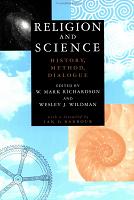 In their highly stimulating and engrossing book, W. Mark Richardson and Wesley J. Wildman’s (eds.) Religion and Science: History, Method, Dialogue (1996), offer an interdisciplinary approach to “building bridges” between religion and science. The various sections of the book correspond to three major kinds of inquiry: historical studies, methodological analyses, and substantive dialogue. Each section provides essays written by many notable scholars, including John Hedley Brooke, Claude Welch, Nicholas Wolterstorff, John Polkinghorne, Arthur Peacocke, among others.
Beginning in Part 1 with essays on the history of the relationship between religion and science, John Hedley Brooke’s “Science and Theology in the Enlightenment” challenges the assumptions that theology was rebuffed by the emerging epistemology and method of science in the seventeenth and eighteenth centuries. Indeed, in many ways theology remained resilient, particularly in the form of William Paley’s Natural Theology (1802). Brooke writes, “whether one referred to the exquisite, microscopic structures in living organisms that had so captivated Robert Boyle, the marvellous migratory instincts of birds that so impressed John Ray, or the elegant laws of nature that governed the Newtonian universe, there was a profound sense in which the sciences could reinforce arguments for design, thereby proving their utility against skeptical and atheistic philosophies that were commonly seen as subversive of a stable society.”
But in “meeting their rationalist critics on their own ground,” Brooke observes, “Christian apologists were almost unwittingly sacrificing what was distinctive in their understanding of God.” As Blaise Pascal warned, “those who sought God apart from Christ, who went no further than nature, would fall into atheism or deism.” Brooke cites Michael J. Buckley’s At the Origins of Modern Atheism (1987) in support of his claim that “a Christian apologia reduced to the argument from design was easy prey to the alternative metaphysics of Lucretius: was not the appearance of design surely illusory, reflecting the simple fact that defective combinations of matter had not survived?” “Atheism takes its meaning from the particular form of theism it rejects. So to understand the origins of modern atheism it is no good looking at the history of atheism.” Rather, “it is essential to examine the history of theism.” Arguments for a personal God based on impersonal forces of nature became one of the chief reasons for the rise of modern atheism. The take away from Brooke’s essay is that “if the bridged built by physico-theologians eventually collapsed, it was not simply that they were undermined by science. It was rather that a greater burden had been placed on the sciences than they could support.”
In the following essay, “Dispelling Some Myths about the Split Between Theology and Science in the Nineteenth Century,” Claude Welch begins by recalling the popular “warfare” model between science and religion, exemplified by John William Draper and Andrew Dickson White. Both authors, Welch claims, were partly responding to Pope Pius IX’s Syllabus of Errors of 1864, which included the “error” of “supposing that the Pope ought to reconcile himself ‘with progress, with liberalism, and with modern civilization.'” And in both authors, “biblical criticism gets more attention than does evolutionary theory.” For instance, in his concluding chapter of Volume II of his A History of the Warfare of Science with Theology in Christendom, White extols higher criticism as opening “treasures of thought which have been inaccessible to theologians for two thousand years,” and has led to “the conceptions of a vast community in which the fatherhood of God overarches all, and the brotherhood of man permeates all.” According to Welch, White’s comments are “remarkably similar to what many liberal theologians were saying in response to evolutionary theory and to biblical criticism.”
But recent work has demolished the metaphor of warfare as an historical interpretation. If we want real instances of warfare, Welch argues, we need only to observe “Comte’s positivism, or of the emergence of a radical materialistic monism particularly in Germany in the 1850s” found in such writers as Ludwig Büchner (1824-1899), Jacob Moleschott (1822-1893), and Karl Vogt (1817-1895). “These latter three,” writes Welch, “seized upon Darwin to further an anti-Christian agenda they had already developed.” This antagonism is expressed even more fully in the writings of Ernst Haeckel (1834-1919), “who undertook in the 1860s to convert Germany to Darwinism”; in his hands “Darwinism could become a symbol of antireligion for reasons that had little to do with evolution.”
What was happening in the nineteenth century was the theological accommodation (read: capitulation) to new “scientific” conceptions, particularly in geology and biology. This accommodation took the form of “mediating” theologies, which entailed a spirit of liberal open-mindedness, of tolerance and humility, of devotion to “truth” wherever it might be found. It was also the abandonment of cherished religious notions. Schleiermacher’s Glaubenslehre (1821) argued that the “doctrine of creation has no particular interest in a point of origination,” that “the idea of the Fall has no reference to an event in early history.” What is more, the popular “preoccupation with an afterlife was countered by the emergence of ‘secular societies,'” greatly weakening the idea of Hell and Damnation and Providence.
Thus the foundations had already been set for the reception of Draper and White. “The work of Draper and White…caught the popular mind of the late nineteenth century, not because of the intrinsic soundness of their arguments, but because of the real growing secularization of the European (and American) mind in the nineteenth century…never mind whether religion and science were really in conflict; they were increasingly thought to be in conflict.”
Wesley J. Wildman’s essay, “The Quest for Harmony: An Interpretation of Contemporary Theology and Science,” sees the interaction between science and religion within modernity as exhibiting an awkward tension that is indicative of a deeper cultural crisis, one evolving out of a failure of human beings to converge and unify the spiritual, ethical, intellectual, and social aspects of their being. “A promising starting point,” he says, “is the awareness that the root cause of the problematic character of modern Western culture is a profound confusion, a schizophrenic uncertainty, about how to be in the world.”
The interaction between science and religion is an informative example. The popular narrative, a tale told and retold both in schools and the media, recounts how
Christian theologians have duped the West to protect their own sacred narratives: first, theology insisted that certain things were true of the world; next, science discovered that these beliefs were false; and then, theology resisted this new [or “true”] knowledge, until finally it was forced to give up its false claims about the world, one by one.
This is a popular story. But it also happens to be completely “dissociated from reality.” And yet like most stories and legends, “the symbolic value of the story is the reason it was and is so infamous, rather than its fidelity to facts.”
The last essay in Part 1 comes from Holmes Rolston III, “Science, Religion, and the Future,” who argues that both science and theology are indispensable human institutions: that is, they need each other. While “science seeks to understand the world,” it needs religion to keep it humane, it “pushes science toward questions of ultimacy, as well as value, and it can keep science from being blinkered, or…religion can keep science deep.”
According to Rolston, recent developments in the sciences offers hope of a more congenial relation with religion. Astrophysics and nuclear physics, for example, are describing a universe “fine-tuned” for stars, planets, life, and mind; evolutionary and molecular biology shows increasing signs of tremendous order in the organization of life: “that order represents something more than physics and chemistry; it is superimposed information.”
For all the advances in our scientific age, problems remain as acute as ever. To solve problems of justice—of overpopulation, overconsumption, and underdistribution—science is necessary; “but science is not sufficient without conscience that shapes and uses to which science is put.” “Science and religion,” Rolston argues, “must face together the impending disaster of today’s trends projected cumulatively into tomorrow: population explosion, dwindling food supply, climate change, soil erosion and drought, deforestation, desertification, declining reserves of fossil fuels and other natural resources, toxic wastes, the growing gap between concentrated wealth and increasing poverty, and the militarism, nationalism, and industrialism that seek to keep the systems of exploitation in place.”
This dialogue between religion and science is exemplified in Part 3 of this book, where six case studies seek to demonstrate constructive interactions between science and theology. Noteworthy features of these studies are their wide range of diverse approaches to theological, philosophical, and methodological issues, incorporating what was discussed in earlier chapters. The studies include such topics as “cosmology and creation,” “Chaos theory and divine action,” “quantum complementarity and Christology,” “information theory and revelation,” “molecular biology and human freedom,” and “social genetics and religious ethics.” Written by astrophysicist at the Vatican Observatory William R. Stoeger, professor of theology and science Robert John Russell, scientist at the Standford Linear Accelerator Karl Young, professor of mathematical physics John Polkinghorne, professor of philosophy Edward MacKinnon, professor of philosophy of education James E. Loder and associate professor of physics W. Jim Neidhardt, professor of historical and systematic theology Christopher B. Kaiser, Head of Mathmatics John C. Puddefoot, theologian and biochemist Arthuer Peacocke, professor emeritus of molecular and cell biology R. David Cole, assistant professor of philosophical theology W. Mark Richardson, professor of anthropology William Irons, and professor of systematic theology Philip Hefner, Part 3 explores the complex interface between science and religion in today’s world.
Part 2 of the book brings us into questions of shared methodologies between theology and science. Constructed as two round discussions involving four perspectives, this set of chapters include arguments from Nicholas Wolterstorff, Nancey Murphy, Mary Gerhart and Allan Melvin Russell, and Philip Clayton and Steven Knapp. Our main concern here is the essay by reformed epistemologist Nicholas Wolterstorff, “Theology and Science: Listening to Each other.”
Wolterstorff introduces his essay by noting that the most powerful and profound interpretation of modernity is that of German sociologist, philosopher, and political economist Max Weber (1864-1920). According to Weber, the essence of modernity lies in the emergence of differentiated action spheres in the domain of society and differentiated value spheres in the domain of culture, and then the spread of rationalization within these spheres. “The characteristically modern person is the one who discards both tradition and affect as determiners of action, and instead engages in rational calculation of means and rational appraisal of values before acting.”
How did the modern person come about? He emerged when the world was treated as disenchanted. “Once upon a time,” writes Wolterstorff, “in the days of primitive religion, humanity lived in an ‘enchanted garden’—a magical garden.” No longer. Modern man has “left the magic garden.” A necessary condition of modern man, says Weber, is disenchantment. “This grand sweep, from the enchanted gardens of primitive religion, to the progressively disenchanting world religions, to the disenchanted world of our differentiated modernized societies and cultures, represents the disappearance of religion from the human scene.” Religion, therefore, and according to Weber, is civilization’s irrational remnant from a primitive past.
Wolterstorff argues that Weber reflects “the Enlightenment understanding of science and its relation to religion—an understanding which has come crashing down in the last quarter century.” Enlightenment thinkers perpetuated convictions first set out in the Middle Ages, where scientific knowledge must begin from “what is evident, either to oneself or to someone else, and then proceed to construct deductive arguments.” Science, in other words, is the conclusions of demonstrative arguments.
Thus “before entering the halls of science, we are to shed all our particularities—our particular social locations, our particular genders, our particular religions, our particular races, our particular nationalities—and enter those halls with just our humanity.” This is the foundationalist picture of science. In his Reason within the Bounds of Religion (1976, 1999), Wolterstorff sums up foundationalism in three principles:
(1) A person is warranted in accepting a theory at a certain time if and only if he is then warranted in believing that that theory belongs to genuine science (scientia).
(2) A theory belongs to genuine science if and only if it is justified by some foundational proposition and some human being could know with certitude that it is thus justified.
(3) A proposition is foundational if and only if it is true and some human being could know noninferentially and with certitude that it is true.
Foundationalism presupposes that there are some certitudes which form a foundation upon which a (scientific) theory can be built using methods of inference (demonstration) which are most certainly reliable. According to this view foundational certitudes can be known noninferentially (not inferred from other propositions). That is, these are things that can be known for certain without knowledge of this certainty being derived from something else. That is, the certainty of these things is self-evident.
Foundationalism holds that scientific theory is deducible from the foundation. Deductivism, however, has virtually collapsed because many theories that seemingly warrant acceptance are not deducible from any foundation. Given the untenability of deductivism, some foundationalists have resorted to probabilism. But probabilism assumes an uniformity of nature. The conclusion is only justified if nature is uniform. But it is impossible to say with any certainty that nature is uniform. One might argue that it is probably uniform, but then we are now using an inductive argument to justify the very principle which we need in order to justify an inductive argument. That is, we still lack a justification for induction. Which theory than belongs to genuine science? There are many acceptable theories, but few of them are provable with respect to foundationalism and none of them are probable with respect to foundation. In fact, Wolterstorff argues, there are no foundational propositions, that is, no propositions that we can know noninferentially and with certitude to be true.
Foundationalism has indeed failed, and has “all but disappeared from that part of the academy which is acquainted with developments in philosophy of science.” How are we then to view science as nonfoundationalist in character?
When it comes to devising and weighing theories in science, Wolterstorff recommends a triple distinction between data, theory, and control beliefs. Data and theory are understood to be self-explanatory. Control beliefs, on the other hand, requires further explanation. “When engaging in science,” Wolterstorff explains, “we operate with certain convictions as to the sorts of theories that we will find acceptable. Control beliefs are of many different sorts. Sometimes they take the form of methodological convictions…sometimes they take the form of ontological convictions.” In other words, control beliefs are those beliefs which the scholar uses in weighing a theory and assessing whether it constitutes an acceptable sort of theory on the matter under consideration. Control beliefs will cause us to reject some theories because they are inconsistent with those beliefs. They will also lead us to devise theories, since we desire to have theories that are consistent with our control beliefs.
In cases of perceived conflict between data, theory, and control beliefs, the conflict is eliminated through a process of “equilibrium,” which is achieved by making revisions in one of the three—if not all of the three. “Most of the deep conflicts between science and religion,” writes Wolterstorff, “occur at the control-belief level.”
Wolterstorff concludes by emphasizing three important points. First, “the Christian faith is such and the theoretical disciplines are such that we must expect conflict—disequilibrium—to emerge repeatedly.” This is because Christianity and Western theorizing constantly “overlap in their concerns.” The idea that religion and science operate in separate spheres is “just one proposal, and an extremely radical one at that, for the recovery of equilibrium.”
This ongoing struggle may require revisions either to Christian belief (which has been the case) or in how we understand science (which has been the case). The tendency to affirm scientific authority over religious authority in cases of conflict ignores the implicit—and indeed sometimes explicit—control beliefs within scientific theorizing.
And finally, the results of theorizing, and most unambiguously in the social sciences and humanities, are often militated against Christian conviction. But according to Wolterstorff, “theorizing in general is far indeed from being a religiously neutral endeavor.” We cannot leave our particular social locations, our particular genders, our particular religions, our particular races, or our particular nationalities, in the “narthex as we enter the halls of science.” Rather, with different particularities, we shall have to engage in the dialogue of theorizing, aiming for equilibrium as an outcome.
Religion and Science: A Brief Note
Posted on December 18, 2013 Leave a Comment
Although published more than twenty-years ago, the essays “Science and Religion” (1985) and “Beyond War and Peace: A Reappraisal of the Encounter between Christianity and Science” (1986), written by Ronald L. Numbers and David C. Lindberg respectively, still serve well as introductions to the science-religion debate; and particularly well in introducing to the reader the figures John William Draper (1811-1882) and Andrew Dickson White (1832-1918).
Both authors focus more on A.D. White, for “no work—not even John William Draper’s best-selling History of the Conflict between Religion and Science (1874)—has done more than White’s to instill in the public mind a sense of the adversarial relationship between science and religion.” Indeed, White’s two-volume History of the Warfare of Science with Theology in Christendom (1896) not only remains in print today, but has been translated into German, French, Italian, Swedish, and Japanese.
In 1869, when A.D. White was president of Cornell University, he lectured to a large audience at the Cooper Union in New York city on “The Battle-Fields of Science.” The lecture would be published the very next day by the New-York Daily Tribune. In that lecture White argued that
In all modern history, interference with Science in the supposed interest of religion—no matter how conscientious such interference may have been—has resulted in the direst evils both to Religion and Science, and invariably. And on the other hand all untrammeled scientific investigation, no matter how dangerous to religion some of its stages may have seemed, temporarily to be, has invariably resulted in the highest good of Religion and Science.
In the years following the Cooper Union address, A.D. White published, in 1876, a brief survey entitled The Warfare of Science, and from time to time the Popular Science Monthly published several articles by him on the “New Chapters in the Warfare of Science.” In 1896, he published his “magnum opus,” the History of the Warfare of Science with Theology in Christendom. “Along the way,” write Numbers and Lindberg, “he narrowed the focus on his attack: from ‘religion’ in 1869, to ‘ecclesiasticism’ in 1876…and finally to ‘dogmatic theology’ in 1896.” But the distinction was merely a rhetorical strategy, and as Numbers and Lindberg point out in a footnote, “the focus on dogmatic theology in his 1896 volumes seems to have been more of an afterthought—a misleading effort to distance himself from [John] William Draper.”
There follows a brief excursion on some of A.D. White’s claims in History of Warfare. Numbers focusing on the years between the American Revolution and Civil War, contrasts A.D. White with more recent scholarship, from Samuel Eliot Morison, Theodore Hornberger, Perry Miller, Donald Fleming, Henry F. May, Conrad Wright, Morgan B. Sherwood, James R. Moore, Richard Hofstadter, Walter P. Metzger, and many others, ranging from topics such as “Science and Religion in the Colonies,” “Science and Scripture in the Early Republic,” “The Darwinian Debates,” to “Science and Religion in Modern America.” Numbers concludes his survey that the “polemically attractive warfare thesis…[is] historically bankrupt.” A.D. White’s History of Warfare
assumes the existence of two static entities, ‘science’ and ‘religion,’ thus ignoring the fact that many of the debates focused on the questions of what should be considered ‘science’ and ‘religion’ and who should be allowed to define them; it distorts a complex relationship that rarely, if ever, found scientists and theologians in simple opposition; it celebrates the triumphs of science in whiggish fashion; and, all too often, it fails to treat religious ideas and institutions with the respect accorded to the realm of science
In Lindberg’s survey (written with Numbers), the focus is on early Christianity, the Copernican Revolution, the Galileo affair, the Darwinian debates, and the Scopes “monkey” Trial. The Church Fathers used Greek scientific knowledge in their defense of the faith, and thus occipied a prominent place in Christian worldview. In this sense, “science was thus the handmaiden of theology.” Copernicus was a Catholic church administrator from northern Poland, and a group of young Lutheran mathematical astronomers who worked under Philipp Melanchthon, Martin Luther’s reforming successor, welcomed his heliocentric astronomy. The Galileo affair was a multifaceted event, filled with opposing theories of biblical interpretation, personal and political factors, and must be seen within the context of the Reformation and the Council of Trent. What is more, “all participants called themselves Christians, and all acknowledged biblical authority.” During the Darwinian debates, the clergy were among the first to embrace and popularize Darwin’s theory. Following James R. Moore, Numbers and Lindberg write, “the Darwinian debates created conflict, not between scientists and theologians, but within individual minds experiencing a ‘crisis of faith’ as they struggled to come to terms with new historical and scientific discoveries.”
If we “fail to escape the trap of assigning credit and blame,” conclude Numbers and Lindberg, “we will never properly appreciated the roles of science and Christianity in the shaping of Western culture; and that will deeply impoverish our understanding.”
Reinventing Christianity in the Nineteenth Century
Posted on December 17, 2013 2 Comments
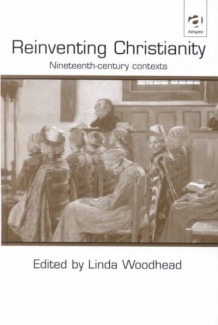 Linda Woodhead’s edited volume Reinventing Christianity: Nineteenth-Century Contexts (2001) is a group of portraits exhibiting the range of changes, adjustments, and initiatives in nineteenth-century Christianity. The collection, individually as well as collectively, eschews the standard assessment that Victorian Christianity was a religion in crisis. Its aim is to “introduce the most important varieties of Christianity in the Victorian era, and to consider their interactions with other aspects of western culture and society.”
After an extremely helpful introduction, this collection of essays offers a wide-ranging survey of the Victorian religious experience, beginning with the “Transcendent Christianity” of famous Baptist preacher Charles Spurgeon (1834-92), the ultramontanism of the nineteenth-century Catholic basilica of Notre Dame de Fourvière in Lyon, and the debates and controversy over confession in the Church of England. “Despite the immense emphasis on sin and damnation on the part of both ultramontane Catholicism and Evangelical Protestantism,” Woodhead writes in her introduction, “neither was intended simply to engender fear and despair. On the contrary, their insistence on God’s transcendence and on human wretchedness served to intensify the need and longing for salvation.”
“Transcendent Christianity” is then contrasted with “Liberal Christianity and Alternative Spiritualities.” The following begins with an article on the world parliament of religions at Chicago in 1892, describing how the Unitarian triumphalism of its organizers was trumped by the representatives of eastern traditions, giving way to new forms of spirituality. According to Woodhead, although the rise of transcendent Christianity retained many believers, it also had the effect of alienating others. Those alienated by transcendent Christianity came to be classified as “liberal.” As Woodhead explains, “instead of viewing God as different and wholly other, liberalism affirms continuity and similarity between God and humanity. Christian liberals generally interpreted the doctrine of incarnation to mean both that there was something of the human in God, and something of the divine in human beings.” Liberals, then, were more optimistic, believing in the perfectibility of individuals and society, which often led them to a “strongly activist, ethical, and in some cases political stress” on Christianity. “Nowhere was Christian liberalism stronger than in the USA.”
The next essay then turns to the remarkable influence of Swedenborgianism, which “enjoyed a unique period of social and intellectual respectability after the 1840s.” Emanuel Swedeborg (1688-1772) is remembered as a seer, a mystic, a revelator or a theosopher by biographers. His reputation and influence rests on his authorship and his claims in the eighteen religious works he published between 1749 and 1771—from the Arcana Coelestia (1749-1756) to Vera Christiana Religio (1770-1771). He believed he was called to reveal the internal sense of the Bible and to announce a new “True” Christianity. During the nineteenth century, Swedenborgianism “helped bridge the gap between transcendent forms of Christianity and a purely inner spirituality; it offered a discourse in which key Victorian obsessions including death and ‘conjugal love’ could be articulated, and it offered a form of toleration towards other religions much greater than that which even liberal Protestantism could countenance.”
The final essay in this section discusses transcendentalists and Catholic converts in America, tracing the Catholic destinations of a number of Boston transcendentalists, including Orestes Brownson, Isaac Hecker, and Sophia Ripley, thereby showing how “radical spirituality could lead back to transcendent Christianity.”
Part two of the volume surveys some literary approaches in “Christianity and Literature,” going on to “Christianity and Gender,” before concluding with “Christianity and Science.” Particularly noteworthy is a chapter on the nineteenth-century roots of the religion of English novelist, poet, playwright, essayist, literary critic and painter D.H. Lawrence (1885-1930). The Bible was central to Lawrence’s religiosity. Yet he rejected “traditional Christian uses of the Bible,” preferring the “radical reinterpreters of Christianity like the philosopher Friedrich Nietzsche and the Biblical exegete Ernest Renan, and partly through the influence of representatives of alternative spirituality like Edward Carpenter and Madame Blavatsky (the founder of the Theosophical Society).” According to Woodhead, this chapter show “how challenges to Biblical authority from science and historical investigation did not necessarily lead to a straightforward choice between accepting or rejecting the Biblical text and the faith that rested on it”; questioning the authority of scripture more often led to a “disjunction between materialism, rationalism and literalism on the one hand, and more imaginative, poetic, aesthetic, open and creative modes of religious knowledge and interpretation on the other.”
Another essay discussing the astonishingly daring feminist theology of Florence Nightingale is worthy of notice. Nightingale is an example of “the remarkably subversive uses to which theology could be put in the hands of women.” According to Woodhead, Nightingale’s critique of contemporary Christianity and her radical reinterpretation of the Gospels can be said to “anticipate many of the achievements of feminist theology over a century later.”
The final section on Christianity and science begins by attacking the image of a “war” between the two and the way contrived master-narratives have contributed to misunderstanding. What is important for understanding science and the nineteenth century, says Woodhead, “is not the creation of a more adequate single story, but an investigation of why such stories came about, which contexts supported them, and whose interests they upheld.” The picture of Christianity in this chapter, as with the previous chapters, casts doubt on simplistic assertions about universal and inevitable secularization in the nineteenth century. “The sciences have never simply led to secularization. At issue has always been the cultural meaning to be placed on new forms of science” (my emphasis).
The following essay further contextualizes the “war” in terms of a new “knowledge class” seeking to rival the power of the clergy established in the universities, demonstrating that “the ideas of war between science and religion was a rhetorical strategy from the start.” An essay on influential and widely-ride naturalist and illustrator Philip Gosse (1810-1888) shows how far Edmund Gosse’s Father and son (1907) has misled the public into thinking he was a “scientific crackpot,” “bible-soaked romantic,” “a stern and repressive father,” and a “pulpit-thumping Puritan throwback to the seventeenth century.” In fact, writes Woodhead, “[Philip] Gosse was a severe critic of more optimistic forms of natural theology, his transcendent Protestantism leading him to emphasise both the fallenness of the created order and the greater authority of the Bible in matters pertaining to God.”
In her conclusion, Woodhead notes that the nineteenth century brought “unprecedented social, political, economic and cultural change,” and although Christianity was “profoundly affected by such change,” it was not “merely a passive victim of such forces.” “Christianity was actively and centrally involved in many of the most important cultural shifts and debates of the nineteenth century, and was transformed and reinvented in the process.” It responded by provoking, resisting, embracing, or selectively appropriating.
John William Draper and the Art of Forgetting
Posted on December 15, 2013 Leave a Comment
 In a unique paper on John William Draper, Bradford Vivian uses French Jesuit Michel de Certeau’s philosophy of history to understand the massive “forgetting” that gook place in the nineteenth century. Vivian argues in “The Art of Forgetting: John W. Draper and the Rhetorical Dimensions of History” (1999) that “the rhetorical dynamics of [Draper’s] History of the Conflict Between Religion and Science created a way of knowing—a highly persuasive worldview—that not only rendered hostile the relationship between religion and science but, more significantly, installed in the modern episteme a discourse that continues to shape knowledge about religion and science.” The History of Conflict “helped induce a persuasive cultural ‘forgetting’ by depicting science as the savior of Western civilization and religion as its doom.”
According to Certeau, “history is not a mimetic representation of the past, but is instead a selective process that actively creates the past.” In the reconstruction of the past, a willed forgetting occurs—and must occur, says Certeau. The “discourse of separation,” the act of dividing or breaking the past in historical “periods” is the “postulate of interpretation (which is constructed as of the present time) and its object (divisions organizing representations that must be reinterpreted). The labor designated by this breakage is self-motivated. In the past from which it is distinguished, it promotes a selection between what can be understood and what must be forgotten in order to obtain the representation of a present intelligibility.” However, those forgotten elements do not disappear, but remain as “resistances” or “survivals,” thus rendering history a “contested field, comprised of competing interpretations.” There is, then, a rhetorical nature to history; it is a way of knowing and exists as an “epistemological ideal.”
The nineteenth century was “characterized by a faith in the progressive spirit,” and history became the scientific observation of such progress. “Leopold Van Ranke and Auguste Comte articulated influential conceptions of history that operated by virtue of a scientific method and documented the laws that determined the course of human events.” In this sense, religion became the target of such historians. For instance, the “modern image of the Middle Ages as a seemingly endless night of theocratic darkness is largely the result of a fervent historical forgetting induced by the rhetorical strategies of nineteenth-century scientific historians.” Replacing theology with science did not amount to atheism, however. Indeed, according to Draper, science “has given us grander views of the universe, more awful views of God.” Theology was a false epistemology, whereas scientific law more truly disclosed God’s blueprint.
According to Vivian, “Draper embodied the distinctive qualities of nineteenth-century scientific historians.” Draper was indeed inspired by Comte’s theory that history is an “orderly phenomenon, driven forward by the machinery of scientific law and human progress.” Following Draper’s biographer, Donald Fleming, Vivian records that Draper “regarded himself as a scientific historian and even viewed history as a branch of natural science,” and by documenting the history of science, “Draper intended to demonstrate that the modernizing force of scientific progress led away from Europe and directly to America.”
In documenting his history, Draper’s work provides many examples of historical “forgettings.” If this is true, how is it that History of Conflict went through 50 American printings in 50 years, 21 printings in the United Kingdom over 15 years, and translated into dozens of languages throughout the world, thereby achieving an exceptional international popularity? According to Vivian, its popularity is primarily due to its dramatic style, “it is essentially a drama, unified by a prophetic narrative that compels readers to view science as the guardian of knowledge and religion as its most baneful enemy.” Its prophetic ethos, moreover, is optimistic, portending a bright future.
It was also a self-serving history. Draper, according to Fleming, was “hungry for recognition.” Draper’s choice to write in the popular genre, necessary for the International Scientific Series, “reflected a desire to reach a larger audience and to sway the public toward an appreciation not only of science but also Draper himself.”
According to Vivian, the second half of History of Conflict is more reflective and abstract, relaying to readers that the “conflict between science and religion is a thoroughly epistemological battle, a struggle against devotion to the ignorance induced by religion and an embrace of the power wrought by scientific knowledge.” Indeed, readers are given an ultimatum: “readers must therefore take part in this battle on behalf of science in order to preserve ‘absolute freedom of thought.'” Draper therefore successfully created an epistemic system of thought by defining science and religion as in conflict.
In the next section of the paper, Vivian debunks one particular narrative in Draper’s history, that of the Flat Earth. Here he follows closely Jeffrey Burton Russell’s Inventing the Flat Earth (1997).
Yet despite its many errors, Draper’s History of Conflict was perceived as an historical text. Why? According to Vivian, “history in the nineteenth century was not expected to be a strictly empirical form of knowledge.” Nineteenth-century historians modeled their writing on “nineteenth-century novelists who strove to create an impression of omniscience, of continuity, of unbroken flow”; it was the construction of an ethos, a prophetic style that exerts pressure on readers to make a choice.
But how could such a history be viewed as an example of scientific history? The tension the modern reader feels in trying to understand how nineteenth-century scientific history was “scientific” and “popular” is just that. The divisions of modern Western culture—a division between the sacred and the profane, between the spiritual and the empirical, between religion and science—is a consequence of their artificial separation in such works as Draper’s History of Conflict.
John Tyndall and the “War” between Science and Religion
Posted on December 14, 2013 Leave a Comment
While scanning Linda Woodhead’s (ed.) Reinventing Christianity: Nineteenth-Century Contexts (2001) yesterday, I found Gowan Dawson’s “Contextualizing the ‘War’ between Science and Religion” particularly enlightening.
 Dawson explores Victorian materialism as it was exemplified by polemicists like John Tyndall. While the confrontation between T.H. Huxley and Bishop Samuel Wilberforce at the British Association for the Advancement of Science (BAAS) in Oxford in 1860 serves as a paradigmatic example of the “war” between science and religion in the nineteenth century, Tyndall’s Presidential Address to BAAS at Belfast in 1874 in fact aroused far more controversy.
In his Address, Tyndall gives an account of the development of science from the glorious days of ancient Greece, from “free-thinking and courageous” pagan philosophers like Democritus and Epicurus and even Roman poet Lucretius, which was then momentarily submerged by Christian and other regressive forces in the Middle Ages, to its triumphal revival in the Renaissance. By his reading, Tyndall saw the beginnings of a rigorously materialistic explanation of the natural world, without recourse to any form of supernaturalism, in the ancient doctrines of pagan philosophers, connecting it with the most advanced scientific conclusions of his own day. He claims that the “‘grand generalizations’ of ‘our day’ are really experimentally verified developments of the old atomic philosophy.” The advances of modern science “have their origin in a philosophy of matter which is over two thousand years old.” Modern science is the heir to these developments, and stands in direct continuity with them.
Tyndall’s account provoked outrage amongst many Christians. The periodical press afforded a “textual site” for much of the pillory hurled against Tyndall’s advocacy of pagan materialism. But as Dawson points out, this was not simply a clash between two metaphysical systems: theism on the one hand and a godless scientific materialism on the other. What Tyndall’s critics saw in his Address was the social and ethical implications of materialism. Indeed, Tyndall’s belligerent anti-clerical Address was censured for advocating the disreputable atheistic hedonism of Greek and Roman philosophers. As Dawson puts it, “Victorian exponents of this ancient understanding of the natural world could be portrayed as implicitly advocating the immoral sensualism which had precipitated the downfall of pagan antiquity.” For instance, Henry Reeve, editor of the Edinburgh Review, not only dismisses contemporary thought as merely the return to the conjectures of the pre-Socratic age, but that the “Lucretian doctrines of Professor Tyndall” could very well lead “to a bestial emphasis on earthly pleasure.” “Scientific materialism,” Dawson writes, “will uproot the true morality which Christianity has bestowed upon the world, and cast humanity once more into the sordid pit of pagan depravity.”
Sermons preached in Belfast also implicated Tyndall’s materialistic conclusions. Calvinist theologians in particular, with their emphasis on the Fallen condition of man, contended that it would leave him bereft of any sense of morality. For instance, Robert Wallace, professor of systematic theology at Belfast Presbyterian College, makes explicit connection between Tyndall and Epicurean doctrine. James McCosh, President of Princeton College, responded to Tyndall’s materialism by identifying it with the disreputable ethics of the pagan world. “The moral corruption of first-century Rome…provides a cautionary warning of the inevitable consequences of the unbelief predicated by present-day materialism.” These denunciations of Tyndall’s scientific creed can be located, Dawson explains, in a long tradition of Christian hostility towards Epicureanism, which dates back as far as the last centuries of the Roman Empire. For religious commentators, the resemblance between classical and modern philosophy actually undermined the intellectual pretensions of contemporary thought.
Responding to such imputations of pagan hedonism, Tyndall argued that hedonism “is by no means the ethical consequence of a rejection of dogma.” Thus Tyndall contests “the pessimistic theological assumption that without a metaphysical criterion for morality civic society will ultimately give way under the unrestrained selfishness which is man’s original condition.”
Dawson, following the work of Adrian Desmond, concludes that not only is the warfare image hackneyed, so is the reaction to it. “The point is not to deny the struggle, any more than to refight ‘the good fight.'” Historians should instead endeavor to understand the social currents which underwrite such moments of conflict.
Book History and the History of Science
Posted on December 13, 2013 4 Comments
 This morning I began reading the “special section” collection of articles published in The British Journal for the History of Science, entitled “Book History and the Sciences” (2000). Jonathan R. Topham provides an introduction explaining why historians of science have been not a little skeptical about the value of the book history approach. “It is often dismissed as an intellectual fad or as an enterprise which is illuminating but ultimately peripheral, rather than being valued as an approach which can offer major new insights within the field.” Historians of science in recent decades have tried to get away from an “unsocial history of ideas, usually rooted in texts,” so their apprehensions are well taken. In this sense they see book history as retrograde.
Topham wants to reassure historians of science that book history does indeed “reintroduce social actors,” but with the caveat: as “engaged in a variety of practices with respect to material objects.” It is an approach that rejects a history in which books are seen as merely disembodied texts. According to Topham, book history “applies to print culture an approach which historians of science have pioneered in other contexts, such as studies of laboratories, observatories, lecture halls and museums.” Such an approach can contribute significantly to a cultural history of science. “Exploring in detail the historical encounters of readers with printed matter enables the historian to elaborate an account of scientific communication by print which, instead of methodologically privileging the role of scientific authors, acknowledges the complex and contested nature of such communication.”
Besides this introduction, I found particularly fascinating Lesile Howsam’s “An Experiment with Science for the Nineteenth-Century Book Trade: the International Scientific Series.” She argues that “a close examination of the publishing history of scientific books can be particularly fruitful for the scholar interested in how text and physical object combined to constitute the reader’s experience at a given place and moment in time.” Her object of study is the International Scientific Series (ISS), published in Britain and North America from 1871 to 1911. She asks a series of questions about the histories of authorship, of publishing and of reading in the Victorian era: “What are historians of Victorian science to make of this collection of texts, most of which were written by scientific practitioners, and some by world-famous men of science? Can we construe the contributions as an ideological community in the scientific culture of the late nineteenth century? What are we to make of the publishers and promoters of the series? Can anything be found out about the people who read the books and what contribution they made to popular conceptions of what constituted the ‘sound material’ of science that prevailed in the closing decades of the nineteenth century?” But whereas historians of science may inquire about the way professionals and amateurs defined science in the ISS, historians of the book may inquire: “What and how did these works fit in the contemporary context of scientific publishing, and of publishing in general? Were the texts as fixed as they appear, or is there evidence of revision? When revisions occurred, were they announced to booksellers and the reading public, or were they concealed? Did publishers agree with the titans of science who gave them editorial advice about what constituted a saleable manuscript, and when they failed to agree, whose opinion prevailed?
Both sets of questions yield remarkable dividends. According to Howsam, “editorial decisions about what titles to include in the series are evidence of contemporary definitions of science, particularly the inclusion of the social science with the natural sciences.” Moreover, “production decisions about how to keep the series in print are evidence of how the contemporary culture of science interacted with the culture of publishing.”
Books emerge not merely from artistic motives, but from a “desire to instruct,” “inform,” or “persuade.” Books, and nineteenth-century books in particular, were “conversion projects,” and scientific authors of science of nineteenth-century Europe and North America “were just as passionate evangelists, for science, as were their opposite numbers in the missionary societies.” T.H. Huxley and his coterie wished to revolutionize the dissemination of science in society, to create a much broader audience than before. They found this in Edward Livingston Youmans (1821-1887) call for a series of new books “covering the entire field of modern science.” Youmans was an American writer working for New York publishing firm D. Appleton and Company. According to his biographer, John Fiske, Youmans was “an interpreter of science for the people.” In 1871, Youmans traveled to Britain to pitch the series to a number of scientists and philosophers, including John Tyndall, T.H. Huxley, his close friend Herbert Spencer, and even requested Charles Darwin to endorse the project. Youmans and William Henry Appleton entered into contract with London publisher Henry S. King and Company later that year. Before returning to New York, Youmans also traveled to France and Germany, making arrangements with publishers and scientists for the corresponding series there.
Huxley, Tyndall, and Spencer would form as ISS’s advisory body, “charged with helping the publisher decide which books should be included in the series, and to some extent with soliciting further titles form their powerful network of acquaintances.” Their motives, according to Howsam’s analysis of letters and other documents, were threefold. First, they wanted greater recompense for their own personal efforts. Second, “they envisioned the series as a tool in their campaign for a more secular approach to public policy.” Finally, they wanted the series to “educate” the non-professional reader about what they perceived was the latest developments in the physical and social sciences.
Howsam goes on to show how bookseller became aware of the series, how it was revised for new editions, including substantial changes based on criticisms and translations, the addition of prefaces or appendices to bring them up to date, and how in general authors kept their specific contributions “alive.” “Although the series must have found its place on the bookshelves of many collections both public and private,” Howsam argues, “few collectors were aware of the fluidity of the texts enclosed inside the uniform red bindings.”
In tracing its reception, Howsam relies on book review columns gleaned from Nature and Westminster Review, but also suggests other journals, letters, and autobiographies in order to enter the consciousness of nineteenth-century readers of popular scientific works. These latter remain, however, fragmentary, and thus periodical reviews is our best source of “what the reviewers, and beyond them readers, thought of how the series was achieving its objectives.”
“In the hands of Yousmans, King and Appleton, and Huxley, Tyndall and Spencer,” Howsam concludes, the International Scientific Series became a “vision of modern secular science.” And it was the “publishers who made the ultimate publishing decisions.” Books have a dual nature, as text and as physical object. Investigating both aspects, historians of the book are “learning to recognize the malleable text lurking below the deceptively bland leather or cloth-bound skin of the apparently torpid beast, and to demonstrate that books produced in the past had a recoverable dynamic existence in that past culture.” Book history reveals books as complexly embodied objects, giving us a glimpse of “motivations not only of the men and woman who wrote and published them, but also of booksellers who distributed them and the readers who consumed them.”
Wresting with Nature – Science and Place
Posted on December 12, 2013 Leave a Comment
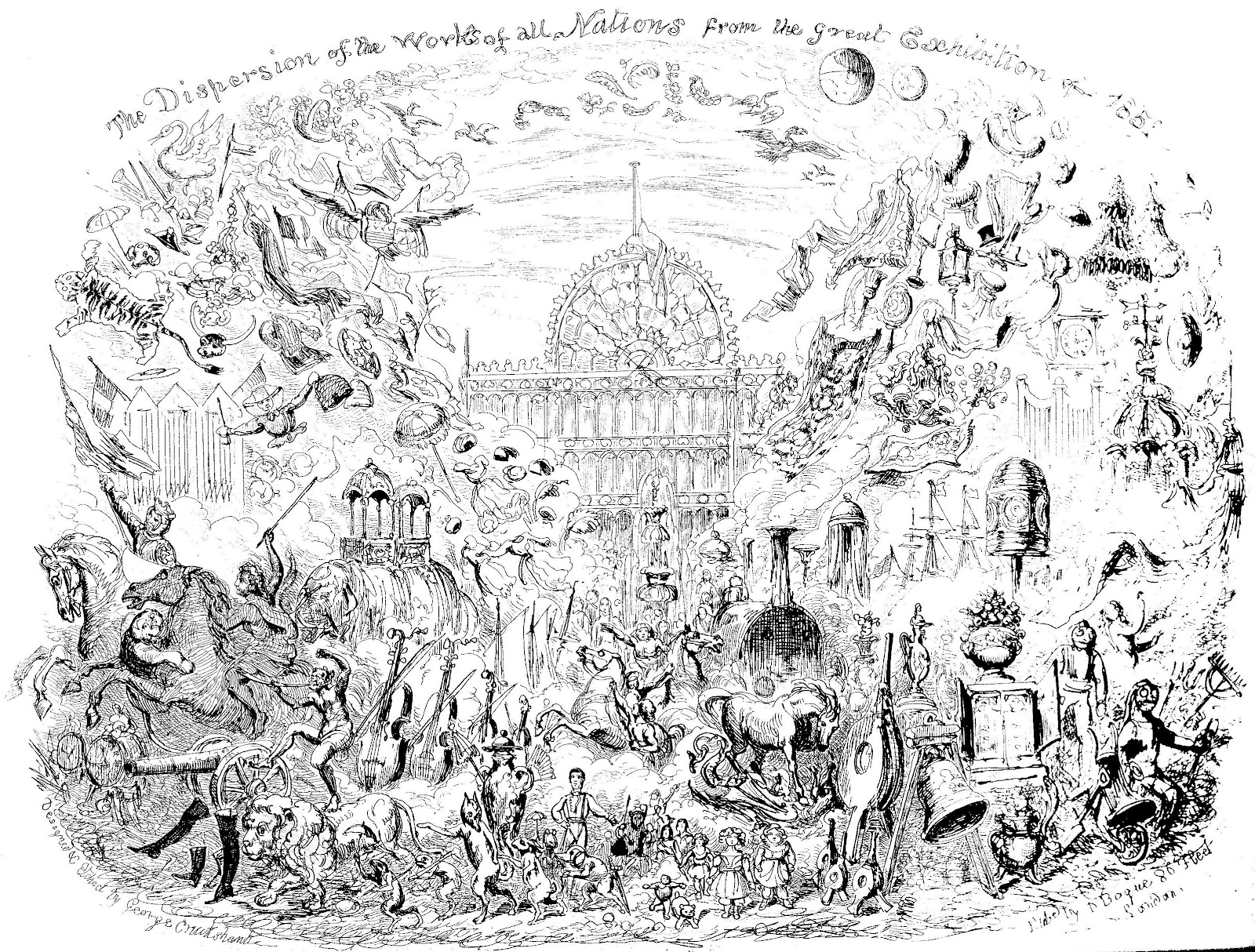
The Great Exhibition of the Works of Industry of all Nations 1851
David N. Livingstone once again wraps things up with his “Science and Place.” Imagining science in the singular has been used by progressivists in the service of “philosophical argument or social policy in order to provide grounds for investment in such cultural capital as intellectual advancement, technical control, and instrumental progress.” But a “geography of science,” Livingstone tells us, reveals a “science” influenced in significant ways by location. This analysis undoubtedly “disturbs settled assumptions about the kind of enterprise science is supposed to be and calls into question received wisdom about how scientific knowledge is acquired and stabilized.” In other words, what passes as “science” is different not only from time to time, but also from place to place.
Livingstone supports these claims by looking at “productions of space.” Spaces are social productions of practice, including scientific ones. “Venues like the laboratory, the observatory, the museum, the field, the botanical garden, and the hospital…” but also “cathedrals, coffee houses, tents, breeding clubs, royal courts, stock farms, exhibition stages and, no doubt, many more” are spaces and sites of scientific performance, principle, practice and theory, of institutions and ideas; and each is conditioned by geography.
The following sections on “spaces of experimentation,” “spaces of expedition,” and “spaces of exhibition,” are drawn largely from Livingstone’s Putting Science in its Place (2003), and a summary of them can be found here, here, and here.
Just as scientific knowledge is produced in a variety of places, so too the results of scientific inquiry are received in different venues. Darwin’s theory evolution is a case example, experiencing a “different fate in different national settings, religious spaces, and institutional arenas.” Protestants in Edinburgh, Belfast, and Princeton developed “markedly different tactics in their reading of the Darwinian challenge.” This leads Livingstone to posit that “scientific ideas rarely circulate as immaterial entities”—they are embodied.
More specifically, ideas are embodied “written texts,” for it is “print rather than thought or theory that is let loose upon the world.” A consideration of textual spaces is therefore necessary for understanding scientific culture. But because textual meaning is mobile, distinctive cultures of reading must be parsed within “regions and between them, within cities and between them, within neighborhoods and between them.”
“At every stage in the cycle of scientific culture, place matters. Where scientific work is conducted and where its wares are encountered make a difference to both the production and consumption sides of the enterprise. This means that if we are to understand the place of science in our culture we will need to attend more carefully to the places of scientific culture and to how these spaces have historically come into being.”
Wrestling with Nature – Science and the Public
Posted on December 12, 2013 1 Comment
The other essay I found particularly interesting is Bernard Lightman’s “Science and the Public.” It was in reviewing Mary Somerville’s popular work, On the Connexion of the Physical Sciences (1834), when English polymath William Whewell (1794-1866) first coined the word “scientist,” used as a umbrella term to avoid the “endless subdivision of the physical sciences.” In reviewing Somerville, Whewell hoped that her work, and others like it, would help “counteract the growing fragmentation of the physical sciences.”
Although concerned over its growing fragmentation, Whewell nevertheless took comfort that the Anglican clergy guaranteed a “strong religious framework unified science.” But by the middle of the nineteenth century, a new cult of science had emerged, represented by such names as Renan, Taine, Tyndall, Bernard, Büchner, Huxley, and Haeckel, vying for cultural authority. “Whoever determined the boundaries between legitimate and illegitimate scientific knowledge, between valid and invalid ways of doing science, and between the professional scientist and the mere amateur controlled the definition of science and could dominate the intellectual, social, and political agenda of the day.” According to Lightman, both groups, the Anglican establishment and the scientific naturalists, attempted to enroll the support of the British public. This was made possible by mechanized printing presses, railway distribution, improved education, and the penny post. While Huxley and his allies dominated the world of scientific journalism, popularizers of science, claims Lightman, “proposed a more egalitarian relationship between scientist and layman.”
In the beginning of the nineteenth century, such figures as Charles Lyell (1797-1875), Adam Sedgwick (1785-1873), Charles Babbage (1791-1871), Augustus De Morgan (1806-1871), Richard Owen (1804-1892), Humphry Davy (1778-1829), John Herschel (1792-1871), and William Whewell “adhered to an ideal of gentlemanly science based on a conception of a hierarchical society, masculine authority, and government by an Anglican, aristocratic elite.” From this group, natural theology was used to preserve the political and social status quo, presenting experimental science as a genteel, theologically safe, and socially conservative activity. “Science teaching at the ancient universities,” writes Lightman, “was not intended to institute modern, professional education, but instead to educate Christian gentlemen.” The science of gentlemen, then, leads to the recognition of a divine, static and hierarchical order behind nature.
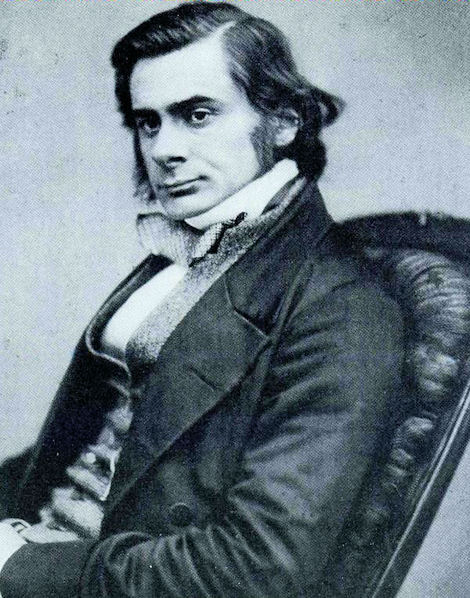
A young, and dashing, Thomas Henry Huxley at 32 in 1857
By the mid-nineteenth century, the circulation of knowledge was no longer limited to the wealthy and to the aristocracy. Born into a low-middle-class family, Thomas Henry Huxley (1825-1895) was deeply affected by the poverty he saw in the East End slums. “It was a grim reminder,” writes Lightman, “of how the Anglican-aristocratic establishment had failed to provide for many members of English society.” “Huxley never forgot his early struggles to establish a scientific career for himself,” he continues, “and throughout his life he set as one of his main goals the redefinition of both the meaning and institutional infrastructure of British science.” Sharing many aspects of Huxley’s lower-middle-class roots, John Tyndall (1820-1893), Herbert Spencer (1820-1903), William Kingdon Clifford (1845-1879), Leslie Stephen (1832-1904), Edward Tylor (1832-1917), E. Ray Lankester (1847-1929), Henry Maudsley (1835-1918) formed an alliance, promoting, according to the Fabian socialist Beatrice Webb (1858-1945), the notion that the scientific method solves all problems and the “transference of the emotion of self-sacrificing service from God to man.”
Huxley, Tyndall, and Spencer would in the latter half of the nineteenth century found the “X-Club,” a private, informal society where the member could exchange ideas on literature, politics, and science over dinner. Most important here is that members and supporters of the X-Club engaged the Anglican Church in the pages of the periodical press and in public debate. In these forums, members, and particularly Huxley, “presented a seemingly more democratic science, which emphasized how a scientific education could discipline the mind and teach the public to resist” unscientific practices and beliefs.
But in attempting to crush the authority of the Anglican establishment, Huxley revealed an increased commitment to the “professionalization” of science from the public domain. In his “On the Study of Biology” (1876), for example, Huxley argued that natural history was an outmoded term, “old” and “confusing,” in need of a replacement with a new term that would “characterize the study of the totality of living phenomena.” Huxley promoted “biology,” which, interestingly enough, did not “involve the analysis of exquisitely designed organs of perfection and it could be conducted without having to deal with any questions concerning the wisdom, power, and benevolence of a divine being”; that is, stripped of all religious content (Peter Harrison gives a detailed account of the origins, rise, and fall of “Natural History” in the same volume). Biology, moreover, must be “analogous to the study of the other physical sciences; it must be performed, in other words, in the laboratory by “men of science.” “The democratic nature of science,” writes Lightman, “became lost in Huxley’s stress on expertise developed only in the laboratory.”
Of course, such claims of scientific naturalism were met with resistance by the intellectual elite. The most effective opposition came from a reformed group of scientists known as the “North British,” composed of William Thomson (1824-1907), James Clerk Maxwell (1831-1879), Peter Guthrie Tait (1831-1901), Henry Fleeming Jenkin (1833-1885), William Macquorn Rankine (1820-1872), who “found the perceived anti-Christian materialism of the metropolitan scientific naturalists quite distasteful and they prepared to enter into an alliance with Cambridge Anglicans to undermine the authority of Huxley and his allies.” Thomson and Maxwell were particularly public in their disagreements with Huxley and Tyndall, for example. “While Huxley trained his biology students…to see a fully secularized material world through the lens of the microscope, Maxwell and the other North British Physicists were prepared to admit God into their laboratory as the creator who had given purpose to nature and to all scientific activity.”
More importantly, Huxley’s claims were also resisted by popularizers of science, who belonged to groups that Huxley and his colleagues were trying to edge out of science; namely women and Christian ministers. Mary Somerville but also Rosina Zornlin (1795-1859), Jane Loudon (1807-1858), Anne Pratt (1806-1893), Elizabeth Twining (1805-1889), Lydia Becker (1827-1890), Margaret Gatty (1809-1873), Mary Ward (1827-1869), Agnes Giberne (1845-1939), Agnes Clarke (1842-1907), and Eliza Brightwen (1830-1906) published widely on physical geography and geology, on botany, on evolutionary theory and natural history, on scientific instruments such as the microscope and telescope, on astronomy, and, more generally, on “short stories designed to teach children scientific, as well as moral, lessons.” John George Wood (1827-1889), Ebenezer Brewer (1810-1897), Charles Alexander Johns (1811-1874), Charles Kingsley (1819-1875) George Henslow (1835-1925), Henry Neville Hutchinson (1856-1927), moreover, sold a staggering amount of work on popular science. Richard Proctor (1837-1888) in particular authored “over sixty books, mostly on astronomy” and “wrote at least five hundred essays that appeared in a wide variety of periodicals such as Popular Science Monthly, Cornhill Magazine, Contemporary Review, Fortnightly Review, Fraser’s Magazine, and Nineteenth Century.” Indeed, Proctor “founded his journal Knowledge in order to challenge Nature for control of the popular science periodical market.”
It did not take long for Huxley, Tyndall, Spencer and friends to try their hands at writing popular works. Perhaps the most well known is the International Scientific Series, its aim to “disseminate an authoritative and collective image of science as stable, secular, and comprehensive.” Indeed, in its early years in England it was directed by an advisory committee composed of Huxley, Tyndall, and Spencer. And least we forget, John William Draper’s The History of the Conflict Between Religion and Science was among the most popular works in the entire series.
During the nineteenth century, increased contact with scientific ideas was made possible by the communications revolution.”Driven by the twin engines of empire and industrialization, science became a cultural and social force to be reckon with.” One consequence of this nineteenth-century revolution was that “scientists gained unprecedented cultural authority at the expense of the Christian clergy, as science came to be seen as providing a model for obtaining truth.” Lightman warns us about drawing overarching conclusions that the scientific naturalists won the contest in determining the meaning of science. Granted. However, although the meaning of science may still be debated amongst historians, philosophers, and even scientists—in other words, amongst intellectuals—popular perceptions convey a meaning of science as secular, mechanistic, and independent of theology. Indeed, it is often said that it was this “science” that made the modern world. In this sense, the Anglican establishment may have won the battle against Huxley and his coterie, but they clearly lost the war for the hearts and minds of the people.
Wrestling with Nature – Science and Religion
Posted on December 11, 2013 Leave a Comment
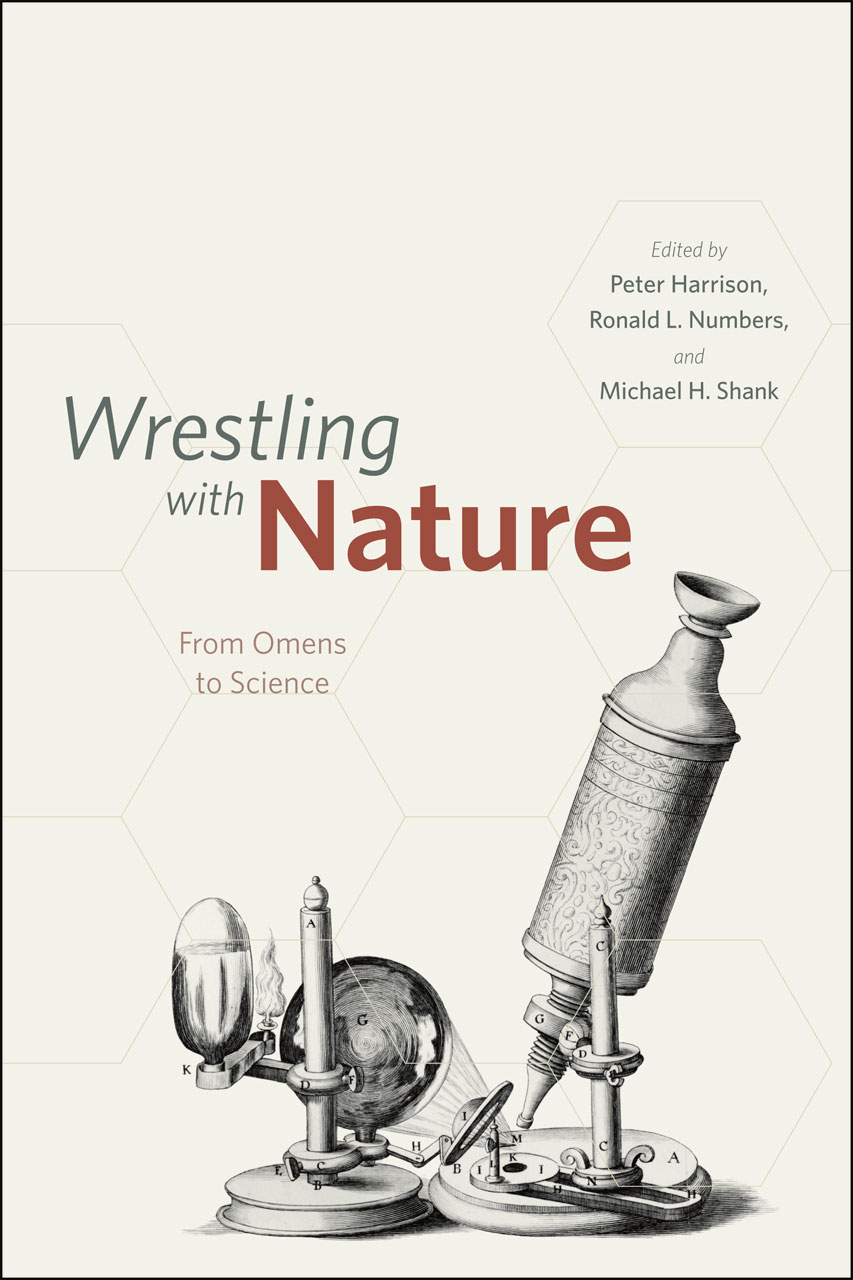 Wrestling with Nature: From Omens to Science (2011) uses the popular-case study format to examine “how students of nature themselves have understood and represented their work.” The essays are thematic but roughly chronological, beginning with “natural knowledge in ancient Mesopotamia” (Francesca Rochberg), moves on to “natural knowledge in the Classical World” (Daryn Lehoux), and then two essays on natural knowledge in the “Arabic Middle Ages” (Jon McGinnis) and “Latin Middle Ages” (Michael H. Shank). The book then transitions into the Renaissance and early modern periods with essays on “Natural History” (Peter Harrison), “Mixed Mathematics” (Peter Dear), and “Natural Philosophy” (John L. Heilbron). The second half of the book is less chronological and more thematic, concentrating on how “science” demarcated its territory, separating itself from other ways of understanding or manipulating the natural world, particularly in the nineteenth century. Here we find essays on “Science and Medicine” (Ronald L. Numbers), “Science and Technology” (Ronald R. Kline), “Science and Religion” (Jon H. Roberts), “Science, Pseudoscience, and Science Falsely So-Called” (Ronald L. Numbers and Daniel P. Thurs), and “Scientific Methods” (Daniel P. Thurs). The book concludes, as with the previous book reviewed on this blog, with essays by Bernard Lightman (“Science the Public”) and David N. Livingstone (“Science and Place”).
Here I want to focus only on three chapters I found particularly interesting. Roberts in “Science and Religion” observes that in recent years studies on relating science and religion “has become hot.” Everyone is doing it: from colleges and universities, journals and newsletters, organizations and think tanks, to books and magazines—everyone is talking about “science and religion.”
But “prior to about the middle of the nineteenth century, the trope ‘science and religion’ was virtually nonexistent.” The two only came together when both terms attained modern form. We have seen this argument before. Here Roberts emphasizes that it was “elite members” of the church who devoted themselves to theology, whereas “most adherents” treated “religion” primarily as a “life of piety and communal devotion and a set of ritual practices.” This however contradicts what Jaroslav Pelikan, Claude Welch, and many others (including Roberts himself, only a few pages further down) have said on the matter of creeds and dogma throughout the history of the Christian church.
The tracing of “science” is less contested. Roberts claims that “God-talk” was once central in the work of natural philosophers. But as early as the mid-eighteenth century, an “ever-growing number of investigators in the realms of natural philosophy and natural history began making determined efforts to pursue their inquiries untrammeled by concern with the testimony of biblical narrative.” By substituting “natural laws” for divine agency, “men of science” began “bringing all phenomena within the scope of natural laws and secondary causes,” a view that would become known as “methodological naturalism.”
But it was during the late nineteenth century where “science” underwent its most significant constriction. Once thought of as “systematized knowledge,” it was restricted to “empirical investigation of natural (and sometimes social) phenomena.” Many intellectuals at this time began casting science and theology as distinctly different enterprises. Thus John William Draper conceived science and religion as “two contending powers, the expansive force of the human intellect on one side, and the compression arising from traditionary faith and human interests on the other.” By the end of the century, a deluge of books and articles addressing “science and religion” swept across the Anglo American landscape.
Conceptualizing science and religion as distinct entities with distinct enterprises led to their ultimate separation. Friedrich Schleiermacher and Immanuel Kant, for example, located religion in “a sense of contingency, or dependence,” in the “feelings associated with the human condition.” Albrecht Ritschl held that religion and science “appealed to different elements of human experience.” Twentieth-century Anglo American liberal Protestants often stressed inner experience and minimized doctrinal beliefs, in what Pelikan has acutely called the “discomfort with creed caused by the consciousness of modernity.” We see this sentiment in Andrew Dickson White’s qualifications that the villain was not “religion”—which defined as “the love of God and of our neighbor”—but “Dogmatic Theology.” This distinction, Roberts tells us, “became increasingly common among liberal Christians, including scientists, in the United States and Great Britain during the half century after 1890.” Science and religion had become “separate spheres of experiential data.”
Many Christians rejected such artificial separation. Charles Hodge, J. Gresham Machen, and William Jennings Bryan were only a few of many who called for a more traditional, “Baconian” conception of science, one that would include theology among the sciences. In the 1920s “fundamentalism” emerged, pushing for a conception of science that would ban teaching evolution in public schools. But there were also more peaceful separatists. In 1923 Robert A. Milikan and a group of scientists, clergymen, and theologians signed a “Joint Statement upon the Relations of Science and Religion,” which maintained that science and religion “meet distinct human needs” and thus “supplement rather than displace or oppose each other.”
Between the two world wars, many theologians, and even some scientists, “insisted that the natural world served as an appropriate object for theological reflection.” For example, F.R. Tennant, Sir James Jeans, Arthur F. Smethrust, William Grosvenor Pollard, and Ian Barbour essentially called for a “re-merging of the spheres” of science and religion. Some conservative Protestants even began reasserting the theological perspective to once again bear on our understanding of the natural world.
More recently, the rise of young-earth creationists, who aggressively contest the notion that the “vocabulary of modern science” alone “provides an adequate description of the natural world,” has appealed to philosophers of science such as Karl Popper and Thomas Kuhn, who have even suggested that “creationism constitutes a ‘research program’ no less rigorously ‘scientific’ than Darwinism.” This in turn encouraged creationists to demand “equal time” in the public classroom. On the other side, “militance among proponents of scientific naturalism has also escalated.” Scientists such as Steven Weinberg, Stephen Hawking, Richard Dawkins, Richard Lewontin, Edward O. Wilson, Francis Crick, and philosopher Daniel Dennett, “have dismissed, even scorned, the beliefs of orthodox Christians.”
More measured minds have resisted such efforts to compartmentalize science and religion. From theologians, philosophers, sociologists, to historians of science, these thinkers have called for a more contextualized understanding of science and religion. “Most modern intellectuals,” concludes Roberts, “have joined their predecessors in assuming that both enterprises possess distinctive elements and in exploring their interrelationship.” This congenial conclusion may strike one as deeply unsatisfying, however, especially in light of the fact that the fastest-growing religious category in the United States is what are called “nones“—people who say they have no religious affiliation—or the explosion of New Atheist “churches,” which proselytize “science” and calls to “unconversion.”
 James C. Ungureanu