
What is Natural Philosophy?
Posted on January 13, 2015 Leave a Comment
 Over the weekend I came across Andrew Cunningham’s collection of essays in The Identity of the History of Science and Medicine (2012). I had briefly mentioned Cunningham in an older post, but for heuristic purposes I thought it would be useful to reflect on some of his arguments here.
Beginning in 1988, Cunningham published an essay on “Getting the Game Right: Some Plain Words on the Identity and Invention of Science.” In this essay he asks whether the historian of science is “studying the right subject?” That is, when the historian sets out to study the history of science, is she or he properly equipped to identify science in the past? The short answer Cunningham posits is no: historians of science have failed to properly identify the nature of science. As such, we also fail to properly understand its history. “It follows,” he writes, “that if we get it wrong—if we are identifying the wrong thing as science—we will be writing myths, hallucinations and romances which can only purport to be a history of science: we will be writing accounts of events which may not have happened, and of the adventures of a something which may well not have existed.” In other words, understanding the nature of this thing we call “science” is absolutely essential—otherwise we are just creating myths.
The source of this error, Cunningham claims, is “that we are actually taking to our investigation a ready-prepared set of finding guides to identify past science.” These guides or assumptions determines (i.e. dictates) what we consider “science” in the past—indeed, it determines all the history that we write. But this is clearly arbitrary, if not entirely mistaken. In short, our conception of “what science is” is absolutely critical.
When we take our modern criteria for “what counts as science” and apply it to the past, we ignore a host of historical complexities and contingencies. Cunningham and others have labeled this attitude as “present-centredness,” when we “look at the past with both eyes in the present.” This is a projection of present concepts back onto intellectuals of the past. Cunningham argues that historians of science need to “get out of the present.”
To overcome our “present-centredness,” historians of science need to remove certain obstacles hindering our view of the past. The first, Cunningham tells us, is our belief in the inherent “specialness of science.” This is difficult, no doubt, as “science, its claims and achievements, totally dominate our modern outlook. The world we live in, the physical, the technological, and the intellectual world, id deeply pervaded and affected by the presence of science and scientists.” Although I disagree with Cunningham’s claim here (it seems to me that our modern outlook is pervaded by the belief in science rather than science), for the sake of the argument we will assume he is correct. Now, because science has become so pervasive, we take for granted certain claims about the nature of science. The most obvious example, that it is “objective.” But according to Cunningham, this commitment to “objectivity” in science prevents us from raising a “single question about the nature of science, or about the appropriate shape of a valid history of science.” Thus our “present-centredness” has already settled its history, shaping “the past of science to our own preconceptions about the nature and importance of science—preconceptions which are derived from the present”!
This is quite the dilemma. What do we as historians of science do? First we need to realize that the very “specialness of science” needs to be investigated. That is, why do we put so much faith in science? Secondly, we need to put this “specialness” completely aside. If we do not do this, Cunningham says, “we will simply be writing self-serving and self-confirming history, from which all properly historical questions have been refused application.” Indeed, our commitment to the “specialness of science” has prevented us from “treating the history of science historically” (my emphasis).
Cunningham purposes some solutions. First, science must be viewed as a “human activity, a human practice.” Science, in other words, is an invented institution. “Everything about the doing of science, everything about its practice, is a human activity, wholly a human activity, and nothing but a human activity.” Secondly, we must resist the urge to make science a “non-human-activity,” to make it, in other words, about “ideas” or “knowledge.” By making it about “ideas” or “knowledge,” we reify “science,” or, even more radically, deify it. But this of course is entirely an abstraction. Instead, the history of science is “centrally about people, about people engaged (or not) in that activity, about how and why they started that activity for themselves to engage in, about how they pursued, changed or abandoned that activity over time, [and] about how their pursuit of that activity affected the way they pursued other activities.”
Cunningham then compares the human activity of science to a game. Like games, science is intentional, structured and disciplined; it has a point and has rules; you either participate in it or you do not; it is indiscriminate, no matter who plays it; the experts are the only skilled players; and it is invented. Comparing science to a game, Cunningham admits, sounds almost sacrilegious. And there is actually a good, historical reason for this.
If the practice of science is an intentional activity, then those who engage in science must have had a “concept of science as an activity they could engage in.” This seems obvious, but many miss what follows: “if a given person in the past did not have or could no have had the concept of science as something to engage in, then he could not possibly have been doing science.” In short, we must let past actors speak for themselves, we must “see things their way.” What was their description of their own activity? In short, we must reconstruct their activity “with the extension, boundaries, aims, typical products that that activity had for its practitioners.”
So, how did people of the past practice “science”? Well, they described this practice not as “science” but as “philosophy” or “natural philosophy.” Whether it was “anatomy” or “chemistry,” each “science” was a sub-discipline of Natural Philosophy. In fact, according to Cunningham, no one called such activities “science” until as late as the 1800s. By the late eighteenth century, however, the intentional human activity of natural philosophy was beginning to be displaced by another human activity, and this activity is “science” as we know it today. So at one point in history, we had two activities, with some overlap: natural philosophy and science. And as Cunningham perceptively points out, “in the games of Natural Philosophy and Science, although both deal with the natural world, and both produce a ‘product’ (i.e. findings or statements about Nature), yet what counts as an appropriate product in the one may well differ from what counts as an appropriate product in the other.”
But what, then, was natural philosophy? How did our historical figures describe and understood their own intentional activity? Whatever their answer, we must take seriously. This is what it means to “get out of the present.” When we do this, we discover that the “single greatest difference between Natural Philosophy and Science is that Natural Philosophy was an enterprise which was about God; Science by contrast is an enterprise which (virtually by definition) is not about God.” According to the natural philosophers, Cunningham argues, nature was the book of God’s works. Thus natural philosophy was the “exploration of God’s creation and an admiration of His wisdom and foresight”; it was the “attempt to discover God’s laws, or an attempt to penetrate the mind of God.” Natural philosophy, in short, was “about God’s achievements, God’s intentions, God’s purposes, [and] God’s messages to man.”
It is important to stress that Cunningham’s argument is about human practices and their intentionality. As we shall see later, many of Cunningham’s critics miss this very crucial point in his argument.
In the final section of his essay, Cunningham draws our attention to the period c.1780-c.1850, when our modern conception of “science” was first invented. By using the term “invented,” Cunningham simply means the fact that science is a practice and creation of men. The invention of “science,” Cunningham argues, was causally inter-related to the massive political, social, intellectual, and economic changes of the period. The discipline of the history of science was also invented during this same period, in the early nineteenth century. “The inventors of science and their immediate successors,” he claims, “unselfconsciously rewrote the past in a way which showed themselves to be the heirs to a grand tradition.” When historians of science began writing histories of the “inductive” sciences, or histories of “biology,” “geology,” “chemistry,” or “physics,” such historians “gave science itself a new identity.” They separated the human practice from the concept. That is, “they separated the thought—the ‘idea’—from the thinker.” Ideas, in others words, became autonomous concepts, detached from the lives and practices of their creators. This is of course is what has often been called “whiggish” history.
But there is more. According to Cunningham, science was “invented at the very same time and places in which the bourgeoisie triumphed politically and where industrial capitalism first became the dominant mode of economic production.” Just as capitalism separates the product of man’s labor from the human process, nineteenth-century histories of science separated ideas from their human producers. Cunningham claims this was no mere coincidence. The “scientist” became a “genius,” an “intellectual entrepreneur, engaged in a risky enterprise against great odds; we are in his debt, and hence his ‘originality’ deserves the proper credit.”
But “as long as we write the history of science as the history of discrete ‘ideas,'” Cunningham concludes, “we not only continue to misrepresent the identity of the subject whose history we claim to be studying, but we are also perpetuating the illusions and values that were built into the invention of science itself.”
Visions of Science: Epilogue
Posted on January 6, 2015 1 Comment
James A. Secord closes his Visions of Science (2014) with an Epilogue, concluding that the early decades of the nineteenth century was a “period of projections, projects, and prophesies, of attempts to imagine the future.” This was the promise of the new science. The technological innovations in printing, publication, and distribution diffused the message of the new prophets widely. But this new knowledge had a life of its own, and both Tories and radicals feared it. The Tories feared its ramification on traditional values; the radicals feared it would ultimately distract the worker from his political plight.
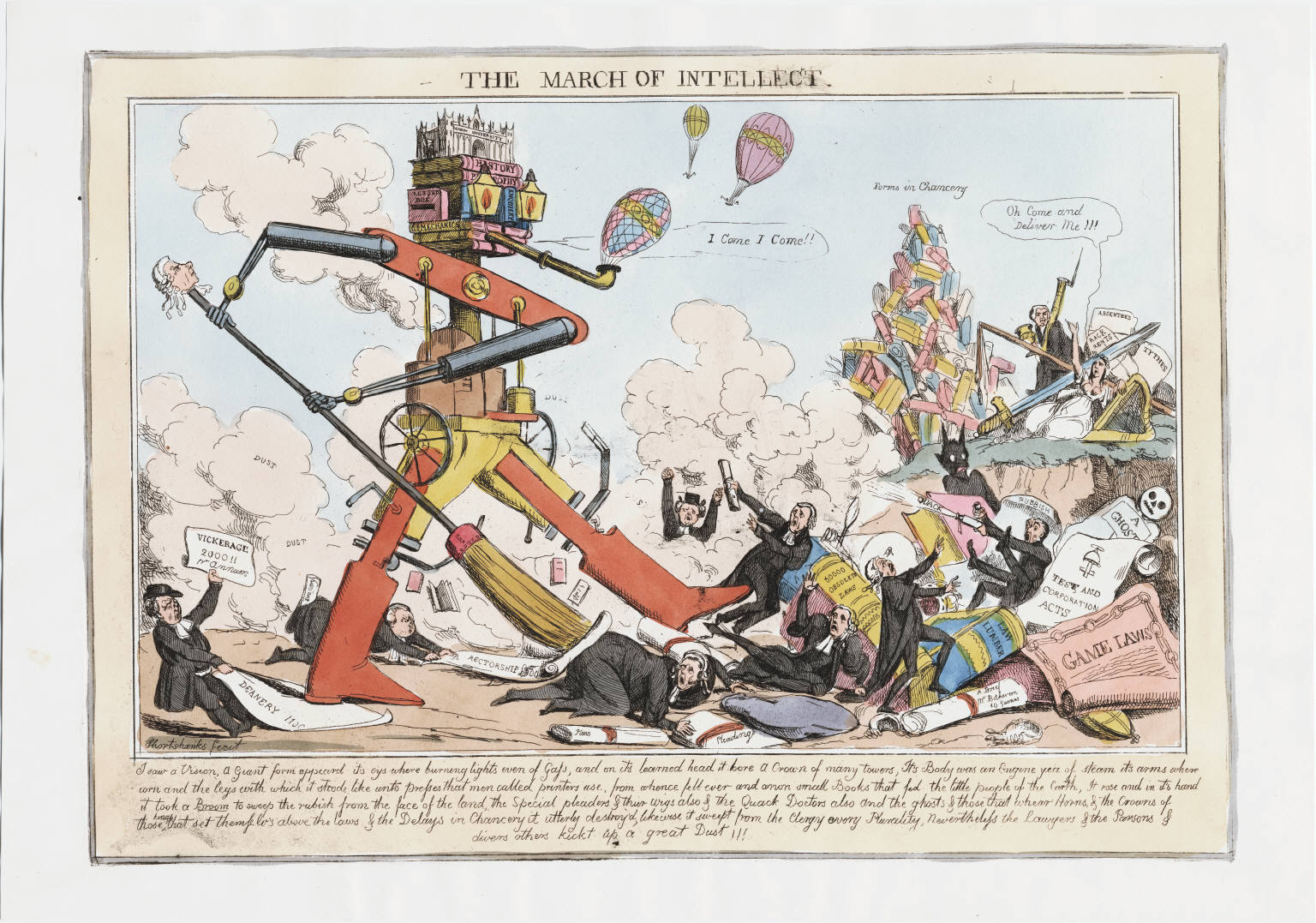
“I come, I come! cries the great machine of intellect, ushering in the universal availability of information.” (The British Museum, 1828)
In any event, according to Secord the “secular millennium of useful knowledge trumpeted by Brougham in 1825 never arrived.” While the utopia quickly faded, a new prophetic ethos emerged, which “fed into a deeper and more lasting current of belief in progress.” Every author Secord discusses assumed that science “revealed the laws instituted by divine providence that underpinned the material and spiritual advance of civilization.” This is worth reflection. To these men and women, God had bestowed upon Britain a divine commission to “spread enlightenment across the globe.” They had a powerful vision of progress, and they used the new science to support it. Indeed, the new science need not lead to atheism or materialism. The metascientific works of the nineteenth century engaged the reader to reflect on “scientific law, the uniformity of nature, and divine goodness” simultaneously.
However, this rhetorical strategy was remarkably altered a generation later. The scientific naturalists retained the metaphysical belief in progress, but left out the doctrine of divine providence of Christian tradition. Another generation later, men and women now pay obeisance to scientists themselves.
Secord’s Visions of Science is readable, engaging, and informative. It is written however for a popular audience, with large text, spacing, and margins, encouraging annotations. Even the physical appearance of the book is inviting, the grey jacket cover going well with a black case cloth and red endpaper. His footnotes cite well-known authors, which provides guidance for further investigation. Some specialists will undoubtedly find faults and something to criticize. But it should be obvious at the outset that Secord pursued an non-specialist audience. A helpful Chronology follows the Epilogue, marking important political events and works published from 1819 to 1837. A guide to Further Reading follows, with classic and more recent works on science in nineteenth-century Britain. The work is printed on cheap paper, though, which made annotating difficult even with a fine round stic pen. There are also some embarrassing typos, such as, for example, when Secord writes “Book of Revelations” and “though” when he obviously meant “Book of Revelation” and “through.” This is surprise coming from editors of Oxford University Press.
These criticisms notwithstanding, James Secord has produced an important book. Both specialist and non-specialist will benefit from its insight and analysis of influential, early nineteenth-century popularizers of science.
Visions of Science: Thomas Carlyle
Posted on January 5, 2015 Leave a Comment
Scottish doctor and chemist Andrew Ure (1778-1857), in his The Philosophy of Manufactures (1835), proclaimed his era as “distinguished from every preceding age by an universal ardour of enterprise in arts and manufactures.” And of all the nations, “Great Britain may certainly continue to uphold her envied supremacy, sustained by her coal, iron, capital, and skill, if, acting on the Baconian axiom, ‘Knowledge is Power,’ she shall diligently promote moral and professional culture among all the ranks of her productive population.” He praised the “physico-mechanical” philosophy for all the blessings it has bestowed on society, “ameliorating the lot of mankind.” The manufacturer, through his factory of machines, and through the manipulation of nature, has produced “articles of necessity, convenience, or luxury, by the most economical and unerring means.” Ure compared the factory “to the muscular, the nervous, and the sanguiferous systems of an animal.” The machine has replaced the human. “Machinery, with little or no aid of the human hand,” he writes, “dispenses entirely with manual labour.”
Ure’s enthusiasm for the “Iron Man,” the great industrial and manufacturing revolution of the early decades of the nineteenth century, was shared by many. But there is another side to the story, of course. The factory was also the “dark Satanic mills” of William Blake’s 1808 poem. Hell had risen, with fog, mud, nightmare, darkness, and squalor, and engulfed the earth. Michael Thomas Sadler (1780-1835), British Tory MP and evangelical Anglican, decried the sorry lot of the factory worker, especially children. He put together a committee to investigate the poor conditions of the factories. He was awarded with much resistance from Whig politicians, who put together their own committee to investigate the findings of Sadler’s committee! The plight of the poor was no match for ideas of progress.

Thomas Carlyle (1795-1881)
In his last chapter, James Secord explores the work of Thomas Carlyle (1795-1881), who, in his well-known Sartor Resartus, serialized in Fraser’s Magazine from 1833-34, and published in a single volume in 1838, satirized men of science and their ideas and hopes of progress. Carlyle appears to be an odd selection in a book that discusses the work of science popularizers such as Davy, Babbage, Herschel, Somerville, Lyell, and Combe. But it is a fitting end, for Carlyle’s writings influenced—perhaps unexpectedly—the next generation of the men of science, the scientific naturalists.
Sartor begins by asking why, in a “our present advanced state of culture, and how the Torch of Science has now been brandished and borne about,” why has “little or nothing of the fundamental character, whether in the way of Philosophy or History, has been written on the subject of Clothes” (my emphasis). This was, of course, ironical. The author digresses into the great advances of science, declaring that “to many Royal Society, the Creation of a World is little more mysterious than the cooking of a dumpling.” Indeed, he goes on, “Man’s whole life and environment have been laid open and elucidated; scarcely a fragment or fibre of his Soul, Body, and Possessions, but has been probed, dissected, distilled, dessicated, and scientifically decomposed: our spiritual Faculties, of which it appears there are not a few, have their Stewarts, Cousins, Royer Collards: every cellular, vascular, muscular Tissue glories in its Lawrences, Majendies, Bichats.” All this deep and glorious scientific work, and yet no science of clothes!
But there is hope, for “Germany, learned, indefatigable, deep-thinking Germany comes to our aid.” While the Philosophy of Clothes languishes among the English, there is a man in Germany, a Professor Diogenes Teufelsdröckh (“god-born devil-dung”) of Weissnichtwo (“know-not-where”), who has published a treatise expressly on the subject, Die Kleider, ihr Werden un Wirken (“Clothes, their Origin and Influence). Kindly, Teufelsdröckh has sent a copy of this work to the present editor and narrator of Sartor. The rest of Sartor discusses the “difficulties,” “reminiscences,” and “characteristics” of Die Kleider.
According to Secord, Sartor is a parody, an ironic “inversion of the reflective scientific treatises that flourished around 1830,” an ad absurdam extension of mechanical philosophy as another author puts it. Many commentators have pointed out the similarities between Carlyle’s Sartor and Jonathan Swift’s (1667-1745) Tale of a Tub (1704) or Gulliver’s Travels (1726). But as Secord notes, although Carlyle indeed drew from these genres, he only did so “to undermine them, to demonstrate the impossibility of drawing sharp lines between different literary forms.” But of all literary forms, Carlyle unremittingly mocks the literature of scientific reflection. As Ralph Waldo Emerson observed, in the American edition of Sartor (Boston, 1837): “the manifest design of the work…is, a Criticism upon the Spirit of the Age,—we had almost said, of the hour, in which we live; exhibiting, in the most just and novel light, the present aspects of Religion, Politics, Literature, Arts, and Social Life.” It is a work, he continues, which will find its “way to the heart of every lover of virtue.”
Most contemporary readers, however, were confused by the work. At times prolix, paradoxical, and personal, many readers were puzzled and even angered by Carlyle’s mockery of Whiggism, with its talk of “Progress of the Species, Dark Ages, Prejudice, and the like.” Indeed, talk of the progress of science “finds small favour with Teufelsdröckh.”
In a chapter entitled “Natural Supernaturalism,” Carlyle calls for the “birth of a spiritually vital science that would release the human potential for action.” Here the “editor” discusses how Teufelsdröckh’s Philosophy of Clothes has attained “transcendentalism.” Teufelsdröckh asks whether a miracle is simply a violation of the Laws of Nature? But what, exactly, are the Laws of Nature? They are the fixed, unalterable rule of the Universe. But Sartor asks, “What those same unalterable rules, forming the complete Statute-Book of Nature, may be possibly be?
They stand written in our Works of Science, say you; in the accumulated records of Man’s Experience?—Was Man with his Experience present at the Creation, then, to see how it all went on? Have any deepest scientific individuals yet dived down to the foundations of the Universe, and gauged everything there? Did the Maker take them into His counsel; that they read His ground-plan of the incomprehensible All; and can say, This stands marked therein, and no more than this? Alas, not in anywise! These scientific individuals have been nowhere but where we also are; have seen some hand breadths deeper than we see into the Deep that is infinite, without bottom as without shore.
Laplace’s Book on the Stars, wherein he exhibits that certain Planets, with their Satellites, gyrate round our worthy Sun, at a rate and in a course, which, by greatest good fortune, he and the like of him have succeeded in detecting,—is to me as precious as to another. But is this what thou namest ‘Mechanism of the Heavens,’ and ‘System of the World’; this, wherein Sirius and the Pleiades, and all Herschel’s Fifteen thousand Suns per minute, being left out, some paltry handful of Moons, and inert Balls, had been—looked at, nick-named, and marked in the Zodiacal Way-bill; so that we can now prate of their Whereabout; their How, their Why, their What, being hid from us, as in the signless Inane?
System of Nature! To the wisest man, wide as is his vision, Nature remains of quite infinite depth, of quite infinite expansion; and all Experience thereof limits itself to some few computed centuries and measured square-miles. The course of Nature’s phases, on this our little fraction of a Planet, is partially known to us: but who knows what deeper courses these depend on; what infinitely larger Cycle (of causes) our little Epicycle revolves on? To the Minnow every cranny and pebble, and quality and accident, of its little native Creek may have become familiar: but does the Minnow understand the Ocean Tides and periodic Currents, the Trade-winds, and Monsoons, and Moon’s Eclipses; by all which the condition of its little Creek is regulated, and may, from time to time (unmiraculously enough), be quite overset and reversed? Such a minnow is Man; his Creek this Planet Earth; his Ocean the immeasurable All; his Monsoons and periodic Currents the mysterious Course of Providence through AEons of AEons.
We speak of the Volume of Nature: and truly a Volume it is,—whose Author and Writer is God. To read it! Dost thou, does man, so much as well know the Alphabet thereof? With its Words, Sentences, and grand descriptive Pages, poetical and philosophical, spread out through Solar Systems, and Thousands of Years, we shall not try thee. It is a Volume written in celestial hieroglyphs, in the true Sacred-writing; of which even Prophets are happy that they can read here a line and there a line. As for your Institutes, and Academies of Science, they strive bravely; and, from amid the thick-crowded, inextricably intertwisted hieroglyphic writing, pick out, by dexterous combination, some Letters in the vulgar Character, and therefrom put together this and the other economic Recipe, of high avail in Practice. That Nature is more than some boundless Volume of such Recipes, or huge, well-nigh inexhaustible Domestic-Cookery Book, of which the whole secret will in this manner one day evolve itself, the fewest dream.
There is an obvious and quite deliberate echo of God’s response to Job in the Hebrew Bible: “Where were you when I laid the earth’s foundation? Tell me, if you understand. Who marked off its dimensions? Surely you know! Who stretched a measuring line across it? On what were its footings set, or who laid its cornerstone—while the morning stars sang together and all the angels shouted for joy? (Job 38.4-7).
Lest we think Carlyle a Luddite or anti-scientific, we should recall, as Secord reminds us, that he excelled in mathematics while at the University of Edinburgh; indeed his first job was teaching mathematics at Annan Academy, a preparatory school for boys in Scotland. He was also a paid assistant of David Brewster (1781-1868), one of the founding members of the British Association for the Advancement of Science. “Carlyle’s ability to mock the developing traditions of scientific writing,” Secord writes, “drew on long experience of teaching, translating, and reviewing.”
Carlyle had become disillusioned from with contemporary science at a young age. In an 1822 article he had written for Brewster’s Edinburgh Encyclopedia on the French mathematician, physicist and philosopher Blaise Pascal, Carlyle ridiculed Pascal’s famous calculator as “a wonderful but useless proof of its author’s ingenuity.” When he began pursuing studies in mineralogy, Carlyle was introduced to the work of Goethe, Schelling, and other writers of German Romanticism. Against the utilitarian philosophies of British thinkers, Carlyle was enraptured dynamic Naturphilosophie. He came to see mechanics as limited, “focused on applications, and based on experiment and observation; dynamics was primary, vital, and grounded in intuition.” Carlyle saw a need to reform natural philosophy once again, for contemporary philosophers and mathematicians were “turning so-called ‘useful knowledge’ into a Pascal-like engine for the mechanical transformation of every area of life.” This “mechanization” was the “Signs of the Times,” and it will drastically and poisonously alter every aspect of society.
Secord transitions from Sartor to the wider context to help us better grasp Carlyle’s denigration of the “Age of Machinery.” At the urging of Lord Brougham, the Society for the Diffusion of Useful Knowledge (SDUK) was founded in 1826 with the concerted goal of communicating every piece of “useful” information available to the working classes. But according to Carlyle, the “world of bookselling and publishing was as completely corrupted by mechanism as the rest of British society.” He mocked the SDUK in an 1833 article in Fraser’s Magazine. Fraser’s was known its satirical bite, for railing “against the utopian impracticality of schemes for universal education.” According to Secord, every “issue had articles mocking radicals and the reforming Whigs, especially their support for utilitarian political economy.” The new learning would only distract the worker. Ultimately, these aspirations were impractical. Worse yet, the new learning would endanger traditional values, “the schoolmaster peddling reason could be succeeded by the demagogue preaching irreligion and democracy.” In short, a periodical like Fraser’s was an ideal place for Carlyle to publish his Sartor.
In his call to reform science, Carlyle’s Sartor “became a spiritual guide for thousands of readers in Europe and America, especially [Secord tells us] young men in search of a creed to replace traditional Christianity.” The high calling of the man of science appealed, for example, to readers like Thomas Henry Huxley and John Tyndall. Both Huxley and Tyndall rejected materialism as a philosophy of life: “The evolution of matter and of life need not lead to a world devoid of spirit and governed solely by material processes.” As Sartor declares, the new men of science could “stand peaceful on his scientific watch-tower,” a truly “spiritual observatory.”
Visions of Science: George Combe
Posted on January 4, 2015 1 Comment
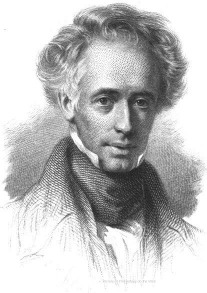
George Combe (1788-1858)
“Skulls do not lie.” That was the common motto among the phrenologists of the nineteenth century. In his sixth chapter to Visions of Science (2014), Secord examines the life and work of George Combe (1788-1858), the most read and well-known phrenologist of the nineteenth century. Most of what Secord writes in this chapter can be found in his earlier Victorian Sensation (2000). In addition, he makes use of previous studies, including Roger Cooter’s The Cultural Meaning of Popular Science: Phrenology and the Organization of Consent in Nineteenth-Century Britain (1984), and especially John van Wyhe’s Phrenology and the Origins of Victorian Scientific Naturalism (2004), which I have mentioned in another post, and Charles Gibbon’s biography of Combe in The Life of George Combe, Author of ‘The Constitution of Man’, 2 vols. (1878).
Long before Darwin published his Origin of Species (1859), doctrines of natural law had been peddled by Combe—yet Combe has been accorded no role in standard histories of evolutionary naturalism. Combe originally published his The Constitution of Man, Considered in Relation to External Objects in 1828 to a select audience, but starting in 1835, when W. & R. Chambers began publishing an inexpensive “People’s Edition” version of the text, Combe became one of the most widely-read authors of the century.
Combe had been influenced by the writings of Franz Joseph Gall (1758-1828) and Johann Spurzheim (1776-1832), who had effectively argued that the brain was the organ of the mind, and its relative size and shape dictated the development of an individual, intellectually, morally, emotionally, and so on. Combe argued that so-called “natural laws” of phrenology were essential for living rightly, “as a first step towards self-help and not being misled by others.” As Secord writes, “readers could achieve the self-knowledge that would allow them to change their circumstances and act appropriately in a rapidly changing and increasingly individualistic world.”
Combe’s argument was immensely attractive to Victorians. Novelist Margracia Loudon, for example, read Constitution at least three times, sparking “an experience akin to a religious conversion.” As she writes in a letter to a friend:
…never was I so entirely delighted with any book. That one small volume seems to me to comprise more wisdom, of a kind practically applicable to the production of human happiness, than all the ponderous works put together that I have ever met with. All the vague aspirations after any thing true or beautiful, which I have ever traced, faintly gleaming through the mystic or inconsistent pages of other writers, appear to me to be, in Mr. Combe’s book, concentrated into a steady, cheering, guiding light, by which mankind, if they would be accept the aid it offers them, might feel assured of attaining true felicity, both temporal and eternal.
Combe’s Constitution proclaimed that the laws of nature were progressive. If we are to attain true progress, true happiness, we must obey these laws. “The first principle on which existence on earth, and all its advantages depend,” Combe writes, “is obedience to the physical and organic laws.”
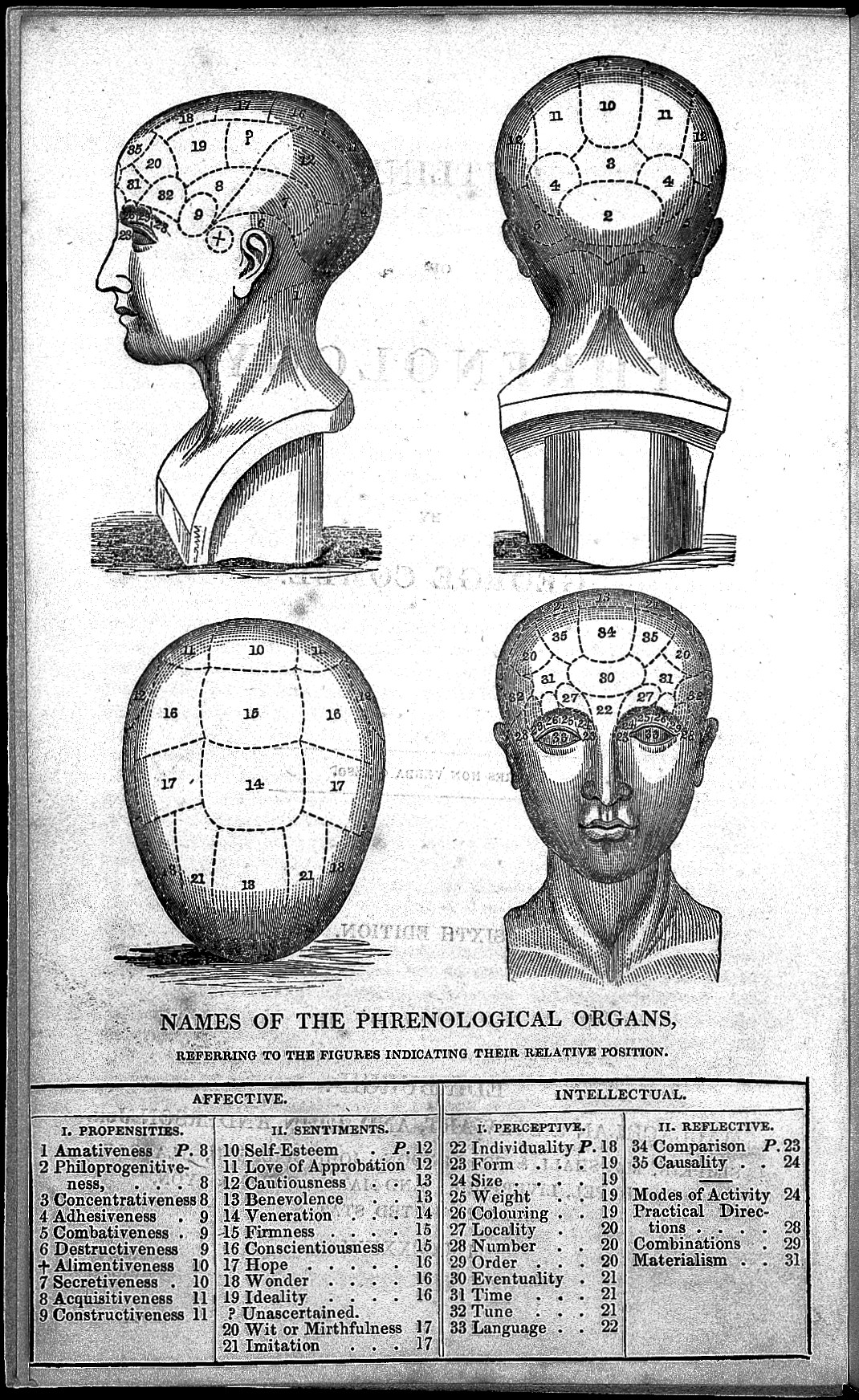
“Names of the Phrenological Organs,” from George Combe, Outlines of Phrenology (Edinburgh, 1836)
As Charles Lyell, Combe began as an Edinburgh barrister. During this time he came to reject the traditional Christian doctrines of human sin and redemption. He thought the philosophies of John Locke, Adam Smith, and Dugald Stewart too abstract to apply to everyday life. Although impressed with Spurzheim’s work as a surgeon, he was disgusted by the Burke and Hare scandal, who murdered and sold prostitutes for dissection at university anatomy lectures. Phrenology, he thought, ought to be more practical, “pursued primarily through skilled observations by experienced practitioners, rather than through dissection or physiological experiment…what really mattered was the skilled movement of the fingers of the trained phrenologist.”
Combe wanted to give phrenology a greater “scientific” status, and what better way to achieve this goal than through the printed word. He developed a network of followers who published “primers, introductory surveys, advanced textbooks, and journals” on phrenology. From polemical pamphlets and treatises to standard works of scientific reference, Combe pushed for the respectability and scientific status of phrenology.
More than geology, the science of the mind was by far the most contentious of the new “sciences.” Radicals such as Thomas Hope (1769-1831), Richard Carlile (1790-1843), William Lawrence (1783-1867) and others used the new science for their materialist philosophies.
Combe wanted phrenology to be respectable, so when Scripture or theology came up in his Constitution, he discussed them in “reverential terms and claimed to be compatible with every word in the New Testament.” Combe feigned humility when he said that natural law did not ensure salvation. The problem, as Secord points out, “was that Constitution maintained that understanding the laws of nature must be a preliminary to all religious instruction, so that the Bible needed to be interpreted in light of the Constitution rather than the other way around.” Of course, the greatest fear among evangelical readers was that the “laws of nature revealed by science would replace the need fro a caring God.”
These fears were amplified when sales of the Constitution reached unprecedented numbers. However, like the rest of the authors Secord discusses, Combe was no atheist. For Combe, God had created a progressive system, and if humans truly wanted to improve themselves, they had to obey these progressive, natural laws. Indeed, “an understanding of the natural laws was an essential prerequisite to appreciating the higher truths of Christianity.”
So, why was Combe’s Constitution so appealing? According to Secord, Combe did not tell his readers what they did not already believe. Certain prejudices and assumptions about race, gender, and class were readily available to Victorians. What Combe achieved was giving these assumptions the veil of “scientific” status. As Seocrd observes, “it allowed readers to interpret the character of others as expressed in their behaviour, whether they were intimate relations, strangers on the street, or potential political allies.” This desire to judge character based on material or outward appearances became a “science” under Combe. Futhermore, the Constitution “motivated an understanding of one’s own mind that was at the core of the developing idea of self-help, while showing how that understanding could be used towards broader aims and social transformation.” Indeed, it provided the “underpinnings for a whole range of Victorian reform movements, from removing Church control over education to repeal of the taxes on corn.” In short, it provided both political and metaphysical assumptions under the guise of “science.”
“In this world of masks, misleading impressions, and the clutter of material things,” Secord concludes, “Constitution offered a way of using surfaces to penetrate to the underlying nature of individual character.”
Visions of Science: Charles Lyell
Posted on January 3, 2015 5 Comments

Charles Lyell (1797-1875)
James Secord opens his fifth chapter, which focuses on Charles Lyell’s (1797-1875) Principles of Geology (1830-33), by stating that geology had become the most contentious of the new sciences. But this requires some qualification. In Britain, where knowledge of the natural world was used to prove the existence, power, and wisdom of God, many leading geologists were clergymen. The situation was rather different in France, however, where leading intellectuals were anti-clerical.
The history of geology is complex and full of interesting characters. Hexamera, or commentaries on the creation account in the book of Genesis, have been part of the Christian tradition since the second century. “Sacred chronology,” as it was called, attempted to calculate the age of the earth based on the genealogies of the patriarchs recorded in Genesis, Jewish lunar calenders, and pagan histories. There was no consensus among chronologists, however. The most famous (or infamous) of course was the date offered by James Ussher (1581-1656) in his Annals of the Old and New Testament (1650).
With the advent of mechanical philosophy, many thinkers attempted to give a new and more refined account of the earth. René Descartes (1596-1650), John Ray (1627-1705), Thomas Burnet (1635-1715), William Whiston (1667-1752), and John Woodward (1667-1728) had used prevailing mechanical theories to explain the formation and changes of the earth, now called geomorphology. Yet these thinkers proposed mechanical theories that accorded with the biblical account.
The presence of organic fossils, however, had always presented a challenge to the traditional biblical narrative. At the dawn of the eighteenth century, the discoveries and theories of Carolus Linnaeus (1707-78), George Louis Leclarc, Comte de Buffon (1707-88), Pierre Simon Laplace (1749-1827) and others had made it increasingly difficult to reconcile a literal reading of “days” in Genesis with observations from nature. Despite these difficulties, biblically focused geology continued throughout the eighteenth century, in the work of, for instance, Jean-André Deluc (1727-1817), John Townsend (1739-1816), John Macculloch (1773-1835) and others.
What has been called “naturalistic” or “secular” theories of the earth arose from seventeenth century deism. Perhaps the most successful was Scottish gentlemen farmer James Hutton (1726-97). In his Theory of the Earth (1795), Hutton proposed an immensely old earth to explain its changes, completely circumventing the “biblical” time scale. Independent of Hutton, French deist Jean-Baptiste de Lamarck (1744-1829), a protégé of Buffon, likewise proposed an immense age to the earth. And George Cuvier (1769-1832), a devout Protestant, viewed the flood as one of a series of dramatic natural events, but like Hutton and Lamarck, he understood the earth to be extremely old. In 1813, Cuvier explained that there had been a series of great geological “catastrophes” in earth history. These, he supposed, wiped out species in restricted regions. John Playfair (1748-1819) popularized Hutton’s work in his Illustrations of the Huttonian Theory of the Earth (1802) the following century, and in 1822, English geologist William Daniel Conybeare (1787-1857) accepted the Huttonian theory to explain the elevation of mountains and continents. Indeed, Hutton’s ideas—as conveyed by Playfair—would serve as the foundation of Lyell’s Principle of Geology. As Secord writes, “Playfair’s Illustrations presented geology as a science which dealt with stable systems operating under unvarying laws. Lyell never seems to have read Hutton’s original publications, but he used Playfair’s works extensively.”
Secord claims that the Principles of Geology was used “to come to terms with the consequences of scientific findings in relation to the biblical accounts of the Creation and the Flood.” He nicely sums up the central argument of these book thus: “Those studying the history of the earth should carry out their investigations under the assumption that causes now visible (volcanoes, rivers, tidal currents, earthquakes, storms) are of the same kind that have acted in the past, and have done so with the same degree of intensity as in the present.” In a well-known aphorism, Lyell held that “the present is the key to the past.”
Lyell was born and raised in a moderate Tory environment. By the time he began writing his Principles, however, his sympathies were becoming ever more Whiggish. At Oxford he encountered a geology of a particularly devout kind. For example, he attended the lectures of Rev. William Buckland (1784-1844), his first teacher in geology, and who also spoke of the earth as “millions of millions of years” in age in his Reliquiae diluvianae (1823). His interpretation was sanctioned by many leading Anglican theologians, including John Bird Sumner (1780-1862) and E.B. Pusey (1800-82). In Buckland’s scheme, the Bible covered only the history of mankind, not the rest of creation. According to Secord, Buckland offered his students a “romantic vision of the progress of life through countless ages, populated by strange animals perfectly adapted to even stranger physical conditions, and culminating in the creation of the human race.”
By the mid-1820s, Lyell was an ardent liberal Protestant. Although trained as a barrister, he saw in science a “refuge from political and religious strife.” Lyell abandoned the attempt to harmonize Genesis and geology in detail, finding in Genesis religious truths, such as God’s creation of all things, but no science. Like many others, Lyell argued for a greatly expanded time frame for Creation.
Lyell published his first edition of the Principles through John Murray. But this was intended for a limited audience. He “targeted a conservative and respectable readership,” writes Secord. He wanted to convince gentlemen and ladies that geology was not anti-Bible and anti-Christian, and that it had nothing to do with materialism. He wrote for “an enlightened clerisy of truth-seekers,” and “saw no need for ordinary readers to master all the research and reasoning that had gone into the making of knowledge.”
Lyell challenged Cuvier’s “catastrophist” perspective, arguing that all earth movements were slow and gradual on the same scale as modern volcanoes, rivers, tidal currents, earthquakes, and storms. According to Lyell, a scientific, vera causa geology did not admit the existence of catastrophes, especially the like of which had never been observed. Lyell claimed that the laws of nature have not changed over time, that the kind of causes operating now have not changed, and that the intensity of these causes have always remained the same. Catastrophist speculations were not science and therefore had no place in geology.
As a science, moreover, geology should have nothing to do with providential interventions. Lyell’s theory was similar to Hutton’s. William Whewell (1794-1866), Master of Trinity College, Cambridge, had coined the terms “uniformitarianism” and “catastrophism” in 1832 in his review of Lyell’s Principles, and firmly assigned Lyell to the uniformitarian camp. Lyell, it has been said, envisaged a “steady-state” earth, and as far as he was concerned, there was no overall change in any particular direction—that is, no “progress.”
But as Secord observes, Lyell did see progress in the history of mankind. Nature was static, to be sure; but humanity was progressive. While he “rejected the possibility of constructing any narrative ‘story of the earth,'” Lyell nevertheless saw the history of mankind as “militantly Whiggish, developmental, and progressive.” Interestingly, many of his contemporaries claimed that the stratigraphic record did show progress in nature. Clerical geologists, such as Buckland and Adam Sedgwick (1785-1873) gladly connected their geological findings with biblical history and Christian eschatology.
Whewell’s label for Lyell was not entirely fair. In public statements, Lyell “no more advocated a steady-state, cyclical, or non-progressionist cosmology than he did progression itself.” Indeed, no narrative was possible, for “too much of the record had been lost.” Nevertheless, he saw uniformity as the guiding principle of geologists, and science in general.
Lyell’s Principles were well-received, even among religious reviewers. But this should come as no surprise. By the mid-nineteenth century, most clergy geologists acknowledged that the earth was a great deal older than the 6,000 years of Ussher’s “biblical” chronology. Nevertheless, Lyell’s attempt to completely free geology from Moses remained controversial. Indeed, in his polemical “historical sketch of the progress of geology,” Lyell considered the clergy as the chief obstacle of geology. He writes, “the progress of geology is the history of a constant and violent struggle between new opinions and ancient doctrines, sanctioned by the implicit faith of many generations, and supposed to rest on scriptural authority.”
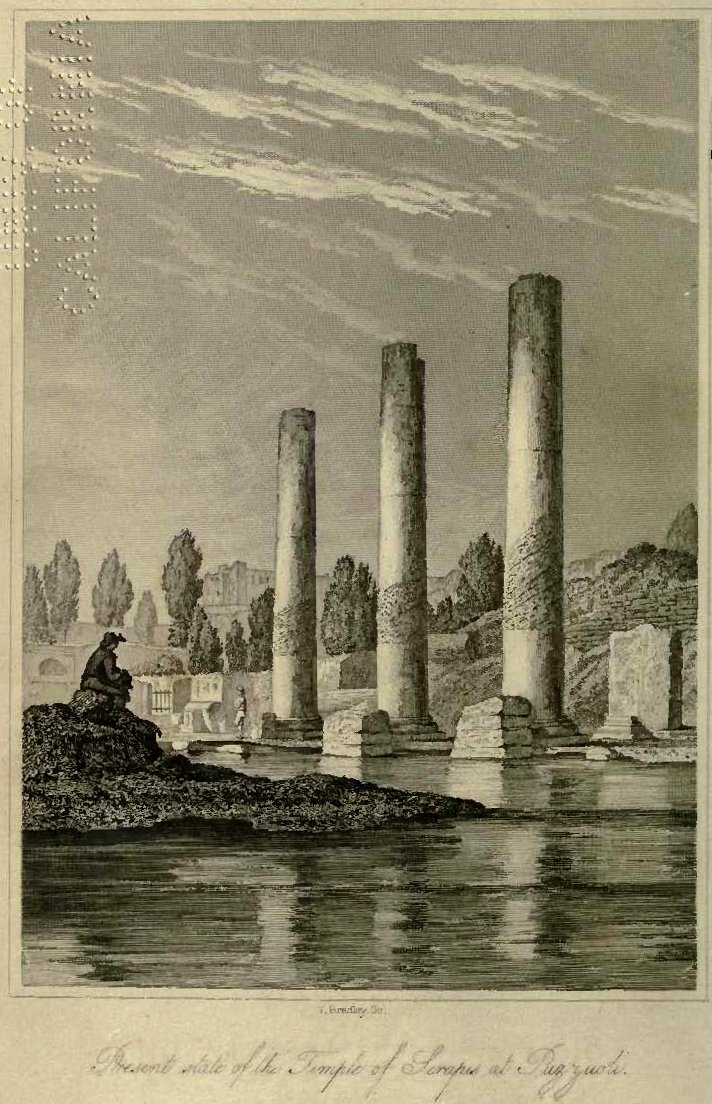
The Temple of Serapis, frontispiece to Lyell’s Principles of Geology (London: Murray, 1830)
At the same time, Lyell was not trying to undermine the clergy. In fact, he wanted to show that change did not mean complete destruction, as the frontispiece of the Principles demonstrates. All of this appealed to more liberal-minded clergy and readers. Lyell felt confident that his book “will be thought quite orthodox and would only offend the ultras.”
But as Secord points out, the new geology had unintended consequences. Both atheists and deists used geology to “give the stamp of authority to unbelief.” There were particularly dangers in questions of human species. In his Philosophie zoologique (1809), for instance, Lamarck had argued for the evolution of one species to another, that is, “transmutation.” When Lyell visited Paris, Secord tells us, he was “shocked to discover that transmutation has met with some degree of favor from many naturalists.” But in his Principles, Lyell argued transmutations as “untenable.” This rejection was part and parcel of his uniformity principle. Since there is no progressive history of life, no progress was possible, and therefore no evolutionary transmutation. Moreover, his readers “needed to be shown that geology was safe,” and thus French ideas of transmutation needed to be crushed. But more than this, Lyell himself was religiously appalled by the doctrine of transmutation. As Secord notes, his private notebooks revealed a deep-seated contempt for transmutation. Secord writes:
If transmutation was true, these notebook entries suggested, no divinely implanted reason, spirit, or soul would set human beings apart; they would be nothing but an improved form of apes that he watched, fascinated, at the newly opened London Zoo. Transmutation was a dirty, disgusting doctrine, which raised fears of miscegenation and sexual corruption. Not only did transmutation repel Lyell’s refined aesthetic sense, it undermined his lofty conception of science as the search for laws governing a perfectly adapted divine creation. With humans no more than better beasts and religion exposed as a fable, the foundations of civil society would crumble, just as they had done in revolutionary France.
It was his reading of Lamarck’s Philosophie zoologique in 1827 that motivated Lyell to deny all grand narratives of progress.
Visions of Science: Mary Somerville
Posted on December 29, 2014 3 Comments
Jeffrey Burton Russell, in his remarkable Inventing the Flat Earth (1991), wrote that the “Flat Error,” the myth that medieval thinkers insisted that the earth was flat, continues to survive because, firstly, we wittingly or unwittingly “repeat and propagate errors of fact or interpretation”; secondly, we are often led by our “biases more than by the evidence”; thirdly, we blindly privilege certain systems over others; fourthly, our assumptions about “progress” leads us to “devalue the past in order to convince ourselves of the superiority of the present”; and finally, such “myths” take on a “life of their own, creating a ‘cycle of myths’ reinforcing one another.” Most recently, Maria Popova, the author of the usually excellent Brainpickings blog, in celebrating the life of Mary Somerville (1780-1872), has fallen into such blunders. On her Twitter account, Popova claimed that the word “scientist” was coined for a woman, that being Somerville. She then links the tweet to a specious article with an entirely misleading hook:
Not only did Scottish mathematician, science writer, and polymath Mary Fairfax Somerville (December 26, 1780—November 28, 1872) defy the era’s deep-seated bias against women in science, she was the very reason the word “scientist” was coined: When reviewing her seminal second book, On the Connexion of the Physical Sciences, which Somerville wrote at the age of 54, English polymath and Trinity College master William Whewell was so impressed that he thought it rendered the term “men of science” obsolete and warranted a new, more inclusive descriptor to honor Somerville’s contribution to the field.
Thony Christie, at The Renaissance Mathematicus, has done a fine job debunking Popova’s claim, and has himself written some insightful comments about Somerville. In brief, Whewell did not coin the word “scientist” on Somerville’s behalf. Besides, according to Sydney Ross’ excellent article, “Scientist: The Story of a Word” (1962), British men of science detested the word. “To them,” Ross wrote, “the word scientist implied making a business of science; it degraded their labours of love to a drudgery for profits or salary.” The Duke of Argyll regarded the word with “great dislike,” as did Grant Allen and Lord Rayleigh. John Lubbock had never used it himself, and preferred the old word “philosopher.” And Thomas Henry Huxley was quite unequivocal: “To any one who respects the English language, I think ‘Scientist’ must be about as pleasing a word as ‘Electrocution.'”

The Brilliant Mary Somerville
At any event, another insightful guide is, of course, James Secord’s Visions of Science (2014), particularly his fourth chapter, which is dedicated to Mary Somerville. Since my knowledge of Somerville was very limited, after reading Secord’s chapter I spent most of the day reading various articles and works on Somerville, some already cited in Secord, and some not. Besides the ones cited in Secord, which I will mention below, I have found useful Elizabeth C. Patterson’s “Mary Somerville,” The British Journal for the History of Science, vol. 4, no. 4 (1969); Claire Brock’s “The Public Worth of Mary Somerville,” British Society for the History of Science, vol. 39, no. 2 (2006); and Patricia Fara’s “Mary Somerville: A Scientist and her Ship,” vol. 32, no. 3 (2008). In addition, some contemporary sources, for example, “Mrs. Mary Somerville, The Leisure Hour (Oct 7, 1871); “Mrs. Somerville,” The Illustrated Review (Dec 1872); The Morning Post (Dec 2, 1872); The Times (Dec 2, 1872); “Mrs. Somerville,” The Saturday Review (Dec 7, 1872); The Athenaeum (Dec 13, 1873); The British Quarterly Review (Jan, 1874); “Mary Somerville,” The Quarterly Review (Jan, 1874);The Academy (Jan 3, 1874); “Mary Somerville,” Chambers’s Journal (Jan 17, 1874); “Mary Somerville,” Good Words (Dec, 1875); “Mary Somerville,” Blackwood’s Edinburgh Magazine (Jun, 1888); and finally “An Evening with Mrs. Somerville,” The Leisure Hour (Nov, 1892), have also increased my understanding of Mary Somerville’s life and work.
Secord is an authority on Somerville. In addition to this chapter, Secord is the editor of a nine-volume Collected Works of Mary Somerville, published by Thoemmes Continuum Press (2004). Of course, her most well-known works were The Mechanism of the Heavens (1831) and On the Connexion of the Physical Sciences (1834). “Connexion” is the operative word. After the discovery of the relation between electricity and magnetism in the 1820s, Secord tells us, “there were tantalizing indications of a unity underlying all physical phenomena.” The prospects of a “theory of everything” loomed large mid-century. The great physicist James Clerk Maxwell (1831-79), in his article “The Correlation of Physical Forces, Nature (1874), recognized this as Somerville’s aim, writing: “Mrs. Somerville’s book on the ‘Connection of the Physical Sciences’ was published in 1834 and had reached its eight edition in 1849. This fact is enough to show that there already existed a widespread desire to be able to form some notion of physical science as a whole.” According to Somerville, mathematics was the “most promising source of ultimate unity.”
Henry Brougham had approached Somerville in 1827 to write an accessible version of Pierre-Simon Laplace’s massive five-volume Traité de mécanique céleste (1798-1827) for English readers. Brougham, as we have seen, had an “almost unlimited hope for the possibilities of readers achieving enlightenment through self-education.” How best to make such a complex text accessible, he had no doubt that Somerville was up to the task. Brougham saw her as “someone who exemplified in her person the virtues of self-help that would be required more widely in the population if the proposed work was to succeed.”
Secord goes on to give a brief biography of Somerville, drawn from her own Personal Recollections, from Early Life to Old Age of Mary Somerville, edited by her daughter Martha Somerville and published by John Murray in 1874. She was the only daughter of Admiral Sir William Fairfax, who initially opposed her natural curiosity. According to Patterson, she “grew up in the freedom of a hearty outdoor life, which fostered a robust constitution and an abiding interest in and love of plants and animals, but with so little formal education.” All together, Somerville had only twelve months of formal schooling. But she was an “Edinburgh belle,” attracting the best circles of Edinburgh society. Her first husband had a “low opinion of the capacity of…[the female] sex,” but “had neither knowledge of nor interest in science of any kind.” He died in 1807. As a widow, she developed genial relationships with leading intellectuals. In 1812 she married again, this time to the more liberal-minded William Somerville, an army doctor and later physician to the Royal Hospital. William and Mary were enthusiastic travelers, making frequent Continental tours, where they both enjoyed the company of many European savants.
When Brougham approached Somerville, many other women had become well-known popularizers of science. Maria Edgeworth, Sarah Trimmer, Priscilla Wakefield, Jane Marcet, and Margaret Bryan were active popularizers during the first half of the nineteenth century. Bernard Lightman, in his erudite Victorian Popularizers of Science (2007) has called this group of female popularizers the “maternal tradition,” for they addressed themselves to an audience of uninformed women and children. Later, mid-century, the “maternal tradition” was redefined by a “golden age” of female popularizers of science, such as Arabella Buckley, Phebe Lankester, Sarah Bowdich Lee, Mary Ward, Anne Pratt, Anne Wright, Margaret Gatty, Rosina Zornlin, Mary Roberts, Jane Loudon, Elizabeth Twining, Lydia Becker, Mary Kirby, and others still. But as both Lightman and Secord point out, Somerville did not belong to the “maternal tradition.” She was atypical, writes Lightman, in the sense that she “addressed knowledgeable adults, including men.”
Indeed, her original publisher, Brougham’s Society for the Diffusion of Useful Knowledge, refused to publish her Mechanism because they feared it was too technical and voluminous. John Murray, who was a cordial friend of the Somervilles, published it in 1831, including her later Connexion in 1834. Both texts are made for drudgery reading, however. Dense, abstruse, and full of technical terms such as “apsides,” “ellipse,” “cosine,” “isogeothermal,” “perturbations,” “eccentricities,” leading to an extensive glossary, they are demanding reading. Somerville, moreover, continually revised her Connexion, later editions becoming “longer, more authoritative, didactic, and ponderous.” But as Secord points out, “the value of Somerville’s labours would not be in making French celestial mechanics accessible to the millions, but as a symbol.”
She had a “reforming zeal,” and was liberal minded both in politics and religion. She stressed the interconnections and interdependences found in nature. In some editions of her Connexion, a quotation from Francis Bacon appears on the title page, “No natural phenomenon can be adequately studied in itself alone—but, to be understood, it must be considered as it stands connected with all Nature.”
But the “most obvious and immediate significance of Connexion,” Secord tells us, “was theological.” Somerville had shown that the mathematical laws of French celestial mechanics need not lead to atheism or materialism. As Secord puts it, “the connected explanation of these laws provided by science is not seen as support for a thorough-going materialism, as it had been by Laplace, but rather as evidence of God’s all-knowing foresight.” Indeed, the Connexion closes with a profound declaration that mathematics is the highest form of theology:
These formulae, emblematic of Omniscience, condense into a few symbols the immutable laws of the universe. This mighty instrument of human power itself originates in the primitive constitution of the human mind, and rests upon a few fundamental axioms which have eternally existed in Him who implanted them in the breast of man when He created him after His own image.
Somerville had been raised within a Scottish Presbyterian tradition, but she “never could find God in formal church-going.” Rather, she found the “divine transcendence of God’s power” in the language of mathematics. Later in life she would became sympathetic toward the rational religion of the Unitarians. As Secord aptly puts it, “Somerville may have abandoned traditional Christianity, but she had replaced this by a passionate faith in a God who could be best understood through mathematics.” One final interesting element of Somerville’s thought that Secord draws our attention to is her ready acceptance of commercial progress and imperial expansion. As Fara also shows, “Somerville gave her name to a ship that carried British products around the world, and portrayed herself as an ideal role model for women and also an exemplar of European civilization.” Her Whig political leanings, her transcendent theology, and her rejection of the divinity of Christ, were combined with an English imperial ideology that viewed English society as civilization, progress, and the future of mankind.
Visions of Science: John Herschel
Posted on December 28, 2014 2 Comments
In his Reflections on the Decline of Science in England (1830), Charles Babbage ushered in the authority of astronomer John F.W. Herschel (1792-1871) as testimony that science in England was in decline. In a footnote to his article on “Sound” in the Encyclopaedia Metropolitana (1817-45), Herschel lamented about the “crude and undigested scientific matter” found in English scientific journals. He complained that there were “whole branches of continental discovery” that remained “unstudied, and indeed almost unknown, even by name” among English scientists. Babbage had sent a draft manuscript to Herschel of his Decline of Science in 1830. And although he agreed with Babbage’s reforming goals, he nevertheless recommended that he “burn it, or rewrite it.” According to Secord, Babbage had “blazoned” Herschel’s footnote, “as testimony that science was in a bad way.” But Herschel so deeply regretted this association to the declinist position that, after reading the draft, he told Babbage that “if I were near you and could do it without hurting your and thought you would not return it with interest I would give you a good slap in the face.”

A wild-eyed John Herschel late in life
John Herschel is the next key figure in Secord’s Visions of Science (2014). Herschel wanted to see science reformed just as much as Babbage did, “but feared the execution in Decline a disaster from which it would be difficult for science to recover any shred of reputation.” This was not simply because he hated public controversy; rather, he saw science as a “conduct to everyday life.” In this sense, Babbage’s polemical writing lacked the qualities and character of the true man of science.
Secord begins by pointing out that Herschel’s most well-known work, Preliminary Discourse on the Study of Natural Philosophy (1831) was unlike any other philosophical treatise published at the time. “Given its low price and large sales,” he says, “readers of the Preliminary Discourse were far more likely to have used it as a conduct manual” (my emphasis). According to Secord, “conduct manuals gave instructions, not only about table etiquette and topics for conservation, but also about good character and appropriate mode of thinking.” As Herschel and many others saw it, “science was pervasively bound up with defining and maintaining canons of behaviour, from cultivating appropriate modes for discussion to encouraging the avoidance of outright fraud.” Indeed, science could “now provide a foundation for good character across the social spectrum.”
The book’s “material form,” as Secord puts it, supports his claim. The Preliminary Discourse was published by Longman for Dionysius Lardner’s “Cabinet Cyclopaedia,” and modeled from other encyclopedic “preliminary discourses,” such as Jean le Rond d’Alembert’s (1717-83) Encyclopédie of the eighteenth century, the Britannica (1771), Ree’s Cyclopaedia (1802), the Edinburg Encyclopaedia (1808), and the Encyclopaedia Metropolitana (1817). Further, it was a small book: machine printed, on lower quality paper, with stereotyping, bounded with glazed pink calico cloth over boards made of card, and sold for six shillings. Further still, Herschel modestly presented himself on the title pages as simply “John Frederick William Herschel, Esp., A.M., Late Fellow of St John’s College, Cambridge, &c. &C &c,” without, as Secord aptly puts it, “an ‘ostentatious parade’ of honours and societies trailing in its wake.” The Preliminary Discourse sold well and was translated into French, German, Italian, Swedish, and Russian.
Secord argues that the Preliminary Discourse emerged from the debates surrounding the decline of science, particularly in regards to the Royal Society. For Herschel conduct was central. “If Decline, with its polemical tone and political edge, was an example of how not to behave, the Preliminary Discourse could offer a model for the actions of the ideal seeker of after truth.” Indeed, as Secord perceptively points out, Herschel had accepted Lardner’s commission in February 1830; Babbage sent his daft manuscript in March 1830; and Herschel wrote most of the book in the summer of 1830, “immediately after the clashes over Babbage’s book.” In short, the Preliminary Discourse was a “quietly utopian vision of science and its public uses.”
The Preliminary Discourse wasn’t simply a philosophical treatise on observation, experiment, and induction. Because of its unimposing style, ordered structure, and humble tone, readers found it inclusive. It gave readers the impression, writes Secord, “that in understanding the Preliminary Discourse, they are engaged in the first steps of scientific study.” The text is grounded in the belief that “reading has the power to transform the human condition.” In reading, one can “vicariously” live through the scientist in “the act of discovery and an appreciation of natural truth.” As a result, humanity is “brought to the frontiers of human knowledge and ‘nearer to their Creator.'”
Indeed, this was Herschel’s chief aim in the Preliminary Discourse: to develop these “habits of the mind.” He wanted to distinguish between necessary and contingent truths. In mathematics we have what is necessary. The properties of a circle or square remain the same whether we are in broad daylight or the darkness of a cell. But the senses can be “tricksters or magicians.” Because we are often misled by our senses, “nature and its laws” are always contingent. Science, in short, must be modest.
This modesty in science has great moral and practical benefits. What Herschel offered was “a wider rational foundation for how to behave in everyday life.” As Secord notes, Herschel drew on a “tradition of the scientific pastoral, in which the contemplation of nature leads to an inner repose and the erasure of selfish, individual feelings.” Science would not only revitalize political life, it would ultimately lead us to “appreciate the need for a higher power, and avoid the brazen certainty of unbelief.”
Herschel’s book became so popular that newspapers, magazines, journals, and pamphlets mined it for quotations, “becoming set-pieces to be learned by heart.” And this “serial anthologizing,” particularly in cheap weeklies, afforded readers who could not afford to read Preliminary Discourse, whether for economic reasons or time constraints, to learn from its sagacious author. Scientific thinking was presented as a higher calling that almost anyone could now pursue.
Visions of Science: Charles Babbage
Posted on December 27, 2014 3 Comments
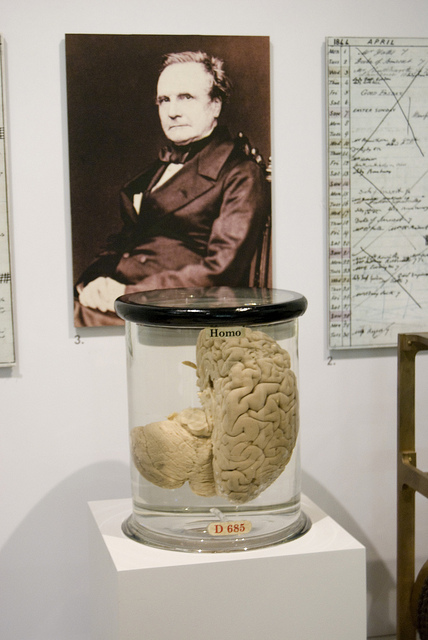
Charles Babbage’s brain in a vat at the Hunterian Museum
When he died, Charles Babbage (1791-1871), English polymath, mathematician, philosopher, engineer, and the “father of the computer,” donated one half of his brain to the Royal College of Surgeons, where it still sits in display today in the Hunterian Museum. The other half resides in the computing galleries of the Science Museum in London.
Fittingly, Babbage is the subject of Secord’s next chapter in Visions of Science (2014), and particularly his Reflections on the Decline of Science in England (1830), including his later Economy of Machinery and Manufactures (1832). With the death of Davy in 1829, “the loss of such a celebrated discoverer led to fears that the momentum achieved early in the century was petering out.” The most well-known, if not notorious, lament came from the pen of Babbage. According to Secord, the Decline of Science “portrayed English science as moribund and corrupt, and looked to the Continent, especially France, for models of scientific reform.”

The ‘Calculating Engine’ by Babbage
Known for his magnificent calculating engine, Babbage “believed that machines would ultimately reshape intellectual labor as fully as they were transforming the craft trades and manual work.” The relationship between science and technology was a much contested issue during the early decades of the century. From our own vantage point, science and technology is often represented as inextricably connected, closely intertwined, and coterminous. This is a view presented to us largely by the media and Hollywood. But this commonplace ignores the immense complexity of a long historical debate. Not only has the historical relationship between science and technology been in constant flux, but historical figures themselves have held conflicting views. Those who argued for a close relationship between science and technology associated both with state funding and the economy. But this is a historically situated argument. During the revolutionary Napoleonic era, for instance, “science” was harnessed for national benefit. But was this knowledge, pursued for the welfare of the state, “science”?
In the early twentieth century, historians of science such as George Sarton, Alexandre Koyré, Herbert Butterfield and others, would have said no. “Science,” Sarton said, “was about the production of truths, not technologies.” Koyré maintained that the great minds of the past, such as Galileo or Newton, were not engineers or craftsmen. Technological improvement was incidental, a mere by-product of the progress of science.
This view, it has been claimed, was a reaction against Marxist histories, which portrayed science as the offspring of economic and technological development. Marxist historians Boris Hessen, Edgar Zilsel and others, argued that the impetus behind modern science was its economic utility. This, in a qualified sense, was none other than Francis Bacon’s (1561-1626) view. Indeed, Bacon insisted that natural philosophy should be cultivated and put into the service of the commonwealth. Likewise, the founding of the Royal Society of London fostered a utilitarian view of science.
By the eighteenth century, France in particular sought to harness the technological potency of the sciences. New institutions such as the École Polytechnique, for example, were designed, write Peter J. Bowler and Iwan Rhys Morus in a different work, “to deliver an education in natural philosophy (to army cadets in particular) that was fully expected to result in technological and engineering expertise” advantageous to the state.
And here is where Charles Babbage enters the stage. His Decline of Science was an invective against the Royal Society for not pursuing science as the French and Germans had done. There was something “rotten in the [English] system.” Babbage was not alone in his critique, however. A number of newspapers, magazines, reviews, and pamphlets, including the Morning Chronicle, Lancet, and The Times, took note of the mismanagement of the Royal Society. Many saw it as a “bloated monopoly,” and called for the formation of new scientific societies, such as the Astronomical Society and Geological Society, a more “reformed, mathematically refined, and secure version of the subject.”
To this end, Babbage felt justified in naming names. That is, he sought a “public accounting” of the failures of specific members of the Royal Society. For example, in his Decline of Science he attacked specifically astronomer Edward Sabine as a charlatan. He justified his public character assassinations by arguing that “a true philosopher, faced by accusation of corruption and forgery, would remain calm. Only those with something to hid would react badly; openness was a sign of honesty.” This was polemic at its finest.
But Babbage, by attacking the of governance, leadership, and organization of the Royal Society, aimed at something bigger. As Secord writes, “reform of the Royal Society served as a model of what needed to be done more generally in politics and the emerging industrial economy.” Observation is relative. Thus Babbage called for a mechanism that would “calibrate observations.” More importantly, there was the problem of fraud. This included, says Secord, “hoaxes, forging, trimming, and cooking.” How does one ameliorate such a disease? By making science completely open. It must be open to adepts and experts alike. It must be, in short, public. And finally, moral character must be essential. “Freed of human subjectivity and foibles, the pursuit of knowledge would be manly ans secure, a suitable model for political action.”
In his next book, On the Economy of Machinery and Manufactures, Babbage targeted the dirty secrets of the book trade, and, in much the same way he did with members of the Royal Society, he very publicly attacked specific publishers and printers for their moral shortcomings. But all this came at a cost. In 1832 he accepted the nomination as a Whig parliamentary candidate for Finsbury. He lost to the Tories. “Many readers,” writes Secord, “were uncomfortable with the praise Decline heaped on foreign governments that gave honours, money, and status to scientific men.” Men such as William Robert Grove (1811-96), William Whewell (1794-1866), and George Bidell Airy (1801-92) were not as enthusiastic as Babbage was for the Napoleonic regime. Whewell and Airy, for example, saw “no merit in Babbage’s argument that state funding for science was essential to ensure continued technological progress.” Babbage seemed to bestow too much power to the state.
Even more disconcerting, however, Babbage seemed to invoke the trope of conflict between science and religion. As Secord notes, “the promotion of the use of knowledge for human needs, would best be served by secular—not religious—education; for among the unenlightened, even true religion was tinged by ‘superstition’ and developed irrational habits of thought.” Indeed, it seemed that Babbage maintained that science and the state would solve all problems: “Ministers of the state, with minds shaped by reason rather than tradition, would then be in a position to give scientific men the opportunities they needed for the research that would reshape the economy.”
Secord concludes this chapter with some comments that beg further explanation. For example, Babbage seemed to think that although mankind was the masterpiece of “divine power,” “other planets still loftier forms of intelligence will have appeared, the product of the same laws of nature.” For this “Almighty architect” had created the universe by a process akin to a calculating engine. And what “looked to ordinary observers like miracles of creation could be understood by the man of science as the intelligent actions of a divine machine.” Secord says no more than this about Babbage, thus leaving his reader wondering what, then, was Babbage’s religious views?
Visions of Science: Humphry Davy
Posted on December 26, 2014 1 Comment
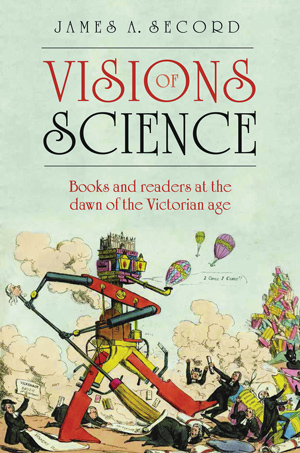 My Christmas gift this year was James A. Secord’s recent Visions of Science: Books and Readers at the Dawn of the Victorian Age (2014). After reading Secord’s magisterial Victorian Sensation: The Extraordinary Publication, Reception, and Secret Authorship of Vestiges of the Natural History of Creation (2000) earlier in the year, I have looked forward to Secord’s next big book. And Visions is a big book, not so much in page number (a mere 306, including endnotes, whereas Victorian Sensation was a massive 624) as in topic. Secord focuses on a series of remarkable books published in the early decades of nineteenth-century Britain. He discusses seven in total: Humphry Davy’s (1778-1829) Consolations in Travel (1830), Charles Babbage’s (1791-1871) Reflections on the Decline of Science in England (1830), John Herschel’s (1792-1871) Preliminary Discourse on the Study of Natural Philosophy (1831), Mary Somerville’s (1780-1872) On the Connexion of the Physical Sciences (1834), Charles Lyell’s (1797-1875) Principles of Geology (1830-33), George Combe’s (1788-1858) Constitution of Man (1828), and Thomas Carlye’s (1795-1881) Sartor Resartus (1836). I have read all but Somerville’s On the Connexion this past year in my research, so Secord’s insights on these works is a much welcomed aid.
Initially, the selection may appear odd. But Secord is interested in the great transformation of the sciences during this period. “Science,” he says, “was changing from a relatively esoteric pursuit into one known to have profound consequences for the everyday life of all men and women.” Each of the above authors, in this respect, had something profound to say about the future of science. Each author, in his and her own way, had stressed the need of science “as a remedy for the country’s social, political, and religious malaise.” More importantly, each author “projected a vision of the future.”
Secord sets up his project with a short introduction. Modern science emerged in Britain within a Christian atmosphere of apocalyptic and millennial ideas and hopes. But at the same time, Secord writes, “there was a sense of limitless possibility through projections of the future economy based on machines.” These utopian hopes were of course embodied within the new science. There was a danger in the new science, however. As Secord notes, “Paris was the scientific capital of the world in the 1820s.” But in the British mind, French science was associated with the naturalism or materialism of the philosophes. More importantly, concerns over the new science was directly associated with the shock of the French Revolution. Science had to be domesticated and disassociated from anything that smacked of the French, both from its “godless libertarianism” and its guillotines.
This was achieved by some of the authors that Secord discusses. They constructed an image of science as offering a way forward, as mending the current political tensions between the Tories, Ultras, and Whigs. This was a push toward reform, but not simply a reform in politics. It was an attempt to reform all aspects of society, knowledge, science, and religion. And this could only be achieved with what Secord calls “the mechanisms of intellect”; that is, the transformation of the production and availability of knowledge. The steam-powered printing press played a central role in the diffusion of the new knowledge. But so did the creation of new institutions, clubs, and societies, such as the Society for the Diffusion of Useful Knowledge (SDUK) in 1826. According to Lord Chancellor Henry Brougham (1778-1867), one of the founding members of the SDUK, the new science could be used as a route to political reform. In his short 1825 tract, Practical Observations upon the Education of the People trumpeted the new science as “nothing less than the complete reformation of society through knowledge.” Obstacles to self-improvement, says Brougham, are chiefly “want of money, and want of time.” He therefore promoted “cheap publications.” But more than that, he called for the publication of “our best authors upon ethics, politics, and history, and promote cheap editions of them in Numbers, without waiting until the demand was such as to make the sale a matter of perfect certainty.” To this end, new ambitious publishers emerged with the goal of diffusing the new knowledge to all classes of society, such as Archibald Constable, John Murry, the well-known Longman company, and most recently the enterprising brothers William and Robert Chambers. In short, these new books popularized science by using philosophy, religion, and history, thus rousing “metascientific” discourse. For “happily the time is past and gone,” writes Brougham in his Practical Observations, “when bigots could persuade mankind that the lights of philosophy were to be extinguished as dangerous to religion; when tyrants could proscribe the instructors of the people as enemies to their power.” Indeed, “it is preposterous to imagine that the enlargement of our acquaintance with the laws which regulate the universe, can dispose to unbelief.”
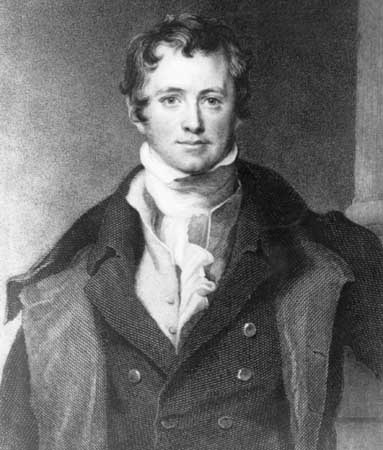
A young Humphry Davy (1778-1829)
Secord’s first chapter deals with Davy’s interesting Consolations in Travel. Davy was a well-known and well-regarded Cornish chemist, inventor, and president of the Royal Society. Davy’s book is constructed as a dialogue between Onuphrio (a liberal aristocrat), Ambrosio (a liberal Roman Catholic), Eubathes (a physiologist and naturalist), Philaethes (the narrator), and a “Unknown” stranger. The dialogue partners discuss the laws of history, divine progression, happiness, and the enlightenment of society.
According to Secord, Davy’s Consolations in Travel was modeled off of Boethius’ classic Consolation of Philosophy, Samuel Taylor Coleridge’s (a close friend of Davy) Consolations and Comforts from the Exercise of and Right Application of the Reason, the Imagination, and the Moral Feelings, and, perhaps more covertly, French philosopher Comte de Volney’s The Ruins: A Survey of the Revolutions of Empires. Boethius and Coleridge were safe, but Volney was dangerous grounds. Davy thus takes Volney’s narrative and transforms it for English conservatism. Whereas Volney sees “kingcraft and priestcraft” as passing away, “to be replaced by a faith unified around a God known not through Scripture or dogma, but the laws of nature,” Davy has each character in his dialogue acknowledge the value in religion, including Christianity. The skeptical aristocrat Onuphrio, for example, declares: “I consider religion as essential to man, and belonging to the human mind in the same manner as instincts belong to the brute creation, a light, if you please, of revelation to guide him through the darkness of this life, and to keep alive his undying hope of immortality.” But this is a new kind of Christianity. Onuphrio, for example, does not see Christianity as occupying a more privileged place than other religious traditions. Even Ambrosio, the Catholic in the dialogue, envisions a “creed fitted for the most enlightened state of the human mind and equally adapted to every climate and every people.”
After the men retire, Philaethes, the narrator, experiences a vision. In the vision Philaethes is guided by “Genius” through a journey on the history of humanity. Genius explains to him how civilization has progressed from the barbarous to higher states of being. This has been achieved in two ways. First, and most recently, by the invention of the printing press. “I looked, and saw,” says Philaethes, “that in the place of the rolls of papyrus libraries were no filled with books. ‘Behold,’ the Genius said, ‘the printing press; by the invention of Faust the productions of genius are, as it were, made imperishable, capable of indefinite multiplication, and rendered an inalienable heritage of the human mind. By this art, apparently so humble, the progress of society is secured.” Second, the progress of civilization has been accomplished by great men. “It sometimes happens,” Genius discloses to Philaethes, “that a gigantic mind possess supreme power and rises superior to the age in which he is born…but such instances are very rare; and, in general, it is neither amongst sovereigns nor the higher classes of society, that the great improvers or benefactors of mankind are to be found.” Davy than adumbrates a list of such men: “Anaxagoras, Archimedes, Roger Bacon, Galileo Gallilei, in their deaths or their imprisonments, offer instances of this kind, and nothing can be more striking than what appears to have been the ingratitude of men towards their greatest benefactors.” Genius goes on to reveal the laws of history, society, and spiritual natures to Philaethes.
In another dialogue, while the characters are exploring the ruins of the temples of Paestum, they encounter an “Unknown” stranger who introduces the topic of geology to their discussions, a touchy subject for both British scientists and religious believers at the time. Ambrosio believes in a single creation, but is not a scriptural literalist. Onuphrio promotes the cyclical geological theory of James Hutton. What all speakers agree on, however, is that there is no evidence for the transmutation of species, a position advocated by more radical thinkers Erasmus Darwin and Jean-Baptiste Lamarck. Philalethes argues that “all philosophy must begin from a foundation of faith, and that this can be validated not only by studying God’s works, but also by drawing parallels between the infinite mind of the divine and the mind of man.” It is interesting how the revelation of Scripture is replaced by a revelation of nature, or natural theology, in Davy’s dialogue.
Secord notes how some early reviews of Davy’s Consolations in Travel were highly critical. In general, however, Davy’s short book was well received. And what these more charitable reviewers focused on, from the Literary Gazette to La Belle Assemblée, was Davy’s spirit of progress. What is interesting about Davy, however, is that he was not at all enthusiastic about the spread or diffusion of scientific knowledge. In a letter to his wife, for example, he wrote:
I become, however, every day more sceptical as to the use of making or endeavoring to make the people philosophers. Happiness is the great object of existence, and knowledge is a good only so far as it promotes happiness; few persons ever attain the Socratic degree of knowledge to know their entire ignorance, and scepticism and discontent are the usual unripe fruits of this tree—the only fruits which the people can gather; but I will say no more, knowing how unpopular my arguments will be; yet I could say much.
According to Secord, Davy’s vision of universal history and the progress of European civilization “become a commonplace, moving from speculation to assumption as the century progressed.” The scientific sage of the philosophes had become a “scientific, Christian philosopher” in Davy. But this philosopher was not a philosophy of the people. Rather, he was the provincial, aristocratic gentlemen of science. According to Davy, with the help of “great men in history and in science” civilization will be reborn, “rising towards infinite wisdom.”
The Bodleian Library: A Protestant Arsenal against Catholicism
Posted on December 8, 2014 Leave a Comment
 The other day I began reading the introduction to Anthony Grafton’s Worlds Made by Words: Scholarship and Community in the Modern West (2009). This work is a collection of essays, originally published between 1983 and 2008, on the nature of scholarship. Grafton covers a wide-ranging set of topics, from The Republic of Letters to Google’s digitizing empire and the future of reading. Amidst such topics are concise, but erudite, discussions on Francis Bacon, Johannes Kepler, Isaac Casaubon, Mark Pattison, Leon Battista Alberti, Johannes Trithemius, Tommaso Campanella, his own postgraduate supervisor Arnaldo Momigliano, and the Warburg Institute of the University of London. Grafton also discusses John O’Malley and his work on the Jesuits, in addition to the relationship between Christian and Jewish learning in the seventeenth and eighteenth centuries.
What particularly struck me in the introduction was his reference to Paul Nelles’ essay on the Bodleian library of Oxford, “The Uses of Orthodoxy and Jacobean Erudition: Thomas James and the Bodleian Library” (2007). Citing Nelles, Grafton writes: “The Bodlien was created…to serve as an arsenal of erudition for the Protestant side in the great intellectual war that raged over the Christian past.” He goes on to say that Bodleian’s first librarian, Thomas James (1573-1629), “believed that Catholic scholars had deliberately corrupted the texts of the church fathers to make them support their theological positions.”
I immediately found Nelles’ piece with a quick Google search. Nelles begins his essay with a thought-provoking question: What was the Bodleian library for when it opened its doors in 1602? Whatever the intentions of its founder, Sir Thomas Bodley (1545-1613), as its first librarian, Thomas James set its early program. According to Nelles, James was a “rabid anti-papist,” and thus something of an embarrassment to historians of the library. Nevertheless, “the scholarly work James carried out as Bodley’s librarian affords a rare glimpse of the interaction of libraries, manuscripts, printed books, and the readers who used them.”
For three decades James labored at collecting the textual tradition of the Latin Church Fathers and Medieval English authors. According to Nelles, James’ scholarship became a “store-house of Protestant learning and a bulwark against Roman Catholicism or, in the language of the period, ‘popery.'”
Of course, James was not alone in this initiative. Indeed, Bodley supported his goals, and shared much of the same religious orientation. They were sons of Marian exiles, and both were strict Calvinists. While attending New College at Oxford from 1593-1602, James was surrounded by anti-Roman sentiment and theology. James eventually became a “profound student of manuscripts, an able textual scholar, and an acute reader of the church Fathers,” marshaling “library resources at Oxford and elsewhere in order to engage Roman Catholic theologians and church historians on their own ground.” He was convinced that the “historical roots of the modern English church were to be found in a pure Saxon ecclesiastical community which had conformed to the primitive church as described in the writings of the Fathers and the early councils.” His near contemporary, Richard Hooker (1554-1600), likewise used the writings of the Church Fathers in his Laws of Ecclesiastical Polity (1594) in sketching out the history of the English church. Others included John Jewel (1522-1571), Thomas Bilson (1547-1616), and Andrew Willet (1562-1621). In short, “by the early seventeenth century the use of the Fathers had emerged as a pivotal, though not uncontroversial, element within Anglican theology as the conformity of the contemporary reformed church with the primitive church.”
Another element in James’ scholarship was his emphasis on the historical continuity between ancient Christianity and the contemporary English church. According to Nelles, this view goes as far back as John Foxe’s (1517-1587) Book of Martyrs (1563), where he allegedly “documents the trials and tribulations of the ‘true church’ which had survived underground and invisible through centuries of papal corruptions and outright persecution.” James contributed to this tradition with his Apologie for John Wickliffe (1608).
And of course the final element of James’ scholarship is his obvious anti-popery. According to Nelles, “almost all of James’s published writings—particularly those devoted to textual scholarship—are directed against papist corruption and deception.” Nelles aptly summarizes this commonplace:
According to this view, attempts by the Bishop of Rome to control and corrupt Christian religion had been adroitly seen off within the early church: the church of the Fathers had not been subject to papal jurisdiction and at times could be seen to have been aggressively anti-Roman. Yet through deceit and treachery the pope had usurped Christ’s rightful place at the centre of the church over the course of the middle ages. The pope (now Antichrist) used all means possible to increase his power: he withheld the true teachings of Scripture; he appealed to popular superstition through liturgical hocus-pocus and abuse of the sacraments; and he invented traditions founded neither in Scripture nor the writings of the Fathers. From this perspective it was at the Council of Trent that the views of the popish minority came to dominate the church as a whole. Thus, while early Protestants had merely broken with Rome, the contemporary reformed church was engaged in a pitched battle with a united Roman Catholic church supported by foreign Catholic princes and receiving instructions directly from the pope.
In the case of James, he believed that papist corruption went beyond doctrine, the sacraments, and church government, extending to “falsification, corruption, and destruction of ecclesiastical records and the textual heritage of the church.” According to Nelles, James’ “conception of the history of the church and his unique vision of the value of the insular textual legacy directly influenced his views on the nature and purposes of books and libraries.”
For instance, in 1600, James published a catalogue of manuscripts housed in Cambridge and Oxford colleges. Dedicated to King James I, the palaeographical Ecloga Oxonio-Cantabrigiensis won much acclaim, the famous biblical chronographer James Ussher once told him that “you are in a manner the only man among us that make search for the furthering of God’s cause.” James saw himself in the tradition of “Elizabethan hunters of medieval manuscripts,” cataloging nearly 3,000 codices (1,325 in Oxford; 1,498 in Cambridge). But despite its scholarly character, according to Nelles, “James firmly positioned the Ecloga within the context of the paper war which raged between Catholic and Protestant scholars over the sources of church doctrine.” Indeed, the Ecloga was presented as a “gateway for Protestant scholars to an untainted manuscript tradition of patristic texts.” According to James, the Reformed church was supported and confirmed by authentic manuscripts, whereas the Catholics, “habitual liars and gross forgers,” were the true “heretics.” This was a well-known commonplace, from William Perkins to William Crashawe. As Nelles sums it up, “Armed with evidence of present-day Catholic suppression and altering of texts from the Index librorum prohibitorum and the Index expurgatorius and further justified by notorious medieval forgeries such as the Donation of Constantine and the False Decretals, Protestant polemicists imagined centuries of papist textual meddling.”
A few years later, James turned to the Latin Church Fathers, and again complained that they had been “manifoldly corrupted” by the hands of “Popery and superstition.” In his proposal, Humble Supplication…for the reformation of the ancient Fathers Works, James set out with a team of students of Divinity to hunt down as many manuscript copies as possible. Once completed, James maintained that this new index would “show the corruptions of the printed copies of either Papists or Protestant editions, which have been very lamentably abused in this kind by too much trusting of the Papists.”
James never finished this project, the financial support drying up by 1612. Nelles turns to James’ program as Bodleian librarian. Interestingly enough, although he remorselessly attacked Catholic scholars, it is clear that James appropriated much of their findings. “On most technical issues of scholarship,” writes Nelles, “James and his Catholic opponents in fact had much in common.” This engagement with the Catholic world of scholarship is found in a large number of Bodleian indices of “prohibited and expurgated books published by Catholic authorities in Spain, Portugal, Italy, France, and Germany.” But as Nelles is careful to mention, “Bodleian was by no means exceptional in the orientation of its holdings. On the contrary, the amassing of an abundance of Catholic scholarship in the Bodleian in its first decades reflected activities” in other libraries in Britain.
In the conclusion of the essay, Nelles considers the relationship between James’ Ecloga and the early collections of Bodleian. When James became its first librarian, he donated several volumes to the library, which were listed in his Ecloga. While some manuscripts were in fact ignored, others listed in the Ecloga were not even present in the library at the time. This suggests, Nelles tells us, that James not only “stole these volumes,” but that James “appropriated these manuscripts while preparing the Ecloga, later bringing them into the Bodleian.”
At any rate, studying Oxford’s first Bodleian librarian reveals a remarkable religious and cultural context. “From its inception,” Nelles writes, “the Bodleian was much more than an Oxford or even a university library. For James and others it played a central role upon both the English and continental religious and political stage. The contemporary observer who viewed the Bodliean Library…through lenses heavily tinted with anti-popery was surely not alone in his sentiments…the Bodleian, whose riches were considered to exceed those of even the Vatican library, served as ‘a very lively fruit of the true religion of Jesus Christ.'”
 James C. Ungureanu