
Huxley and Wilberforce at Oxford and Elsewhere
Posted on August 22, 2015 Leave a Comment
 In an amusing piece published for the Westminster Review in 1907, David Wilson provides readers with a “fanciful sequel” to the Oxford debate of 1860. Entirely satirical, irreverent, and missed by most scholars who have discussed the topic, Wilson begins by calling Oxford the “backwaters of the Universe.” These “collection of boarding-schools” are compared to “a stock farm with good fences, where foals and calves are fed and groomed and as far as possible kept out of mischief. From such a place while all goes well there is no news to be expected.” Nevertheless, some “adult visitors” occasionally “disturb the monotony of [its] adolescent existence.” He then goes on to repeat the traditional version of the “famous debate” between Huxley and Wilberforce, taken largely, he admits, from “the ‘Life of Huxley’ and the books.”
But then he turns to his “fanciful sequel,” comparing such stories to women: “they please best when they please by their intrinsic attractions.” I quote the story in full:
When Huxley died, he was agreeably surprised to find himself doing a journey in an electric railway underground, in a carriage better than the best Pullman cars but not unlike them, and just sufficiently filled to be pleasant. The train was incredibly fast, but went without a jolt. Only by feeling for it, so to speak, could he, when standing, discover a gentle wave of motion, which became imperceptible when he subsided into a chair. Before he could talk to any fellow-passenger, the train came to a stop. He got out with the others, and went through a long and spacious passage, bright with shining tiles and electric lamps. It was more like the nave of Westminster Abbey than any tunnel, and, long though it was, he had not ceased admiring it when he came out into what seemed to be an infinitely improved Crystal Palace, expanded into boundlessness. At any rate, the eye could see no bounds.
The light was bluish, but soft, abundant and agreeable. Circular fans were whirling above little round tables, at one of which he took his place and called for ice.
“I fear there must be some mistake,” he said to the smiling waiter, who stood rubbing his hands after fetching the ice-cream, and was asking what he wanted to drink.
“Mistake, sir?” asked the waiter, looking at the plate he had just put down.
“Oh, not in this; this is all right,” said Huxley, sipping, and looking again round the bustling scene, where every man and woman seemed to be cheerful and merrily employed. “What I fear is that some mistake has been made about my destination. The ticket I gave up at the door was for…” He paused.
“Hell, sir?” asked the waiter, briskly.
“Yes.”
“Then that’s all right; and even if it had been different, you could not have been better off anywhere than we are here.”
“But, but,” began Huxley, ” I don’t want to hurt your feelings, but in fact it was commonly reported and believed on earth that this place was,—well,—disagreeably warm.”
“Oh, to be sure, it used to be so, but so many scientific gentlemen have come down of late that we have now all the latest improvements, with additional advantages of our own. Besides, there’s nobody here against his will. You can extinguish yourself as easily as a candle, whenever you like. People stay here far longer than they used to do, and lots of those in the other place envy us now. I assure you that the Celestial Inspector who has just been down to look at our arrangements—they come regularly, you know, to prevent overcrowding and make sure the fires are equable—a mere excuse for an outing, I do believe—was saying to His Highness a few minutes ago—I heard it myself, I was taking him some liquor, as he felt thirsty in the heat of the furnace-rooms—I heard him say—and I don’t think it was politeness, for you know these people up there cannot make polite speeches, they have always to talk straight—so I’m sure he meant what he said, and says he: “I wish I could remain here altogether, you are so snug. The wet clouds on the way are not attractive.” Then His Highness said, “You cannot be afraid of sciatica, surely,” and they both laughed and laughed, and when they were done laughing, “It’s the company,” said the Inspector. “The company here would atone for any climate. It makes me hoarse to think of the eternal Hallelujahs, and these tiresome old women. They are in millions, like the sands of the desert, and every one of them thinks herself The Queen, and wants Jesus all to herself! It is as absurd and as monotonous as a lunatic asylum. Poor Jesus!” Look! There’s the Inspector passing now, sir,—not unlike yourself, if I may venture to say so.”
As everybody else was rising, in honour of His Highness and the Celestial Inspector passing, Huxley rose too, and the Celestial aforesaid happening to look round,—
“I hope to come back and see you another time, Huxley,” cried Wilberforce, for he it was! He waved his hand affectionately and smiled, as if he were alive again for a moment; and then as he looked elsewhere his countenanced gradually changed. Mephistropheles stood grinning sardonically while the sad Celestial turned reluctantly Heavenwards, and floated upwards and away with a look of constrained resignation on his features, an expression of infinite ennui, if that can be called an expression, which seemed to have become suddenly as unchangeable as the streak of the Milky Way.
Some Disjointed Thoughts on Democracy, Plato, and the Christian Roots of Liberalism
Posted on August 7, 2015 2 Comments
Yesterday I was inspired by someone dear to me to write out these thoughts. In a rather uncomfortable disagreement, this person, after I had complained about the direction society was moving (a common aghast of the postgraduate), they simply retorted, “that’s democracy.” My first impulse was to aggressively and disdainfully disagree. But I knew this person had a healthy, I think, ambiguity about their beliefs, in regards to society, politics, and even religion. So I held my tongue. But the more I thought about this brief, impromptu, and somewhat trite conversation, the more I felt obliged to give it greater scrutiny.
Do we, in fact, live in a democracy? A related question, and perhaps more important, is whether democracy happens to be the best form of government? My interlocutor had made, at least in my mind, some uncomfortable assumptions.
This is the stuff of Philosophy 101. My immediate thoughts, upon reflection (and during a sleepless night), turned to Plato and his Republic. Plato, most of us fondly remember, had proposed that there were at least five forms of government: Aristocracy, Timocracy, Oligarchy, Democracy, and Tyranny. Now, it seems clear to me that we most certainly do not live in a democracy. Rather, our system of government, and what seems to me what most nations aspire to, wittingly or unwittingly, is a “multarchy”—a term coined by University of Notre Dame professor of philosophy Gary Gutting. And as Gutting himself put it in an article he published for the New York Times in 2011, America is a “complex interweaving of many forms of government.” That seems to me to be right. Emphatically, then, we do not and never have lived in a pure democracy. In fact, not only does this seem impossible, it also seems undesirable.
According Gutting, our bureaucracy corresponds to Plato’s aristocracy, our military to timocracy, the oligarchy to the super wealthy, and so on. In other words, America’s form of government, in some very particular and peculiar ways, corresponds to all five forms of Plato’s list. What Gutting leaves out in his analysis, however, is that Plato listed these five forms of government in his dialogue in descending order. Thus democracy is just shy of tyranny, and is ultimately a mob-like beast. According to Plato, it is only in an aristocracy, led by the unwilling philosopher-king (a constant theme, I was reminded the other day, in C.L. Lewis’ Chronicles of Narnia, which recently aired on Australian television) that comprises the best form of government. Do we really need any reminders that so-called “democracy” has led to all kinds of atrocities?
But of course other systems of government have as well. But here I am reminded particularly by one of the Founding Fathers of American independence. In a long letter to John Taylor (1753-1824), John Adams (1735-1826) wrote:
Remember, democracy never lasts long. It soon wastes, exhausts, and murders itself. There never was a democracy yet that did not commit suicide. It is in vain to say that democracy is less vain, less proud, less selfish, less ambitious, or less avaricious than aristocracy or monarchy. It is not true, in fact, and nowhere appears in history. Those passions are the same in all men, under all forms of simple government, and when unchecked, produce the same effects of fraud, violence, and cruelty. When clear prospects are opened before vanity, pride, avarice, or ambition, for their easy gratification, it is hard for the most considerate philosophers and the most conscientious moralists to resist the temptation. Individuals have conquered themselves. Nations and large bodies of men, never.
But suppose for a moment we do indeed live in a democracy, and that such a form of government is just—then it seems to me that we have to assume that people in general are good, and, in turn, that they make good decisions. That seems to me to be utterly false. We are a broken people. Angry, greedy and self-centered, ugly and spiteful, our politicians and polity alike constantly make poor decisions. Thus it seems that any idea of a successful democracy was built on the dream of a morally upright society, or, at least, on the idea of a morally upright governing body.
This has finally led me, curiously enough, to Samuel Moyn’s recent articles on Christianity and liberalism on the Immanent Frame. I have mentioned Moyn in another context, in his biting critique of Jonathan Israel’s radical Enlightenment project. But here, and in several other recent works, Moyn has taken up the task of tracing the origins of modern day conceptions of “human rights.” In an earlier post, Moyn argued that
…the original context of the European embrace of human rights—in which they were linked to the conservative defense of human dignity and attached to the figure of the human person—was in Christianity’s last golden age on the Continent…The ‘death of Christian Europe,’ as one might call it, forced…a complete reinvention of the meaning of the human rights embedded in European identity both formally and really since the war. The only serious thread of persistence was, ironically, in Eastern Europe, and especially in Poland, not coincidentally the main exception of Christian collapse…[in time, however,] Human rights had become a secular doctrine of the left; how that happened is another story.
More recently, Moyn argues that such notions as “human dignity” and “human rights” can be traced to Pope Pius XII in his Christmas Message of 1942. Pius XII’s “Five Points for Ordering Society” begins thus:
1. Dignity of the Human Person. He who would have the Star of Peace shine out and stand over society should cooperate, for his part, in giving back to the human person the dignity given to it by God from the very beginning; should oppose the excessive herding of men, as if they were a mass without a soul; their economic, social, political, intellectual and moral inconsistency; their dearth of solid principles and strong convictions, their surfeit of instinctive sensible excitement and their fickleness.
He should favor, by every lawful means, in every sphere of life, social institutions in which a full personal responsibility is assured and guaranteed both in the early and the eternal order of things. He should uphold respect for and the practical realization of the following fundamental personal rights; the right to maintain and develop one’s corporal, intellectual and moral life and especially the right to religious formation and education; the right to worship God in private and public and to carry on religious works of charity; the right to marry and to achieve the aim of married life; the right to conjugal and domestic society; the right to work, as the indispensable means towards the maintenance of family life; the right to free choice of state of life, and hence, too, of the priesthood or religious life; the right to the use of material goods; in keeping with his duties and social limitations.
According to Moyn, this formulation (or, perhaps, reformulation) of human rights and dignity was novel for the time. And although he does admit that others have claimed the fundamental Christian origins of human rights (here, e.g., he cites John Witte, Jr. and Nicholas Wolsterstorff), his concern is the “novel communion between Christianity and human rights, on the 1940s and shortly before.”
That’s all well and good. Moyn is certainly entitled to his delimitation. But what struck me most this morning, upon reading Moyn’s piece, was his supposedly radical claim that “without Christianity, our commitment to the moral equality of human beings is unlikely to have come about…”
To be sure, Moyn’s outlook, as far as I can tell, is entirely secular, in the sense that he is not offering some Christian apologia. Rather, he is simply trying to get the history right. Here his mention of John Witte, Jr.’s The Reformation of Rights: Law, Religion, and Human Rights in Early Modern Calvinism (2008) is particularly interesting. Witte argues that “Calvin and his followers developed a distinct theology and jurisprudence of human rights and gradually cast these rights teachings into enduring institutional and constitutional forms in early modern Europe and America.” This is essentially a counterargument against those who still claim that “human rights” was an offspring of Enlightenment thought (à la mode de Jonathan Israel). This argument is not entirely new. W. Stanford Reid back in 1986 published a short article in Christian History arguing that the Genevan reformer “not only set forth ideas which exercised a powerful influence for democracy in his own day, but also that his ideas had a broad influence on subsequent political thinking in the western world. Although the theological connection which he made between politics and Christianity has largely disappeared, he can still be regarded as one of the fathers of modern democracy.”
This emphasis on modern politics in continuity with traditional Christian ideas, and Calvinism in particular, is also seen in other areas of scholarship. Some have argued, for example, that Reformation theology played a particularly important role in the development of modern science. R. Hooykaas’ Religion and the Rise of Modern Science (1972), of course, is an oft-cited example. More recent work by Susan Schreiner in The Theater of His Glory: Nature and Natural Order in the Thought of John Calvin (1991), Peter Harrison in The Bible, Protestantism, and the Rise of Natural Science (1998), Kenneth J. Howell in God’s Two Books: Copernican and Biblical Interpretation in Early Modern Science (2002), L.S. Koetsier in Natural Law and Calvinist Political Theory (2003), and most recently Jason Foster in his essay, “The Ecology of John Calvin,” published in Reformed Perspectives Magazine (2005), also attest to this trend. Even a completely “secular” (or, at least, thought to be completely secular) and obscure concept like “transhumanism” turns out to have roots in the Apostle Paul (!), as Peter Harrison and Joseph Wolyniak have recently pointed out in the latest issue of Notes and Queries.
So where does that leave me? The idea of a pure democracy is, of course, an illusion. It is rooted, like most of our modern concepts, on particularly theological ideas. Plato had rejected democracy because he saw the masses as credulous and uninformed, subject to their emotions and generally blind to critical thought. In short, the masses cannot govern themselves. John Adams seems to have had a little more hope, but not much more. Democracy always ends up committing suicide. His hope, however, if Moyn, Witte, Reid, and others are correct, was rooted in a Christian theology (Calvinist or Thomist, depending on who you ask) of human dignity and rights.
The Papers of the Metaphysical Society
Posted on July 5, 2015 Leave a Comment

Earlier this year Catherine Marshall, Bernard Lightman, and Richard England and Oxford University Press published a very handsome collection of the Metaphysical Society papers. Dedicated to the memory of John Burrow and Frank Turner, the editors’ introduction offers insight into the background and legacy of this remarkable society. In 1869 at the Willis Rooms in London, W.B. Carpenter, James Hinton, R.H. Hutton, James Knowles, James Martineau, Roden Noel, Charles Pritchard, J.R. Seeley, Arthur Stanley, Alfred Tennyson, John Lubbock, and Thomas Henry Huxley established a debating experiment that would last for the next eleven years. Others would soon join, including a striking variety of religious figures, from Anglican to Catholic to Unitarian to deist, agnostic, even atheist.
Previous scholarship on the Metaphysical Society is slim. According to the editors, aside from Alan Willard Brown’s 1947 book, The Metaphysical Society, “no other work has ever been produced on the subject apart from a handful of articles and the obvious passages in major scholarly books on Victorian intellectual history” (9). One of the most essential elements of the Metaphysical Society—i.e. its Minute Book—was only recently discovered, at Harvard University in 2010. The editors list a number of books, biographies, and articles since the 1940s that mention or discuss different aspects of the society, thus bringing anyone interested in the Metaphysical Society up to speed (9-14).
The history of the papers is complicated. At one point, the Bodleian Library had a near-complete set. A full set however is located at the Library of Harris Manchester College, Oxford, and seems to have belonged to Mark Pattison, a member of the Society. Most of the papers were expanded and published in popular Victorian periodicals, such as the Contemporary Review, Fortnightly Review, Nineteenth Century, Macmillan’s Magazine, and Mind.
According to the editors, the Metaphysical Society “took up challenging issues that have long resisted resolution and attempted, in the best tradition of collegiate discussion groups, to arrive at a better understanding” (25). In other words, this was an attempt at compromise. Ultimately, however, they failed. But by “examining the nature of their failure,” the editors reassure us, “we will better understand the similarities and differences of the schools of thought represented.”
The 95 papers collected here come with a short biography of the paper’s author, as well as a summary of the main argument. The editors also helpfully indicate whether the paper was subsequently published and in what periodical. As Lightman notes in his acknowledgments, the Metaphysical Society papers are a “Holy Grail” to students or scholars interested in Victorian science and religion.
Darwin and the Divine Programmer
Posted on June 11, 2015 1 Comment
Many have attempted to explain the inspiration and origins of Charles Darwin’s theory of evolution by natural selection. One recent attempt comes from Dominic Klyve in his 2014 article “Darwin, Malthus, Süssmilch, and Euler: The Ultimate Origin of the Motivation for the Theory of Natural Selection,” published in Journal of the History of Biology. While Darwin was undoubtedly inspired by Thomas Malthus’ Essay on the Principle of Population, Malthus’ own ideas about geometric population growth derived from the work of German Protestant pastor and demographer Johann Peter Süssmilch (1707-67) and Swiss mathematician Leonhard Euler (1707-83). According to Klyve, it is here, in the work of Süssmilch and Euler, where we find the “ultimate” origins of Malthus’ geometric theory, and therefore Darwin’s theory of evolution by natural selection.
Interestingly enough, both Süssmilch and Euler were strong physico-theologians. Süssmilch, for example, believed the purpose of demography was the “study of the laws (that is, the ‘divine order’) which manifest themselves in mortality, fecundity, and the propagation of the human species, and which can be analyzed using the statistics of deaths, marriages, births, etc.” As Klyve puts it, Süssmilch “believed that population across Europe and the world was slowly increasing, and that this was due to the handiwork of God.” Euler too believed population growth was an example of “divine order.”
According to Klyve, Darwin needed three things to rightly conceptualize his theory of natural selection: time, rapid population growth, and stability. While the old age of the earth was demonstrated by Lyell’s work, the other two pieces come from Süssmilch and Euler.
While Klyve may have secured a spot for Euler in the intellectual history of Darwin’s work, I am more convinced that another mathematician may have played a similar, if not greater, role in Darwin’s ideas: Charles Babbage.
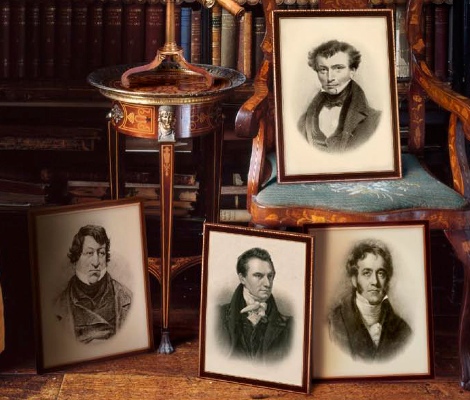 This past week I have been reading Laura J. Snyder’s engrossing tale of the Philosophical Breakfast Club: Four Remarkable Friends who Transformed Science and Changed the World (2011). The Philosophical Breakfast Club was the creation of four Cambridge men, William Whewell (1794-1866), Charles Babbage (1791-1871), John Herschel (1792-1871), and Richard Jones (1790-1855). These four Cambridge friends met together on Sunday mornings after chapel to discuss Francis Bacon, reforms in knowledge, society, and science. All four would become central to the founding of the British Association for the Advancement of Science (BAAS) in 1831.
In Chapter 8 of this book, “A Divine Programmer,” Snyder gives a fascinating account of Darwin attending one of Babbage’s popular Saturday evening soirées. It was Lyell who had invited Darwin to Babbage’s dinner party, which were, as Darwin later put it in a letter to his sister “the best in the way of literary people in London—and that there is a good mixture of pretty women!”
These parties were also something of a gastronomic affair (much like the BAAS meetings were). According to Snyder, a “table would be laid with punch, cordials, wine, and Madeira; tarts; fruits both fresh and dried; nuts, cakes, cookies, and finger sandwiches…oysters, salads, croquettes, cold salmon, and various fowls.” There was also dancing, music, and literary, artistic, and scientific amusements. But most important of all was Babbage’s demonstration of his Difference Engine.
On this particular evening, with Darwin present in the audience, Babbage, according to Snyder, gave something of a sermon. In describing his machine, Babbage related God as a divine programmer:
“In like manner does God impress His creation with laws, laws that have built into them future alterations in their patterns. God’s omnipotence entails that He can foretell what causes will be needed to bring about the effects He desires; God does not need to intervene each and every time some new cause is required…God, then, is like the inventor of a complex, powerful calculating engine.”
Ignoring for the moment Babbage’s own god-complex, his image of God as programmer, who had, as Snyder puts it, “preset his Creation to run according to natural law, requiring no further intervention,” would lead to a remarkably different view of the relationship between science and religion in the nineteenth century—one that would dramatically alter Darwin’s own view of God’s agency in the natural world.
Babbage’s own view emerged from a confrontation he had with his Cambridge friend Whewell and his Bridgewater treatise, to which Babbage would later add his own, unauthorized work to the series. Indeed, as Snyder observes, Babbage constructed his engine with the purpose to “counter Whewell’s view of miracles as interventions of God outside natural law.”
But Snyder’s most salient point in this chapter is that before attending Babbage’s Dorset Street soirée, Darwin was already struggling with the species question. In fact, Darwin had just returned from his voyage on the Beagle when he was invited to Babbage’s party. “At the very moment he was introduced to Babbage and his machine,” she writes, “Darwin was questioning the fixity of species and the prevalent notion of special creation.”
Just as Babbage anticipated changes and modifications in his machine, he imagined God as a programer and inventor, who would have anticipated changes in creation. Darwin, Snyder suggests, “would have seen how Babbage’s view of a divine programmer gave him a way to reconcile his beliefs in God with his growing sense that new species arose from old ones in a purely natural, evolutionary process.” But in time, however, Darwin and many others would come to think that nature did not need a divine programmer at all.
That Great Temple that’s not Made with Hands
Posted on June 1, 2015 Leave a Comment

John Tyndall scaling a rock face. From John Tyndall “Hours of Exercise in the Alps” (London, 1871)
I causally opened John Tyndall’s New Fragments (New York: D. Appleton and Co., 1896) this morning on the desktop and was pleasantly surprised by its first entry, “The Sabbath,” a Presidential Address delivered before the Glasgow Sunday Society in October, 1880, which was then quickly published in The Nineteenth Century the following month, and subsequently as a pamphlet in December.
I say “surprised” because I knew that Draper and White had made much use of the then emerging comparative religious studies in their work, including new studies on higher criticism of the Bible. But did Tyndall? Indeed he did, and this short essay demonstrates this physicist’s wide reading in the new emerging field.
He begins by observing that the present age desires “to connect itself organically with proceeding ages.” This “developmental” view has been set forth, he says, by scientific naturalists Darwin and Spencer, but also by religious scholars Renan and Müller. In particular, Tyndall finds a kindred spirit in Scottish theologian John Caird (1820-98). According to Tyndall, Caird maintained in his Introduction to the Philosophy of Religion (1880) that “throughout the ages he discerns a purpose and growth, wherein the earlier and more imperfect religious constitute the natural and necessary precursors of the later and more perfect ones.”
This leads Tyndall to suggest that changes or “transmutations” (his word) in the mind, and especially in religion, are “often accompanied by conflict and suffering.” We see this, he says, with the transition from Roman paganism to Christianity, from “Jewish Christianity” to “Gentile Christianity,” from Peter to Paul. Tyndall derives this narrative from Renan’s L’Eglise Chrétienne, or The Christian Church (1879). But “men at length began to yearn for peace and unity,” he writes, “and out of the embroilment was slowly consolidated that great organisation the Church of Rome.”
Thus each “transmutation,” each period of growth, required some struggle, “in which the fittest survive.” In short, even the errors, conflicts, and sufferings of bygone times “may have been necessary factors in the education of the world.” This background leads Tyndall to the main point of the essay: namely, the “Sabbath question.” He sees the issue of keeping the Sabbath as a problem of dogmatic theology and not religion, however. Following the anti-Sabbatarian works of Scottish lawyer and phrenologist Robert Cox (1810-72), including his massive Sabbath Laws and Sabbath Duties (1853), his two volume The Literature on the Sabbath Question (1865), and others, Tyndall offers a number of proof-texts showing that adherence to dogma “oppressed almost to suffocation” human civilization. According to Tyndall, Jesus deliberately broke the Sabbath, crowning his “protest against a sterile formalism by the enunciation of a principle which applies to us to-day as much as to the world in the time of Christ”—namely, “The Sabbath was made for man, and not man for the Sabbath.”
What is particularly interesting in this essay is Tyndall’s concern about potential visitors to the British Museum. That is, he is targeting those who “object to the opening of the museums on religious [sic] grounds.” In an ironic twist taken from the natural theological tradition, Tyndall asks “Do they who thus stand between them and the public really believe those treasures to be the work of God? Do they or do they not hold, with Paul, that ‘the eternal power and Godhead’ may be clearly seen from ‘the things that are made’? If they do—and they dare not affirm that they do not—I fear that Paul, with his customary plainness of language, would pronounce their conduct to be ‘without excuse.'” He then lists Luther, Melanchthon, Tyndale, Calvin, Knox, and others, who, in his view, “emphatically asserted the freedom of Christian from Sabbatical bonds.” These reformers, in short, followed a “higher symbolism.”
At the same time, Tyndall could not help himself to a little military language, retelling the tale of the flat earth myth, the tyrannical power of the Catholic Church, and the “booming of the bigger guns” and the “incessant clatter of small arms” in his own day. He subsequently discusses the human nature of the Old Testament and his amazement that “learned men are still found willing to devote their time and energy to these writings under the assumption that they are not human but divine.”
Though this might seem a “liberal,” perhaps “radical” position, Tyndall claims he is truly a “Conservative.” He says that “madness or folly can demolish: it requires wisdom to conserve”! In his estimation, a conservative has foresight, looks ahead and prepares for the inevitable, and thus knows when the true spiritual nature of man will be bound up with his material condition. “Wholesome food, pure air, cleanliness—hard work if you will, but also fair rest and recreation—these are necessary not only to physical but to spiritual well-being.” This doctrine, he says, is the “true Gospel.” Indeed, a “most blessed influence would also be shed upon the clergy if they were enabled from time to time to change their ‘sloth urbane’ for action on heath or mountain.”
Taking a line from English poet, author, and humorist Thomas Hood (1799-1845), Tyndall reveals that his house of worship is not built by any human hands:
That bid you baulk
A Sunday walk,
And shun God’s work as you should shun your own
…
Calling all sermons contrabands, In that great Temple that’s not made with hands.
The International Scientific Series and the Dissemination of Scientific Naturalism
Posted on May 30, 2015 Leave a Comment
 In examining John William Draper’s History of the Conflict between Religion and Science (1874), it is important to recall that it belonged to D. Appleton and Co.’s popular International Scientific Series (ISS), which was, as Roy M. MacLeod put it in his seminal essay, “Evolutionism, Internationalism and Commercial Enterprise in Science: The International Scientific Series 1871-1910” (1980), the Victorian attempt at “codifying and popularizing scientific knowledge in a systematic fashion to a wide reading public.” Indeed, MacLeod’s essay was perhaps one of the earliest examples of what Adrian Johns would later call the “history of the book.” In MacLeod’s case, it was a series of books published under the entrepreneurial ambitions of American science popularizer Edward Livingstone Youmans.
Little work has been done on the ISS. MacLeod is a helpful starting point. In his essay he describes how Youmans traveled throughout Europe to secure authors and publishers for the series, including many of the leading scientific naturalists of England, John Tyndall, Thomas Henry Huxley, Herbert Spencer, and many others. It is also worth pointing out that Youmans was the first editor of Popular Science Monthly, which he used “as a vehicle for communicating the findings and ideas of scientists to the educated American public,” as William E, Leverette has aptly observed. Thus in order to ascertain the diffusion of scientific naturalism and, more important, Draper’s History of Conflict, Youmans’ publishing motivations and ambitions are critical. MacLeod also provides a useful Appendix at the end of his essay listing the English editions of the ISS, published by Kegan Paul, Trench, Trübner & Co.
A decade later Leslie Howsam published an essay on “Sustained Literary Ventures: The Series in Victorian Book Publishing” (1992), where she examines in some detail the publishing houses of Charles Kegan Paul, Henry S. King and his successors at Kegan Paul, Trench, Trübner & Co. More recently, Howsam focuses on the ISS itself, in “An Experiment with Science for the Nineteenth-century Book Trade: the International Scientific Series” (2000). Here she argues that a “close examination of the publishing history of scientific books can be particularly fruitful for the scholar interested in how text and physical object combined to constitute the reader’s experience at a given place and moment in time.” According to Howsam, “editorial decisions about what titles to include in the series are evidence of contemporary definitions of science, particularly the inclusion of the social science with the natural sciences.” Moreover, “production decisions about how to keep the series in print are evidence of how the contemporary culture of science interacted with the culture of publishing.”
But perhaps the most helpful introduction to the ISS is Bernie Lightman’s recent essay, “The International Scientific Series and the Communication of Darwinism” (2010). A common theme that often emerges in Lightman’s work is the loss of control. That is, Huxley loses control of his “agnosticism,” the “scientific naturalists” lose control of “evolutionary naturalism,” and so on. Here Lightman argues that by “the early 1880’s a new course had been set when the original founders of the series were no longer in control.”
According to Lightman, the ISS was “based on diffusing Spencerian evolution beyond America to the world at large.” Youmans was obsessed with Spencer’s work. Indeed, his Popular Science Monthly promoted the idea of evolution and evolutionary philosophy not of Darwin but of Spencer. As Leverette has pointed out, Spencer’s ideas were frequently defended in the Popular Science Monthly. Besides Spencer, however, Youmans had formed a “British Committee” for the ISS that included Huxley and Tyndall. With this trio secured, Youmans added Henry S. King as the British publisher of the series. The series enjoyed great success, particularly the works published by Spencer and Draper, which both through more than 20 editions.
Dramatic changes occurred in the series during the late 1870s, however. King became ill and eventually died in 1878. Youmans, whose health was also failing, left the series by 1880. Charles Kegan Paul had purchased H.S. King and Co. and took it over by 1877. According to Lightman, Kegan Paul was a Broad Churchman who later abandoned his faith in 1874 because he could no longer “adhere to the teachings of the Church of England.” He became attracted to Positivism, but by 1890 converted to Catholicism. His return to the Church is retold in a number of remarkable essays and books, in his Faith and Unfaith and Other Essays (1891), Confessio Viatoris (1891), and Memories (1899). In his confession, for example, Paul writes
Day by day the Mystery of the Altar seems greater, the unseen world nearer, God more a Father, our Lady more tender, the great company of the saints more friendly, if I dare use the word, my guardian angel close to my side. All human relationships become holier, all human friends dearer, because they are explained and sanctified by the relationships and friendships of another life. Sorrows have come to me in abundance since God gave me grace to enter His Church, but I can bear them better than of old, and the blessing He has given me outweighs them all. May He forgive me that I so long resisted Him, and lead those I love unto the fair land wherein He has brought me to dwell! It will be said, and said with truth, that I am very confident. My experience is like that of the blind man in the Gospel who also was sure. He was still ignorant of much, nor could he fully explain how Jesus opened his eyes, but this he could say with unfaltering certainty, “One thing I know, that whereas I was blind, now I see.
And as Lightman points out, when Kegan Paul took over the series, “he did not feel bound by the contract that Tyndall, Spencer, and Huxley had signed with King.” For one, he no longer selected authors who wished to disseminate evolutionary naturalism. All three would eventually resign from the Committee. In their absence, Kegan Paul would bring in new authors who embraced new versions of natural theology. However, the series was never as successful as it was with Huxley, Tyndall, and Spencer at the helm. By 1911, the series came to a close.
A Christian Virtuoso: Robert Boyle’s Religious Vocation
Posted on April 17, 2015 Leave a Comment
Michael Hunter, the leading expert and custodian of Robert Boyle’s (1627-91) legacy, delivered a paper last night at a seminar here at the University, entitled “‘Physica Peregrinans’: Robert Boyle, His Informants and the Role of the Exotic in Late Seventeenth-Century Natural Philosophy.” Hunter examined Boyle’s records of interviews he conducted with travelers returning from exotic locations throughout the world. Boyle intended to publish these interviews in a book, Physica Peregrinans, or “The Traveling Naturalist: Containing Answers given to Severall Questions propunded by the Author to Navigators & other Travellers in remote Countreys .” During the Q&A, it became apparent that Boyle rejected the scholastic, Aristotelian approach to common experience. According to Hunter, for Boyle “nature was in fact often surprising and exciting in its fecundity and variety, and people’s conception of what was possible needed to be expanded accordingly.” Equally noteworthy, it seems that Boyle used empirical investigation in support of the supernatural in nature—that is, he offered “a natural history of the supernatural,” as Peter Harrison put it during the discussion following the paper.

The Shannon Portrait of the Hon. Robert Boyle, F.R.S., by German painter Johann Keresboom (1689)
My knowledge of Hunter’s work on Boyle is limited. I have read Hunter’s “The Social Basis and Changing Fortunes of an Early Scientific Institution: An Analysis of the Membership of the Royal Society, 1660-1685,” a lengthy essay published in Notes and Records of the Royal Society of London in 1976. Hunter would go on to greatly expand this piece into his well-known The Royal Society and its Fellows, 1660-1700: The Morphology of an Early Scientific Institution (1982). The only other work of Hunter’s I’ve perused was his 2007 article in the British Journal for the History of Science, “Robert Boyle and the Early Royal Society: A Reciprocal Exchange in the Making of Baconian Science.”
So after the talk I paid a visit to the University library and found Hunter’s more recent work on the great English scientist, Robert Boyle: Between God and Science (2009). Boyle, who ranks with Isaac Newton, Michael Faraday, and Charles Darwin as a seminal figure in the history of science, was also a deeply, and resolutely, religious man. As Hunter wrote in his article on Boyle in the Oxford Dictionary of National Biography (2004), “The central fact of Boyle’s life from his adolescence onwards was his deep piety, and it is impossible to understand him without doing justice to this.”
In his Robert Boyle: Between God and Science, Hunter aims to bring this fact out. As a natural philosopher, Boyle not only dabbled in all branches of physics, he also experimented in alchemy, anatomy, botany, biology, medicine, and mathematics. He wrote on epistemology and moral philosophy, on scientific method and scientific theory, and just as vigorously labored with biblical exegesis and theology. Indeed, his first two published books were Some Motives and Incentives to the Love of God (1659) and New Experiments Physico-Mechanical, Touching the Spring of the Air and its Effects (1660). Natural philosopher and religious apologist, Boyle sought to justify the ways of God to men.
Like most men, however, Boyle did have doubts. Richard S. Westfall, in his Science and Religion in Seventeenth-Century England (1958), had made much of these doubts. In answering hypothetical atheists, he argues, Boyle attempted to satisfy his own doubts about the implications of the new science. But as Hunter points out, doubt had a positive role in Boyle’s faith. Boyle once wrote, for instance, that those “whose Fayth hath never had any Doubts, hath some cause to Doubt whether he hath ever had any Fayth.”
Boyle was so committed to his faith that, upon the urging of Archbishop Ussher, he learned Greek, Hebrew, Syriac and Aramaic in order to read the Bible in its original languages. Hunter even suggests that Boyle’s interest in natural philosophy and experimentation was largely spurred by his concern to combat the rise of atheism and materialism.
Boyle’s religion was central to his vocation and vision of science. “For Boyle,” Hunter writes, “science and theology were truly complementary.” But as with Copernicus, Kepler, Newton, and other seminal figures in early modern science, Boyle’s “successors found it easy to adopt his methodological prescriptions and his mechanistic worldview in conjunction with only a vestigial form of his passionate theism.” But that is not the real Robert Boyle. He was, as Stephen D. Snobelen puts it in his clever summary of Hunter’s book, the
Seventh son, gentleman, wealthy landowner, Etonian, visitor to the Continent, Protestant educated, multilinguist, moralist, alchemical adept, forerunner of modern chemistry, champion of experimental philosophy, popularizer of the air-pump, promoter of natural philosophy, early Fellow of the Royal Society, formulator of what came to be called ‘Boyle’s law’, prolific author, citizen of the Republic of Letters, a director of the East India Company, principled lifelong celibate, medical reformer and practitioner, hypochondriac, man of tender conscience, man of charity, pious believer, Bible reader, lay theologian, apologist for reasonable Christianity, high priest of nature, advocate of natural theology, founder of the eponymous lectureship in defence of the faith, backer of foreign Bible translations, supporter of overseas missions and governor of the Corporation for the Propagation of the Gospel in New England—Boyle was all of these things and more.
The Persistence of the Conflict Narrative in the Academy
Posted on February 16, 2015 7 Comments
In the latest issue of Zygon, Thomas Aechtner, Lecturer in History of Religious Thought at the University of Queensland, decisively demonstrates the historical bankruptcy of postsecondary textbooks and reference materials in anthropology publications. He argues that these publications continue to “present the conflict model’s narrative as the historical account of religion and science interactions.” Thus it continues to thrive not “merely as a popular artifact, but also as a conspicuous historical narrative in modern university-level pedagogical and reference materials.”
Publishers such as AltMira, McGraw-Hill, Peason, Routledge, Sage, and Wadsworth (and surely others), persist in publishing textbooks and reference guides that use the “conflict thesis” as an organizing narrative. Aechtner lists several recent textbooks, including Social and Cultural Anthropology: The Key Concepts (2000), Encyclopedia of Anthropology (2006, 2008), The Tapestry of Culture: An Introduction to Cultural Anthropology (2009), 21st Century Anthropology: A Reference Handbook (2010), Anthropology: A Global Perspective (2012), and others still, which all continue to reduce the complex interactions between science and religion into caricatures. Discussions of the Scientific Revolution and the Age of the Enlightenment, Heliocentrism, Copernicus, Bruno, and Galileo, Darwin and evolutionary theory, science and secularization, merely preserve the narratives of Draper and White without ever questioning their accuracy or legitimacy. As Aechtner writes, “the cumulative picture of historical science-religion interactions sketched by many introductory anthropology materials is unquestionably one of conflict.”
Aechtner wonders why, despite the abundance of revisionist historiography, do these textbooks continue to use the conflict model for history. Perhaps, he muses, it is “due to genre constraints and publication limitations associated with such works.” That may indeed be true. However, as he goes on to point out, there are cases where authors of these textbooks deliberately misrepresent science-religion relations. For example, both Anthropology: A Global Perspective and Cultural Anthropology: A Global Perspective cite John Henry’s excellent work, The Scientific Revolution and the Origins of Modern Science (2002). But whereas Henry is careful to note that conflict between science and religion is not inevitable, the authors of these textbooks completely ignore such measured and important qualifications. “This demonstrates,” writes Aechtner, that such textbooks “seem to disregard and even contradict a fundamental message about science and religion contained so forcefully within the very pages of their cited source.” In short, the conflict narrative “persists within university-level pedagogical and reference books used to teach the uninitiated on contemporary postsecondary campuses.”
Students beware.
Walt Disney’s History of Science
Posted on January 27, 2015 Leave a Comment
Some interesting reading this morning. In a recent blogpost by Adam Richter, PhD Candidate at the University of Toronto, he argues that popular, American attitudes toward science derive largely from Disney World attractions, particularly “Tomorrowland,” where “progress” is a major theme. Indeed, this theme of progress is pervasive in Disney productions. Connected with this theme of progress is corporate industry. Attractions such as the “Test Track,” “Spaceship Earth,” and “Ellen’s Energy Adventure,” are sponsored by Chevrolet, Siemens, and ExxonMobil respectively, and hosted by celebrities like Ellen DeGeneres and Bill Nye. “For historians of science,” he writes,” I think it’s helpful to view Disney World’s attractions as artifacts that reflect particular American attitudes toward science since the mid-20th century.” Disney’s whiggish vision of the past and progressive vision of the future are, of course, deeply flawed—if not profoundly troubling. Richter, however, sees this as an opportunity. If historians of science could tap into that kind of imagination, creativity, and articulation, the public would greatly benefit.
But Walt Disney achieved his ends largely through anachronism. In the comment section of Richter’s post, Gabriel Finkelstein, historian and expert on Emil du Bois-Reymond at University of Colorado Denver, suggested a recent piece by Andre Wakefield in History and Technology, “Butterfield’s Nightmare: the history of science as Disney history” (2014). Wakefield argues that “narratives that link the Scientific Revolution, the Enlightenment, and the Industrial Revolution together in an imagined causal series are prone to Disneyish anachronism.” This is the “American mid-twentieth-century form of Whiggishness.” An interesting and provocative example Wakefield discusses is Disney’s production Our Friend the Atom (1957), a scientific propaganda film. As Wakefield notes, Our Friend the Atom “represented a joint venture between General Dynamics, which manufactured nuclear reactors, and the US Navy.” It was also hosted by Nazi war criminal Dr. Heinz Haber. In telling viewers (children) the nature of the atom, Haber and Disney provide a “history of the atom,” complete with Democritus, Aristotle, the Dark Middle Ages, the “inventor-scientist-experts” of the seventeenth century, the Scientific Revolution, the Industrial Revolution, before concluding with our current Atomic Age. As Wakefield concludes, “Disney’s fable…is also a fable about the history of science and technology. Disney history collapses time. Past, present and future become indistinguishable. 2000 [sic] years of history disappear in the blink of an eye, giving way to the very sudden arrival of the Scientific Revolution, which then almost immediately becomes the Industrial Revolution. All of it portends a clean and happy consumer future of unbounded freedom and possibility.”
Disney history may be imaginative, creative, and attractive, but it is a fabricated history.
The English Deists
Posted on January 14, 2015 Leave a Comment
In addition to reading Cunningham, I have spent the last several days reading works on the Cambridge Platonists and seventeenth-century latitudinarian theologians: Benjamin Whichcote (1609-83), Peter Sterry (1613-72), George Rust (d.1670), John Wilkins (1614-72), Henry More (1614-87), Ralph Cudworth (1617-88), John Smith (1618-52), John Worthington (1618-71), Nathaniel Culverwel (1619-51), Simon Patrick (1626-1707), John Tilloston (1630-94), Edward Stillingfleet (1635-99), Joseph Glanvill (1636-80), John Norris (1657-1711), and Richard Cumberland (1631-1718). Peter Harrison has provided extensive comments on these figures in his Religion and the Religions in the English Enlightenment (1990), The Bible, Protestantism and the Rise of Natural Science (1998), and The Fall of Man and the Foundations of Science (2007). The Cambridge Platonists attempted to “establish some final court of appeal on matters of religious doctrine” against the rising religious pluralism in the aftermath of the English Reformation. They did this by grounding religious belief not in institutional authority but in the “certitude of the mind itself.” Their religion was a “rational religion.” Although each held a strong view of “reason,” the Cambridge Platonists continued to take the doctrine of the Fall quite seriously.
In addition to Harrison, I have found Jackson I. Cope’s Joseph Glanvill: Anglican Apologist (1956), C.A. Patrides’ The Cambridge Platonists (1969), Richard S. Westfall’s Science and Religion in Seventeenth-Century England (1970), and Jon Parkin’s Science, Religion and Politics in Restoration England (1999) helpful in contextualizing the lives and thought of these men.
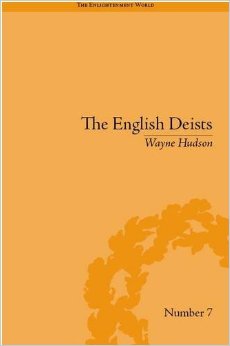 Studying the Cambridge Plantonists has quite naturally led me to the so-called English deists: Charles Blount (1654-93), Matthew Tindal (1656-1733), Thomas Woolston (1669-1733), John Toland (1670-1722), Anthony Collins (1679-1729), Thomas Morgan (d.1743), Thomas Chubb (1679-1747), Conyers Middleton (1683-1750), and Peter Annet (1693-1769). This is how I came across Wayne Hudson‘s insightful two volume work, The English Deists: Studies in Early Enlightenment (2009) and Enlightenment and Modernity: The English Deists and Reform (2009).
Hudson points out that eighteenth- and nineteenth-century historians looked back on this group of thinkers as attempting to “undermine belief in revealed religion, while claiming to believe in natural religion.” We see this, for example, in John Leland’s A View of the Principal Deistical Writers (1754-6) and Leslie Stephen’s History of English Thought in the Eighteenth century (1876). This pattern of interpretation, a paradigm of belief and unbelief, has now become common parlance. Hudson, however, seeks to challenge this interpretation.
According to Hudson, “the writers known as English deists were not atheists or deists in an exclusive or final sense, but controversialists working with various publics for a range of purposes in a period in which ‘the public’ was being constructed.” There were “multiple deisms” and multiple social roles in which each figure was active. Most of the so-called English deists in fact denied that sobriquet. As Hudson writes: “Blount used the term ‘deist,’ but not of himself. Toland denied all his life that he was a deist. Collins used it only once in print, and then of others. Tindal never claimed in print to be a deist, although he outlined the stance of a ‘Christian deist,’ a position also adopted by Morgan. Chubb admitted that he was trying to promote deism, but refused to call himself a deist in a sense exclusive of Christianity, while Woolston and Middleton claimed to be trying to defend Christianity against ‘the deists.'” This is consistent with the fact that most of the English deists were “constrained by livelihood or social role to be Christians, and some of them were obliged to maintain a level of involvement with the established Church.”
The claim that the English deists were religious rationalists is also challenged. Religious rationalism begins with Richard Hooker’s (1554-1600) Of Lawes of Ecclesiastical Politie (1593), in which he insisted that reason could know the law of God without revelation. The Cambridge Platonists supported another form of religious rationalism, one informed by patristic and scholastic sources, as well as Renaissance Platonism. But like Hooker, they were all supernaturalists who found salvation only in revelation. And finally the latitudinarians articulated a “reasonable version of Christianity in plain language,” yet continued to hold a high Christology.
Although these writers certainly impacted the English deists, and many of them quoted the Cambridge Platonists consistently in their own writings, it is “misleading,” writes Hudson, to suggest that the deists “simply took the latitudinarians’ principles one step further.” Indeed, the English deists “almost all rejected Athanasian Christianity, in so far as it treated God as a person to whom human beings had obligations.”
Although the English deists are often associated with the Enlightenment, Hudson claims this association also needs revision. There are three forms of Enlightenment that must be distinguished: the Protestant Enlightenment, Radical Enlightenment, and Early Enlightenment. As Hudson argues, “if these writers had really been the outright enemies of Christianity they were accused of being, they would have lost their jobs and ended in prison.” Moreover, “they were not free citizens of an international secular republic of letters, but writers dependent on Christian acceptance and toleration, without which it was difficult for them to pay their bills and buy books.”
In his first chapter, Hudson provides the “genealogies of deism,” concluding that “whereas in Catholic countries deism was more clandestine and sometimes aggressively anti-Christian, in Protestant countries thinkers might interest themselves in various deisms without abandoning Christianity or their social and political identities as Protestants.”
In the following chapter on Edward, Lord Herbert of Cherbury (1583-1648), often referred to as the “father of English deism,” Hudson argues that Herbert was a “Renaissance eclectic influenced by Platonism, Stoicism and Hermeticism.” He was likely influenced by the theistic naturalism of Jean Bodin (c.1529-96), and many of his contemplates viewed his work on religion as ecumenical, particularly his De Veritate (1624), De Religione Gentilium (1663), and De Religione Laici (1645). Indeed, his work was sympathetically read by Rust, Whichcote, More, Culverwell, and Cudworth. But Herbert’s work was undoubtedly more radical than the Cambridge Platonists, for his “natural theology was more extensive and more certain than the modest conclusions of Christian natural theology.” And as Hudson explains, Herbert also “rejected any idea of original sin and believed in a compassionate God and in the goodness of human beings.”
Hebert was also apparently interested in magic, medicine, and occult philosophy. Hudson bases these claims on two untranslated Latin poems Herbert supposedly composed, A Philosophical Disquisition on Human Life and On the Heavenly Life. Hudson includes these poems in an Appendix.
The remaining chapters of The English Deists discuss the standard list of English deists, but with much qualification. Blount, for example, is said to have combined classicism, multiple deisms, and borrowed heavily from free-thought and Protestantism alike. Toland promoted enlightenment attitudes and practices but retained some version of classical theistic naturalism. Collins, who called for toleration of a great diversity of views, included rational Christianity in his new social epistemology. Tindal, a lawyer and civil philosopher, promoted the theology of Protestant liberal thought, and did not challenge orthodoxy directly until the end of his life. As Hudson remarks in his conclusion, “until at least the 1720s, the main task [of the deists] was to attack ‘priestcraft’ and the High Church party and to argue for the liberty of belief and opinion.” The English deists were constrained in thought and activity by the Early Enlightenment, and therefore must be read in the context of the Protestant Enlightenment in seventeenth- and eighteenth-century England.
 James C. Ungureanu